9 best Custify alternatives in 2026, priced and compared

Kurnia Kharisma

Katelin Teen
Last edited September 17, 2026

Why teams start shopping for a Custify alternative
Fairness to Custify first, because it has earned some. It sits at 4.7 from 527 reviews on G2, and 4.9 across 135 reviews over on Capterra, which for a platform in this category is a strong showing. The concierge onboarding is a real differentiator against self-serve rivals. Customer data sits in German data centres. No setup fees either. Reviewers keep praising the calculated metrics and the playbooks. So for a European mid-market SaaS team that wants a hand held through implementation, it is a reasonable buy.
So why do people shop around anyway? Three reasons keep coming up, and only one of them is about features.
You cannot get a number. The Custify pricing page is a quote form sitting behind a reCAPTCHA. No plan name on it, no tier, no starting price, and nowhere on the site is there a free trial. I searched the full page text for a currency symbol, for "per month," for "per seat." Zero hits on all three. A legitimate business model to run, sure, but budgeting turns into a guessing game, and that is the thing that pushes buyers toward a comparison post like this one.
Setup takes longer than the demo suggested. The most common criticism sitting in Custify's own review profile is the initial build. Segments, calculated metrics, health scores, all of it starts from scratch. Below is a 5-star reviewer saying it anyway, and that is the version I trust the most:
"The initial setup time to get health scores and playbooks across different client tiers required large upfront planning especially since our data wasn't filtered properly before it was sent to Custify."

None of that is unique to Custify. It is the tax the whole category charges, and two sections down I put real numbers on it.
The tool becomes a reporting layer. This is the quiet one. Somebody buys a CS platform to prevent churn, and it ends up being the thing a CSM updates on a Friday so that leadership has a dashboard waiting on Monday. One mid-market reviewer described that end state better than I could:
"It helps measure success scores and is supposed to anticipate churn by using signals, but most of the time we end up just filling in information for upper management, and it doesn't really benefit clients."
And here is where the road ends. This one from a CS leader who lost the argument internally:
"Against my advice leadership went with Gainsight. As I expected, 18 months the later they said 'this is too expensive' and said we are terminating at next renewal."

If that is where you already are, swapping Custify out for Vitally changes nothing about it.
The thing most Custify alternative roundups skip
A real story here instead of a claim, because I have watched this one happen from the other side of it.
I watched a customer spending about $800 a month with eesel churn because a Google Drive sync failed silently, three times over. Their core knowledge source happened to be a Google Sheet of daily order statuses. Sync breaks, answers go stale. In the win-back thread with our founder, they wrote:
"We switched to a system that is working well at half the cost. But long term we will just build our own, which is so possible now with AI. I think you have a decent system for now, but we are probably too large of a customer for this. That being said, we probably would have stayed if support was faster and better."
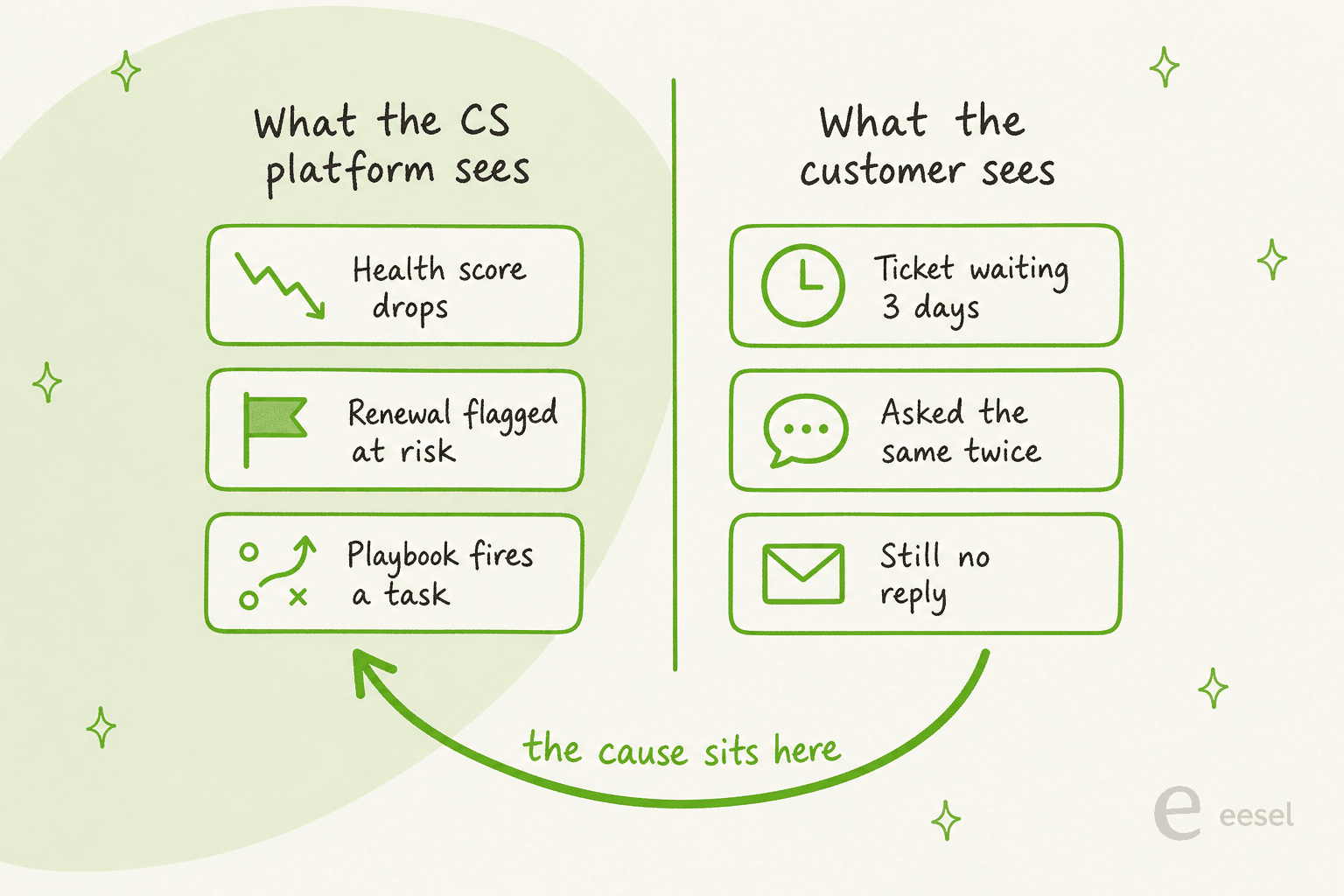
Why that matters for this post. No health score would have caught that account. Usage, healthy. Logins, healthy. Nothing flagged on the renewal. Right up until the day it left, the account was actively using the product, and what killed it was a support experience, not a missing playbook.
Hold that pattern in your head while you read the nine options below. A customer success platform measures an account very well. Changing what is happening inside the account is a different job, and it does not do that one. So if your accounts turn red because tickets sit for three days, or because the same question gets asked twice over since nobody wrote the answer down anywhere, the fix is living in the support queue and not in a better scoring model.
Both halves are real. Buy for the one you actually have, though. And if you have never had to draw that line before, the distinction between customer success and customer service is the clearest place to start from, which is a different discipline again to client services.
How long these actually take to implement
Every vendor demo makes setup sound like a fortnight of work. G2 publishes what buyers actually report, and that spread is the single most useful pre-purchase number in the category.
| Platform | Reported time to implement | Reported time to ROI | Average discount |
|---|---|---|---|
| Custify | 2 months | 9 months | 7% |
| Planhat | 3 months | Not reported | Not reported |
| Gainsight | 5 months | 18 months | 16% |
Read those two right-hand columns together. Gainsight buyers report a 16% average discount and an 18-month payback; Custify buyers report a 7% discount against a 9-month payback. A bigger discount stretched over a longer payback is not the better deal. It is the heavier one, and that combination is exactly what produces the "too expensive at renewal" conversation quoted above.
Operators who have run more than one of these tend to be blunt about why the timelines stretch out:
"Gainsight, Churnzero or Planhat are all technical ops heavy tools, you would need to spend a lot of time in setting them up, it will take at least 6 months to get up and running... you also would need someone technical in your team to maintain it."
Practical read on that: either budget for a dedicated ops person, or pick a platform that will not need one. That is the real fork in the decision, far more than any feature comparison is.
How I picked these nine
Short methodology note, so you know what these takes are worth.
In the week of 25 August 2026 I read every vendor's own live pricing page and their product pages, plus the docs where those exist. Every number below is either printed on the vendor's own site, or it is marked explicitly as unpublished. Where a vendor's pages contradict each other I say so, instead of picking whichever figure flatters. What I did not do is run a 90-day head-to-head deployment across nine platforms, and I am not going to pretend otherwise.
The four things I graded on:
- Can you compute the bill before the call? Published price, published tier, published quota, or nothing.
- What is the billable unit? Per CSM, per managed account, per seat, flat, or undisclosed. This decides whether two quotes are even comparable.
- Is AI in the base plan or an add-on? In 2026 every vendor here says AI agents. Not all of them include it.
- Who is it actually for? Enterprise CS org, mid-market team, or a five-person startup.
One thing I deliberately left out of the grading: raw feature count. Health scoring, playbooks, NPS surveys, renewal tracking, every platform here does all of it. The feature grids converged years ago, and going through them line by line is how buyers end up with a tool nobody opens.
Two adjacent lists are worth keeping open alongside this one. Churn management software covers the wider category, tools that are not full CS platforms included. And AI tools for customer success is the right list when your shortlist is explicitly AI-led.
The 9 best Custify alternatives at a glance
| Tool | Best for | Public price | Plan names shown | Quotas shown | Free trial | Billed for | AI in base plan | The catch |
|---|---|---|---|---|---|---|---|---|
| eesel AI | Churn caused by support backlog | Yes, from $299/mo for 500 credits | Teammate plan, add-ons for SSO and more | N/A, one fixed monthly price | 100 free credits, no card | Tickets and chats handled | Yes, it is the product | Not a CS platform, no renewal forecasting |
| Gainsight | Enterprise CS orgs | No | Essentials, Enterprise | Yes, 10/20 users, 100/200 customers each | PX module only | Full users plus included customers | Yes, prebuilt agents | Heaviest implementation on this list |
| ChurnZero | Mid-market wanting bundled AI | No | None published | No | No | Flat tier plus AI credits | Yes, via credits | The pricing page does not exist |
| Planhat | One data model across post-sale | No | CRM, CSP, PSA lines | No | No | Users and view users | Listed as included | Most opaque pricing of the nine |
| Totango | Multi-product enterprise accounts | No | Enterprise, Premier, Growth | Yes, 10/20 seats, 2k/10k accounts | No | Practitioner seats plus accounts | Sold as separate Unison product | Three products to buy, not one |
| Vitally | Fast-moving PLG SaaS | No | None published | No | Sandbox inside the sales cycle | Undisclosed | Not disclosed | Publishes neither price nor quota |
| Velaris | Teams wanting done-for-you setup | No | None published | Partial, 5 users included | No | One license, 5 users, add-ons | Yes, agents plus Copilot | Says it is wrong for under 50 staff |
| ClientSuccess | Seeing the ladder before the call | No | Startup, Growth, Enterprise | Yes, 10/50/unlimited customers | No, POC instead | CSMs plus modules | No, AI is an add-on module | 10-customer cap on the entry tier |
| Akita | Small teams wanting a price today | Yes, $49/$99/$499 | Small, Growing, Enterprise | Yes, 10k/100k/unlimited | Contradicted on its own site | Seats plus integrations | None, no AI anywhere | No AI story at all in 2026 |
Pick what you need to know up front. Every vendor below was checked against its own live pages in August 2026.
- Akita : $49 / $99 / $499 a month
- eesel AI : from $299/mo for 500 credits, flat
- Custify
- Gainsight : except Skilljar add-ons
- ChurnZero
- Planhat
- Totango
- Vitally
- Velaris
- ClientSuccess
Two of ten. If a computable budget matters to your procurement process, that number is the story of this category.
- Gainsight : Essentials, Enterprise
- Totango : Enterprise, Premier, Growth
- ClientSuccess : Startup, Growth, Enterprise
- Akita : Small, Growing, Enterprise
- Custify : quote form only
- ChurnZero : no pricing page at all
- Planhat : product lines, not tiers
- Vitally : demo form only
- Velaris : one license, no tiers
Plan names alone tell you roughly where you will land on the ladder, which is more than half this category gives you.
- Gainsight : 10 or 20 full users, 100 or 200 customers each
- Totango : 10 or 20 seats, 2,000 or 10,000 accounts
- ClientSuccess : 10, 50, or unlimited customers
- Akita : 10k, 100k, unlimited records
- Velaris : 5 users, unlimited viewers
- Custify
- ChurnZero
- Planhat
- Vitally
Quotas without prices still help. They tell you which tier your account count forces you into, which is usually what really moves the quote.
- eesel AI : 100 free credits, no card
- Gainsight : Product Experience module only
- Custify
- ChurnZero
- Planhat
- Totango
- Vitally : sandbox inside the sales cycle
- Velaris
- ClientSuccess : proof of concept instead
- Akita : its own pages disagree
Akita's homepage advertises a 14-day free trial. Its pricing FAQ answers the question "Do you have a free trial?" with a flat no. Both are live right now.
1. eesel AI
Best for: teams whose churn signal is really a support signal.
Starting here needs a caveat, so, straight out: eesel is not a customer success platform. No renewal forecast. No QBR builder, no CSM task ladder either. If your evaluation requires any of that, skip this section entirely and go to Gainsight or ChurnZero. Better I say it plainly here than you discover it on a call.
What it actually does
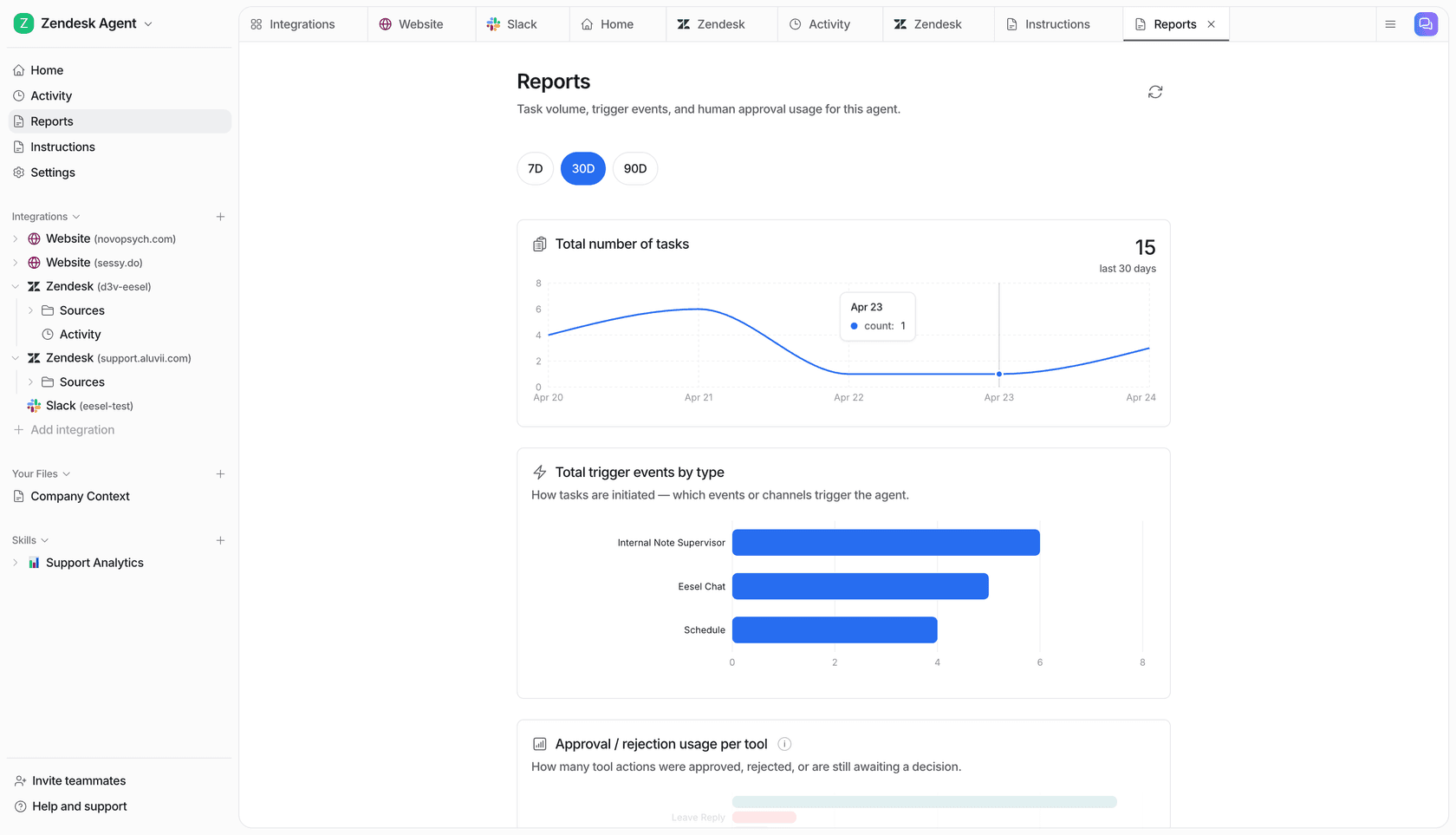
eesel plugs into the helpdesk you already run, then works the queue. It drafts replies and sends them, handles ticket routing and tagging, answers in Slack or in a chat widget, with your existing knowledge base plus past tickets and docs as the source.
It sits inside Zendesk instead of asking anybody to learn a new console, and on Freshdesk and Gorgias the same thing holds.
Why it belongs on a Custify alternatives list is narrow and specific. For plenty of B2B SaaS teams, the leading indicator of churn turns out to be response time rather than login frequency.
eesel has been putting AI agents onto live support queues for years now, and the lesson I keep watching land is this one: a confident-sounding bot that gives wrong answers costs more trust than having no bot at all. Which is why every rollout gets simulated against your own historical tickets first, so the numbers are in front of you before anything goes live. On a German jewellery retailer's Zendesk traffic, in one real cross-validated trial, that simulation surfaced 93% triage accuracy, 100% spam detection, and a 7% factual error rate. That last number is the one worth having before launch and not after it.
The results are the part I would put actual weight on. Gridwise resolved 73% of tier-1 requests inside its first month, off a seven-day trial. And a director of support at Yellowdig put it this way:
"It feels like a partnership, rather than a vendor relationship. eesel AI was flexible enough for us to get started quickly and iterate, with great support from the eesel team. Recently, a new customer success hire joked that our eesel AI bot was their best friend during onboarding and interviewing."
Pricing
| Item | Cost |
|---|---|
| Free plan | 100 credits, no credit card |
| 500 credits a month | $299/mo |
| 1,000 credits a month | $499/mo |
| 2,500 credits a month | $999/mo |
| 5,000 credits a month | $1,899/mo |
| Blog post generation | $4.00 per post |
| Platform fee and per-seat fee | $0 |
| Pay a year upfront | Two months free |
| Add-ons | SSO and MFA from $199/mo, priority support from $299/mo |
One credit covers one ticket or chat, however many replies go back and forth, so nobody is sitting there anxious about a customer replying twice. 500 tickets a month fits the $299 plan. The full breakdown sits on the pricing page.
Pros
- The only tool here you can price to the dollar before talking to anyone.
- Simulates against your own ticket history before go-live, so you see accuracy first.
- No seats, so adding the whole team costs nothing extra.
Cons
- Not a CS platform. No renewal forecasting, health scoring, or account planning.
- Credits reset monthly and do not roll over, and a spike month either pauses agents or needs overage turned on at $0.80 per extra credit.
- SSO and MFA are add-ons from $199/month, and HIPAA is a talk-to-us conversation.
My take: shopping for a Custify replacement because leadership wants better churn reporting? Wrong tool. Shopping because your accounts are going quiet and you already know support is behind, that is a different thing, and this is the cheapest and fastest option on the list to test. The 100 free credits mean the test costs you nothing.
2. Gainsight
Best for: enterprise CS organisations that need analyst-grade depth.
What it actually does
Gainsight is the category incumbent, and it behaves like one. It says 3,500+ companies use it, naming ADP, Workday and Notion among them, and it was named a Leader in the 2025 Gartner Magic Quadrant for Customer Success Platforms. For 2026 the pitch is "Retention-as-a-Service," built on agents.
The depth here is real. Customer 360 pulls health scorecards, product usage, support history, renewal timelines and stakeholder maps together into one record. Revenue optimization claims it surfaces the at-risk accounts about three months earlier.
Agent Studio lets teams build custom agentic workflows in natural language, sitting on top of their own data and governance model. Gainsight MCP exposes health scores, open risks and renewal timelines to any MCP-enabled model, a forward-looking move that most of this category has not made yet. Then the adjacent products cover communities, customer education and conversation intelligence, so the surface area runs wider than any single competitor here.
Pricing
Quote-gated, though Gainsight publishes more structure around it than almost anyone else here.
| Plan | Full users | Customers per user | Viewer licenses | Price |
|---|---|---|---|---|
| Essentials | 10 | 100 | Unlimited | Request pricing |
| Enterprise | 20 | 200 | Unlimited | Request pricing |
Enterprise adds renewal and expansion forecasting, company news, organisational mapping. Two footnotes worth having. The Product Experience module has a real self-serve free trial, the only one anywhere across that whole pricing page. And Gainsight-owned Skilljar does print dollar figures on add-ons, $10,000 for Content Syndication and from $25,000 for the Data Connector, which is as close to a public price signal as the company gets.
Pros
- Deepest functionality in the category, by a wide margin.
- Publishes both tier names and included quotas, so you can guess your tier.
- Adjacent products cover communities, education, and conversation intelligence.
Cons
- Heaviest implementation lift here; this is a CSM-team platform, not a light tool.
- The included quotas are tight. Twenty full users at 200 customers each caps Enterprise at 4,000 managed accounts before you negotiate.
- No public price for the core CS platform.
My take: with a real CS org behind you, named segments, a renewals motion, somebody whose actual job is administering the platform, Gainsight is the safe pick, and the quotas above let you sanity-check whatever quote comes back. At ten people, it will out-scale you and the implementation eats a quarter.
3. ChurnZero
Best for: mid-market teams that want AI agents bundled rather than billed separately.
What it actually does
ChurnZero sits closest to Custify on positioning, and it is the strongest of the lot on community proof, at 4.7 across 1,566 reviews on G2 with 89% of those at five stars. Washington DC-based. Its 2026 story is unusually concrete about what the agents actually are.
Instead of one vague "AI assistant," ChurnZero ships named agents grouped into teams: Renewal, Engagement, Expansion, Onboarding, and Workflow, and the individual agents get names too, Vibes, Pulse, Harbinger, Recap, Scribe, Compass. The Workflow team is what brings them into email, Slack and Teams.
There is also ChurnZero Connect, an MCP bridge piping live data into Claude and ChatGPT. And the Renewal Hub pulls churn risk, renewal dates and expansion potential together into one shared view.
In-app communications will run adoption prompts inside your own product, and the survey tooling is built in, which matters when you currently pay separately for CSAT and NPS collection.
Pricing
There is no pricing page. Literally, I mean: churnzero.com/pricing/ serves a not-found template, and /product/ does the same. Every CTA routes off to a demo form.
What ChurnZero does state on its AI page is the commercial shape: one annual subscription, "transparent flat-rate tiers," then pre-purchased AI credits on top of that. It is the structural fact worth carrying into a negotiation, since it means AI usage is a second meter for you to size rather than a flat inclusion. No dollar figure exists anywhere on its own properties, and both G2 and Capterra list the pricing as not provided by the vendor.
Pros
- Best community proof of any CS platform here, at scale.
- Names its agents and what each one does, which makes the AI claims auditable.
- MCP support means your existing AI tooling can read the data.
Cons
- The pricing page does not exist, which is a step beyond quote-gating.
- AI credits are a second meter you must forecast, on top of the tier.
- No free trial or self-serve path of any kind.
My take: for a mid-market SaaS team with a real renewals motion, ChurnZero is the strongest all-round pick here, and on the strength of its review base alone I would put it above Custify. Walk into the call with one question written down: how many AI credits does a typical account of our size consume in a month? No answer to that, and the flat-rate tier is not the whole bill.
4. Planhat
Best for: teams unifying customer success, sales, and services on one data model.
What it actually does
Planhat is architecturally the most interesting option here. Rather than shipping one fixed app, it runs as a CSP, CRM, or PSA off a single underlying data model. So if your post-sale org has customer success, account management and a professional services team all keeping their own separate systems, that is a different proposition from everything else on the list.
The health engine is built on what Planhat calls a living model of the customer: CRM data, time-series product telemetry, touchpoints captured automatically. It gathers transcripts, emails, and tickets with no CSM logging them by hand, and that is the most direct attack going on the manual-updating problem that kills adoption in this category.
Its published customer results are specific, and each of them links out to a named story. Macrobond reports 21% less churn, FirstUp 34% more customers per CSM, GlobalData 300+ hours saved annually per person.
Pricing
The most opaque of the nine. I searched the full rendered pricing page for currency symbols, for "per month," for "per user," and none of it is there. The page organises by product line instead (CRM, CSP, PSA), each one with an "Enquire" form attached. No tiers, no quotas, no free trial.
Planhat AIP, the AI layer, is listed as included on all plans, though the usage limits go undisclosed. One G2 reviewer mentions AI credit cost as a factor, which suggests metering does exist somewhere underneath the marketing copy. Another reviewer, a senior CSM at an enterprise, put the complaint plainly inside an otherwise positive four-star review:
"The pricing model would also benefit from greater simplicity and transparency."
Pros
- One data model across CS, sales, and services is a real structural advantage.
- Automatic touchpoint capture removes a chunk of CSM admin.
- Named, linked customer outcomes rather than anonymous stat carousels.
Cons
- Neither prices nor quotas are published, which is the worst of both worlds.
- AI usage limits are undisclosed despite AIP being "included."
- Its own product page 404s, which is a small but telling sign of site upkeep.
My take: Planhat is the right answer for one specific shape of company, where the post-sale org spans three functions and the tooling sprawl is the actual problem being solved. For everybody else, the opacity gets hard to justify when Gainsight will at least show you the ladder.
5. Totango
Best for: enterprises with multi-product accounts and complex hierarchies.
What it actually does
Totango now sells three products off one shared data set, the visible result of the Catalyst merger. Totango itself is the enterprise CSP. Unison is a standalone AI intelligence engine, predicting churn and finding expansion. Then Catalyst, the growth-oriented package aimed at revenue-minded CS teams.
The signature feature is SuccessBLOCs, pre-built best-practice frameworks that turn up with workflows and content already configured. Where your motions map onto standard patterns that is the fastest on-ramp in the category, and it takes away most of the blank-canvas problem that makes SaaS onboarding tooling so slow to stand up.
It flags a Forrester Wave Leader 2025 badge along with a G2 Fastest Implementation badge, and it is built explicitly for multi-product health models.
One correction worth making here, because it still circulates. Totango's old free Community tier is gone. No free plan exists on the live site.
Pricing
Quote-gated, but with published quotas.
| Product and tier | Included | Price |
|---|---|---|
| Totango Enterprise | 10 practitioner seats, 2,000 accounts, 5 teams | Talk to sales |
| Totango Premier | 20 practitioner seats, 3 viewers, 10,000 accounts, unlimited teams | Talk to sales |
| Unison Standard | Standard risk model, 1 CRM integration, 3 customer tiers | Talk to sales |
| Unison Custom | Adds 1 custom model, SSO, 6-month model evaluation | Talk to sales |
| Catalyst Growth | 2,500 accounts, 5 Salesforce custom objects, playbook designer | Talk to sales |
Pros
- Pre-built SuccessBLOCs measurably compress time to first value.
- Publishes seat and account quotas per tier, so tier fit is knowable.
- Unison can be bought without the CSP, which is unusual and useful.
Cons
- Three products means three line items and a more complex negotiation.
- No free tier and no trial, despite the historical Community edition.
- The AI engine is a separate purchase, not bundled into the CSP.
My take: Totango is the enterprise pick when your accounts are complicated for real reasons, several products, nested hierarchies, regional teams spread out. The SuccessBLOCs argument holds up. Just price all three products in one go, because buying the CSP and then discovering the churn intelligence is a separate SKU makes for an unpleasant surprise come renewal.
6. Vitally
Best for: fast-moving product-led SaaS teams that value speed over configurability.
What it actually does
Vitally is the modern, design-led entrant, the one mid-market PLG companies tend to shortlist against Custify. The pitch is speed. It claims 73% faster time to go live than the category average, plus 60% faster time to estimated ROI. It carries a G2 Customer Success Grid Leader badge and turns up on the Momentum grid too.
Feature-wise the expected surface is covered: health scores tailored per segment, automations triggering off any signal, dashboards, a docs layer. Where it differentiates is in feeling like a 2020s product instead of a 2014 one, which sounds soft, and it matters enormously for the failure mode I described earlier. A tool that CSMs actually open beats a more capable tool they avoid.
Adoption is not a solved problem for anybody, though. One CS leader running 15 CSMs on Vitally described the state of play honestly, and it is the fairest summary of the whole category I found:
"However, there is a TON of manual work which is tough to reinforce... If the CS were to not update anything, the managers would not know anything that is going on."
Pricing
Nothing at all. vitally.io/pricing is a "Let's Talk Success" demo form that asks for job title, company URL, an employee-count band. No tiers. No quotas, no numbers. Alongside Planhat, Vitally is the most opaque option on the list.
One softener to that: Vitally does offer a dedicated trial sandbox with your own customer data and team, only it sits inside the sales process instead of being self-serve.
Pros
- The most pleasant day-to-day experience in the category, which drives real adoption.
- Sandbox trial with your own data, even if sales-gated.
- Strong and improving position on G2's grids.
Cons
- Publishes neither price nor included quotas, so nothing about cost is knowable up front.
- Reviewers split on value, with some saying cost is high relative to included users.
- Less configurable than Gainsight or Planhat if your model is unusual.
My take: Vitally is my pick for a 30 to 150 person PLG SaaS company where the CS team is small, opinionated and allergic to enterprise software. On the adoption problem it does better than anything else here. Go in knowing the number only arrives after a call, and ask specifically how the viewer seats get counted.
7. Velaris
Best for: mid-market teams that want the vendor to do the implementation.
What it actually does
Velaris is the newest serious entrant on the list, London-based, launched back in May 2021. It says it is the only vendor named a Visionary in the 2025 Gartner Magic Quadrant for Customer Success Platforms.
The product is built AI-first, not AI-retrofitted. Its differentiator claim is the Velaris Context Engine, a living context graph covering every customer, event and process, which the agents query in real time. Sitting on top of that are pre-built agents for risk monitoring and handovers, a custom agent builder driven by natural-language instructions, and a Copilot answering portfolio questions in plain English. It exposes an MCP server as well. It also sells a separate Velaris Support add-on with a shared inbox and an AI support agent, making it the only vendor here that acknowledges the two halves I described up top.
Two honest caveats, both from its own pages. On the AI info page Velaris says the platform may be too expensive or feature-rich for organisations under 50 employees, and I respect it for publishing that. Then its own pages disagree with each other on review scores, showing 4.5 G2 with 4.7 Gartner in one place, 4.7 G2 with 4.4 Gartner in another. So treat any single figure carefully.
Pricing
No dollar figures anywhere, and I confirmed that against the rendered page and the raw HTML both. What the pricing page publishes instead is packaging: "All the tools you need in one license," then "5 users. Unlimited viewers. Add-ons available," with a limit of 3 custom objects tucked inside the feature list.
It does publish something more useful than most, though. Implementation is 4 to 8 weeks, and explicitly not do-it-yourself. Velaris scopes, maps, migrates, builds the custom integrations for you. That is the clearest implementation commitment on the whole list.
Pros
- AI-native architecture rather than agents bolted onto an older core.
- Publishes an implementation window, which nobody else does.
- Publishes its own floor, telling small companies it is not for them.
Cons
- No price, and only partial quota disclosure.
- Vendor contradicts itself on review scores and integration counts.
- Its AI info page is dated November 2025, so some claims are nine months old.
My take: Velaris is the one I would add onto a shortlist that already has ChurnZero and Vitally sitting on it, specifically when your team has no ops person to run an implementation. The done-for-you setup is as much the product as the software is. Under 50 people, believe them and look elsewhere.
8. ClientSuccess
Best for: teams that want to see the whole tier ladder before the sales call.
What it actually does
ClientSuccess is the steady mid-market option, and there is one thing it does better than every quote-gated peer here. It shows you the entire feature matrix and every cap, and hides only the number. The pricing FAQ is direct about why, saying public pricing does not get published because each plan is scoped to team size, contract length and the integrations required, and that most teams have pricing back inside 24 hours.
The core platform covers health scoring, journey management, NPS surveys, renewal forecasting, playbook automation, CRM integrations. Its automation and AI layer, called SmartCS, handles generative email and meeting summaries, and separate modules exist for Meeting Intelligence and customer onboarding portals, which matter when your gap is onboarding rather than renewal.
Pricing
No dollar figures, though this is the fullest tier disclosure of any gated vendor here.
| Startup | Growth (most popular) | Enterprise | |
|---|---|---|---|
| Max customers | 10 | 50 | Unlimited |
| Max full licences | 500 | 5,000 | Unlimited |
| Customer goal tracking | 1 per customer | 3 per customer | Uncapped |
| Assigned CSM | Onboarding only | Included | Included |
| Custom dashboards | Not included | Add-on available | Included |
| Customer portal | Not included | Add-on available | Included |
| Price | Not published | Not published | Not published |
Two things jump out of that table. First, the billable unit is CSMs plus modules and not the 500 or 5,000 logins, so the big number there is a ceiling rather than the meter. Second, the customer caps are brutally low: 10 accounts on Startup, 50 on Growth. A mid-market team sitting on 300 accounts gets pushed to Enterprise by account count long before it needs one single Enterprise feature. Automation and AI is an add-on module and not base, same as Meeting Intelligence and Customer Onboarding Portals.
Pros
- Publishes every cap and every feature, which makes tier fit computable.
- Straight answer in the FAQ about why pricing is gated, and a 24-hour turnaround.
- Offers a proof of concept against your own data in place of a trial.
Cons
- AI is an add-on, so the base license is a 2019-shaped product.
- The 10 and 50 customer caps will force most real teams to Enterprise.
- No self-serve trial, and the POC's terms are not published.
My take: ClientSuccess is the most honest of the gated vendors, and that tier table on its own saves you a discovery call. Just read the customer caps before getting attached to the Growth tier, because that row, not the feature list, is what sets your price.
9. Akita
Best for: small teams that want a price today and can live without AI.
What it actually does
Akita calls itself the startups' first choice for customer success, and out of this whole roundup it is the only vendor that tells you what it costs without a form in the way.
It pulls customer data out of your existing tools and into health scores, segments, alerts, dashboards, trigger-based playbooks. Health scoring is where the investment has gone: separate scores for accounts and for contacts, plus multiple scores running across different products.
The elephant in the room: Akita has no AI. No credit, no agent, no copilot, nothing that summarises. Across the homepage, the pricing page and the feature pages, AI does not get mentioned once. Its automation is rule-and-trigger based. In a category where every other vendor is selling agents in 2026 that is a real gap, and worth knowing too that its blog content stops at 2024.
Pricing
The full published rate card, which is the whole reason it made the list.
| Small Teams | Growing Teams | Enterprise Teams | |
|---|---|---|---|
| Price | $49/month | $99/month | $499/month |
| Integrations included | 2 | 4 | Custom development |
| Full access users included | 2 | 4 | Free onboarding sessions |
| Free read-only users | 4 | 8 | Seminars included |
| Extra integration | $29/month | $29/month | Custom |
| Extra full-access user | $29/month | $29/month | Custom |
| Accounts and contacts | Up to 10,000 | Up to 100,000 | Unlimited |
| Other objects | Up to 100,000 | Up to 1M | Unlimited |
| Tracking events per month | Up to 1M | Up to 1M | Unlimited |
| Full API access | No | Yes | Yes |
No setup fee, no cancellation fee, no minimum contract, month-to-month by default, and an optional 20% discount if you prepay annually. Two wrinkles worth flagging on it. The tracking-event cap is identical on the $49 and $99 plans, so the upgrade buys you record headroom and API access, but no event headroom at all. And the free-trial answer contradicts itself, since the homepage advertises a 14-day free trial while the pricing FAQ answers "Do you have a free trial?" with a flat no.
Pros
- The only complete public rate card in the category, Enterprise tier included.
- Month-to-month with no minimum, so the switching risk is about as low as it gets.
- Read-only users are free, which makes leadership visibility cheap.
Cons
- No AI of any kind, in a year when that is the category's whole pitch.
- Its own pages disagree about whether a free trial exists.
- The $99 tier buys no extra tracking events over the $49 tier.
My take: a small SaaS team that needs health scores and alerts this quarter, with no budget for a six-week implementation, gets a rational and cheap and low-risk answer here, and $49 to find out is a fair deal. Put AI capability on the requirements list at all, though, and it is not a contender in 2026.
What "AI agents" actually means in a customer success platform
Every vendor above, Akita aside, sells AI agents. Being precise about what those agents do is worth the effort, because the marketing language runs nearly identical across all of them while the substance does not.
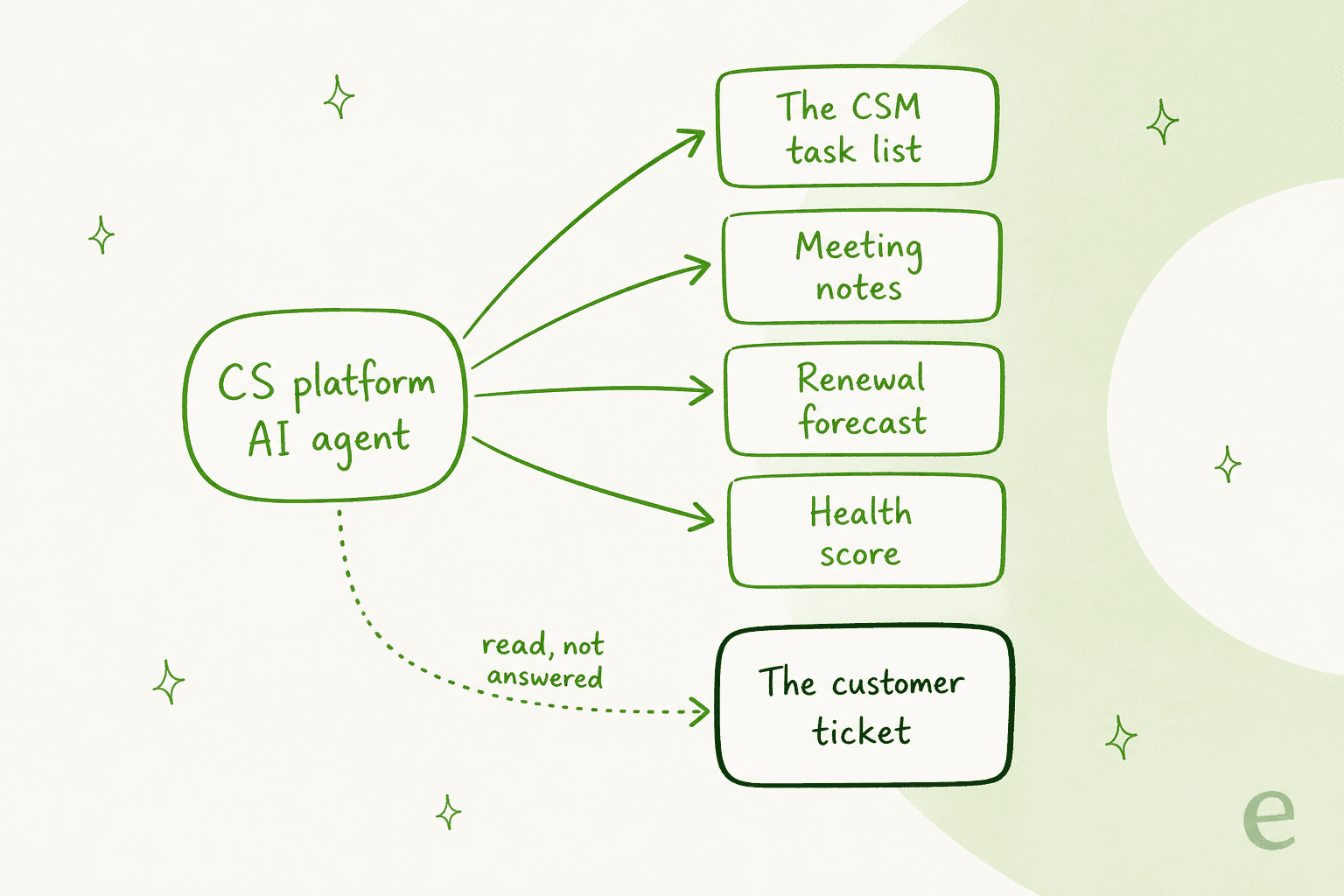
In practice, the AI agent inside a CS platform acts on the CSM's work. Drafts the QBR deck. Summarises the call, writes the follow-up task, updates the renewal forecast, re-scores the account off signals it has read. ChurnZero's agents are named for exactly those jobs. Gainsight's prebuilt agents cover risk, handoff and expansion, and Velaris runs agents over its context graph to flag risk and prep renewals. All real, useful automation, and it removes hours of admin per CSM per week.
What none of them do is answer the customer. Support conversations get read as a signal feeding the health score. Resolved, they are not. It is a defensible product decision, and it is also the distinction deciding whether buying one of these moves your retention number or only measures it more precisely.
Worth calibrating how good the agents are today, as well. A Custify reviewer who gave the product five stars still added this:
"The use of AI isn't that accurate, especially when it comes to analyzing complex customers."
And a long-time Gainsight administrator put the roadmap complaint in a way I have heard from the admins of half the platforms on this list:
"There is an excessive focus on AI at the expense of addressing basic features, parity issues, and stability problems that, if resolved, would significantly improve the platform."
Neither of those means the AI is useless. What they mean is the agents do well at summarising and drafting, then get weaker on judgement once an account is messy, which is roughly where the technology sits across the board right now.
The practical test. Take your last ten churned accounts and write down, one sentence each, why they left. Most of those sentences about the relationship, the value story, the executive sponsor walking out? Buy a CS platform. Most of them about the product experience or about getting help, then fix that first and buy the dashboard later.
Two adjacent moves are worth knowing about while that test runs. Churn signals in support catch the accounts a usage-based health score misses completely, since the account keeps logging in right up until the day it leaves. And AI on the cancellation flow is the last-mile version of the same idea, catching the intent at the moment it turns explicit instead of three months earlier as a probability.
What you will actually pay, and what to ask
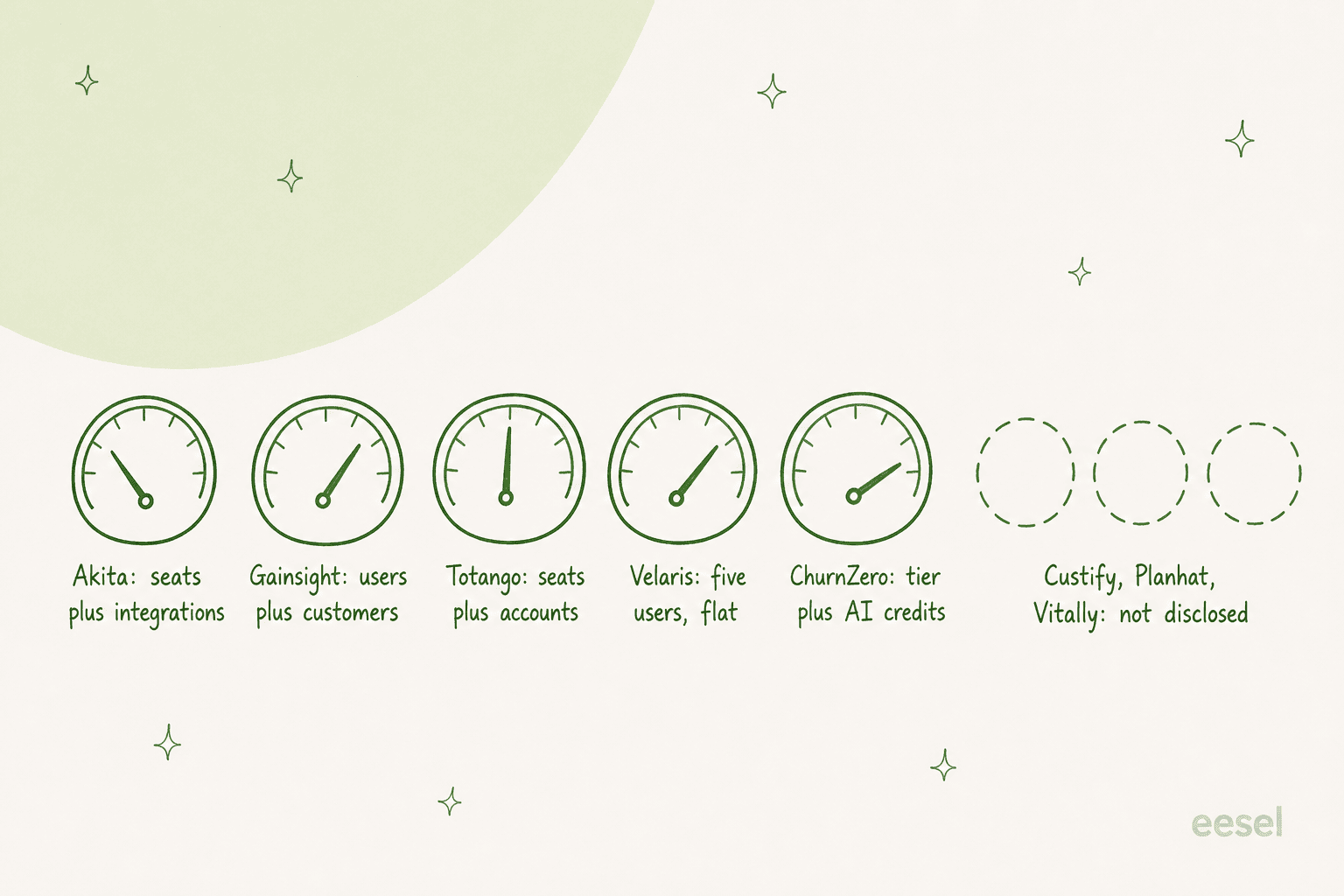
Here is the trap catching most buyers in this category, and the sticker price is not it. It is that every vendor bills for a different unit, so two quotes are not comparable even with both numbers sitting in front of you.
Akita bills per seat, and per integration on top. Gainsight bills full users, each one with a customer allowance attached. Totango bills practitioner seats plus managed accounts, ClientSuccess bills CSMs plus modules. Velaris sells one license carrying five users. ChurnZero charges a flat tier with pre-purchased AI credits on top. Custify, Planhat and Vitally do not disclose the unit at all.
So a $40,000 quote from one vendor and a $40,000 quote from another will behave completely differently the moment three CSMs get added or your account count doubles. Four questions I would write down before any of these calls:
- What exactly is the billable unit? Seats, CSMs, managed accounts, or something else. Get it in writing.
- What happens at 2x our current account count? This is where quota-based pricing bites hardest.
- Is AI in the base license or metered separately? ClientSuccess says add-on. ChurnZero says credits. Planhat says included but will not publish limits.
- What is the implementation commitment, in weeks, and who does the work? Only Velaris publishes a number without being asked.
A worked example, for scale. Take a 12-person CS team managing 400 accounts. That is above ClientSuccess's Growth cap of 50 customers and above Gainsight's Essentials allowance of 10 users, so both quotes land at Enterprise no matter which features you actually need. That same team on Akita pays $99, plus $29 for each of the eight extra full users, so $331 a month, and gets no AI. The gap there is the shape of this whole category.
And for a fair comparison over on the other side of that line: the same team's support queue, running 2,000 tickets a month, fits the 2,500-credit plan at $999 a month on eesel, with no seat count involved anywhere. Not a like-for-like product comparison, and I am not claiming it is one. It is a reminder that cost per ticket and cost per CSM are different budgets, solving different halves of the same retention number.
Try eesel
If you got all the way down here and the honest diagnosis is that accounts go quiet because support is behind, not because the scoring model is wrong, then that is the problem eesel is built for.
eesel connects into the helpdesk you already run, learns from your existing tickets and help centre, then starts resolving the repetitive volume that turns green accounts amber. Before it touches a live customer you can simulate it against your own ticket history, so the accuracy numbers come first instead of arriving in production.
Plans start at $299 a month for 500 credits, where 1 credit is one ticket or chat, with no seats and no platform fee, and the free plan gives you 100 credits with no credit card. Enough to run a real test across a hundred tickets and have an answer this week, rather than after a six-week implementation.
Same applies if you are on HubSpot or on Salesforce. Smaller teams running Help Scout or Front get the same connect-and-go path.
It will not forecast your renewals. Pair it up with one of the platforms above if that is what you need. What it will do is change what the health score is measuring, which is a different and often better place to put the budget.