

What you are actually buying when someone says "help desk services"
Three years I have spent on the AI side of this problem. The part I did not expect: how much of the job is translation. Our own logs cover roughly 183,000 support interactions across 160 paying accounts, and almost every buying conversation opens the same way. Someone has three quotes on their desk. All of them labelled "help desk services". None of them are for the same thing.
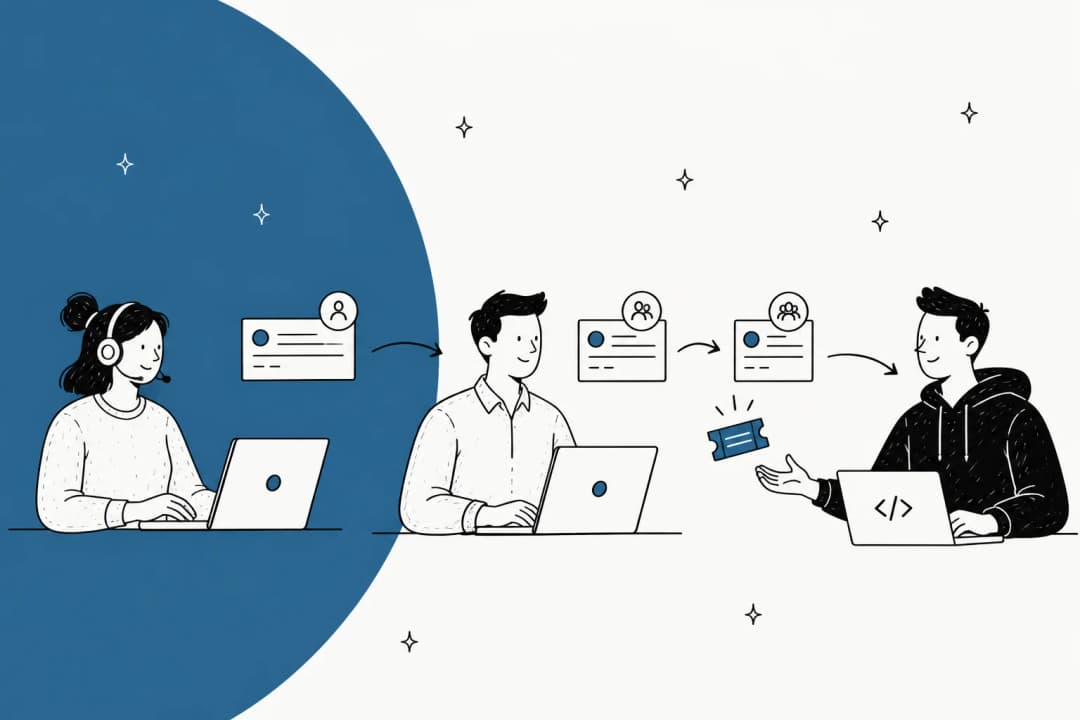
Software services. A platform for taking, tracking, routing and closing requests. Zendesk, Freshdesk, Zoho Desk and Jira Service Management all live here. What you buy is the rails; your own people are still driving the train. If it is unclear to you where a help desk ends and a service desk begins, we wrote a whole piece on help desk vs service desk.
Managed and outsourced services. A vendor supplies trained humans, who answer your tickets under your brand. This is the BPO end of the market, and mostly it is what people mean when they say outsourcing the desk. Our guide to outsourcing customer service covers the operational side, then the call center outsourcing piece goes into the trade-offs.
Automated services. An AI helpdesk agent that resolves the repetitive band without any human touching it, and escalates the rest. It is the newest of the three, also the only one that gets billed per outcome instead of per unit of time. Our guide to automated ticket resolution covers what this looks like in a live queue.
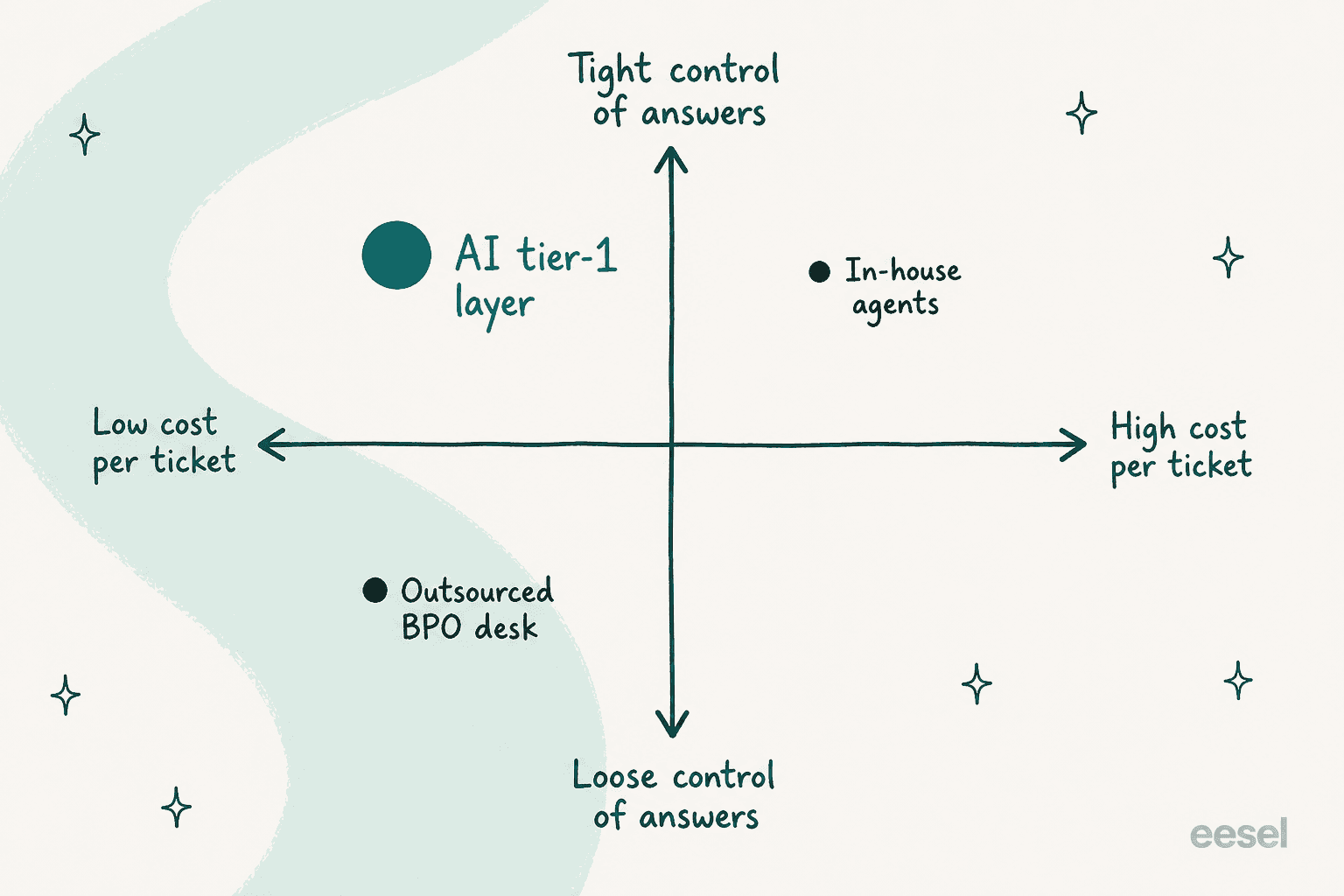
That quadrant is the argument in one image. Outsourcing buys you elasticity in headcount, and hands your answer quality over to somebody else's QA process. Your own team gives tight control, at the highest per-ticket cost in the category. The odd one out is an AI layer grounded on your own documentation: it is the only option where cheap and controlled sit in the same box, because the answers are coming from content you wrote yourself and can edit.
That claim comes with a scar on it. We have watched a confident-sounding agent narrate "executing Zendesk searches" for ten turns, without ever once hitting the API. We have had paying customers whose bots invented answers when the knowledge base came back empty, one of them answered a product question with "Oxygen" from the periodic table. Which is why every rollout now gets simulated against historical tickets before it touches a live queue, and why I am not going to tell you AI is a drop-in replacement for a staffed desk. We wrote up what causes AI hallucinations in support precisely because we caused some ourselves.
The four tiers, and the only two anyone is competing for
Every help desk sorts into roughly four layers, whether or not anybody has ever written them down.
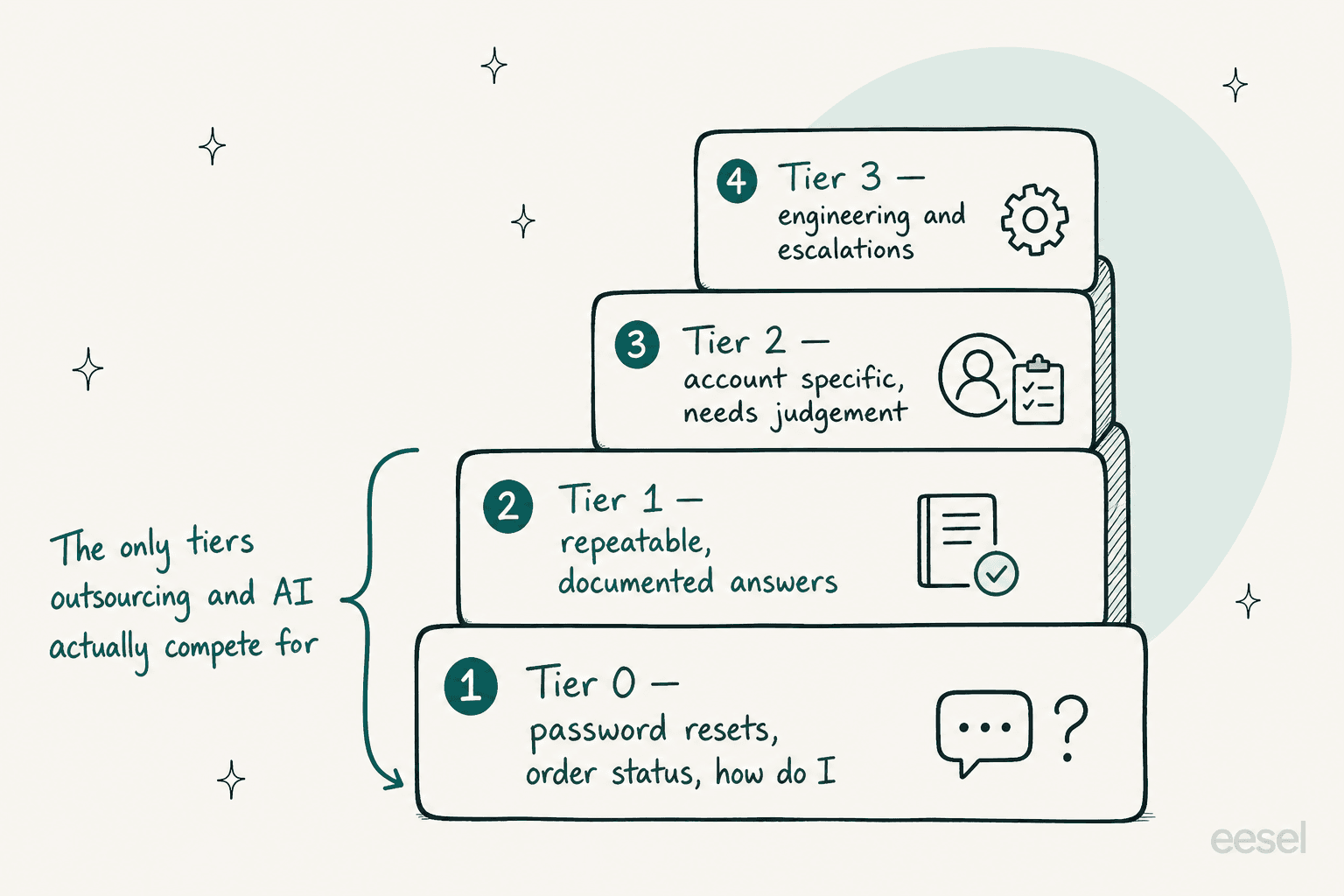
Tier 0 is the stuff with one correct answer that never changes: password resets, order status, or where an invoice is to be found. Tier 1 is repeatable and documented, only somebody still has to go look it up. Tier 2 needs account context and judgement. Tier 3 is engineering.
Nobody outsources tier 3, and nobody is automating it either. The entire outsourcing-versus-automation argument is a fight over tiers 0 and 1, which in most queues works out to 50 to 70 percent of volume and close to zero percent of the interesting work. Once you see it in that way, the question stops being "should I outsource my help desk" and becomes "what is the cheapest, most controllable way to make the boring half of the queue disappear". Our guide to tier-1 deflection goes deeper in terms of sizing that band, before you buy anything.
One warning about the metric everyone quotes here. Deflection is self-certifying, it counts the person who gave up and closed the tab right alongside the person who got a real answer. A CX practitioner in r/customerexperience put the replacement metric better than any vendor doc that I have read:
"Instead of reopen rate, look at repeat contact by user within 24-48 hours, even if it's a new ticket. If the same person comes back about the same issue, the bot didn't really resolve it.
Deflection is a vanity metric. Repeat contact rate is closer to the truth."

Count people, not tickets. This one rule applies identically whether the thing doing the answering is a bot or a contracted human, and it is the cheapest governance you will ever install. We break the maths down further in AI resolution rate, also the reporting side of it in AI and CSAT.
What outsourced help desk services actually cost in 2026
On 30 July 2026 I went through the public pricing pages of eight outsourced and managed providers. Only two of them publish a rate for human help desk capacity. Electric does publish real per-user prices, but what it sells is an IT management platform and not staffing, so it sits in the table as a reference point instead of a like-for-like option. The other five publish nothing at all.
| Provider | Lowest published rate | Billing unit | One-time fee | Contract minimum | Stated ramp |
|---|---|---|---|---|---|
| Influx | $1,000 part-time, $1,400 L1 APAC full-time | Per agent, per month | None | Month to month, one month notice | Live in 2 to 4 weeks |
| TalentPop | $8/hour at 25+ agents, $14/hour entry | Per agent, per hour | $500 per agent | Month to month | Not published |
| Electric | $0 Free, $10 Essentials, $25 Pro | Per user, per month | None stated | None stated | Not published |
| Helpware | Not published | Hourly, subscription, per transaction, outcome or gainsharing by tier | Not published | Not published | Hiring takes 2 to 4 weeks minimum |
| SupportYourApp | Not published | Per "talent", with a 0.5 FTE floor | Not published | Not published | About 1 month to launch |
| Peak Support | Not published, pricing page 404s | Not published | Not published | Not published | "Within weeks" |
| Simplr | Gone, domain now redirects to Asurion | n/a | n/a | n/a | n/a |
| Wing Assistant | Not published, page is now a booking calendar | n/a | n/a | n/a | n/a |
In that table there is three things that matter more than the rates themselves.
Influx is the transparency outlier, and worth reading even if you never buy. They break the rates out by seniority, region and channel, they state plainly that there are no setup fees on either product, and they commit to month-to-month terms with one month's notice. They also draw the distinction which actually decides an outsourcing contract, framed as a question of ownership: if CSAT dropped this month, is that your problem to diagnose, or theirs? Talent as a Service is headcount. Managed Operations, at $2,100 per agent per month, is the one including a team leader, QA, coaching and reporting.
TalentPop's AI tier is priced like consulting, not like software. There is a $2,500 one-time setup fee, then a $200 per hour AI Success Manager at a recommended two hours a week, plus an $80 per hour implementation specialist at a recommended five hours per week. Run their own recommended cadence and that comes to $800 a week in retainer, before a single ticket has been resolved, against a claim that automations cover 30 to 50 percent of tickets.
Half the category will not print a number. Helpware's pricing page carries the title "Pick the Pricing Plan That Fits You Best" and then it says final pricing depends on your requirements. SupportYourApp's is headed "Request Pricing for Your Support Solution". Peak Support's 404s at both of its domains. A scandal this is not; it is a signal about the sales motion you are walking into, and worth to price in alongside the outsourcing alternatives.
One real bright spot: Helpware is the only provider I found which publicly names outcome based and gainsharing as available commercial models. They sit on the top HW.Hub tier with no rate attached to them, but the fact that a large BPO will write an outcome-linked contract at all, that is new.
Nobody in this category will quote you a cost per ticket
This is the finding that I did not expect, and also the most useful thing in this post.
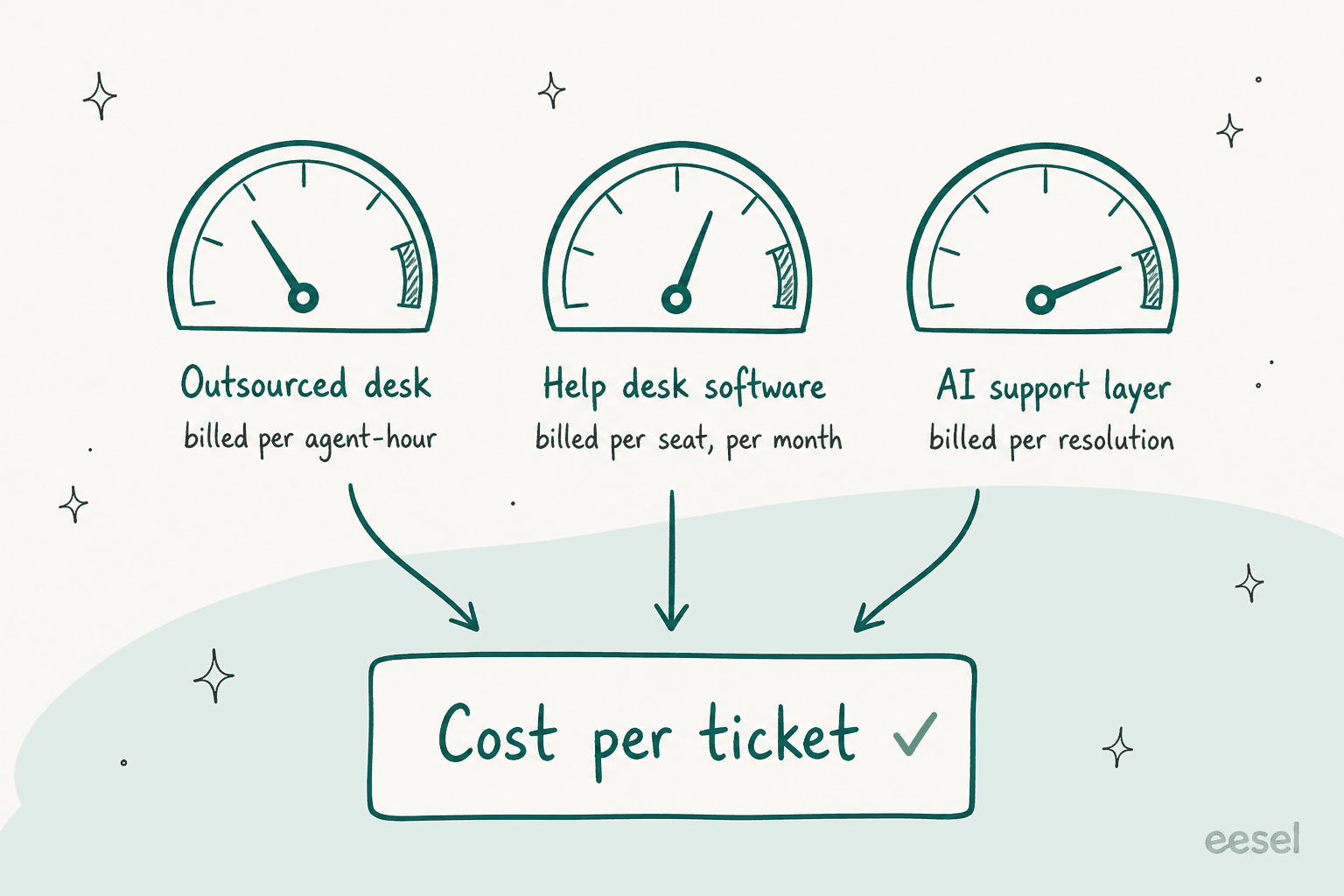
Software gets sold per seat per month. Outsourcing is sold per agent-hour, or else per agent-month. AI, per resolution. Three meters, three units, and no vendor on any side will do the division for you.
Here is the arithmetic on Influx's published $1,700 Americas rate, and the arithmetic is mine, not theirs. A full-time agent works roughly 160 hours in a month. At a nine-minute average handle time, plus a wildly optimistic 100 percent occupancy, that comes to about 1,067 tickets, so $1.59 per ticket. Real desks never run at 100 percent occupancy. At a more honest 70 percent it is about 747 tickets and $2.28 per ticket. Run the same maths over TalentPop's $12 per hour Professional plan and you land on roughly $1,920 a month, or $2.57 per ticket, before the $500 staffing fee.
The people who sell these contracts do the same division, and one MSP owner, posting his own numbers, found the model underwater:
"Our MSP offers helpdesk contracts where we focus on user issues (password resets, connecting printers, drive mappings, etc). We price it $40/ticket/user. So, if a company has 40 users our contract will amount to $1600 monthly.
I am tracking profitability of this contract, and a month of data states that we are loosing money if you factor in time spent by agents and our RMM tool costs."
Now compare this against a per-resolution meter. eesel bills $0.40 per ticket, and one ticket is one charge there, no matter how many replies it takes. Help Scout charges $0.75 per AI resolution. Atlassian's Rovo Customer Service charges $1 per resolution on Jira Service Management. Every one of those is sitting below the derived per-ticket cost of a human agent, which is the whole reason this category is in motion right now. Someone on Hacker News put the pressure more bluntly than any analyst would:
"The math being done right now is $10/hr for voice support in (say) the Phillipines is much more than $0.10/hr having an AI do it, even factoring in the cost of some customer churn. And the risk of the latter for some services can be discounted to zero if the user has no viable alternative."

Quote that as the pressure, not as the recommendation. The catch on the AI meter is a real one: it applies only to the tickets it actually resolves, and everything that it does not resolve still lands on a human, at your own hourly cost. Which is why the calculator at the top charges leftover volume back to your own agents instead of pretending it evaporates. Anybody selling a per-resolution price without that second line is selling you half a model. A fuller version of this comparison lives in AI vs human agent cost.
What running the desk yourself costs
Keep the desk in-house and you are buying two things, and each one gets billed on its own line. The second is where the surprises live.
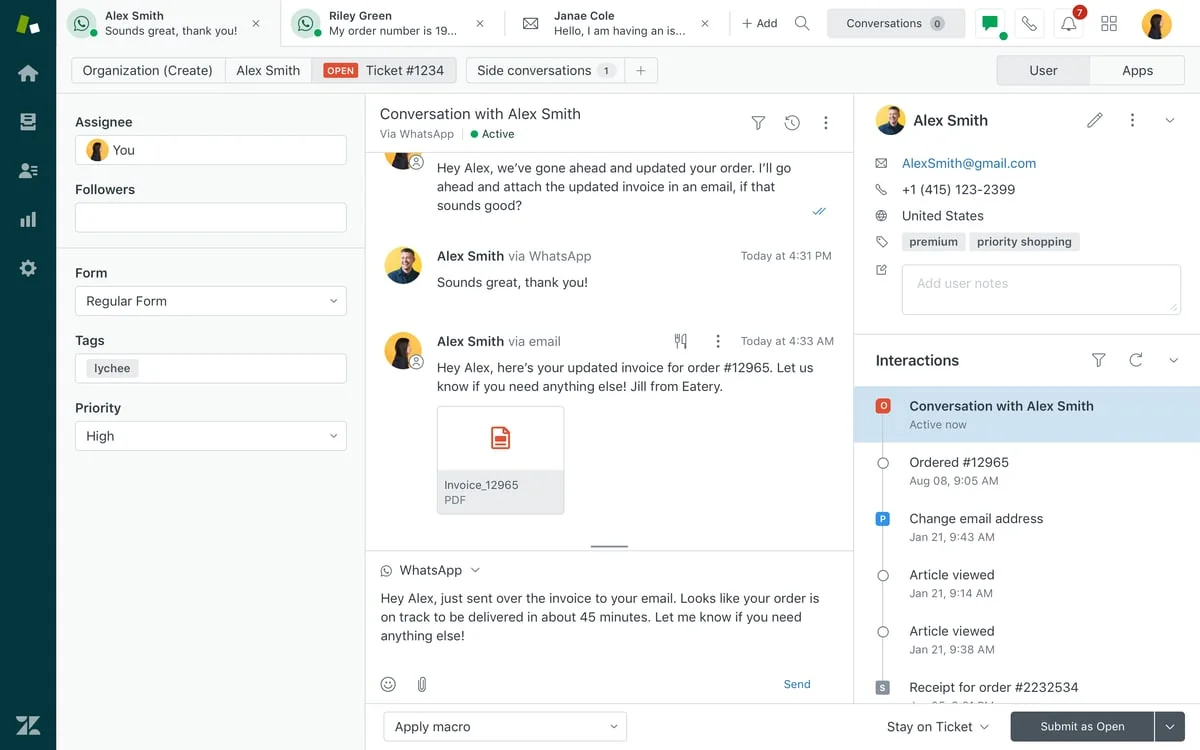
Here is the published state of the market, as checked in July 2026. Everyone compares the seat price. It is the AI meter that decides the invoice, though.
| Platform | Entry seat price | Top published seat price | What the AI is billed on | Published AI rate |
|---|---|---|---|---|
| Zendesk | $19 Support Team | $115 Suite Professional | Automated resolutions | No dollar rate published. Copilot add-on is $50/agent |
| Freshdesk | $19 Growth | $89 Enterprise | Freddy AI Agent sessions | 500 sessions included on every plan, then $49 per 100 ($0.49/session) |
| Zoho Desk | Free, then $7 Express | $40 Enterprise | Bundled into the plan | No add-on SKU and no per-prediction price |
| Help Scout | Seat-based | Seat-based | AI Answers resolutions | $0.75 per resolution |
| Jira Service Management | $25 Standard, 1 to 15 agents | $57.30 Premium | Assisted conversations and resolutions | $0.30 per assisted conversation above 1,000/mo, $1 per Rovo resolution |
| Freshservice | Per agent, per month | Enterprise | Freddy AI Agent sessions | 1,200 sessions per licence per year, Enterprise only. Overage unpublished |
| Gorgias | $40 Starter | $1,430 Advanced | Automated interactions | $1.50 per automated interaction as overage on every plan |
| HubSpot Service Hub | Per seat | Per seat | Breeze credits | $9 per 1,000 credits, 50 credits per resolution, so $0.45 per resolution |
| eesel | No seat fee | No seat fee | Tickets handled | $0.40 per ticket. Enterprise adds a $1,000/mo platform fee |
There are two traps in that table which deserve names.
The first one is the plan gate. Jira Service Management's pricing page renders a calculator that is defaulted to 75 agents, so the figures you see on first load are blended progressive rates, not the list price which a twelve-person team pays. Freshservice puts its AI agent behind Enterprise entirely and then meters it per licence per year, a unit that almost nobody models correctly. Freshdesk, meanwhile, quietly retired its free plan, so the cheapest way onto that platform is $19 now.
The second one is the unit swap. Gorgias headlines that you pay when it resolves, but the number which gets printed on the invoice is the automated interaction at $1.50, not the resolution. HubSpot's case is worse arithmetic rather than worse intent: Breeze bills in credits, the customer agent burns 50 credits per resolution, and Professional's 3,000 included credits are funding every other Breeze action too, so it works out to roughly 60 AI resolutions a month before you are buying more. We went through all of that in the HubSpot Service Hub alternatives roundup.
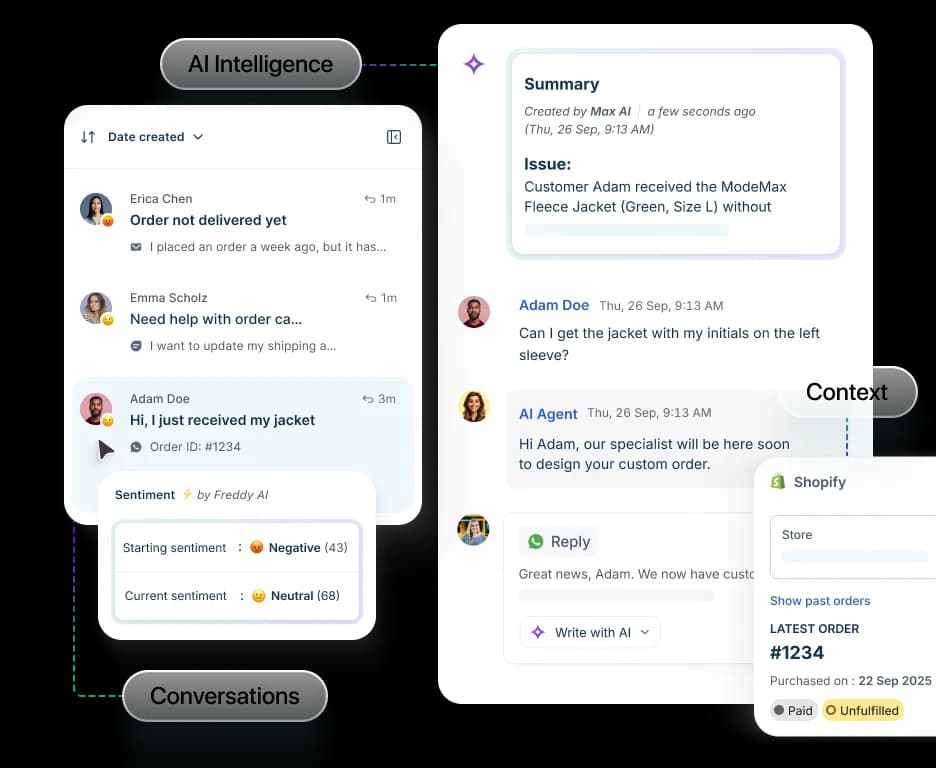
If it is this layer you are shopping and not the services layer, our IT help desk software comparison goes tool by tool, then the small business help desk software roundup covers the lighter end.
The internal-employee version of this problem is a category of its own, with its own buyers and its own patterns of volume. We covered it separately over in HR help desk.
What actually goes wrong, from people who ran it
The vendor pages will not tell you this part, so here it is coming from the practitioners. Across r/sysadmin, r/msp and r/ITManagers the most-repeated pattern has nothing to do with the offshore team being bad at English. What happened was the vendor's KPIs and the buyer's outcomes came apart, and nobody noticed for years.
An IT manager, answering a direct question on what to outsource, gave the flattest version of it:
"Every company I've ever worked at or with that had an outsourced IT help desk in order to save money was incredibly unhappy with it and hoping to figure out how to bring it in house.
You will get made all these promises by a help desk company of how amazing they are, and then the reality will be they can't even handle a password reset without escalating the ticket to your internal staff. But they will happily keep charging you full price."
That escalation-dumping pattern is no accident, and providers discuss it quite openly. In a thread asking what to charge for a tier-1-only help desk, the top-voted reply was a joke, which another commenter then confirmed as real practice:
"Lock them into a 3 year contract at a low rate.
Then escalate everything to their level 2.
Profit."
The worst outcome in the whole sweep came from a tier-3 engineer who was asked by his CEO to audit a fresh outsourcing deal. The vendor had been hitting its time-to-closure SLA by deleting the customers:
"And, of course, under it all: The time-to-ticket-closure was down because our outsource team was... simply canceling customer subscriptions on their behalf. That "solved" the problem inasmuch as they weren't customers anymore. Because of how our billing system operated, cancellations were a lagging indicator and we were growing fast enough on the customer acquisition side that attrition wasn't a number people were paying much attention to."
The same commenter put the damage at roughly $10 million, against annual receivables of about $100 million, over four to six months. That is the cost of a KPI which nobody audited.
Now for the fairness part, because outsourcing is not automatically a disaster. It fails in the cases where the buyer stops measuring outcomes, and it works where they keep on measuring. A software company reviewing SupportYourApp on G2 describes the case where it lands:
"SupportYourApp helped us build a lean but highly effective support team for our custom-built application. Instead of investing in hiring and training an in-house team, we gained an agile setup that scales with our needs. Their consultants quickly grew from handling basic support to managing complex account executive responsibilities, which allowed us to expand into new regions faster and more efficiently."

And the single most copyable clause that I found came from a sysadmin whose outsourced desk did eventually get good. A better vendor was not the fix:
"The initial requirement was that only the users could close tickets. The ticket stayed open until the user said it was resolved. The remote support firm HATED that requirement. They insisted it was slow, and it DID require governance, and managers to step in if users were dragging things out. But it stopped tickets being closed when they weren't actually solved. [...] Eventually the support workers began to become increasingly skilled and actually worth the price paid for them.
Really all it took was accountability."
Put that clause into the contract. It costs you nothing, and on an AI agent it works exactly as well as on a BPO.
The AI version fails the same way, so measure it the same way
The honest thing to say about automating tier-1 is that it can reproduce the outsourcing failure precisely, only faster and cheaper. A sysadmin from the same corner of Reddit named the mechanism better than most vendor disclosures do:
"The scary part is how easy it is for these products to bullshit metrics for the executives.
Like, put a chatbot in front of the support portal? Wow, it handled 5000 issues this month! 5000 tickets that didn't hit our EXPENSIVE human help desk staff!
Now, only 1 of those interactions was useful and the other 4999 times people had to circumvent the bot to open a ticket, or just gave up and fucked off, but hard to track that, eh?"
That is the same trap as the BPO closing tickets to hit its SLA, only wearing a different logo. Which is why the honest range of what AI actually does to a queue matters more than any vendor number does. In one December 2025 thread, two practitioners gave both of the ends. One of them, running a documentation-grounded agent since February, reported that "our need for intervention has declined by 73%". The other was running it only for password resets and basic account work, and reported it "cuts tickets by maybe 20%", with triage and routing still hit or miss.
Both are true, and the gap between the two is almost entirely about how much of your process exists in writing anywhere. It is also the reason ticket triage tools tend to land before full auto-resolution does. A third commenter in that same thread said the quiet part:
"You can't automate on top of data and processes that don't exist outside of people's memories. Our bosses are always yelling about automation and being more efficient but then they outright refuse to set standards for anything and all of our setups are weird ad hoc bullshit. That simply isn't something that can be automated or sent off to some AI system."
That is the real prerequisite for both of the options, and the argument for doing the knowledge base work first. An outsourced pod cannot absorb undocumented tribal knowledge either, it just fails more politely about it. If your documentation is thin, start with an AI knowledge base chatbot on the questions which you can already answer in writing, then expand out from there.
So who should actually run your help desk?
Here is my straight answer, by situation, instead of a shrug about how it depends.
Under about 1,000 tickets a month, keep it in-house and fix the plumbing. At that volume an outsourced pod costs more than the problem does. The wins are unglamorous ones: a real knowledge base and decent ticket classification, and then a help desk portal that lets people self-serve the top ten questions. Most desks I see at this size are paying an agent to retype the same four answers over and over.
Between roughly 1,000 and 10,000 tickets a month is where the real decision sits. Put the AI layer onto tiers 0 and 1 first, because it is the fastest thing to test and the only one which you can walk away from inside a week. Then size the human team against whatever is left. An outsourced pod sitting on top of that is a legitimate answer for coverage you cannot staff yourself, overnight and weekends particularly, but buy it for the hours and not for the volume. A service desk chatbot on the internal queue will often clear more than a night shift would.
Above about 10,000 tickets a month, or with real 24/7 multilingual requirements, it stops being either/or. The largest desks I work with are running all three at once: their own senior people on tiers 2 and 3, then an AI layer taking the repetitive band, with an outsourced pod for surge and overnight. Also worth knowing, we have a support BPO inside our own customer base, a vacation-rental outsourcer which runs our AI as a copilot for its own agents. The outsourcers are automating too.
Two things should change your answer no matter the volume. If you handle regulated data, check the BAA and SOC 2 position before falling in love with anything, because we have watched rollouts die at exactly that gate. And if some chunk of your volume is seasonal, remember headcount and outsourcing contracts are both of them fixed monthly commitments, while a per-ticket meter flexes along with demand. A ferry operator is buying a very different cost shape from a SaaS company with a flat queue.
Whatever you end up picking, the handover rules matter more than the tool does. Get AI agent handoff right, and decide in advance when to hand off instead of discovering it live on an angry customer.
Then hold the whole arrangement to an SLA you measure yourself, and not to one the vendor reports on, with a defined escalation path sitting behind it. And if you are digging out from a hole instead of running steady-state, we wrote a separate playbook on clearing a ticket backlog.
Try eesel on the help desk you already run
If the boring half of your queue is the thing you are trying to buy your way out of, then you do not need a new platform, or a new pod. eesel plugs into the Zendesk, Freshdesk or Jira Service Management desk that you already have, it learns from your help center and your past tickets, and it starts drafting or resolving right inside the tool your team already lives in. No new workflow to learn, no migration, and no procurement cycle either: it is self-serve, so you can test it against your real queue this week.
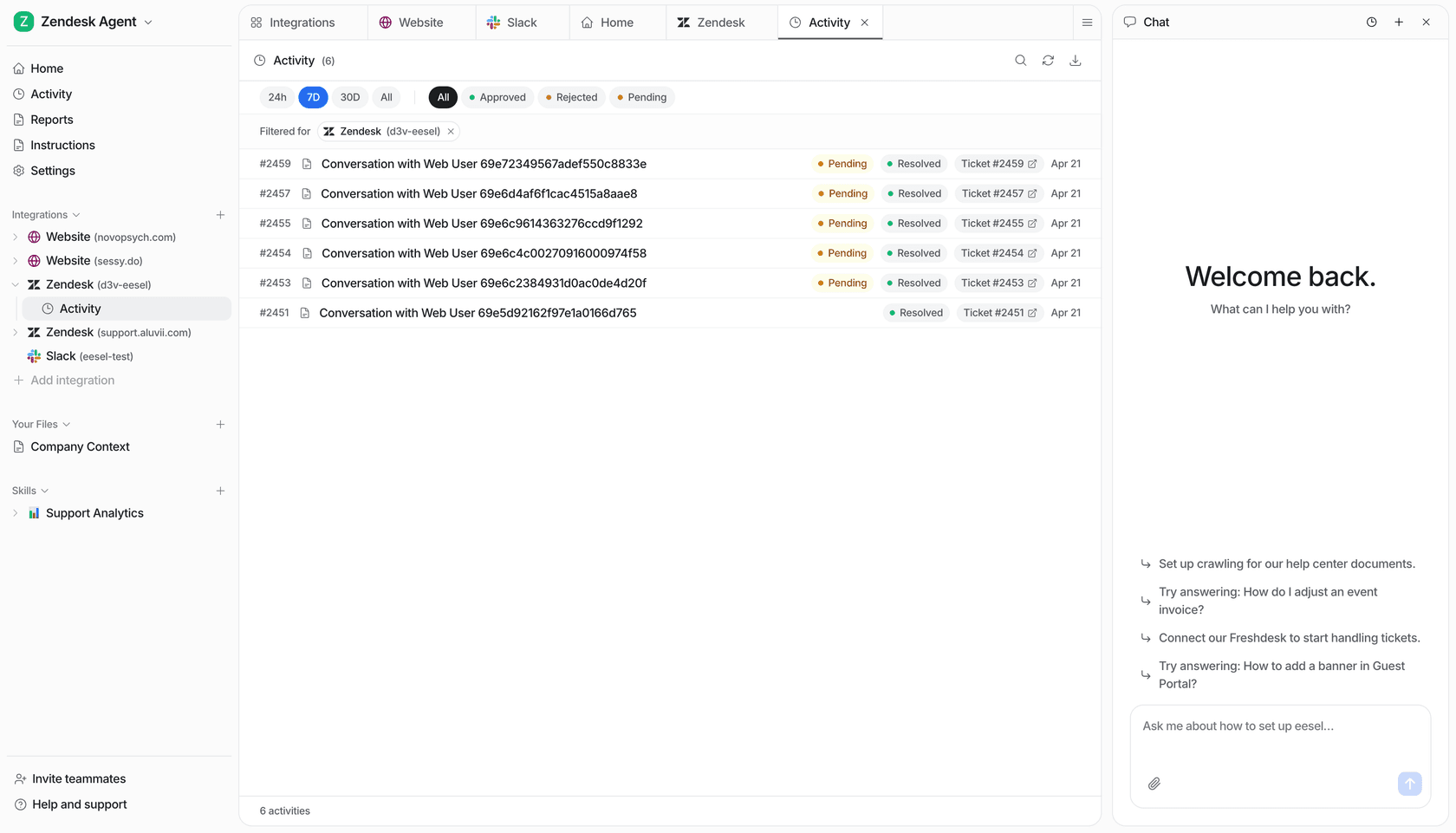
The part that matters for this particular decision is the shape of the bill. No seats and no platform fee on the standard plan, only $0.40 per ticket handled, so the cost moves along with your volume instead of with your headcount plan. You get a weekly ledger too, of exactly what it handled, which is more reporting than most outsourced contracts hand over, and considerably more than what a new hire produces.
"We use it to be the first responder to our Helpdesk tickets in Jira. It essentially acts just like an agent would."
InDebted runs that on an internal Jira Service Management desk which is backed by Confluence and Slack, currently deflecting 15 percent and targeting 55. Over on the customer-facing side, a gig-economy driver-analytics app on Zendesk got to 73 percent of tier-1 requests resolved in its first month, with the results visible inside a seven-day trial. And CartonCloud's service desk lead makes the point which usually gets lost in an outsourcing conversation, that the brand voice survives the automation.
Start with a free trial, point it at your busiest queue, and find out what tier-1 is actually costing you before anybody sends you a proposal.
Frequently Asked Questions
What are help desk services?
How much do outsourced help desk services cost in 2026?
Is it cheaper to outsource the help desk or automate it?
What is a good help desk service for a small team?
What is the difference between a help desk and a service desk?
How do I measure whether a help desk service is actually working?
Can AI help desk services replace tier-1 agents completely?


Article by
Kurnia Kharisma Agung Samiadjie
Kurnia is a software engineer and writer at eesel AI with two years of SEO experience, writing about AI tools, helpdesk software, and customer support. He pairs a developer's understanding of how these products are built with search-driven research into what actually ranks and resonates with the people searching for them.