
What "Meta Muse for Zoho Desk" actually means
Most of my week goes into reading other companies' API docs, and Meta's 2026 product names are the ones that take the most untangling. There is three Meta products in play here, and only one of them is actually talking to your customers:
- Muse, the personal AI agent Meta launched in September for consumer errands. It is not built to answer a business's customers.
- Muse Spark 1.3, the model, sold through the Meta Model API. You can build a Zoho Desk bot on top of it, which is a route I cover further down. The Muse Spark 1.3 overview has the model detail.
- Meta Business Agent, which Meta launched in June as the AI that answers your customers on WhatsApp, Messenger and Instagram. This one is the product a Zoho Desk team is really weighing up.
The three-way breakdown lives in my Meta Muse for customer support guide. This post zooms in on the Zoho Desk side, meaning what happens to your Instant Messaging channel and to Zoho's own bots, and then to your bill too, once Meta's agent joins.
On a different helpdesk? The Meta Muse for Zendesk, Freshdesk and Front posts cover those.
One detail surprised me a bit while I was researching this. Zoho says the generative AI behind Zia runs on open-source models "such as Llama", hosted on Zoho's own servers, per its spring 2025 Zia Q&A. So a lot of Zoho Desk teams have been running a Meta model family for a while without ever signing anything with Meta. The question here isn't Meta's model, it's Meta's agent. My Zia generative AI post covers how that side works.
How WhatsApp works in Zoho Desk today
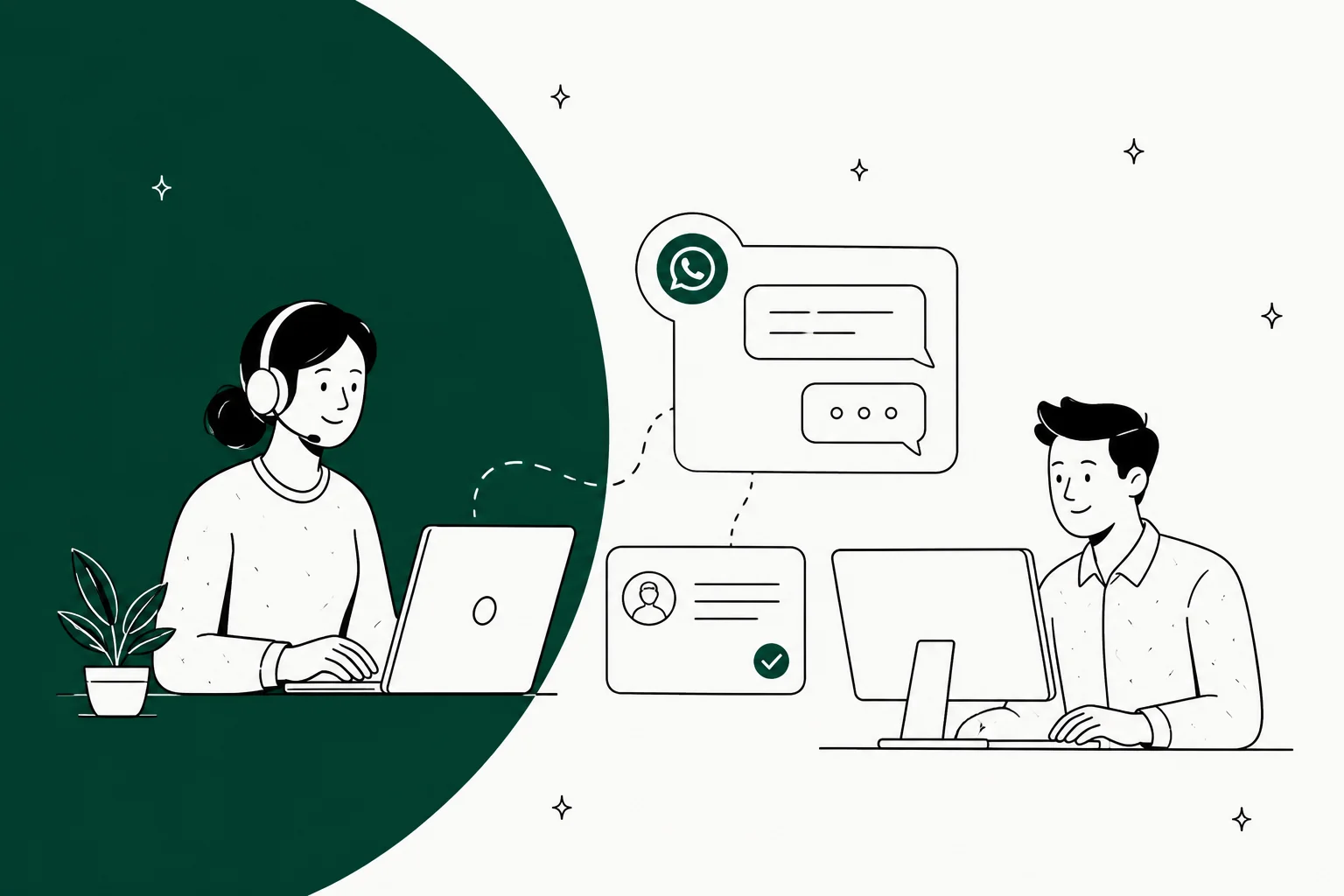
Zoho Desk's WhatsApp setup is different from most helpdesks in one way, and it shapes everything below: Zoho is the BSP. Its help center says Zoho is one of WhatsApp's authorized Business Service Providers, and that "the integration with the IM module is free." There's no Twilio or other third-party provider sitting in the middle, also Zoho keeps your messages on its own servers.
There are a few details in Zoho's own docs which matter for the Meta question:
- WhatsApp starts on Standard. Per the Zoho Desk pricing page, the Instant Messaging module (WhatsApp, Instagram, Messenger, Telegram, WeChat and Line) comes in at Standard, $14 per user per month billed annually. The Express plan at $7 don't include it.
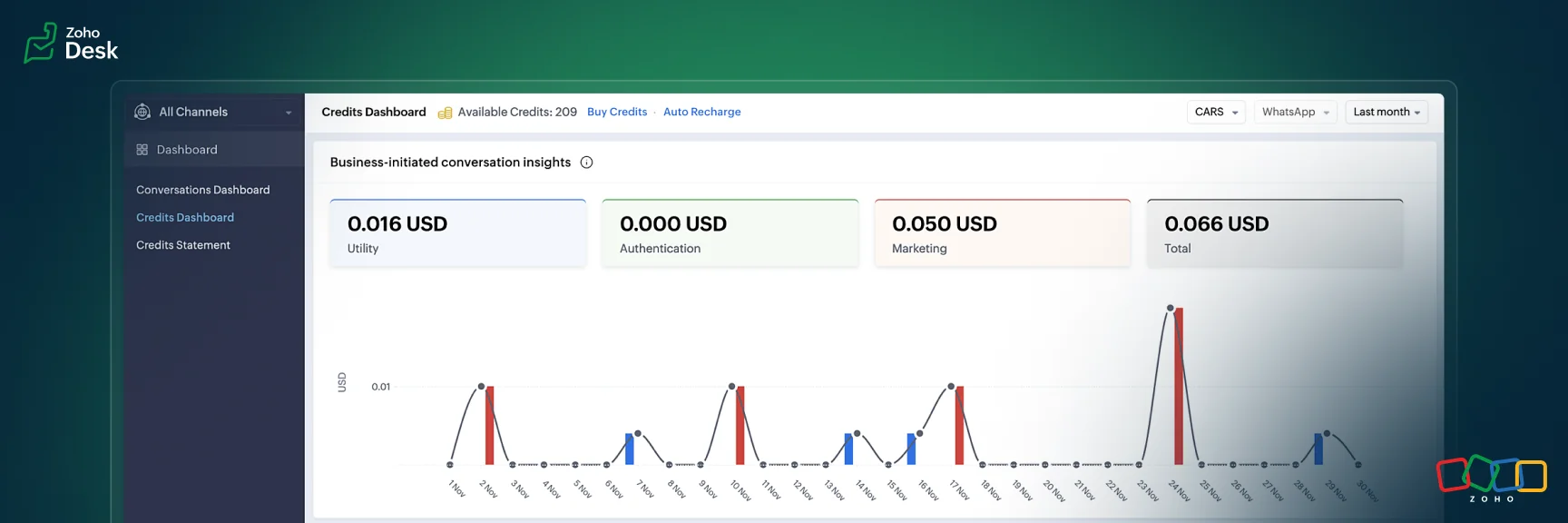
- You pay Meta through IM credits. Each credit is "valued at $2 USD, and a 3% VAT is applied to the total purchase," per Zoho's credits guide. Meta's per-message charges comes out of that balance, and you can set an auto-recharge on it.
- Your phone app can stay. Zoho's Co-Existence option connects a live WhatsApp Business app number and syncs up to six months of history, though "Historical chats do not create tickets" and bot replies don't fire for messages sent from the phone.
- One number, one service. Zoho notes that "Only a single phone number / WABA can be connected to a single service," and sharing one number across Desk, CRM and SalesIQ only works on bundles such as Zoho One or CRM Plus, per its shared number guide.
Zoho customers have been asking for a while how to keep their existing number. Under Zoho's own BSP announcement, one of them put it quite bluntly:
"I've been asking for this for years, last time you had to create a whole new number just for this to work but no one has two WhatsApp Business numbers!"
Co-Existence is Zoho's answer to that. Still, the number is a sticky one: a Zoho Desk agent told another customer that "a WhatsApp Business account can only be associated with a single application and not multiple third-party applications." Meta's new routing rules loosen that (more below), but it tells you how careful you should be in terms of what sits on the number.
For the rest of the product, my Zoho Desk reviews roundup and the Zoho ticketing system guide go deeper, and the Zoho Desk AI review covers Zia as a whole.
Zoho's own AI already answers on WhatsApp
This is the part that most "add Meta's AI" guides skip. Zoho Desk can already put an AI on your WhatsApp number by itself. In the spring 2025 release, Zoho extended Answer Bot "across IM channels such as WhatsApp, Telegram, Line, WeChat, Facebook Messenger," trained on your knowledge base articles. Guided Conversations flows are now directly associated with instant messaging platforms too.
Answer Bot is on the Standard plan and Guided Conversations sits on Enterprise ($40). My Zia Answer Bot and Guided Conversations posts cover each one, and Zia Agents is Zoho's newer build-your-own layer. If one of these already answers your WhatsApp chats, that changes the Meta decision by quite a lot.
If you're still choosing a helpdesk, my Zendesk vs Zoho Desk comparison prices both side by side.
What happens when Meta Business Agent joins your Zoho Desk number
Meta's docs got a lot more detailed in September, and for a team whose WhatsApp channel lives in Zoho Desk the new detail matters, a lot.
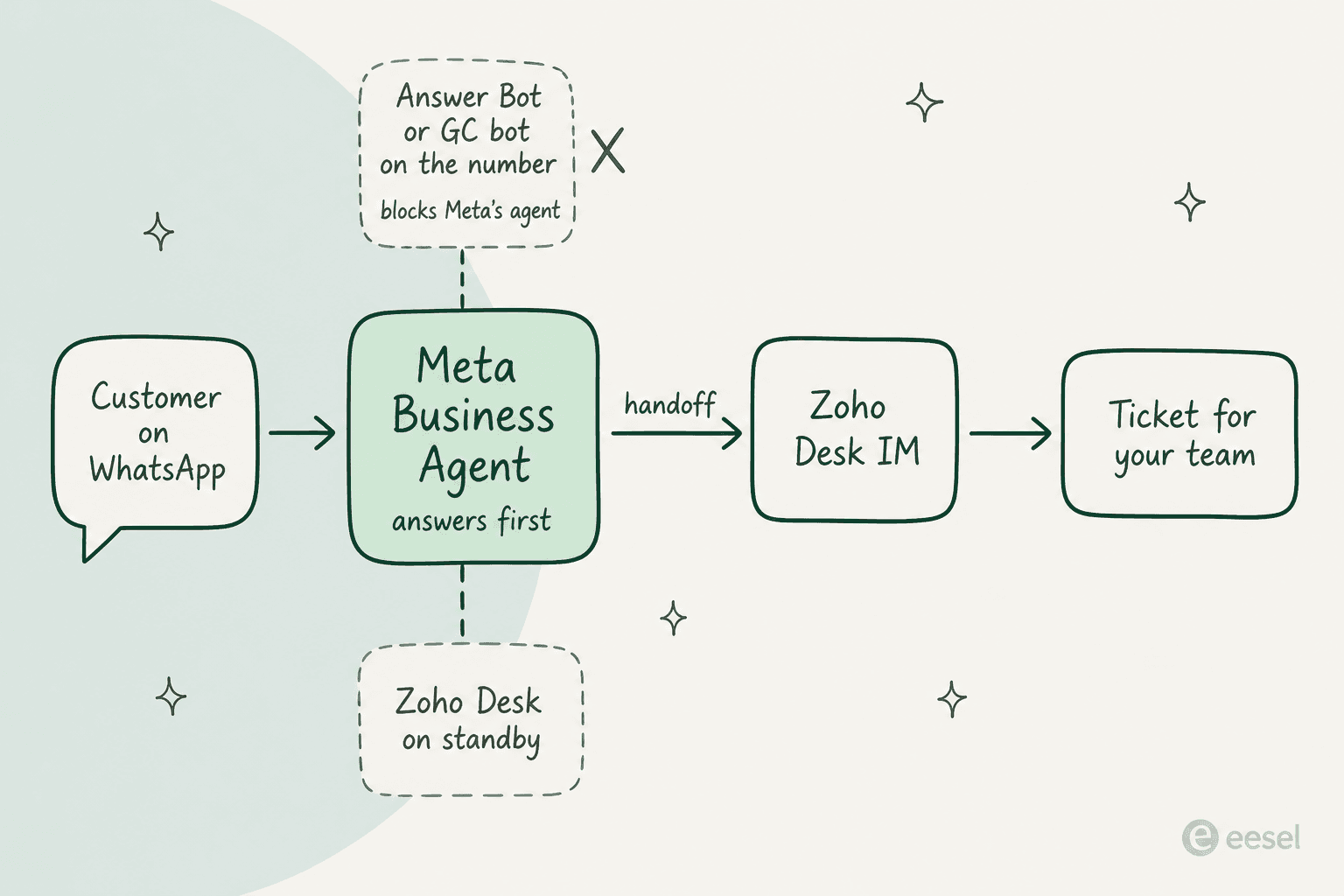
It answers first, and Zoho Desk moves to standby
Meta's Conversation Routing decides which app answers each message when more than one app is connected to a number. Zoho Desk's IM channel is one of those apps. When you switch on Business Agent, "The agent becomes the sole primary for messaging entry points" and "Previous primary destinations move to standby so they retain context," per Meta's routing setup guide.
Put in plain terms, new WhatsApp messages reach Meta's agent first and not your IM inbox. You can split by entry point, for example keeping Zoho Desk as primary for direct messages and putting the AI on click-to-WhatsApp ads. That setup only lives inside Meta Business Suite though, and Meta is quite blunt on it: "There is no public API for configuring Conversation Routing."
One AI per number, so Zoho's bots and Business Agent can't share
Meta's Platform overview sets the eligibility rule: the number must be "Not already running another AI agent on that number," because "an active authorized-agent integration blocks Meta Business Agent."
Meta doesn't define exactly what counts here. The reading which I'd plan around is that Answer Bot or a Guided Conversations bot answering on the number counts. So it's a choice, not a stack. If Zia is handling your WhatsApp chats today, adding Meta's agent means you turn Zoho's bot off on that channel first.
Handoff goes back through the thread, and Zoho isn't a named partner
When Business Agent hands off, the chat don't move to some Meta inbox, it stays in the same WhatsApp thread. What passes to another app on the number is only the ownership. Meta's customer support guide lists "A staffed destination for handed-off conversations" as a prerequisite, and a plain handoff goes to whichever app you set as the "escalation partner", per the thread control docs. The Zendesk version of this flow is in my Zendesk WhatsApp handoff post.
For a Zoho Desk team, that partner would be Zoho's own WhatsApp app, since Zoho is the provider on the number. When Meta introduced Business AI (the earlier name for Business Agent), it named "Salesforce, Microsoft Dynamics 365 Contact Center, ServiceNow, Zendesk, Gorgias and Klaviyo Service." Zoho isn't on that list.
Zoho's side is quiet on this, too. Its October 1 pricing announcement walks through service messages, utility messages and sandbox changes in detail, and it doesn't mention Business Agent even once. I couldn't find any Zoho Desk help article that does. Going by Meta's routing docs, a handoff should land in your IM inbox as a normal conversation, as long as Zoho Desk is the escalation partner. Nobody on either side has documented that flow yet, so I would test it on a spare number first before trusting it with real customers.
A few more handoff details worth knowing:
- Context travels in a 2,000-character note. The handoff event carries a free-text
metadatafield that Meta suggests using "to carry the ticket or order reference." - You don't control the triggers. Handoff fires on low confidence, integrity issues or a customer asking for a person, and "You do not configure the triggers," per Meta's capabilities page. My AI agent handoff guide covers what a good one looks like, and Zia escalation support covers Zoho's own version.
- Meta warns about the 2am handoff. Its guide says: "An agent that hands off at 02:00 into an unstaffed queue produces a worse outcome than one that says when the team is next available and raises a ticket."
A BSP consultant who had an early Platform access flagged the accuracy side of it:
"Consistency is a problem. I saw the same product come back at two different prices in two replies. If you don't ground it properly, it just makes things up. No third-party connectors yet. CRM, order systems, anything to actually complete a sale - not there yet."

Connectors have arrived since that July post, which is bringing me to the part that's specific for Zoho.
Zoho Desk's OAuth vs Meta's connector auth
Business Agent takes actions through connectors, which is to say HTTP APIs or remote MCP servers that you define yourself. Meta's connectors reference says: "Currently, only OAUTH2_CLIENT_CREDENTIALS, API_KEY, and NONE are supported." That's where the Freshdesk and Gorgias versions of this setup broke, because both want Basic auth.
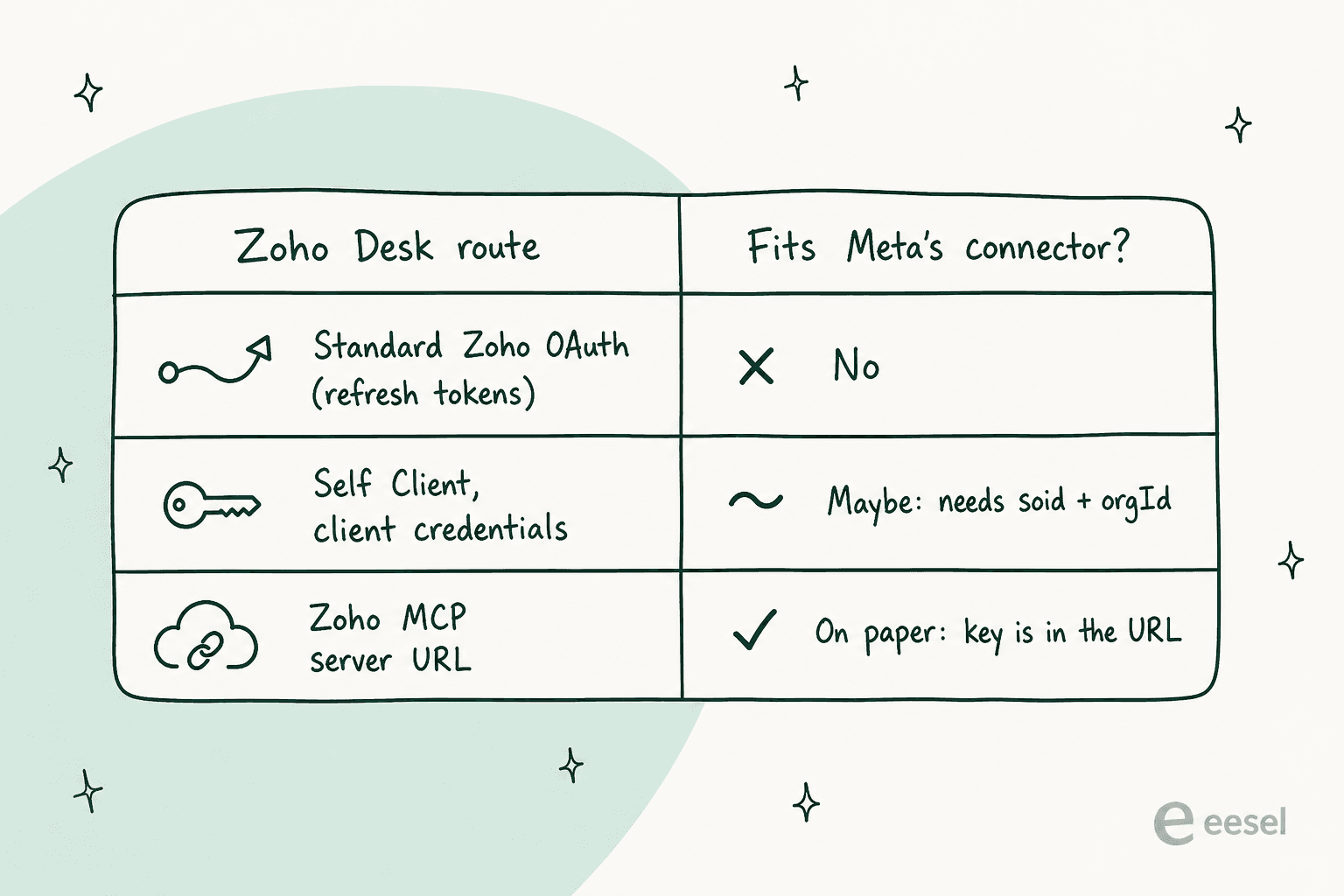
Zoho Desk sits somewhere in between. Its API docs accept either Authorization: Zoho-oauthtoken or Authorization: Bearer, which is friendly. But the tokens comes from Zoho OAuth and they expire after an hour, plus every call also wants an orgId header. That leaves you with three routes:
- Standard Zoho OAuth (server-based or self client with an authorization code). You get a refresh token and swap it for new access tokens. Meta's connector has no refresh-token flow, and a pasted API key would go stale within the hour. This one doesn't fit.
- Self client with client credentials. Zoho's self client docs do offer a client credentials grant, the exact type Meta supports. The catch is that Zoho's token request wants a
soidparameter for multi-portal products, and Meta's OAuth config only takes a token URL, scopes, client ID and secret. Zoho's own Kaizen post also recommends this flow for one-time tasks rather than integrations. Maybe, with testing. - A Zoho MCP server. Zoho MCP builds a server stocked with Zoho Desk tools, and its FAQ says to treat the server URL like a password, with a "Regenerate API Key" button to mint a new one. Because the key lives in the URL, Meta's MCP connector with auth set to
NONEshould be able to reach it, on paper.
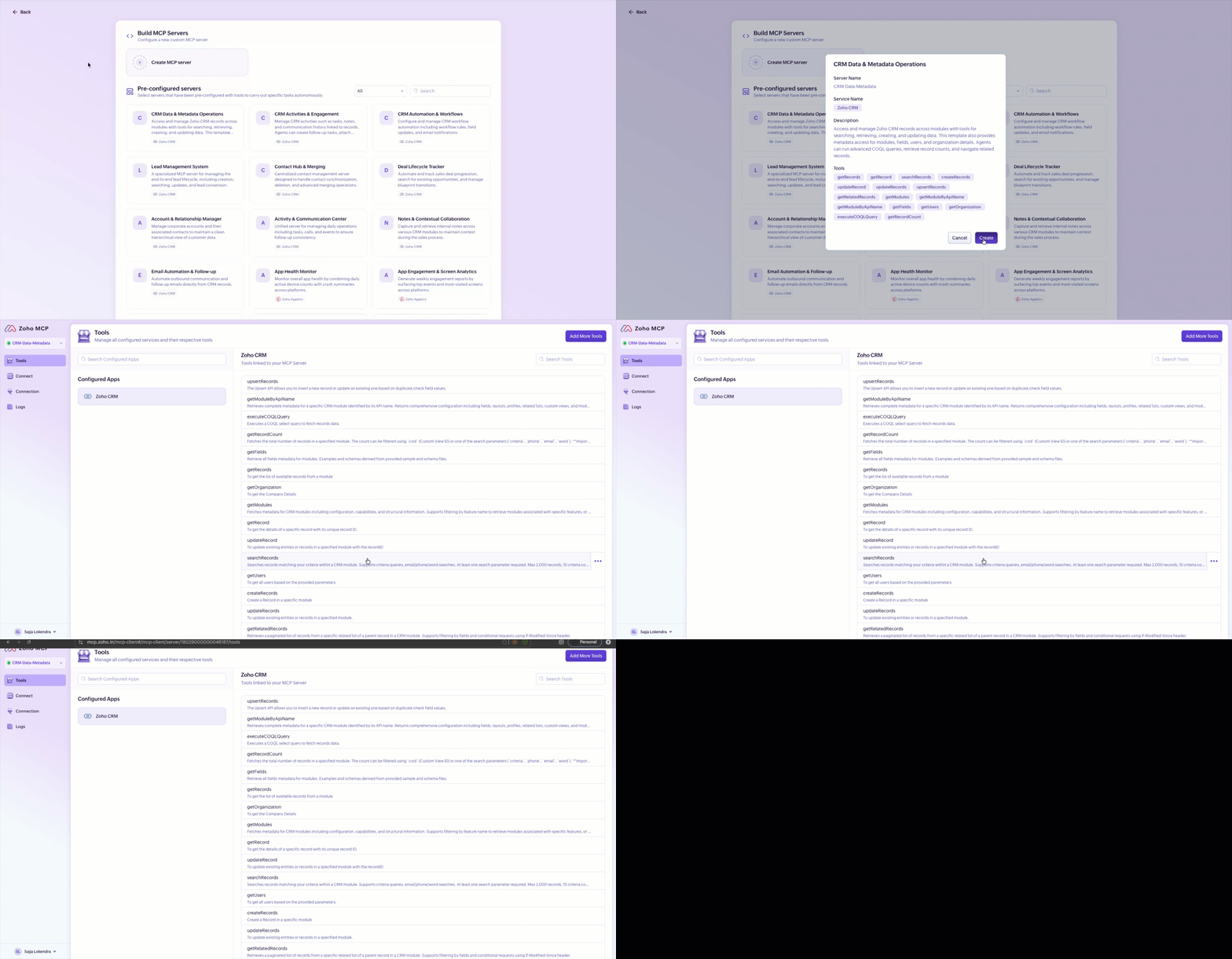
Zoho MCP is free to use for now, and its FAQ promises advance notice if pricing arrives. The same server already works with ChatGPT and Claude, which my ChatGPT for Zoho Desk and Claude for Zoho Desk posts walk through.
There is two things worth to watch if you build it. Zoho Desk meters its API in daily credits: Express gets 25,000 plus 100 per user, Standard 50,000 plus 250, Professional 75,000 plus 500, and Enterprise 100,000 plus 1,000, with concurrency caps of 10 to 25 calls at once. MCP calls draw from that same pool. And Meta itself flags the silent-failure risk: "A failed ticket is invisible: the agent has already said a colleague will be in touch, the shopper waits, and nobody finds out until they message again angrier."
What it costs: Meta Business Agent vs Zoho's own bots on WhatsApp
The two AIs bill in quite different units, and both of them sit on top of the WhatsApp charges you already pay through Zoho's IM credits.
| Cost line | Meta Business Agent | Zoho Answer Bot or Guided Conversations on WhatsApp |
|---|---|---|
| Unit | Tokens, $2.00 per 1M (Meta pricing) | Included in your Zoho Desk plan, no per-reply AI fee |
| Plan needed | WhatsApp Business Platform number | Standard $14 for Answer Bot; Enterprise $40 for Guided Conversations (Zoho pricing) |
| Simple question (Meta's example, 4 messages) | About 16 to 20 cents | Plan cost only, plus the service fee below |
| Complex question (Meta's example, 10 messages) | About 40 to 50 cents | Plan cost only, plus the service fee below |
| WhatsApp fee on AI replies | None extra; each message is billed once | Service message fee from Oct 1, after 1,000 free per number |
| What it learns from | FAQ entries and files you add | Your knowledge base articles |
| Where it answers | WhatsApp, Messenger, Instagram | Zoho Desk IM channels, your website and the ASAP widget |
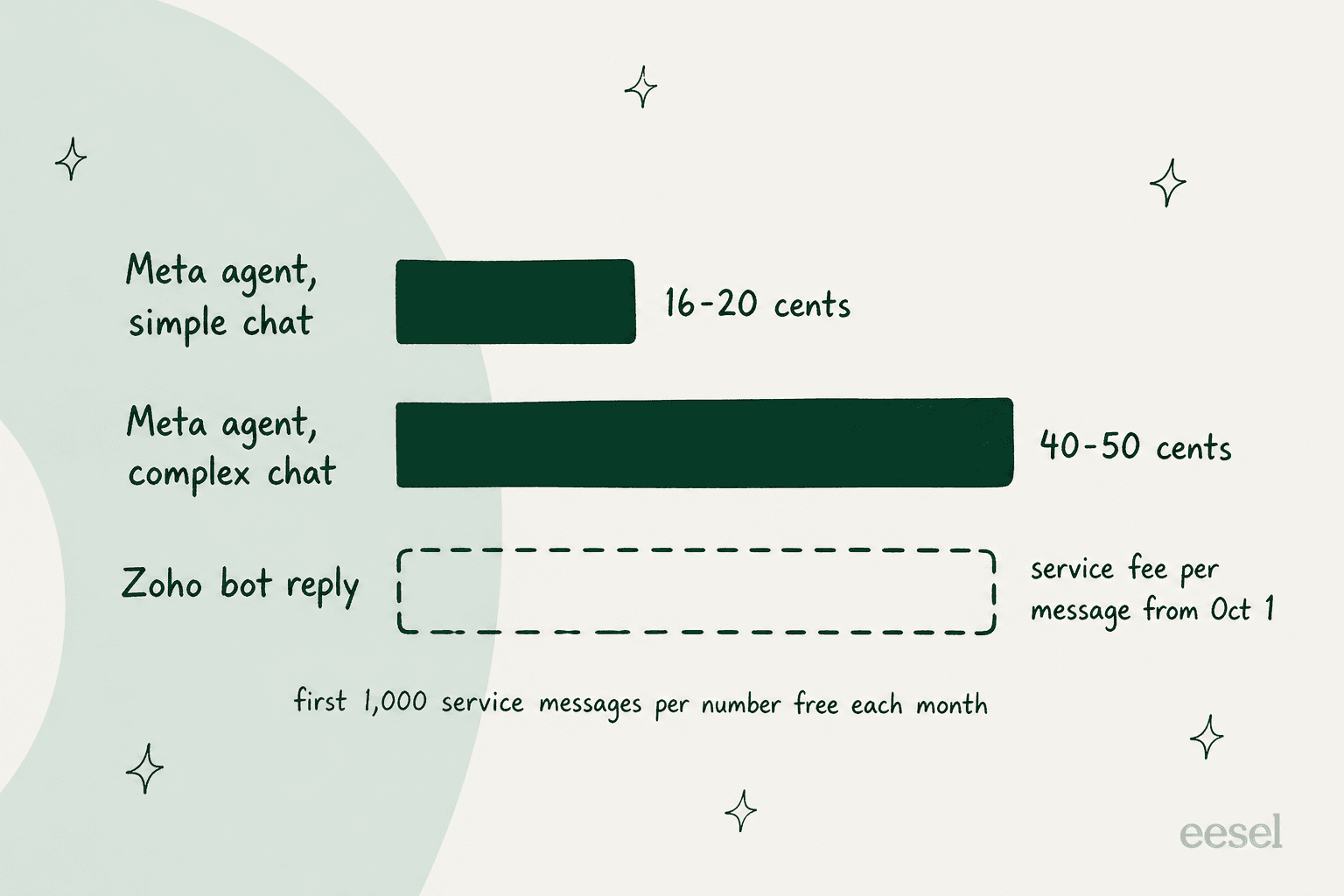
So on paper Zoho's own bot is the cheaper AI, as you already pay for the seat anyway. What Meta's agent buys you is a different skill set: it can answer from your Meta catalog and handle sales questions inside WhatsApp. Early users noticed the per-message part of the math fast:
"My concern is that the per-message cost is insanely high at approximately 5 cents per message."
A cheaper bot is only cheaper if it answers well though. Zoho itself says Zia's answer quality depends on how closely a customer's wording matches your knowledge base articles, and my Zoho Desk AI accuracy post covers where that bites. The Zoho Desk AI pricing explainer breaks down which Zia feature sits on which plan.
October 1 changes the math for Zoho's bots too
The change that most Zoho Desk teams will actually feel is not the AI price. From October 1, 2026, Meta charges service messages per message after 1,000 free per phone number per month. Meta's pricing page says each message is billed "either as a Meta Business Agent message or as a service message, never both."
Zoho spelled out what that means on its side: "messages sent from the Guided Conversations (GC) and Zia bots configured for a WhatsApp channel will also be considered Service messages." Your agents' replies inside the 24-hour window counts too. Two more lines from the same announcement are worth to pin up:
- "If there aren't enough credits available, the message will not be sent." Auto-recharge stops being optional on a busy number.
- "Starting October 1, sandbox channels will support incoming messages only." If you test flows in a WhatsApp sandbox, change that before the 1st.
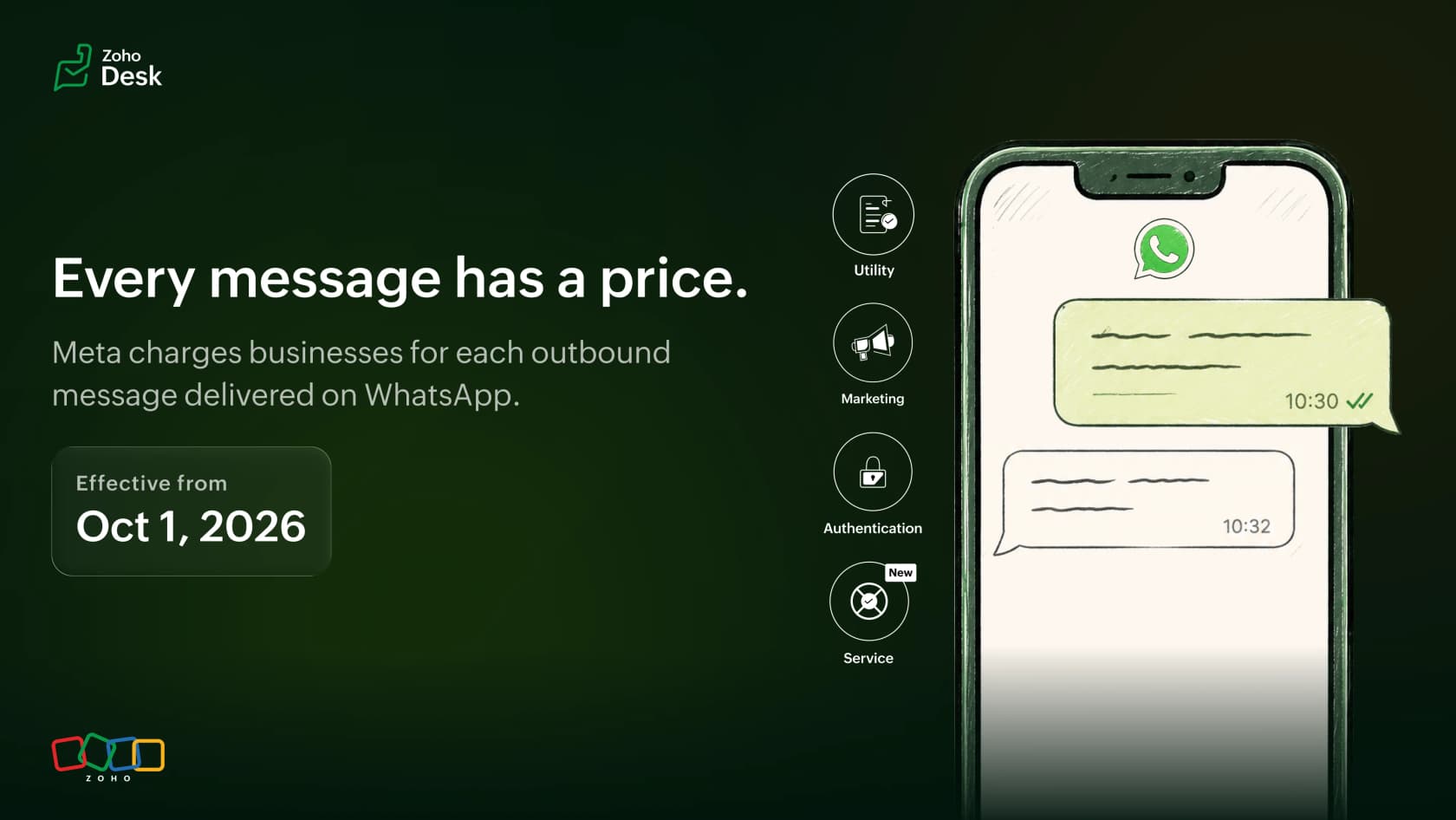
Picking Meta's agent doesn't dodge the service fee, it only changes who is writing the first few replies: Business Agent messages bill as tokens, and everything your team or Zia sends after the handoff bills as service messages. My WhatsApp API pricing explainer has the full rate history, and the earlier Meta policy changes post covers what Meta did to third-party bots.
Building your own Zoho Desk bot on Muse Spark
The third route skips Business Agent entirely and builds straight on the model. It's the closest one to my day job, so here's what it involves in reality.
On the model side, Muse Spark 1.3 costs $1.25 input and $4.25 output per 1M tokens on the standard tier (Meta Model API docs). The cheaper contributor tier is off the table for support, because Meta's terms say "You must not submit sensitive, confidential, or personal information to the Discounted Services." A Zoho Desk ticket is full of names, emails and order numbers. My Muse Spark 1.3 review covers where the model is strong.
On the Zoho Desk side, everything else is yours to own:
- Auth that stays alive. Zoho access tokens last an hour, so your service owns the refresh-token loop, the
orgIdheader and the right regional domain (Zoho runs separate endpoints for the US, EU, India, Australia and more). - Knowledge. Help center articles plus past tickets, kept in sync. Pulling history eats API credits, and search calls cost 3 credits each.
- Event triggers. Webhooks sit on Professional ($23) and above, so a cheap Express seat plus your own code doesn't get you real-time events.
- The conversation loop. Read the ticket, draft a reply or a private comment, set tags and the assignee. For a first version I'd ship it writing private comments only, so nothing reaches a customer without a person.
- Escalation and testing. Your own confidence threshold, plus a replay of real tickets before anything goes live. My build vs buy guide lays out the full list.
I've watched plenty of teams weigh up this path, and my advice every time is to count in the maintenance, not only the build. The same build on other models is covered in Grok for Zoho Desk.
Where Meta's agent stops for a Zoho Desk team
None of this is hidden, it's all in Meta's own docs, but it lands harder when your team is working out of Zoho Desk:
- It only answers in Meta's apps. Zoho Desk carries email, web forms, live chat, phone and Telegram too. Business Agent covers none of them, so you'd run two AIs with two sets of rules. My AI chatbot for Zoho Desk post covers the non-WhatsApp side.
- Your ticket history isn't a knowledge source. Meta's support guide tells you to "export the top drivers from your helpdesk for the last quarter" and write FAQ entries by hand. The best answers in your Zoho Desk archive stay out of reach. Zia has a similar gap, since Answer Bot trains on KB articles, as my Zia knowledge base post explains.
- Regulated industries are excluded. Businesses in finance, health, government, alcohol or gambling can't use the Platform.
- English is strongest. Meta notes English performs best. Zoho's multilingual help center is one of its strengths, and my Zia language support post has the details, so test Meta's agent hard in your other languages.
- Accuracy still needs grounding. Meta's help center warns "Some AI messages may be inaccurate or inappropriate."
That last point is the one I have seen from the inside. A B2B technical support team on a call with eesel described its bot saying "yes, we support your car model" for brands that weren't in its database, because the knowledge base said "we support all models." Their summary of the setup was "trial and error in the beginning." Any AI you put on WhatsApp will do the same thing with a vague source, which is why I test against the real tickets before anything goes live.
One commenter in r/WhatsappBusinessAPI summed up the boundary pretty well:
"If you look at the current AI agent closely, it can only do things inside Meta, but nothing outside it."
Which setup fits your Zoho Desk team
Here's how I'd pick, based on where your customers write in and on how your team works.
| Your situation | Best fit | Why |
|---|---|---|
| Small shop, customers only on WhatsApp, product and catalog questions | Meta Business Agent | Answers from your Meta catalog, lives where customers are |
| Already on Standard, simple FAQ traffic, strong knowledge base | Zia Answer Bot on the IM channel | You already pay for it, one bot across IM channels |
| Zoho Desk team with WhatsApp plus email and chat | An AI that works your Zoho Desk tickets | One set of rules, learns from past tickets, no handoff plumbing |
| Engineering team that wants full control | Muse Spark API plus Zoho Desk API or Zoho MCP | Cheap per token, but you build and maintain the OAuth, sync and testing |
| Finance, health or another regulated vertical | Not Business Agent | Excluded from the Platform |
For most of the Zoho Desk teams I talk to, the third row is the real one here. A customer writes on WhatsApp, follows up by email and later replies to a CSAT survey, and your team needs all of that on one Zoho Desk ticket, not split between Zoho and Meta. That's the reason why the AI choice inside Zoho Desk matters more than the Meta question does.
If you're comparing those, my best AI for Zoho Desk roundup and the 8 best AI integrations list are good next reads.
The Zoho Desk alternatives list helps if you're rethinking the helpdesk itself, and the best AI for WhatsApp support covers WhatsApp across tools. For the deflection side, see AI ticket deflection for WhatsApp.
Try eesel in Zoho Desk
eesel is an AI helpdesk teammate that joins Zoho Desk like a new hire: one Zoho authorization, and it works inside your portal. It learns from your Zoho Desk help center and your past tickets, plus Confluence, Notion or your website if you connect them. Then it drafts replies as private comments, answers the routine tickets itself, and tags and routes the rest, following plain-language instructions about which tickets it may touch. Its triggers fire when a ticket is created, when a customer replies, or when a teammate mentions @eesel in a private comment.
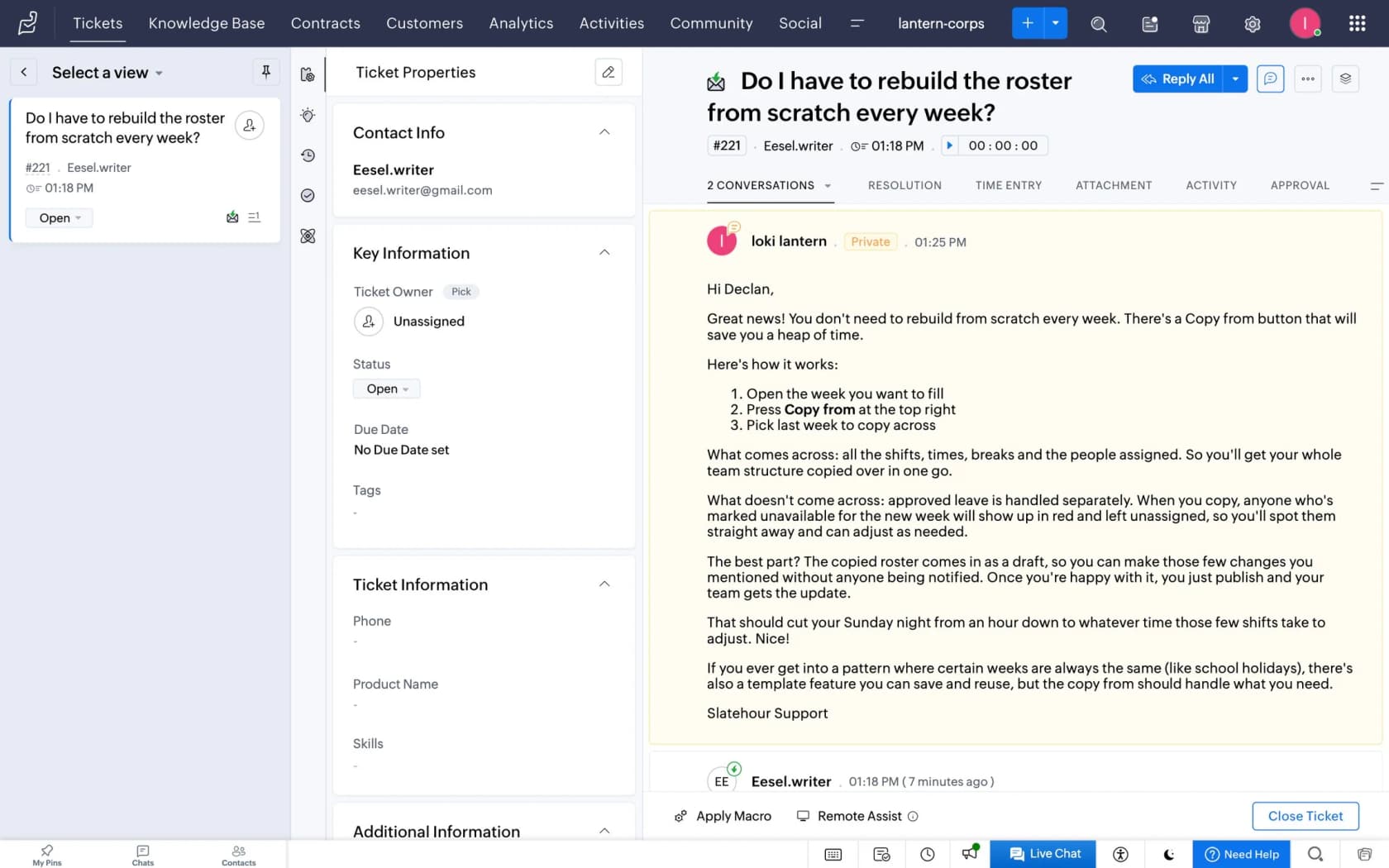
Every draft lists the help center articles behind it, and a correction you give once gets saved into its instructions for next time. Pricing is a fixed monthly credit plan, where a ticket or chat counts as one credit however many replies it takes, so a customer asking five follow-ups doesn't multiply the bill. If you'd rather script it, the eesel CLI lets you, or a coding agent like Claude Code, run eesel integrations connect zoho_desk, sync your sources and switch automations on from a terminal.
Try eesel free with 100 credits and no card, and see how it handles your Zoho Desk tickets before the October 1 pricing change lands.
Frequently Asked Questions
Can I use Meta Muse with Zoho Desk?
Does Meta Business Agent integrate with Zoho Desk?
Can Meta Business Agent and Zia Answer Bot run on the same WhatsApp number?
How much does Meta Business Agent cost compared with Zoho Desk's own bots?
Which Zoho Desk plan do I need for WhatsApp?
What changes for Zoho Desk WhatsApp costs on October 1, 2026?
Can I build a Zoho Desk bot on Muse Spark instead?
What is the best AI for Zoho Desk WhatsApp support?


Article by
Rama Adi
Rama is a software engineer at eesel AI with two years of experience writing about B2B SaaS, AI tools, and customer support technology. Based in Bali, Indonesia, he brings a developer's perspective to product comparisons — cutting through marketing copy to what the integrations and APIs actually do.