7 best Gemini 4 Neon alternatives, ranked by cost per task (2026)

Kira

Katelin Teen
Last edited November 19, 2026

The best Gemini 4 Neon alternative is GPT-6.2 Sol: Artificial Analysis scores it 57.3 for $1.01 a task, against Neon's 59.6 for $3.74. Astra matches Neon's score for $2.07, Opus 5.5 costs $10.04, and Carbon, Kimi K3.1 Pro and DeepSeek win on honesty, open weights or bulk price. Neon's edge is that it guesses wrong on 14% of unanswerable questions, not 55%. For a support bot, an eesel helpdesk teammate makes this choice for you and tests it on your past tickets.
Why are people looking for Gemini 4 Neon alternatives?
Gemini 4 Neon is the middle model of Google's Gemini 4 family, released on 18 November 2026. It costs $3 input and $15 output per million tokens, has a 1,048,576-token context window, and has no free tier. My Neon review found it a strong model: about half of Carbon's cost per task, and unusually willing to say "I don't know".
The reasons to shop around are all about the bill and the stack. Neon writes a lot of tokens, so it costs more per task than OpenAI's models, and a Hacker News reader spotted it on launch day:
"That looks to me like OpenAI equals or beats everything Google offers at half the price."

Others want a vendor that is not Google, open weights they can host, or a model that is faster in a live chat. Those are different jobs, so I sorted the alternatives by job and put one number under all of them: cost per task.
If you want to test any of these on support questions without building a harness, the eesel CLI lets a coding agent upload approved help articles and macros to an eesel helpdesk teammate, then ask test questions and check the answers before anything goes live. Connecting the helpdesk itself still needs an admin to approve it.
How I picked these alternatives
I started from what a buyer sees. I asked ChatGPT, in a fresh chat, which alternatives to compare against Gemini 4 Neon for an app. It named six, in this order: GPT-6.2 Astra, Claude Opus 5.5, GPT-6.2 Sol, Gemini 4 Carbon, Kimi K3, and DeepSeek V4.1 Flash. It also told the asker to compare "cost per successful task", tool calling, JSON validity, latency and retries, not price per million tokens. I followed that framing and added Claude Sonnet 5.5, because it shares Sol's price tag and behaves very differently.
For every model I used three things, all read on 19 November 2026:
- The vendor's own pages: pricing, model page, context window and tool support, linked in each section below. Every price in this post comes from those pages, not from a third party.
- Artificial Analysis: its per-setting results for score, cost per task, minutes per task and hallucination rate. A "task" is one benchmark task from its Intelligence Index, not one of your tickets.
- Hacker News: the launch threads for Neon, Astra and Sol, where developers posted their own costs and timings.
I have not run Neon through my own tests, because I have no Google key for it. I did run a 90-run support test on Astra and Sol last week, and I use those results where they apply. Treat the ranking as a shortlist, then use the testing section to check it on your work.
What does cost per task say about Neon's alternatives?
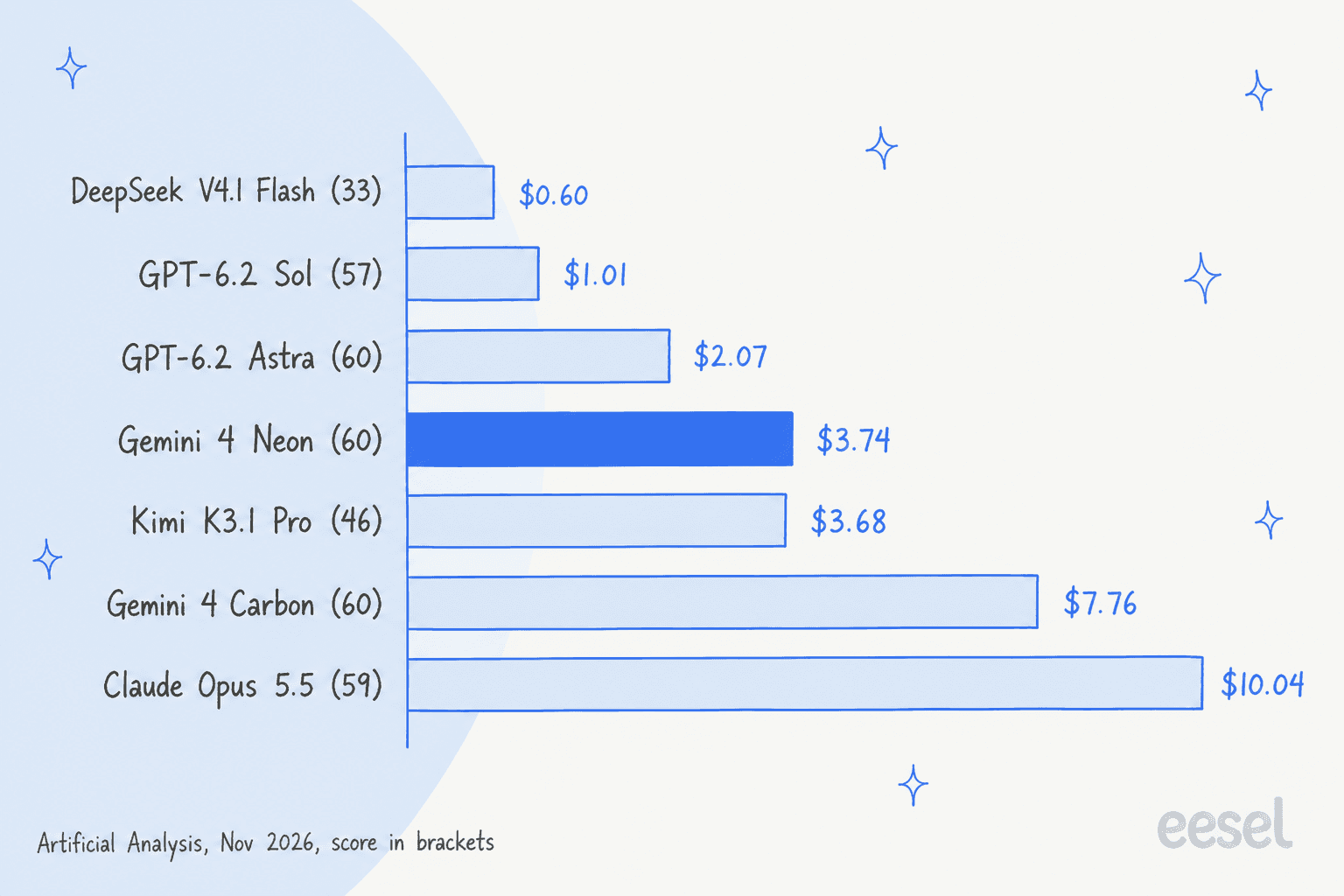
Price per token is half the story. The bill is price multiplied by how many tokens the model writes, and thinking tokens count as output. Artificial Analysis publishes both halves, so this is the table I would start from:
| Model and setting | Index score | Cost per task | Minutes per task | Output tokens per task | Wrong when unsure |
|---|---|---|---|---|---|
| Gemini 4 Neon high (default) | 59.6 | $3.74 | 14.8 | 90,188 | 14% |
| Gemini 4 Neon medium | 54.9 | $1.90 | 8.3 | 50,000 | 16% |
| GPT-6.2 Astra max | 62.1 | $4.00 | 13.7 | 41,029 | 59% |
| GPT-6.2 Astra high | 60.1 | $2.07 | 5.9 | 17,828 | 58% |
| GPT-6.2 Sol max | 57.3 | $1.01 | 8.5 | 40,360 | 55% |
| GPT-6.2 Sol high | 54.9 | $0.56 | 4.6 | 20,160 | 60% |
| Claude Opus 5.5 max | 59.1 | $10.04 | 24.5 | 173,313 | 50% |
| Claude Opus 5.5 medium (API default) | 48.2 | $2.45 | 6.9 | 43,817 | 67% |
| Claude Sonnet 5.5 max | 54.5 | $10.02 | 32.6 | 285,387 | 43% |
| Claude Sonnet 5.5 high (API default) | 41.5 | $1.64 | 7.2 | 58,421 | 64% |
| Gemini 4 Carbon high | 60.0 | $7.76 | 37.2 | 122,768 | 11% |
| Kimi K3.1 Pro | 46.5 | $3.68 | 39.4 | 72,239 | 37% |
| DeepSeek V4.1 Flash 1017 max | 32.6 | $0.60 | 13.7 | 138,962 | 64% |
Everything in the table was read on 19 November 2026 from Artificial Analysis. "Wrong when unsure" is its AA-Omniscience hallucination rate, where lower is better. The model pages:
- Gemini 4 Neon and Gemini 4 Carbon
- GPT-6.2 Astra
- Claude Opus 5.5
- Claude Sonnet 5.5
- Kimi K3.1 Pro
- DeepSeek V4.1 Flash 1017
Four things stand out:
- Same score, different bill. Astra at high scores 60.1 for
$2.07, which is45%less than Neon's$3.74for 59.6. Opus 5.5 at max costs$10.04for 59.1, about 2.7 times Neon. - Sol at high matches Neon at medium. Both score 54.9, but Sol costs
$0.56and Neon$1.90. - DeepSeek is not cheap per task. Its input price is 13 times lower than Sol's, yet a task costs
$0.60against Sol high's$0.56, with a score of 32.6 against 54.9. It writes 138,962 tokens to get there. - Neon is the honest one. At 14%, only Carbon beats it among the models above that score near 60. Sol, Astra and Opus guess wrong on 50% to 59% of unanswerable questions.
The reason is verbosity, and it is the part of the mechanism people skip. Output tokens are the expensive side of every price card, and each model has its own habit of how many it writes before answering:
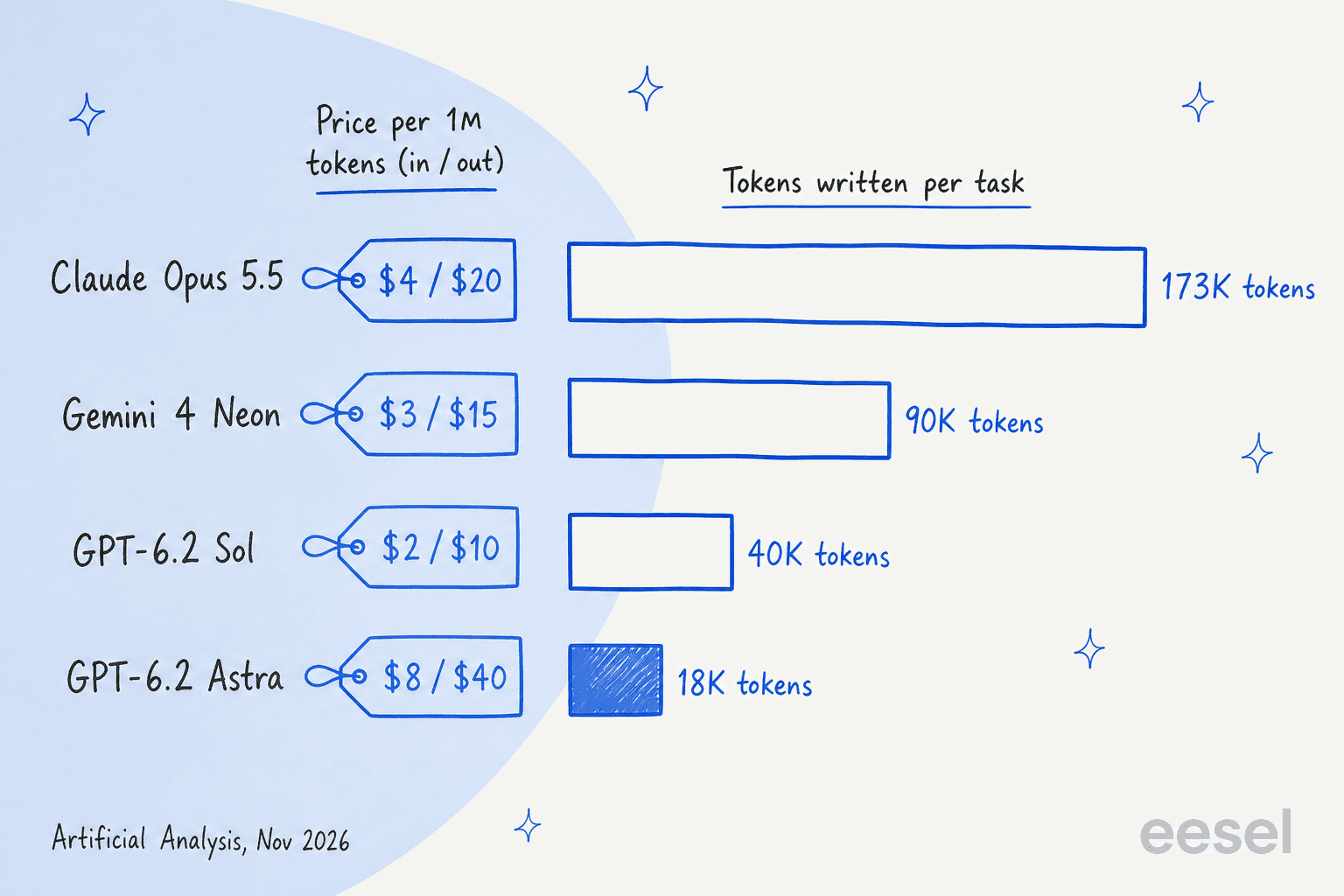
The chart uses each model's top-score setting for Opus and Sol, and the default high for Neon and Astra. Astra has the most expensive sticker of the four and the cheapest habit: it writes about a fifth of what Neon does for the same score. That is why I tell people not to compare rate cards.
Gemini 4 Neon alternatives at a glance
Here is everything else a buyer asks about, from each vendor's own docs:
| Model | Price per 1M (in / out) | Cached input | Context | Best score (setting) | Free API tier | Open weights | Data residency option |
|---|---|---|---|---|---|---|---|
| Gemini 4 Neon (reference) | $3 / $15 | $0.15, implicit only | 1,048,576 | 61.4 (xhigh) | None | No | Region global, us or eu on Google's enterprise platform |
| GPT-6.2 Astra | $8 / $40 | $0.40 | 1,050,000 | 62.1 (max) | None listed | No | Regional endpoints, +10% |
| GPT-6.2 Sol | $2 / $10 | $0.10 | 1,050,000 | 57.3 (max) | None listed | No | Regional endpoints, +10% |
| Claude Opus 5.5 | $4 / $20 | $0.20 | 1M | 59.1 (max) | Free test credits for new users | No | US-only inference, +10% |
| Claude Sonnet 5.5 | $2 / $10 | $0.10 | 1M | 54.5 (max) | Free test credits for new users | No | US-only inference, +10% |
| Gemini 4 Carbon | $2 / $10 to 30 Nov, then $4 / $20 | $0.10, then $0.20, implicit only | 1,048,576 | 60.0 (high) | None | No | Not checked for Carbon (the Neon guide lists global, us, eu) |
| Kimi K3.1 Pro | $2 / $10 | $0.20 | 1,048,576 | 46.5 | None listed | Yes, under Moonshot's own licence | None documented on the pricing page |
| DeepSeek V4.1 Flash | $0.15 / $0.60 off-peak, $0.30 / $1.20 peak | $0.003 off-peak, $0.006 peak | 1M | 32.6 (max) | None listed | Yes, MIT | None documented on the pricing page |
Two notes. "None listed" means the vendor's pricing page does not mention a free API tier, not that I confirmed there is none. And Carbon's price doubles on 1 December, which matters because Artificial Analysis computes its cost per task at the higher December price.
What would each alternative cost per month?
Cost per task is a benchmark number, and your task is smaller. This calculator scales the Artificial Analysis cost per task by how big your task is next to a benchmark task, multiplies by your volume, and keeps only the settings that clear the score you need. It is an estimate, so use it to see the shape of the gap, then measure your own.
At the defaults, 10,000 short ticket replies a month and a score bar of 55, Sol max is about $505 a month and Neon high about $1,870. Drag the score bar to 60 and Sol drops out, which is the honest trade: you pay for the last five points.
1. GPT-6.2 Astra
Best for: teams that want Neon's score and are happy to pay a low bill for it.
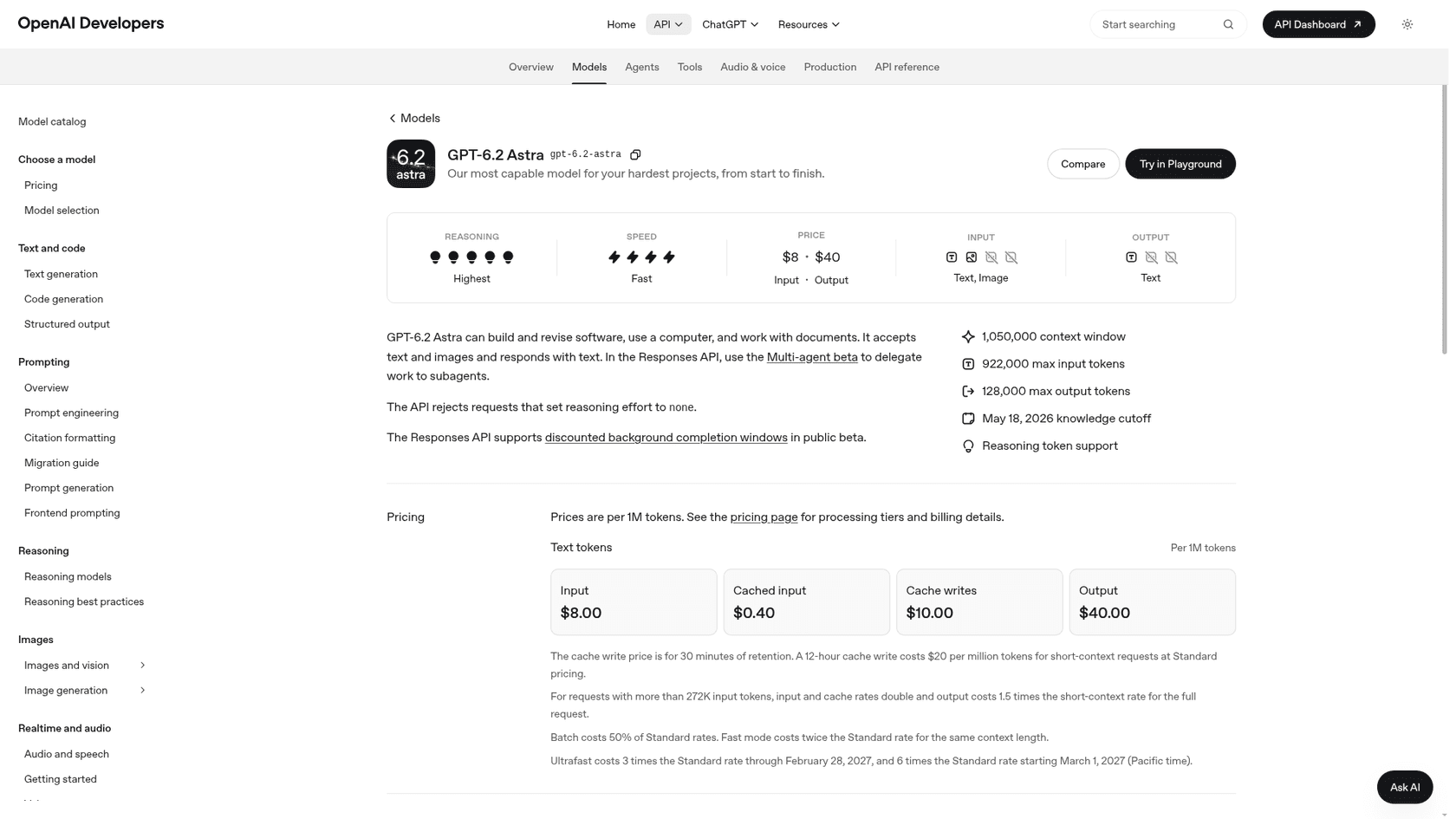
GPT-6.2 Astra is OpenAI's top model, launched on 17 November 2026, a day before Neon. It has a 1,050,000-token context window, 128,000 max output tokens and a May 2026 knowledge cutoff, and the API rejects reasoning effort none. Its price is steep at $8 input and $40 output per million tokens, which is 2.7 times Neon's input rate.
On the bill, though, Astra is the model that beats Neon at its own game. At high effort it scores 60.1 for $2.07 a task and finishes in 5.9 minutes, against Neon's 14.8. It gets there by writing 17,828 tokens where Neon writes 90,188. At max it climbs to 62.1, just above Neon's best 61.4, for $4.00. My own 90-run support test in the Astra alternatives guide found the same habit: effort barely moved the cost on short tickets, from $5.75 to $6.57 per 1,000 tickets across low to high.
One Hacker News reader ran a toy benchmark that shows how this plays out in practice:
"GPT-6.2 Astra scored 92 in 6.6 min for $2.04, vs Kimi K3.1 Pro (93 in 11.5 min for $0.68)"
Pros
- Matches Neon's score for about 45% less per task, and is more than twice as fast
- Same 1,050,000-token window and the Responses API many teams already use
- Cached input at
$0.40, with batch at half the standard rate
Cons
- Guessed wrong on 58% of unanswerable questions in AA-Omniscience, against Neon's 14%, so it needs a handoff rule that does not depend on the model declining
- Requests over 272K input tokens double the input rate and raise output to 1.5 times the standard rate
- The sticker price makes it look pricey in any spreadsheet that skips tokens per task
Pricing: $8 input, $0.40 cached and $40 output per million tokens at Standard, per OpenAI's pricing page. Regional processing adds 10%. See GPT-6.2 Astra pricing for the tiers.
Verdict: the model I would try first if you want Neon-level scores and your bill matters. Skip it if you need the model itself to decline when it is unsure, because that is where Neon is better.
2. GPT-6.2 Sol
Best for: the lowest bill that still scores in the high 50s.
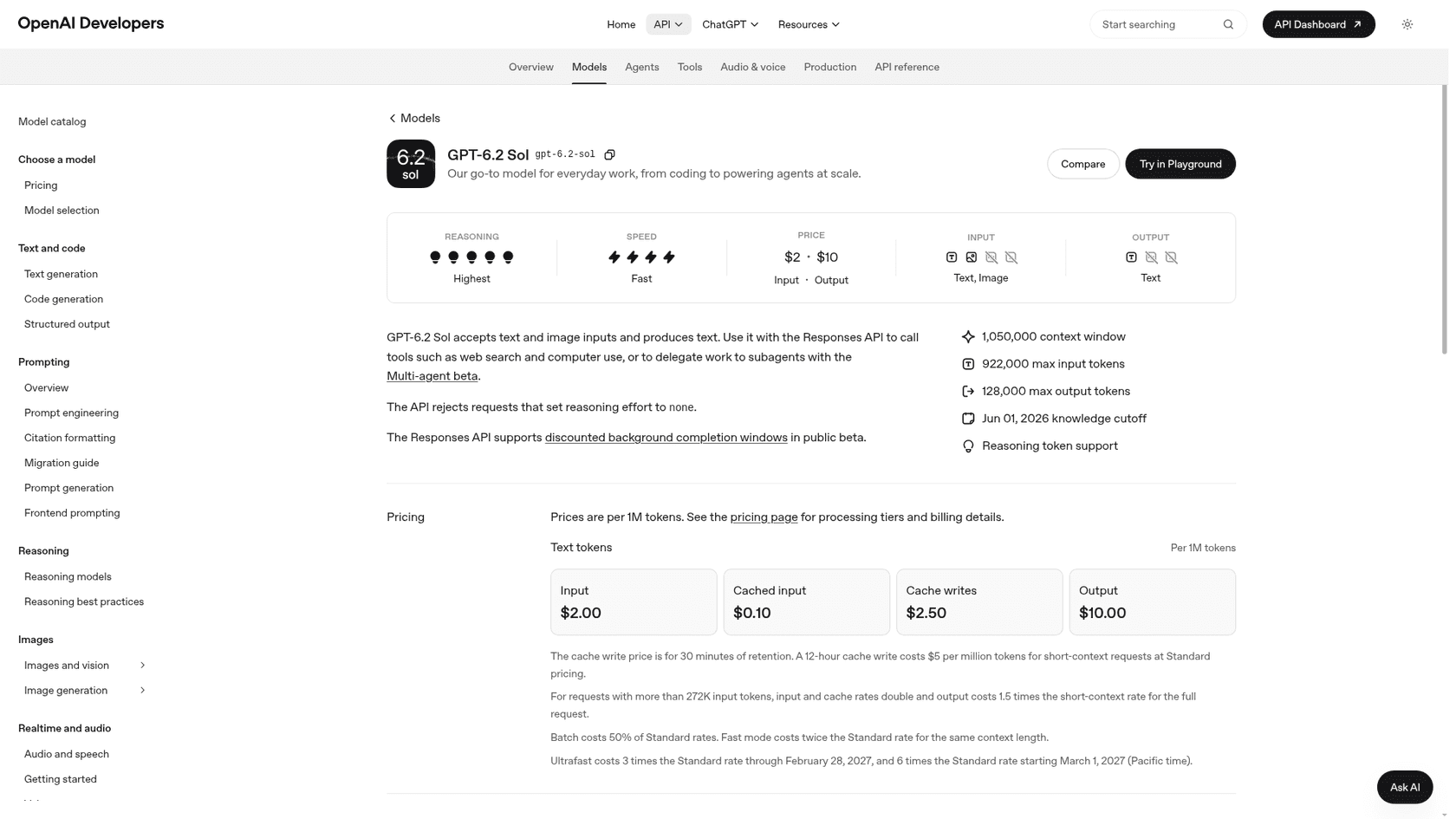
GPT-6.2 Sol is OpenAI's everyday model, with the same 1,050,000-token window as Astra, a June 2026 knowledge cutoff, and $2 input and $10 output per million tokens. Artificial Analysis scores it 57.3 at max effort for $1.01 a task, and 54.9 at high for $0.56. That second number is the one I keep coming back to: the same score as Neon on medium, at under a third of the cost.
In my own support test, Sol answered all 45 runs correctly across low, medium and high effort, including a prorated refund that came out to $990 every time, a prompt injection that got a polite no, and Spanish and German tickets answered in the customer's language. Cost was $1.42, $1.40 and $1.54 per 1,000 tickets, about a quarter of Astra's. Opinion on the ground is split on the harder cases:
"OpenAI's models require constant reprompting for me."
That reader preferred Sonnet 5.5, and it is a fair warning that a cheap model asks more of your prompt.
Pros
$0.56to$1.01a task, the cheapest model here that scores above 54- Fast: 4.6 to 8.5 minutes per task on Artificial Analysis
- Same API surface as Astra, so you can route between them
Cons
- Wrong on 55% to 60% of unanswerable questions, so it will answer when it should hand off
- Cache writes are billed separately at
$2.50per million tokens for a 30-minute hold, so the cached rate is not free money - The API rejects reasoning effort
none
Pricing: $2 input, $0.10 cached and $10 output per million tokens, per OpenAI's pricing page. Batch halves it. The Sol pricing guide has the detail.
Verdict: my default for most workloads. Start here, and move up to Astra or across to Neon only for the tasks it visibly fails.
3. Claude Opus 5.5
Best for: long coding and agent sessions on an Anthropic stack.
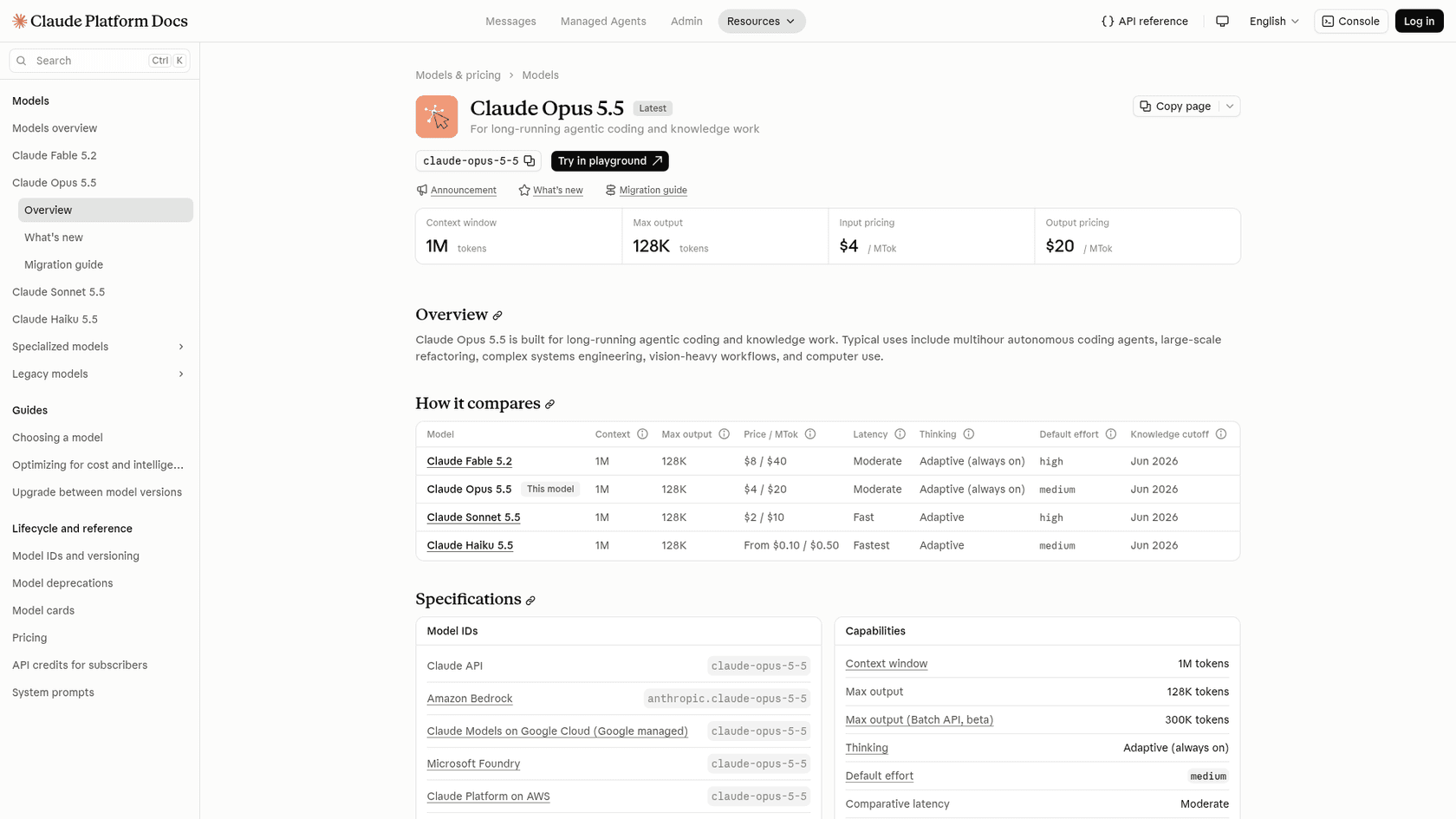
Claude Opus 5.5 came out on 22 September 2026 at $4 input and $20 output per million tokens, with a 1M-token window, 128K max output, always-on adaptive thinking and a default effort of medium. It runs on the Claude API, Amazon Bedrock, Google Cloud and Microsoft Foundry. Google's own comparison table in the Neon model card has Opus slightly ahead of Neon on Terminal-Bench 4.1 and FrontierCode 2.0, so this is the strongest coding rival on the list.
The catch is the habit I described earlier. At max effort Opus writes 173,313 tokens per task, and that turns a half-price sticker into the most expensive row in the table: $10.04 a task for 59.1, against Neon's $3.74 for 59.6. At the API default of medium, it is $2.45 for 48.2, which is a weaker score than Neon medium's 54.9 at a higher cost. A Hacker News reader still put it ahead of the field two months on:
"Every day I'm just more and more amazed at Opus 5.5 and how ahead it was."
Pros
- Cached input at
$0.20, and batch at half price - Anthropic's pricing page lists US-only inference through
inference_geofor a 10% uplift - Strong in long coding sessions, which is where Google's own table gives it the edge
Cons
$10.04a task at max, about 2.7 times Neon for the same score- Anthropic's pricing page lists only
autoandnonetool choice for Opus 5.5, so test any agent that forces a specific tool - Wrong on 50% of unanswerable questions at max, and 67% at medium
Pricing: $4 input, $0.20 cached read and $20 output per million tokens, per Anthropic's pricing page. Fast mode is $8 and $40. See Opus 5.5 pricing.
Verdict: pick it if you are already on Anthropic and your jobs are long code sessions. Skip it if cost per task is your constraint, and read my Opus 5.5 review first.
4. Claude Sonnet 5.5
Best for: Anthropic shops that run short, low-effort tool turns.
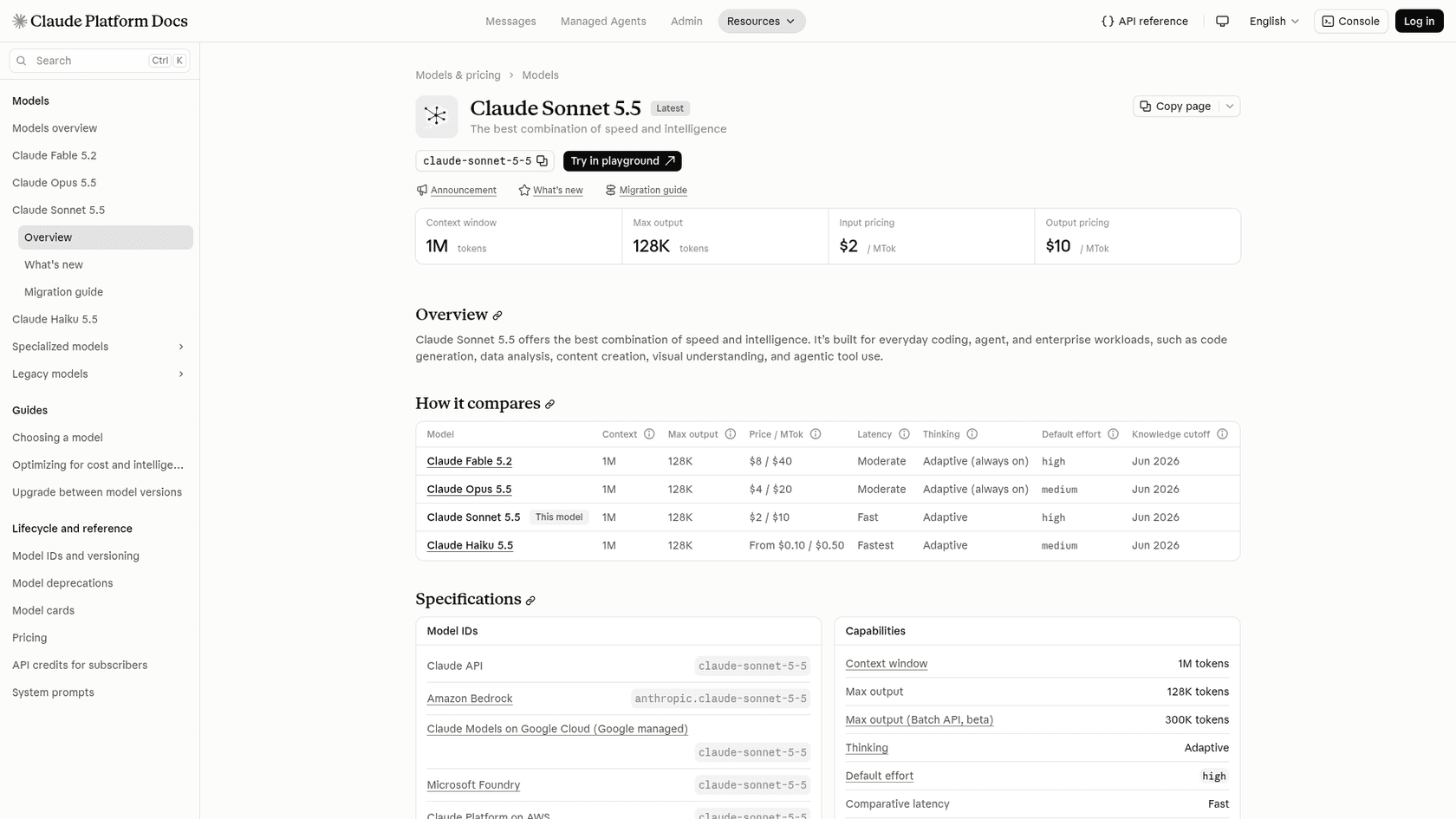
Claude Sonnet 5.5 has the same $2 and $10 sticker as Sol, a 1M-token window, a June 2026 cutoff and a default effort of high on the API. That is the trap. On Artificial Analysis it costs $10.02 a task at max for 54.5, ten times Sol, because it writes 285,387 tokens and takes 32.6 minutes. At the default high it costs $1.64 for 41.5, and Neon low beats that on both counts at $0.75 for 44.1.
There is a bright spot. Sonnet 5.5 guessed wrong on 43% of unanswerable questions at max, which is better than Sol, Astra or Opus, though far behind Neon.
Pros
- Cached input at
$0.10, and a lower hallucination rate than the OpenAI pair - 1M-token context, 128K max output, and the same platforms as Opus
- Fits teams that have already built around Anthropic's tools
Cons
- Score swings from 41.5 at high to 54.5 at max, while cost swings from
$1.64to$10.02 - Same
autoandnonetool choice listing as Opus on Anthropic's pricing page - Slowest of the mainstream models at max, at 32.6 minutes per task
Pricing: $2 input, $0.10 cached read and $10 output per million tokens, per Anthropic's pricing page. Batch is $1 and $5. See Sonnet 5.5 pricing.
Verdict: pick it only if Anthropic is a hard requirement and you will run it at low or medium effort. Otherwise Sol does the same job for less, and my Sonnet 5.5 review explains the effort trap.
5. Gemini 4 Carbon
Best for: teams that want the fewest made-up answers and will pay for it.
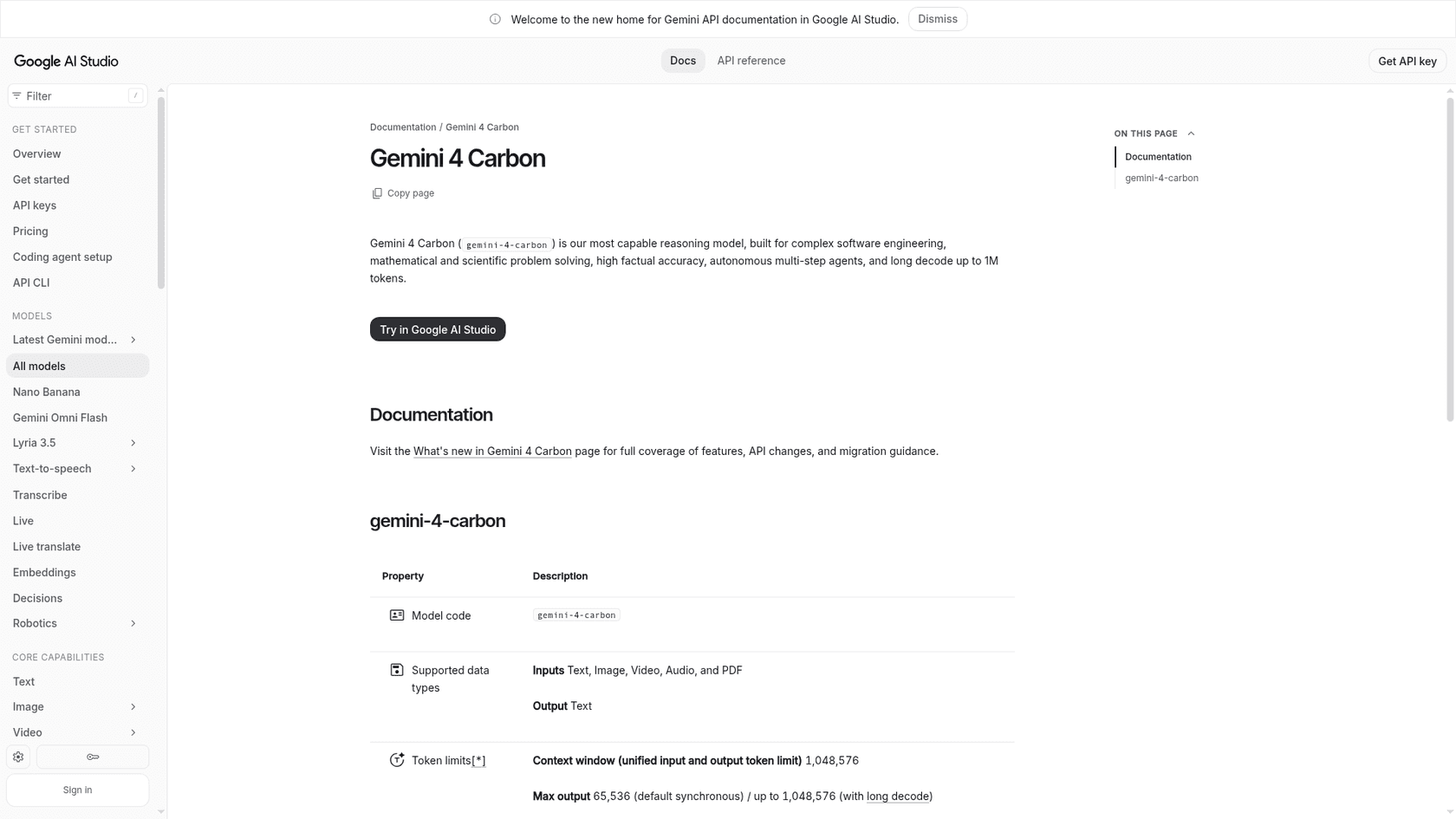
Gemini 4 Carbon is the model Neon was adapted from, and Google describes it as its most capable reasoning model, built for software engineering, science and long multi-step agents. It is now on the Gemini API with paid-only pricing: $2 input and $10 output through 30 November 2026, then $4 and $20 from 1 December, with cached input at $0.10 rising to $0.20.
Carbon's case is honesty. At medium effort it guessed wrong on 4% of unanswerable questions, and at high 11%, against Neon's 14%. Its cost is the problem. At high it scores 60.0 for $7.76 a task, more than twice Neon's $3.74 for the same score, and it takes 37.2 minutes. One Hacker News tester measured the same slowness from a different angle:
"I've tested 75 models so far, and Gemini 4 Carbon is 68th/75 in terms of slowness"
Pros
- The lowest hallucination rate on the list: 4% at medium, 11% at high
- 1,048,576-token window and long decode up to about 1M output tokens
- Same Google stack as Neon, so migration is a model-name change
Cons
$7.76a task at high, twice Neon's for the same score, once the promo ends- Slow: 29.6 to 37.2 minutes per task, with a long tail that the HN tester saw
- No free tier
Pricing: $2 input and $10 output until 30 November, then $4 and $20, per Google's pricing page. Compare it with my Carbon alternatives roundup.
Verdict: pick it if wrong answers cost you more than time, and budget at the December price. Otherwise Neon gives you the same score for half the money.
6. Kimi K3.1 Pro
Best for: teams that want open weights from a non-US vendor.
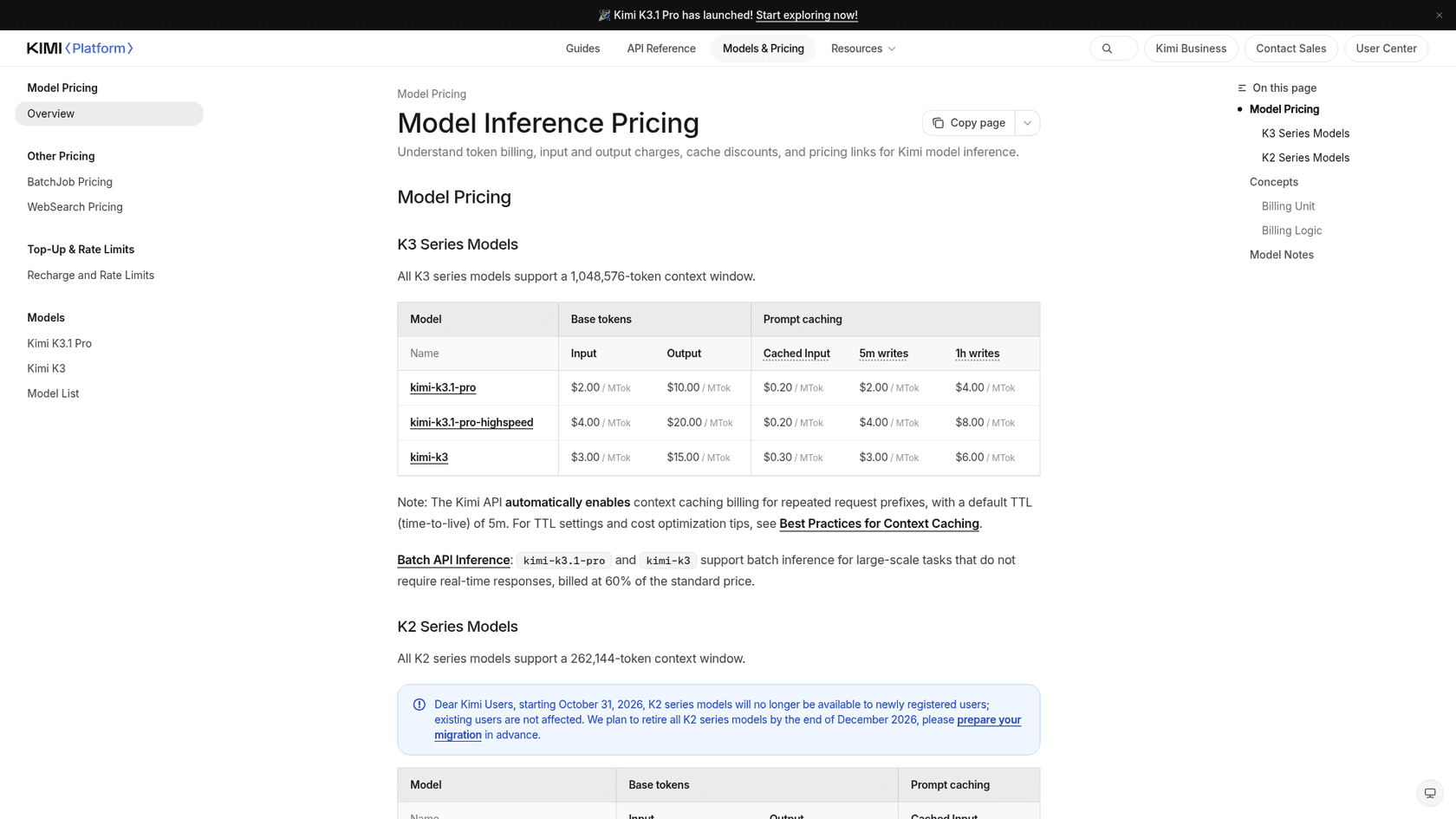
ChatGPT named Kimi K3, but the model I would test today is Kimi K3.1 Pro, which costs less than the older Kimi K3 at $2 input and $10 output per million tokens, with cached input at $0.20. K3 is still $3 and $15. K3.1 Pro has a 1,048,576-token window, and a highspeed version at $4 and $20. Artificial Analysis lists it as open weights with 2.8T parameters and 104B active.
The score is where it trails: 46.5, against Neon medium's 54.9. It also takes 39.4 minutes per task and costs $3.68, so Neon medium beats it on score, cost and speed. The price case rests on a different kind of task. The PacBench result quoted above had Kimi at $0.68 against Astra's $2.04 on one coding toy, so on narrow jobs it can be much cheaper than the leaderboard suggests.
Pros
$2/$10per million tokens and open weights under Moonshot's own licence- Batch inference at 60% of the standard price, per the Kimi pricing page
- Guessed wrong on 37% of unanswerable questions, better than Sol, Astra and Opus
Cons
- 46.5 on the index, far below Neon, Astra and Opus
- 39.4 minutes per task, the slowest model in my table
- No regional endpoint documented on the pricing page
Pricing: $2 input, $0.20 cached and $10 output per million tokens for kimi-k3.1-pro, per Kimi's pricing page. My Kimi K3.1 Pro pricing post covers plans.
Verdict: pick it if open weights or vendor diversity is the point. Skip it for hard reasoning, and read my Kimi K3.1 Pro review first.
7. DeepSeek V4.1 Flash
Best for: bulk classification and routing at the lowest sticker price.
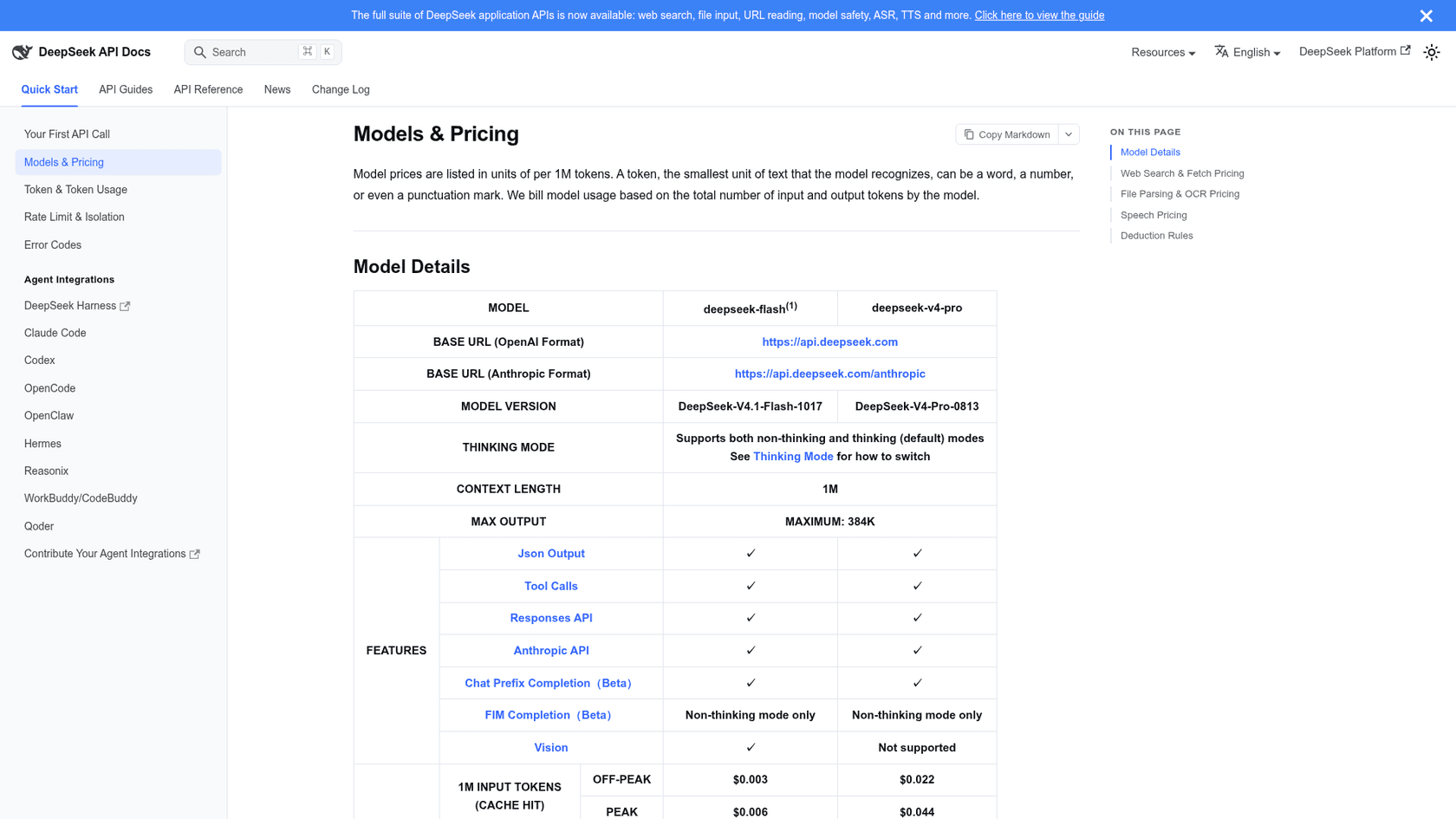
The current model is DeepSeek V4.1 Flash, which DeepSeek's docs list as deepseek-flash running DeepSeek-V4.1-Flash-1017. It costs $0.15 input on a cache miss and $0.60 output per million tokens off-peak, and double that at peak (01:00 to 04:00 and 06:00 to 10:00 UTC on weekdays). Cache hits are $0.003. It has a 1M-token window, 384K max output, JSON output, tool calls, vision and a concurrency limit of 2,500.
Artificial Analysis scores it 33 at max for $0.60 a task, computed at the peak rate, so off-peak is about half by my arithmetic. The surprise is that cheap tokens did not make a cheap task: it writes 138,962 tokens, so Sol high at 54.9 costs about the same. One commenter on the launch thread had a different budget in mind:
"I don't think it beats Deepseek v4.1 Flash 1017 at cost per task."
He is right on token prices and, for light work, on bills. The weights are MIT-licensed, so you can host it yourself.
Pros
$0.15/$0.60off-peak, and$0.003cache hits- MIT open weights, 552B total and 16B active according to Artificial Analysis
- JSON output and tool calls listed on its pricing page
Cons
- Index score 32.6, so it is a triage model, not a reasoning model
- Wrong on 64% of unanswerable questions at max
- No regional endpoint or data-processing terms on the pricing page, so ask before sending customer data
Pricing: $0.15 input (cache miss), $0.003 cache hit and $0.60 output off-peak, per DeepSeek's pricing page. See DeepSeek V4.1 Flash pricing for the peak and off-peak math.
Verdict: pick it for classification and routing, where a 33 is plenty. Skip it for anything customer-facing without a human in the loop.
Which Gemini 4 Neon alternative should you pick?
Here is the decision as I would make it, by job:
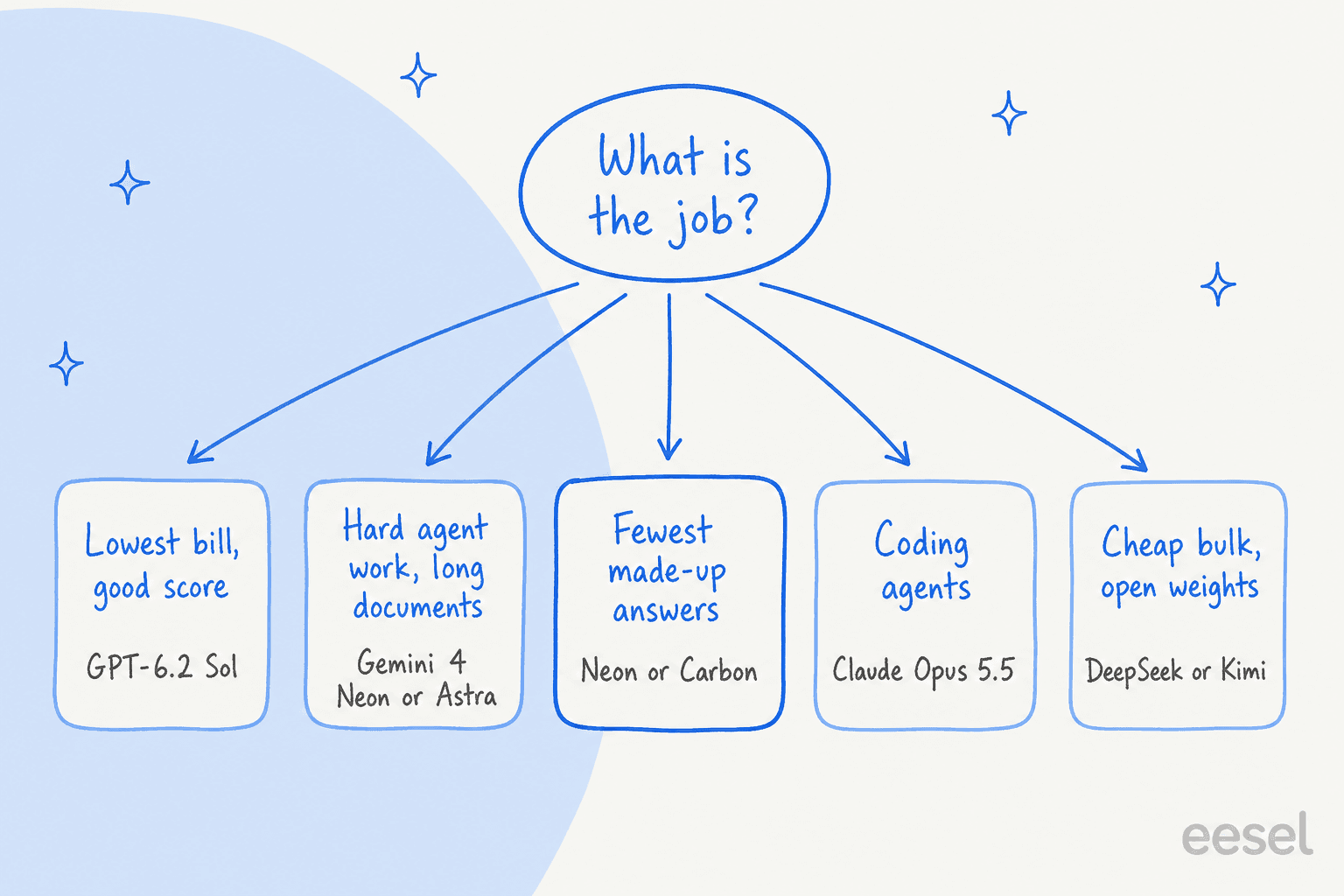
| If your job is... | My pick | Why |
|---|---|---|
| Lowest bill with a high-50s score | GPT-6.2 Sol | $0.56 to $1.01 a task |
| Neon's score at a lower cost | GPT-6.2 Astra high | 60.1 for $2.07 |
| Hard agents and very long documents | Neon on high, or Astra | Neon's long-context rows lead in Google's own table |
| A model that declines when unsure | Neon or Carbon | 14% and 4% to 11% wrong when unsure |
| Long coding sessions on Anthropic | Claude Opus 5.5 | Strong coding, but $10.04 a task at max |
| Open weights or a non-US vendor | Kimi K3.1 Pro | $2/$10, 46.5 score |
| Triage and routing at volume | DeepSeek V4.1 Flash | $0.60 a task, MIT weights |
| Live chat | Neon medium or Hydrogen | 8.3 minutes, not 14.8 |
My overall view: route, do not switch. Send most tasks to Sol, send the ones that need a stronger model to Astra or Neon, and keep a lower tier for triage. If you are still weighing families, my ChatGPT versus Gemini comparison goes wider. The Gemini alternatives roundup covers the rest of Google's line, and the OpenAI versus Gemini API guide covers the platforms.
How do you test alternatives on your own workload?
A leaderboard task is not your task. These are the five checks I would run before I moved any real traffic, in the order I would run them:
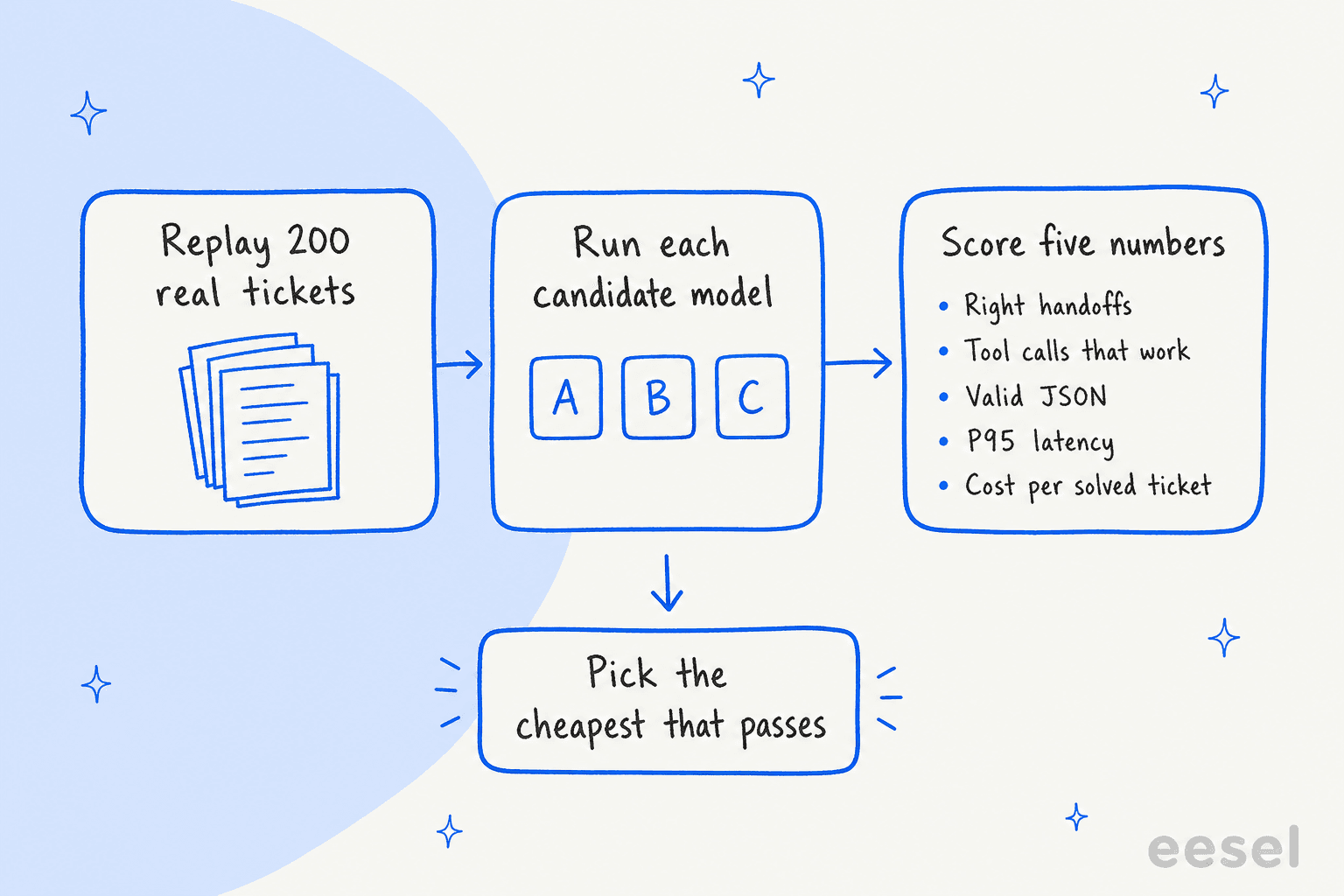
- Tool calling. Replay tasks with your real tool definitions, and count three things: the right tool chosen, arguments that validate, and no call when none is needed. If your agent forces a particular tool, test that mode first. Anthropic's pricing page lists only
autoandnonetool choice for Opus 5.5 and Sonnet 5.5, so a design that relies on forcing a tool needs a check before a migration. My guide to OpenAI function calling covers the OpenAI side. - Structured output. Measure the share of responses that parse against your schema without a repair step. DeepSeek's pricing page lists JSON output as supported, and OpenAI's JSON mode has its own rules, so run the same schema through every candidate. One invalid response in fifty becomes a retry and a cost.
- Latency, at the tail. Record median and P95 time to first token and time to finish. The HN tester above measured Carbon at 5 seconds median to start, with one call at 50 seconds and one timeout. Medians hide that, and customers feel the tail. Artificial Analysis also measured 56.5 seconds to first answer token for Neon at xhigh, so measure each effort level you plan to use.
- Retries. Count timeouts, rate-limit errors and malformed outputs per 100 calls, then use
cost per attempt x (1 + retry rate)as your real cost. This is the number that ties a cheap model back to an expensive one. - Wrong answers versus handoffs. Seed about 20 tickets whose answer is not in your docs, and count how often each model answers anyway. This is the same behaviour the AA-Omniscience numbers hint at, measured on your content.
Then put it all on one line: cost per solved ticket = total spend / tickets resolved correctly with no human edit. That is the number to rank by, and it is the model-level version of cost per ticket. Run each candidate on the same 200 tickets, at two effort levels, twice. My 90-run test on Astra and Sol showed that effort barely moved the cost on short tickets, which changed which effort level I would ship.
What does this mean for a support agent?
If your goal is a support bot, these seven models are the engine, not the agent. What the agent knows, when it must hand off and whether someone tested it before launch decide how it behaves, and a confident wrong answer to a refund question costs more than a handoff. eesel has spent years putting AI agents on live support queues, and the lesson that stuck is to simulate every rollout against historical tickets before the agent replies to a customer.
That is how smava, a German loan comparison company, runs eesel in one Zendesk. Between 8 August and 8 September 2026, three agents handled about 27,000 tickets: one categorised about 14,600, one drafted about 15,300 replies from 820 macros and help articles, and per-brand agents prepared customer-ready answers. Each agent has one job and a list of things it must never do, and a person approves the draft before anything is sent. SamCart splits work by channel: one agent for Freshdesk tickets and another for website chat, each answering from the same 280 help center articles.
Neither story is about picking the best model. They show the model is a setting inside a design, and the design includes knowledge, handoff rules and testing. If you want to compare models on your own queue, simulate the agent on past tickets, and watch the handoff rate more closely than accuracy. My AI support agent benchmarking guide lists the numbers I track, and AI customer service cost shows what a queue costs in total.
Try eesel
If you are choosing a model because you want better answers in your queue, the eesel AI helpdesk teammate is the employee that sits on top of whichever model you pick. It learns from your past tickets and help center, hands off to a person when your docs have no answer, and can be tested on your real ticket history before it replies to anyone. It works inside Zendesk and Freshdesk, and it is where I would start if the real question is "which model" for a support rollout.
Pricing is a fixed monthly credit plan, with a free plan of 100 credits and no card, so a model's price change does not move your bill. Try eesel on a slice of your queue.