


Gemini 4 Neon is the Google model I would use for hard agent and long-document work, run on high: Artificial Analysis scores it 59.6 at $3.74 a task, about half of Carbon's $7.76 for the same score. It is not the cheapest route to that score. OpenAI's Astra hits 60.1 for $2.07, and Neon writes five to six times more tokens per task. Its real edge is honesty: it guessed wrong on 14% of questions it could not answer, against 54% to 61% for Sol and Astra.
The eesel CLI lets a coding agent upload approved help articles to an eesel helpdesk teammate and test its answers on your own tickets, which is how I would check any model before it replies to a customer.
How I reviewed Gemini 4 Neon
I have not run Neon through my own test suite yet, so every number below comes from three places I could check on launch day, 19 November 2026:
- Google's own pages: the launch post, the model card, and the pricing page.
- Artificial Analysis: I read the per-setting results for Neon, Carbon, Hydrogen, Sol, Astra, and Opus 5.5 from its model pages. Its index is a suite of 9 evaluations, so a "task" below means one benchmark task, not one of your tickets.
- The Hacker News launch thread, which passed 460 points the day it opened.
I tried Reddit and X for user voice and could not get either to load, so the community quotes are all from Hacker News. If your own workload looks different from a benchmark, treat my verdict as a shortlist, not a result. The Neon explainer covers model ID, access, and migration, so I keep that short here.
What is Gemini 4 Neon, in one paragraph?
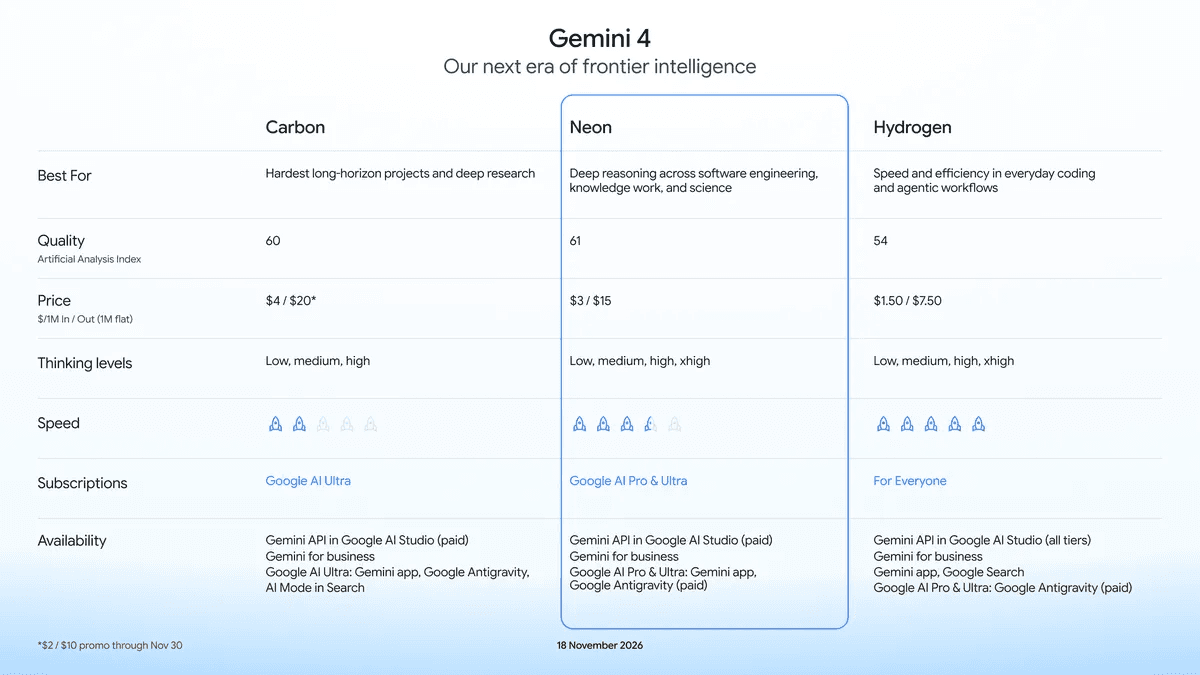
Neon is the middle model of Google's Gemini 4 family, released on 18 November 2026 as gemini-4-neon. Google says it is adapted from Carbon, shares its 1,048,576-token window, and has four thinking levels: low, medium, high (the default), and xhigh. It costs $3 per million input tokens and $15 per million output tokens, with no free tier. Google calls it the balance of "depth and efficiency", and its own chart places it between Hydrogen and Carbon:
Is Gemini 4 Neon good at the hard stuff?
Yes, and the evidence is stronger than for most launch-day claims because the leaderboard and Google's own table agree. Artificial Analysis puts Neon at 61.4 on xhigh and 59.6 on high, ahead of Opus 5.5 at 59.1 and Sol at 57.3 (their best settings). Google's vendor-reported table shows where the lead comes from:
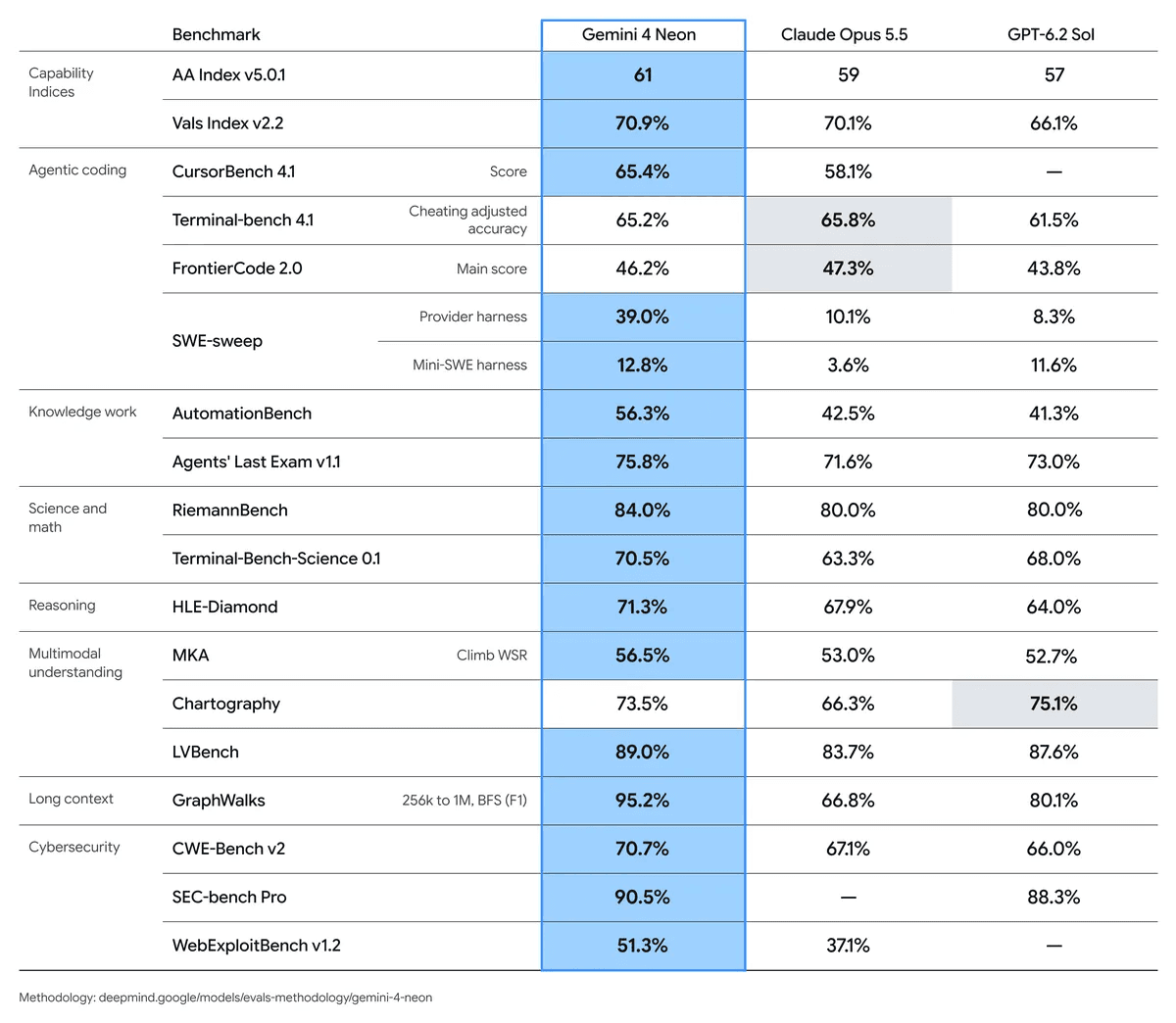
Reading the columns instead of the bold cells:
- Knowledge-work agents: AutomationBench
56.3%against42.5%for Opus 5.5 and41.3%for Sol. - Long context: GraphWalks from 256k to 1M tokens,
95.2%against66.8%and80.1%. If your job is "read a very long document and answer precisely", this is the row that matters. - Coding, mixed: Opus 5.5 is slightly ahead on Terminal-Bench 4.1 (
65.8%against65.2%) and FrontierCode 2.0 (47.3%against46.2%). Neon's SWE-sweep lead of39.0%uses Antigravity's own harness, so I would not lean on it.
These are Google's numbers, picked by Google. The independent ones are the Artificial Analysis rows below, and they tell a more interesting story than the headline score.
How much does Neon cost per task at each setting?
Per-token price hides most of the bill, because thinking tokens bill as output. Here is Artificial Analysis's per-setting data for Neon next to its siblings, as I read it on 19 November:
| Setting | Index score | Cost per task | Minutes per task | Output tokens per task |
|---|---|---|---|---|
| Neon low | 44.1 | $0.75 | 3.7 | 21,726 |
| Neon medium | 54.9 | $1.90 | 8.3 | 50,000 |
| Neon high (default) | 59.6 | $3.74 | 14.8 | 90,188 |
| Neon xhigh | 61.4 | $6.44 | 21.5 | 141,631 |
| Carbon high | 60.0 | $7.76 | 37.2 | 122,768 |
| Hydrogen xhigh | 53.9 | $3.16 | 15.2 | 154,406 |
| Opus 5.5 max | 59.1 | $10.04 | 24.5 | 173,313 |
| Astra high | 60.1 | $2.07 | 5.9 | 17,828 |
| Sol max | 57.3 | $1.01 | 8.5 | 40,360 |
Three things stand out:
- Neon beats Carbon on its own turf. At high it matches Carbon's score within half a point for
52%less cost and60%less time. Google claims 32% lower cost per task than Carbon, so on this data the real gap is wider than the pitch. - High is the sweet spot. Going from medium to high buys 4.7 index points for $1.84 more. Going from high to xhigh buys 1.8 points for $2.70 more and 6.7 extra minutes.
- Astra is the problem. At the same score, Astra costs $2.07 a task and finishes in 5.9 minutes. Astra's price per token is higher ($8 in, $40 out), yet it is about
45%cheaper per task because it writes 17,828 tokens where Neon writes 90,188.
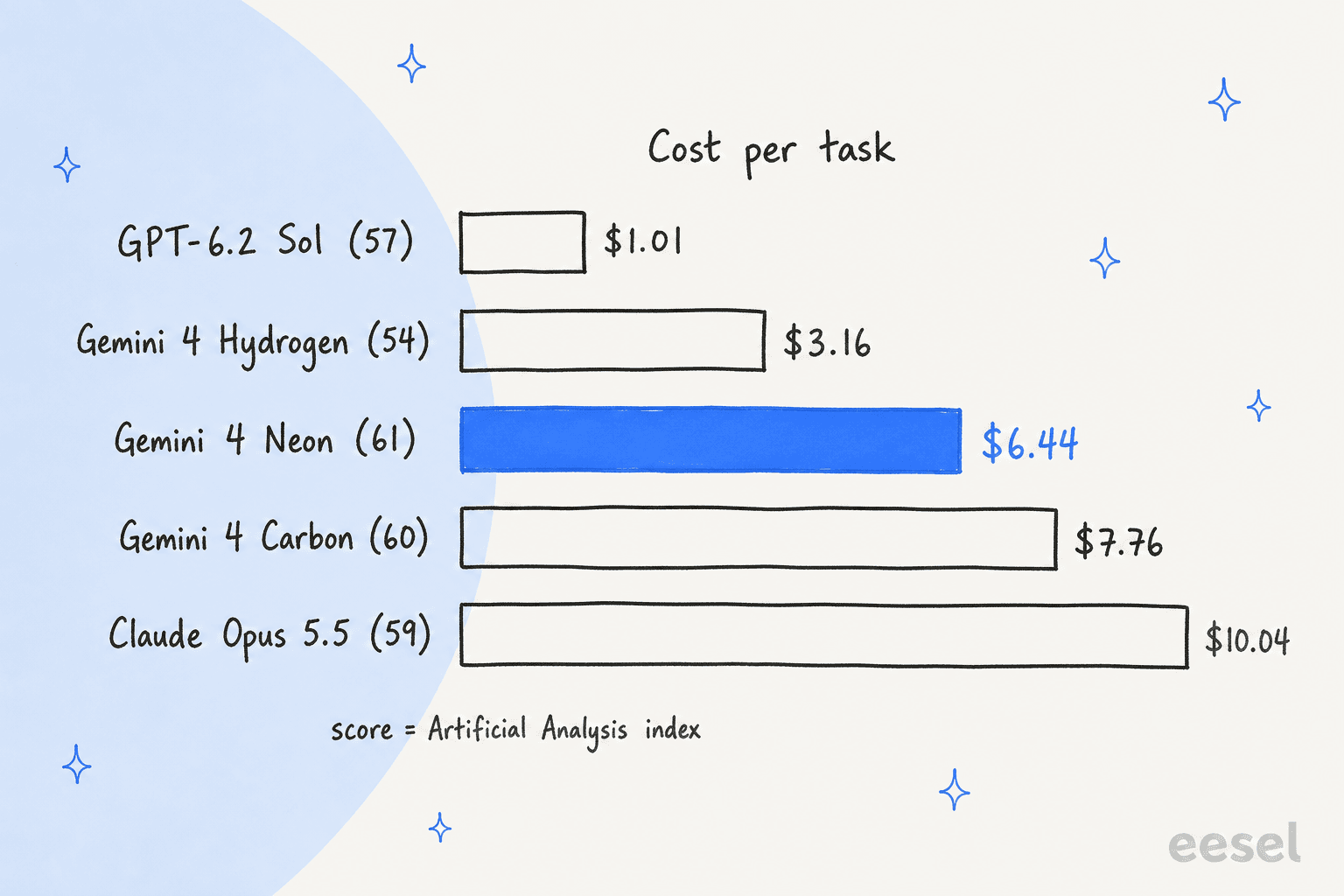
The chart uses each model's best setting, which is the fair way to compare "what is the most this model can do" and the unfair way to compare "what should I pay". For the second question, use the table.
Does Gemini 4 Neon hallucinate less than Sol and Opus?
This is the finding that changed my view of the model. On Artificial Analysis's AA-Omniscience test, which scores how often a model gives a wrong answer instead of declining when it does not know, the Gemini 4 family sits far apart from the rest:
| Model and setting | Hallucination rate (lower is better) | Questions answered correctly |
|---|---|---|
| Gemini 4 Argon high | 4% | 48% |
| Gemini 4 Carbon medium | 4% | 49% |
| Gemini 4 Hydrogen xhigh | 8% | 50% |
| Gemini 4 Carbon high | 11% | 58% |
| Gemini 4 Neon high | 14% | 59% |
| Gemini 4 Neon xhigh | 14% | 60% |
| Claude Opus 5.5 max | 50% | 66% |
| GPT-6.2 Sol max | 55% | 62% |
| GPT-6.2 Astra high | 58% | 66% |
| Claude Fable 5.2 high | 58% | 77% |
Neon says "I don't know" far more often than Opus, Sol, or Astra, and it pays for that in raw accuracy: 59% to 60% correct against 66% for Astra and 77% for Fable 5.2. Among Google's models it is also more willing to guess than Carbon medium, Argon, or Hydrogen.
Whether that trade is good depends on the job. For a research agent that must always produce an answer, the extra refusals are friction. For a customer-facing agent that should hand off when it is unsure, a model that declines is closer to what you want, and it is the behaviour I look for first. One caveat I want to be loud about: AA-Omniscience is a general-knowledge test. It does not measure how a model behaves with your help center, so test on your own tickets before you believe it.
Where does Gemini 4 Neon fall short?
I found six real limits, in order of how much they would bother me:
- It is verbose. At xhigh it wrote 283 million output tokens across the index, against 60.9 million for Sol. Output tokens are the $15 ones, so your bill moves with the model's habits, not just the price list.
- The top setting is slow. Artificial Analysis measured 56.5 seconds to the first answer token at xhigh and 110 tokens per second after that. Carbon needs 73 seconds and 55 tokens per second, so Neon is faster than Carbon, but it is not a live-chat model above
medium. - Astra and Sol are cheaper per task. Per token Neon is cheaper than Astra. Per task it is not, as the table shows. Sol max scores 57.3 for $1.01, which is 6.4 times cheaper than Neon xhigh.
- It is less accurate when it should answer. See the hallucination table: the trade is caution for correctness.
- Access has strings. There is no free API tier, and the Antigravity FAQ, as one Hacker News reader quoted it, bars third-party tools from using subscription access. They called that a dealbreaker:
"I'd like to keep my Gmail account, so Google can keep their model and will not get my business."

Another reader pointed out the workaround, which is plain API keys:
"You can't use subsidized tokens in 3rd party apps. Although they just suspend your Gemini account now, not your google account."
- The safety report is pending. Google's model card says the full report arrives in the coming days, so I would hold any regulated workload until it lands.
Which model beats Neon for your job?
Here is the decision as I would make it today:
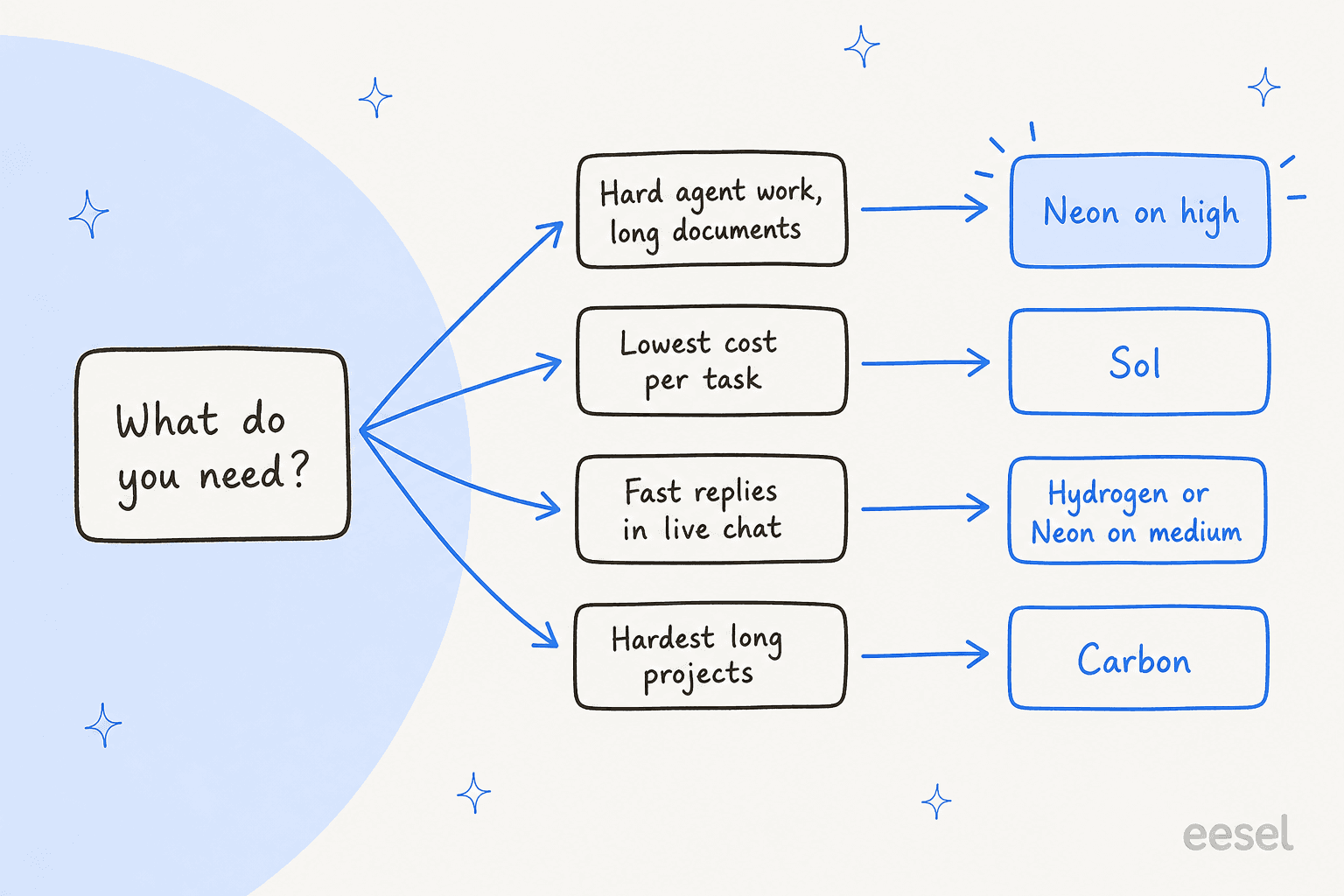
The fork hides the interesting part, which is that cost and hallucination pull in opposite directions. So here is the data in one tool. Set the lowest index score you can accept and the highest hallucination rate you can tolerate, and it lists every Artificial Analysis setting I pulled that clears both bars, cheapest first:
Try the extremes. Ask for a score of 55 with no hallucination limit and Sol xhigh wins on price at $0.65. Put a ceiling near 20% on the same score and Neon high is the cheapest answer at $3.74, with Carbon medium the careful one at 4%. Drop the score to 54 and Neon medium takes over at $1.90. The Gemini 4 family is the only place to get a high score and a low guess rate together, and that is the honest case for Neon.
How does Neon compare with Carbon, Hydrogen, Astra, Sol, and Opus?
| Model | Price per 1M in/out | Best setting score | Cost per task (best) | Hallucination rate | My one-line take |
|---|---|---|---|---|---|
| Gemini 4 Neon | $3 / $15 | 61.4 | $6.44 | 14% | Best Gemini for hard work; run it on high |
| Gemini 4 Carbon | $4 / $20 after the promo | 60.0 | $7.76 | 11% | Neon replaces it for most work |
| Gemini 4 Hydrogen | $1.50 / $7.50 | 53.9 | $3.16 | 8% | The default for small tasks |
| GPT-6.2 Astra | $8 / $40 | 62.1 | $4.00 | 59% | Higher score, fewer tokens, guesses more |
| GPT-6.2 Sol | $2 / $10 | 57.3 | $1.01 | 55% | Cheapest per task by far |
| Claude Opus 5.5 | $4 / $20 | 59.1 | $10.04 | 50% | Neon matches it for about a third of the cost |
Carbon's list price is $4/$20 from 1 December and $2/$10 until 30 November, which makes it cheaper per token than Neon for a few more days only. That does not change the per-task math, because Carbon thinks much longer.
What are people saying about Gemini 4 Neon?
The launch thread on Hacker News passed 460 points. The most useful reply compared Neon with its rivals on Vals and then put the price in context:
"Latency is by far the best for the level of quality. It's about 2x more expensive than Sol 6.2, but significantly better and faster. You get what you pay for."
The per-token gap against Sol is 1.5 times, not 2, and per benchmark task it is between 1.9 and 6.4 times depending on the setting, so "you get what you pay for" holds on quality but is more expensive than it sounds. Another reader read the same pricing as a loss:
"That looks to me like OpenAI equals or beats everything Google offers at half the price."
On the Artificial Analysis numbers that is close to right on cost per task and wrong on hallucination, which is why I split the two in this review. A third commenter, who tests long agent jobs, was less interested in the score:
"Argon and Carbon both made such discoveries such as "it would seem that i need to be pointing at an enemy to shoot them". Its almost entertaining to read, its like its discovering the world on first principles."
That user was starting the same task on Neon when they posted, so there is no verdict yet. And one reader summed up what many want from Google:
"Hydrogen has already became my default for 80% of small tasks. If Neon is as fast but smarter that would honestly be very cool"
On the data, Neon is smarter than Hydrogen by 8.8 points at high, but it costs twice as much per task ($3.74 against $1.87). These are single commenters, not a survey, and I could not reach Reddit or X for more.
Who should use Gemini 4 Neon?
| You are... | My take |
|---|---|
| Running Carbon or Argon for hard coding or analysis | Switch to Neon on high and compare. Same score, about half the cost and time. |
| Paying for Opus 5.5 at max | Test Neon high. The score is level and the bill is roughly a third. |
| Building a planner and worker agent | Neon plans, Hydrogen executes. |
| Reading very long documents | Neon, per Google's GraphWalks row and the AA knowledge-work results. |
| Optimising cost per task above all | Skip Neon. Use Sol or Astra. |
| Building a live chat reply | Neon on medium at most, or Hydrogen. |
| Needing a free tier | Hydrogen. Neon has none. |
| On Gemini 3.8 Flash for simple jobs | Stay. Neon is overkill and more verbose. |
If you are choosing between families, my ChatGPT versus Gemini comparison and the Gemini alternatives roundup go wider. My broader read on this tier is in the piece on frontier AI.
What does this review mean for support teams?
A support agent is a place where the "declines instead of guessing" result matters more than the headline score. A confident wrong answer to a refund question costs more than a handoff to a person. But the model is one part. What the agent knows, when it must hand off, and whether anyone tested it before launch decide how it behaves.
That is the pattern in how smava, a German loan comparison company, runs eesel in one Zendesk. Between 8 August and 8 September 2026, three eesel agents handled about 27,000 tickets: one categorised about 14,600 of them, one drafted about 15,300 replies from 820 macros and help articles, and per-brand agents prepared customer-ready answers. Each agent has one job and a list of things it must never do, and people approve every draft before it is sent. SamCart splits the same way: one agent for Freshdesk email, another for website chat, each with its own tone.
The model choice is a setting inside that design, not the design. If you want to compare models on your queue, simulate the agent on past tickets and watch the handoff rate, not just accuracy. My which LLM is best guide covers the checks I would run, and AI customer service cost shows what a queue costs in total.
If your team builds in a terminal, the eesel CLI lets a coding agent do the repeatable parts: upload exported help articles and macros, adjust the agent's instructions, and ask test questions before go-live. Connecting the helpdesk itself still needs an admin to approve it. See agentic coding CLIs and the guide to an AI agent MCP server for how those tools work with models like Neon.
My verdict on Gemini 4 Neon
Use it if you were going to pay for Carbon or Opus 5.5, run it on high, and measure cost per task, not per token. Skip it if cost per task is your only constraint, because Sol and Astra are cheaper, or if you need a free tier. Its best feature is not the 61.4 score. It is that a model this capable guesses wrong so rarely, which is worth testing before you decide.
Try eesel
If you are picking a model because you want better answers in your queue, the eesel AI helpdesk teammate gives you that without a model decision. It learns from your past tickets and help center, hands off to a person when the answer is not in your docs, and you can test it on real ticket history before it replies to anyone. It works inside Zendesk and Freshdesk, and it is the first thing I would try for a customer support AI rollout.
Pricing is a fixed monthly credit plan, with a free plan of 100 credits and no card, so a model's price change does not move your bill. Try eesel on a slice of your queue.