


Gemini 4 Neon costs $3.00 per 1M input tokens and $15.00 per 1M output tokens, with no free tier, and thinking tokens bill as output. The sticker price hides the real bill: on Artificial Analysis a task costs $0.75 on low, $1.90 on medium, $3.74 on the default high and $6.44 on xhigh. Batch and Flex halve the rate, Priority adds 80%, and a cache hit cuts input to $0.15. Carbon's $2/$10 launch price ends on 30 November, so the case for Neon over Carbon starts on 1 December.
The eesel CLI lets a coding agent upload approved help articles to an eesel helpdesk teammate and test its answers on past tickets, which is how I would check any model's cost and behaviour before it replies to a customer.
How I priced Gemini 4 Neon
Everything with a dollar sign on it comes from Google's pricing page, which I read on 19 November 2026, the day after launch, including the Batch, Flex and Priority tabs. Caching rules come from Google's caching docs, and the tier definitions from its Flex inference page. Cost per task comes from Artificial Analysis, where a "task" is one benchmark task from its index, not one of your tickets or pull requests.
I have not run Neon on my own workload. The monthly examples below use token counts I chose and label as assumptions, so swap in yours with the calculator. The first Neon explainer is here, and the launch-day review has the quality side. This post is only about the money.
What does Gemini 4 Neon cost per million tokens?
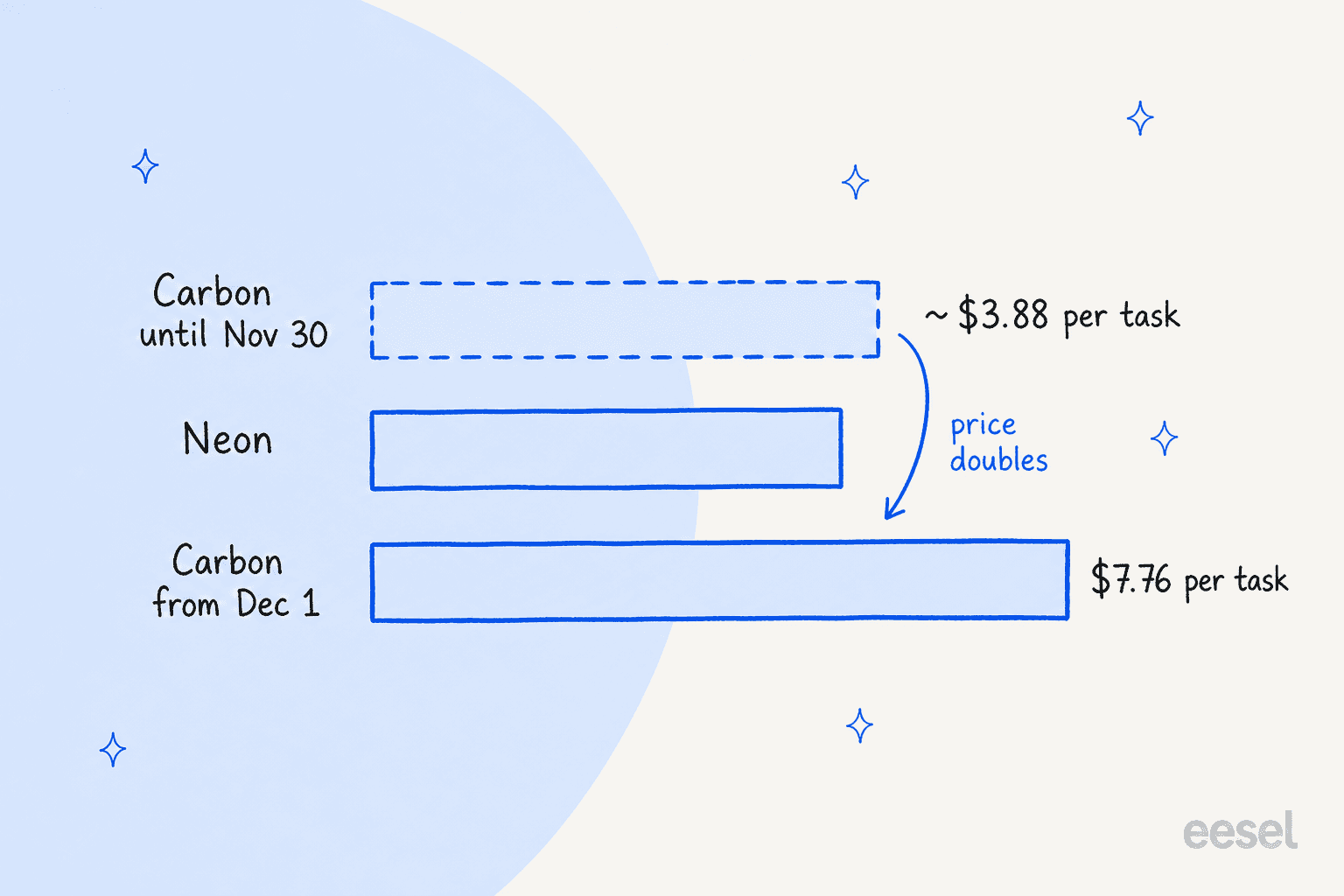
Neon is billed per million tokens on four service tiers. Google's page lists one price for the whole 1,048,576-token context window, with no higher rate for long prompts.
| Tier | Input | Output (incl. thinking) | Cached input | Speed and reliability |
|---|---|---|---|---|
| Batch | $1.50 | $7.50 | $0.075 | Asynchronous, up to 24 hours |
| Flex (preview) | $1.50 | $7.50 | $0.075 | Synchronous, 1 to 15 minute target, best effort |
| Standard | $3.00 | $15.00 | $0.15 | Seconds to minutes |
| Priority | $5.40 | $27.00 | $0.27 | Seconds, not sheddable |
Three details I would not skip:
- No free tier. The Free column reads "Not available" and Google states that every token is counted and billed. Gemini 4 Hydrogen does have one, so it is the cheaper place to prototype.
- Priority is the dearest. Google describes it as 75 to 100% more than Standard. On Neon the page shows
$5.40and$27.00, which is80%more. - Flex is a bargain with a catch. It is the same
$1.50/$7.50as Batch, but it is a preview feature with best-effort availability. Google lists its savings as aimed at "non-production evals, background agents, and data enrichment", and I would not put a customer-facing reply on it.
You can reach Neon through the paid Gemini API or, per Google's what's-new page, through Google AI Pro and Ultra plans in AI Studio. Subscription access, such as Google AI Ultra, is a different bill from the API, so I leave it out of the maths here.
What does Gemini 4 Neon actually cost per task?
Per-token prices tell you the rate, not the bill, because a model that thinks longer writes more output tokens. Here is Artificial Analysis's per-setting data for Neon:
| Thinking level | Index score | Cost per task | Minutes per task | Output tokens per task |
|---|---|---|---|---|
| low | 44.1 | $0.75 | 3.7 | 21,726 |
| medium | 54.9 | $1.90 | 8.3 | 50,000 |
| high (default) | 59.6 | $3.74 | 14.8 | 90,188 |
| xhigh | 61.4 | $6.44 | 21.5 | 141,631 |
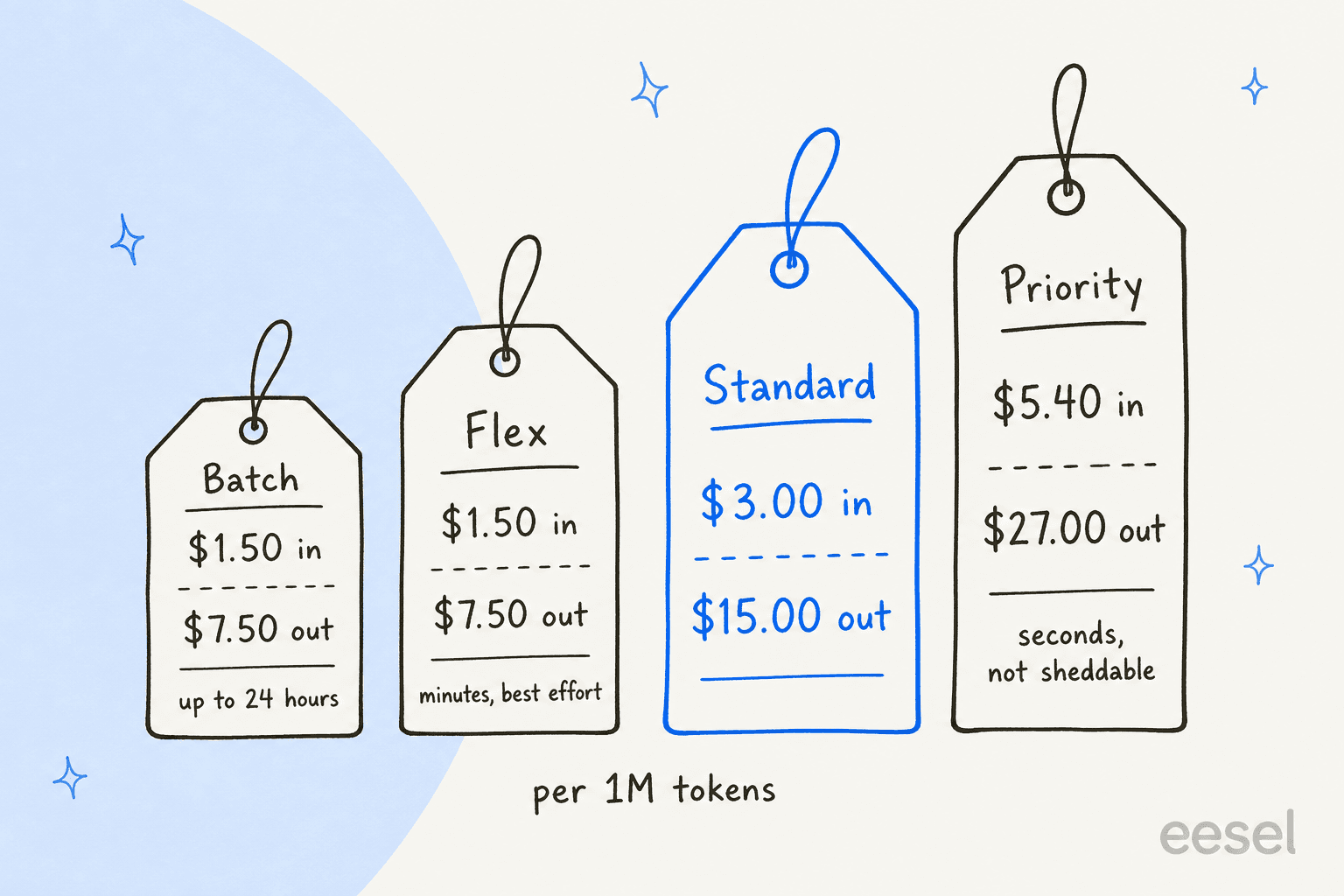
The score per dollar falls fast. From medium to high you pay $1.84 more for 4.7 index points. From high to xhigh you pay $2.70 more for 1.8 points and wait 6.7 extra minutes. Google's own guidance is to run your evaluations at all four levels and "pick the lowest thinking_level that meets your quality bar", which is the right way to read this table.
Here is the part I found most useful. Multiply the output tokens by $15 and high comes to about $1.35 of the $3.74, roughly 36%. The other $2.39 is input, the context an agent re-reads every turn. I am assuming Artificial Analysis bills at list price, so treat the split as a rough guide. But it points the same way for every level: in agent work the input side is the bigger bill, and the cache rate matters more than the output price.
Is Gemini 4 Neon cheaper than Carbon?
On 1 December, yes, by about half. Until then, it is close to a tie.
Gemini 4 Carbon and Argon carry a launch price on Google's page: $2.00 in and $10.00 out "through November 30, 2026", then $4.00 and $20.00 starting 1 December. Neon's row has no end date and no step.
The Artificial Analysis cost for Carbon, $7.76 a task, is computed at the December price. Its Carbon page says Carbon "costs $4.00 per 1M input tokens and $20.00 per 1M output tokens". Both rates double on 1 December, so the same work costs half as much until then. By my arithmetic that is about $3.88 a task through 30 November, against Neon's $3.74.
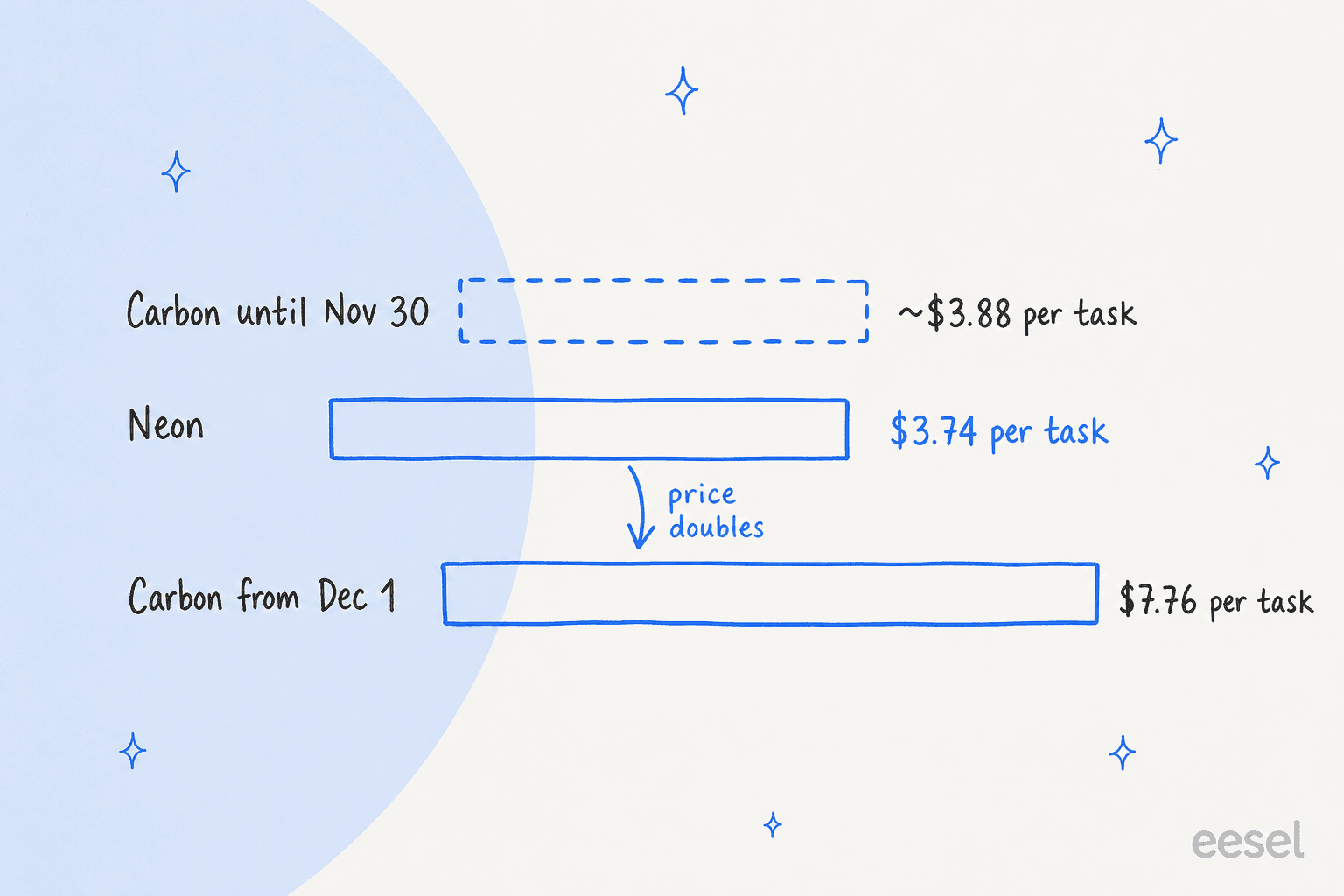
The $3.88 is my estimate, not a figure from either company. It assumes Carbon writes the same tokens per task before and after the price change, which it should, because the model is unchanged. Google's own launch claim is a 32% lower cost per task than Carbon, and the December list price makes the gap wider than that.
What I would do: if you are trialling Carbon now, budget at the December price, not the promo. A Hacker News reader spotted the awkward positioning on launch day:
"So it's better and cheaper than the recently released Carbon? So Carbon is already deprecated, or?"

It is not deprecated. It is priced to be a promotion until the month ends, and Neon is the model with a stable price. My Carbon review covers where Carbon still wins, and the Argon pricing post shows it shares Carbon's price steps.
How does Neon compare with Astra, Sol and Opus on cost?
Not well on price. Per task, Neon is dearer than OpenAI's models and cheaper than Anthropic's top setting, whose rates are in the Anthropic API pricing guide. Here is the same Artificial Analysis data, at each model's best-scoring or default setting:
| Model and setting | Index score | Cost per task |
|---|---|---|
| GPT-6.2 Sol max | 57.3 | $1.01 |
| GPT-6.2 Astra high | 60.1 | $2.07 |
| Gemini 4 Neon high | 59.6 | $3.74 |
| Gemini 4 Hydrogen xhigh | 53.9 | $3.16 |
| Gemini 4 Carbon high (December price) | 60.0 | $7.76 |
| Claude Opus 5.5 max | 59.1 | $10.04 |
Astra's per-token price is higher than Neon's, yet it is cheaper per task because it writes about 17,800 tokens where Neon writes about 90,200. A cheaper rate card does not mean a cheaper model, and a Hacker News reader put the buyer's view bluntly:
"That looks to me like OpenAI equals or beats everything Google offers at half the price."
On cost alone I agree. Neon's case is its low hallucination rate, which I covered in the review. If your question is price, the GPT-6.2 Sol review my wider Gemini alternatives roundup and the OpenAI versus Gemini API comparison are the better starting points.
How much does caching save on Neon?
A cache hit bills at $0.15 per million tokens instead of $3.00, so 95% less on those tokens. The catch is that you cannot switch it on or steer it. Google's docs say explicit caching is not supported for Gemini 4 models, and implicit caching "is enabled by default". Three rules decide whether you get the discount:
- The minimum is 4,096 tokens. Shorter prompts never hit the cache.
- Order matters. Google says to put "large and common contents at the beginning of your prompt" and send similar prefixes close together in time.
- Agent loops have a floor. For multi-turn use, Gemini caches the full previous request only if the new request adds at least 2,050 tokens. For smaller additions it "re-processes the last 2,050 tokens of the previous request at the standard input rate". Most agent turns clear that bar, but a chatty bot with short replies may not.
Here is what that is worth on a long document. Say you load a 500,000-token contract bundle and ask 100 questions, each answered in 2,000 tokens. These are my assumptions, priced at Standard rates:
| Scenario | Input cost | Output cost | Total for 100 questions |
|---|---|---|---|
| Every question uncached | $150.00 | $3.00 | $153.00 |
| First uncached, 99 cache hits | $1.50 + $7.43 | $3.00 | $11.93 |
That is a 92% saving, but only if every follow-up hits the cache, which implicit caching does not promise. Read usage.total_cached_tokens on your first few runs to see what you actually get before you plan around it.
What does a realistic month cost?
It depends on three numbers you control: tokens in, tokens out and cache share. I built a calculator so you can plug in your own. It prices the same workload on Neon, Hydrogen and both Carbon prices.
The defaults are my illustrative support-ticket workload: 5,000 requests a month, 6,000 input tokens each with a 75% cached prefix, and 1,500 output tokens including thinking. On Standard that is about $0.028 a request and $138 a month on Neon. The same ticket costs about $0.014 on Hydrogen and, from December, about $0.037 on Carbon.
Three other workloads, using the same method:
| Workload (my assumptions) | Neon, Standard | Same on Batch or Flex |
|---|---|---|
| 5,000 support replies, 6,000 in (75% cached), 1,500 out | $138 | $69 |
| 5,000 support replies, no cache hits | $202 | $101 |
200 agent tasks on high, at Artificial Analysis's $3.74 | $748 | $374 (my halving) |
The no-cache row is the one to look at. It is the same logic as cost per ticket, where the unit you divide by matters more than the headline rate. Losing the cache adds 46% to the support bill, and it happens quietly if your prompt is under 4,096 tokens or your system prompt changes every request.
What else shows up on a Neon bill?
Four things sit outside the token rate.
- Search grounding. Google gives 5,000 free search requests a month, shared across all Gemini 3 and newer models, then charges
$14per 1,000 requests, with a daily cap of 1,500 requests. Google also states that one prompt may trigger several searches, and you are billed for each. The same applies to Maps grounding. - Tool overhead. Google says every token the model processes is billed, "including thinking tokens and internal tool system instructions and function declarations when using grounding". Long tool lists are input tokens too.
- Output you did not read. Thinking tokens are billed even when you only see a short answer. Set
max_output_tokenshigh enough that the limit does not cut a reasoning run short, but watch the usage fields. - Long decode. Output can run past 65,536 tokens up to the full window, and every one of those tokens is
$15per million.
Which Neon tier and level should I pick?
Pick the cheapest combination that meets your quality bar, then measure it for a week. My starting points:
- Live customer chat or an interactive coding tool: Standard on
medium. Priority is80%more and only buys reliability. - Overnight evals, backfills, data enrichment: Batch for anything that can wait a day, Flex for anything that needs the answer in minutes. Both are
50%off. - A hard agent task where
highfalls short:xhigh, for 1.8 more index points and72%more cost per task. Test first. - Quality does not matter much: use Gemini 3.8 Flash or Hydrogen. Neon is not the model for cheap work.
If you are choosing a model for a support AI agent, the token bill is the smaller decision. My guide to AI customer service cost puts the model line next to the software, people and review time that usually dominate. Swiftreg, a UK private number plate seller, ran two eesel agents on Zendesk and handled about 2,100 tickets between 8 August and 8 September 2026, sending 1,494 public replies. Its agents answer from live order lookups the team wrote and carry hard rules about what must go to a person. That setup, not the model, decides whether a reply is right, and it is worth simulating on past tickets before you pay for a better model. My list of the best AI models for support tickets is the next stop.
If your team works in a terminal, the eesel CLI lets a coding agent upload exported help articles and macros, adjust the agent's instructions and ask test questions before go-live. Connecting the helpdesk itself still needs someone with admin access to approve it. The wider pattern is in my piece on agentic coding CLIs.
My verdict on Gemini 4 Neon pricing
Neon is fairly priced and not cheap. Its rate is stable, its tiers are clear, and a half-price Batch or Flex lane is useful for background work. But its cost per task depends on the thinking level you choose and on whether your prompts hit the cache, so measure both before you commit. If you are weighing it against Carbon, wait until 1 December to compare list prices, and if cost per task is your only constraint, GPT-6.2 Astra and Sol are cheaper. For the full picture start with the Gemini pricing overview, then the ChatGPT versus Gemini comparison.
Try eesel
If you are pricing a model because you want better answers in your queue, the eesel AI helpdesk teammate gives you that without a model decision. It learns from your past tickets and help center, hands off to a person when the answer is not in your docs, and you can test it on real ticket history before it replies to anyone. It works inside Zendesk, Freshdesk and other helpdesks, as in the Zendesk example below.
Pricing is a fixed monthly credit plan, with a free plan of 100 credits and no card, so a model's price change does not move your bill. Try eesel on a slice of your queue.