Engaige alternatives: 9 picks with published prices (2026)

Riellvriany Indriawan

Katelin Teen
Last edited October 5, 2026

The nine at a glance
| Tool | What it replaces | Published price | AI billing unit | Voice | Ecommerce actions | Runs on your desk | Free tier | Best for |
|---|---|---|---|---|---|---|---|---|
| eesel AI | The AI only | Yes | 1 credit / ticket, from $299/mo | No | Yes | Yes | 100 credits | Keeping your desk, fixed monthly price |
| Gorgias | The whole desk | Yes | $0.85 to $1.00 / automated interaction, $1.50 extra | Add-on from $25/mo | Yes | No | Trial only | Shopify-first brands |
| Zendesk | The whole desk | Yes | $1.50 committed, $2.00 PAYG | Yes | Via apps | No | Trial only | Enterprise breadth, 1,800+ apps |
| eDesk | The whole desk | Yes | $0.99 / outcome | Add-on | Yes | No | 14-day trial | Amazon, eBay, marketplace sellers |
| Richpanel | Either | Yes | Flat from $100/mo, unlimited | Phone on Pro | Yes | Yes (portal) | Yes | Flat-fee self-service at volume |
| Tidio | Either | Yes | ~$0.65 / Lyro conversation | No | Via connectors | Yes (Lyro standalone) | 50 convos | Small teams, fastest setup |
| Freshdesk | The whole desk | Yes | $0.49 / session | Freshcaller | Via connectors | No | Yes | Cheapest seat with a real agent |
| Decagon | The AI only | No | Quote | Yes | Yes | Yes | No | Enterprise, voice plus text |
| Sierra | The AI only | No | Quote | Yes | Yes | Yes | No | Enterprise outcome contracts |
| Engaige (for reference) | The AI only | No | Flat monthly, per-ticket band in a blog post | No | Yes | Yes | No | Benelux ecommerce, hands-on rollout |
Why teams start looking for Engaige alternatives
I work eesel's support queue every day, so I read a vendor page the way an agent reads a macro. What does this thing actually do when a real ticket lands in front of me. On that test Engaige holds up better than most of the category, it is built to act, and the honesty about its own limits is rare enough to notice.
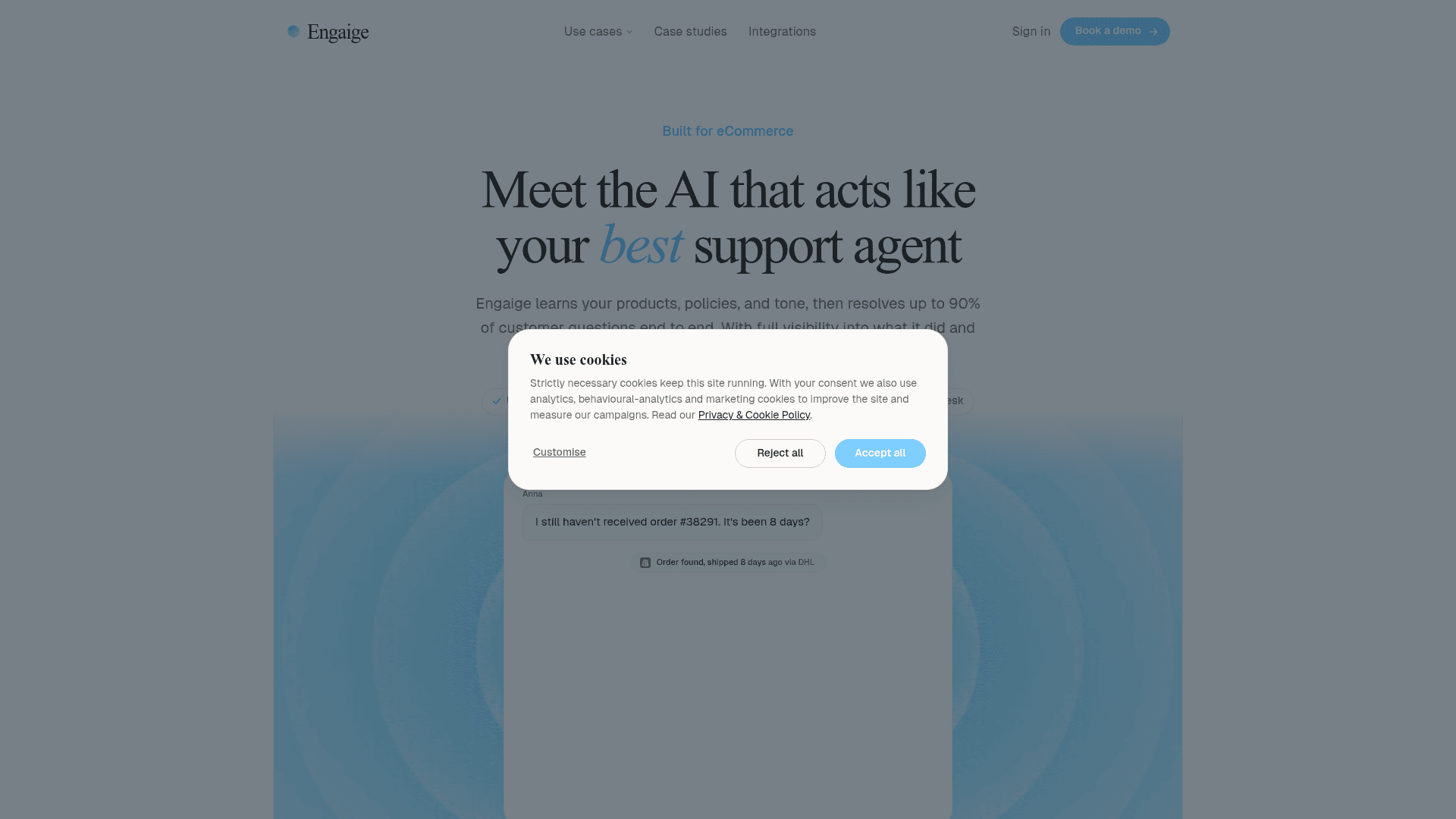
Start from what it gets right, since that is the thing you have to match in a replacement. The demo scene Engaige uses is a stuck parcel. Read the order in Shopify, then the DHL tracking history, notice that the parcel sat four days at a sorting facility, create a replacement order with expedited shipping, and tell the customer. That is a resolution. A chatbot answering questions would have pasted in a tracking link and stopped there.
The integration list backs up that claim. Roughly ninety-five systems connect, across helpdesks and storefronts, marketplaces, payments, shipping, returns and subscriptions, and the shipping side in particular reads like it was written by somebody who has really shipped parcels in Europe: PostNL, Trunkrs, Budbee, MyParcel, Monta, Picqer, bol.com, Mollie, Buckaroo. Missing a connector? The integrations page says they build it on request, live in about a week.
Named outcomes as well, and you can open them yourself. HelloPrint runs 80% of support automated across 21 countries at 200,000 tickets a year, and the team went from 100 agents down to 28. Otrium resolves 60% of its 120,000 annual tickets end to end.
So where does the search traffic come from? Four reasons. Engaige volunteers two of them itself.
There is no price to model
This one is the big one. letsengaige.com/pricing returns a 404. In its own ROI article Engaige describes the model as "a flat monthly price of around €0.40 to €0.50 per ticket (dropping toward €0.30 at volume)", which is a good model to buy, but it is a sentence in a blog post and not a price list. The flat fee, the volume band and the overage that sits on top are not printed anywhere I could find, and every route ends at a demo booking. I worked through the numbers in my Engaige pricing breakdown.
A flat fee you cannot see is not a predictable bill, it is a negotiation. That is a real gap against the rest of this shortlist, where a spreadsheet is possible before you talk to anybody at all. Gorgias prints $0.85 to $1.00 per automated interaction, with $1.50 past the allowance. eDesk prints $0.99 per outcome, Zendesk prints $1.50 and $2.00, Freshdesk prints $0.49 a session, and we print plans from $299 a month on the pricing page.
It is text-only, and says so
Email, live chat, WhatsApp, SMS and social DMs are all covered, and no voice agent ships at all. The reasoning gets stated plainly on Engaige's own scoring page: with text the model has room to read the order, check the policy, then finish the action before it answers, where a live call gives it seconds. It calls this "not a roadmap gap: a position", and marks itself down on the channel criterion to say so.
I find the argument persuasive. It stays a constraint anyway. If phone is 20% of your contacts then no amount of text quality closes that gap, and you end up running two vendors for one queue. Zendesk voice answers calls autonomously, and so do Decagon and Sierra.
It only fits one industry
Built for ecommerce, with no pretending otherwise, since Engaige ends its own product note with "the catch: ecommerce-specialised, not horizontal". The use cases are five post-purchase ones: WISMO, refunds and returns, product advice, damaged and missing items, and subscriptions. Tickets about B2B onboarding, or SaaS billing, or IT requests? Wrong shape of tool, and a good AI ticketing system is the better search to run.
The rollout is vendor-led, on the vendor's clock
The published ramp goes like this. Agent Assist on day zero, autonomous somewhere around day seven, then "30-80% of tickets resolved autonomously by week two", and up to 90% by week four where the integrations run deepest. HelloPrint's case study says Engaige "handled the rest" after HelloPrint provided the input, with the system operational inside two weeks.
Fast, yes. Hands-on too, not self-serve. The site carries no signup link anywhere on it, only a sign-in for the customers who are already in. So if you would rather connect a helpdesk by yourself on a Tuesday afternoon, that is a different product you are shopping for.
Before you compare anything: what "90%" is actually counting
A resolution ceiling gets quoted by every vendor in this post. Engaige says up to 90%. Gorgias markets up to 60% instantly, Tidio claims 67%, and Freshworks says up to 80%. None of those numbers mean anything before you know what got counted, which is the part where I would spend a full hour ahead of a single demo.
So here is our own data, the least flattering version I have on hand. We ran a trial on the live Zendesk traffic of a German jewellery brand, about a thousand tickets a month, eight languages in the queue. Triage accuracy came in at 93%, and spam detection at 100% with zero false positives, which mattered, because 22% of that inbox was spam. Drafts came out directionally right 88% of the time. Then the honest number: only 12% of those drafts went out as-is, and a 7% factual error rate on the rest.
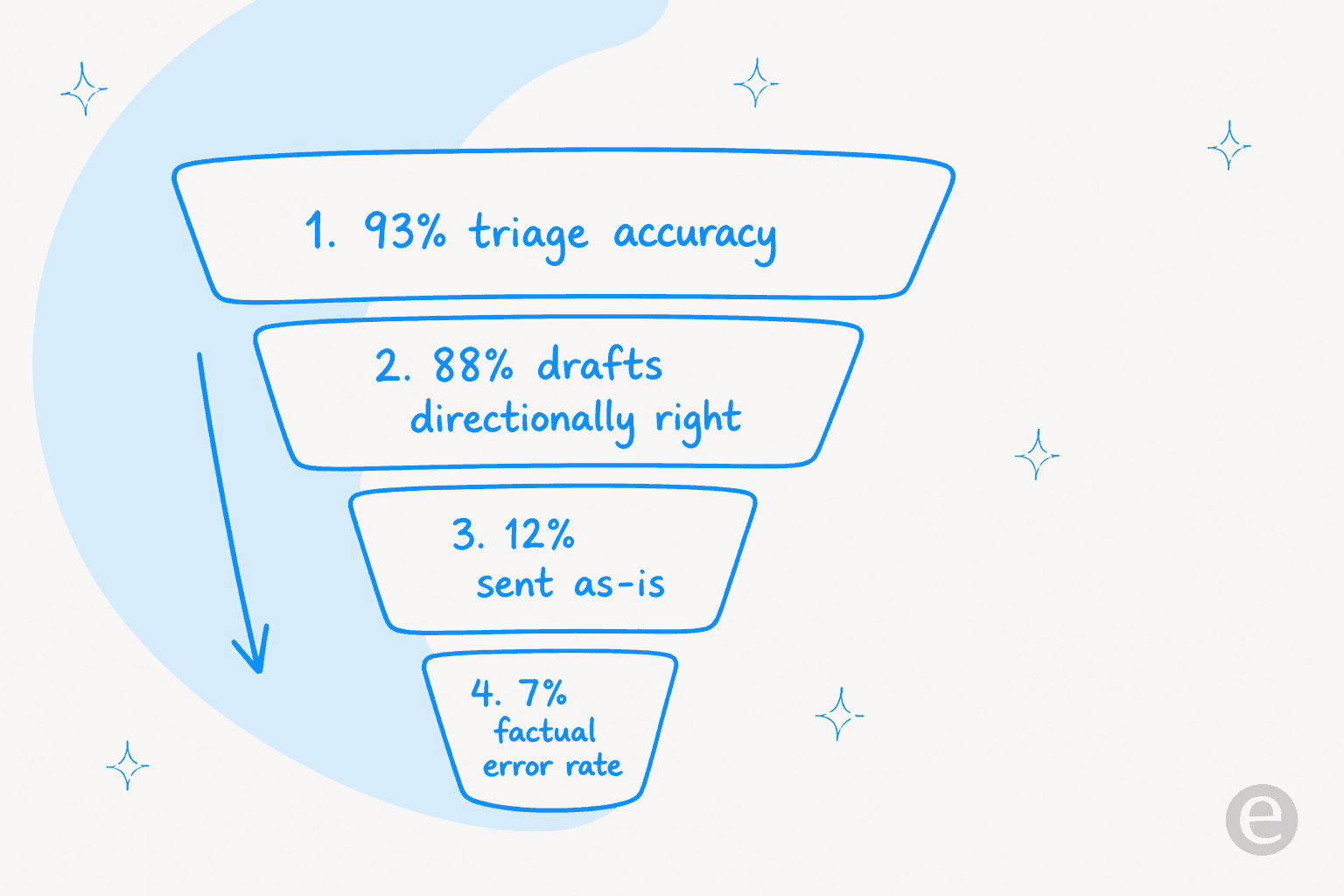
Read that funnel from top to bottom and almost any headline you want can be produced out of the same trial. "93% accurate" is true. "Only 12% autonomous", also true. By category the picture moved again: returns and refunds hit 93.8% useful drafts, warranty claims 96.4%, and refund status 100%.
Which is why a per-ticket-type rollout beats a global switch, and it is also the objection I hear most often on calls:
"The AI will never be able to answer 100% of the questions, but if it tries and just answers 'sorry I don't know this,' I cannot go and check all my 7,000 tickets to see if the AI actually made a good answer. I need an AI who is only handling the tickets that it's confident to handle and all the other ones, leave them alone."
a CX lead at a DTC supplements brand on Gorgias and Shopify, roughly 7,000 tickets and 30,000 orders a month
Two questions for every vendor on this list. What counted as resolved. And can I watch it on my own tickets before it ever replies to a customer. The longer list is in our AI customer service metrics guide.
1. eesel AI
Our own tool, so read the rest of this list for the honest comparison. Architecturally eesel is the same shape as Engaige, an AI layer on the helpdesk you already run. Three differences matter for this shortlist. It publishes a rate. It is not ecommerce-only, and it replays itself against your ticket history before it answers anyone at all.
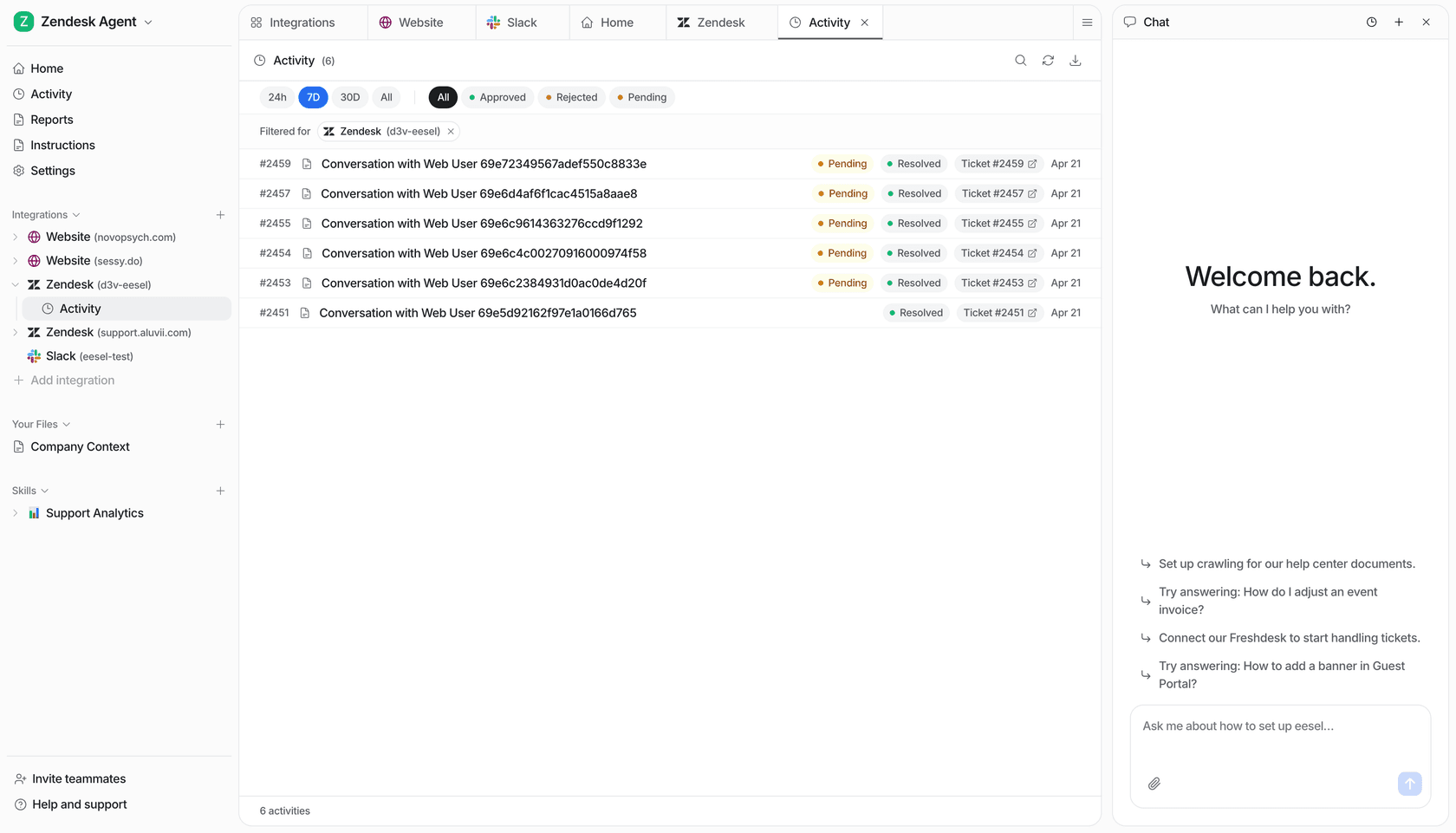
Features. Connects into Zendesk, Freshdesk, Gorgias, Front, Help Scout, HubSpot and more through its integrations, then trains on your past tickets and help center and internal docs, not on a crawl of your public site. For a store it reads live order data, so a WISMO reply carries the real tracking state and not a template. It runs as a chat bubble on the storefront as well, or in copilot mode where it drafts for the agents.
Pros. Simulation is the piece I would sell hardest. Point it at your last few thousand tickets, then read what it would have said, broken out per ticket type, before anything at all goes live. The price is one fixed monthly plan, and overage stays off unless you turn it on with a monthly cap you set, so one peak week cannot turn into a surprise invoice. No seats and no platform fee either.
Cons. No voice agent, the same as Engaige. It is horizontal instead of commerce-native, which is why the deepest carrier and 3PL coverage in this whole post belongs to Engaige and not to us. And it is a layer. So if what you actively want is to leave your helpdesk, this does not solve that.
Pricing. One fixed monthly price sized to volume: 500 credits for $299, 1,000 for $499, 1,500 for $699, 2,500 for $999, 3,500 for $1,349 and 5,000 for $1,899. One credit covers one ticket or chat, however many replies it takes, and only tickets the agent actually works on count. The free plan has 100 credits, no card. Paying a year upfront gets two months free. Past the plan you can switch on overage at $0.80 a credit with a cap you set. Every integration and every seat is included, and SSO and MFA, data residency and priority support are paid add-ons.
Verdict. Best fit when the desk is fine and the AI on top of it is not. A support lead at Gridwise put the ramp at 73% of tier-1 requests inside the first month, and that was after a seven-day trial.
Want AI for the store you already run? eesel plugs into Shopify and your current helpdesk in a few minutes, reads your order data and your past tickets, and shows you exactly what it would have replied before it talks to a single customer. 100 credits free, no card. Try eesel.
2. Gorgias
This is the ecommerce helpdesk Engaige most often sits on top of. Also the most direct replace-the-whole-desk answer for a brand on Shopify.
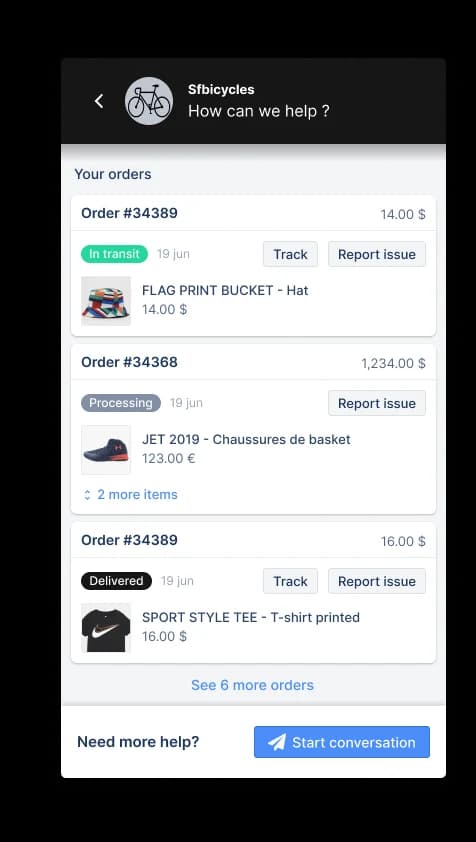
Features. A full ecommerce inbox across email and chat, contact form, Facebook, Instagram, TikTok Shop and WhatsApp, with an AI Agent that comes on every plan and takes real actions: cancellations, discounts, order status lookups, plus the order management flows behind them. 254 apps sit in the library, and the Shopify, BigCommerce, WooCommerce and Magento connectors come depending on tier.
Pros. Pricing goes by ticket volume and not per seat, so adding agents costs nothing. Gorgias says it powers 40% of Shopify brands. Its own customer Orthofeet reports being "above 50% automation" after they targeted 30% in 30 days, a usefully unglamorous number to see in public.
Cons. The AI got layered onto a ticketing product instead of being built AI-first, and it runs deepest on Shopify, where the whole company is concentrated anyway. Magento shows up only on Pro and above. The API is 2 requests a second on every plan, Advanced included, which bites the moment you build against it.
Pricing. Starter $40/mo (50 tickets, 30 automated interactions), Basic $90 or $77 annual (300 tickets), Pro $550 or $471 (2,000 tickets, 190 automated), Advanced $1,430 or $1,227 (5,000 tickets, 530 automated). Overage runs $0.40 a ticket, dropping to $0.36 once you are on Pro or above, and then $1.50 per automated interaction past whatever allowance is included. Voice from $25/mo, SMS from $17/mo. The stacking is modelled in our Gorgias AI pricing breakdown.
Verdict. The default when you want one bill for the desk and the AI together, and your store sits on Shopify. Already on Gorgias and only after better AI? A layer is the cheaper change of the two, so see our Gorgias alternatives list.
3. Zendesk
The enterprise incumbent, now repositioned as a resolution platform. Widest ecosystem on this page too, by a distance.
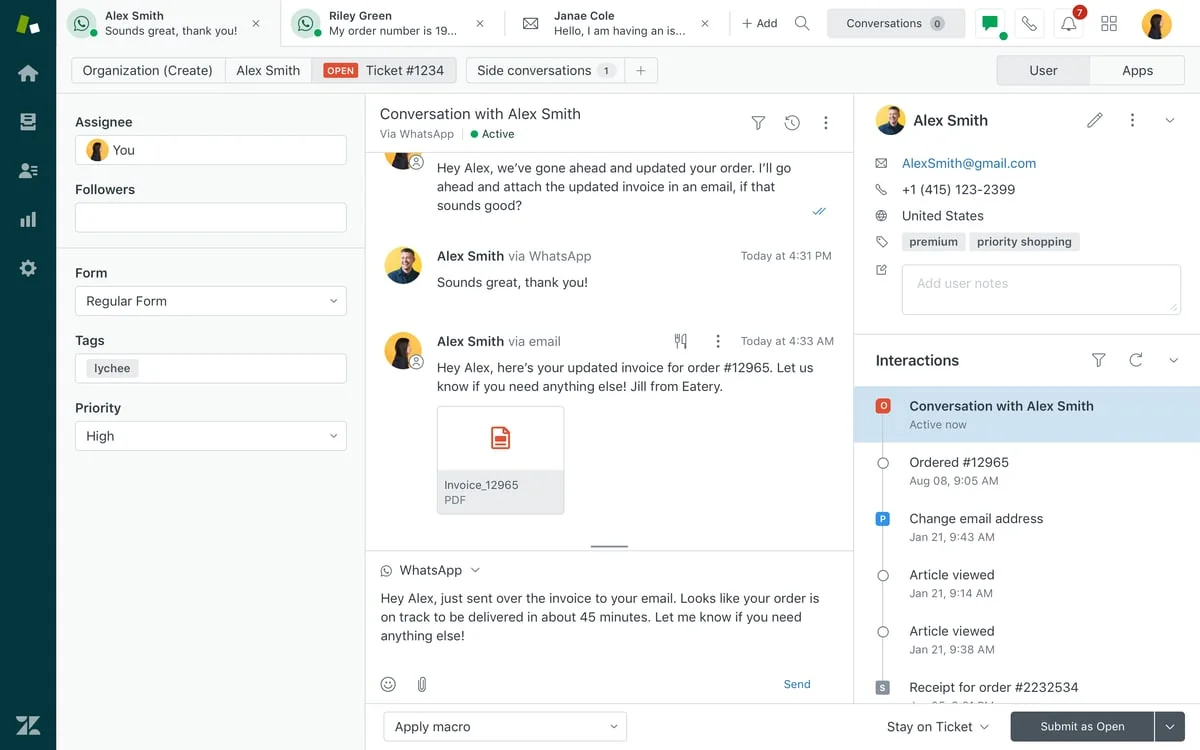
Features. Ticketing and messaging, knowledge base, voice, workforce management and quality assurance, all inside one suite, with autonomous AI agents running alongside a Copilot for the humans. 1,800+ marketplace apps as well, and an Action Builder for the multi-system workflows.
Pros. Breadth. A connector exists for nearly everything, voice is first-class here instead of an add-on, and the ecommerce returns tooling is mature. When procurement wants SOC 2 and SSO and an audit trail all signed off inside one contract, this is the path of least resistance.
Cons. Two meters running at the same time. You pay per agent seat, and per automated resolution, and then Action Builder credits are a third line at $200 per 100,000 actions. It is horizontal, so the store actions arrive through apps and not natively. Buyers on our calls describe the native AI as expensive against what it gives back, which is the reason plenty of Zendesk customers end up shopping for a layer instead of a replacement.
Pricing. Support Team $19 per agent a month billed annually ($25 monthly), Suite Team $55 ($69), Suite Professional $115 ($149). Automated resolutions come to $1.50 each on a commitment, or $2.00 pay-as-you-go, the highest published unit rate anywhere here. Full detail sits in our Zendesk pricing guide.
Verdict. Right when one vendor has to cover every channel, phone included, and the budget can carry two meters. Wrong when you already run Zendesk and only want the AI part to be better, since that is the Zendesk AI agents question and not a migration.
4. eDesk
The marketplace specialist. When a meaningful share of your tickets arrives out of Amazon, or eBay, or some Mirakl operator instead of your own storefront, this is the one Engaige does not really compete with.
Features. One workspace covering marketplaces and storefronts, email, live chat, social and contact forms, with the order and tracking context inline, order adjustments, and an AI Agent included on every tier. The add-ons cover AI Assist for drafting and Translate for multilingual queues, then Feedback for review requests on Google and Trustpilot.
Pros. The billing definition here is the clearest in the roundup. An outcome gets charged once per ticket, only where the agent actually replied or took an action, and never for doing nothing. Marketplace collaboration is native, and so are the multi-brand workflows, rather than bolted on afterwards. And there is a 30-day guarantee on the base subscription if the workload does not drop.
Cons. Per-user pricing means your seat count is what drives the bill, and the drafting features that are actually useful sit behind a $30 per agent add-on instead of in the base plan. Voice comes as an add-on too, through eDesk Talk or Aircall. Rule-based automations are not on the entry tier at all.
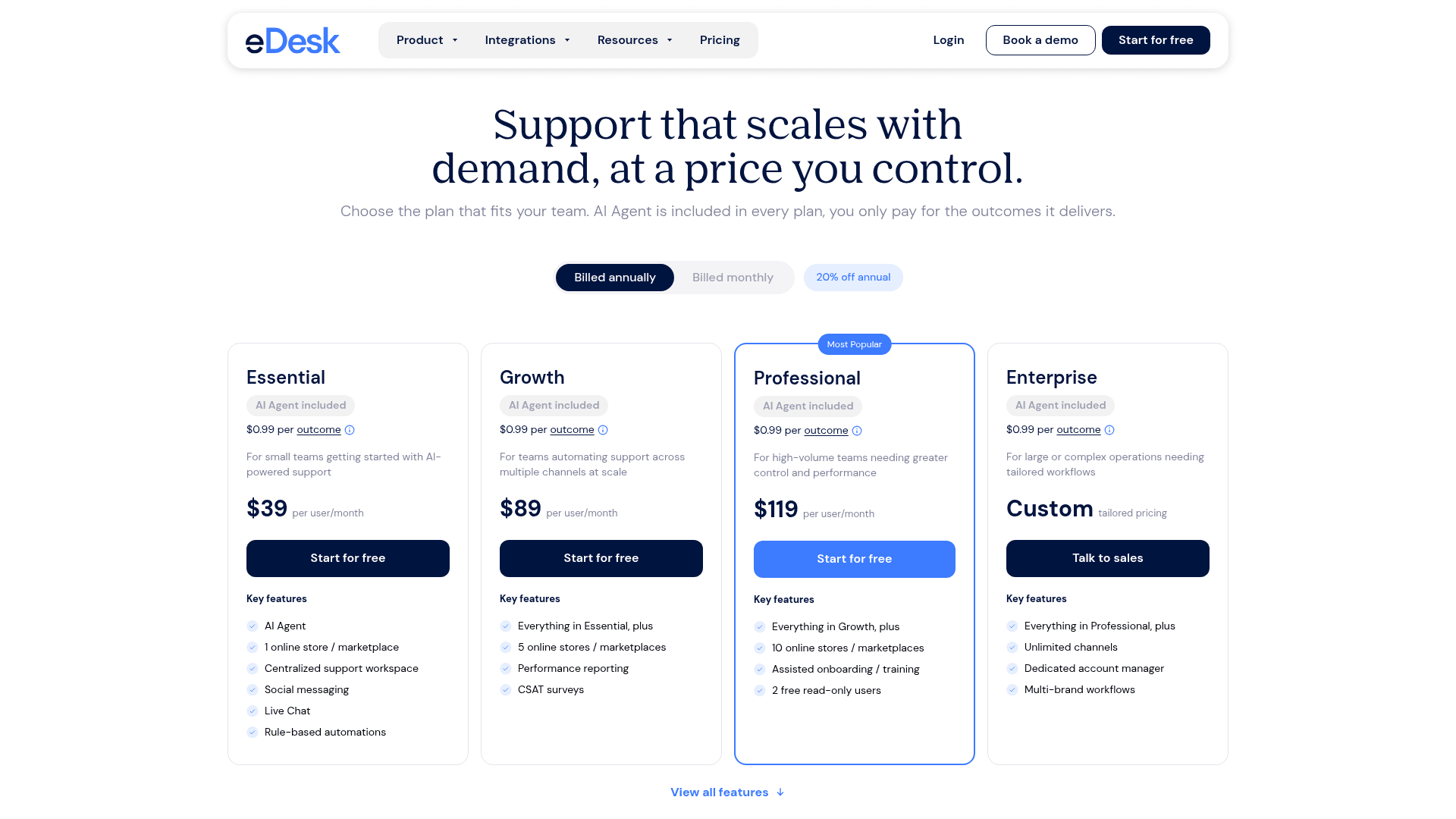
Pricing. Essential $39 per user a month, Growth $89, Professional $119, Enterprise custom, and all of them carry the AI Agent at $0.99 per outcome. AI Assist $30 per agent, Translate $19 per agent, Feedback $99 per account. Changes get tracked on our eDesk pricing page.
Verdict. The marketplace answer. Its own customers put the AI at 35% resolution for Yvolution, and 30% of support volume for MyBoatStore across Amazon, eBay and Shopify, numbers that read like a real deployment and not a ceiling. Compare it against the field in our eDesk alternatives roundup.
5. Richpanel
Structurally the most interesting answer here, because Richpanel sells both halves separately and will let you buy either one on its own.
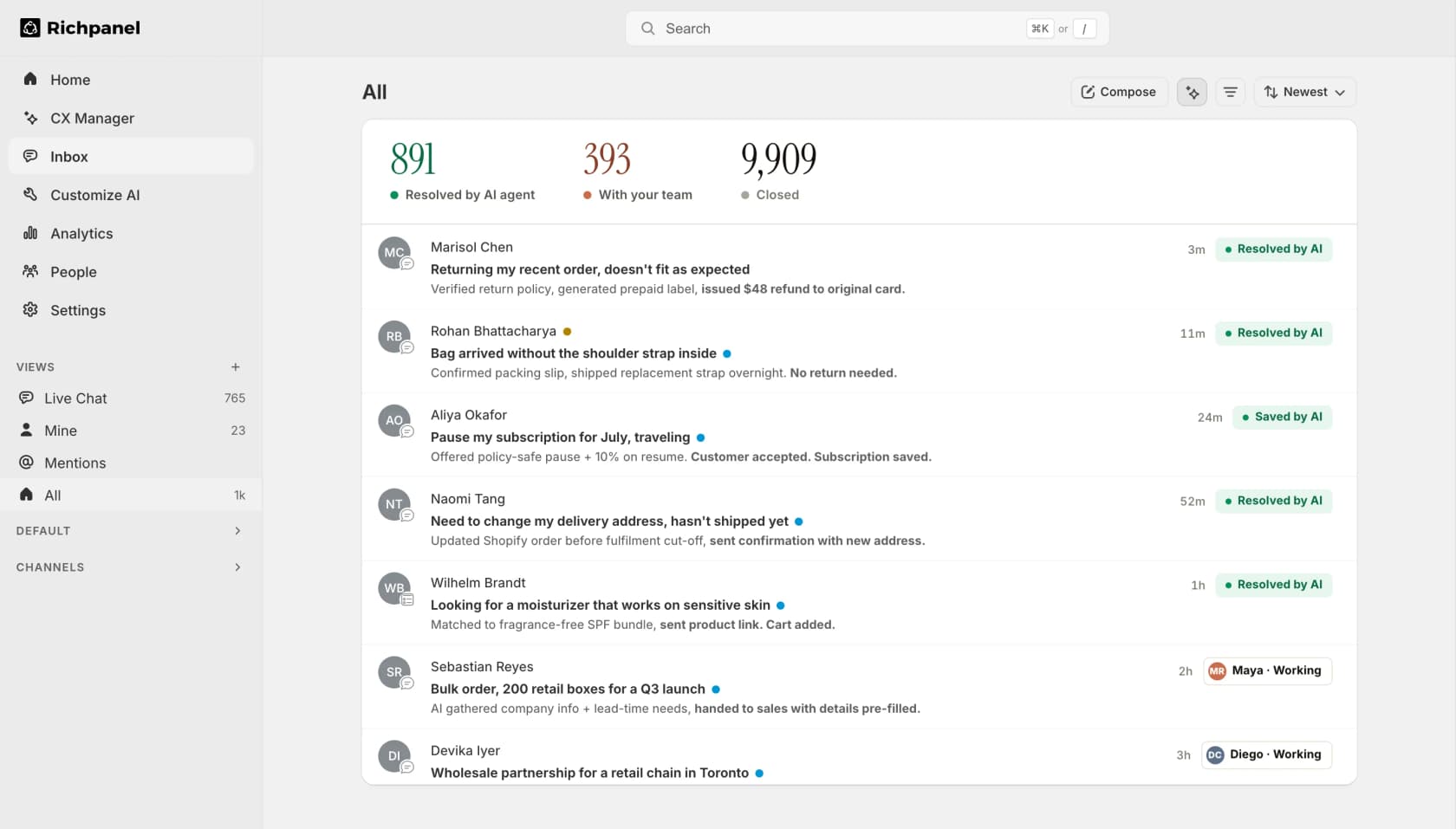
Features. Two products. First a self-service portal, which layers onto Zendesk, Gorgias, Help Scout or Salesforce and handles the order tracking, the returns and the subscription changes without touching your desk. Then a full support inbox, email and chat and social, phone and SMS, for the case where you do want the desk replaced.
Pros. The portal's Pro tier is a flat $100 a month with unlimited resolutions, the only uncapped AI price on this page. At high automation volume that comes out dramatically cheaper than anything metered per resolution, and the bill goes boringly predictable, in exactly the way Engaige's unpublished flat fee promises to be.
Cons. The pricing page is hard to read. One card shows an order-volume header and then a different order limit down in the body, and the two products interleave with monthly and annual toggles across them. Budget for a call just to confirm which tier you are actually on. Positioning is explicitly as an alternative to named competitors, rather than on its own terms.
Pricing. Self-service portal: free tier, then Pro $100/mo with unlimited resolutions, Pro Max $300/mo, and annual order-volume tiers at $250/mo up to 5,000 orders and $500/mo up to 20,000. Help desk side: Base $9/mo for 3 users, Pro $60 per user, Pro Max $120 per user. The details are in our Richpanel pricing guide.
Verdict. Strongest pick when you like the flat-fee logic Engaige uses, and want to see the number before you sign it. Where it falls short of a full desk is covered in our Richpanel alternatives list.
6. Tidio
Fastest thing on this list to get running. It is also the other tool here that will sell you the AI on its own.
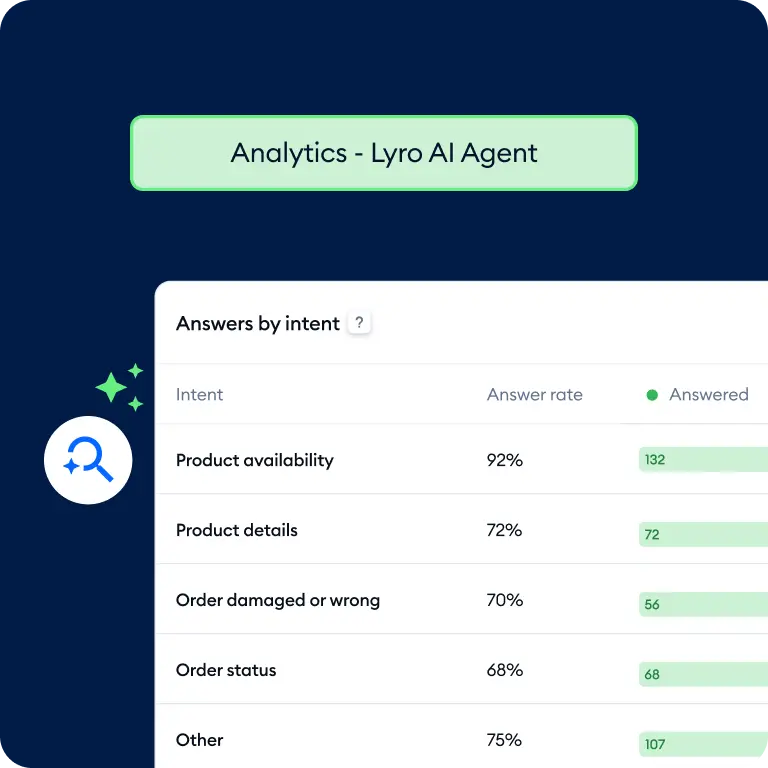
Features. A live chat and helpdesk platform, with the Lyro AI agent sitting on top of it, and Flows for the proactive no-code conversion paths. Lyro handles the common questions, hands off to humans when it needs to, and takes support actions through connectors.
Pros. Lyro comes standalone, marketed explicitly to bolt onto Zendesk or Salesforce or any other helpdesk, so the layer is buyable without the desk under it. Tidio claims Lyro solves up to 67%, and backs that with a money-back guarantee if it does not reach at least 50%, the only performance guarantee anybody on this page publishes. The free tier covers 50 billable conversations.
Cons. The bill stacks up. Billable conversations, Lyro conversations, then Flows visitors, three separate meters with three separate sliders, and the Plus tier starts at $300 a month before any usage lands on it. Its autonomous store actions are newer and they depend on the integration, so verify the specific action you need instead of assuming. No voice.
Pricing. Free (50 billable conversations), Starter $24.17/mo (100), Growth from $49.17/mo (250), Plus from $300/mo plus usage, Premium custom. Lyro is an add-on, from $32.50/mo for 50 AI conversations, so roughly $0.65 each at entry volume. Flows from $24.17/mo. See the numbers in our Tidio AI pricing breakdown.
Verdict. Best for a small team that wants something live inside this week. At scale those three meters get expensive, and that is mostly what our Tidio Lyro alternatives roundup is about.
7. Freshdesk
Cheapest seat here that still arrives with a real autonomous agent on it, and not only a suggestion box.
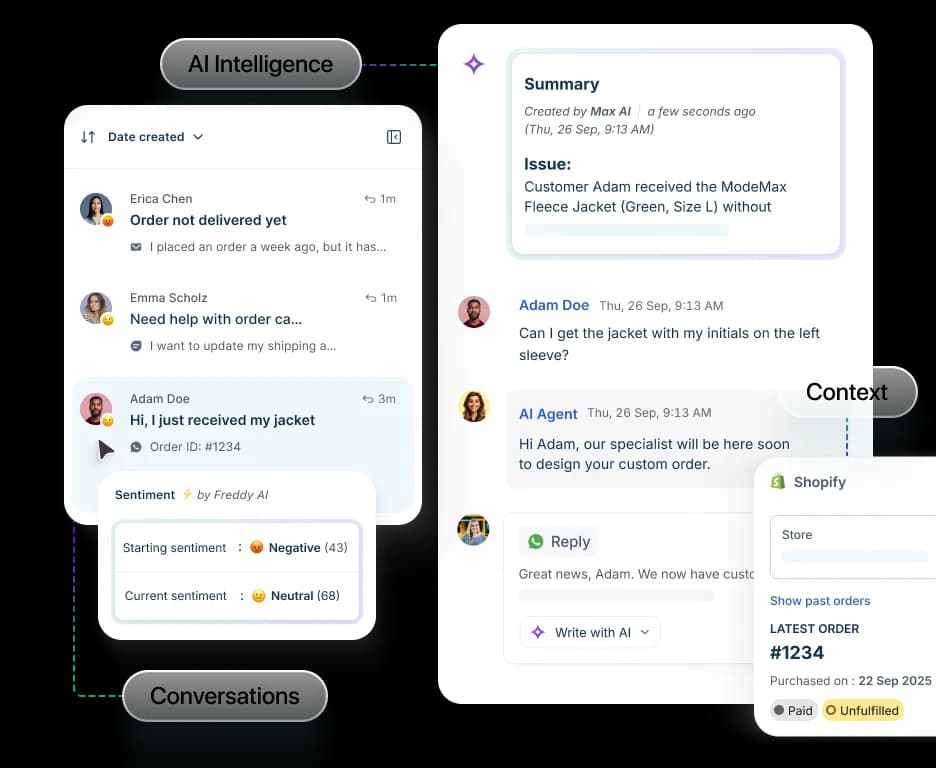
Features. An omnichannel helpdesk, so ticketing and self-service portals and automation, where Freddy AI Agent runs prebuilt workflows over first-line volume while Freddy Copilot drafts for the agents. Voice is covered by Freshcaller, which is a separate product.
Pros. The Freddy AI Agent sits on all three paid plans, Growth at $19 an agent included, and that is the single cheapest legitimate entry to an autonomous agent in the whole comparison. A real free plan exists too. Knowledge base tooling is solid for the money you pay.
Cons. Sessions get metered whether the agent resolves anything or not, the opposite of how eDesk defines an outcome. An email session is a 72-hour window counted from the customer's first message, so a slow thread and a fast thread cost you the same. Those first 500 sessions are a one-time allowance, not a monthly refill. And it is horizontal, so the store actions depend on connectors.
Pricing. Growth $19 per agent a month, Pro $55, Enterprise $89. Freddy AI Agent is included on all three, with the first 500 sessions included, then $49 per 100 sessions after that, which works out at $0.49 a session. Freddy Copilot is a $29 per agent add-on, on Pro and above. The gates are all in our Freshdesk pricing guide.
Verdict. The budget answer, as long as what you model is sessions and not resolutions. The ceiling is covered in our Freddy alternatives list.
8. Decagon
The enterprise agentic option. One of only two here that will answer a phone.
Features. Autonomous agents over voice and chat and email, configured with natural-language Agent Operating Procedures in place of flow builders. Duet generates those procedures, tests them, refines them, and Duet Autopilot is the current flagship. Observability is transparent, so every decision traces back to the model calls behind it, the workflow triggers, the knowledge articles.
Pros. It executes refunds and cancellations, account changes too, and the named outcomes are specific. Chime at 70% resolution across chat and voice with a 60% support-cost decrease. Duolingo at 80% deflection, and Noom moving 59% to 68% inside thirty days. Non-technical teams own the agent logic while the engineers keep the guardrails and integrations and versioning, which is a clean split.
Cons. No published price at all. /pricing returns a 404, and every route on the site is a demo request. The docs sit behind a login, so how the thing gets configured cannot be evaluated before you talk to sales. No published implementation timeline either. And it is enterprise-shaped, which for most mid-market ecommerce teams just means the wrong buying process.
Pricing. Quote only. In January 2026 Decagon raised a $250M Series D at a $4.5 billion valuation, which tells you the segment it is selling into. What can and cannot be sourced is covered on our Decagon pricing page.
Verdict. The pick when you are enterprise and phone-heavy, and buying a platform instead of a tool. Store-specific fit is covered in our Decagon for ecommerce write-up, then the rest of it in our Decagon review.
9. Sierra
The other enterprise voice-capable agent here, and the purest expression of outcome pricing anywhere in the category.
Features. An agent platform, resolving across voice and chat, email and messaging, and completing transactions inside systems of record. 33 published customer case studies sit there to read through.
Pros. The outcomes are the strongest in this roundup, and Sierra is careful with the wording, keeping containment and resolution apart instead of blurring the two. Ramp at 90% case resolution. Brex 90% faster with 15,000+ hours saved a year, Wilson at 77% containment, SoFi at 61% containment across 50,000+ conversations, and Minted at 65% for the cases its agent is designed to handle. Vivid Seats went live in under four weeks.
Cons. Sierra publishes no price. No per-outcome amount, no minimum, no volume tiers, and the docs are gated behind a notice that the products are confidential. Its own Outcomemaxxing post concedes outcome pricing "is more complex than seat-based or consumption pricing" and only works where the software is highly autonomous and highly attributable, adding that Sierra is not dogmatic about it and does consumption-style work where that fits better. Useful honesty. It also means the model you sign may not be the model from the website.
Pricing. Quote only, and outcome-oriented. That $950M raise in May 2026, at a valuation over $15 billion, is the founder's own figure, and it sets the buyer profile.
Verdict. Right for a large enterprise that can attribute its outcomes and negotiate a contract for them. For a store doing a few thousand tickets a month, the procurement overhead on its own is the disqualifier. More in our Sierra AI pricing breakdown, plus the Sierra reviews.
What each one actually costs at your volume
Engaige will not hand you a number without a call. So the only move left is to price everything else, then see where a flat quote would have to land in order to compete. Plug your own volume in below.
Two patterns fall out of that table almost immediately. Per-seat tools get decided by headcount and not by your ticket volume, so a five-person team on Zendesk Suite Team is already paying $275 before one single AI resolution happens. Per-resolution meters do the other thing, they scale the bill along with success, so the better your agent gets the more you owe, unless the rate is flat.
How to actually pick
Four questions, in order. The first one on its own eliminates most of the list.
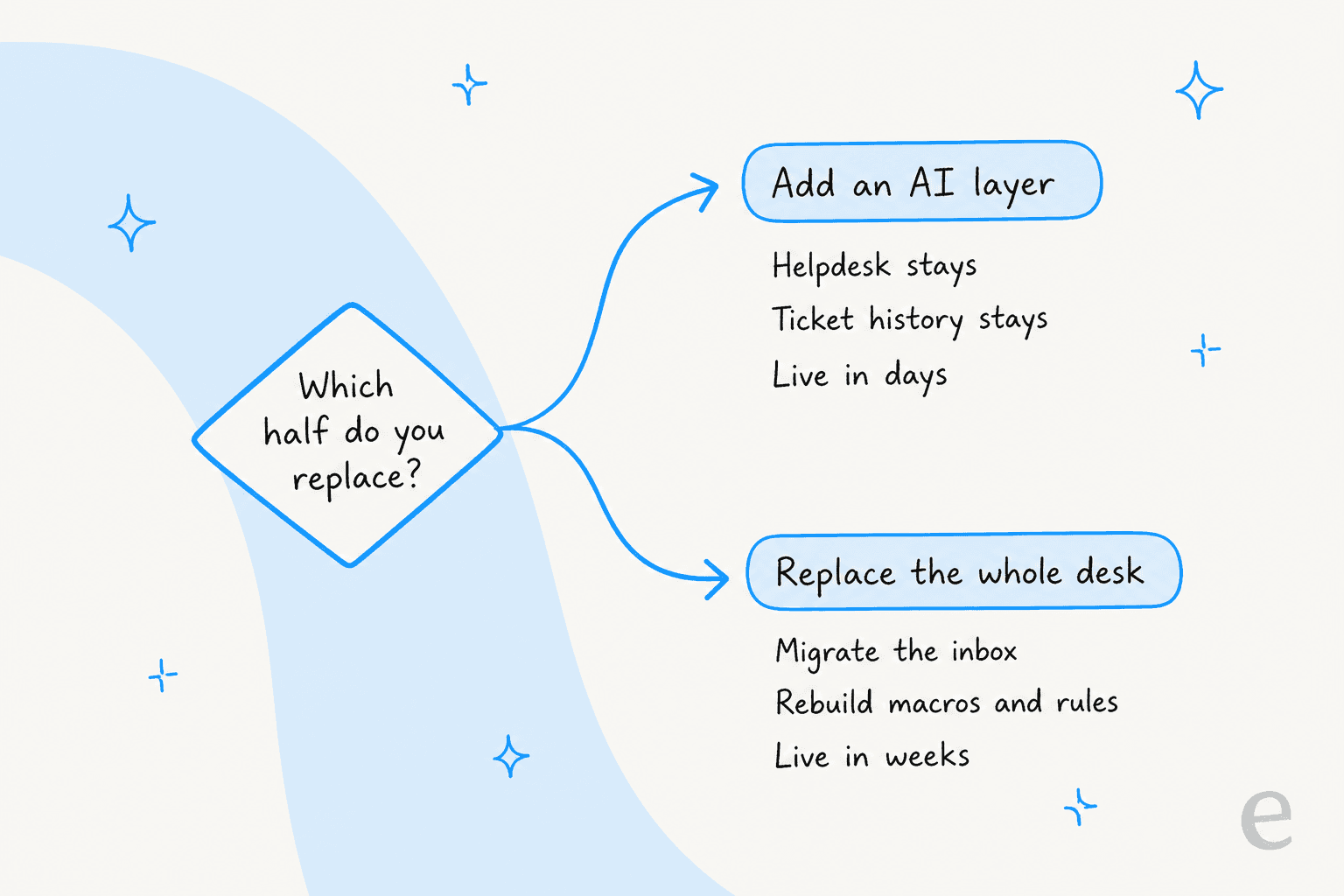
- Do you want to leave your helpdesk? If no, then the shortlist is eesel, Richpanel's portal, Tidio's standalone Lyro, or Engaige itself. If yes, it becomes Gorgias for Shopify, eDesk for marketplaces, Freshdesk on budget, Zendesk for breadth.
- Does anyone call you? Voice kills off the text-only options outright. Zendesk, Decagon and Sierra answer phones. Gorgias and eDesk sell voice as an add-on, while Engaige, eesel and Tidio do not have it.
- Do your tickets need actions or answers? Where most of the volume is WISMO, refunds and returns, you need something that writes into your store, and the best AI helpdesk for ecommerce comparison is the right next read. Where it is product questions and policy instead, an AI shopping assistant or just a good knowledge base does more for less money.
- Can you see it on your own tickets first? This one I would refuse to skip. Ask for a dry run over your ticket history, broken per ticket type, before anything at all goes autonomous. In our own trial data the gap between "88% directionally right" and "12% sent as-is" was the entire story, and no vendor's marketing page was ever going to tell you which of the two you were buying.
Whatever ends up on your shortlist, price it per resolved ticket instead of per unit, and get the resolution definition in writing while you are at it. The rest of the evaluation is covered in our guide to AI for customer service automation.
One last platform note. Almost every tool here runs deepest on Shopify, so if you sell on WooCommerce instead, or on Magento, check the specific store action you need before signing anything.
Frequently Asked Questions
How much does Engaige cost?
letsengaige.com/pricing returns a 404 and every call to action on the site is "Book a demo", so the only way to get a firm number is a sales call. That is unusual in this category rather than universal: Gorgias, eDesk, Zendesk, Freshdesk, Tidio and eesel all print rates you can model first. If you want a starting point for the maths, our breakdown of AI customer service cost walks through the per-ticket version.What are the best Engaige alternatives for a Shopify store?
Does Engaige do phone or voice support?
Can I keep my current helpdesk instead of switching?
Which Engaige alternative is cheapest per resolved ticket?
What should I ask a vendor about their resolution rate?
Do any Engaige alternatives handle refunds and returns, not just answers?
Is there a free Engaige alternative to start with?



Article by
Riellvriany Indriawan
Riell is a designer and writer at eesel AI with about two years of experience researching CX platforms, AI chatbots, and helpdesk software. She combines her design background with a sharp eye for how these tools actually look and feel in practice — making her comparisons unusually visual and user-focused.