


Why sellers look for eDesk alternatives
Let me be fair to eDesk first, because it earns its fans. It's built specifically for ecommerce and marketplace support, it connects to a huge spread of channels (Amazon, eBay, Walmart, Shopify, TikTok Shop, social, email, live chat), and the reviews that praise it nearly all praise the same two things: easy setup and unusually good human support. As one Shopify seller put it, "it's wonderful to have our eBay, Amazon and Shopify messages all come into one place."
The pain shows up later, and it's consistent across G2 and the Shopify store:
- Price creep. This is the loudest complaint by a distance. The harshest review, titled "Sky-High Prices - Plunging Value," describes a 47% rate hike, then a proposal to push the bill to 245% of its current amount, and a quiet switch from an "unlimited user" model to per-seat. Pricing volatility is the recurring theme, not a one-off.
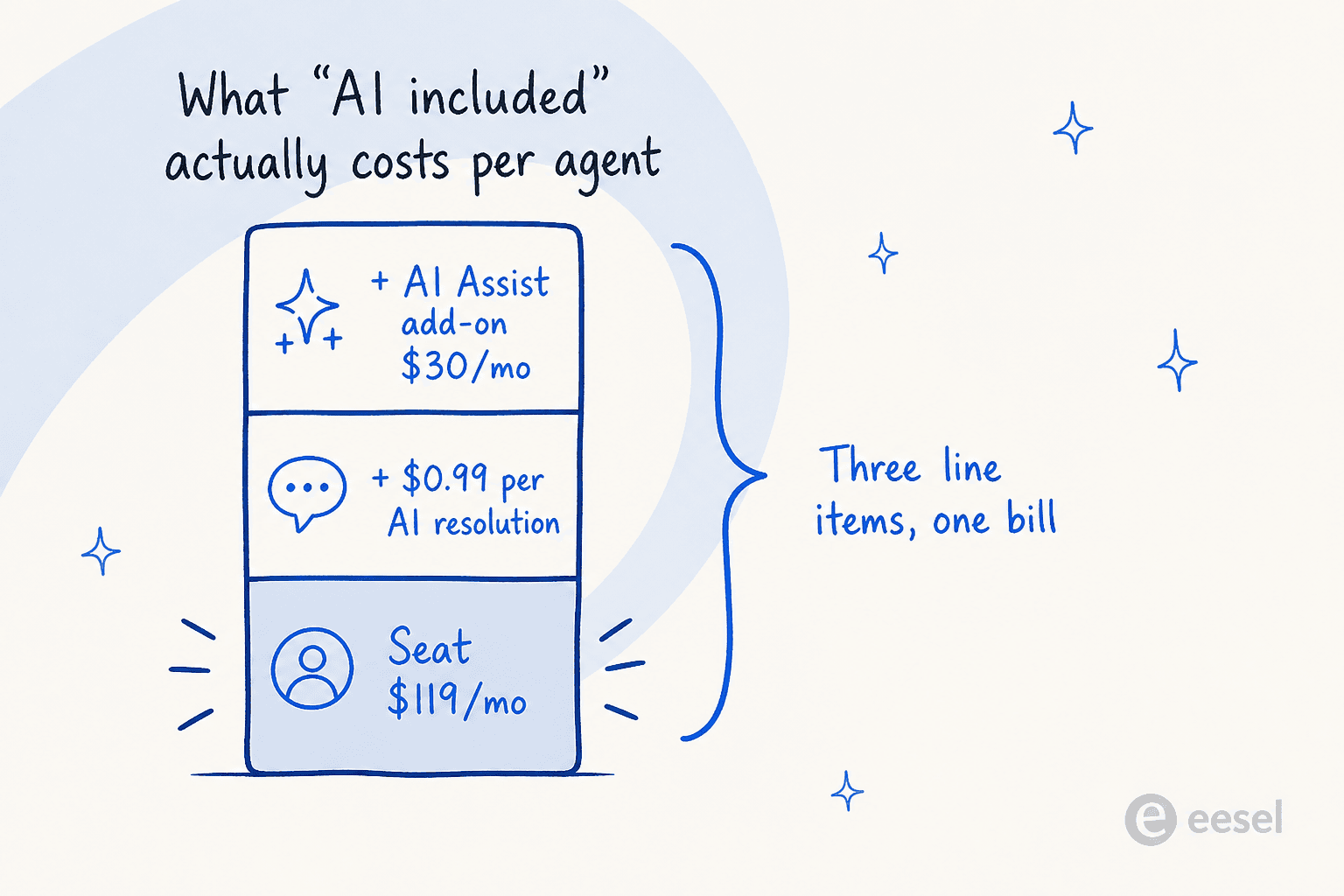
- "AI included" hides the real number. The AI Agent is in every plan, but you pay $0.99 per automated resolution, and the AI Assist suggestions are a separate per-agent add-on. The sticker price and the invoice are two different things.
- The AI feels dated. A 2026 Shopify reviewer noted the "integrated AI system seems a little weak compared to current" competitors, and an older review flagged AI summaries that ran longer than the email they summarized.
- Billing and UI friction. One CEO described "a maze of billing errors" where support couldn't explain their own ticket counts, and another reviewer said the knowledge base felt like "an afterthought," buried behind a three-dot menu.
Here's the part worth slowing down on, because it's the bit that surprises people. When a tool says "AI included," it usually means three line items, not one.
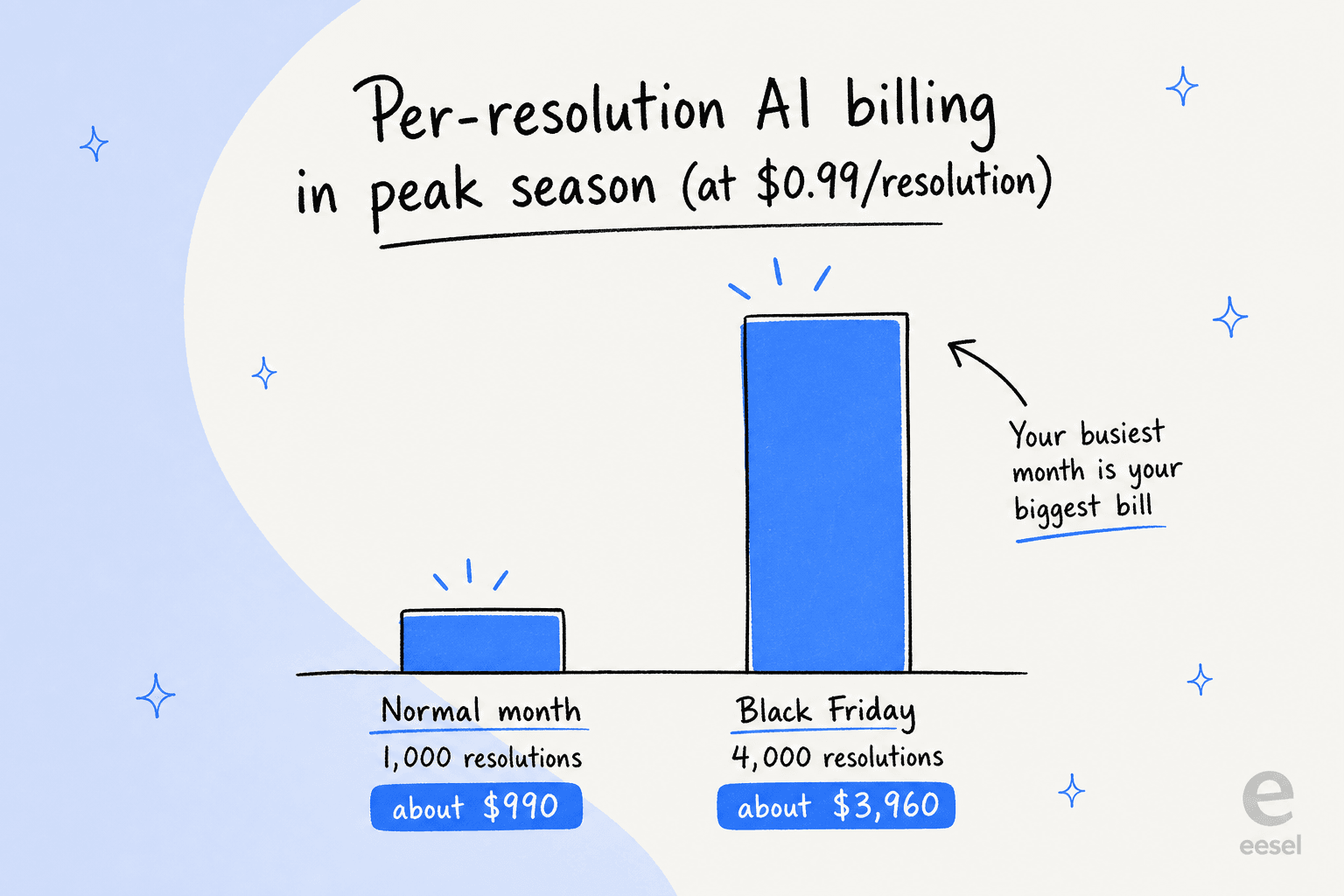
And the per-resolution piece has a nasty habit: it scales with your busiest month. If you do 1,000 AI resolutions in a normal month and 4,000 over Black Friday week, your AI bill roughly quadruples right when your margins are tightest. We modelled this for a real ecommerce customer, and the seasonal swing on per-resolution pricing was stark.
None of this makes eDesk a bad product. It makes it a product worth pressure-testing against the field, especially if you're not a pure marketplace seller paying for marketplace breadth you don't use.
How I picked these eDesk alternatives
I run AI support for a living, so my method here is the same one I'd use for our own rollouts: I dug into each vendor's live pricing page, product docs, and AI behaviour, then cross-checked the marketing claims against what real users say on G2, Capterra, and the Shopify App Store. I weighted four things that actually decide whether a switch is worth it:
- Total cost, not sticker price. Seat price plus AI metering plus add-ons. The honest number.
- Marketplace and channel coverage. Can it actually do what eDesk does for Amazon, eBay, and Walmart sellers?
- AI quality and safety. Does it resolve real tickets, and can you stop it before it hallucinates?
- Time to value. How fast can a small team get live without a consultant.
A quick note on intent: a helpdesk migration is a big lift, so for several teams the better answer isn't a different inbox at all, it's adding a stronger AI layer to the one they have. I've flagged where that applies.
The 9 best eDesk alternatives at a glance
Here's the short version before the deep dives. Prices are the entry paid tier per agent/month unless noted.
| Tool | Best for | Starting price | AI pricing model | Marketplace inbox (Amazon/eBay) | Free option |
|---|---|---|---|---|---|
| eesel AI | Adding AI to your current helpdesk | Usage-based, ~$0.40/ticket | Pay per ticket, no seat fees | Via your helpdesk + Shopify | $50 trial credit |
| Gorgias | Shopify-first brands | from $10/mo (Starter) | $0.90-$1.00 per resolution | Limited (Shopify-centric) | 7-day trial |
| Re:amaze | Marketplace + multichannel sellers | $29/seat (or $59 flat) | $0.85 per resolution | Yes | 14-day trial |
| Richpanel | AI-first ecommerce support | $500/mo + seats | $0.25 per conversation | Yes (incl. Amazon) | 30-day guarantee |
| Zendesk | Scaling and enterprise | $55/agent (Suite Team) | Per automated resolution | Via app + connectors | 14-day trial |
| Freshdesk | Budget all-rounder | $19/agent (Growth) | $49 per 100 sessions | Via marketplace apps | Free 1-2 agents, 6mo |
| Help Scout | Simple, relationship-led teams | $25/user | $0.75 per resolution | Limited | Free up to 5 users |
| Zoho Desk | Best value / Zoho users | $7/agent (Express) | Zia included | Via integrations | Free Forever, 3 users |
| Gladly | Premium retail, voice-heavy | Contact sales (~$120/seat) | $1.50 per AI resolution | Limited | Shopify trial |
If you want a wider net than this, our roundups of AI customer service for ecommerce and the top AI customer service tools go broader still.
Not sure which row is you? This quick picker narrows it down.
The 9 best eDesk alternatives for 2026
1. eesel AI
Best for: teams who want the highest AI resolution rate without ripping out their helpdesk.

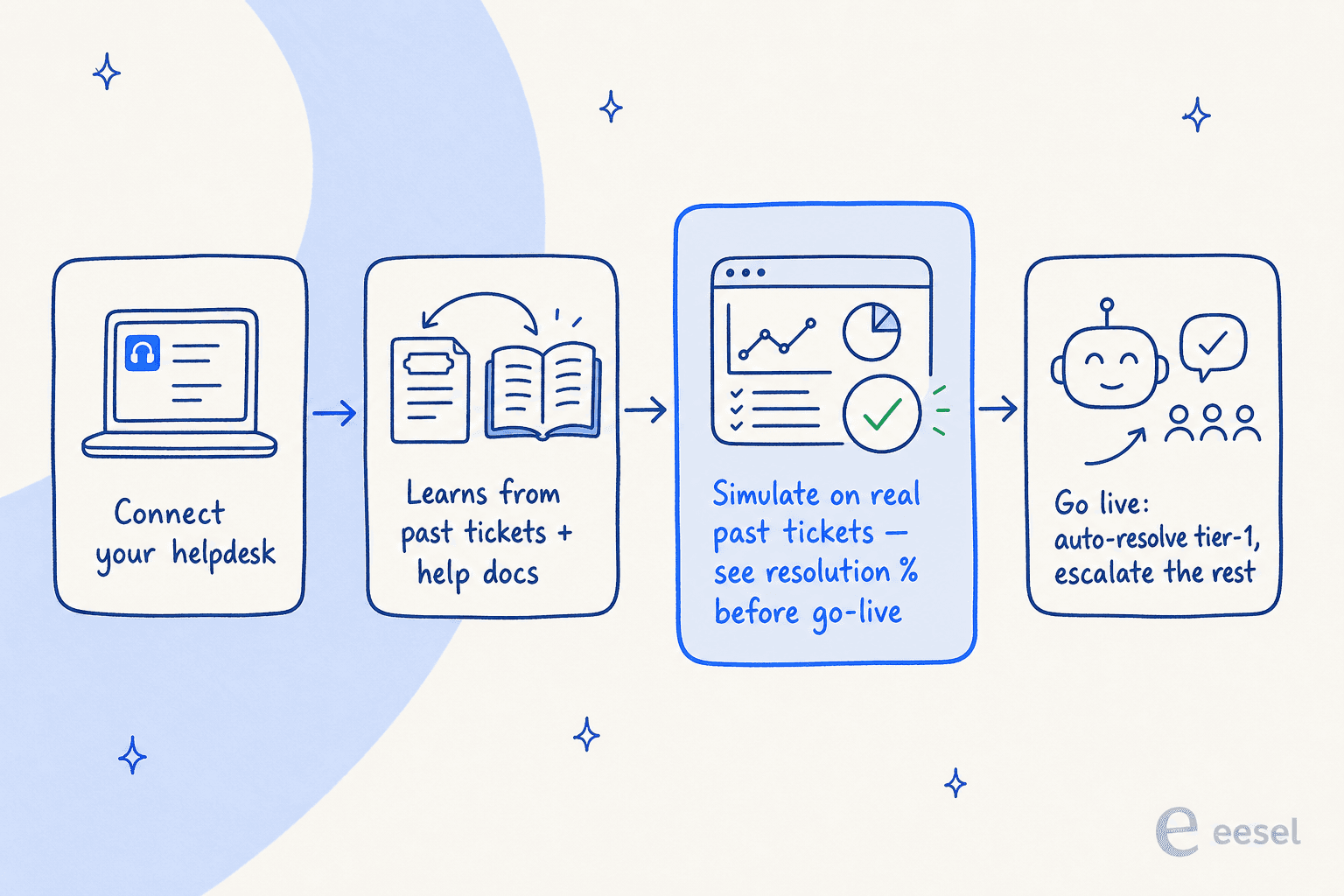
I'll be transparent: this is the tool I help build, so take the framing with that in mind. But it solves a specific eDesk problem cleanly. Instead of being another inbox you migrate into, eesel AI is an AI layer that sits on top of the helpdesk you already use, including Zendesk, Freshdesk, Gorgias, and Front, plus Shopify for order context. It learns from your past tickets and help docs on day one, drafts and resolves tier-1 work, and escalates the rest.
The piece that matters most for an ecommerce team burned by a flaky bot is the safety model. You can run a simulation on past tickets and see exactly what the AI would have answered, and what its resolution rate would be, before it touches a live customer.
Pros:
- No migration: keep your current helpdesk and channels.
- Trains on past tickets, the single most-requested capability I hear from sellers.
- Simulation mode shows resolution rate before launch, with confidence-based routing to guard against hallucinations.
- Usage-based pricing with no per-seat fees.
Cons:
- It's an AI layer, not a full helpdesk, so you still need an inbox underneath.
- No native marketplace inbox of its own; that comes from your connected helpdesk.
Pricing: usage-based at roughly $0.40 per resolved ticket, no seat fees, no platform minimum, with $50 of free trial credit to start. Full detail on the eesel pricing page.
My take: if your eDesk frustration is really about AI quality and cost rather than the inbox itself, this is the lowest-risk fix. Gridwise, for example, saw eesel resolve 73% of tier-1 requests in the first month. If you genuinely need a new marketplace inbox, keep reading.
2. Gorgias
Best for: Shopify-first brands that want support to drive revenue, not just close tickets.
Gorgias is the ecommerce helpdesk most Shopify merchants reach for first, and for good reason: orders, customers, and store data live natively in the ticket, so agents cancel, refund, and upsell without leaving the conversation. It claims to power conversations for 40% of Shopify brands. Its AI Agent is pre-trained on a billion-plus ecommerce conversations and is pitched as much at driving sales as at deflection.
Pros:
- The deepest Shopify integration of any tool here.
- Strong automation for refunds, order edits, and subscriptions.
- Conversational, non-pushy upsell that some brands report real ROI on.
Cons:
- Pricing is the top objection: roughly 3x Zendesk for similar ticket volumes, per community consensus.
- AI is billed per resolved conversation and each one counts as a billable ticket.
- Weaker for non-Shopify marketplaces than eDesk.
Pricing: four self-serve tiers from $10/mo (Starter, 50 tickets) up to $750/mo (Advanced), plus the AI Agent at $0.90 per resolution annually or $1.00 monthly. The full math is in our Gorgias pricing breakdown.
My take: if you're 90% Shopify, Gorgias is a sharper fit than eDesk. If you live in Amazon and eBay, its marketplace story is thinner, and the per-resolution AI cost deserves a hard look. Browse more Gorgias alternatives if it doesn't fit.
3. Re:amaze
Best for: marketplace and multichannel sellers who want the closest like-for-like eDesk swap.
Re:amaze (owned by GoDaddy) is probably the most direct philosophical match for eDesk: a unified inbox for email, social, SMS, voice, and chat aimed squarely at small-to-mid ecommerce teams, with order data surfaced inside conversations and proactive engagement tools built in. It ships live chat, chatbots, and a real-time visitor dashboard as first-party features rather than add-ons.
Pros:
- True multichannel inbox with strong ecommerce order context.
- Unusual flat-rate Starter plan ($59/mo for unlimited team members, 500 conversations).
- Proactive "Cues" and co-browsing for higher-touch selling.
Cons:
- The AI Agent is still labelled Beta and feels earlier-stage than Gorgias or Richpanel.
- Per-seat pricing on higher tiers adds up for larger teams.
- Reporting depth is modest.
Pricing: Basic $29/seat/mo, Pro $49, Plus $69 (annual rates are ~10% lower), or the $59 flat Starter plan, with AI resolutions at $0.85 each across plans.
My take: if eDesk's inbox is what you like but the price is what hurts, Re:amaze is the most natural landing spot, especially for teams under a few hundred conversations a month.
4. Richpanel
Best for: ecommerce teams that want an AI-first helpdesk with marketplace coverage.
Richpanel leads with "hire an AI support team" and frames the whole purchase as hiring employees rather than buying software. Its unified inbox covers email, chat, social, SMS, voice, and Amazon marketplace, and its AI team (Frontline, Copilot, QA, and a CX Manager layer) resolves order tracking, returns, and subscription cancellations end-to-end. The QA AI that reviews every reply before it sends is its direct answer to the hallucination worry.
Pros:
- Genuinely marketplace-aware, including native Amazon.
- A 50% autonomous resolution guarantee in 30 days, or your money back.
- Low per-conversation AI cost at $0.25.
Cons:
- The $500/mo base plus $100/seat structure is steep for very small teams.
- Newer and smaller (2,000+ brands) than the incumbents.
- Best ROI only kicks in around 2,000+ conversations/month.
Pricing: $500/mo for the AI Agent plan plus $0.25 per conversation and $100/seat/month for humans; a sample 2-agent, 3-seat bill lands near $800/mo. Enterprise is custom.
My take: for a marketplace seller doing real volume who wants AI to do the heavy lifting, Richpanel is one of the strongest eDesk swaps here. For a five-ticket-a-day shop, the base fee is hard to justify.
5. Zendesk
Best for: teams scaling past ecommerce into complex routing, or heading toward enterprise.
Zendesk is the heavyweight: a full resolution platform with AI agents, omnichannel messaging, voice, QA, workforce management, and an 1,800-app marketplace. It's not ecommerce-specific, but with marketplace connectors it can do most of what eDesk does, and it scales far beyond it. It was named a Leader in the 2025 Gartner Magic Quadrant for CRM customer engagement.
Pros:
- The deepest feature set and integration ecosystem here.
- Strong reporting and QA across both human and AI interactions.
- Scales cleanly from mid-market to enterprise.
Cons:
- Layered pricing (seat + per-resolution AI + $50/agent add-ons) is the classic surprise-bill pattern.
- Overkill for a small marketplace seller.
- The entry $19 plan includes no AI at all.
Pricing: Suite Team $55/agent/mo, Suite Professional $115 (most popular), with AI agents billed separately per automated resolution. See our notes on Zendesk's outcome-based pricing.
My take: if your reason for leaving eDesk is "we've outgrown it," Zendesk is the safe scale-up. If it's "this is too expensive and complex," Zendesk is the wrong direction, and an AI layer on a simpler inbox will serve you better.
6. Freshdesk
Best for: budget-conscious teams that still want a credible AI roadmap.
Freshdesk is the value all-rounder: a clean ticketing platform with omnichannel support, a generous free tier, and Freddy AI agents that take real actions. It's used by 74,000+ businesses and leans hard into agentic AI now, with 50+ prebuilt workflows. Marketplace coverage comes through its app marketplace rather than natively.
Pros:
- A real free tier (1-2 agents for six months), rare among serious helpdesks.
- Low entry pricing and a gentle learning curve.
- Freddy AI Copilot is solid for agent assist.
Cons:
- Marketplace support is bolt-on, not native like eDesk.
- Freddy AI is consumption-priced and climbs at volume.
- Advanced workflows live on higher tiers.
Pricing: Growth $19/agent/mo, Pro $55, Enterprise $89 (annual), with the Freddy Email AI Agent including 500 sessions then $49 per 100 sessions. See the full Freshdesk pricing guide.
My take: for a smaller seller who wants to cut the eDesk bill without losing a real product, Freshdesk is the safe value pick. Pair it with an AI layer if Freddy's per-session cost gets steep.
7. Help Scout
Best for: small, relationship-led teams who want simplicity over marketplace breadth.
Help Scout is the anti-enterprise option: an email-like shared inbox with a knowledge base, the Beacon widget, live chat, and a layer of AI, all designed to be learned in under an hour. Its AI Answers agent resolves about 73% of interactions on average. It's not a marketplace tool, so this is a fit only if your support is mostly email and chat.
Pros:
- The easiest tool here to adopt; clean, low-clutter inbox.
- Honest AI Answers resolution stats.
- Free tier for up to 5 users.
Cons:
- No native marketplace inbox; weak fit for Amazon/eBay sellers.
- AI Answers at $0.75/resolution stacks on top of seat cost.
- Reviewers note thin reporting and a history of pricing-model flip-flops.
Pricing: Standard $25/user/mo, Plus $45, Pro $75 (annual), with AI Answers at $0.75 per resolution and a free plan for up to 5 users.
My take: if you left eDesk because it felt too heavy and you don't need marketplaces, Help Scout is a breath of fresh air. If marketplaces are core, it's not your tool.
8. Zoho Desk
Best for: value seekers and teams already in the Zoho ecosystem.
Zoho Desk is the price champion. A genuine Free Forever plan and a $7/agent entry tier undercut nearly everyone, and Reddit consistently frames it as doing "almost everything Zendesk does at half the cost." Its Zia AI handles self-service, agent assist, and automation, and it plugs natively into the wider Zoho suite. Marketplace coverage comes via integrations and bridges.
Pros:
- Outstanding value: Free Forever (3 users), then $7-$40/agent.
- Strong automation (Blueprint, SLAs, routing) at the price.
- Deep fit if you already use Zoho CRM.
Cons:
- Zia AI is widely seen as underwhelming; the best AI features are gated to Enterprise.
- Steep learning curve and a cluttered UI are common complaints.
- No native marketplace inbox.
Pricing: Free Forever (3 users), Express $7/agent/mo, Standard $14, Professional $23, Enterprise $40 (annual), with Zia included. See the AI integrations for Zoho Desk if Zia falls short.
My take: for a cost-driven switch where marketplaces aren't central, Zoho Desk is the best value here. Just plan to bolt on a stronger AI layer, because Zia is the weak link.
9. Gladly
Best for: premium, high-touch retail brands with heavy voice and a people-not-tickets model.
Gladly is the premium outlier. Instead of tickets, it models a single lifelong conversation per customer across chat, voice, email, SMS, and social, and it's built explicitly for consumer brands (its roster includes TUMI, UGG, Crate & Barrel, and Nordstrom). Its Sidekick AI resolves and takes real actions, and it rates a strong 4.7/5 from 1,112 reviews on G2.
Pros:
- Genuinely excellent unified customer profile and voice support.
- High AI resolution claims (76%) and strong CSAT.
- Loved by premium retail teams.
Cons:
- Expensive and largely sales-gated; not built for small teams.
- Segmented reporting is the top user complaint.
- A dense interface with a real learning curve.
Pricing: core platform pricing is contact-sales, but the Shopify plan exposes real rates: a $250/mo spend cap, $1.50 per AI resolution, and $120/seat/month.
My take: if you're a premium brand where every customer interaction is a relationship and phone matters, Gladly is special. For a lean marketplace seller, it's more platform (and more cost) than you need.
So which eDesk alternative should you choose?
Stripping it back to the decision that actually matters:
- You love eDesk's inbox but hate the bill → Re:amaze is the closest swap; Zoho Desk if you want to cut cost hardest.
- You're Shopify-first → Gorgias, with the per-resolution AI cost checked against your volume.
- You're a marketplace seller doing real volume → Richpanel for AI-first, or Re:amaze for a gentler price.
- You're scaling toward enterprise → Zendesk.
- Your real problem is AI quality and cost, not the inbox → add eesel AI on top of what you already run.
The one trap to avoid: don't switch helpdesks just to get better AI. A migration is weeks of work and risk, and in my experience the AI layer is usually the thing you can fix in an afternoon.
Try eesel for your ecommerce support
If you got here because eDesk's AI felt weak or its per-resolution bill kept climbing, that's the exact gap eesel AI was built to close. It plugs into the helpdesk you already run (Zendesk, Freshdesk, Gorgias, Front) and into Shopify for live order context, learns from your past tickets and macros, and only auto-replies when it's confident, escalating everything else.
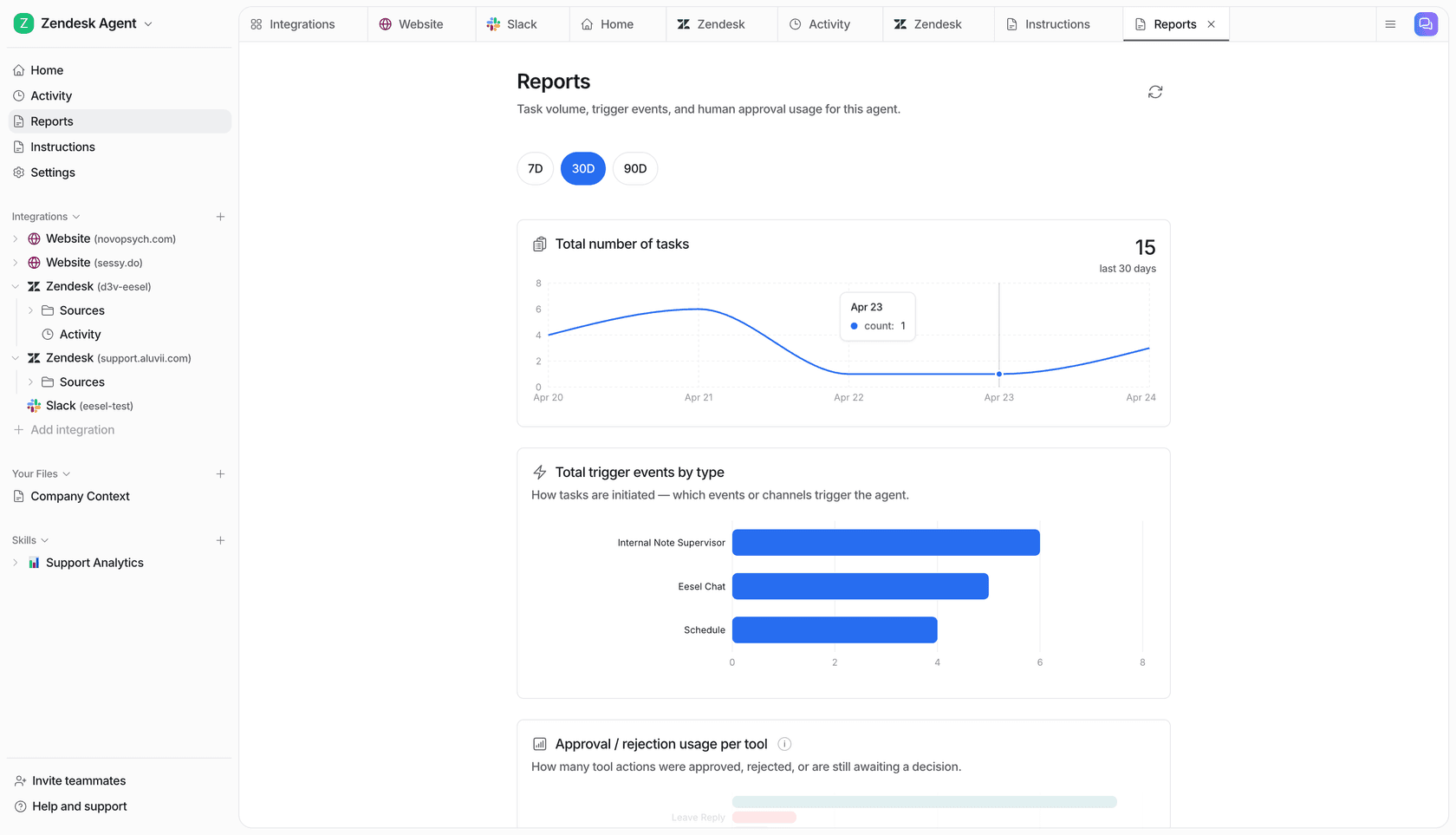
The part marketplace teams tend to like most: you can simulate on your past tickets and see its resolution rate before it ever answers a customer, so going live isn't a leap of faith. Pricing is usage-based at about $0.40 per ticket with no seat fees, which sidesteps both the per-seat creep and the Black-Friday per-resolution spike. You can try eesel free with $50 of credit, no credit card, and see your own numbers in an afternoon.
Frequently Asked Questions
What is the best eDesk alternative in 2026?
How much does eDesk cost, and why do people look for cheaper eDesk alternatives?
Are there free eDesk alternatives?
Which eDesk alternative is best for Amazon and eBay sellers?
Can I add AI to my existing helpdesk instead of switching off eDesk?
How is eesel AI priced compared to eDesk's per-resolution model?
Do eDesk alternatives hallucinate, and how do I keep AI answers safe?


Article by
Kurnia Kharisma Agung Samiadjie
Kurnia is a software engineer and writer at eesel AI with two years of SEO experience, writing about AI tools, helpdesk software, and customer support. He pairs a developer's understanding of how these products are built with search-driven research into what actually ranks and resonates with the people searching for them.