The 8 best Marblism alternatives in 2026

Kurnia Kharisma

Katelin Teen
Last edited August 27, 2026

Why look for a Marblism alternative
Let me be fair to Marblism first, because it does real things well. For a solo founder drowning in "100+ unread emails" and a social account that "hasn't been updated in weeks," the pitch lands: hire a five-to-seven person AI team for less than a streaming bundle. Setup needs no prompt-engineering, the named-persona approach (you talk to Eva, Sonny, Stan by name) clicks for people, and the social-media output in particular gets praised. One founder on Trustpilot put the appeal plainly:
"I like Marblism's approach to having distinct personalities with distinct skills. Instead of writing agents or workflows for all these tasks, you have agents that focus on being an EA, Blog Writer... I'm just about a year into Marblism and have 3 businesses running with these 'employees'."

I have spent the last three-plus years putting AI agents on live support queues, and the pattern I have watched over and over is that a tool which does seven jobs at once rarely does the one job you care about to a standard you can ship. That is the crack running through Marblism, and it shows up in three concrete places.
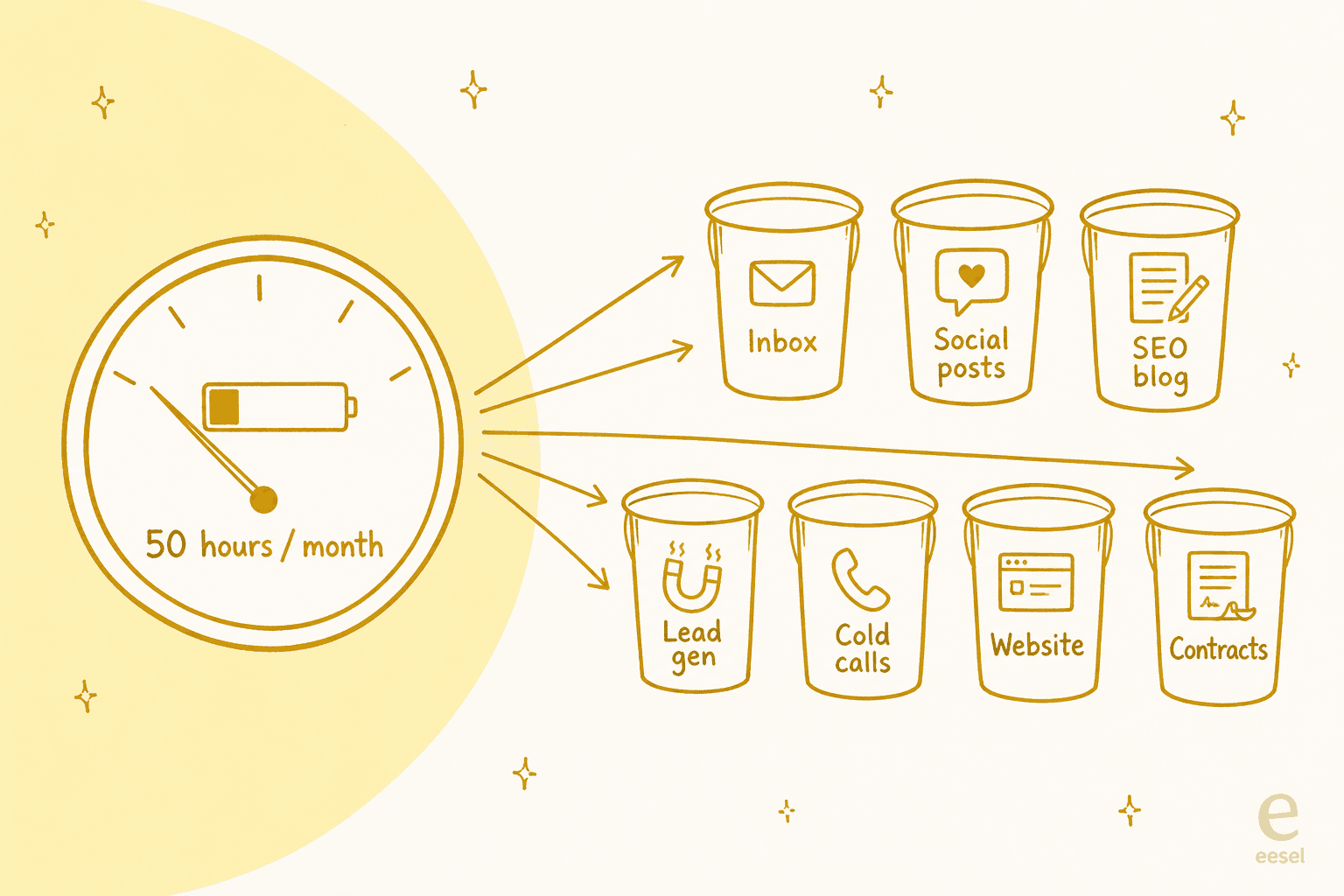
The 50 hours are one shared pool, split seven ways. Every plan bundles 50 hours of AI work a month across the whole team. Chat and quick tasks are free, but the "advanced AI actions" that do the real work all draw from the same meter. Run Sonny hard on social and there is less left for Stan's outreach or Penny's blogging. Breadth is the selling point, and it is also the constraint.
Quality is uneven outside social. The most organic community signal I found, a Reddit post whose title literally says it is not sponsored, praised the social output and then flagged the edges:
"Marblism is great for Facebook and LinkedIn, like the post quality blew me away (I started a comic strip series). However it doesn't do..."

A 2-star Trustpilot reviewer trying to use Eva just for email had a rougher time: "I have been working 10 days on it and it just can't get it right. Simply just trying to move all emails from a domain to a folder should be straight forward."
Billing is the sharpest, most repeated complaint. It spans both review platforms. The one organic G2 review is a 1-star billing dispute, and Trustpilot's recent 1-stars echo it:
"It's a scam DO NOT SIGN UP NOT WORTH IT... They use credits which go away in like 2-4 days!! The refused to respond within the 7 day money back guarantee, when I requested to cancel and get a refund and then continued to charge me..."
Marblism disputes these in its public replies, and 85% of Trustpilot reviews are 5-star, so this is a real friction point rather than the whole story. But when the recurring negative is about money and refunds, it is worth knowing before you hand over a card.
None of this makes Marblism a bad product. It makes it a broad one, and broad has a cost. The rest of this post is about the tools that make a different trade.
How I picked these alternatives
I did not want to hand you another list of seven look-alike bundles. So I sorted the field by the decision that actually matters when you leave Marblism: what do you want more of that Marblism gave you less of?
That splits cleanly into three groups, and it is the frame I would use before reading a single price.
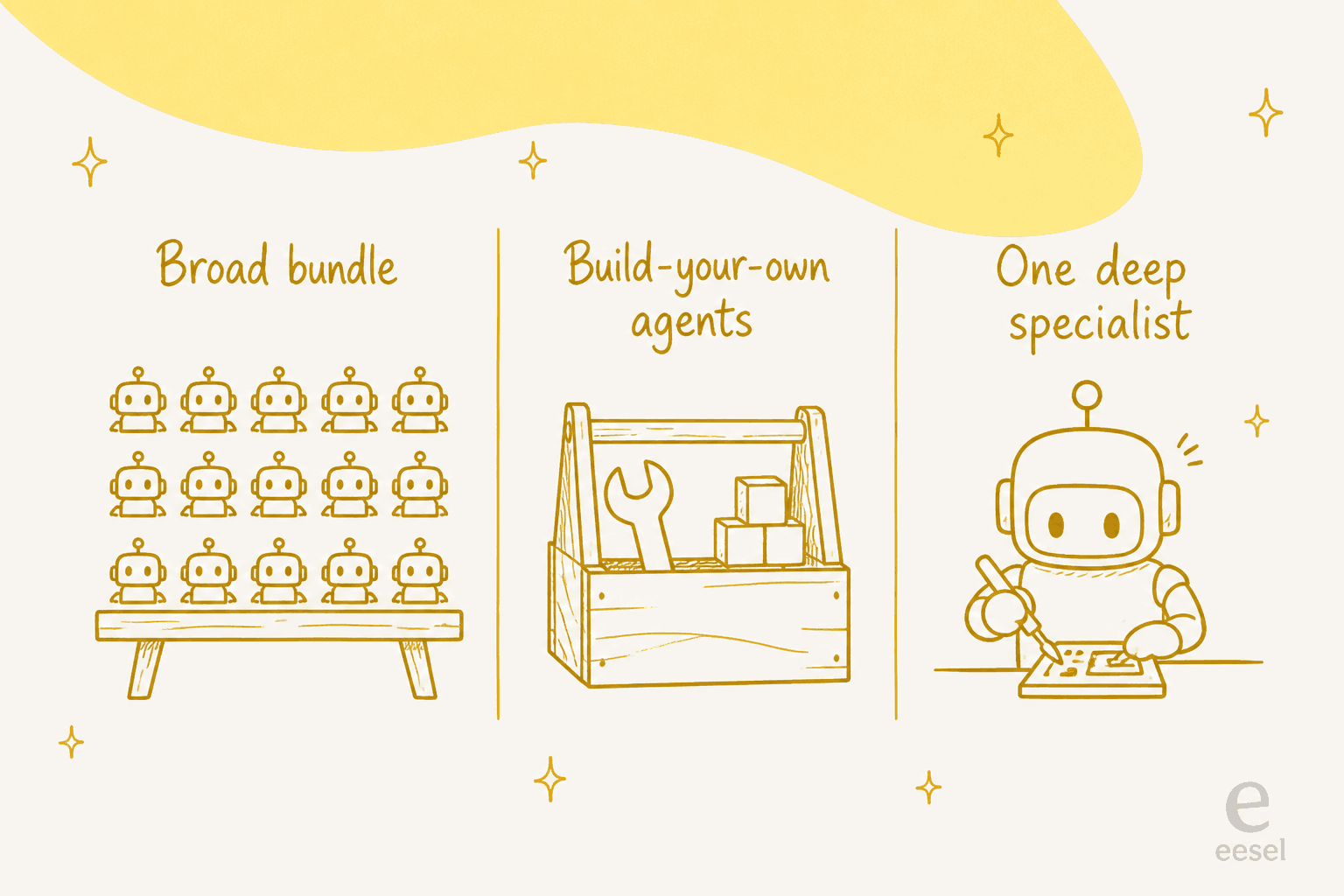
- Another broad bundle, cheaper or with more roles. Sintra AI and Sistava live here.
- A build-your-own agent platform, where you wire up the exact jobs you need. Lindy, Tasklet, and Cassidy.
- One deep specialist that owns a single function properly, the way the best AI agent examples tend to. eesel for support and content, Artisan and 11x for outbound.
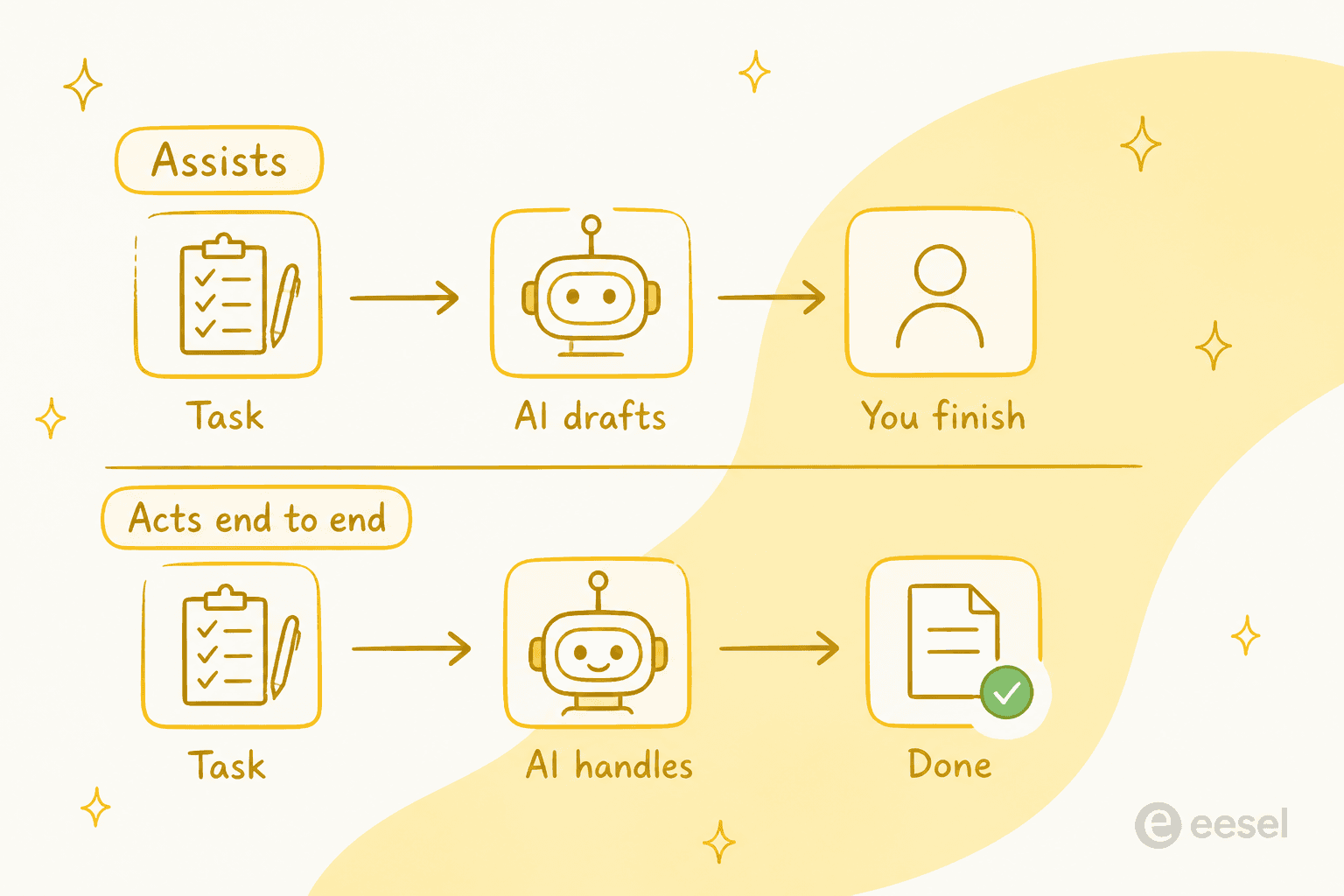
Inside those buckets I weighed four things: how deep the tool goes on its core job, whether it acts or merely drafts and hands back to you, how transparent the pricing unit is, and where the work happens (a separate dashboard, or inside the tools you already use). That "acts vs assists" line is the one most bundles blur, and it is the difference between saving time and creating a new review queue for yourself.
The 8 best Marblism alternatives at a glance
| Tool | Best for | Group | Pricing model | Starting price | Free option | Autonomy |
|---|---|---|---|---|---|---|
| eesel AI | Depth on support and content | Deep specialist | Fixed monthly credits (1 per ticket or chat); $4 per blog post | From $299/mo (500 credits), 100 free credits | Free tier + simulation | Acts, with confidence gating |
| Sintra AI | Widest cheap role bundle | Broad bundle | Flat + 250 credits/mo | $15.60/mo (annual promo) | 14-day money-back | Assists, some acting |
| Lindy | Agents inside Slack and your tools | Build-your-own | Per seat + shared credits | $29.99/mo per user | 7-day free trial | Acts, approval-gated |
| Cassidy AI | Enterprise governance + knowledge | Build-your-own | Seats + credits (quote) | Free Starter, Business by quote | Free Starter tier | Acts, admin-controlled |
| Artisan (Ava) | Outbound lead gen done for you | Deep specialist | Credits | $250/mo (Startups) | Free tier + trial | Acts autonomously |
| 11x | Scaling outbound at mid-market | Deep specialist | Quote-only | Demo-gated | No | Acts autonomously |
| Tasklet AI | Plain-English task automation | Build-your-own | Credits | $25/mo (Free tier exists) | Free tier | Acts on a schedule |
| Sistava | Role-based employees, tight gates | Broad bundle | Credits | $49/mo (Free tier exists) | Free tier (2,000 credits) | Draft-first, gated |
A note on the pricing column: these are not all the same unit, and that matters more than the headline number. Marblism meters hours, Sintra and Sistava meter credits, Lindy meters seats plus credits, and eesel meters credits you can actually count, one per ticket or chat. A cheap sticker price on an opaque credit can cost more than a clear credit unit once you are running real volume.
<label class="opt" for="q1">The one job I really need done is customer support or content</label>
<label class="opt" for="q2">I mostly want outbound leads and booked meetings</label>
<label class="opt" for="q3">I want to build my own agents across my existing tools</label>
<label class="opt" for="q4">I want the cheapest possible all-in-one bundle</label>
<label class="opt" for="q5">I'm an enterprise and need governance and a knowledge base</label>

<div class="ans a1">Go deep, not wide. <strong>eesel AI</strong> runs support and content as real teammates, trained on your own tickets and help center, and you can <a href="https://www.eesel.ai/pricing">simulate it on your data</a> before it answers anyone.</div>
<div class="ans a2"><strong>Artisan's Ava</strong> or <strong>11x's Alice</strong> own outbound end to end (sourcing, sequencing, replies, booking) far deeper than Marblism's Stan.</div>
<div class="ans a3"><strong>Lindy</strong> and <strong>Tasklet</strong> let you describe a job in plain English and run it inside Slack, Gmail, and your CRM, with approval gates.</div>
<div class="ans a4"><strong>Sintra AI</strong> is the closest match: 12+ role-based helpers on one low monthly plan. Watch the shared 250-credit cap.</div>
<div class="ans a5"><strong>Cassidy AI</strong> is built for it: SOC 2 Type II, a permission-aware knowledge base, and a services team to roll it out.</div>
1. eesel AI
Best for: teams that would rather one AI teammate do support or content properly than seven do everything at 70%.
I work on eesel, so treat this as the opinionated entry it is, but the reason it leads this list is the exact trade Marblism does not make. eesel sells AI teammates you hire for a defined job, not a generalist that dabbles in seven. The current roster is an AI helpdesk agent and an AI blog writer, each arriving with the skills, integrations, and company context for its role.
The difference is depth. Where Marblism's Eva drafts from what you tell it, the helpdesk teammate learns from your actual solved tickets, your help center, and your macros at once, and it lives inside Zendesk, Freshdesk, or Slack rather than a separate dashboard. It acts (replies, tags, escalates) instead of just suggesting, and low-confidence answers become drafts for review rather than a wrong reply to a customer.

The other thing Marblism cannot really offer is a dry run. Because we have watched confident-sounding bots quietly give wrong answers, every eesel rollout can be simulated against your historical tickets first, so you see the resolution rate and the gaps before it touches a live customer. In production, Gridwise resolved 73% of tier-1 tickets in the first month, and Smava runs 100,000+ German tickets a month fully automated.
Pricing: transparent and countable, with one fixed monthly plan from $299 for 500 credits (1 credit per ticket or chat) and no per-resolution surcharge, and you can start free with 100 credits and simulate before paying. Blog posts are $4 each. That is a different animal from a flat monthly hour pool.
Pros:
- Real depth in one job, trained on your own tickets and docs, not just a description
- Acts inside your existing helpdesk, with confidence-based gating and a simulation mode
- Countable per-action pricing and a genuine free start
Cons:
- It is not a seven-role bundle; there is no social-media or cold-calling employee
- The roster is focused (support, content, e-commerce), so a solo founder wanting one tool for everything will need to pair it with something else
Our take: if the job that actually keeps you up at night is support tickets piling up or a blog that never gets written, eesel goes far deeper than any generalist bundle, and you can prove it on your own data first. If you genuinely need one login for social, calls, and contracts too, it is not that tool, and that is fine.
2. Sintra AI
Best for: the founder who liked Marblism's idea and just wants the widest role bundle for the lowest price.
Sintra is the closest thing to a like-for-like swap. It packages 12+ named helpers (Soshie for social, Penn for copy, Cassie for support, Seomi for SEO, and so on) into one dashboard, with a shared "Brain AI" context layer and one-click task templates. If Marblism's persona model is what you liked, this is that, with more roles.
The catch is the same shape as Marblism's, moved to a different meter. Every plan includes 250 monthly credits shared across all helpers, and the most common complaint is that they drain faster than you expect:
"The Sintra helpers are trained to drain your credits. They do things that you don't ask them to do and they make frequent mistakes that you have to use credits to tell them to fix."
Pricing: a single all-in plan sold on billing length, with a running promo: roughly $48.50/mo for one month, down to $15.60/mo on the annual plan, all with 250 credits and a 14-day money-back guarantee. I dug into the model in my Sintra AI review.
Pros:
- Widest role roster of any bundle here, genuinely cheap on the annual plan
- Fast, no-code start with pre-built task templates
- 100+ languages and up to five business profiles
Cons:
- The 250-credit cap is shared, so heavy use hits the wall quickly
- Breadth over depth, and reviewers cite helpers acting unprompted and making mistakes that cost more credits to fix
- The permanent "sale" pricing makes the real rate hard to pin down
Our take: if you specifically want the bundle model and Marblism's roles were not quite enough, Sintra is the natural move. Just budget for the credit ceiling, and do not expect its support helper to replace a real helpdesk.
3. Lindy
Best for: teams that want AI agents working inside Slack and their existing tools, not in yet another tab.
Lindy is a no-code AI teammate you build by picking a trigger and describing the job in plain English. It is model-agnostic, it lives in Slack threads and via @mentions, and crucially it gates any outward action (sending an email, updating a ticket) behind an approval step. My standalone Lindy review goes deeper on the build experience. If you want to design the exact agents you need rather than accept a fixed roster, this is the flexible option, and I compared the field in my Lindy alternatives piece.
Pricing: billed per seat with a shared credit pool: Plus at $29.99/mo per user (3,000 credits), Pro at $99.99, Max at $199.99, plus a 7-day free trial. The honest catch is that credits do not roll over and anyone who even @mentions Lindy takes a paid seat, so cost tracks headcount.
Pros:
- Genuinely lives in your tools (Slack, iMessage, thousands of integrations, MCP)
- Model choice per task, with approval gates on anything that leaves the building
- No-code, natural-language setup that non-technical users can actually use
Cons:
- Cost and credit opacity are the top user complaints; a single big build can burn thousands of credits
- Every active user needs a paid seat, so team costs scale with people, not usage
- It is a horizontal teammate, not a purpose-built support or content tool
Our take: Lindy is the best pick when you want to build rather than buy a fixed bundle, and when working inside Slack matters. Watch the seat-plus-credit math closely before you roll it out to a whole team.
4. Cassidy AI
Best for: larger companies that need governance, permissions, and a real knowledge base behind their agents.
Cassidy is a no-code agent and workflow platform aimed squarely at the enterprise. Its pitch is "the people closest to the work should be the ones automating it," inside IT's guardrails. It leans on a permission-aware knowledge base, 73 named integrations, model choice across OpenAI, Anthropic, and Google, and a full suite of admin controls. This is a different buyer than Marblism's solo founder, and I wrote it up in detail in my Cassidy AI breakdown.
Pricing: a free Starter tier (3 seats, 10,000 AI credits, 1 workspace) and a quote-only Business tier. Cassidy publishes no dollar figure for Business, and credits are token-derived (a chat is 1 to 30 credits, a workflow run 1 to 100), so real cost needs a pilot. It also sells through a hands-on services team, which means a rollout, not a five-minute setup.
Pros:
- Strong enterprise governance: SOC 2 Type II, SSO, RBAC, audit logs, HIPAA
- Permission-aware knowledge base and model-agnostic execution
- Deploys into Slack, Teams, Chrome, and Office apps
Cons:
- No public pricing above the free tier, and credits are hard to budget without a trial
- Sales-led and services-attached, the opposite of Marblism's self-serve simplicity
- Overkill for a solo founder or a small team
Our take: if you are a bigger organization and the thing Marblism lacked was governance and a serious knowledge layer, Cassidy is the grown-up option. If you are one person wanting to hire an AI team by tonight, it is the wrong shape.
5. Artisan (Ava)
Best for: founders whose real need behind Marblism's Stan was serious outbound lead generation.
If the Marblism employee you actually cared about was Stan, Artisan does that one job far deeper. Its agent, Ava, is an autonomous AI BDR that sources from 250M+ verified B2B contacts, enriches and prioritizes them, ghostwrites multichannel sequences, handles replies, and books meetings, sending from your reps' own mailboxes. It is autonomous by default with guardrails you set. The one thing it explicitly does not do is place calls itself; it queues leads for your reps to dial. My AI lead generation guide covers the category.
Pricing: the startup tiers are self-serve and published: Free ($0, 300 credits), Intern at $250/mo (10K credits, ~500 leads), and Employee at $600/mo (25K credits, ~1,250 leads), plus a $67/seat dialer add-on. Bigger plans are quote-gated. Credits are spent at enrolment, roughly 20 per prospect contacted.
Pros:
- Deep, autonomous outbound: sourcing, enrichment, sequencing, replies, and booking in one motion
- A large first-party contact database, so you are not stacking a separate data vendor
- Published self-serve pricing at the startup end, which is rarer than it should be
Cons:
- One job only; this replaces Stan, not the rest of the Marblism roster
- Credits get pricier per prospect with heavier personalization, and mailboxes are billed separately
- No native phone dialing by Ava herself
Our take: for outbound-led founders, Ava is a genuine upgrade over a generalist's lead-gen module. For everything else on your plate, you will still need other tools.
6. 11x
Best for: mid-market and enterprise sales teams scaling outbound beyond what a startup tool covers.
11x sells "digital workers" for go-to-market. Its flagship, Alice, is an AI SDR that runs outbound end to end, and a second worker, Julian, is an AI phone agent that handles voice calls, the piece Artisan deliberately skips. It is a heavier, more enterprise-shaped tool, backed by $70M+ from a16z and Benchmark. A real user summed up the right way to use it:
"We evaluated a few of the AI SDR vendors mentioned here and ended up sticking with 11x... It works best when you treat it as support for reps rather than a full replacement."
Pricing: quote-only. There is no public pricing page (/pricing returns a 404) and every CTA routes to a demo. Treat it as an enterprise sales motion, not a card-and-go signup.
Pros:
- Owns both outbound email and voice, via Alice and Julian
- Enterprise posture: SOC 2, deep CRM integrations, self-learning workers
- Built for scale rather than a solo founder's first outbound test
Cons:
- No published pricing at all, and it is demo-gated
- Narrow to sales, so nothing like Marblism's breadth
- Community threads flag vendor-seeded reviews, so vet it with your own pilot
Our take: choose 11x over Artisan when you need voice as well as email and you are buying at a team-or-company scale. If you want a self-serve price, Artisan's startup tier is the friendlier entry.
7. Tasklet AI
Best for: slightly more technical founders who want to describe any task in plain English and have it run on a schedule.
Tasklet turns a plain-English sentence into a running agent. It is closer to an "IFTTT for the agentic age" than a fixed employee roster: agents run autonomously in isolated cloud sandboxes, can drive a real browser, and fire on schedules, events, or webhooks. If Marblism felt too boxed-in and you want to define your own jobs, this is the flexible, cheaper cousin of Lindy. See my workflow automation guide for where this category fits.
Pricing: genuinely accessible. A Free tier (300 bonus credits/day), Starter at $25/mo (10,000 credits), Pro at $100/mo (40,000), and a Custom tier from $250/mo. Credits scale with task complexity and the chosen intelligence level, and they do not roll over.
Pros:
- Describe-it-and-it-runs setup with no flowchart builder
- Always-on triggers and browser automation, so work continues after you close the laptop
- Low entry price and a real free tier
Cons:
- No published per-task credit rate, so real cost is hard to predict up front
- Fewer guardrails and no independent reviews yet; it is a younger product
- More builder than turnkey employee, so expect some setup effort
Our take: Tasklet is the pick for the tinkerer who found Marblism too rigid and wants to compose their own automations cheaply. Less hand-holding, more control.
8. Sistava
Best for: solo founders who want the role-based-employee model with unusually tight approval gates.
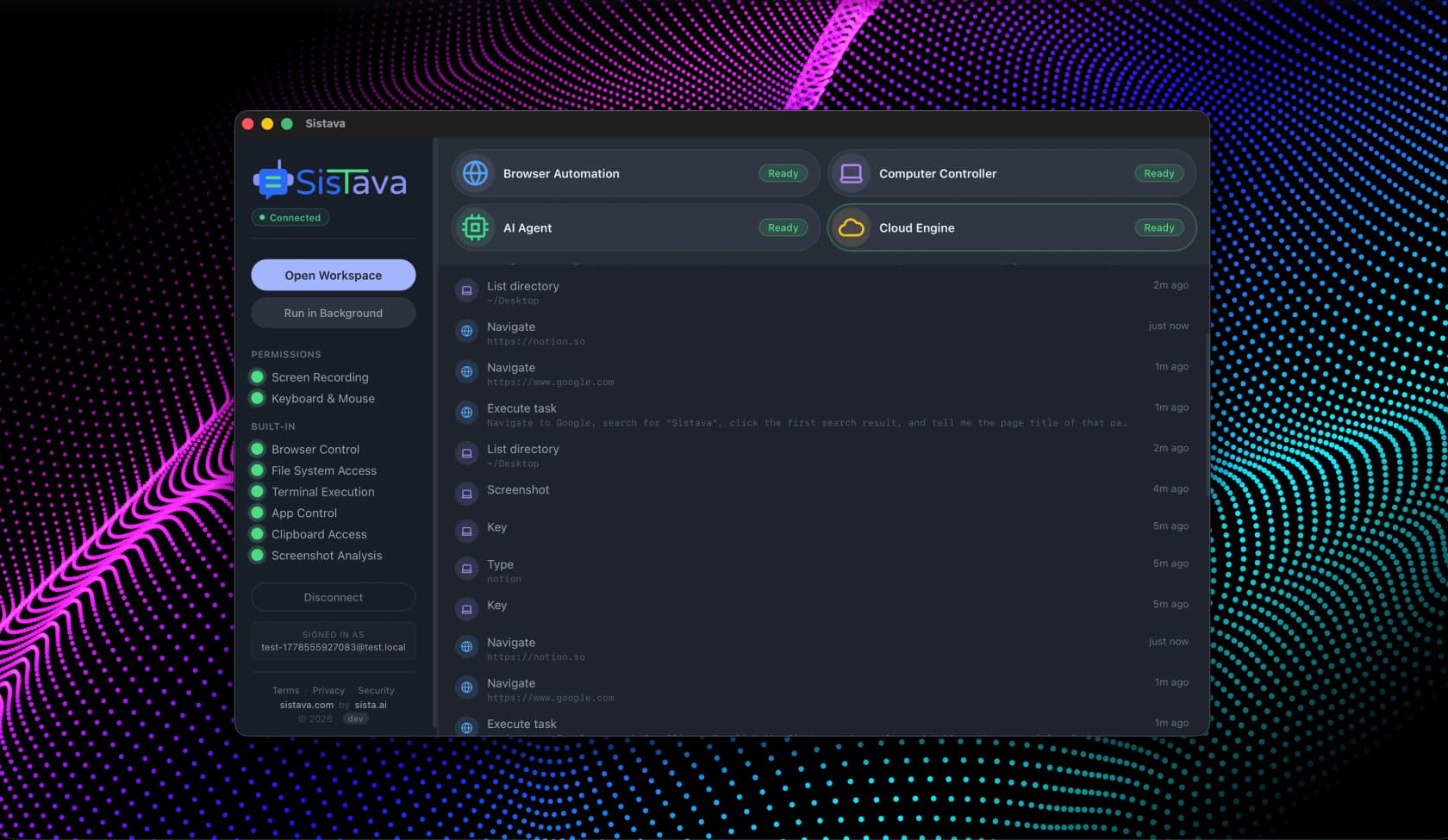
Sistava is another AI-employee platform, "Hire AI Like You Hire Humans," aimed at the same 1-to-5-person teams as Marblism. Its roster spans sales, marketing, support, finance, HR, and more, reachable in Slack, Telegram, email, or as an MCP server. What stands out is the governance: draft-only by default, per-tool and per-conversation approval gates, and explicit autonomy controls. The honest caveat is that it is early, live only since April 2026, with no third-party reviews yet.
Pricing: credit-based, monthly only. A Free tier (2,000 lifetime credits, 2 employees), Starter at $49/mo (20,000 credits, 3 employees), up through Leader at $399/mo. The in-plan credit rate is flat across tiers, and "unlimited employees" is Enterprise-only.
Pros:
- Strong, well-documented approval gates and autonomy controls
- Wide role marketplace with one-click OAuth integrations
- A real free tier to test the model
Cons:
- Very early stage, with no independent reviews and an "Early Access" banner
- No dry-run or simulation mode; the model is approve-as-it-happens
- Credit terms and run-out behavior are behind a login, so budgeting is murky
Our take: if the approval-gate discipline appeals and you are comfortable being an early adopter, Sistava is worth a free-tier look. Just go in knowing it is newer and less proven than the others here.
Try eesel
If you have read this far, the honest throughline is this: Marblism and its bundle cousins are great at doing a little of everything, and the moment one job becomes the job (your support queue, your blog, your outbound), you want a teammate that goes deep on it instead of a meter split seven ways.
That is what eesel is built for. The AI helpdesk teammate joins your existing queue in Zendesk, Freshdesk, or Slack, learns from your real solved tickets, and acts on them with confidence gating, and the AI blog writer researches and drafts in your voice. Both are hireable in minutes, both are priced per unit of work (credits for support, $4 per blog post) rather than a flat hour pool, and, unlike a bundle, you can simulate the results on your own data before anything goes live.

Want to see it run on your own queue before you decide? You can start free and watch it work.