Sintra AI review (2026): is the AI employees bundle worth it?

Kira

Katelin Teen
Last edited October 6, 2026
What Sintra AI actually is
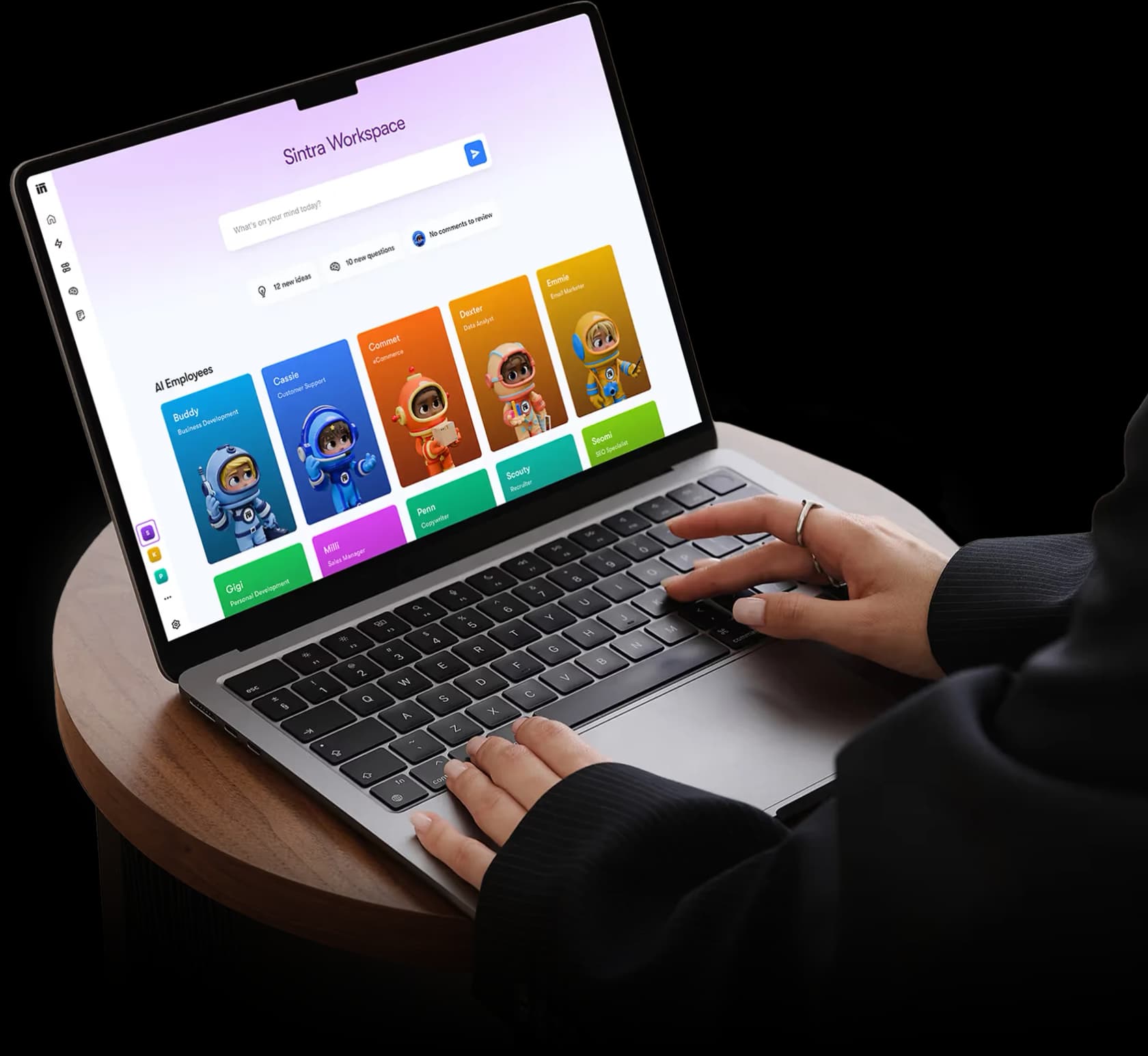
Sintra AI is an "AI employees" platform. Instead of one general chatbot, you get a roster of role-specific helpers, each with a name, an avatar, and a fixed job. Sintra markets 12 of them, and the whole thing is framed as hiring a 24/7 digital team "without adding extra headcount." Every helper runs as a chatbot on web and mobile, and they all draw on a shared memory layer so their output stays on-brand.
The company's scale claims are big: 40,000+ business owners, over 100M prompts processed in 2025, and users across 50+ countries, per Sintra's homepage. Whether or not you take the round numbers at face value, the product is real and reasonably polished, and it sits in the same broad category as the best AI agents and general AI productivity tools people reach for when they can't hire.
Here's the thing worth naming up front, because it shapes the whole review: Sintra is deliberately horizontal. It goes an inch deep across twelve jobs rather than a mile deep on one. That's the opposite trade-off from a tool built to do a single AI customer service job or a single AI content generation job, and it's why the "is it worth it" answer is entirely about which job you actually came for.
The 12 AI employees
Each helper maps to a role, and the naming is cute enough to be memorable. The useful ones for most small teams:
| Helper | Role | What it does |
|---|---|---|
| Cassie | Customer support | Replies to customer emails, drafts responses in your brand voice |
| Penn | Copywriter | Ad copy, blog posts, VSL and video ad scripts |
| Seomi | SEO specialist | Keyword research, SEO blog posts, on-page optimization |
| Soshie | Social media manager | Creates, schedules, and posts social content |
| Emmie | Email marketer | Campaigns, win-back flows, subscriber emails |
| Milli | Sales manager | Cold scripts, pitch decks, lead follow-ups |
| Dexter | Data analyst | Reports, forecasts, profitability calculations |
| Vizzy | Virtual assistant | Calendar, scheduling, daily summaries |
| Buddy | Business strategist | Growth plans, competitor and SWOT analysis |
| Commet | eCommerce / website | Product pages, store setup, listings |
| Scouty | Recruiter | Job ads, screening, onboarding |
| Gigi | Personal coach | Goals, focus, personal productivity |

In practice, the helpers are specialized prompt personas on top of a strong base model (Sintra says they run on Claude Sonnet) plus a shared knowledge store and a set of connectors. That's not a criticism, it's a sensible design, and it's why a general question to Penn or Seomi comes back sounding more focused than the same prompt to a blank AI writing assistant. Just don't expect Cassie to be a full AI customer service chatbot with ticketing, routing, and helpdesk depth. She isn't, and Sintra doesn't really claim she is.

How Sintra actually works under the hood
Two pieces make the helpers more than a themed ChatGPT wrapper: the AI Brain and Sintra X.
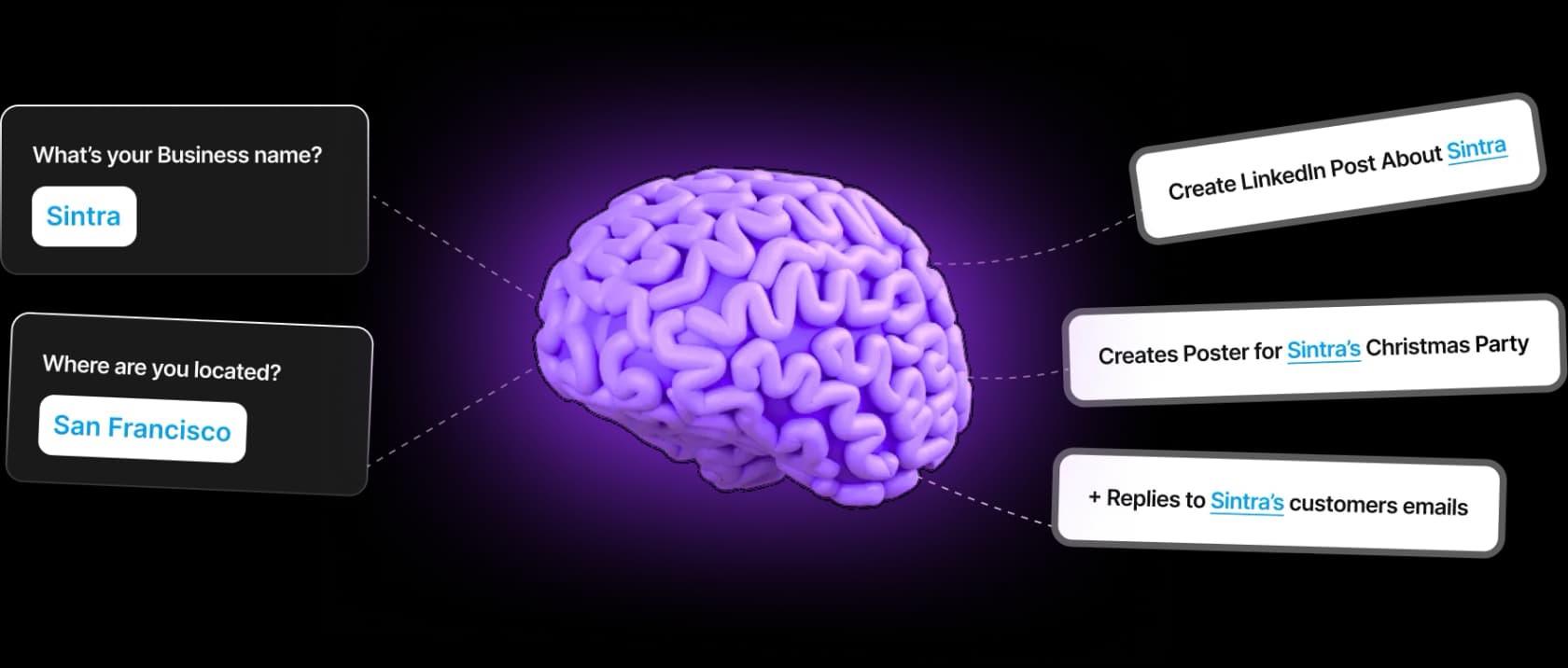
The AI Brain is a personal knowledge store you feed three ways: point it at your website, upload files (guidelines, docs, even books), or answer onboarding questions about your brand. Once it's fed, every helper and every power-up pulls from it, so you're not re-pasting your brand voice into each chat. You can toggle it on or off per helper to control how your data gets used. This is the same idea that makes a good AI knowledge base chatbot work, and it's the part of Sintra that genuinely improves the output the more you invest in it.
Sintra X is the autonomous layer that bundles all 12 helpers together and lets them run tasks with less hand-holding, "even while you sleep" in Sintra's words. You trigger work by chatting ("Soshie, write a LinkedIn post") or by firing a power-up, which is a click-to-run mini-tool: choose parameters, hit go, get a cold-call script or a landing page or a background-removed image. Sintra claims 100+ of them. The autonomy is real but modest, closer to guided task runs than a self-directed autonomous AI agent that plans and executes a multi-step goal on its own.
A word of caution I always give when a vendor leans on self-reported numbers: Sintra's "3x more personalized," "100k+ data points," and "190ms response time" stats are all asterisked marketing claims, not independently verified, and the site can't decide whether it supports "100+" or "150+" languages. None of that is disqualifying, but treat the specifics as vibes, not benchmarks.
Sintra AI pricing: one plan, one credit cap
This is the part to read twice, because it's where most of the review complaints live.
Sintra now sells a single product, Sintra X. There are no feature tiers and no per-seat pricing. Every plan includes all 12 helpers, unlimited workspaces, 15+ integrations, and the same 250 monthly credits. The only thing that changes between plans is the billing term. (Sintra's help center confirms the old single-helper "Individual" plans at $39/mo are no longer offered, even though the marketing page still shows them.)
Here are the standard, non-sale prices, as struck through on Sintra's pricing page:
| Plan term | Charged upfront | Per month | Helpers | Monthly credits |
|---|---|---|---|---|
| 1 month | $97.00 | $97.00/mo | All 12 | 250 |
| 3 months | $177.00 | $59.00/mo | All 12 | 250 |
| 12 months | $624.00 | $52.00/mo | All 12 | 250 |
And the pricing page is almost always running a sale, which is the number you'll actually see when you land there:
| Plan term | Standard /mo | Sale /mo | Discount |
|---|---|---|---|
| 1 month | $97 | $48.50/mo | Save 50% |
| 3 months | $59 | $23.60/mo | Save 60% |
| 12 months | $52 | $15.60/mo | Save 70% |

At $15.60/mo on the annual sale, a twelve-role AI assistant team is a genuinely good deal, and I want to say that plainly before I get to the catch. If you want the full number-by-number breakdown, including how the sale price interacts with top-ups, we cover it in the dedicated Sintra AI pricing post.
The 250-credit cap is the real price
The subscription doesn't buy unlimited work. It buys 250 credits a month, which Sintra calls "energy bars that power AI employees." Chatting costs credits, so does generating an image, running a scheduled task, or having a helper use an integration. Credits reset monthly but don't roll over, and the line that matters most is Sintra's own: "If a workspace runs out of credits, AI employees will stop working." Sintra's credits page also describes a 3-day freemium trial with a one-time bonus of 50 credits, and its pricing guide says a refund under the 14-day guarantee has to be requested through support.
How fast does 250 go? It depends entirely on how you use it:
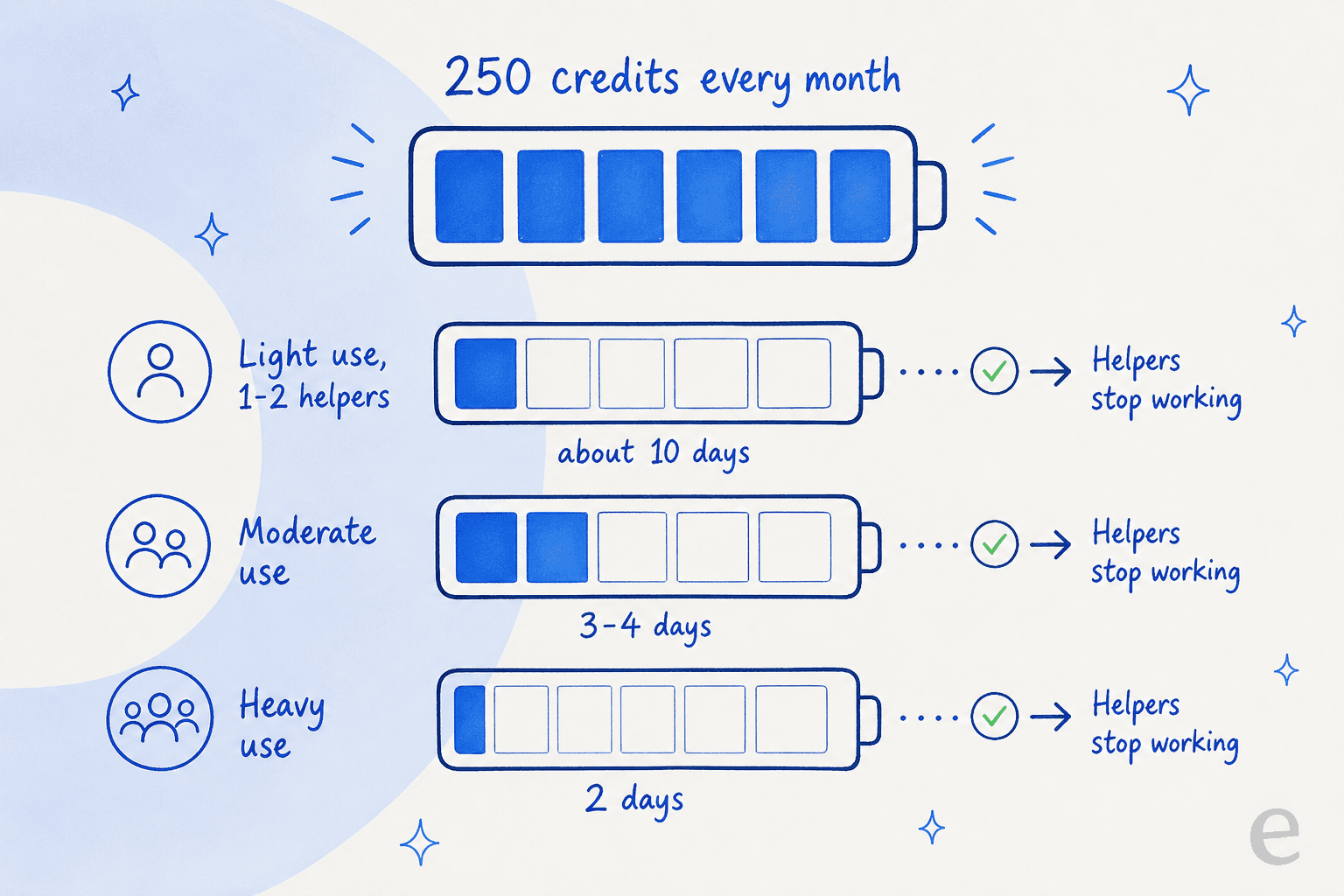
Light use on one or two helpers can stretch to roughly 10 days. Moderate use lands around 3-4 days. Heavy users report emptying the tank in about 2 days. And here's the sharpest complaint: the cap is the same 250 credits whether you pay $52 or $97, so paying more for a shorter term doesn't buy you more capacity. To get more, you buy top-ups, which are a recurring add-on that raises your renewal price and are non-refundable. Credits even get consumed when the AI makes a mistake and you have to correct it.
This is exactly the trap that makes buyers who look closely at AI agent cost models nervous: your bill is decoupled from your value. You can pay the same and get wildly different amounts of actual work depending on a meter you can't easily predict.
What real users say
Sintra's Trustpilot page lists more than 8,600 reviews, but Trustpilot currently shows the company's rating as unavailable because of a breach of its guidelines. The interesting signal is the recent cluster of angry reviews, most aimed at the shift from an older "unlimited" promise to the metered credit system.
"a classic example of a "bait-and-switch" pricing model"

Several long-time users describe buying annual "unlimited AI helpers" plans and then being moved onto the 250-credit system, with no refund for remaining time.
"250 credits will get you through one day for someone running a business."
"This platform is hopeless with terrible Customer Support"
The recurring themes are consistent: credits vanish faster than expected, the only way to get more is to upgrade the whole plan rather than buy a cheap top-up, and refund requests inside the 14-day window get denied on a technicality (users say they were told they "didn't explicitly request" a refund). Support also draws fire for being AI-first and slow to reach a human.
One honesty note, because it matters: Trustpilot's own profile for Sintra carries a "Breach of guidelines" notice saying the company has been offering incentives for reviews. That makes any star average worth less and the negative cluster the more trustworthy read. Either way, the positive reviews are real too. Plenty of solopreneurs say Sintra saved them serious time and consultant fees. The sentiment isn't "it's a scam," it's "it's great until you hit the meter, and then it feels like one."
The verdict: strong on breadth, weak on depth
After going through the product, the docs, and the reviews, here's how I'd score it.
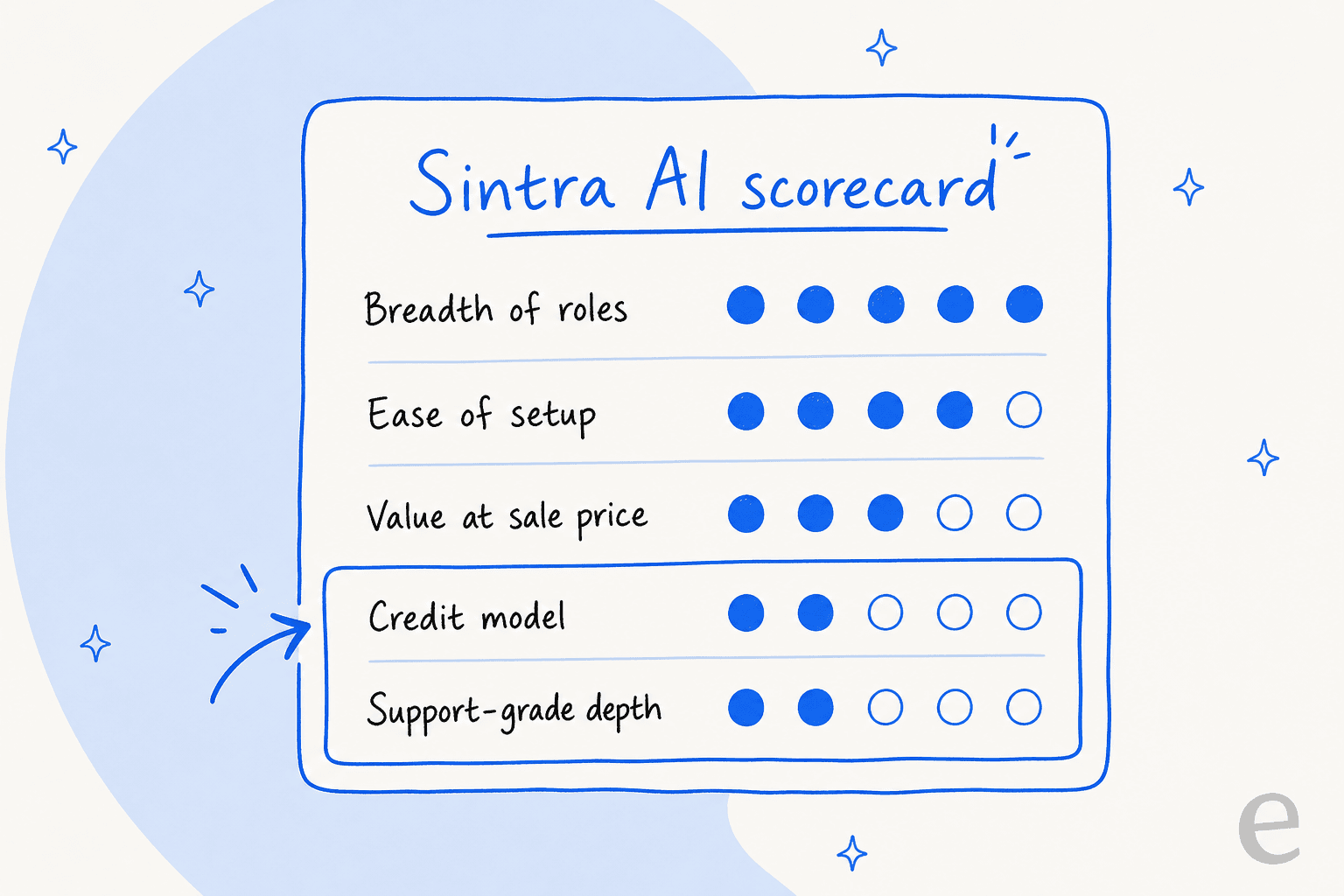
Breadth of roles is Sintra's real strength: twelve credible personas covering social, SEO, email, copy, sales, support, and ops from one login is legitimately useful for someone doing all of it alone. Setup is fast and non-technical. Value is genuinely good at the sale price and merely okay at the standard $97/mo. The two low scores are the ones that decide fit: the credit model is unpredictable and punishes exactly the users who get the most value, and support-grade depth is thin. Cassie is fine for basic email replies but is nowhere near a dedicated AI support agent with real ticketing, and the integration list (Gmail, Notion, QuickBooks) is consumer-SMB, not the Zendesk/Freshdesk/Gorgias-class helpdesks a support team needs.
Who Sintra AI is for (and who should skip it)
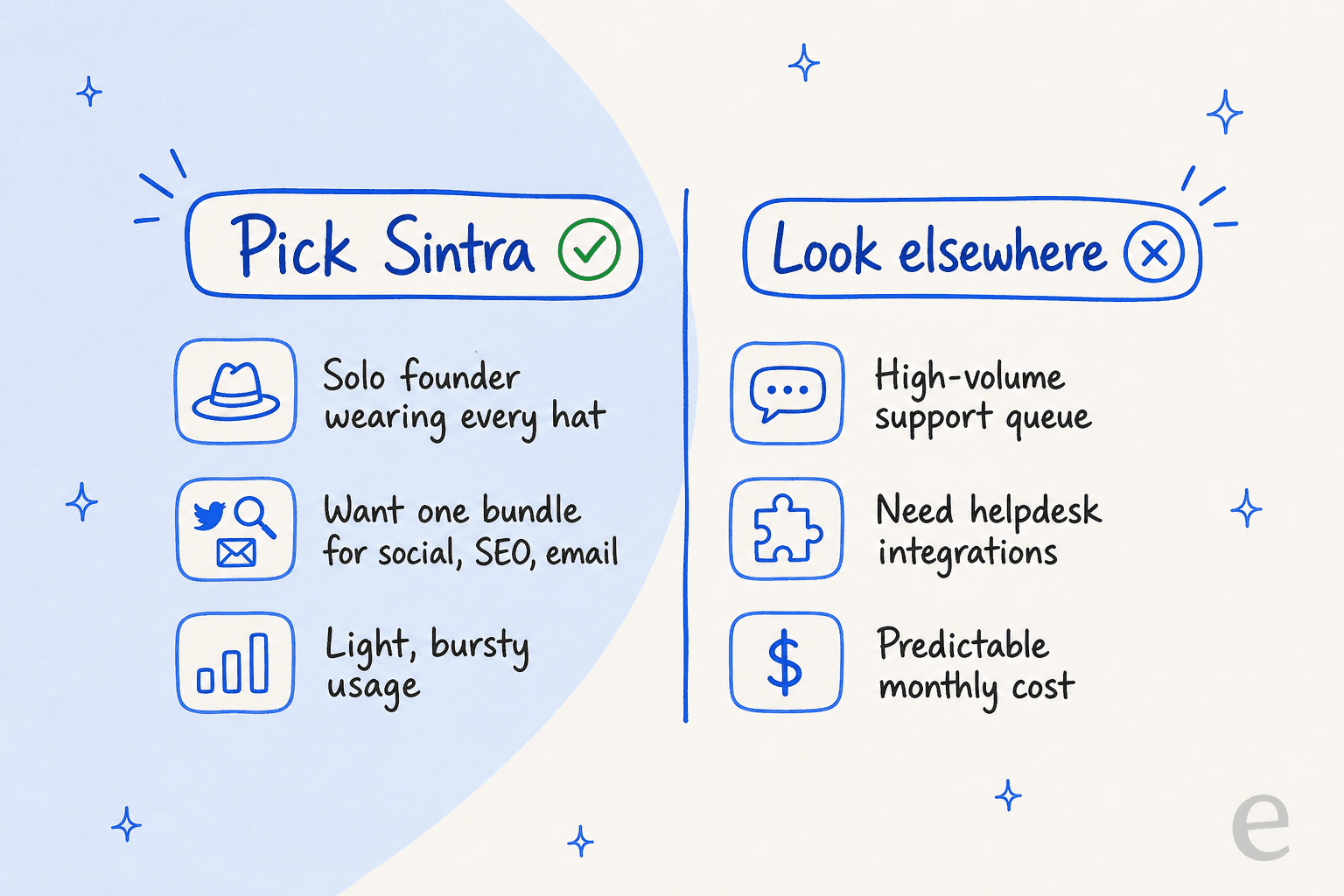
Pick Sintra if you're a solo founder or a tiny team wearing every hat, you want one affordable bundle to touch a lot of jobs, and your usage is light and bursty rather than heavy and daily. For that person, at the sale price, it's a smart buy and a real time-saver. It sits comfortably alongside the other AI tools for small business.
Look elsewhere if you have one job that needs doing deeply and often. If that job is a real support queue, you want a purpose-built AI customer service tool, not one helper in a bundle. If it's a steady content pipeline, you want a dedicated AI content writer or AI blog writer that won't stop mid-draft because the meter hit zero. And if you need predictable monthly costs, a shared 250-credit cap that empties in 2-3 days of heavy use is the wrong shape entirely. Those buyers are usually better served by the best AI customer support chatbot or a focused AI content generation tool built for that one job.
Try eesel
If the reason you're eyeing Sintra is one specific job, running support or producing real content at volume, that's exactly where a focused tool beats a twelve-in-one bundle, and where the pricing stops working against you.
I build eesel, and the sharpest contrast is the meter. eesel has one fixed monthly price from $299/month for 500 credits, where 1 credit is one ticket or chat, plus $4 per blog draft, with no per-seat fees and no platform fee. You start free with 100 credits, no card needed, and if you run out you can turn on overage with a cap you set so the bill never surprises you. A credit is a ticket you can count, which is the opposite of a 250-credit wall spent on chats and images. On the support side specifically, eesel plugs into the helpdesks a real team already runs and simulates every rollout against your historical tickets before it ever answers a live customer, because we've watched confident-sounding bots give wrong answers and we'd rather catch that in a dry run. That's the depth a horizontal bundle can't reach. Try eesel free and see what one job, done deeply, actually looks like.