

Model your own number first
A published band is a rate, and a rate is not a quote. Put your real volume in below and you at least walk into the call already knowing the shape of the deal.
Two things fall out once you push the numbers around. Below about 1,000 resolved tickets the flat fee hurts, and above 5,000 it starts to look very good indeed. The other one: set against published per-resolution rates, Engaige's band is the cheaper unit, which is the argument the company leans on hardest.
What Engaige actually charges
The rate lives in Engaige's ROI article, not on a product page. A blog post, in other words. The wording there is specific, at least: a flat monthly fee, "around €0.40 to €0.50 per ticket at entry and dropping toward €0.30 at volume." The same piece sets that against what it calls the "up to $2 per resolved ticket that outcome-priced rivals charge," naming Salesforce Agentforce per conversation and Zendesk pay-as-you-go.
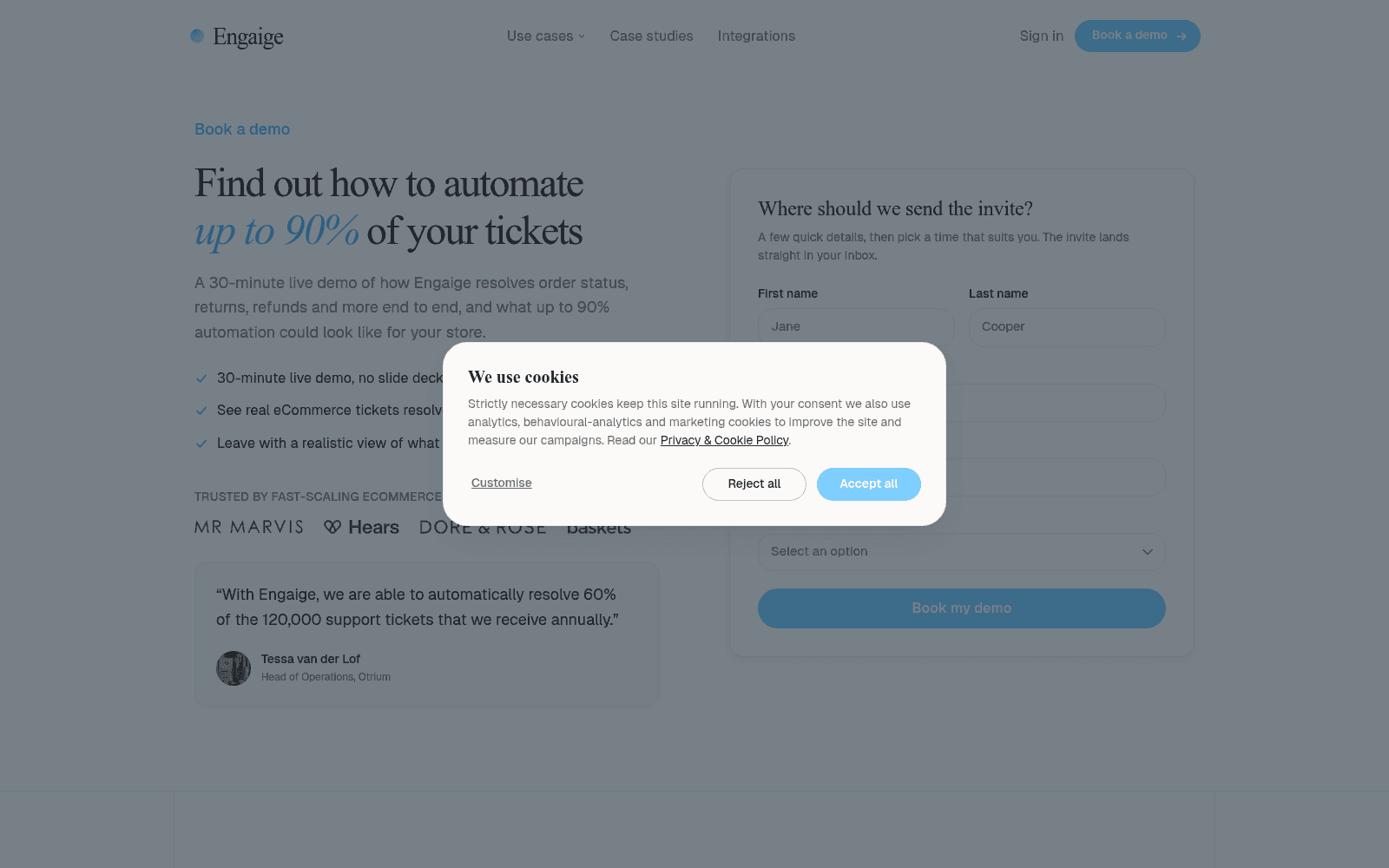
The demo page is where a pricing conversation starts, because there is no pricing page to send you to. The headline promise is automation, not cost.
Data point two is the Capterra listing, last updated 17 August 2026. It records a starting price of €529 per month, categorised as "Usage Based, Per Month," with a free trial available. There is a mismatch in there worth flagging, since Engaige calls the fee flat while Capterra's category says usage-based. The Master Subscription Agreement settles that argument, and the answer turns out to be both, one after the other. Flat up to an allowance. Metered past it.
| What | Engaige's published position | Source |
|---|---|---|
| Effective rate at entry | €0.40 to €0.50 per ticket | Engaige ROI article |
| Effective rate at volume | Toward €0.30 per ticket | Engaige ROI article |
| Starting price | €529 per month | Capterra listing |
| Billing model | Flat monthly fee, allowance plus overage | ROI article and MSA |
| Overage invoicing | End of each calendar quarter | MSA section 9 |
| Renewal increase cap | Greater of Dutch CBS index or 5% | MSA section 9 |
| Default uptime SLA | None unless the Order Form states one | MSA section 3 |
| Public pricing page | Does not exist | letsengaige.com sitemap |
None of that came off the marketing site. It came out of the contract, which is already more than most quote-gated vendors hand over, and it is the actual lesson of this post.
The price is set in the Order Form, not on a page
Engaige's MSA is version 1.0 of the standard subscription terms, published by Engaige Technologies B.V. out of Utrecht. It defines "Fees" as the amounts in the Order Form "including any overage and professional-services charges." Then it defers nearly every commercial variable back to that same document.
So the Order Form is the pricing page. Seven blanks on it decide what you pay. Every one of them is negotiable before signature, and expensive after it.
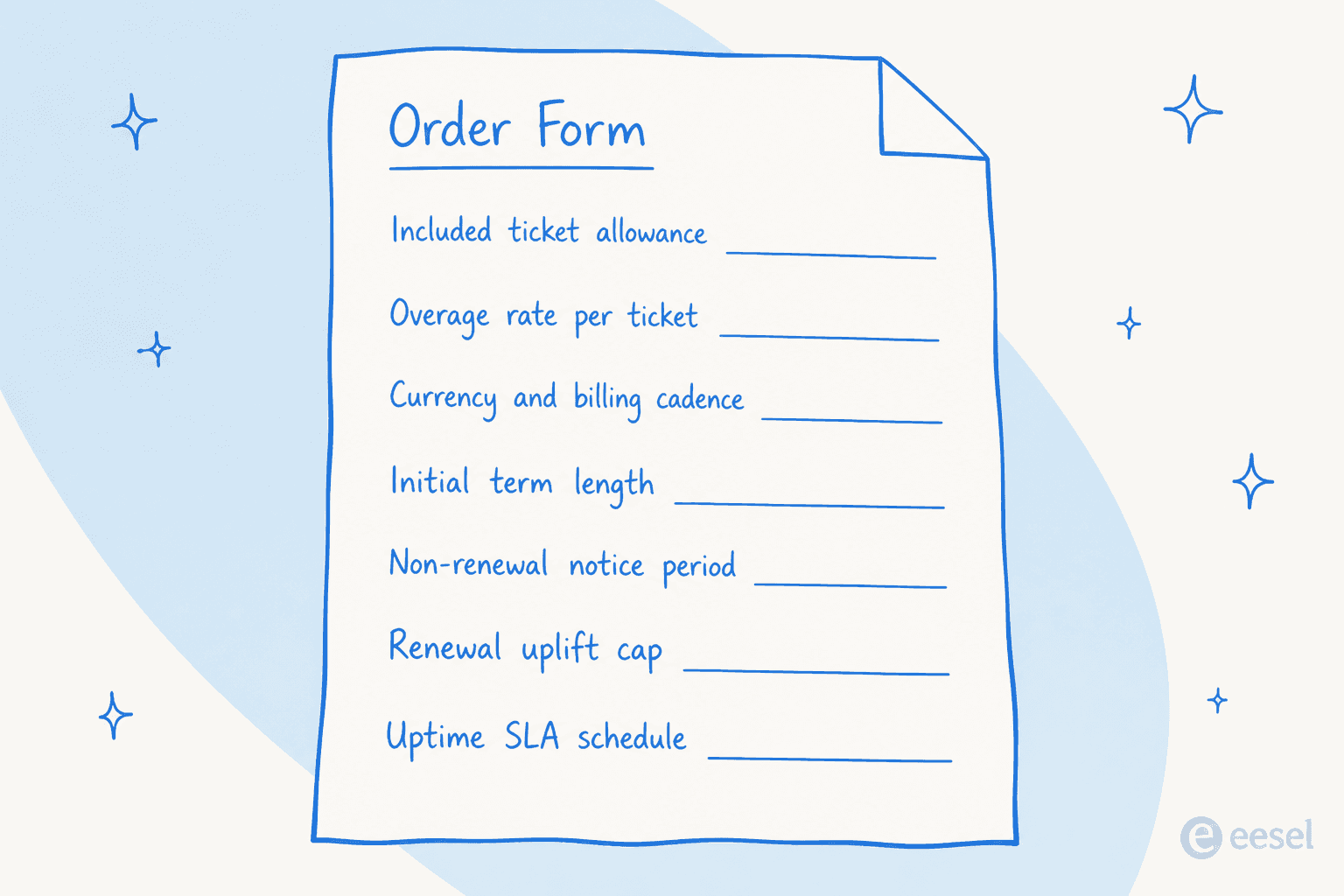
Taking them in order:
- Included allowance. Overage applies "unless the Order Form provides for unlimited usage," says the MSA, which quietly tells you unlimited is something you are allowed to ask for.
- Overage rate. Set entirely in the Order Form, with no published default anywhere. The single most important number to pin down, then.
- Currency and cadence. Invoiced in advance, in whatever currency and at whatever cadence the Order Form states. Pay late and you trigger Dutch statutory commercial interest, plus a right to suspend on reasonable notice.
- Initial term. Renewals come out automatically equal in length to the initial term. A two-year first term therefore means two-year renewals.
- Notice period. Where the Order Form says nothing, the default falls to 30 days before the current term ends.
- Renewal uplift cap. Better than the market norm, and covered further down.
- SLA schedule. Absent by default, though an enterprise schedule exists on request.
One more clause worth knowing about. Additional modules, or usage allowances, or extra seats: each one requires a new or amended Order Form signed by both parties, so mid-term expansion is a paperwork event rather than a dashboard toggle. And the MSA confirms per-user licensing exists as an option ("where the Services are licensed on a per-User basis"). Seats, in other words, can become a second meter next to tickets, depending how your deal gets written.
The entry price sits exactly on the break-even line
Engaige's own ROI maths is explicit, which I do appreciate. A human-handled ticket runs about €4. A Dutch support employee earns around €40,000, call it €48,000 loaded, so about €4,000 a month. Divide one by the other and you land at roughly 1,000 tickets a month as the point where the AI absorbs one full-time agent. Past that point, in the company's words, "every resolved ticket is margin."
Now drop the €529 entry price onto that same line. At the published €0.40 to €0.50, €529 buys you somewhere between 1,050 and 1,320 tickets.
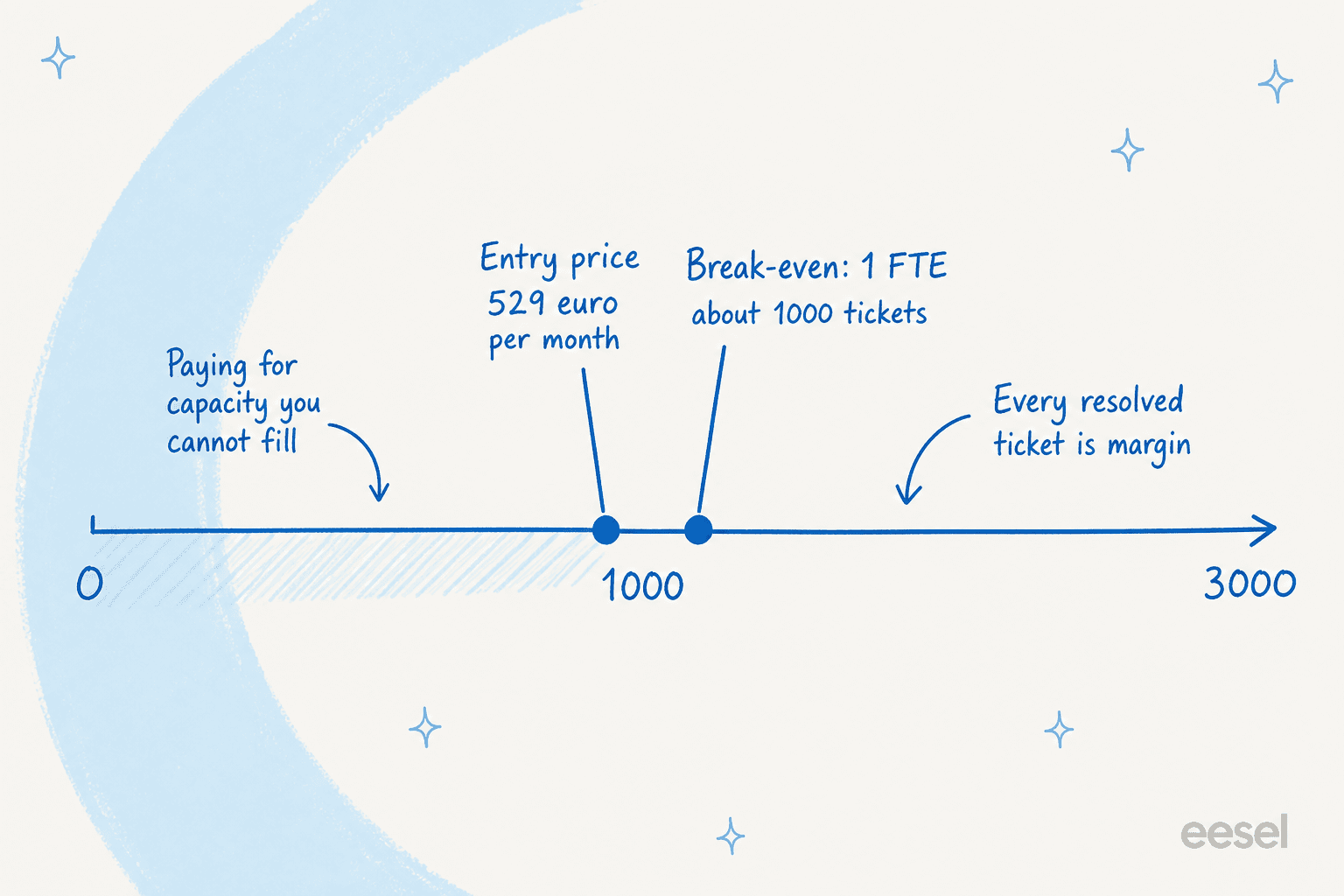
The two markers sit on top of each other. Good pricing design on Engaige's part, and a warning label at the same time, because the entry tier is priced for a store that is already at one-FTE volume. A brand doing 400 tickets a month still pays the same €529, and displaces €160 of human work for it. A quiet month buys you no relief at all. That is the trade for a low unit rate.
If you are doing this modelling properly, my comparison of AI versus human agent cost runs on the same displacement logic, and measuring AI support ROI covers the metrics Engaige's own article is built on.
Buyers I speak to get to this arithmetic without any help from me. One eesel prospect, running roughly 250 tickets a month, worked out that the plan tier carrying the one feature they actually needed cost more than the handling it would replace. They walked. Different vendor, identical maths.
The seasonality trap
Ecommerce is who Engaige sells to, and the homepage makes that pitch with a volume chart marked at Valentine's, Summer and the Holidays: "more resolved, same team," through "the seasonal peaks that break most support teams."
Peaks are the product. Peaks are also the thing that pushes you past an included allowance.
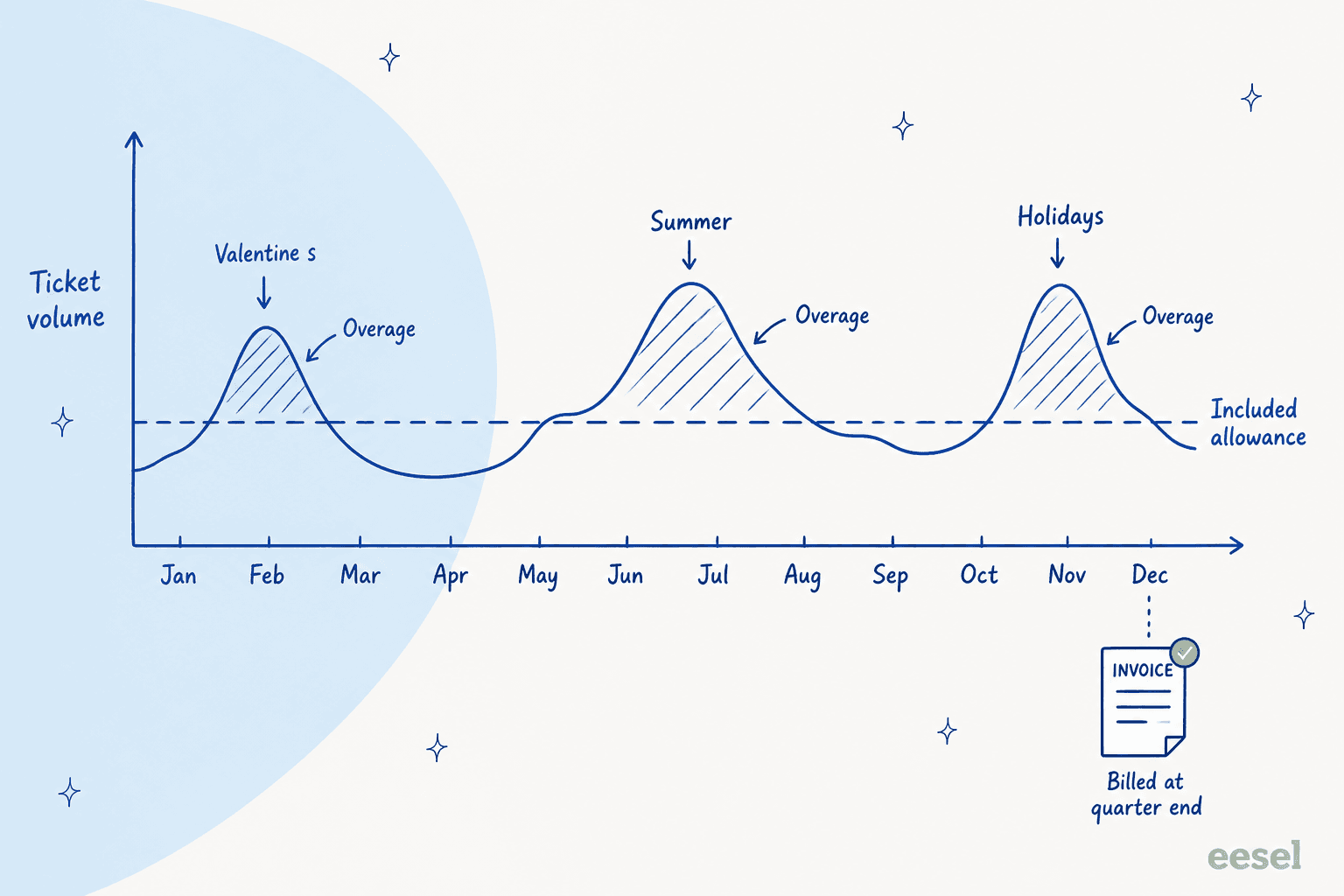
The timing in the MSA is the sharp bit here. Overage is invoiced at the end of each calendar quarter, rather than in the month it actually happens. So a Black Friday and Christmas spike lands on a 31 December invoice, which arrives in the January cash trough, by which point the peak revenue has already gone on stock and shipping. None of that is hidden, and none of it is unusual. It is simply the opposite of the "flat monthly fee" framing on the marketing side, and it is the first thing I would model before signing.
That caution comes out of a real analysis. An eesel cost comparison, built for a merchant running about 1,000 tickets a month, showed per-resolution pricing charging roughly $792 in a normal month at an 80% resolution rate, then about $3,168 in a Black Friday month at 4,000 tickets. A flat rate keeps November identical to March. Engaige's model sits in between the two, flat inside the allowance and per-resolution-shaped once you are outside it. So size the allowance for your peak. Not your average. My guide to AI support for Black Friday covers the operational half of the same problem.
What the contract locks in, and where it is better than average
Three of the MSA's terms sit above market. One sits below. Worth knowing both before you start negotiating.
| Term | What the MSA says | Read |
|---|---|---|
| Renewal increase | Capped at the greater of the Dutch CBS Services Producer Price Index over 12 months or 5%, with 45 days' notice and a 30-day non-renewal window | Above market. Most vendors publish no cap at all |
| Feature removal | Engaige will not materially diminish purchased functionality during a term, and gives 14 days' notice of materially adverse changes | Above market |
| MSA changes | Fee-structure changes require 30 days' notice; your remedy is non-renewal | Standard, and clearly written |
| Uptime SLA | None by default. Enterprise schedule on request | Below market for a system in the resolution path |
| Liability cap | 12 months of fees paid, with the usual carve-outs | Standard |
| Data on exit | Personal data handled per the DPA; other content exportable for 30 days | Standard, but 30 days is tight |
| Taxes | All fees exclusive of VAT | Standard for an EU vendor |
The renewal cap deserves credit. Price stability is a live buying criterion, not a legal footnote. One budget-conscious buyer I spoke with had watched a previous vendor's price more than double, and came into the conversation asking to pay annually purely to lock the rate in. Engaige has written that ceiling into its standard terms, which is a stronger answer than most of its competitors can give.
The SLA gap is the one to push on. An agent closing up to 90% of your tickets on its own is sitting in the critical path of your customer experience, and the default position there is no uptime commitment, no service credits.
What the money buys
Worth getting concrete here, since a unit price only means something next to the work it is doing.
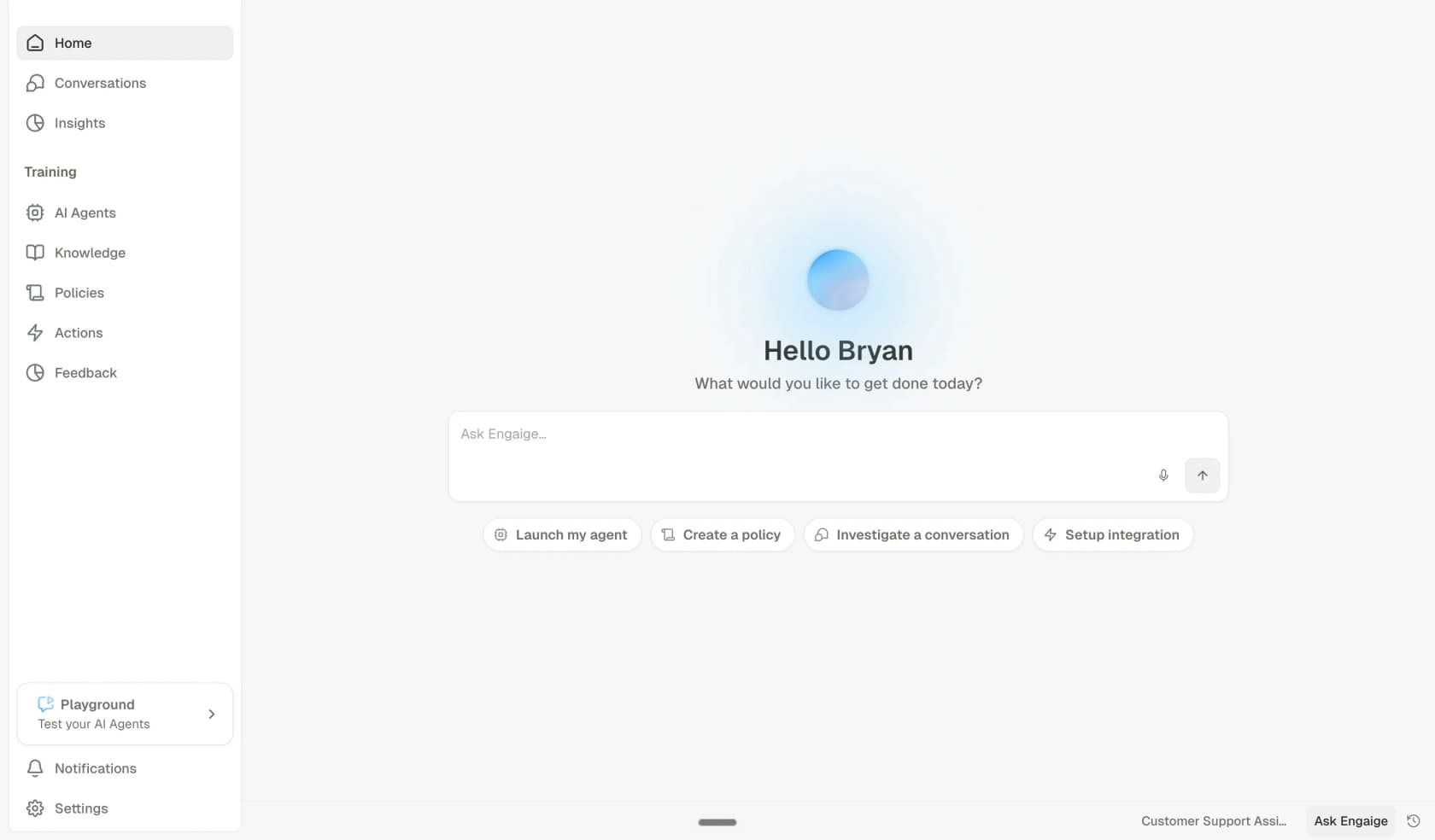
The Engaige platform, as shown on Engaige's Capterra listing: policies, actions and knowledge are configured by talking to the product rather than through a rules builder.
What you are buying is an action layer that sits on top of the helpdesk you already run, not a replacement for it. On the store side, native integrations cover Shopify, Adobe Commerce, WooCommerce and BigCommerce; on the inbox side, Zendesk, Gorgias, Freshdesk, Front, Help Scout and Dixa, with returns, subscriptions, 3PL and carrier tools sitting underneath. Engaige counts "50+ vetted, plug-and-play native integrations" on its Gorgias comparison page.
Being a layer rather than a replacement has a cost consequence: the per-ticket fee stacks on top of whatever your helpdesk already costs you in seats. Worth totalling those seat bills up before you go comparing unit rates:
- Gorgias AI pricing and Freshdesk pricing if you are on either of the two most common ecommerce stacks.
- Front pricing and Help Scout pricing for teams running a shared-inbox tool instead.
- Dixa pricing and Kustomer pricing once you are up at the higher end of the range.
The use cases this pricing is really about are the repetitive ecommerce ones: order tracking and WISMO, refunds and returns, damaged or missing items, subscription changes, then pre-sale product advice. Engaige's own framing is that it takes the action itself, rather than drafting a reply for somebody else to send.
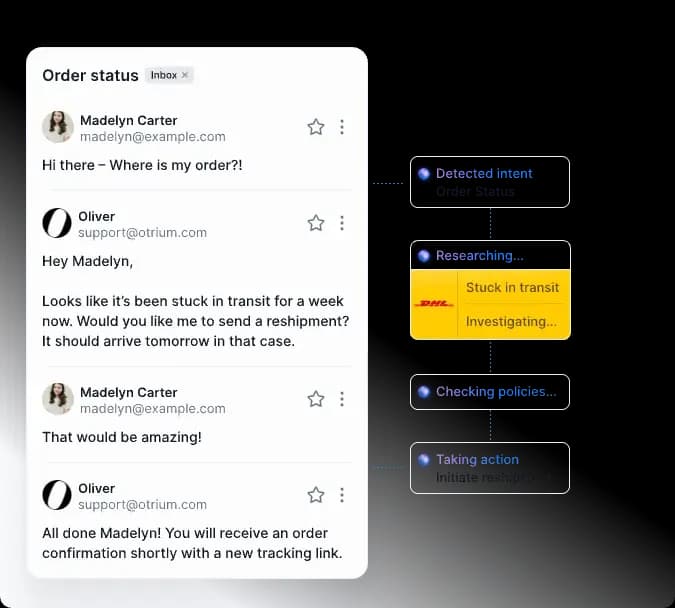
How Engaige illustrates a WISMO resolution on its Otrium case study: intent, research, policy check, then the reshipment action, each step visible.
The published customer results are the strongest part of the value argument, and they are all dated 2026 on Engaige's own case pages:
| Brand | Volume | Automated end to end | Also reported |
|---|---|---|---|
| HelloPrint | 200,000 tickets a year | 80% | 30% lower handling time, 90% faster first response, live in two weeks |
| Otrium | 120,000 a year | 60% | 24/7 coverage across channels |
| MR MARVIS | 120,000 a year | 60%+ | Product advice in brand voice |
| Mixam | 50,000 a year | 50% of chats | Human agents 2x as efficient |
HelloPrint's CEO Hans Scheffer is quoted on the case page saying Engaige "proved invaluable as we scaled across 21 countries." Engaige's own ROI article puts a harder number on the same story. HelloPrint "automated 80% of its support and cut its support team by 72%, from 100 to 28 agents, while service quality went up." Run the maths at 200,000 tickets a year and the volume band's €0.30 rate implies roughly €5,000 a month, set against 160,000 automated tickets that would cost €640,000 a year to handle at €4 each. That is the deal in its best possible light. At that volume it is also a good deal.
One more thing here, and for European buyers it quietly justifies a premium. Every sub-processor on Engaige's subprocessors page is EEA-resident, the model layer included. Azure OpenAI EU, Anthropic's EEA endpoint, OpenAI EU data residency and Google Gemini in an EEA project, each of them contractually barred from training on customer content, with Weaviate, Supabase and Google Cloud sitting in EU regions underneath. Engaige treats the LLM layer as an approved category it can route within, which is an honest way to describe how these systems actually behave.
How the unit price compares
Rate on its own is the wrong comparison. What matters is the unit being metered, and what that unit does to your bill when volume moves.
| Vendor | Published unit | Rate | Shape |
|---|---|---|---|
| Engaige | Ticket | €0.40 to €0.50 entry, toward €0.30 at volume | Flat fee against an allowance, quarterly overage |
| Zendesk | Automated resolution | $1.50 committed, $2.00 pay-as-you-go | Per-resolution, on top of per-agent seats |
| Gorgias | Automated interaction | ~$0.90 to $1.00 inside allowance, $1.50 past it | Bundled allowance, then per-interaction |
| eesel | Ticket or chat handled | $0.40 | Metered, no allowance, no seat fee, no minimum |
| Decagon and Sierra | Quote only | Not published | Annual contract |
Engaige wins the unit-rate line, and loses on flexibility. For its market that is a coherent place to stand, since volume there is high and seasonal instead of low and lumpy.
Community pricing talk lands in roughly the same range. In a thread asking what teams actually pay for AI support agents, one operator reported solving 3,000 chats a month for around €1,100 at a 65% resolution rate. That works out near €0.37 a chat, sitting right on top of Engaige's band. Someone else in the same thread was paying a very different number:
"~10k per month for one of the big name agents that handles calls, tickets and chats. Additional ~5k for separate integration for AI QA and reporting + human for training AI agent + human for QA."

The direction of travel is not automatically downward, either. A r/customerexperience thread on a Gartner projection, the one saying generative AI cost per resolution could exceed $3 by 2030, drew this response:
"By the time you pay for the heavy compute, the RAG orchestration, and the constant tuning, $3 a ticket actually makes offshore human agents look cheap again. Slapping a bot on a broken process doesn't save money; it just shifts the expense to the cloud bill."
Against a $3 ceiling, a €0.30 floor is a strong claim. It is also exactly why you want the overage rate in writing, since that is the field where a €0.30 deal quietly turns into something else.
Third-party review signal is thin so far. Capterra shows a 5.0 rating built on one single review, which is a placeholder more than a data point, and at the time of writing there is no G2 or Trustpilot presence at all. This is a small company. Engaige Technologies B.V. is registered in Utrecht, and its own press page records a €1 million seed round in September 2024, then a change of CEO in August 2026, with Julian Bakker succeeding founder Tijmen van den Elzen. So treat the case studies as the evidence base, because they are what there is.
Who the price fits
It fits an ecommerce brand doing 5,000 or more tickets a month, weighted toward WISMO, returns and product questions, on Shopify plus one of the mainstream helpdesks, with EU data residency somewhere on the procurement checklist and enough volume stability that you can size an allowance honestly. At that shape, the €0.30 band is the cheapest published per-ticket rate in the category.
It fits less well in four situations. Below roughly 1,000 tickets a month, where the flat fee gives you no floor relief. When volume swings by 4x at peak and you have not negotiated the allowance and overage explicitly. When a contractual uptime commitment is required and you are not going into an enterprise negotiation to get one. And when you need a price you can approve today, because a self-serve path does not exist here.
In those cases a metered tool with published rates is simply easier to defend internally. Three roundups to start from, then:
- Shopify AI alternatives, for when the store is the centre of gravity.
- The best AI support agent roundup, if you want the wider field.
- Yuma alternatives, which is the closest ecommerce-only comparison set.
If you are earlier than that and still mapping the space out, I have covered the underlying pieces separately:
- The basics of customer service automation, plus how to build an AI knowledge base.
- Channel-level guides on AI self-service and on multilingual support.
- The metrics work, meaning first response automation and ticket deflection.
- Where to steer things once it is live, which is CSAT and improving resolution rate.
Want the same unit price without the order form?
If the €0.30-to-€0.50-a-ticket band is the thing that drew you to Engaige, here is what to know: you can have that rate without negotiating an allowance, a term length or an overage clause. eesel charges $0.40 per ticket or chat session handled. No platform fee, no per-seat charge, no monthly minimum, and a hard monthly spend cap you set yourself, so a Black Friday spike cannot turn into a surprise. Dashboard lookups cost nothing.
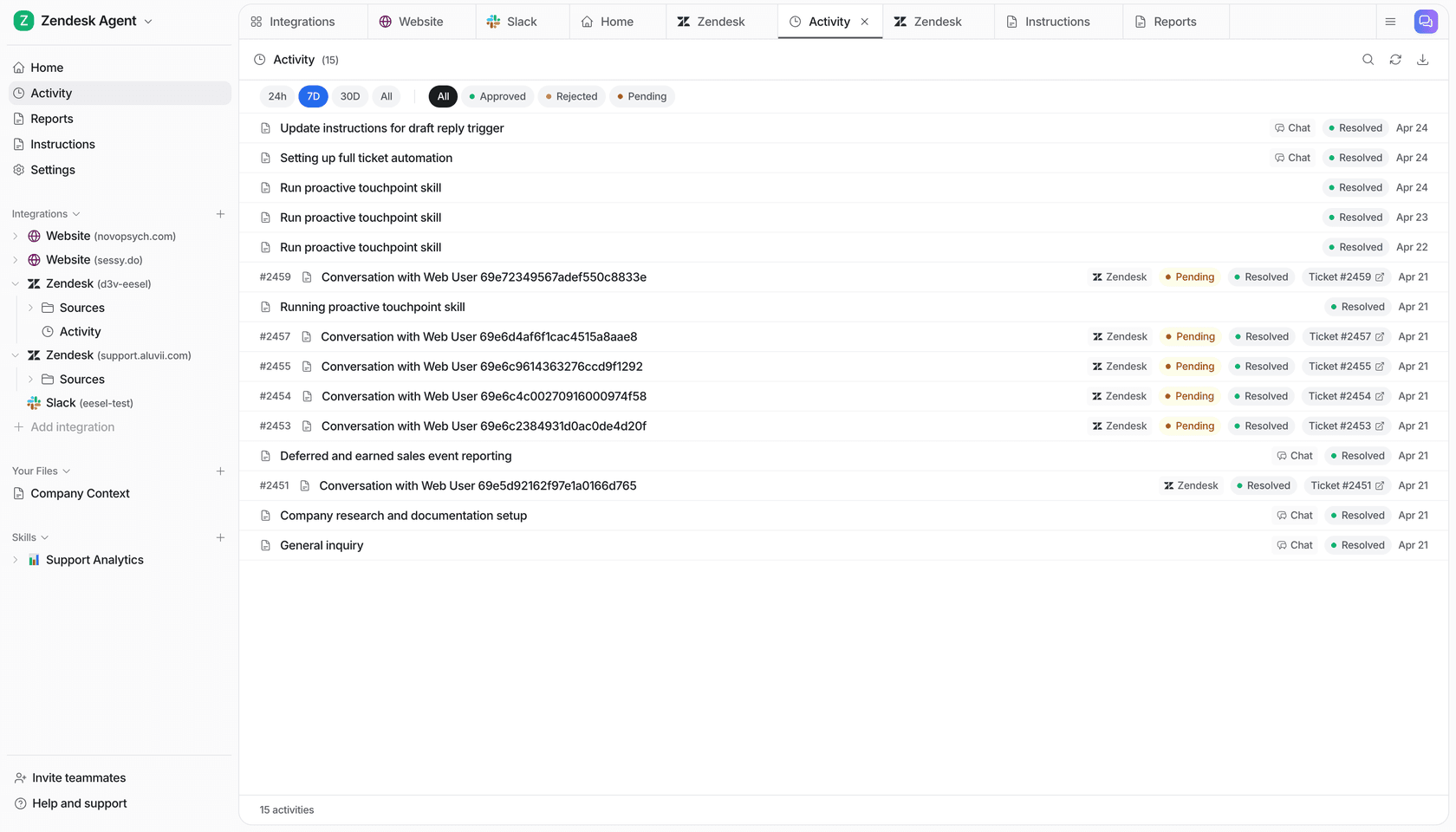
Every line in eesel's activity log is one billable task, so the bill and the work are the same list. There is no allowance to reconcile at quarter end.
It plugs into the helpdesk you already run instead of replacing it, so a Gorgias, Zendesk or Freshdesk store keeps its own inbox and workflows. Then, before anything goes live, you can run a simulation across hundreds of your own past tickets and compare the agent's answers against what your team actually sent. That is the honest way to find out whether "up to 90%" applies to your queue or only to somebody else's. $50 of usage is free, and no card is needed.
The bottom line on Engaige pricing
Per ticket, Engaige is cheaper than any competitor that publishes a rate at all, and it tells you so in a blog post instead of on a pricing page. The €529 entry point is real, and consistent with the €0.40 to €0.50 band. The €0.30 volume rate is real as well. At HelloPrint-scale volume it is a very good deal.
The container is the risk, more than the rate is. A flat fee against an allowance, with overage set in a private Order Form and invoiced quarterly, turns your seasonality into a bill that arrives late. Engaige's own contract is unusually candid about all of it, right down to a renewal cap most of its competitors would never print. So read the MSA before you take the demo. Walk in knowing the seven blanks. Ask the overage question first.
Frequently Asked Questions
How much does Engaige cost?
Does Engaige publish a pricing page?
What is Engaige's pricing for small ecommerce teams?
Does Engaige charge per resolution or a flat fee?
Is there an Engaige free trial?
Does Engaige raise its prices at renewal?
Does Engaige include an uptime SLA?
What does Engaige cost compared to Zendesk or Gorgias AI?



Article by
Kurnia Kharisma
Kurnia is a software engineer and writer at eesel AI with two years of SEO experience, writing about AI tools, helpdesk software, and customer support. He pairs a developer's understanding of how these products are built with search-driven research into what actually ranks and resonates with the people searching for them.