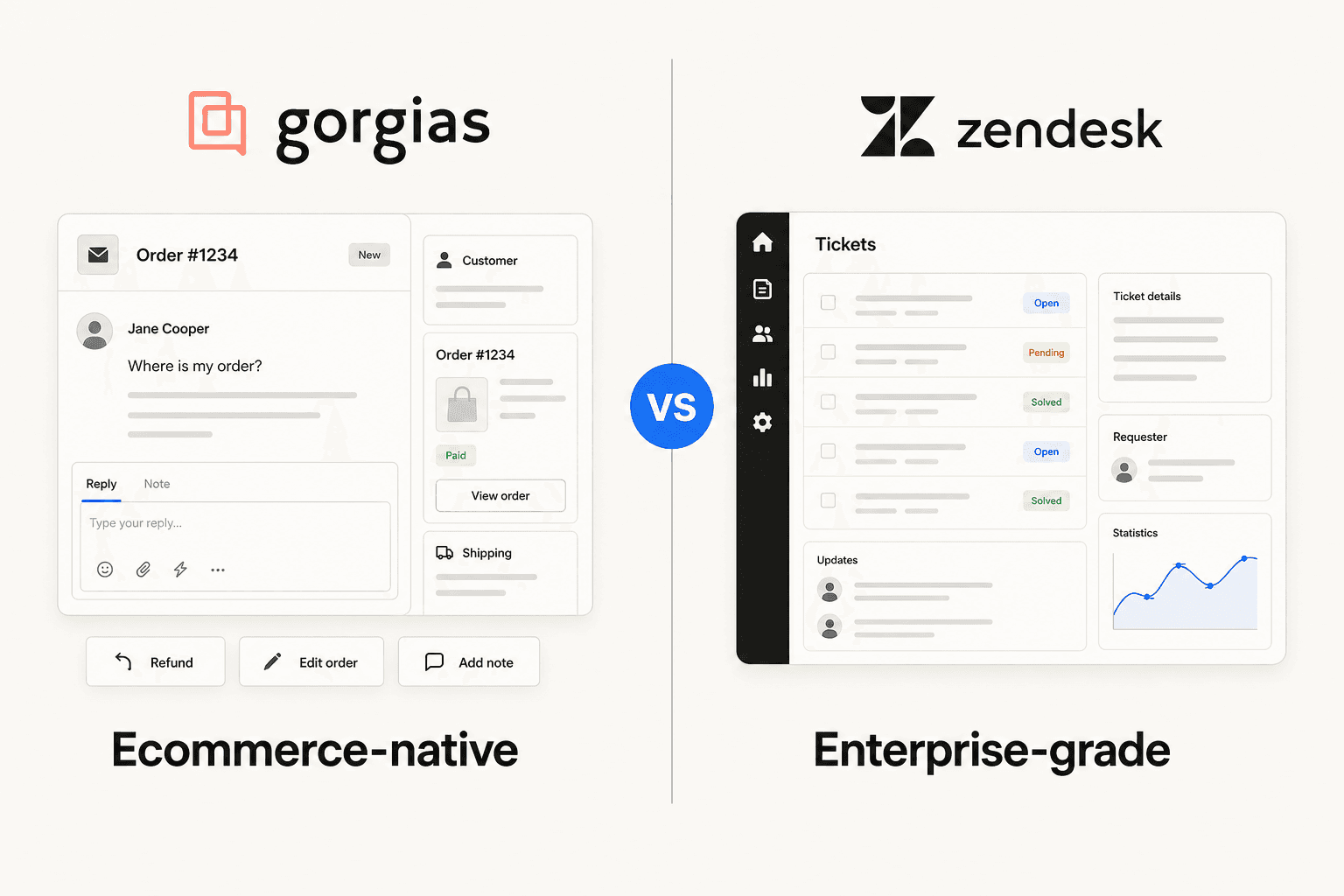
When your Shopify support inbox starts overflowing, two names come up in almost every merchant's research: Gorgias and Zendesk. Both are legitimate platforms with large customer bases and real AI capabilities. The choice between them is not really about which is better - it is about what each was designed to do.
Gorgias was built from the ground up for ecommerce. Every product decision since its founding has centered on Shopify merchants, DTC brands, and turning support conversations into revenue. Zendesk has been around since 2007 and was built for airlines, banks, and enterprise software companies - then adapted for ecommerce later. That origin shapes everything: how each tool handles Shopify data, how it prices its product, and how long it takes to get running.
This comparison covers the practical differences that matter for ecommerce teams: Shopify integration depth, AI capabilities, pricing structure, ease of setup, and which use cases each genuinely suits. For a wider view, see our guide to the best helpdesk software for ecommerce in 2026.
What Gorgias does
Gorgias is a combined helpdesk and AI agent platform built exclusively for ecommerce brands. It powers 17,000+ ecommerce merchants globally - including 40% of the top 1,500 Shopify brands - and is Shopify's only designated Premier Partner in the customer experience category.
The product has three connected layers: the Helpdesk (a unified inbox for email, chat, SMS, WhatsApp, Instagram, Facebook, TikTok, and voice), the AI Agent (automated resolution of post-purchase support), and the AI Shopping Assistant (proactive pre-purchase engagement). All three pull directly from Shopify's data, so when a customer writes in about their order, whoever handles it - human or AI - has everything visible in one ticket view.
Gorgias reports $500M+ in revenue driven through conversations on its platform and a 4.2x average ROI across customers. On G2, it holds 4.6/5 across 558 reviews. On the Shopify App Store, it has 4.3/5 from 635 reviews, with 83% being five-star.
What Zendesk does
Zendesk is an AI-first customer service platform that describes itself as the "Resolution Platform" - an end-to-end system covering AI agents, omnichannel ticketing, quality assurance, workforce management, voice, and analytics. It serves 22,000+ service teams and was designated a 2025 Gartner Magic Quadrant Leader for CRM Customer Engagement Center.
Zendesk is not ecommerce-native. Retail is one vertical among many alongside financial services, software, healthcare, and IT/HR. Third-party analysis from April 2026 estimates around 46,000 ecommerce/retail customers out of 130,000+ total. That context shapes feature priorities: things a DTC brand needs daily (order actions, revenue attribution, checkout chat) were not part of Zendesk's original design.
What Zendesk does well is scale and depth: complex ticket routing across large teams, 1,800+ marketplace integrations, enterprise security and compliance (SOC 2, HIPAA, ISO 27001), workforce management, and a growing AI layer via its Resolution Learning Loop. On G2, it holds 4.3/5 across 6,838 reviews. On Capterra, it's 4.4/5 from 4,079.
Shopify integration - where they actually differ
This is the most important comparison point, and the reason most Shopify merchants who've tried both tend to stay on Gorgias.
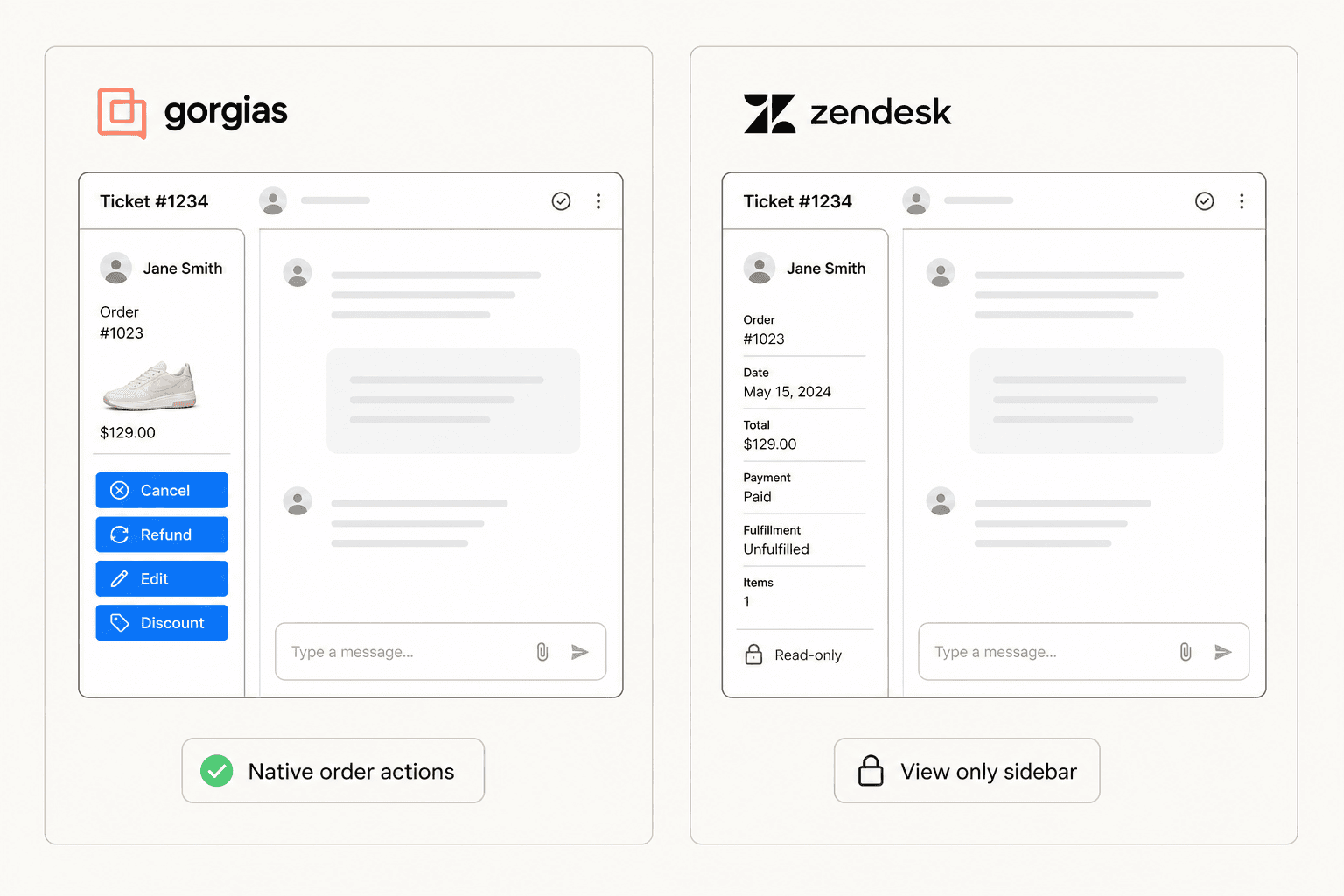
Gorgias treats Shopify data as a first-class citizen. From inside a ticket, agents can look up order history, edit orders before fulfillment, cancel, process refunds, generate unique discount codes, and send product recommendations - no tab-switching required. Beyond that:
- WISMO automation: The AI Agent sends real-time order status using live Shopify data before any human sees the ticket.
- Checkout chat: A live chat widget triggers specifically at the checkout step to prevent cart abandonment.
- Revenue attribution: Every support conversation that converts to a purchase is tracked. Gorgias surfaces pre-sale ticket counts, converted tickets, and total revenue driven per conversation - available on Pro tier and above.
- Customer prioritization: Tickets route and prioritize based on a customer's Shopify LTV, subscription status, or spending level.
This depth is why Shopify designated Gorgias its only Premier Partner in CX - a closer integration relationship than any other third-party helpdesk has with Shopify.
Zendesk's Shopify integration shows order data in a sidebar within a ticket - but it is fundamentally read-only. Agents who need to act on an order still open Shopify Admin in a second tab. To have AI agents take order-level actions in Zendesk (cancel, refund, update shipping), you need the Advanced AI Agents add-on, which has no public price and requires contacting sales. As of May 2026, Zendesk's Shopify Marketplace listing returns a 404. Zendesk also has no cart abandonment tools, revenue attribution, or checkout chat.
A Capterra reviewer who switched from Zendesk put it directly:
"The Shopify integration is the best in class. You can see order history, issue refunds, and edit orders directly inside a ticket without switching tabs. Macros save a ton of time on repetitive tickets and the automation rules are actually flexible enough to be useful."
Verified Reviewer, Senior Manager Digital Marketing, Capterra

For more on native order management in Gorgias, see our guide to Gorgias order editing from ticket. For Zendesk's approach to ecommerce returns, see how to set up a Zendesk ecommerce returns workflow.
AI capabilities
Both platforms have made significant AI investments, but the architecture and cost model are different.
Gorgias AI Agent is a separate purpose-built layer, trained on 1B+ ecommerce conversations via a direct OpenAI partnership. It's priced at $1.00 per fully resolved conversation on monthly plans ($0.90 on annual), with resolutions bundled into Helpdesk plans (60 on Basic, 600 on Pro, 2,500 on Advanced). Additional resolutions cost $150 per 100 interactions.
The AI Agent handles WISMO queries, returns and refund requests, FAQ responses, subscription management, and pre-purchase product questions. Recent Shopify App Store reviews reflect strong performance on factual queries:
"The AI Agent in particular has been surprisingly effective at handling routine inquiries like order tracking and shipping updates without needing human intervention. Recently it handled a 'where is my order' ticket, provided the tracking link and delivery context, and the customer left a 5-star CSAT."
Seido Knives, Shopify App Store

One caveat from community discussions: the AI Agent performs well on post-purchase factual queries but has been flagged for hallucinating product recommendations when working with live catalog data. This is a known limitation Gorgias is actively addressing.
Zendesk AI is built into the Resolution Platform framework. Suite Team and above include "Essential AI Agents" - generative responses from the knowledge base and basic automations. The Resolution Learning Loop applies learnings from every resolved interaction to improve automation rates over time.
Full AI capability requires add-ons:
- Copilot ($50/agent/month): real-time response suggestions, tone adjustment, proactive context surfacing, and action execution in third-party systems.
- Advanced AI Agents (contact sales): required for AI agents to take order-level Shopify actions. No public price.
Zendesk meters AI through "Automated Resolutions" - each plan includes 5-15 ARs per agent/month, and overages cost $1.50-$2.00 per resolution. For ecommerce teams scaling through Black Friday or BFCM, those overages can accumulate fast.
The cold-start constraint is also worth knowing: Zendesk's AI features require 1,000+ resolved historical tickets before activation. A new store or a team migrating from another platform won't have immediate access to AI capabilities. For more on evaluating AI support options, see our overview of AI customer service automation tools.
Pricing
The pricing structures are fundamentally different models.
Gorgias prices by ticket volume - not per agent seat. All plans except Starter include up to 500 users, so your whole team can access the platform without per-person costs.
| Plan | Monthly | Tickets included | AI Agent bundled |
|---|---|---|---|
| Starter | $10/mo | 50 | - |
| Basic | $60/mo | 300 | 60 resolutions |
| Pro | $360/mo | 2,000 | 600 resolutions |
| Advanced | $900/mo | 5,000 | 2,500 resolutions |
| Enterprise | Custom | Custom | Custom |
Overage tickets: $40/100 (Starter and Basic), $36/100 (Pro and Advanced). AI Agent overages: $150/100 interactions. Annual billing saves up to 16%.
Zendesk prices per agent per month on annual billing. Every person handling tickets is a seat you pay for.
| Plan | Per agent/month (annual) | AI included |
|---|---|---|
| Support Team | $19 | No |
| Suite Team | $55 | Essential |
| Suite Professional | $115 | Essential |
| Suite Enterprise | $169 | Essential |
Key add-ons per agent/month: Copilot $50, Quality Assurance $35, Workforce Management $25, Contact Center $50. Automated Resolution overages: $1.50-$2.00/AR.
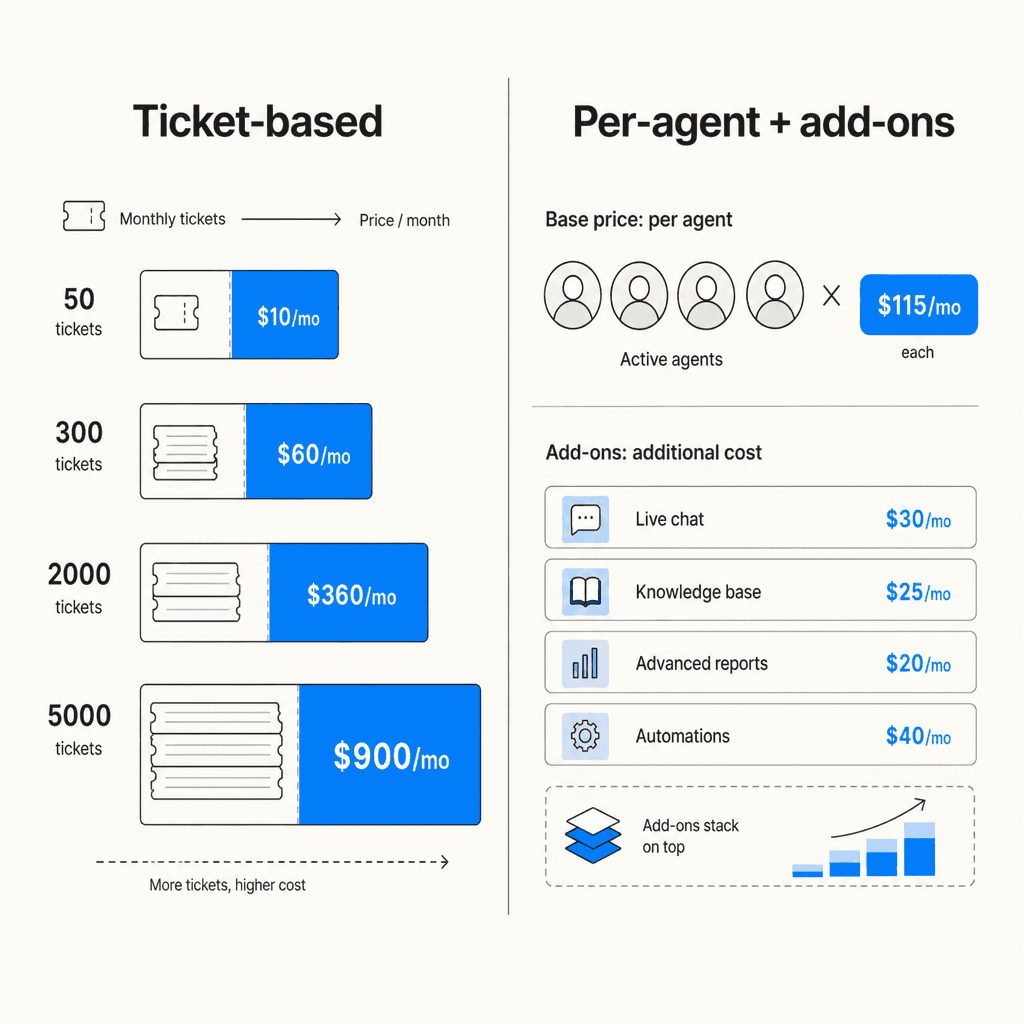
In practice, a 5-person ecommerce team handling 1,000 tickets/month would pay roughly $360/month for Gorgias Pro (includes all 5 people). The same team on Zendesk Suite Team with 5 agents is $275/month - but add Copilot ($250) and QA ($175) to reach comparable feature coverage, and that's $700/month.
For a 10-agent team at Suite Professional with Copilot, QA, and WFM, Zendesk reaches approximately $3,300/month before Automated Resolution overages. Independent pricing analysis from April 2026 confirms this figure using Zendesk's published rates.
The risk works in both directions, though. Gorgias's ticket-based model can become expensive and hard to predict as volume grows:
"Gorgias cost me $1,000 last month for less than 50 inquiries, which works out to about $14.50 per inquiry which is obscene."
Agape Nutrition, 3-year Gorgias user, Shopify App Store
This reflects what happens when base plan tickets and AI Agent resolutions stack up on a plan not calibrated for actual volume. For context on managing high ticket volumes with automation, our guide to AI for refund request handling covers how to reduce the tickets you pay for in the first place.
Setup and ease of use
Gorgias is considerably faster to get running. The company's "50 in 50" onboarding program targets 50% automation in 50 days, and most reviewers report going live within a week. Pre-built macro templates and a one-click Shopify install get teams moving without technical overhead.
Zendesk is more configurable and more powerful - which also means it requires more effort to configure correctly. G2 reviewers consistently report two-week onboarding periods, and the platform generally rewards teams that have someone dedicated to setting it up:
"It took us almost two weeks to get things in order. It would be good to have improved onboarding of new teams."
Sabina K., IT Operations Manager, G2

Reddit threads on the subject are more blunt. A discussion in r/helpdesk captured the recurring sentiment: Zendesk is "like using a spaceship to deliver pizza" - genuinely capable, but you need to know how to fly it. Small teams without a dedicated ops person tend to get a fraction of what Zendesk can actually do.
That is not a knock against Zendesk for the right context. A mid-market brand with a support ops function can absolutely justify the configuration investment. For a 3-person DTC brand handling its own tickets, Gorgias's lower-friction start matters a lot.
What users say about each
User sentiment on both platforms reflects their target markets fairly closely.
For Gorgias, the most consistent praise is the Shopify integration and the ticket-based pricing:
"The pricing model fits a collaborative business environment, because charging per ticket instead of per user allowed nearly everyone in our company to use it freely without worrying about seat limits, which massively streamlined cross-team communication."
Frank A., Head of Digital, Capterra
The most consistent complaints are pricing unpredictability at scale and customer support quality:
"Customer support is non-existent. Phones cut out all the time."
Brace Direct, 3-year Gorgias user, Shopify App Store
For Zendesk, the most consistent praise is the multi-channel consolidation and automation power:
"Zendesk is a ticketing solution, and it does it rather well. It consolidates all the messages of the customers, whether they are emails, chats or social media to a single inbox and so my team does not need to keep moving between the tabs to get the right conversation."
Sabina K., G2
The most consistent complaints are pricing escalation and complexity for smaller teams:
"The pricing structure can also become expensive as you scale, especially if you need premium features."
Matthew B., Operations Director, Capterra
When Gorgias makes sense
Gorgias is the stronger fit when:
- Shopify is your primary or only ecommerce platform. The integration depth is built around Shopify data, and most revenue-generation features assume Shopify as the source.
- You want order actions inside tickets without custom integrations. Refunds, cancellations, discount codes, and WISMO are all native and don't require add-ons.
- Revenue attribution from support matters to you. Gorgias tracks which support conversations lead to purchases. Zendesk has no equivalent.
- Your team is small to mid-size without a dedicated support ops function. The fast onboarding, ticket-based pricing, and pre-built Shopify workflows lower the barrier to entry.
- You're DTC and rely on Instagram, TikTok, SMS, Klaviyo, or Recharge. Gorgias supports all of these natively with 300+ integrations oriented around DTC commerce.
Gorgias is a worse fit for: non-Shopify platforms (WooCommerce and Magento users are second-class), enterprise compliance requirements, ITSM alongside customer support, and teams needing advanced custom reporting.
For other ecommerce-native tool comparisons, see Gorgias vs Front and our roundup of the best AI helpdesks for ecommerce.
When Zendesk makes sense
Zendesk is the stronger fit when:
- You sell across multiple platforms, not just Shopify. Its 1,800+ integrations and general architecture handle WooCommerce, Magento, BigCommerce, and custom stacks without bias toward any one.
- Enterprise compliance or ITSM is required. SOC 2, HIPAA, ISO 27001, and full IT service management are part of the same platform.
- You have a complex support operation with multiple teams or brands. Skills-based routing, deep custom views, and workflow automation handle complexity that Gorgias was not built for.
- Customer support and internal IT/HR helpdesk need to share the same platform. Zendesk's Employee Service offering covers both on a single instance.
- Your team has someone who can configure and maintain the platform. The investment in setup pays off significantly in flexibility and scalability.
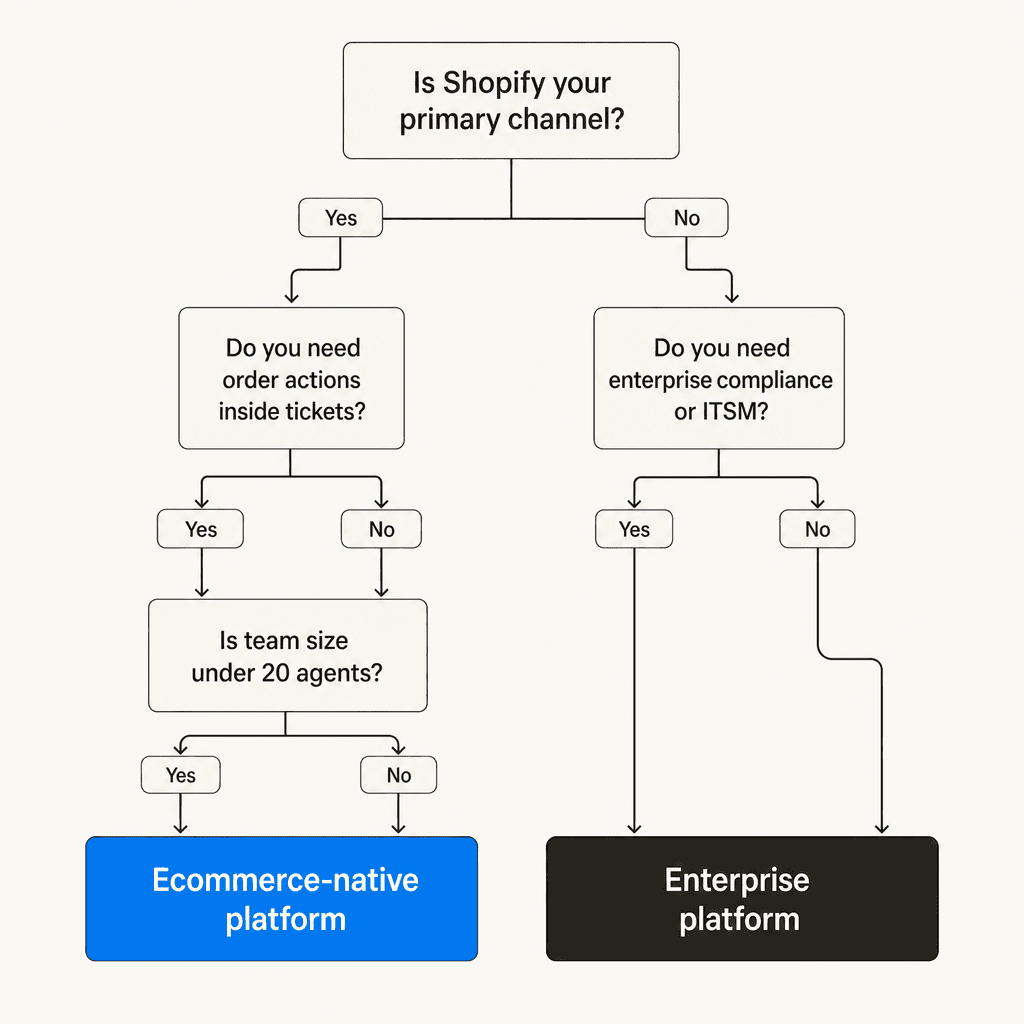
A 2026 thread on r/CRM summarized the community consensus: "If you're Shopify-only then Gorgias makes sense; if you need pure support at scale, go Zendesk." That is a reasonable heuristic for most teams.
For a deeper look at Zendesk's ecommerce-specific capabilities and limitations, see our complete guide to Zendesk ecommerce support. And for automating high-volume queries like order status and returns regardless of which platform you use, our guide to chatbots for order status, returns, and shipping covers the practical setup.
Try eesel AI
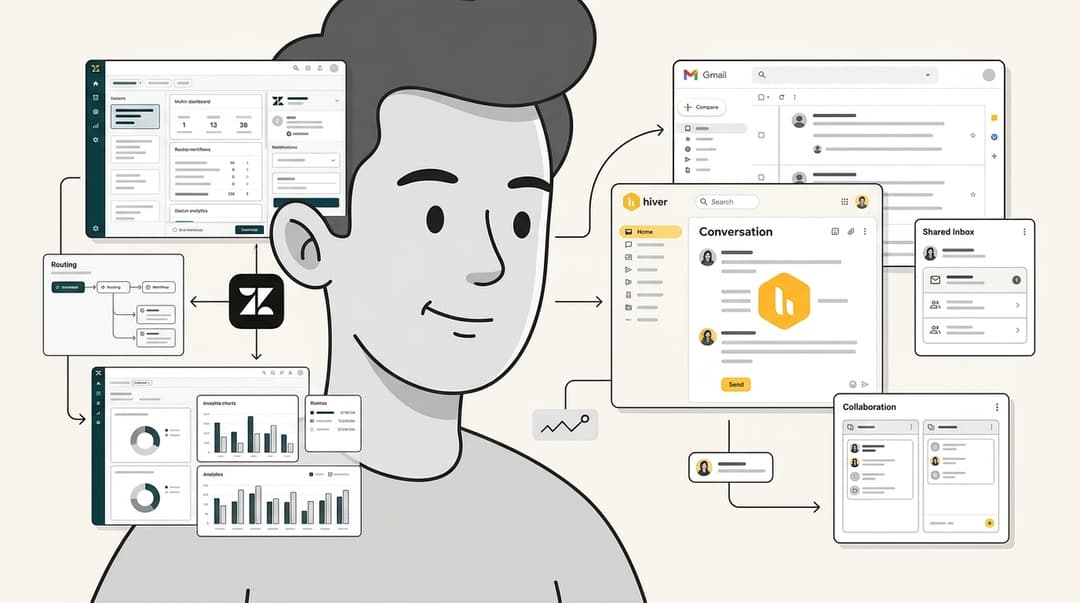
If you are already using Gorgias or Zendesk and want to add a smarter layer of AI on top of what those platforms provide natively, eesel AI works as an autonomous teammate inside either. Rather than replacing your helpdesk, eesel deploys as an agent that reads your past tickets, help center, Notion docs, Confluence, Shopify data, and any other connected source - then handles incoming support at $0.40 per resolved ticket, with no per-seat fees and no monthly minimum.
Unlike the native AI in Gorgias or Zendesk, eesel learns from your actual past ticket history - not just your knowledge base articles. That means it builds understanding of edge cases, your tone, and your specific product from day one. You can start in supervised mode (approve every draft before it sends) and dial up autonomy as confidence builds, with every human correction incorporated into future responses.
Smava processes 100,000+ Zendesk tickets per month through eesel, fully automatically, in German. Design.com handles 50,000+ Freshdesk tickets per month the same way. A free trial with $50 in usage credit - no credit card required - is enough to run it against your real ticket queue and see the coverage before committing.