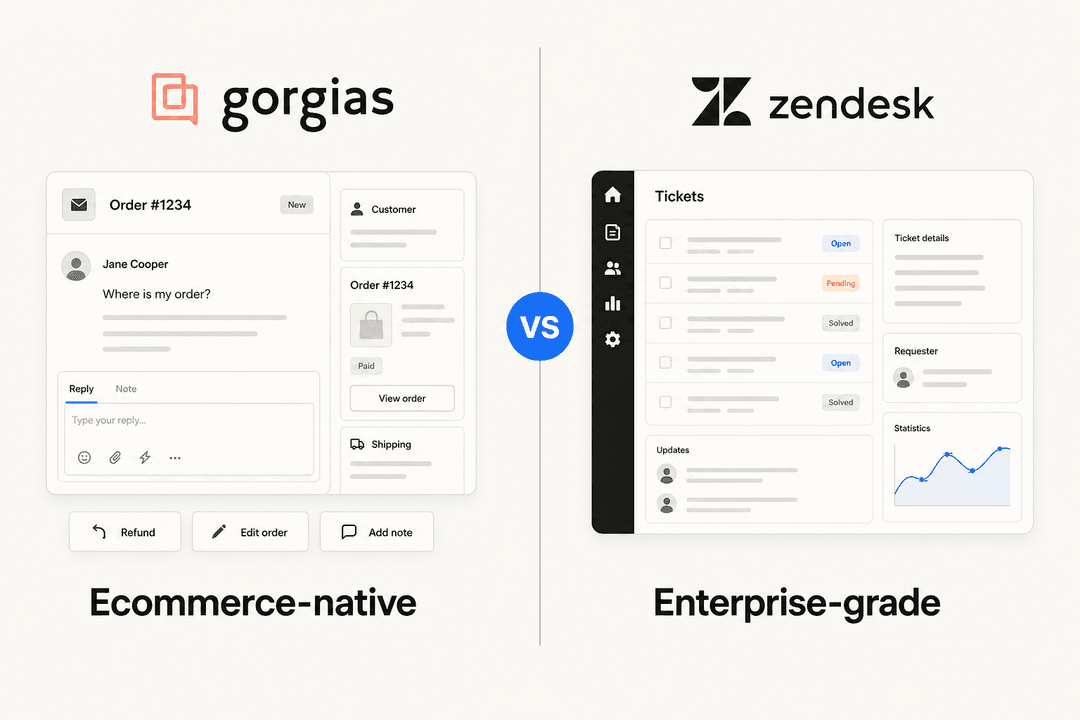
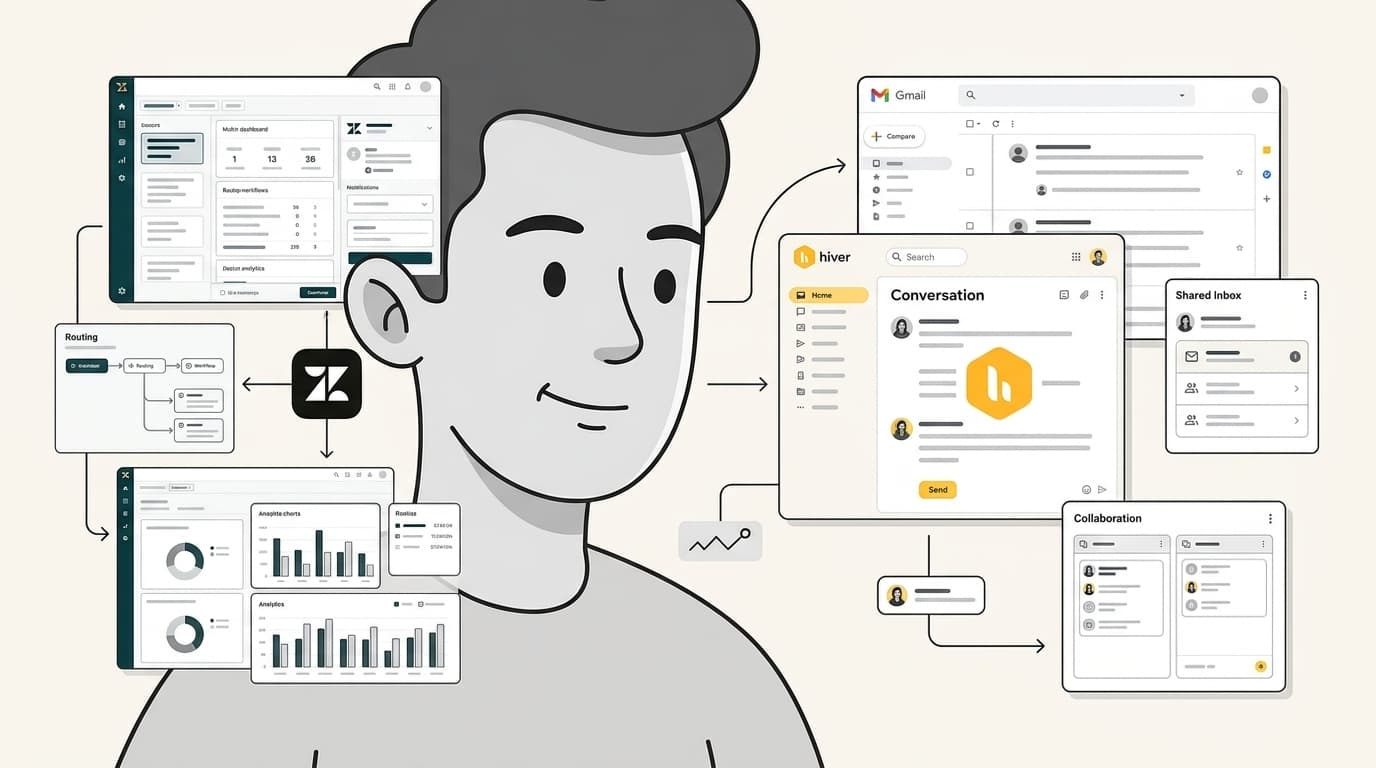
If your team handles under 500 tickets a month, Hiver wins on setup time, under an hour to first resolution within Gmail. Past 2,000 tickets or with a complex multi-brand operation, Zendesk's standalone platform pulls ahead on routing depth. We compared both on total cost and AI accuracy below.
Both platforms have leaned heavily into agentic AI in 2026, but the choice usually comes down to where you want your team to live: in a specialized support suite or their existing email inbox. Below we break down how each one handles tickets that require context from past conversations, what they do well, and where each one still needs a human in the loop.
What is Zendesk?
Zendesk has officially transitioned from a traditional helpdesk to what it calls the "Zendesk Resolution Platform." It is an enterprise-grade, standalone support suite designed to handle massive volumes across every possible customer touchpoint. Unlike simpler tools, Zendesk separates support work from the inbox, providing a dedicated environment for agents to manage resolutions at scale.
The platform is built on four core pillars: Support for ticketing, Guide for knowledge management, Talk for voice support, and Explore for analytics. For large organizations managing hundreds of agents and multi-brand operations, this architecture provides the control and visibility required to maintain consistent service levels across the globe.
In 2026, Zendesk is the choice for teams that need deep omnichannel depth. Whether it is managing WhatsApp threads, Instagram DMs, or global telephony, the platform centralizes everything into a single, high-powered workspace.
What is Hiver?
Hiver takes a different approach by functioning as a Gmail-native customer service platform. Instead of forcing your team to learn a new interface or toggle between tabs, Hiver adds helpdesk functionality directly to the tools they already use. It is the default choice for teams that prioritize relationship management and want to stay within their Google Workspace or Outlook environment.
The architecture is deceptively simple. You can manage shared addresses like support@ or finance@ collaboratively without ever leaving your personal inbox. This is particularly valuable for Finance, IT, and People Operations teams that handle a mix of external customer queries and internal employee requests.
With Hiver, the goal is to make support feel like a conversation rather than a ticket number. It eliminates the friction of traditional ticketing systems, allowing small to mid-sized teams to coordinate and resolve issues with zero ramp time.
eesel AI: The modern alternative to legacy helpdesks
At eesel AI, we believe the future of support is not about where you work, but how the work gets done. We have built the AI Helpdesk Agent to be the first AI teammate you hire, not a tool you configure. While Zendesk and Hiver focus on the interface, we focus on the resolution.
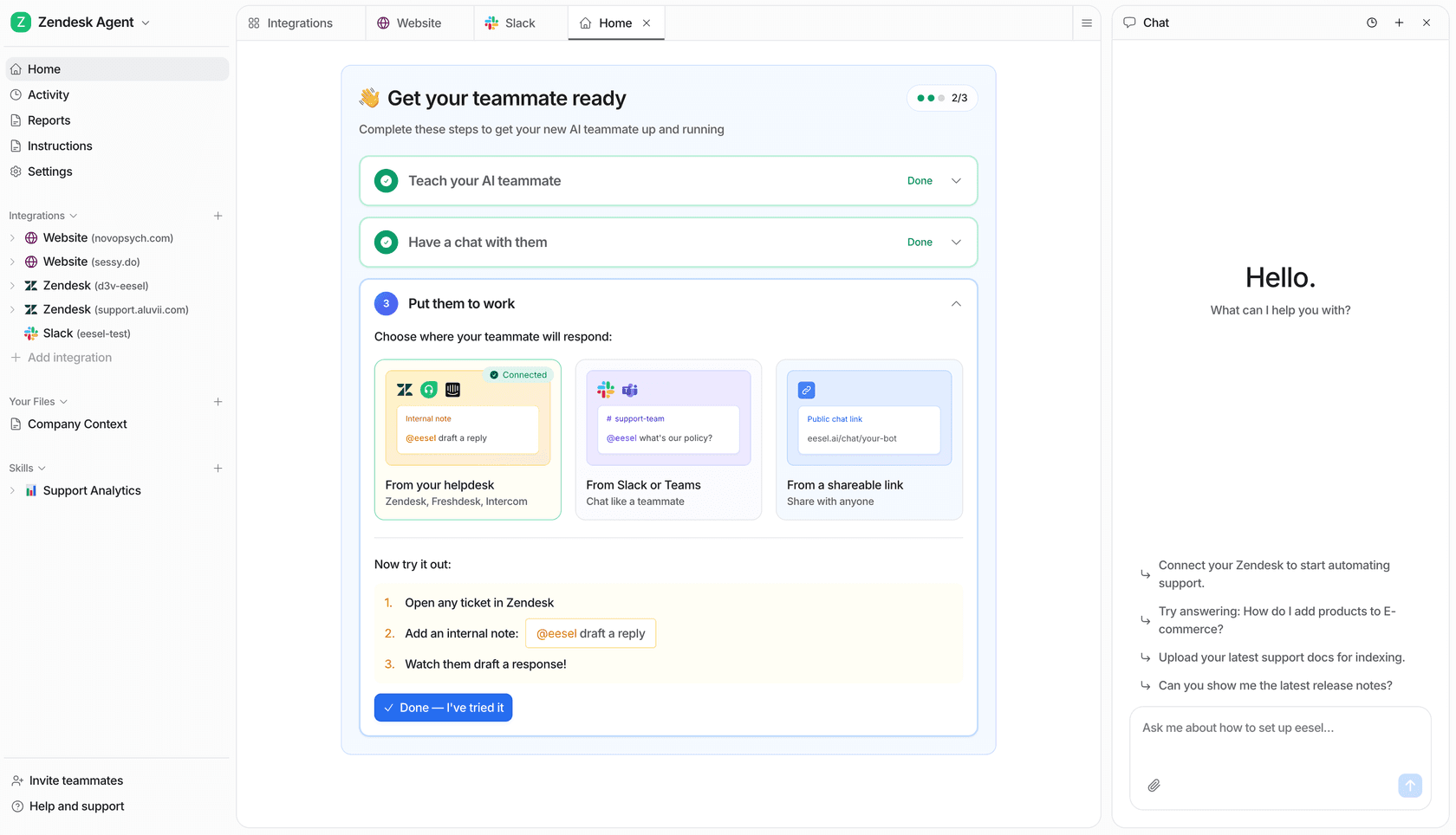
Our AI Helpdesk Agent learns your business in minutes. By connecting to your past tickets, help center articles, and even your website, it gains the context required to resolve up to 81% of customer queries autonomously. It does not need weeks of professional services or a dedicated admin to set up rules. You simply hire it, and it starts working.
Unlike traditional platforms that charge per seat, we focus on outcomes. Whether you are using eesel AI to handle frontline support or complex escalations, the result is the same: productivity that scales with your needs, not your headcount. We are model-agnostic, meaning we always use the best AI models available in 2026 to ensure your customers get the most accurate answers possible.
Key feature comparison: Where Zendesk and Hiver diverge
Choosing between Zendesk and Hiver is a strategic decision that affects how your team operates daily. Let's break it down.
Architecture: Standalone vs. Gmail-native
The biggest trade-off is the interface itself. Zendesk provides a specialized ticketing environment that is powerful but can feel bloated for smaller teams. It requires agents to leave their email and work in a separate portal, which is great for focus in high-volume environments but adds friction for teams that only handle a few dozen tickets a day.
Hiver, on the other hand, lives entirely inside Gmail or Outlook. This familiar interface leads to high adoption rates because there is nothing new to learn. But there's a limit: if you're managing complex omnichannel workflows (like a massive call center), the constraints of an email UI can become a bottleneck.
AI and automation: Answer Bot vs. Hiver AI
In 2026, both platforms have integrated sophisticated AI, but the implementation differs. Zendesk AI focuses on "agentic AI" designed to replace the interaction. Its AI agents reason, adapt, and act independently across all channels.
Hiver AI focuses on assisting the human agent within the inbox. Its AI Copilot drafts replies and finds answers in real-time, while its AI Agents handle multi-step tasks like processing refunds or updating CRMs.
Internal collaboration: Side Conversations vs. Email Notes
How your team works together is just as important as how they talk to customers. Zendesk uses "Side Conversations" to let agents loop in non-agents (like developers or billing teams) via email or Slack without leaving the ticket.
Hiver uses internal notes and @mentions that sit right next to the email thread. This allows for real-time collaboration that feels as natural as a chat app, eliminating the need for internal forward chains.
Pricing and total cost of ownership in 2026
The price tag on the website is rarely the whole story, especially in 2026. While Hiver is generally more affordable for small teams, Zendesk's enterprise features come with a complex pricing structure that can add up quickly.
| Plan Tier | Zendesk Pricing (Annual) | Hiver Pricing (Annual) |
|---|---|---|
| Starter / Growth | $19 (Support Team) | $25 (Growth) |
| Professional / Pro | $115 (Suite Pro) | $55 (Pro) |
| Enterprise / Elite | $169 (Suite Ent) | $85 (Elite) |
| Free Version | No | Yes ($0, Unlimited Users) |
There is also the "AI Tax" to consider. Most of Zendesk's advanced AI features, like the proactive Agent Copilot ($50 per agent/month) or Quality Assurance ($35 per agent/month), are paid add-ons. Hiver includes many of its AI features in the standard Pro and Elite plans, making the total cost of ownership much easier to predict.
Setup and implementation time: Minutes vs. months
The true cost of a helpdesk includes the time it takes to get it running. Zendesk is notoriously complex. For larger organizations, it often requires professional services, custom training, and a 4-12 week timeline to reach full productivity. Some implementation fees can reach $5,000 or more before the first ticket is even solved.
Hiver is built for speed. Most teams can onboard in 2-3 hours and see their first resolution on day one. It is a no-code solution that fits into your existing infrastructure.
As brand strategist Phil Pallen explains in the video above, Hiver is often the preferred choice for SMBs because it removes the technical friction that plagues platforms like Zendesk. It allows teams to focus on the customer, not the configuration.
Choosing the right helpdesk tool for your team
The choice depends on the scale and complexity of your operation.
Choose Zendesk if:
- You manage a global team of 500+ agents.
- You need deep, native omnichannel support (including a full call center).
- You have the budget and personnel to manage a complex, enterprise platform.
Choose Hiver if:
- You want to stay productive inside Gmail or Outlook.
- You need a cost-effective solution with zero ramp time.
- You prioritize relationship-focused support for small to mid-sized teams.
Bottom line? Regardless of which platform you choose, the most valuable move you can make in 2026 is hiring an eesel AI teammate. By offloading your frontline support to our AI Helpdesk Agent, you can achieve high resolution rates and faster response times without the "platform tax." We work with your existing tools, ensuring your team can focus on the complex, human-first work that AI cannot handle.
Frequently Asked Questions
What is the main difference between Zendesk and Hiver for small teams?
How does pricing compare between the two helpdesks in 2026?
Which platform offers better AI agents for customer support?
Is it easy to migrate from one tool to the other?
Can eesel AI integrate with both of these support solutions?


Article by
Kurnia Kharisma Agung Samiadjie
Kurnia is a software engineer and writer at eesel AI with two years of SEO experience, writing about AI tools, helpdesk software, and customer support. He pairs a developer's understanding of how these products are built with search-driven research into what actually ranks and resonates with the people searching for them.