Ringly alternatives: 8 AI phone support options for Shopify in 2026

Rama Adi

Katelin Teen
Last edited August 20, 2026

Why stores start looking past Ringly
I build integrations at eesel, so I spend a lot of my week inside the gap between what a vendor's marketing page says an integration does and what its API actually exposes. That gap is where this whole category lives right now.
The pattern I see on calls is consistent. One of our customers is a DTC supplements and seasonal-products brand running Gorgias, Shopify and Aircall side by side, pushing about 7,000 tickets a month against roughly 30,000 orders. That is a 25 to 30% ticket-to-order ratio, and their stated goal was to auto-resolve half of it: WISMO, subscription changes, basic product questions. Nobody on that call wanted a better phone system. They wanted the volume to stop arriving.
That is the frame most Ringly shoppers are actually in. They are not comparing voice vendors for fun, they hit one of four walls:
- The minute meter does not match how they think about support. Every other tool in an ecommerce stack bills per ticket, per resolution or per seat, the way an AI helpdesk for Shopify does. Minutes are a telecom unit, and they make a support budget hard to forecast because the caller, not you, decides how long the call runs.
- $349 is a real floor for a small store. Grow is the entry point, and there is no cheaper tier below it. A store taking 80 calls a month is paying $349 for maybe 160 minutes of use.
- The guarantee is on the expensive plan. Ringly's homepage promises a 65% resolution guarantee, refunding all subscription fees if it misses within 90 days. On the pricing page, that guarantee is listed as a Pro feature and does not appear on Grow. The gap between those plans is $450/mo.
- They already have a helpdesk. If calls land in Ringly and everything else lands in Gorgias or Zendesk, you now have two systems holding half a customer history each, which is the exact problem the Gorgias phone integration exists to avoid. Ringly does create tickets in your helpdesk, but the call itself lives in a separate product.
None of that makes Ringly a bad tool. It makes it a specific tool, and specific tools deserve a comparison that names the actual axis.
What Ringly is, precisely
Ringly's agent has a name, Seth, and a narrow job: answer inbound calls to a Shopify store, resolve the repetitive ones, and hand off the rest.
What it can actually do on a live call is published as a list of actions: look up an order, request a return, search the product catalog, check stock, check business hours, create a ticket, verify a caller, find a customer, track an order, send an email, transfer the call. That list is the product. It is also, notably, exactly the WISMO-and-returns slice that an ecommerce AI chatbot handles well.
Setup is the strong part. Ringly says most brands go live in under an hour: connect Shopify, add your knowledge sources, pick an escalation preference, connect your helpdesk, forward your number. Having wired a lot of helpdesk integrations myself, an hour is a credible claim for a product this narrowly scoped, because there is very little to configure.
Two things I would want a buyer to know before signing.
The public API is outbound-only. Ringly's API reference lists make-an-outbound-call endpoints and nothing for inbound call control or agent configuration, and the page is stamped "Last updated 1 year ago". Custom workflows are an Enterprise conversation, not something you build against the docs. If your plan involves programmatic control, price Enterprise from the start.
Revenue attribution is post-call, not incremental. Ringly's FAQ says every order placed in Shopify after a call with Seth shows up as Seth-attributed revenue, and that "brands typically see $10-$100 revenue per call". Read that mechanism carefully. A WISMO caller already placed their order. Attributing revenue to a call that happened because a purchase already existed is last-touch bookkeeping, not proof the call created the sale. The number may still be useful directionally, but I would not build a business case on it without a holdout group.
What Ringly costs
| Plan | Monthly | Minutes included | Effective rate | Overage | Notable |
|---|---|---|---|---|---|
| Grow | $349 | 1,000 (~500 calls) | $0.349/min | $0.29/min | Product, order and return calls; transfers the rest |
| Pro | $799 | 2,500 (~1,250 calls) | $0.320/min | $0.19/min | Done-for-you setup, 65% resolution guarantee, fine-tune Seth |
| Enterprise | Quote | Custom | Not published | Not published | Custom integrations, private Slack channel, dedicated onboarding; aimed at 5,000+ min/mo |
A quirk worth catching: on both plans, the overage minute costs less than the average included minute. Grow's included minutes work out to $0.349 each while extra ones are $0.29. Pro's are $0.320 against a $0.19 overage. That means the plans are front-loaded, and the cheapest minutes you will ever buy from Ringly are the ones past your allowance. Running slightly over your plan is not a penalty here, which is unusual and mildly in the buyer's favour.
There is a 14-day free trial, and Ringly's Shopify App Store listing carries a 4.6 rating from three reviews. Three is a small sample, and I would rather quote it honestly than dress it up. The most useful of them is the four-star one:
"There was initial issues with cancelling on their service but after expressing my concerns they tell me they are fixing the UI to tell more clearly when you're cancelled. The call quality was OK, but I decided to use something else."

Ringly's public reply owned it directly: "you were right that after cancelling our app didn't show it had gone through, and that one's on us." Founder-answered support is a real advantage of buying from a small team, and that exchange is evidence of it.
The number nobody puts on the pricing page
Before comparing tools, it helps to know what a voice minute actually costs at the component level, because every vendor among the AI voice companies buys the same three inputs: speech-to-text, a model, and text-to-speech.
Retell publishes the breakdown on its own pricing page via a cost estimator, and at its default settings it lands at $0.115 a minute: $0.045 for the LLM, $0.055 for Retell's voice infrastructure, $0.015 for TTS, with telephony at $0.000 because you bring your own. Bland charges a flat $0.14 a minute on its entry tier with no model pass-throughs. Vapi charges $0.05 a minute for hosting and passes model costs through at cost, or $0 if you supply your own API keys. ElevenLabs Agents works out to a flat $0.08 a minute across its Pro, Scale and Business tiers.
So the working range for an AI voice minute in 2026 is roughly $0.08 to $0.14, before telephony.
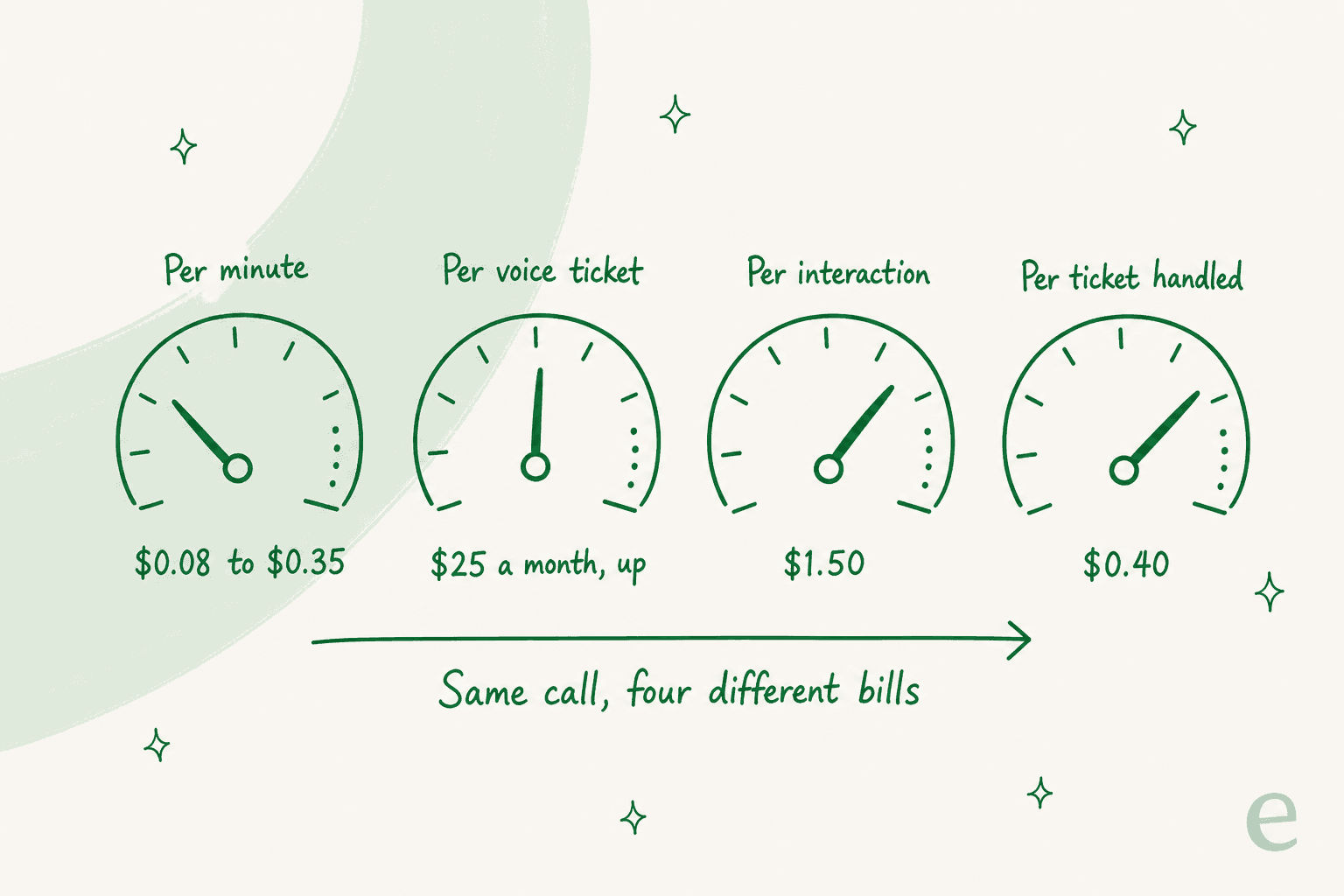
That "before telephony" caveat matters and gets skipped a lot. The platform rate covers the AI, not always the phone line. Bland bundles an inbound number on Start and calls it a $15/mo value. Vapi includes 10 concurrent lines and charges $10 per line per month beyond that. Retell's calculator shows telephony at zero because the default assumption is your own Twilio account. Add a number, inbound minutes and any transfer legs, and a $0.08 platform rate is realistically $0.10 to $0.13 all-in.
What you are actually buying at $0.35 a minute
Run Ringly's Grow plan through that lens. 1,000 minutes of raw voice-agent capacity costs about $115 at Retell's own published component rate. Ringly charges $349. The difference, roughly $234 a month, is the wiring.
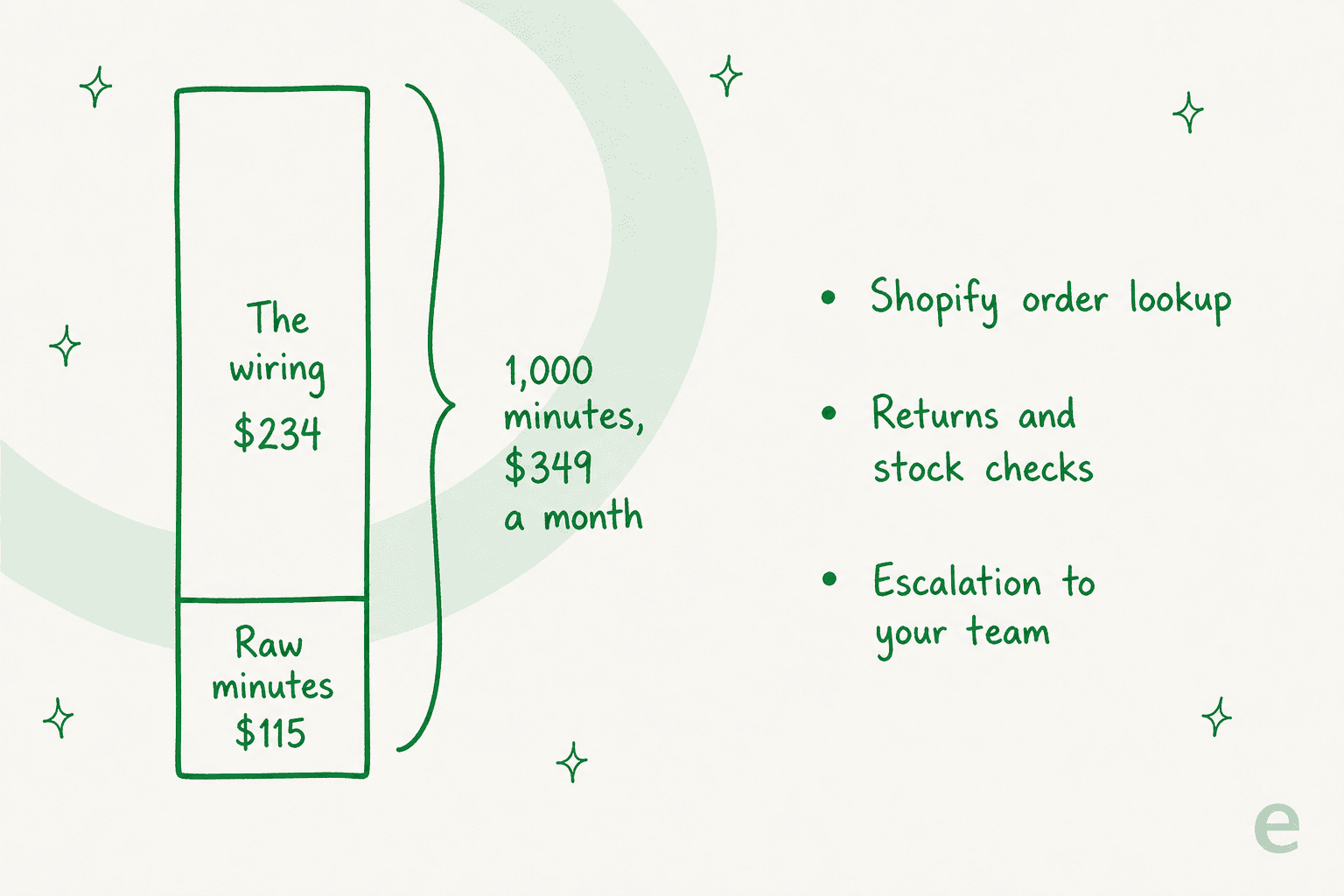
I want to be straight about this, because the easy version of this post would call $349 overpriced and it is not. $234 a month buys you Shopify order lookups that work, a returns flow, stock checks, escalation logic, call recordings, call transcripts and an agent someone else already tuned for ecommerce calls. That is under two hours of contract engineering time a month. If you do not have an engineer sitting idle, building it yourself is the expensive option, not the cheap one.
The premium is only a bad deal in two situations: you have in-house engineering capacity and a reason to own the stack, or your call volume is so low that a $349 floor swamps the per-minute math entirely.
How I picked these eight
Three filters, applied honestly:
- It has to be reachable for a Shopify store. A tool with a $30,000 annual floor is in this list for completeness and clearly labelled, not as a real substitute for a $349 plan.
- The meter has to be published or the gap named. Where a vendor is quote-only, I say so rather than guessing at a rate.
- It has to be honest about the channel. Two entries here do not answer phone calls at all. They earn their place because they change how many calls you get, which is the whole premise of ticket deflection, and pretending they are voice agents would be useless to you.
Every item below follows the same shape: best for, what it does, pricing, where it fits, where it does not, verdict. The full comparison first, for skimmers.
| Tool | Answers calls with AI | Meter | Entry price | Shopify-native | Resolution guarantee | Test before launch | Self-serve trial | Published rate card | Best for |
|---|---|---|---|---|---|---|---|---|---|
| Ringly | Yes | Per minute | $349/mo | Yes | 65% on Pro | No dry run published | 14 days | Yes | Shopify stores that want voice handled for them |
| eesel | No | 1 credit per ticket or chat | From $299/mo (500 credits) | Yes | No | Simulation on past tickets | 100 free credits, no card | Yes | Removing the reason people call |
| Gorgias | No (humans answer) | Per voice ticket | $25/mo add-on | Yes | No | No | Yes | Yes | Keeping calls in one ticket history |
| Retell AI | Yes | Per minute | $0.07/min | No | No | Simulation testing | $10 credit | Yes | True pay-as-you-go testing |
| Vapi | Yes | Per minute + lines | $0.05/min | No | No | You build it | Yes | Yes | Teams with a developer |
| Bland AI | Yes | Per minute | $0.14/min | No | No | You build it | No card required | Yes | Predictable flat per-minute cost |
| ElevenLabs | Yes | Per minute | $0 free tier | No | No | You build it | 15 free minutes | Yes | Voice quality above all |
| PolyAI | Yes | Per minute | Quote only | No | 99.9% uptime SLA | Not published | Demo only | No | Enterprise contact centres |
| Synthflow | Yes | Contract | $30,000/yr | No | Scoped in contract | Scoped in contract | Sales call | No | Enterprise voice programmes |
1. eesel AI
Best for: cutting the call volume before you buy a phone agent at all.
Let me put the limitation first, because it is the whole reason this entry is useful. eesel does not answer phone calls. There is no voice channel, no phone number, no minutes. If your requirement is literally "something must pick up the phone", skip to Retell.
What eesel does is sit in the helpdesk and resolve the text volume that generates most of those calls. It connects to Shopify plus Gorgias, Zendesk, Freshdesk, Front, Help Scout, HubSpot, Salesforce and Jira Service Management, reads your help center and past tickets, and handles conversations end to end like an ecommerce AI assistant should. The relevant slice for an ecommerce store is exactly Ringly's action list: order status, returns, product questions, policy answers.
The reason I lead with it in a voice roundup is a number from our own data. A real-traffic trial on a German jewellery brand's inbox, about 1,000 tickets a month across eight languages on Zendesk and Shopify, the kind of load multilingual ecommerce support has to carry, came back with 93% triage accuracy and 100% spam detection. It also came back with a 7% factual error rate on drafts. On email, a 7% error rate is a human glancing at a draft and fixing it. On a live phone call, there is no draft step. The customer hears the wrong answer.
That asymmetry is why I would always clear the easy volume in text first and size the voice agent for what survives.
Pricing
| Monthly credits | Cost |
|---|---|
| Free plan | 100 credits, no card |
| 500 | $299/mo |
| 1,000 | $499/mo |
| 2,500 | $999/mo |
| 5,000 | $1,899/mo |
| Pay a year upfront | Two months free |
One credit is one conversation handled, not resolved, which I would rather state plainly than let you discover on an invoice. Only tickets the agent actually works on count, and questions asked in the dashboard are mostly free. Full detail is on the pricing page. At 500 conversations a month that is $299, and if you run out you can turn on overage with a monthly cap you set yourself.
Where it fits: a store with a real help center and ticket history, where most inbound is order status and returns, and where the phone is one channel alongside SMS support.
Where it does not: any store whose customers prefer to call, or a business where phone is the channel. It also needs a knowledge base worth reading; if your policies live in someone's head, fix that first.
Verdict: the highest-leverage move on this list, and not a Ringly substitute. Use it to shrink the call queue, then buy voice for the remainder. If you buy voice first, you are paying $0.35 a minute to answer questions your order tracking automation should have answered for free.
2. Gorgias Voice
Best for: keeping every call in the same ticket history as your email and chat.
Second honest limitation up front: Gorgias Voice is a phone channel for humans, not an AI agent that answers calls. What it ships is IVR, call queues with routing, transfers, recordings, transcripts, AI summaries and analytics, with Shopify context on the screen while your agent talks. Gorgias AI Agent handles email and chat; the voice line rings a person.
That is still directly relevant to a Ringly decision. Gorgias claims Voice cuts resolution time by 60% by putting ticket history and Shopify data in one view, and the mechanism is plausible: most call handling time is the agent hunting for the order. If your problem is that calls are slow rather than that calls are numerous, this is the cheaper fix.
The meter is unusual and worth understanding, because it is the one billing unit here that is not a clock. A conversation becomes a Voice ticket the moment a call connects, and follow-up calls on that ticket are unlimited at no extra charge. So a customer who calls back three times about one return is one ticket, not three, and not 14 minutes.
Pricing
| Component | Cost |
|---|---|
| Voice add-on | From $25/mo, annual pricing |
| Helpdesk Starter | $40/mo, then $0.40/ticket overage |
| Helpdesk Basic | $90/mo ($77 annual), then $0.40/ticket |
| Helpdesk Pro | $550/mo ($471 annual), then $0.36/ticket |
| Helpdesk Advanced | $1,430/mo ($1,227 annual), then $0.36/ticket |
| AI Agent overage | $1.50 per automated interaction |
Where it fits: stores already on Gorgias, where the phone volume is low enough that a human can take it and the win is context rather than automation. Also worth reading against the Gorgias alternatives if splitting your history across two products is unacceptable.
Where it does not: you still need people on the phone. This does not remove the headcount that Ringly is pitched against.
Verdict: the best choice if your objection to Ringly was fragmentation rather than cost. Pair it with an AI layer on the text channels and you get most of Ringly's outcome without a second system holding half your call records. Our own Gorgias comparison goes deeper on where the AI Agent's per-interaction meter bites.
3. Retell AI
Best for: testing a voice agent properly before you commit a dollar.
Retell is the closest thing in this list to a true pay-as-you-go voice agent, and it is the one I would reach for to answer "would an AI actually handle our calls?" without a subscription in the way. It went out as a YC W24 launch pitching an 800ms end-to-end conversational speech engine, and the framing has stayed consistent since: bring your own model, they handle the conversation dynamics.
The feature that matters if you are worried about a bot going off-script is simulation testing, included on the free tier. That is the closest thing on offer here to a dry run, and it is the single capability I would not launch a voice agent without.
Retell's pricing page also does something the rest of the category avoids: it shows you the component costs. The estimator breaks a minute into LLM, voice infrastructure, TTS and telephony, which is how I got the $0.115 figure I have been using throughout this post.
Pricing
| Plan | Cost |
|---|---|
| Pay as you go, voice | $0.07 to $0.31/min |
| Pay as you go, chat | $0.002+/message |
| Free credits | $10 |
| Concurrent calls included | 20 |
| Enterprise | Custom, volume-based |
Where it fits: an evaluation. Spend $10 of credit, point it at your five most common call types, weigh it against the Retell alternatives, run the simulation, and you will know more about whether voice works for your store than any vendor demo will tell you. The full rate card is worth reading before you scale.
Where it does not: everything Ringly hands you is now your job. No Shopify connection, no returns flow, no stock lookup, and none of the order tracking plumbing. The $0.07 floor is for a cheap model and a cheap voice; realistic ecommerce config lands mid-range.
Verdict: the smartest first spend for anyone unsure about the category. Whether it becomes your production system depends entirely on whether you have someone to build the Shopify layer. If not, you will end up back at Ringly having learned something valuable for $10. Retell reviews are worth a skim for the pattern of what people ship on it.
4. Vapi
Best for: teams with a developer and a reason to own the stack.
Vapi is the cheapest platform layer here and the most explicit about what it is not doing for you. Build is $0.05 a minute for Vapi's hosting, with speech-to-text, model and text-to-speech costs passed through at cost, or free if you bring your own API keys. Chat is $0.005 a message. Concurrency is 10 lines included, then $10 per line per month.
Two limits I would price in before choosing it. Data retention on Build is 14 days for call history and 30 for chat, which is short if you want to audit a dispute from last month. And compliance is priced as add-ons: HIPAA is $2,000/mo and Zero Data Retention is $1,000/mo, on both Build and Scale. SSO, RBAC and SOC 2 sit on the Scale annual contract, not on self-serve.
Pricing
| Component | Cost |
|---|---|
| Vapi hosting, calls | $0.05/min |
| Vapi hosting, chat | $0.005/message |
| Model providers | At cost, or $0 with your own keys |
| Concurrency | 10 lines included, then $10/line/mo |
| HIPAA add-on | $2,000/mo |
| Zero Data Retention add-on | $1,000/mo |
| Scale | Annual contract, fixed platform fee plus committed volume |
Where it fits: you have engineering capacity, you want the lowest marginal cost per minute of any AI call centre agent, and you are comfortable that the agent's behaviour, the Shopify calls and the escalation logic are code you maintain.
Where it does not: a two-person store. The $0.05 headline is the smallest line item in what you will actually spend, and 14-day retention plus no self-serve SOC 2 is a real gap for anyone with a compliance review ahead of them.
Verdict: the right floor price if you are building anyway, and a trap if you are buying. The honest comparison is not $0.05 against $0.35, it is $0.05 plus your developer's next three weeks against $349 a month.
5. Bland AI
Best for: a flat, predictable per-minute number with nothing passed through.
Bland's pitch is the one thing every other platform makes you do arithmetic for: one number, no model pass-throughs. Its pricing page says it directly, "No token charges. No model-provider pass-throughs." For a store owner who does not want to become an expert in TTS billing, that is worth something real.
The tier structure trades a platform fee against a lower rate, and the break-even is easy to compute. Start is $0.14/min with no platform fee. Build is $0.12/min plus $299/mo, so it only wins past roughly 15,000 minutes a month. Scale is $0.11/min plus $499/mo. For a Shopify store doing 1,000 to 2,500 minutes, Start is the only tier that makes sense, and it is the one with no fee at all.
Pricing
| Plan | Rate | Platform fee | Transfer minutes | Concurrent calls | Calls/day | Knowledge bases |
|---|---|---|---|---|---|---|
| Start | $0.14/min | $0 | $0.05/min | 10 | 100 | 10 |
| Build | $0.12/min | $299/mo | $0.04/min | 50 | 2,000 | 50 |
| Scale | $0.11/min | $499/mo | $0.03/min | 100 | 5,000 | 100 |
Start is also the cheapest honest test of whether AI can answer calls, and it includes 2 credits and an inbound number Bland values at $15/mo, so it is the least fiddly way to get an actual working phone line without a Twilio account.
Where it fits: a store that wants voice AI at a knowable cost and is willing to configure prompts and a knowledge base but not write integration code. 1,000 minutes on Start is $140 against Ringly's $349.
Where it does not: the transfer meter is separate and easy to forget. If your agent escalates 40% of calls, you are paying $0.14 for the AI leg and $0.05 for the human leg on top. And there is still no Shopify connection, so order lookups are yours to build.
Verdict: the best price-per-minute story for a non-developer, and the closest thing to an apples-to-apples cost comparison against Ringly. You save around $200 a month and inherit the integration work. Whether that is a good trade is a question about your calendar, not your budget.
6. ElevenLabs Agents
Best for: stores where the voice itself is the product experience.
ElevenLabs came at this from the other end. It built the best-known text-to-speech in the market and then wrapped agents around it, which shows in both the output quality and the pricing shape. Its agent tiers include a workflow builder, a knowledge base, multilingual support and a web widget.
The arithmetic here is the cleanest on this list. Pro is $99/mo for 1,238 minutes. Scale is $299 for 3,738. Business is $990 for 12,375. All three land on exactly $0.08 a minute, which is the lowest inclusive rate in this comparison by a distance. There is also a real free tier at 15 minutes and a $6 Starter at 75, so you can hear it before you decide.
Pricing
| Plan | Monthly | Minutes | Effective rate | Concurrent calls |
|---|---|---|---|---|
| Free | $0 | 15 | n/a | 4 |
| Starter | $6 | 75 | $0.080/min | 6 |
| Creator | $22 | 275 | $0.080/min | 10 |
| Pro | $99 | 1,238 | $0.080/min | 20 |
| Scale | $299 | 3,738 | $0.080/min | 30 |
| Business | $990 | 12,375 | $0.080/min | 40 |
| Enterprise | Quote | Custom | Not published | Elevated |
Where it fits: a premium brand where a synthetic voice that sounds obviously synthetic is a brand problem. Also anyone who wants to A/B a voice against real customers cheaply; the ElevenLabs reviews cover what people build on it.
Where it does not: it is a voice platform, not an ecommerce support product. No Shopify, no returns flow, no helpdesk ticket creation. Telephony is not clearly bundled at these rates, so budget for a number and inbound minutes on top. The full plan detail is worth checking before you size a tier.
Verdict: the value pick on raw minutes and the one I would use to settle an internal argument about whether customers will tolerate an AI voice. Not a Ringly replacement without engineering, but at $99 for 1,238 minutes it is a very cheap way to find out.
7. PolyAI
Best for: contact centres where uptime is contractual.
PolyAI is the enterprise end of this market and it does not pretend otherwise. Its pricing page confirms the model is per-minute and then publishes no number, which is the standard shape for a category where deals are scoped rather than listed.
What it does publish is the operational commitment, and that is the reason it belongs here rather than in a footnote. Every plan includes a 99.9% uptime SLA on your phone lines, a 24/7/365 emergency support phone line, a web ticket portal, ongoing monitoring and proactive performance improvements. Ringly gives you founder-led support over a private Slack channel on Enterprise. PolyAI gives you a number to call at 3am on Black Friday and a contractual uptime figure. Those are different products bought by different people.
Pricing
| What | Detail |
|---|---|
| Model | Per minute, ongoing use |
| Published rate | None |
| Uptime SLA | 99.9% on phone lines |
| Support | 24/7/365 emergency line plus web portal |
| Included | Monitoring, maintenance, performance improvements, feature upgrades |
| Purchase path | Demo request only |
Where it fits: a brand where an hour of dropped calls is a revenue event you have to explain to someone, and where a scoped contract with an SLA is easier to defend internally than a $349 app subscription.
Where it does not: a Shopify store comparing $349 plans. It sits with Sierra at the enterprise end, and there is no self-serve path, no trial, no published rate, and the sales cycle alone will outlast your evaluation window.
Verdict: in this list to mark the ceiling. If you are shopping Ringly alternatives on price, PolyAI is not your answer. If you got here because a compliance or uptime requirement killed Ringly, it is the first call to make.
8. Synthflow
Best for: enterprise voice programmes with a budget already approved.
Synthflow used to be a self-serve no-code voice builder, and it is the one entry here where I would tell you to double-check your memory against the current page. Its pricing page now shows a single tier: "Enterprise contracts start at $30,000 annually", scoped around call volume, concurrency, telephony setup, integrations, security needs and launch support.
That is a floor of $2,500 a month, or roughly 7x Ringly's entry plan, and there is no smaller option on the page. What you get for it is real: native telephony or SIP trunking, call routing and concurrency planning with, escalation paths, handoffs and fallback logic, CRM and contact-centre integrations, MSA and DPA support, plus implementation, training and ongoing optimisation. Synthflow says it powers over 65 million voice calls a month across 30+ countries and cites 4.5 on G2 from 1,000+ reviews.
Pricing
| What | Detail |
|---|---|
| Entry | $30,000/year Enterprise contract |
| Effective monthly floor | ~$2,500 |
| Self-serve tier | None published |
| Scoped on | Volume, concurrency, telephony, integrations, security, launch support |
| Included | Implementation, onboarding, testing, training, launch support, optimisation |
| Purchase path | Sales call |
Where it fits: a business running voice as a programme rather than a channel, with multiple use cases, a security review to pass and a budget line already approved.
Where it does not: any store for which $349 a month felt like a lot. The self-serve door is closed, and if you last looked at Synthflow when it had a cheap monthly plan, that plan is not on the page any more.
Verdict: capable, and out of scope for the reader of this post. Included because "Synthflow is cheaper" is advice that used to be true and no longer is, and I would rather you learn that here than on a sales call.
Work out what your calls actually cost
The per-minute numbers above only mean something against your own volume, and the crossover points move fast. Put your real figures in.
Two crossovers worth noticing as you move the numbers. Grow beats Pro until about 2,550 minutes a month. Grow plus overage costs $349 plus $0.29 a minute past 1,000; that only reaches Pro's flat $799 at roughly 2,552 minutes. So if you buy Pro below that, you are buying the 65% guarantee and the done-for-you setup, not cheaper minutes. Worth knowing, because Pro is the plan marked most popular.
The second one runs the other way. Ringly never wins on raw price against a bare platform rate, at any volume. At 1,000 minutes it is $349 against Bland Start's $140, and the overage rate keeps the gap open as you scale. Every comparison in that table is a build-versus-buy decision dressed up as a price.
The question under this whole category
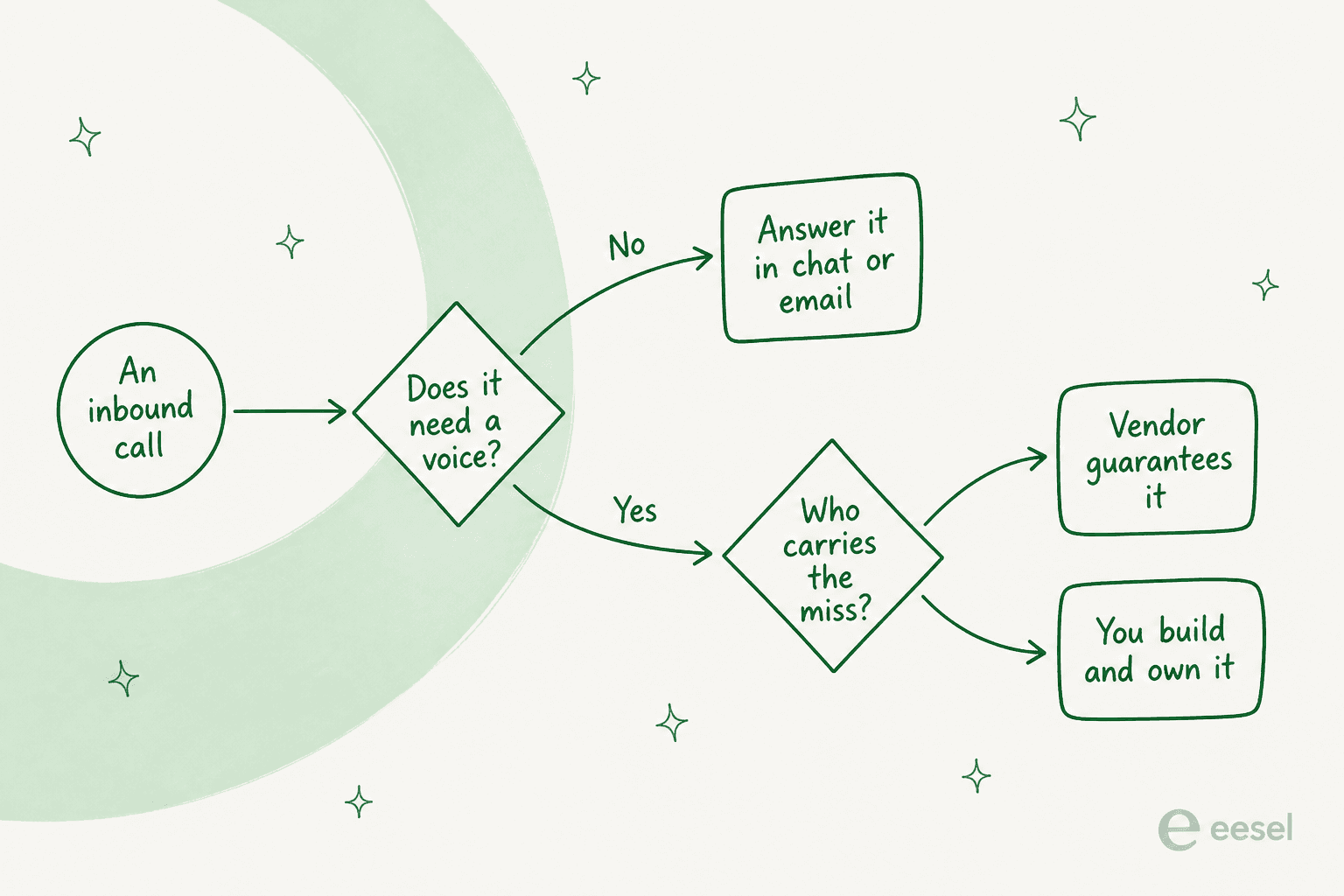
Every vendor above answers "how should a call be handled". Almost none of them ask whether it should have been a call.
A commenter on Retell's own launch thread put the objection better than any competitor's marketing has:
"Why would a company have a fully automated voice line rather than a booking interface? As a customer I'm never happy to call a company to make a reservation. I'd be extra annoyed if an AI picked up and I had to go through the motions of a conversation instead of doing two clicks in a Web UI."

That lands hard on WISMO. A customer calling to ask where their order is does not want a conversation, they want a tracking number. Answering that in 90 seconds of synthesised speech is a worse experience than an order tracking chatbot doing it instantly, and it costs you $0.35 a minute to deliver.
There is a second, sharper problem with a per-minute meter that the same thread surfaced. Another commenter walked through what happens when the caller controls the clock:
"At 17¢ per minute, a 6-minute call will cost just over $1, or about $10 per hour... the dentist could come in Monday morning to an AI receptionist bill of over $6,300 for a single weekend."
That is a thought experiment about a malicious caller, but the ordinary version is real and unavoidable: with a per-minute meter, your bill is set by how long your customers talk, and you do not control that. An elderly caller, a non-native speaker, a person having a bad day about a broken parcel. Each one is fine and each one costs more.
This is where Ringly's shape is quietly better than pure pay-as-you-go, and I want to give it that credit. A plan with included minutes and a soft overage puts a rough ceiling on the month. A pure per-minute platform does not. If you go the build-it-yourself route, a hard spend cap is not a nice-to-have, it is the first thing to configure.
The practical sequence I would recommend to any store owner reading this:
- Count how many of last month's calls were order status, returns or policy. A real deflection rate starts here. In most Shopify stores that is the clear majority.
- Answer that volume in text first. A self-service layer plus refund automation removes the reason to dial.
- Re-measure the call queue after a month. It will be a different, smaller, harder set of calls, and that is when phone support automation is worth pricing.
- Then price a voice agent for that. You may find you need Bland at $140 rather than Ringly at $349, or that a human on Gorgias Voice covers what is left.
Who carries the miss
If you skip everything else, keep this one distinction, because it is the axis nobody puts in a comparison table.
Ringly's 65% resolution guarantee is, as far as I can find, the only refund-backed performance promise in this group. Miss the rate within 90 days and subscription fees come back. That is the vendor putting money behind an outcome, and it is worth more than a per-minute discount to most buyers. Two caveats: the pricing page lists it as a Pro feature and not on Grow, so it costs $450/mo more than the entry plan, and a resolution rate is a different thing from resolution quality. A call that ends without a transfer is scored as resolved whether or not the customer got a good answer, which is why containment rate and escalation quality are two separate numbers.
Everywhere else on this list, the miss is yours. The platforms in the middle of this list sell you capability, and your agent's wrong answer on a live call is a support problem you own. That is not a criticism of those products, it is the deal they are offering, and at $0.08 to $0.14 a minute it is a fair one.
Which brings me back to why I keep pushing the text channels first. On email and chat there is a draft step, a human glance, a queue you can audit before anything reaches a customer. That 7% factual error rate from our own trial data was invisible to customers precisely because a person read the drafts. Put the same model on a live phone line with no dry run and there is nothing between a wrong policy answer and a customer's ear. Simulate against your own history before you go live, whatever you buy. That habit is what separates a working AI phone agent from a liability.
Try eesel for your Shopify support
If you got to this post because your call volume is out of hand, the fastest win is usually not a phone agent, it is removing the reason people are calling.
eesel plugs into Shopify and your helpdesk, reads your help center and past tickets, and handles order status, returns and product questions end to end from $299 a month for 500 credits, where one credit is one conversation handled. It is tuned for Shopify customer support rather than support in general. Before it touches a live customer, it replays your own past tickets and scores its answers against what your team actually sent, so you find the gaps in a report rather than in a recorded call. Most stores have a first agent live in about 30 minutes, and there is a free plan with 100 credits and no card.

Clear the easy volume first, then buy voice for what is actually left. Try eesel or see how it works with Gorgias and Shopify.
Frequently Asked Questions
What are the best Ringly alternatives for a Shopify store?
How much does Ringly cost per month?
Is Ringly worth it compared to building your own voice agent?
Which Ringly alternative is cheapest for low call volume?
Do I even need an AI phone agent for my ecommerce store?
What happens if the AI phone agent gets an answer wrong on a live call?
Can I keep my existing phone number with a Ringly alternative?



Article by
Rama Adi
Rama is a software engineer at eesel AI with two years of experience writing about B2B SaaS, AI tools, and customer support technology. Based in Bali, Indonesia, he brings a developer's perspective to product comparisons — cutting through marketing copy to what the integrations and APIs actually do.