Price your own Ringly bill
The published plans are priced in minutes but they are labelled in calls, so the only way to know what you would pay is to put your own call length in. Set your monthly call volume and your average call length, then this works out both plans and the winner, plus your real cost per call.
Ringly.io pricing at a glance
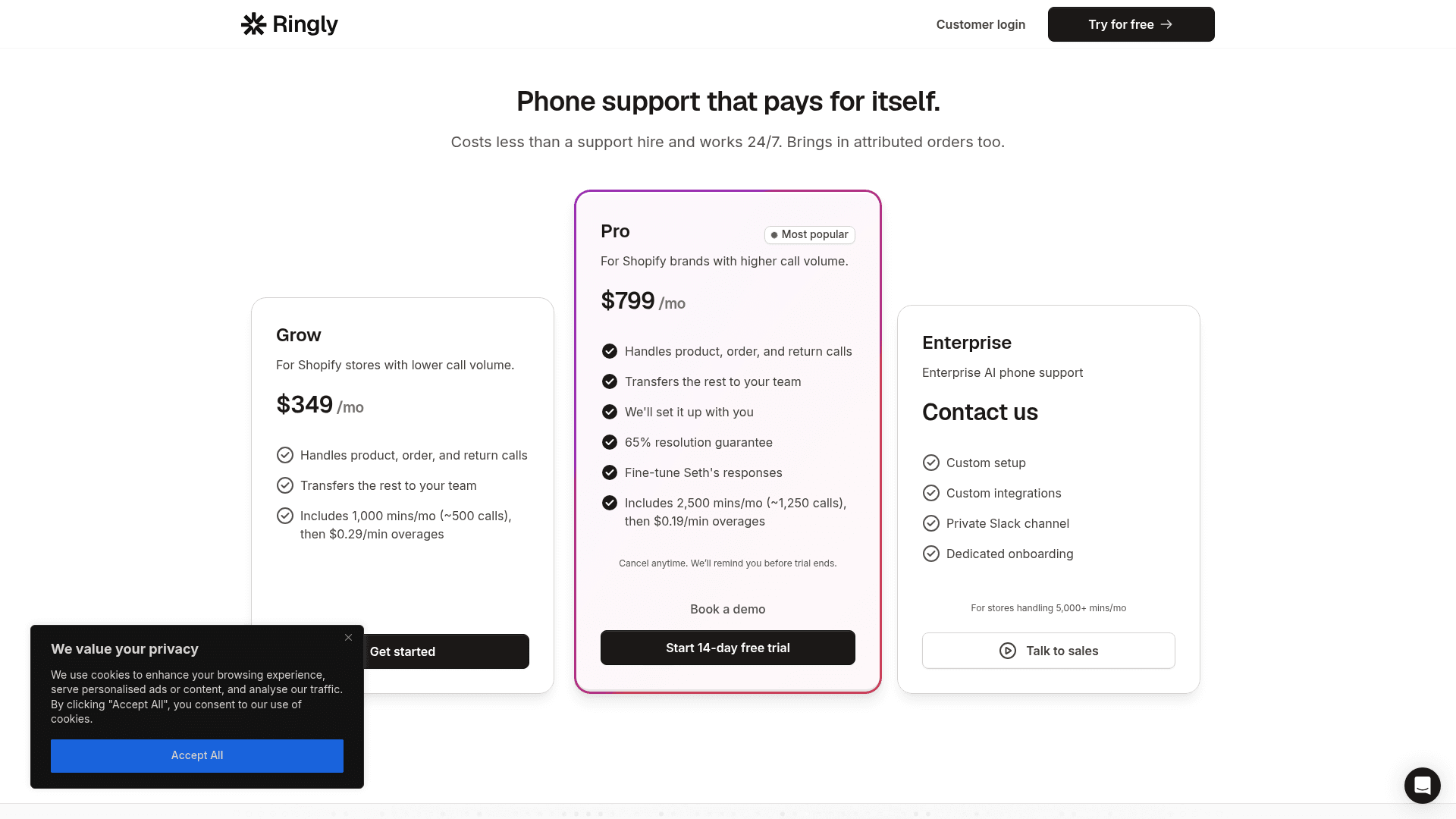
Ringly sells one product: Seth, an AI phone agent that answers a Shopify store's inbound calls, looks up orders, handles returns, and transfers what it cannot resolve. It is the narrowest product in the Shopify support AI category and the pricing reflects that focus. Pricing gets published in full on two plans, and withheld on the third one.
| Grow | Pro | Enterprise | |
|---|---|---|---|
| Monthly price | $349 | $799 | Quote only |
| Included minutes | 1,000 | 2,500 | Custom |
| Ringly's call label | ~500 calls | ~1,250 calls | 5,000+ min/mo |
| Overage | $0.29/min | $0.19/min | Custom |
| Effective rate on included minutes | $0.349/min | $0.320/min | n/a |
| 14-day free trial | No | Yes | Via sales |
| Hands-on setup | No | Yes | Dedicated onboarding |
| Fine-tune Seth's responses | No | Yes | Yes |
| 65% resolution guarantee | No | Yes | Yes |
| Custom integrations | No | Paid add-on | Included |
| Private Slack channel | No | No | Yes |
First thing I check on any rate card is whether the plan fee and the overage rate agree with each other. Here they do not. On both plans the overage minute is cheaper than the average included minute. Grow works out to $0.349 per included minute against a $0.29 overage, and Pro to $0.320 against $0.19. Running over your allowance is no penalty on this pricing model, it works out as a discount. The plan fee behaves like a floor charge, then every minute past the line gets cheaper.
That is unusual and worth to say plainly, because so much helpdesk AI pricing is built the other way round, with punitive overage that is designed to push you up a tier. Ringly's structure does the opposite of this.
What Ringly counts as a call minute
The single most important mechanic in any per-minute rate card is the rounding, and it is almost never on the pricing page. Ringly's sits in the help center instead, and the answer there is good for buyers.
Minutes are billed to the exact second. The meter starts when the line connects and stops when it disconnects. Calls that were never picked up, or never connected successfully, do not get billed at all. And when Seth escalates, billing stops once the transfer completes, per the billing doc, so you are not paying voice-agent rates while a human finishes the conversation.
Those four rules together are the most buyer-friendly metering I have seen on a voice product this year. The per-second billing on its own is already a material difference. If your callers are asking short order status questions, a 67-second call costs 67 seconds. On a vendor that rounds up to whole minutes the same call costs two, which quietly doubles your effective rate.
For context on how unusual that is, compare it with how Richpanel packages its AI tiers.
There is one piece of staleness worth to flag, so you are not surprised by it later. Ringly's pricing doc lists two add-ons, a $5/month phone number and a $9/month knowledge base. Read a little further down the same article though, and the FAQ says phone numbers are actually included free with Seth, the $5 applying only to Ringly's older custom agents. The $9 knowledge base traces to the same legacy product: on Seth, the allowance is one knowledge base holding 500 web pages refreshed every 24 hours, plus up to 20,000 Shopify products synced automatically with live inventory, and product pages do not count against the page limit.
So the practical read here is that Ringly bills one plan fee and one per-minute overage, and that is the whole meter. For anybody who has priced the five-meter rate cards that became normal in this category, a two-line bill is the exception.
The two-minute average, and why your call mix rewrites it
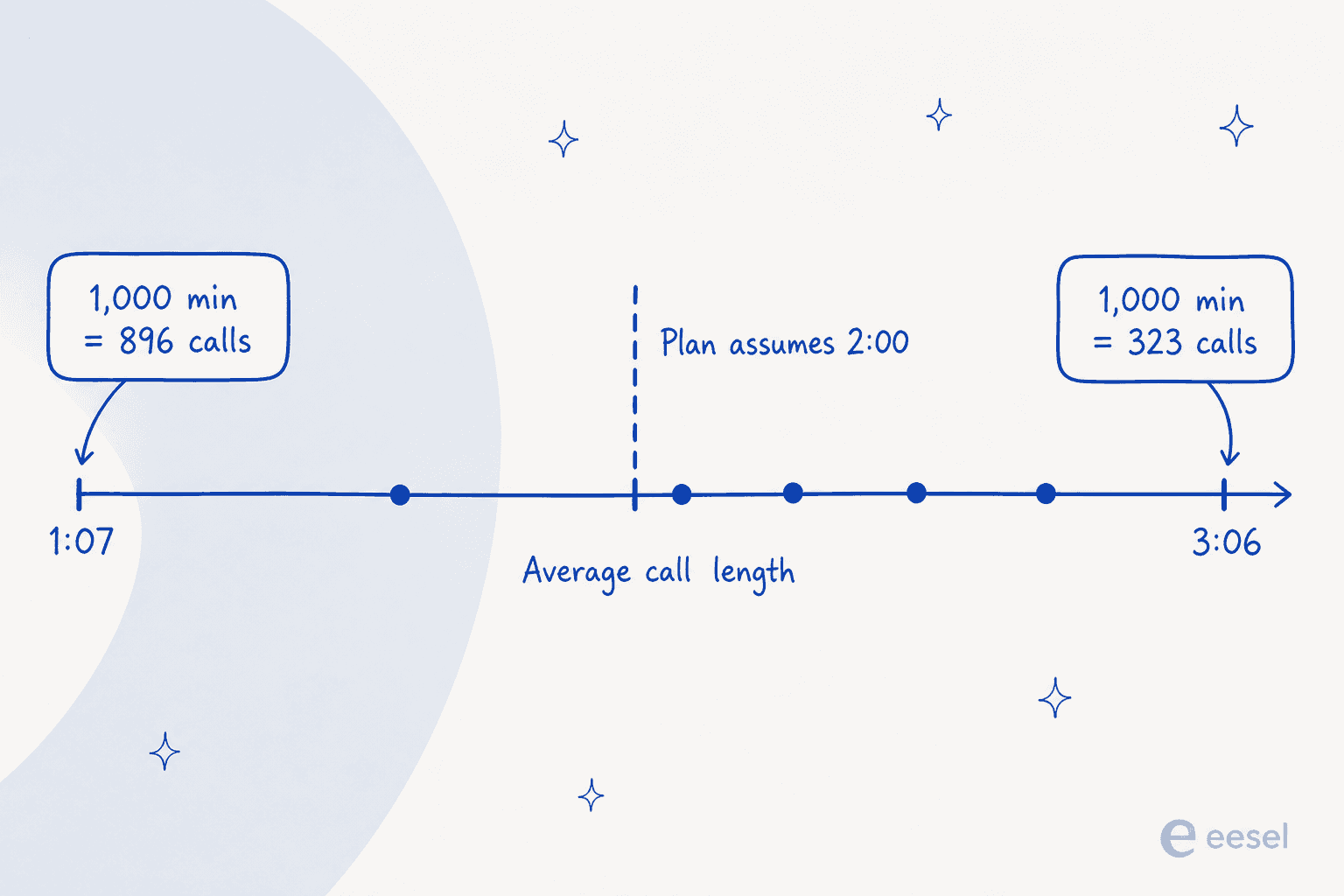
Here is where Ringly's own published numbers start to get interesting. The plans are metered in minutes but they are marketed in calls, and the exchange rate between those two comes out of a single sentence in the pricing FAQ: "On average, support calls to ecom brands take 2 minutes."
That is where the "~500 calls" and "~1,250 calls" come from. As a blended figure it is reasonable enough. It is also not what most of Ringly's own case studies report.
Six of the eight brands Ringly features either publish an average call length, or publish enough data that you can derive one. Here they are, ordered shortest to longest, and everything is taken from Ringly's own customer pages.
| Brand | What they sell | Average call | Calls / 90 days | Phone hours / 90 days | Resolved without a human |
|---|---|---|---|---|---|
| BioLongevity Labs | Research peptides | 1:07 | 3,381 | 62.8 | 79% |
| Hey Zeyla | Scaling skincare | 2:36 | not published | not published | 78.9% |
| Vynzo | Everyday skincare | 2:41 (derived) | 1,672 | 75.0 | 78% |
| Gear Rider | Motorcycle gear | 2:43 | 1,595 | 72.0 | 75% |
| Herbionyx | Supplements | 2:48 | not published | not published | 71% |
| Luxeveria | Premium skincare | 3:06 | not published | not published | 78% |
Five of the six sit above the two-minute mark, and the median is 2:42. The spread from top to bottom is 2.8x. This is not a knock on Ringly's figure, which is a blend across a whole category. It is a warning that the blend is nearly useless for picking a plan, because your position inside that range is set by what your callers ask about, and that is a property of your catalogue rather than of the software.
You can see the mechanism in the case studies themselves. BioLongevity sells peptides to researchers who call to ask whether BPC-157 is in stock and where their order is, and its page describes the 67-second average as what you would expect "when most calls are quick lookups answered cleanly." Luxeveria sells premium skincare, where its page reports that 64.3% of calls run longer than two minutes because a trust purchase involves an actual conversation about whether a serum layers with retinol.
Run that through the meter and Grow's 1,000 included minutes stop being a fixed quantity:
| Your average call | Calls covered by Grow's 1,000 min | Calls covered by Pro's 2,500 min | Cost per call on Grow |
|---|---|---|---|
| 1:07 (quick lookups) | 896 | 2,239 | $0.39 |
| 2:00 (Ringly's label) | 500 | 1,250 | $0.70 |
| 2:42 (median of the six) | 370 | 925 | $0.94 |
| 3:06 (consultative) | 323 | 806 | $1.08 |
At the median of Ringly's own documented accounts, Grow covers 370 calls rather than 500, and Pro covers 925 rather than 1,250. Both of the labels run about 26% optimistic. Cost per call swings from $0.39 to $1.08 across the range, and that is a 2.8x difference on the same plan, at the same sticker price.
None of that makes Ringly expensive. What it makes wrong is the call-count label, as a number to plan against. So pull your own average handle time out of your phone system before you pick a tier, and if you do not have that number yet, call analytics is the thing to fix first. The same discipline applies whether you are pricing voice or automating phone support some other way.
Grow vs Pro: the $450 gap is not capacity
The natural assumption with a two-tier rate card is that the expensive tier is there for higher volume. On Ringly's numbers that is not what happens.
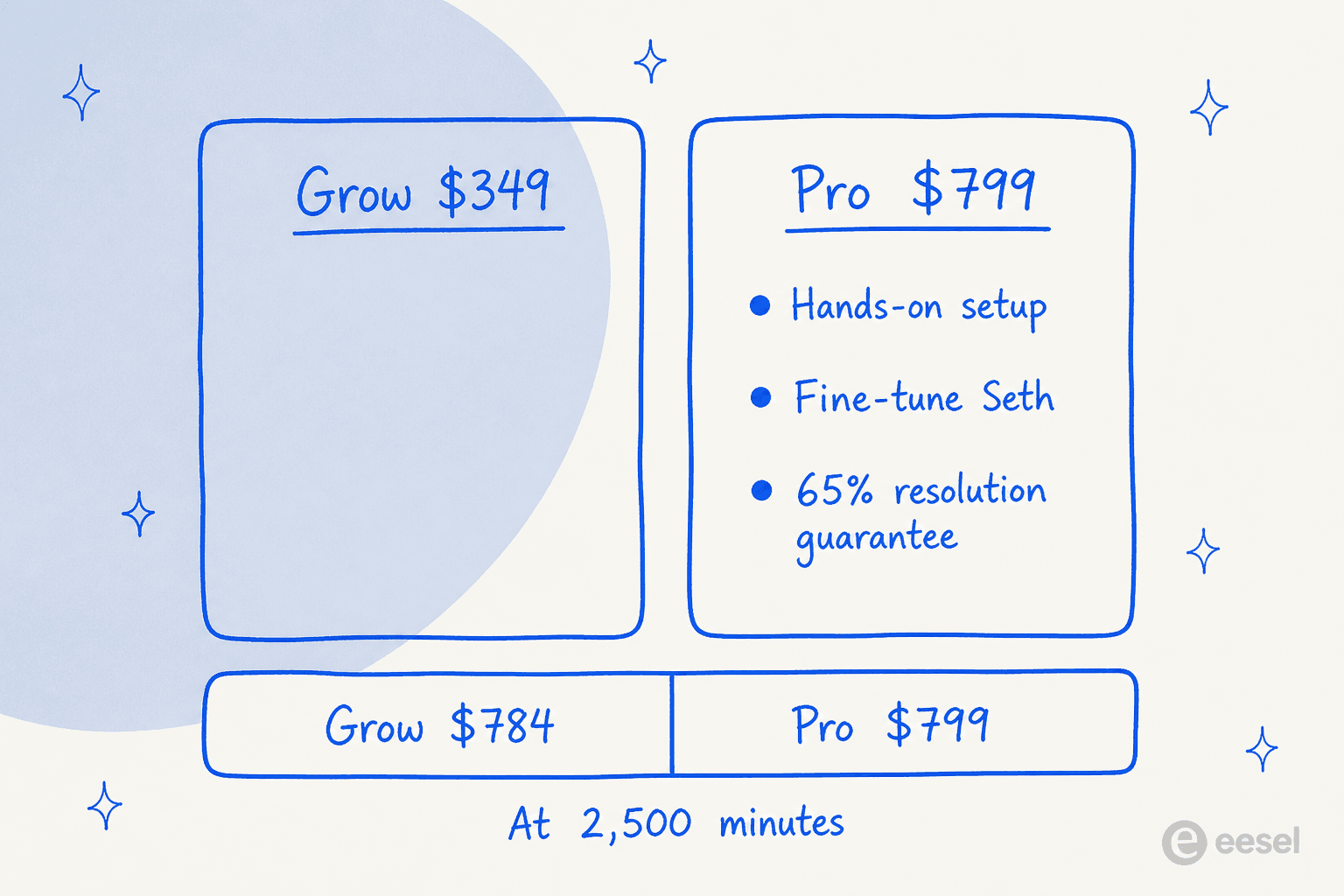
Because Grow's overage is $0.29 and Pro's fee is $450 higher, Grow plus overage does not reach $799 until 2,552 minutes. Pro's own included allowance is 2,500. So at exactly the volume Pro is designed for, Grow costs $784 against Pro's $799, which makes Grow the cheaper of the two by $15.
Pro does win eventually. At 3,000 minutes it is $894 against Grow's $929, and by 5,000 minutes it is $1,274 against $1,509. But 5,000 minutes is also the line where Ringly's own page stops selling you Pro and routes you into Enterprise. Which leaves the window where Pro is the obviously correct purchase on price alone at roughly 2,552 to 5,000 minutes a month.
Which means that for most stores the $450 is buying three specific things, and I went through Ringly's full comparison table to confirm which ones. Everything else is identical across both tiers: 40 languages, uploaded knowledge, call history, call analytics, knowledge-gap detection, conversation memory, Shopify customer lookups, transfers, returns, blocked-caller rules, custom actions, and chat plus help-center support. Notably the multilingual support is not gated, which is not true of most helpdesk vendors. The three real gates are hands-on setup, the ability to fine-tune Seth's responses, and the 65% resolution guarantee. Custom integrations appear as a paid add-on on Pro and are included on Enterprise.
Of those three, the guarantee is the one worth paying for, and it is a rare thing. Most vendors in conversational AI will quote you a deflection target in a slide and put nothing behind it. Set it next to how Sierra prices its outcomes and the difference is obvious.
A published resolution floor with money attached is a real transfer of risk from you to the vendor, and it is the strongest argument on the Pro card. It is also the only part of the rate card that speaks to support ROI rather than unit price. If you care more about cost per resolution than cost per minute, that is where the value sits.
Worth noticing too that all three accounts in Ringly's case studies with enough published data to derive a monthly bill come out Grow-sized:
| Account | Minutes / month | Calls / month | On Grow | Cost per call |
|---|---|---|---|---|
| BioLongevity Labs | 1,256 | 1,127 | $423.24 | $0.38 |
| Gear Rider | 1,440 | 532 | $476.60 | $0.90 |
| Vynzo | 1,500 | 557 | $494.00 | $0.89 |
Every one of them lands under $500 a month on Grow, and every one of them would pay $799 on Pro. It is a useful sanity check on where a real Shopify store with a working phone line actually sits.
The trial rule that is not on the pricing page
This is the finding I would most want to know about before signing up, and it is the reason why I read help centers before pricing pages.
On the pricing page, Grow's button says "Get started" and Pro's says "Start 14-day free trial". Both of them point at the same onboarding URL, so it reads like one signup flow with the trial just mentioned on the more prominent card. Ringly's help center is explicit that it is not that.
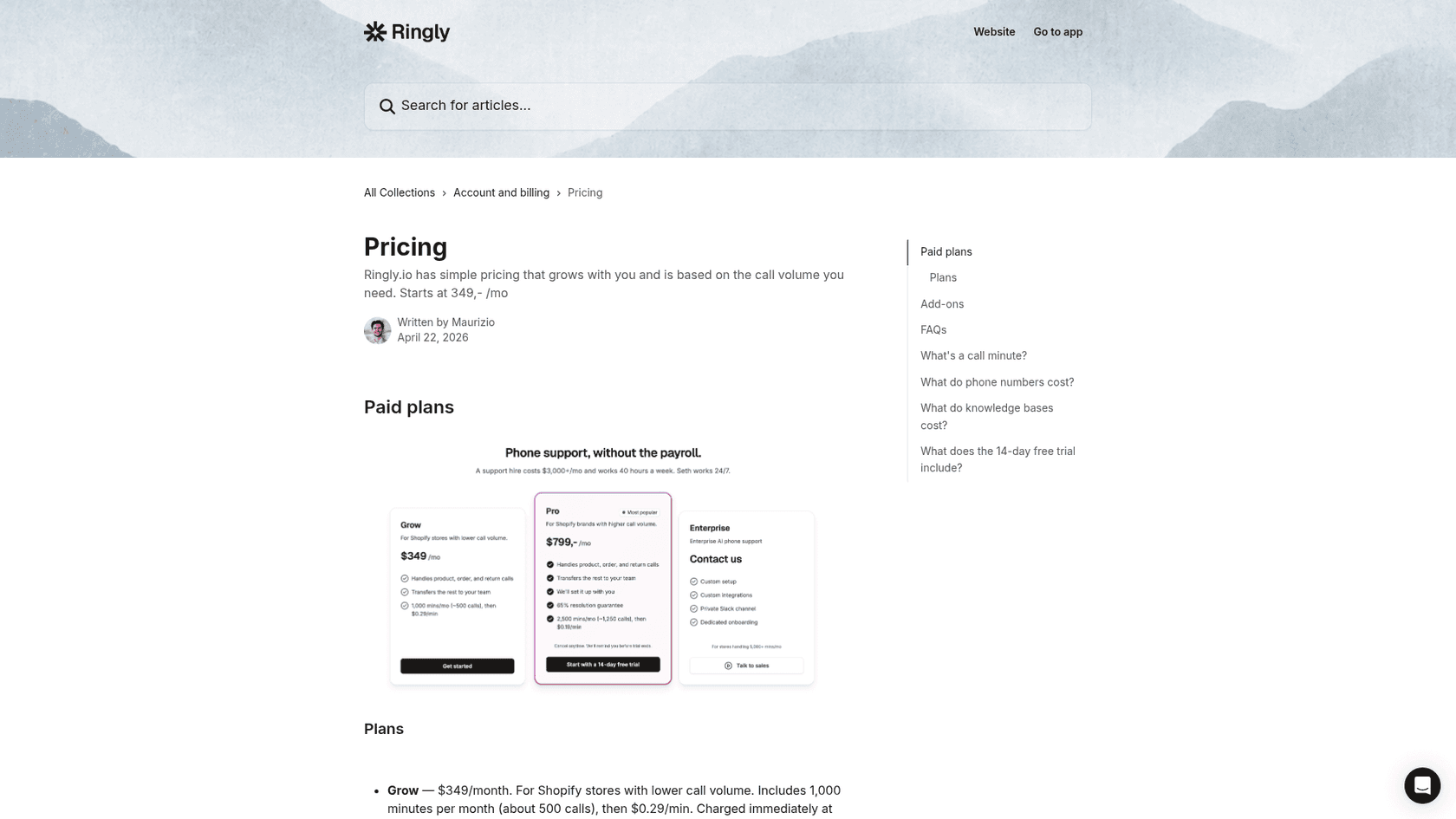
The article states that the 14-day trial is available on the Pro plan only, and that the Grow plan "is charged immediately at signup and doesn't include a trial." Grow's own bullet in the same article repeats it: charged immediately at signup, no trial. On Pro you add a card, you get the full Pro experience including the setup help and the guarantee, then reminders arrive 48 hours and 24 hours before the trial ends.
Read those two together, and the entry plan works out as the riskier purchase of the pair. Committing $349 sight-unseen buys less protection than committing $799 with a trial, and the cheaper plan is also the one without the resolution guarantee. If I were buying, I would take the Pro trial, use the 14 days and the setup help to find out what my real average call length is, and only then decide whether to sit on Pro or drop to Grow.
I am not neutral on why this one matters. Across our own sales calls, the most consistent way to lose a deal is making someone pay before they have seen the thing work on their own data. One US swimwear brand on Gorgias ran twelve successful test chats with our agent, went to the billing page, and opened two cancellation requests in the same session. The product had done its job, then the billing step undid it. A plan that charges on day zero is fighting against that same reflex.
The pricing page is not Ringly's best offer
While going through the case studies for the call-length numbers I found something odd. Every customer page ends on the same offer block, and it is a better deal than anything on /pricing.
The block invites you to book a 30-minute build call with a founder, and lists four terms: a free build Ringly values at $2,500 with no setup fee, live in 14 days or you do not pay until it is, free tuning until it resolves 65% of your calls or your money back, and $25 just for showing up even if it turns out not to be a fit.
Compare that against the pricing page, where the 65% resolution guarantee is a Pro feature that you reach by paying $450 a month more than Grow. The same guarantee is being given away to anyone who books a founder call.
I do not read this as a trick. It reads like a young company running a founder-led sales motion alongside a self-serve page, and the two of them have drifted apart. The practical consequence for you is real though: the route you take into Ringly changes your price. Arriving through the pricing page and clicking "Get started" on Grow is the most expensive way to buy the guarantee, because it does not include it. Booking the call is free and comes with more.
If you are seriously evaluating AI phone support, book the call first. Worst case you learn your own call mix on someone else's time.
What that per-minute rate buys next to the rest of the voice market
Ringly's effective $0.32 to $0.35 per minute looks steep against the headline rates on developer voice platforms, and this is where most comparisons go wrong.
The advertised numbers on build-it-yourself platforms are usually just platform fees, and not the whole bill. Vapi lists $0.05/min and Retell about $0.07/min for voice infrastructure, and you then pay separately for the language model, speech-to-text, text-to-speech, and telephony. Add typical provider rates and a production stack lands somewhere around $0.11 to $0.30 a minute. ElevenLabs Agents is the cleanest comparison at a flat $0.08/min across its paid tiers, and Bland's Start tier bundles the model, transcription, and speech into one $0.14/min number with transfer minutes metered separately.
So Ringly at $0.32 to $0.35 sits just above the top of the fully loaded DIY range, not at four times it. Roughly $200 to $270 of the $349 Grow plan is the integration layer rather than the compute, and that layer is the Shopify order lookups, the returns flow, the escalation rules, the transcripts, and the revenue attribution. Priced as engineering work, that is well under a day of contract time a month.
Whether that trade is right for you comes down to one question. Do you want to own the integration? If you have an engineer with spare cycles and an appetite for maintaining a voice stack, Retell's pricing will be cheaper per minute and more expensive in salary. The same goes for Vapi if you would rather assemble the stack yourself. If you do not, then the premium is the cheaper option and you should stop optimising it. I went through the full field of substitutes in my roundup of Ringly alternatives, and the short version is that very few products do the same job at this price.
One more thing to keep in the back of your mind, on the billing side. The Shopify listing notes that charges are billed by Ringly separately from your Shopify invoice, and that recurring and usage charges run every 30 days rather than monthly. Thirty-day cycles mean 12.17 bills a year, so Grow is about $4,246 annually rather than $4,188. It is $58, but it is the kind of $58 that surprises a finance team. Worth noting too that Ringly's page frames the whole plan against the cost of a support hire, which is the same framing behind most AI agent cost comparisons.
Before you buy minutes, check whether the call should exist
Every per-minute rate card has the same blind spot. It prices the calls you get rather than the calls you ought to be getting. And a meaningful share of inbound ecommerce calls are people who could not find an answer anywhere else, or who wanted a channel that was never going to be efficient in the first place.
This is not a hypothetical objection. It is the loudest thing in the community discussion around voice agents. On Retell's Launch HN thread, one commenter put the question that every Shopify founder should sit with before signing a minutes contract:
"why would a company have a fully automated voice line rather than a booking interface? As a customer I'm never happy to call a company to make a reservation. I'd be extra annoyed if an AI picked up and I had to go through the motions of a conversation instead of doing two clicks in a Web UI."

Another was blunter about the support case specifically:
"What I don't want to do is talk to LLMs for customer support. For that, I always want to talk to a real person. It would be infuriating for an LLM to pick up when calling a business."
You can disagree with both of them and still take the pricing lesson here, which is that a per-minute meter charges you for demand you might be able to remove. Order status, returns and shipping questions all resolve fine in chat and email, and every one that resolves there is a minute you never buy. Your deflection rate is the number that decides how many minutes you are obliged to purchase at all.
So fix order tracking automation in your existing channels first. Do the same for returns and refunds, measure the calls that are left, and price minutes against that number rather than today's volume. A self-service layer that actually answers questions is the cheapest minute you will ever buy.
This is also the honest place to say what my own product does, and what it does not. eesel has no voice channel. It will not answer your phone, and if inbound calls are the problem you are solving this week, Ringly is a more direct answer than anything I sell. My roundup of voice customer support tools is the better starting point for that job. What eesel does is sit on the Shopify side of the same store, or the Gorgias inbox behind it, and resolve the WISMO, returns, and product-question volume in chat and email before it ever becomes a phone call, trained on your help center and your past tickets rather than on a generic model.
If you are already pricing Ringly's minutes, that is the arithmetic worth to run alongside it. eesel is one fixed monthly price from $299 for 500 credits (one credit per ticket or chat) with no platform fee and no seat cost, and the calls it prevents are minutes you do not put on a phone bill at $0.29 each. There is a free plan with 100 credits and no credit card at signup, so unlike a Grow subscription you can find out what your deflection rate actually is before you pay anything. Try eesel on the volume that never needed a phone line, then buy minutes for whatever is actually left.
So is Ringly.io worth the money?
For a Shopify store with real inbound phone volume that a human is answering right now, yes, and the pricing is more honest than most of what I read in this category. Per-second billing, no charge for unconnected calls, a meter that stops on transfer, free phone numbers, and a two-line bill are all points in Ringly's favour, and the 65% resolution guarantee on Pro is a genuine risk transfer that its competitors mostly do not offer.
The three things I would do before signing anything:
- Get your own average call length. Ringly's "~500 calls" is built on a two-minute average that five of its six documented customers exceed. At 2:42 you get 370 calls on Grow, not 500.
- Do not upgrade for capacity. Grow plus overage beats Pro's flat fee up to 2,552 minutes, past Pro's own allowance. Buy Pro for the setup, the fine-tuning, and the guarantee, or do not buy it.
- Book the founder call rather than clicking Get started. The case-study pages give away the same 65% guarantee that the pricing page charges $450 a month for, plus a free build and no setup fee.
And the thing I would want tested before any of it goes live on a real phone line: what happens on the calls it gets wrong. That 7% factual error rate out of our own jewellery trial did not show up in a demo. It showed up when we cross-validated against a hundred real tickets. Voice has no draft step and no undo, so the escalation rules and the handoff are not a footnote on this purchase. They are the purchase. Whatever you buy, track containment and escalation quality from week one.
Sources
- Ringly.io pricing page - plan prices, included minutes, overage rates, plan comparison table, call-minute FAQ
- Ringly.io help center: Pricing - per-second billing, transfer and unconnected-call rules, trial availability by plan, add-on list
- Help center: Seth's knowledge - 500-page and 20,000-product knowledge limits
- Ringly's Shopify listing - plan mirror, 30-day billing cycles, external billing note, 4.6 rating from 3 reviews, launched July 2025
- Ringly customer pages: BioLongevity Labs, Gear Rider, Luxeveria, Herbionyx, Vynzo, Hey Zeyla - call durations, volumes, resolution rates, founder-call offer
- ElevenLabs pricing and Bland AI pricing - comparison per-minute rates
- Launch HN: Retell AI - community discussion on whether inbound calls should be calls
- eesel AI pricing - from $299/month for 500 credits (1 credit per ticket or chat), no platform fee, 100 free credits
Frequently Asked Questions
How much does Ringly.io cost per month?
What is Ringly's pricing for small teams?
Is Ringly's Pro plan worth $450 more than Grow?
How does Ringly count a call minute?
How many calls do 1,000 minutes actually cover?
Is Ringly.io worth it for a Shopify store?



Article by
Kurnia Kharisma
Kurnia is a software engineer and writer at eesel AI with two years of SEO experience, writing about AI tools, helpdesk software, and customer support. He pairs a developer's understanding of how these products are built with search-driven research into what actually ranks and resonates with the people searching for them.