

So what does Netomi actually cost?
The honest answer is that nobody outside a Netomi sales call knows. I checked every obvious path in July 2026: the pricing URL 404s, the plans URL 404s, and the platform overview carries demo CTAs and zero numbers. Software directories that list Netomi all show the same thing, "custom pricing," "quote-based," "contact vendor."
That's not an accident or an oversight. It's a deliberate motion. Netomi sells to large enterprises, the kind that run procurement cycles, sign annual contracts, and expect a bespoke deployment. In that world, a public price does more harm than good for the vendor: it anchors the negotiation and invites apples-to-oranges comparisons. So the number lives behind a demo request, and it's built to order.
For a buyer, the practical takeaway is you cannot estimate Netomi's cost without talking to sales, and you can't self-serve your way to a trial. If your buying process needs a ballpark before a meeting, that's your first friction point, and it's worth naming before you invest weeks into the evaluation.
How Netomi prices: the billable unit nobody publishes
Because Netomi doesn't disclose its billable unit, I won't pretend to quote one. What I can do is read the platform's own positioning and tell you what almost certainly shapes the number.
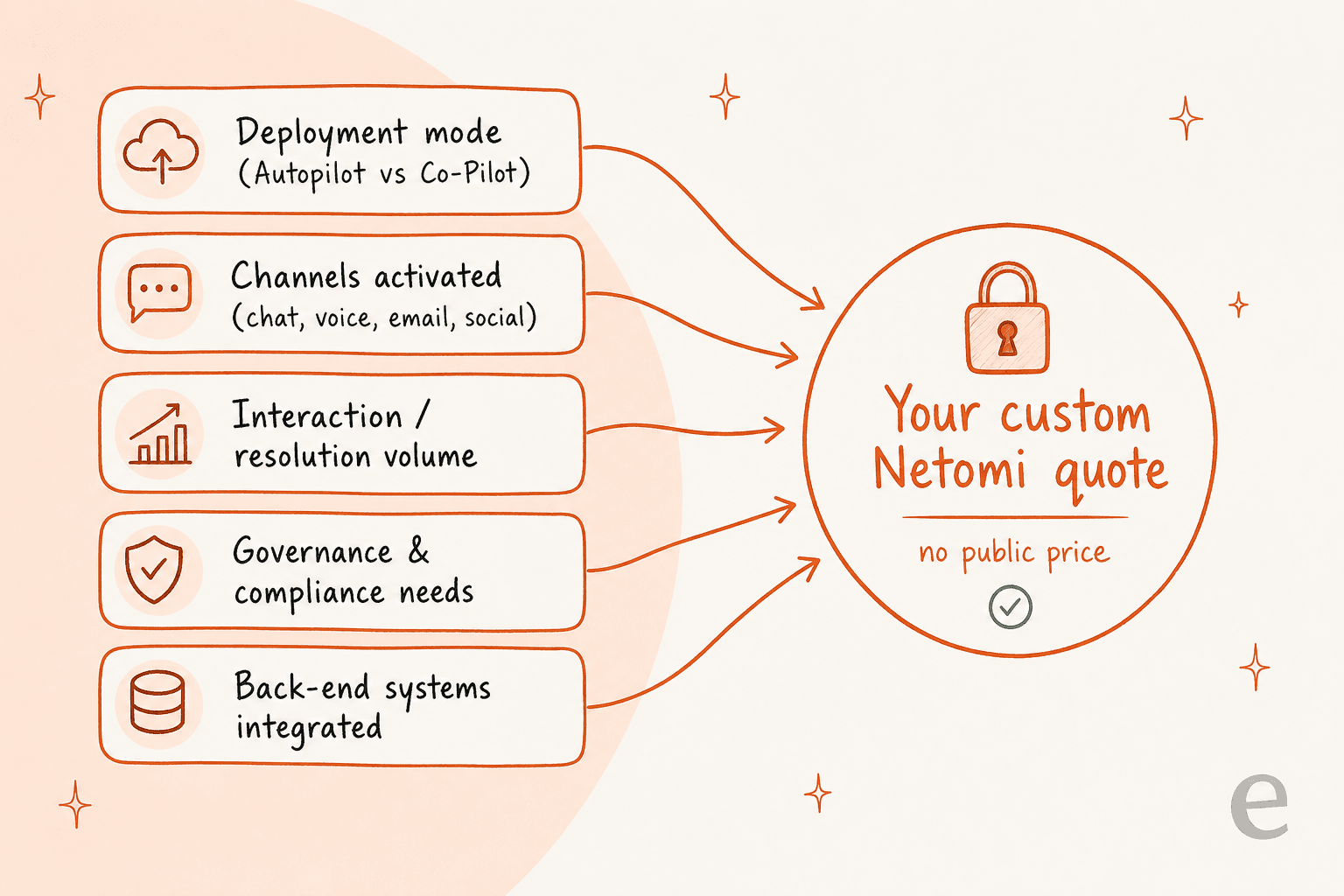
- Deployment mode. Netomi splits into fully autonomous "Autopilot" agents that resolve end-to-end, and a human-in-the-loop "Co-Pilot" that assists live agents. How much of each you turn on changes the scope.
- Channels activated. One agent can run across web chat, in-app, voice, email, SMS, Apple Messages, social, and search. More channels, bigger deployment.
- Interaction or resolution volume. Netomi's whole pitch is autonomous resolution at scale, so contracts scale with how many conversations the AI handles. There's no published "$X per resolution," though, so the exact mechanic stays private.
- Governance and compliance needs. Netomi leans hard on embedded guardrails and a full compliance stack. Regulated deployments carry more weight.
- Back-end systems integrated. Its "Action Agents" execute transactions across your systems (refunds, rebookings, CRM updates). The more systems wired in, the more implementation involved.
The one concrete, verifiable fact is the model itself: a custom, sales-negotiated annual contract with no self-serve option. Everything else is scoped on the call. If you've ever priced Salesforce Agentforce or Ada, this will feel familiar, it's the standard enterprise CX playbook.
What you're actually paying for
To be fair to Netomi, the platform you'd be buying is genuinely substantial. This isn't a thin chatbot wrapper. Whatever the number turns out to be, here's what sits behind it.
| Capability | What it does |
|---|---|
| Autopilot (autonomous agents) | Knowledge Agents retrieve and synthesize answers from approved sources; Action Agents execute multi-step transactions across connected systems. |
| Co-Pilot (human-in-the-loop) | Real-time suggested replies, surfaced knowledge, next-best-action, and auto-documentation inside the agent's existing desk. |
| Agentic Studio | No-code lifecycle tooling to build, train, test, deploy, and optimize agents, with plain-English guardrails and pre-launch simulations. |
| Agentic Insights | Dashboards and a conversation viewer with AI metadata (sentiment, actions called, guardrails hit). |
| Integrations | Native connectors for Salesforce, ServiceNow, Genesys, NICE, LivePerson, plus API and MCP for back-end actions. |
| Governance & security | SOC 2 Type II, ISO 27001, HIPAA, GDPR, CCPA, PDPA, and PCI DSS, with prompt-injection defenses and response validation. |
That compliance list matters if you're a security-conscious enterprise buyer, and Netomi's Fortune 500 roster backs the scale claim. The company raised $110 million with Accenture and Adobe backing, and names customers like Delta, United Airlines, and DraftKings. United's CIO Jason Birnbaum has said generative AI is going to "fix what chatbots couldn't." For a brand fielding millions of high-stakes tickets, that platform depth is the product, and the reason a six-figure contract can pencil out.
What real Netomi users say
The platform is strong, and the review scores reflect it: Netomi holds a 4.8/5 on G2 across 16 reviews and a 4.8/5 on Capterra across 4. That's a small sample, so read it as directional rather than definitive, but the themes are consistent.
The loudest praise is about the people, not just the product. Nearly every positive review credits the implementation and customer-success team:
"Netomi has been a spectacular partner the past three years; they have been proactively pushing and innovating to increase the number of calls our bot can deflect... Over this summer, our contact centre traffic increased by 5X and Netomi's AI helps us handle spikes with ease."

Reviewers also single out the Agentic Studio UI and the Zendesk integration as strong points. But the criticism is just as consistent, and it's the part that affects your real total cost. The single most recurring complaint is analytics:
"The data part is still pretty precarious. In my view, a panel with more robust information is needed and the possibility of extracting data is crucial today for any company."

The other recurring themes: setup takes real time and attention, low-volume teams struggle to see quick ROI, and the experience is tied to which customer-success manager you're assigned, with several reviewers noting the account team changed too often. None of these are dealbreakers for a big brand with a dedicated project team. All of them are things a smaller team would feel keenly.
The costs that aren't in the quote
Here's where I'd push any buyer to look past the contract figure. The number sales gives you is the tip. The total cost of ownership includes a lot that doesn't show up on the order form.
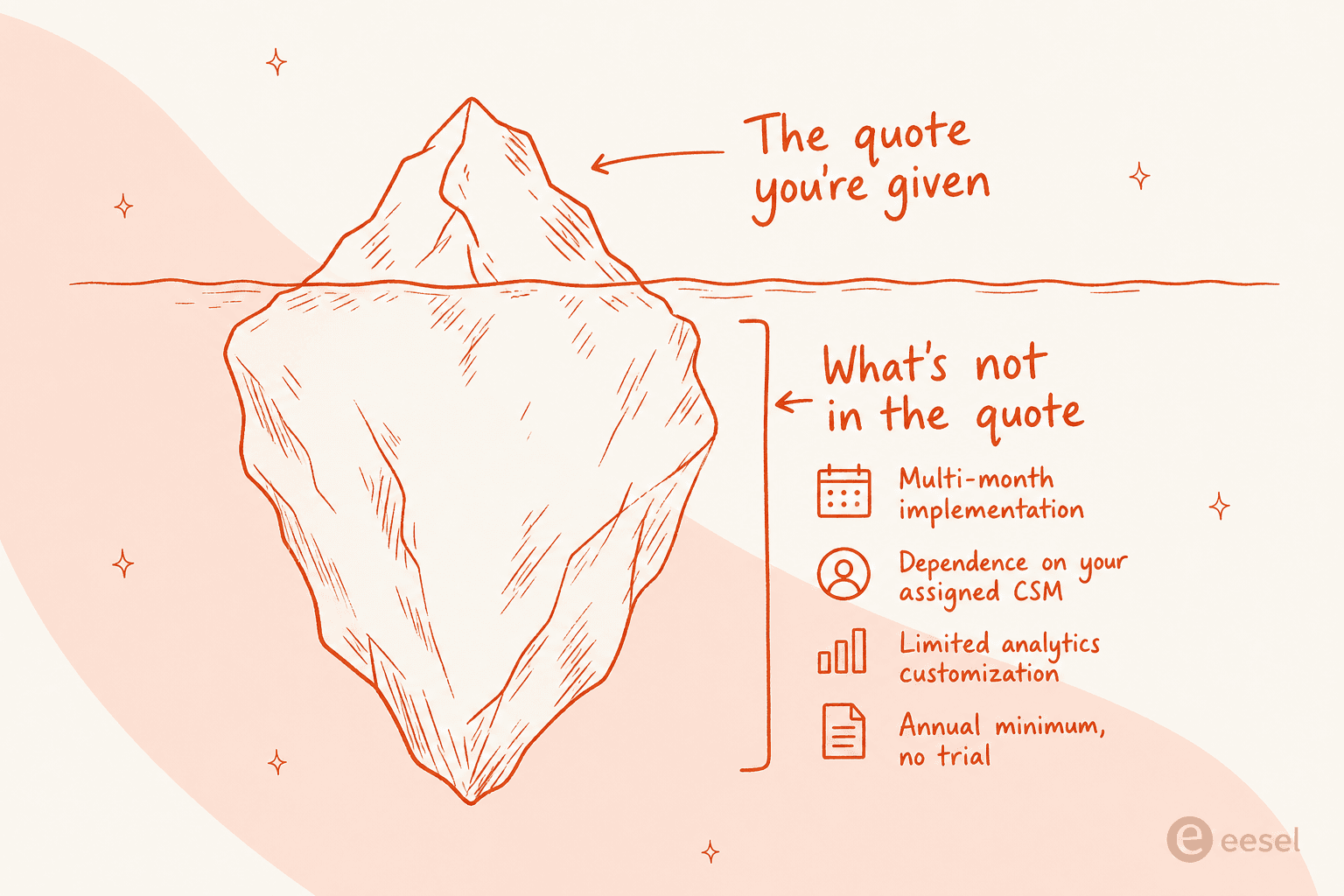
- Implementation time. Reviewers describe setup as taking "quite a bit of time and attention." For an enterprise that's expected; for a team that wanted results this quarter, it's a hidden cost measured in months.
- CSM dependency. When the strongest reviews are about the support team, the flip side is that your outcome depends on who you get. Turnover in that seat is a real risk reviewers flagged.
- Analytics gaps. If reporting is "precarious," you may end up exporting data or building dashboards elsewhere to get the visibility you expected out of the box.
- The annual commitment. No trial and no self-serve means you're committing budget before you've seen the AI run on your own tickets. That's the opposite of how I'd want to de-risk an AI deflection rollout.
That last one is the big one. I've watched confident-sounding bots quietly give wrong answers on live queues, which is exactly why I now want to simulate any rollout against historical tickets before it goes anywhere near a customer, and before I sign anything. A model that requires a signature first inverts that.
Quote-gated vs transparent: the real pricing question
Step back and the Netomi pricing story is really about a philosophy, and it's worth deciding which one you want before you evaluate any tool.
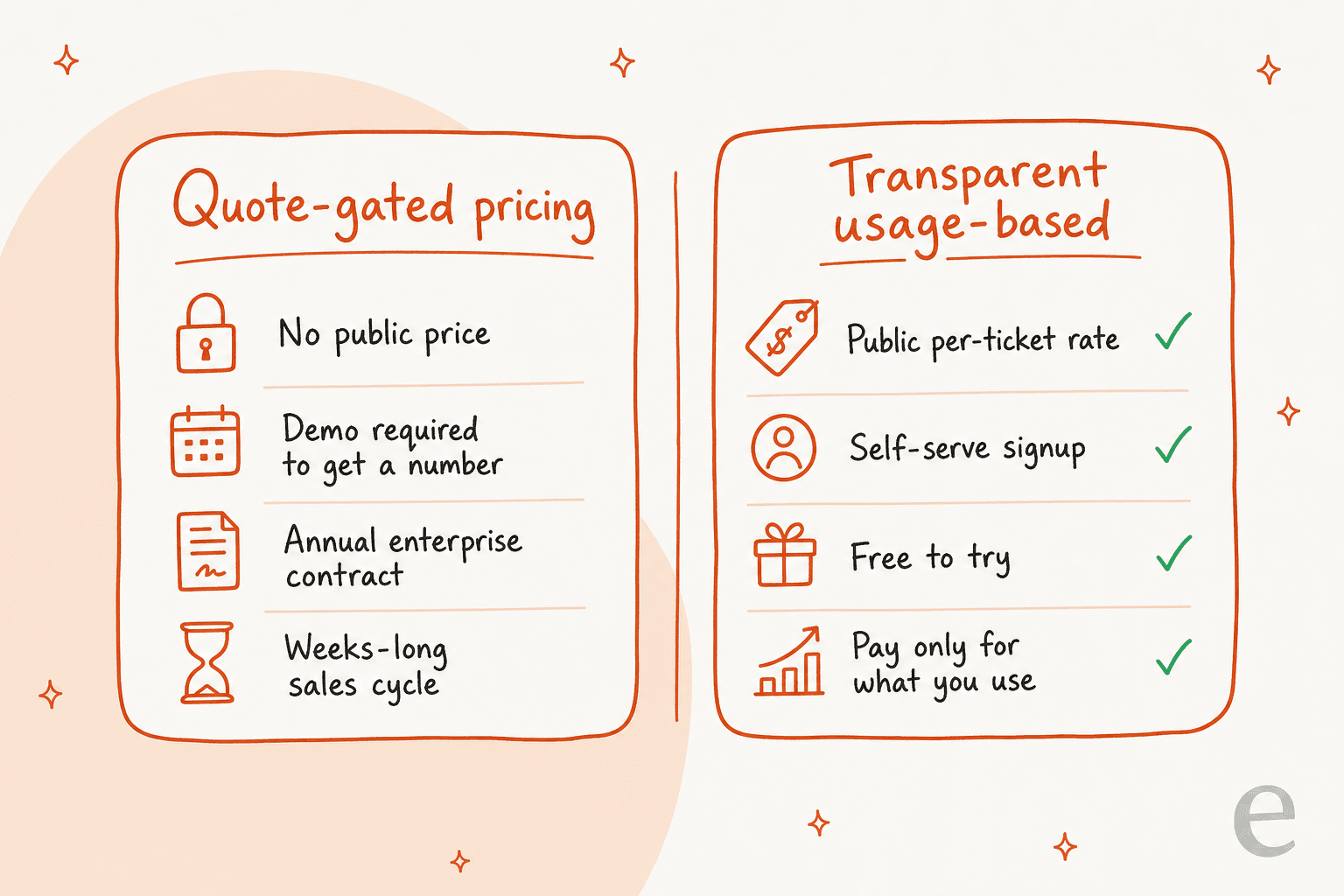
The category is trending toward transparent, published pricing, a published price tied to a unit you already understand, like a ticket. And there's a real reason buyers want it. On our own sales calls I hear the pain constantly: one ops lead at a payouts fintech running 7,000-8,000 escalated tickets a month told us per-interaction pricing was a flat non-starter, because he couldn't predict the bill. When the unit is fuzzy and the number is hidden, budgeting becomes a guessing game.
To make that concrete, here's a rough cost picture at different volumes. These are illustrative category figures, not Netomi's numbers (Netomi doesn't publish any), based on the widely-cited economics of roughly $10 per human-handled ticket versus about $1 per AI-resolved one, with an AI handling around 60% of volume. Plug in where your team sits:
The catch, of course, is that you can only run that math when the per-unit price is published. With a quote-gated tool, you're waiting on a call before you can even start. That's the trade-off worth weighing: enterprise-bespoke depth on one side, versus predictability and speed-to-value on the other.
Try eesel instead of guessing
If the whole "book a call to find out the price" dance is what's grinding your evaluation to a halt, that's the exact gap eesel fills. It's an AI for customer service that plugs into the helpdesk you already run, Zendesk, Freshdesk, Gorgias, and more, and starts helping from day one.
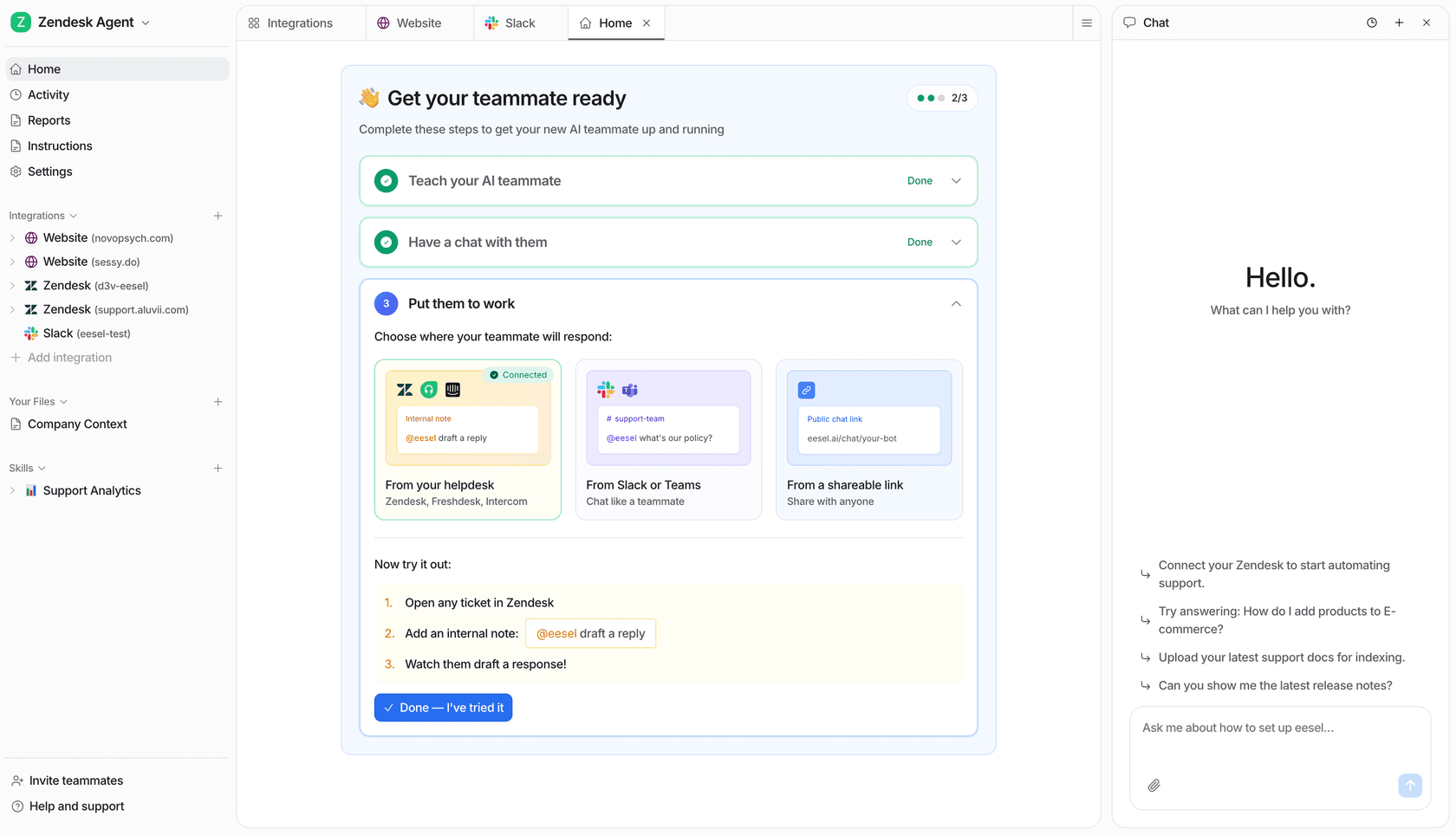
Three things make it the opposite of a quote-gated rollout. Its pricing is published with one fixed monthly price (from $299/month for 500 credits, 1 credit per ticket or chat), no per-seat fees and no surprise bill. You can simulate it on your own historical tickets before it ever touches a customer, so you see the real resolution rate up front instead of trusting a demo. And it's self-serve and free to try, no sales cycle required to get started. Where Netomi is built for the enterprise that wants a bespoke, hands-on deployment, eesel is built for the team that wants to see it work, and see the price, this week.
If you're comparing agentic CX platforms, it's worth putting a transparent, testable option next to the quote-gated ones before you commit a year of budget.
Frequently Asked Questions
How much does Netomi cost?
/pricing and /plans pages return 404 as of July 2026. Every path leads to a 'Request a demo' form, so the only way to get a Netomi price is to book a sales call. If you want a published number you can act on today, eesel's pricing is a fixed monthly price, from $299/month for 500 credits, and listed openly.