How do you review a model you cannot run?
Honestly, and with the methodology stated up front. Otherwise a review of an early-access model is only a rewrite of the announcement with adjectives added.
Here is what I could check. The launch post and its capability list. The FLUX-mimic thesis and its success-rate charts. The Self-Flow research page, which is where the actual method lives, published as arXiv preprint 2603.06507. The model page, and the pricing page, which turned out to be the most informative page of the lot. And two Hacker News threads where people who run these models locally reacted in real time. Every one of those is linked in full at the bottom.
Here is what I could not check: a single generation. I did not run a prompt through FLUX 3, and nobody writing about it this week did either unless they are inside the early-access program.
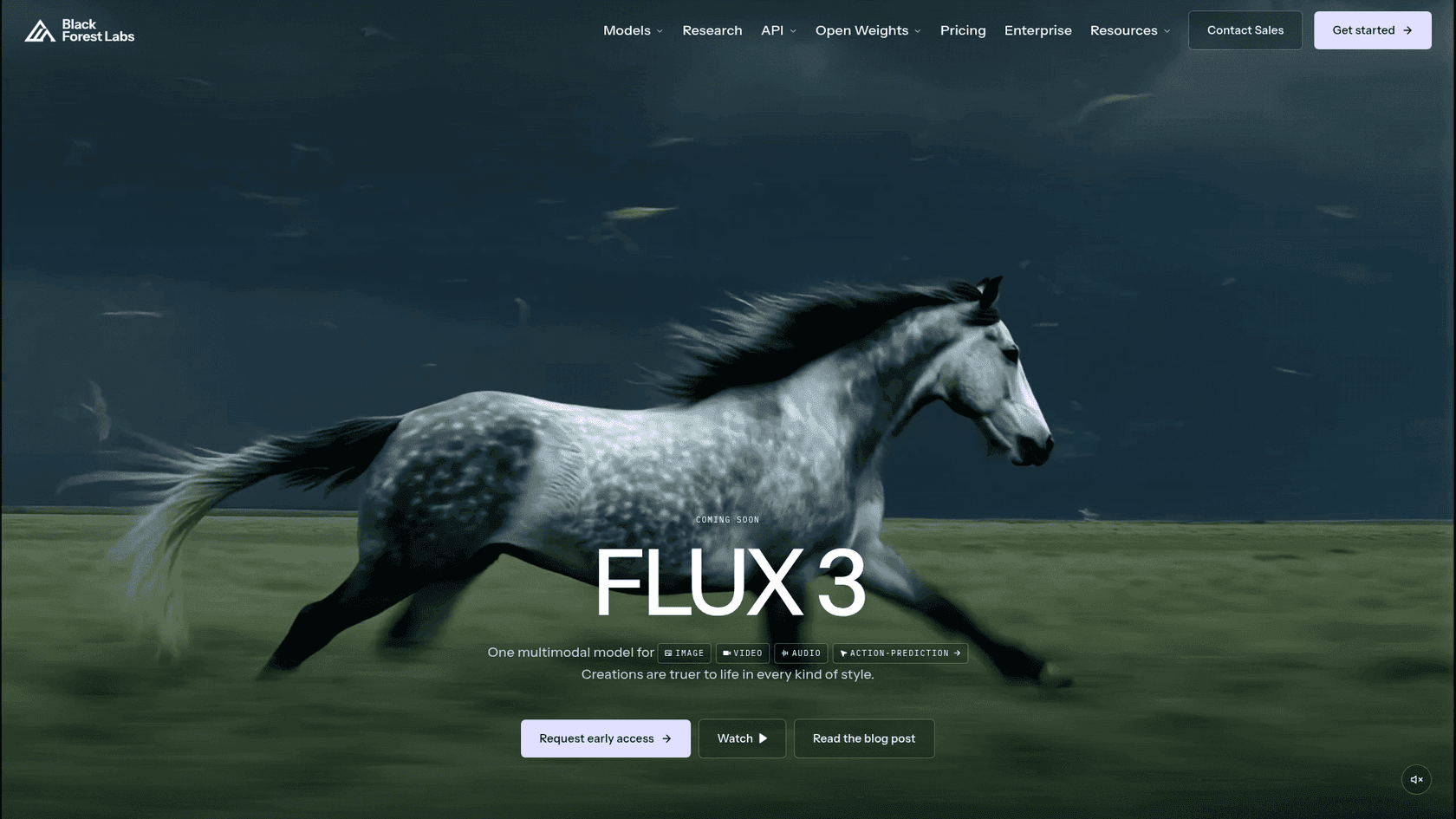
That screenshot is the product surface. A request form, basically. So the fair thing left to review is the paper trail, and the paper trail turns out better than the launch post led me to expect.
The claim under review
FLUX 3 is a multimodal foundation model that trains on images, video and audio inside one architecture, and then the same backbone also predicts robot actions. Black Forest Labs frames this as learning a representation of the world rather than three separate skills. How objects hold together, how things move, how events sound.
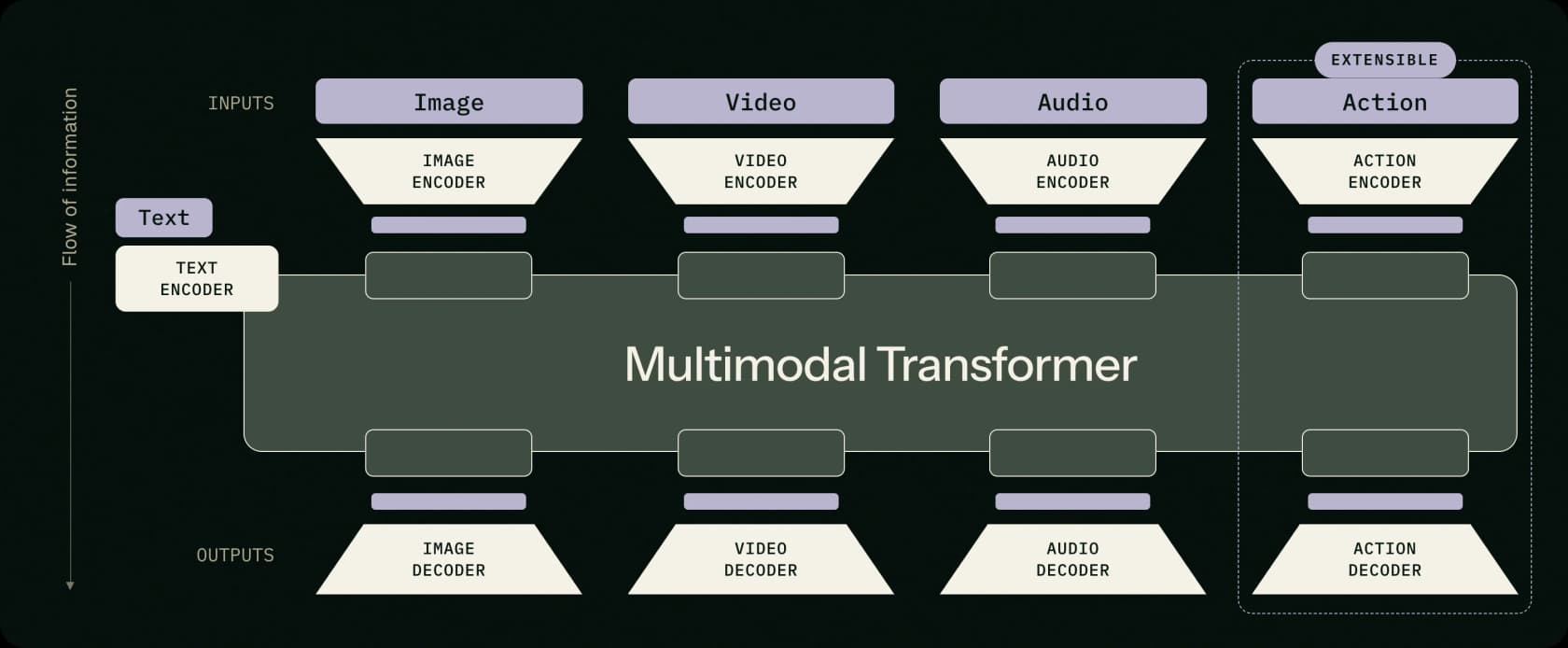
The concrete version: video with native audio up to 20 seconds in a single generation, text-to-video, image-to-video from a starting frame or a visual reference, video-to-video that carries a character into a new scene, keyframe-to-video for controlled transitions, multilingual dialogue, and agentic chaining of clips into multi-shot sequences. Every output comes with audio attached rather than dubbed on afterwards.
That last detail is the one I would test first if I had access. Sound that lands on the frame where the impact happens is a much harder problem than sound that plays over a clip, and it is the kind of thing that either works or embarrasses itself immediately.
Worth saying for anyone planning around this: a 20-second ceiling with audio attached changes what a short explainer costs to make, but it does not change the part that actually decides whether the clip is any good. Writing the video script is still the step most teams skip.
The paper is better than the blog post
This is the part of the review I did not expect would end up the highlight. FLUX 3 is built on Self-Flow, and it is the research page, not the announcement, where Black Forest Labs actually shows its work.
The mechanism is called Dual-Timestep Scheduling, and it is a twist on the standard denoising setup that every diffusion model is built from. Given one clean input, the method draws two timesteps and a random mask, then noises each token according to its assigned timestep, so different parts of the same input arrive at different levels of corruption. The teacher view gets the lower noise level, which creates a deliberate information asymmetry, and the student is trained to denoise the input and reconstruct the teacher's features at the same time. The point of all that machinery is that the model learns strong representations without an external teacher model bolted on.
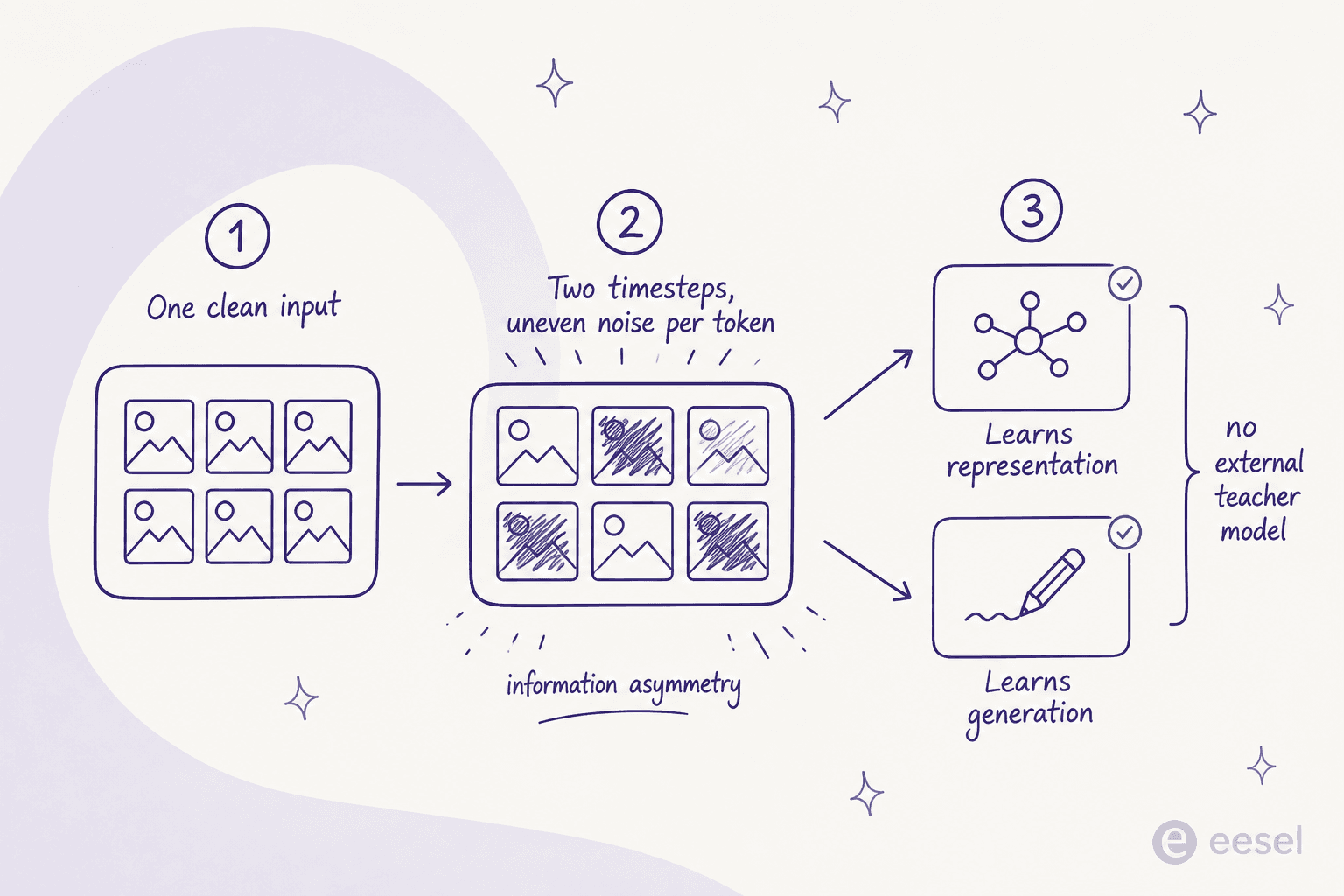
Worth spelling out why that matters to a buyer and not only to a researcher. The usual route to semantic quality in a generative model is to align it against some separate pretrained vision model. That works fine, and it also leaves you maintaining two models whose objectives do not quite agree. Self-Flow's claim is that the representation can come out of the generative training itself. Anyone who has weighed building on top of a pretrained encoder against training something end to end will recognise the trade, and my notes on custom AI models and training an AI model cover the same fork from the applied side.
The ablations are real, too. The image comparison runs a 625M parameter backbone on 20M images against vanilla flow matching, REPA with DINOv2, REPA with SigLIP2, and SRA. For the joint multimodal run it is a single 4B parameter FLUX.2 backbone trained on 200M images and 6M videos, over 100k high-resolution fine-tuning steps. Numbers specific enough to argue with, which is already more than most model launches hand you.
The scaling result is the strongest forward-looking claim in the release:
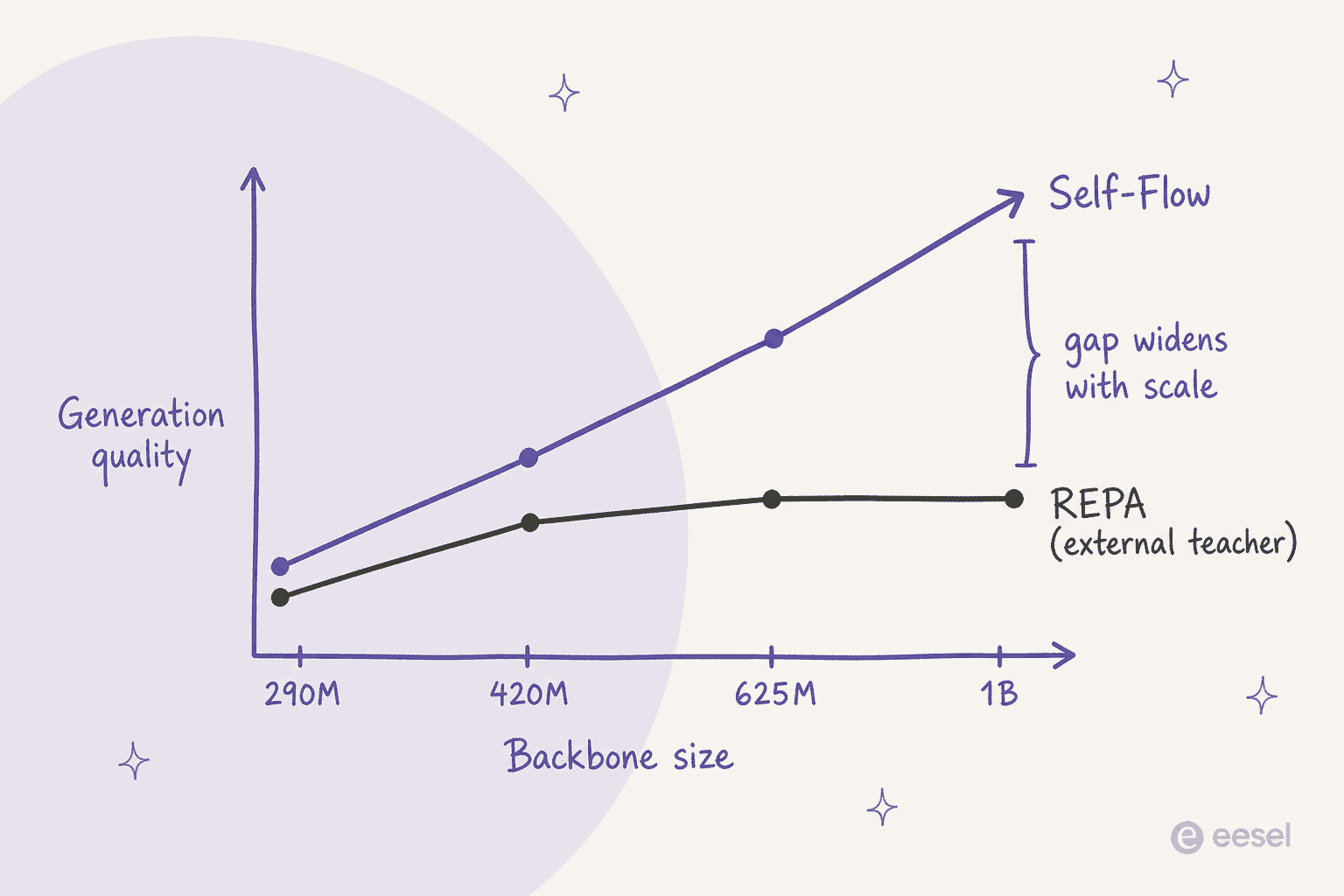
As model size climbs from 290M to 420M to 625M to 1B parameters, the gap between Self-Flow and REPA widens rather than closes, while REPA shows diminishing returns. A method that gets relatively better with scale is worth much more than a method winning at one particular size.
Now the reviewer's caveat, which is a real one. Those experiments top out at 4B parameters on 200M images. FLUX 3 itself is described as significantly scaled up from that setup. Meaning the paper validates the method and not the shipped model. Strong evidence the architecture is sound, then, and no evidence whatsoever about the thing sitting behind the request form.
The video numbers, read the way they were written
Here is the full preference set from the launch post, measured on 10-second text-to-video clips at 720p with audio.
| Compared against | FLUX 3 preferred in | Read |
|---|---|---|
| Luma Ray 3.2 | 93% | Clear win |
| Runway Gen-4.5 | 77% | Clear win |
| Grok Imagine Video | 69% | Win |
| Kling v3 Pro | 60% | Narrow win |
| Happy Horse v1 | 59% | Narrow win |
| Happy Horse 1.1 | 57% | Narrow win |
| Seedance 2.0 | 52% | Coin flip |
| Gemini Omni Flash | 52% | Coin flip |
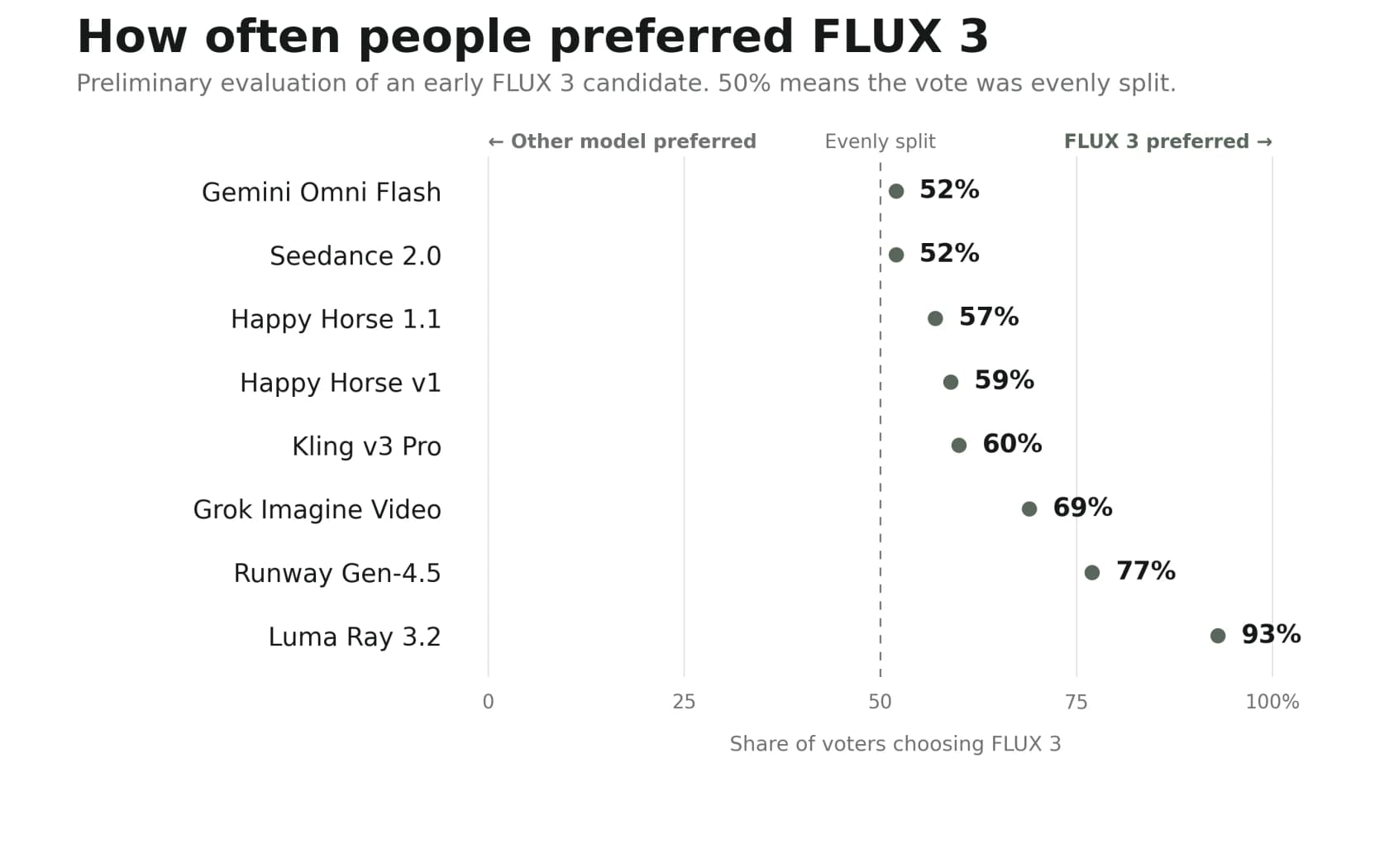
Two things deserve credit here. Black Forest Labs published the losses right alongside the wins, and it set the caveat in bold on its own page: the model and the harness around it are still in development, so the results are preliminary and expected to improve.
Two things deserve scrutiny. The comparison set was chosen by the vendor, on prompts written by the vendor, and Kling has already moved past the v3 Pro that got benchmarked to the 3.0 family. And the honest summary of this table is "competitive with the current frontier", not "ahead of it", because the two closest competitors landed on a coin flip.
None of that makes the table useless. It makes it a vendor-run performance metric, which is a real category of evidence with a known bias, and you read it the way you read any self-reported number: trust the shape, discount the magnitude, and go find the losses. Black Forest Labs at least printed the losses.
If you want those eight models priced rather than ranked, that is exactly what my FLUX 3 alternatives breakdown does, and the full launch analysis covers the capability list in more depth than a review needs to.
The image evaluations ran on a model that was still training
The launch post states this plainly and almost nobody quoted it: the image improvements come from preliminary evaluations conducted during midtraining. The samples do look strong, particularly on typography and on multilingual text rendering, which happens to be where earlier FLUX releases visibly struggled.

It is worth setting that against where the current generation actually sits. One operator who runs a prompt-adherence benchmark site scored FLUX.2 at 5 out of 15, Ideogram 4 at 8, and GPT Image 2 at 12:
"I run a fairly high-traffic site for generative image models focusing on complex prompt adherence. Flux.2 doesn't score anywhere near SOTA proprietary models."

That is the gap FLUX 3 Image has to close, and it is a wide one. Another commenter put the frustration more bluntly:
"I have a feeling open-weight models ought to be outperforming proprietary ones by now, but that still hasn't happened."
For image work you can ship this month, the comparison I would run is FLUX.2 against Nano Banana 2, its Lite variant and GPT Image 2.
If you are picking on cost instead of quality, the three-way image comparison is the page I keep open. Local editing is a separate skill again, and Qwen image editing is what I would benchmark against for that.
This is also the half of FLUX 3 that content teams care about, since an illustration is the part of a post most people are already generating. If that is your use case, the pipeline matters more than the model: blog automation and article writing with images cover how the two fit together, and Midjourney's rate card is the cost baseline I measure against.
The robotics section is the best evidence in the release
If you read only one part of the FLUX 3 material, read the mimic post. That is where a claim about representations gets tested against physical reality, and physical reality is much harder to game than a preference poll.
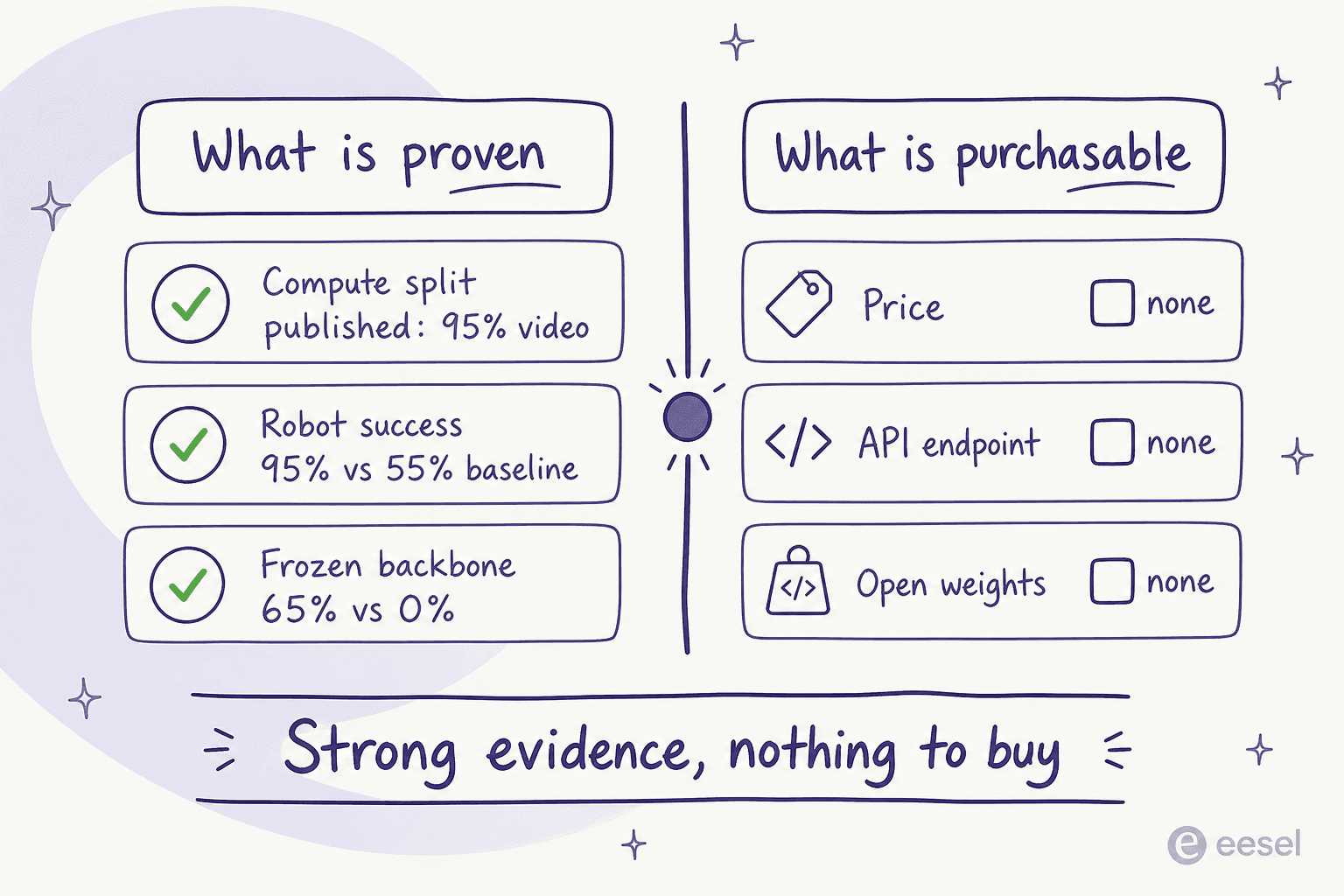
Black Forest Labs and mimic robotics built FLUX-mimic by hanging a lightweight action decoder off the FLUX 3 video path, and Audi has been testing it on production soft-body manipulation work. On a soft-body kitting task across 20 autonomous trials, median success came in at 95% for FLUX-mimic against 55% for the pi-0.5 baseline.
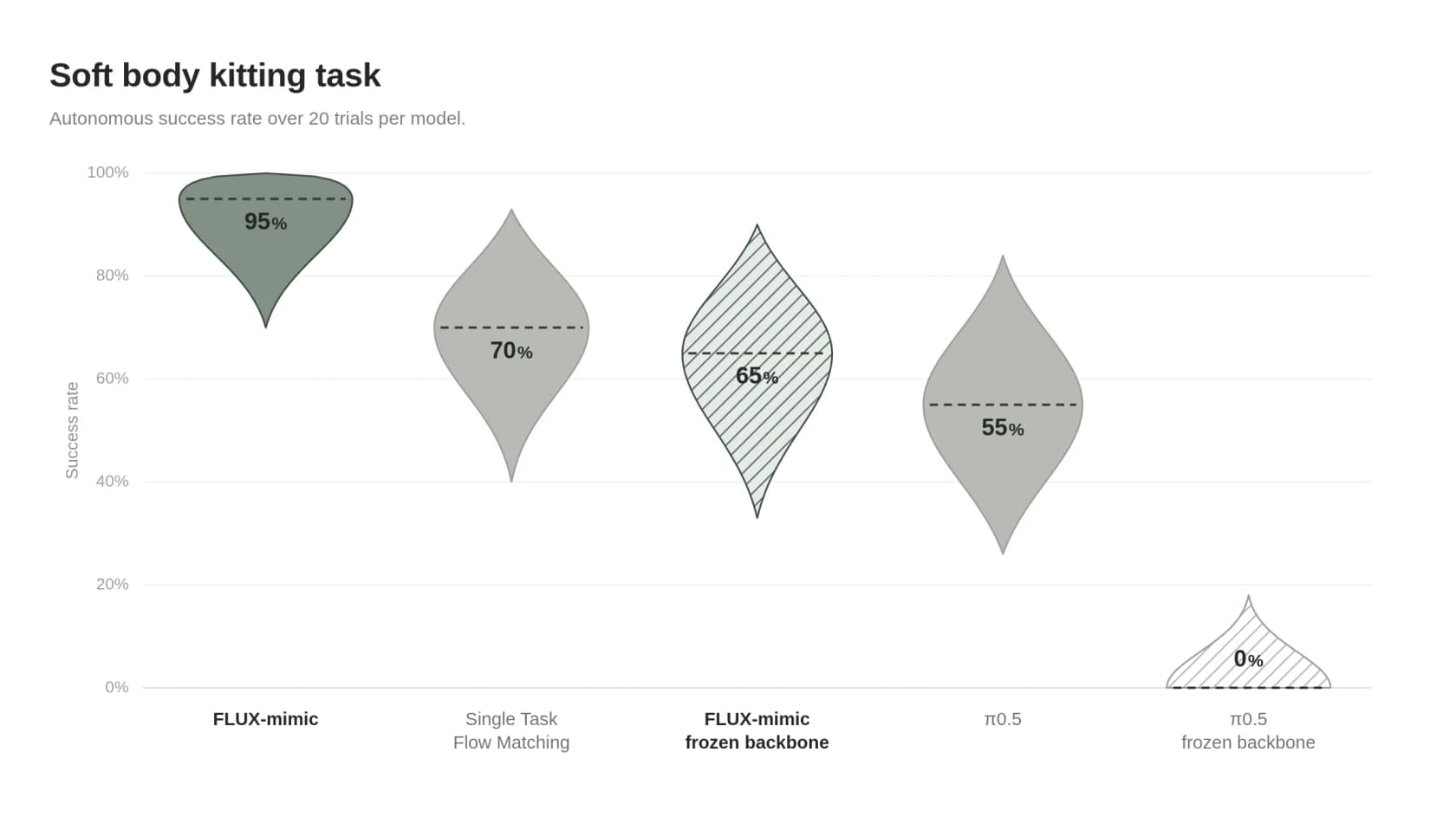
The number I would actually reach for in an argument is the control condition. With the backbone frozen, FLUX-mimic still reached 65%, while a frozen pi-0.5 reached 0%. Freezing the backbone takes fine-tuning out of the equation, so what remains is the quality of the representation the video model already carried. That is the whole thesis of the release, tested properly, and with a result that would have been embarrassing had it landed the other way. Publishing it anyway is the single most credible thing in this launch.
It is also not a lone data point in the field. Gemini Robotics 2 makes a structurally similar bet from the robotics side rather than the generation side, which is a decent sign that the underlying idea is not just one lab's framing.
The Self-Flow page then adds a second layer of the same story, this time from simulation. Fine-tuning the video-weighted multimodal runs at 675M parameters and evaluating action prediction in the SIMPLER simulator, Self-Flow beat plain flow matching across every task early in training at 30k steps, where flow matching failed entirely on the Open and Place tasks. By 100k steps the single-object tasks had converged, while Self-Flow held onto its advantage on the multi-object and sequential ones. The pattern stays consistent throughout: the benefit turns up on the hard compositional tasks and not on the easy ones.
One reader in the thread caught the detail that convinced me most, which is not a success rate at all:
"The video at around 3.30min, where the robot arm took 3 attempts to reseat the window trim, was quite unnerving - I have not seen such resolving before."
Retrying after a failure without being told to is a different capability from getting it right first time, and it is the one that actually matters once a system runs unsupervised. I care about that for the same reason I care about it in support automation. A system that knows it failed can hand off; a system that does not know just files a confident wrong answer and moves on. That is the thesis behind AI agent handoff and behind preventing AI hallucinations.
Another commenter summarised the architecture bet in one sentence better than the launch post did:
"Upshot: a well trained multimodal video generation model has a world representation model trained inside it."
The evidence audit
Six claims, graded on what was actually published rather than what was demonstrated. Open each one.
One model for image, video, audio and action
Better video than the competition
A significant image-quality jump
The backbone transfers to robot control
The method scales
You can use it
Where the review runs out of road
Every review has to answer "so should I buy it" eventually, and this is the point where I have to stop.
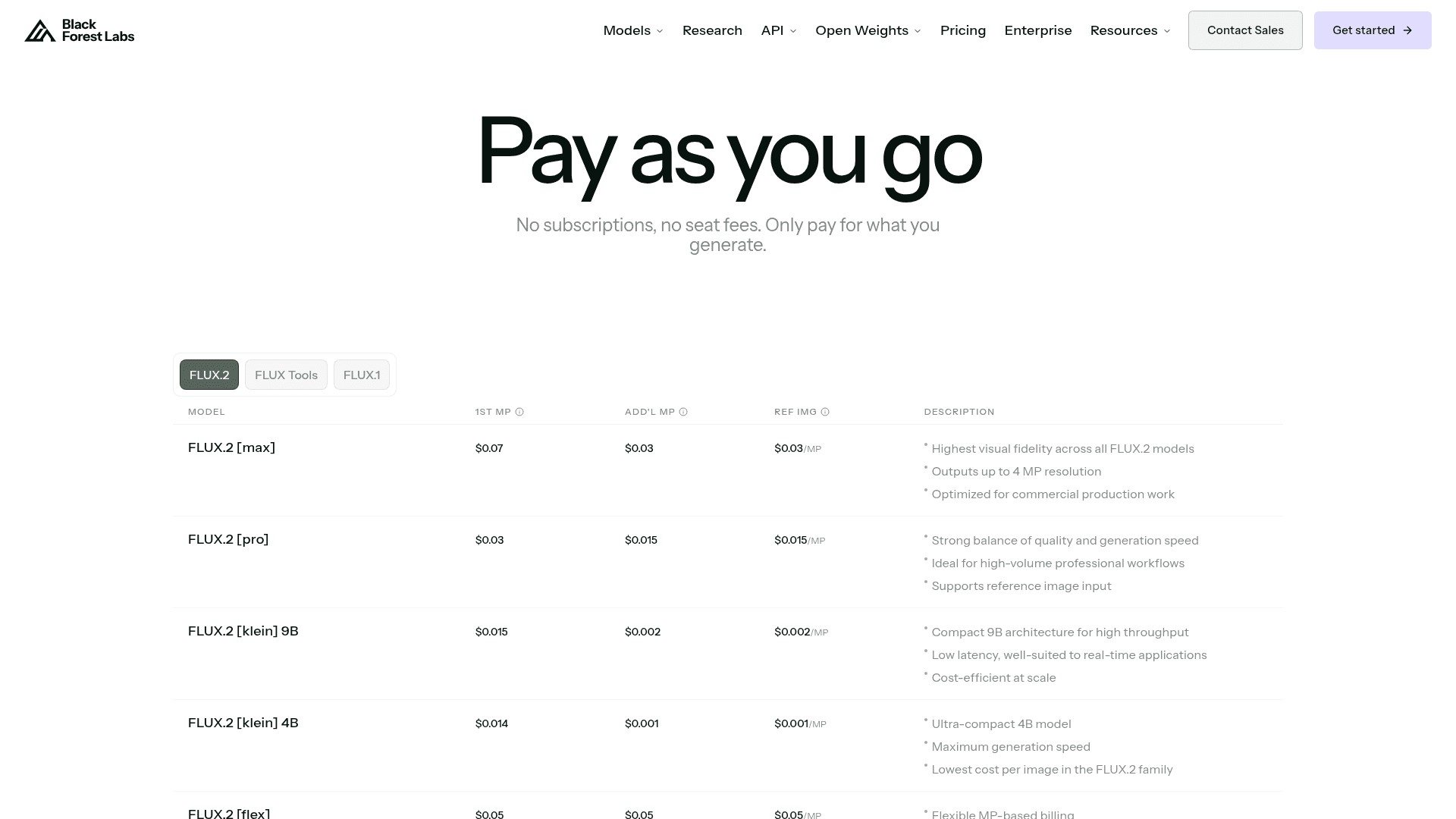
The pricing page has tabs for FLUX.2, FLUX Tools and FLUX.1. FLUX 3 is not on it. The launch ladder runs video and audio first through APIs and private weight access, then action prediction through selected partners starting with mimic robotics, then image synthesis, then open-weight access to the multimodal backbone as FLUX 3 Dev. Only the first rung has started, and the open-weight rung has no date attached to it.
The nearest real numbers are the FLUX.2 rates, and they are worth knowing because they are probably the shape of what FLUX 3 will charge:
| FLUX.2 model | First megapixel | Additional megapixel | Reference image per MP |
|---|---|---|---|
[max] | $0.07 | $0.03 | $0.03 |
[pro] | $0.03 | $0.015 | $0.015 |
[flex] | $0.05 flat | $0.05 flat | $0.05 flat |
[klein] 9B | $0.015 | $0.002 | $0.002 |
[klein] 4B | $0.014 | $0.001 | $0.001 |
One megapixel here means a 1024x1024 output. Billing rounds up separately for the output and then again for each reference image, and anything over 4 MP gets resized down. The gotcha that catches people is that reference-image line, since an editing workflow carrying three references costs meaningfully more than the headline rate suggests.
What the people running these models say
The launch thread hit 571 points across 133 comments, the mimic thread 318. And the most interesting reaction in there was not about quality at all. It was about who FLUX is now for:
"Given that Martin Scorsese is now an 'advisor', I suspect BFL will continue to position itself as the research lab for filmmakers."
That reading fits the evidence better than the alternative. A model priced for VFX pipelines and industrial robotics is a different product from a model priced for bulk content generation, and the launch material leans toward the former. If your plan was cheap volume, the FLUX.2 [klein] tier is where the cheap volume lives, not here.
Which is a useful thing to settle early, because it decides whether FLUX 3 belongs in your budget at all. A team producing one hero video a quarter and a team producing forty social clips a week want opposite things from a vendor, and only one of those teams should be watching this launch. The SEO side of that pipeline usually turns out to be the constraint rather than the render cost.
What I take from this if you buy AI for a living
I am not about to pretend a video model is a helpdesk. What transfers is the review discipline, and that part transfers exactly.
The pattern in this launch is the pattern in most AI pitches I see from the other side of the table: the impressive thing and the buyable thing are two different things, and the marketing does not separate them for you. Black Forest Labs was more honest than most, and it still took reading the pricing page to find out that the product is not for sale. Vendors in generative AI for customer service are rarely that transparent.
The specific version of this that costs support teams money is confidence. A buyer on an eesel sales call described the failure mode better than I could:
"The AI will never be able to answer 100% of the questions, but if it tries and just answers 'sorry I don't know this,' I cannot go and check all my 7,000 tickets to see if the AI actually made a good answer. I need an AI who is only handling the tickets that it's confident to handle and all the other ones, leave them alone."
a CX lead doing 7K tickets a month, from an eesel sales call
That is the same instinct as caring about the frozen-backbone number instead of the highlight reel. What you want to know is the behaviour at the edge, not the best case. Which is why setting confidence thresholds is the first configuration decision I walk anyone through, ahead of anything about tone or coverage, and why AI agents versus chatbots turns on this one property.
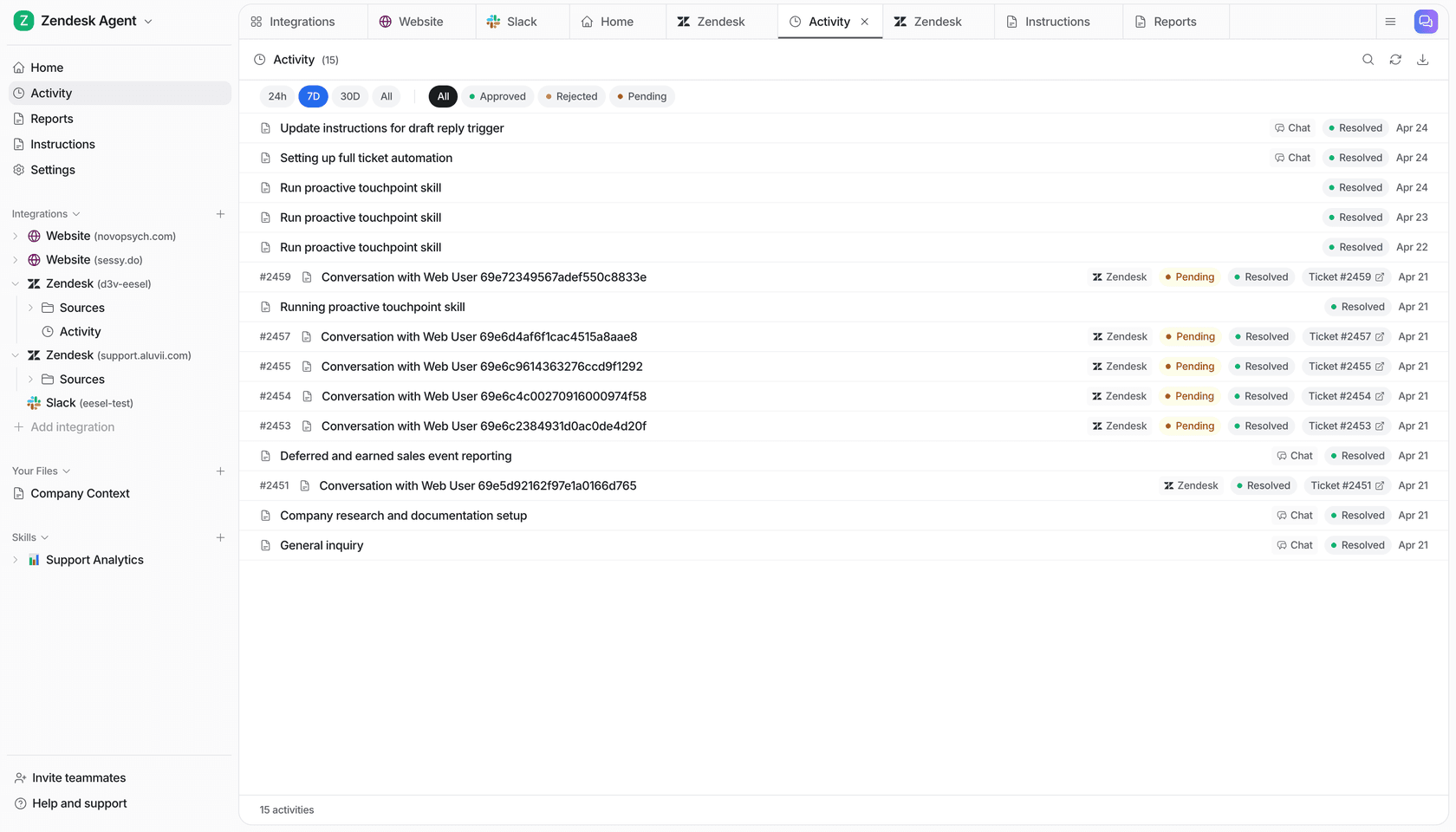
Reviewing an AI model you cannot run is frustrating. Reviewing an AI agent before you commit to it should not be. That is the one thing I would ask of any vendor in this space, eesel included: show me my own numbers before I sign anything. With eesel you point it at your helpdesk, it replays your historical tickets, and what you get back is the resolution rate on your own backlog instead of a preference score from somebody else's prompts. Every action lands in an activity log you can audit line by line. Free to try, and it takes minutes rather than a request form. Try eesel
If you want the deeper version of that argument, AI for tier-1 deflection covers what actually gets automated, and generative AI for support teams covers the rollout.
The verdict
| Dimension | Grade | Why |
|---|---|---|
| Research quality | A | Real baselines, real ablations, published losses |
| Robotics evidence | A | Frozen-backbone control that nobody had to publish |
| Video performance | C | Competitive with the frontier, not clear of it |
| Image performance | C minus | Midtraining samples, no comparative numbers |
| Transparency | B plus | Caveats stated, though the access reality is buried |
| Availability | F | No price, no API, no weights, no dates |
FLUX 3 is the best-documented model launch I have read this year and also one of the least useful ones. Build robots or work in a VFX pipeline, and you should get on the early-access list, because that frozen-backbone result says the representation is real. Need images or clips shipped this quarter, and you should use something carrying a rate card, then check back once there is a price. And if you are here because evaluating AI vendors is your actual job, the thing worth stealing from this launch is not the model at all. It is the habit of publishing the control condition.
For what you can buy instead today, my FLUX 3 alternatives roundup prices eight of them on the same ten-second clip, and the best generative AI tools covers the wider field.
If you are choosing text models in the same sweep, the cheap-throughput three I benchmark against are DeepSeek V4 Flash, Gemini 3.5 Flash-Lite and Qwen 3.7 Flash.
At the frontier end it is GPT-5.6 and Claude Opus 4.6, and which LLM suits support covers the support-specific read on all of them.
Sources
- FLUX 3 launch announcement, Black Forest Labs
- FLUX 3 x mimic, the video-action thesis
- Self-Flow research page, arXiv preprint 2603.06507
- FLUX 3 model page
- Black Forest Labs pricing
- FLUX.2 overview docs
- Launch thread, Hacker News, 571 points
- mimic thread, Hacker News, 318 points
Frequently Asked Questions
Is FLUX 3 worth it based on this review?
How good is FLUX 3 video quality?
What is Self-Flow and why does it matter for a FLUX 3 review?
Can I use FLUX 3 for images yet?
How much will FLUX 3 cost?
[max], $0.03 on [pro], $0.015 on [klein] 9B and $0.014 on [klein] 4B, where one megapixel is a 1024x1024 output and each reference image rounds up separately. If you budget by outcome rather than by unit, cost per resolution is the better frame.Is the FLUX 3 robotics claim credible?
Should content teams wait for FLUX 3?
What is the biggest weakness in the FLUX 3 launch?


Article by
Alicia Kirana Utomo
Kira is a writer at eesel AI with a Computer Science background and over a year of hands-on experience evaluating AI-powered customer service tools. She focuses on breaking down how helpdesk platforms and AI agents actually work so that support teams can make better buying decisions.