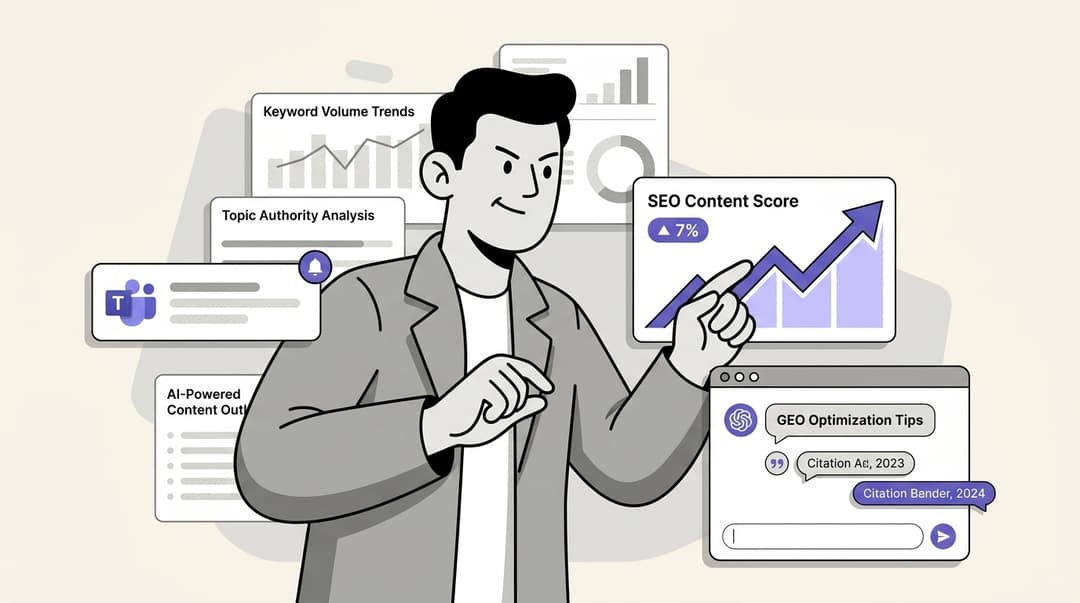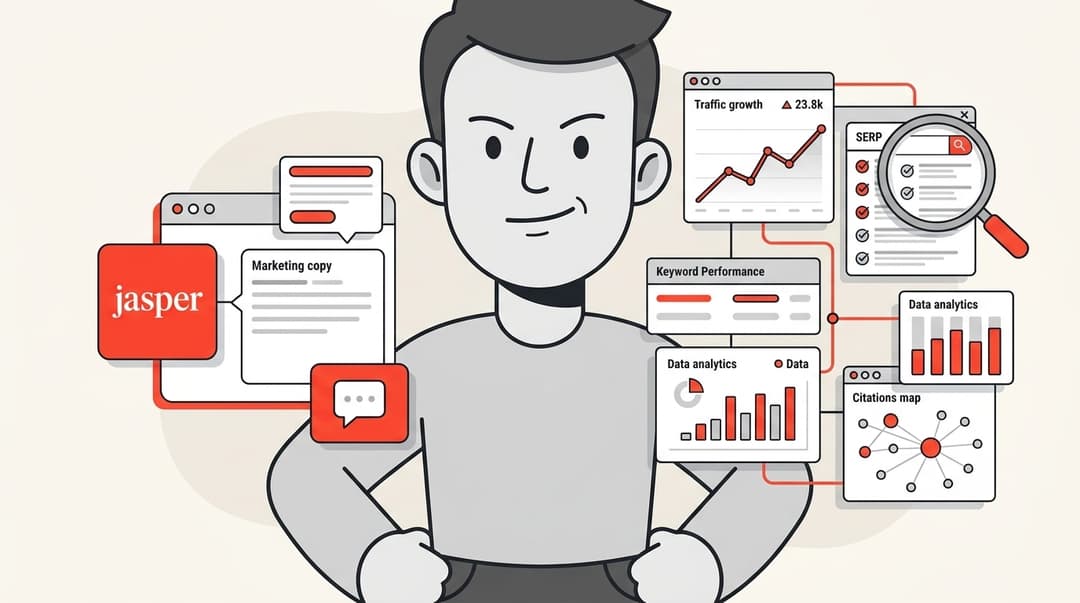


SEO is undergoing a significant shift. For years, the goal was to rank on the first page of Google. Now, it's less about getting a click and more about becoming the source for AI answers on platforms like ChatGPT, Perplexity, and Google's AI Overviews.
Traditional SEO playbooks are becoming less effective. When 60% of searches end without a click, it’s clear that ranking alone is not enough. A new approach is needed.
This guide explores this new landscape. We’re going to break down the new wave of generative AI SEO tools, what they are, which ones are worth considering, and how you can build a strategy around them.
What are generative AI SEO tools?
These tools can be considered assistants for Generative Engine Optimization (GEO) and Answer Engine Optimization (AEO). At their core, these disciplines are about getting your brand cited directly in AI-generated answers.
These tools represent a shift from traditional metrics. The focus is moving beyond keywords and backlinks to optimizing content structure, entity recognition, and sending the correct E-E-A-T signals (Experience, Expertise, Authoritativeness, and Trustworthiness) that help AI models trust your content.
While traditional SEO tools help you climb a list of links, the goal here is to shape the AI's answer. These tools usually fall into three main groups: content generation, visibility tracking, and technical optimization.
The new search reality: Why generative AI SEO tools matter
The way people search has changed. Instead of clicking through articles, users get instant answers from AI, which can mean fewer clicks to your website.
Some are predicting that 50% of traffic will shift to AI by 2028. This shift is currently underway.
Key platforms driving this change include Google's AI Overviews, ChatGPT, and Perplexity. They often pull information from Google's top results, then repackage and summarize it. This makes a first-page ranking a starting point, not the end goal.
For marketers, this presents new challenges. Direct traffic can decrease as visibility is impacted by AI-generated answer boxes. The new goal is to become a source that AI models rely on and cite. To do that, a different set of tools is needed.
A breakdown of generative AI SEO tools
An effective GEO strategy involves more than a single tool. It requires building a stack that addresses various needs. Let’s break down the key tools by their function so you can pick the right ones for your team.
Tools for content generation and optimization
This is about creating content structured in a way that AI can easily understand and process. When your content is simple for an AI to parse and directly answers a user's question, you have a better chance of being cited.
Surfer SEO
-
Focus: Surfer is an on-page optimization platform built to help content rank on Google. In the context of GEO, ranking high on Google is an important step to getting noticed by AI engines.
-
Key Features: Its Content Editor provides real-time feedback on keywords, structure, and readability as you write. They also have a Content Audit tool for updating old content and a Topical Map feature to help spot and fill content gaps.
-
GEO Angle: Surfer operates on the principle that Google rankings inform AI answers. They have also rolled out an AI Tracker that monitors brand mentions in AI Overviews, ChatGPT, and Perplexity, so you can see if your optimization efforts are paying off in the AI space.
-
Pricing: The Essential plan starts at $79/month when billed annually. The AI Tracker is part of the Scale plan or can be added on to other plans.
Writesonic
-
Focus: Writesonic positions itself as an all-in-one platform for both traditional SEO and GEO. It is one of the tools explicitly built to help track and improve visibility in AI answers.
-
Key Features: Their AI Article Writer 6.0 can create fact-checked, SEO-optimized articles with internal links. A key feature is their "AI Visibility Action Center", which analyzes competitor citations to find gaps and opportunities for your content.
-
GEO Angle: Writesonic focuses on GEO. It tracks your brand's visibility across more than 10 platforms, including ChatGPT, Gemini, and Perplexity. Their recommendations are powered by data from over 120 million AI conversations, providing insights.
-
Pricing: You can access the SEO and content features on lower tiers, but the AI Search Visibility (GEO) tracking is only available on the Professional plan, starting at $199/month when billed annually.
eesel AI blog writer
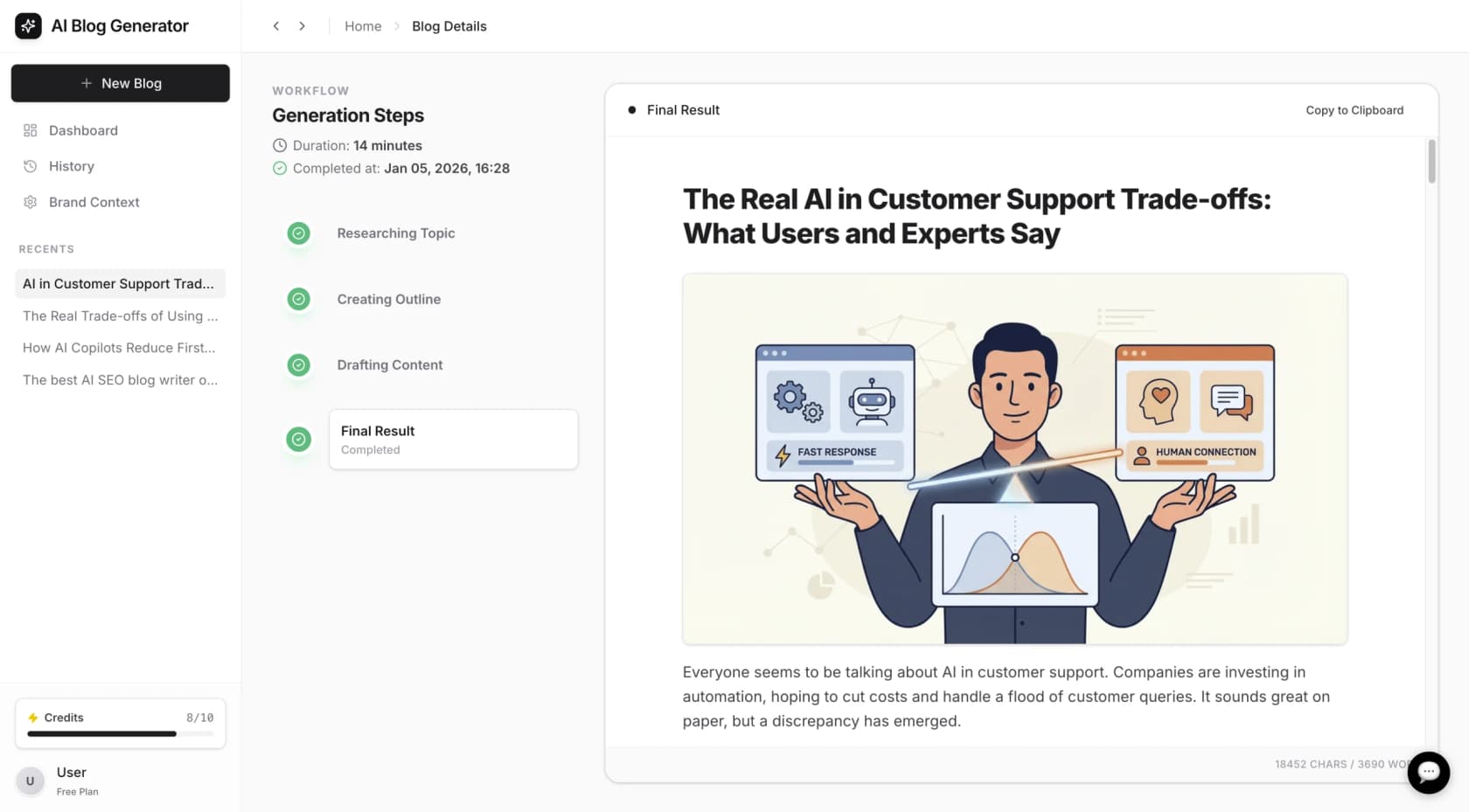
- Focus: The eesel AI blog writer is a generative tool that creates content from a keyword. It generates a complete, publish-ready, and media-rich blog post.
-
Key Features: The tool generates text and also researches your topic, creates a logical structure, and then populates it with AI-generated images and infographics, relevant YouTube videos, and Reddit quotes for social proof. It handles internal and external linking.
-
Unique Advantage: The generated content is designed for Answer Engine Optimization (AEO). This tool was used to increase organic impressions in three months. Its context-aware research is a notable feature, if you're writing a comparison post, for instance, it can pull in pricing data, which contributes to the content's authoritativeness and trustworthiness.
-
Pricing: You can try it for free. Paid plans offer 50 complete blog posts for $99.
Tools for visibility and performance tracking
Measuring performance is key to improvement. This category of tools tracks metrics such as brand mentions in AI answers, sentiment, and competitor visibility.
I’ve tested a bunch of AI SEO Tracking tools. But for now, I'll agree with everyone - there is no such thing as perfect. Nevertheless, I have chosen 3 favorites and so far my team is working only with them. 1. SE Ranking is probably the most well-rounded AI SEO checking tool I’ve used so far. It doesn’t just track if you’re mentioned in AI Overviews, but also breaks down how often, in what format (inline vs block), and what type of content Google is pulling. Super useful if you're trying to figure out how to optimize content for LLM visibility.

Here's a quick look at some of the players:
| Tool | Tracked AI Engines | Key Features | Starting Price |
|---|---|---|---|
| Rankscale.ai | ChatGPT, AI Overviews, Perplexity, Claude, Gemini, Grok, & more | Sentiment analysis, citation source tracking, AI readiness audits | Essentials plan at $20/month for 120 credits |
| SE Ranking | AI Overviews, ChatGPT, AI Mode, Perplexity, Gemini | Competitor benchmarking, SERP overlap analysis, historical data | Pro plan at $95.20/month (AI tracking included) |
| Surfer SEO | Google AI Overviews, ChatGPT, Perplexity | Mention rate, average position, top sources | Included in Scale plan or as a $95/month add-on |
| Writesonic | ChatGPT, Gemini, Perplexity, Claude, & 10+ more | Sentiment analysis, citation gap outreach templates, prompt explorer | Professional plan at $199/month |
Rankscale.ai
-
Focus: Rankscale is a specialized GEO tool dedicated to tracking and analyzing your brand's footprint on AI search engines.
-
Key Features: It tracks a wide range of platforms, including ChatGPT, Perplexity, Claude, and Google AI Overviews. You get deep insights into where your citations are coming from, sentiment analysis on how your brand is being portrayed, and an "AI readiness score" to audit your website.
-
Limitations: Because it's specialized, it doesn't have the broad, traditional SEO features you'd find in an all-in-one platform.
SE Ranking
-
Focus: SE Ranking is a comprehensive SEO platform that has expanded its features to include robust AI visibility tracking.
-
Key Features: Their AI Results Tracker monitors your brand's mentions and links across AI Overviews, ChatGPT, Gemini, and more. A notable feature is its ability to analyze the SERP overlap, showing you where organic results and AI answers align.
-
Limitations: The most advanced AI tracking features require the AI Search add-on, which comes at an extra cost on top of your main subscription.
Tools for technical and foundational SEO
This category focuses on technical optimizations needed for AI crawlers like GPTBot to find, understand, and trust your content.
Indexly
-
Focus: Indexly started out as an indexing automation tool but has since grown into a full-fledged SEO and AI visibility platform.
-
Key Features: It offers an AI Readiness Audit that checks your site's compatibility with crawlers from Google, OpenAI, and Anthropic. It can also automatically generate "llms.txt" files to give AI crawlers clear instructions. On top of that, it tracks your brand visibility and sentiment across AI platforms while still offering its core feature of pushing URLs to Google and Bing for faster indexing.
-
GEO Angle: Indexly connects technical SEO with GEO. It ensures your site is technically sound for AI crawlers while also showing you how you're performing inside the AI models themselves.
-
Pricing: The automated indexing is available on lower tiers, but the full suite of AI visibility tools is on the Business plan, which starts at $79/month.
Best practices for using generative AI SEO tools
Using these tools effectively requires following several best practices.
-
Focus on E-E-A-T signals: These tools cannot replace genuine authority. Use these platforms to enhance your expertise, not replace it. This means filling out author bios, sharing first-hand experiences (using phrases like "we tested" or "our data shows"), and creating original images and infographics. AI models are trained to look for and reward this.
-
Create AI-friendly content structures: Content should be easy to scan for both humans and AI. Use tools to help you build pages with clear, question-based headings, short paragraphs, and bulleted lists. The easier your information is to extract, the more likely an AI is to cite it.
-
Implement structured data (schema markup): This is an important step. Use schema for "Article", "Author", and "Organization" to give AI systems clear, machine-readable context about your content. It is a strong signal for credibility.
-
Track visibility, not just clicks: The metrics for success are evolving. Use visibility trackers like Rankscale.ai or the built-in features in Surfer SEO and SE Ranking to monitor brand mentions in AI chats and appearances in AI Overviews. These are key indicators of organic reach and influence.
Adapting your strategy with generative AI SEO tools
The shift to AI-driven search is ongoing. Adapting to this change is important for staying relevant.
frequent AI posts may work in the short term, but for stable visibility, combining automation with human input wins every time.
A modern SEO stack can benefit from a mix of three tool types: a content generator focused on AEO, a visibility tracker for new metrics, and a technical tool to ensure your site is AI-friendly.
For a deeper dive into how to execute a GEO strategy, this video course offers a complete walkthrough of the process, from content creation to tracking your performance in LLMs.
To understand the capabilities of these tools, it can be helpful to try them directly. For example, the eesel AI blog writer offers a free trial to create an SEO-optimized blog post.
Frequently asked questions
What are the main categories of generative AI SEO tools?
They generally fall into three buckets: content generation and optimization tools like the eesel AI blog writer that create AI-friendly content, visibility trackers like Rankscale.ai that monitor your brand's mentions in AI answers, and technical tools like Indexly that ensure your site is properly set up for AI crawlers.
How do generative AI SEO tools differ from traditional SEO tools?
Traditional SEO tools focus on ranking in search engine results pages (SERPs) by tracking keywords and backlinks. Generative AI SEO tools are designed for the new landscape of Answer Engine Optimization (AEO), helping you get cited directly in AI-generated answers from platforms like ChatGPT and Google's AI Overviews.
Can I rely solely on generative AI SEO tools for my marketing strategy?
While they're becoming essential, they work best as part of a broader strategy. You still need to focus on creating high-quality, authoritative content that demonstrates E-E-A-T (Experience, Expertise, Authoritativeness, and Trustworthiness). These tools augment your expertise; they don't replace it.
Are free generative AI SEO tools available?
Yes, some tools offer free trials or limited free plans. For example, you can try the eesel AI blog writer to generate a complete, SEO-optimized post for free. Many visibility trackers also offer a limited number of credits or a trial period to get started.
What is the most important metric to track with generative AI SEO tools?
Instead of just clicks and traffic, the key metric is "visibility" or "mentions" within AI answers. Tools like Surfer's AI Tracker or Writesonic's AI Visibility Action Center help you monitor how often your brand is cited, the sentiment of those mentions, and how you stack up against competitors.
How quickly can I see results after implementing generative AI SEO tools?
It varies. Technical fixes and content optimization can get you noticed by AI crawlers relatively quickly. However, becoming a trusted, cited source in AI answers is a longer game that depends on building authority and consistently publishing high-quality, well-structured content over time.