
NVIDIA DLSS 5 is real, and it is a different kind of feature than the name suggests. It was announced in March 2026 and shipped on September 3, 2026, with NBA 2K27 as the first supported game.
The one thing to understand: DLSS 5 makes games look better, not run faster. Every DLSS version before it was about frames, more of them or cleaner ones. DLSS 5 adds a new 3D-guided neural rendering layer that puts lifelike lighting, skin, and hair detail on top of the frame your engine already drew. The frame-rate features you already knew are now branded DLSS 4.5.
It is a GeForce RTX 50 Series exclusive, because it runs on fifth-gen Tensor Cores, and it costs frames rather than adding them. If you own an RTX 50 card and a supported game, it is a single toggle worth trying. If you are on an older card, DLSS 5 is not for you, but the DLSS 4.5 upscaling upgrades are, and those are the part that changes your day-to-day image quality. I build AI features for a living, and the design choice underneath DLSS 5 is the most interesting thing about it, so that is where I will spend the back half of this piece.
What DLSS 5 actually is
For seven years, DLSS was a performance story. Super Resolution rendered a game at a lower resolution and used AI to reconstruct a sharper image. Frame Generation invented whole extra frames in between the real ones. The pitch never changed: more frames per second, same card.
DLSS 5 breaks that pattern. Its launch feature, 3D-guided neural rendering, does not treat your frame rate as the goal. It takes the frame your game engine already rendered and uses an AI model to add detail that real-time performance budgets normally force developers to strip out: light passing through hair and foliage, the soft scatter of light under skin, deeper contact shadows. NVIDIA frames the ambition as using AI to draw 23 out of every 24 pixels you see on screen, a goal it lays out in its neural rendering explainer.
So DLSS now does two fundamentally different jobs. One side reconstructs and multiplies frames to buy you speed. The other generates new visual detail to buy you fidelity. DLSS 5 lives entirely on the fidelity side, and keeping those two jobs separate in your head is the fastest way to stop being confused by the version numbers.
DLSS 4 vs 4.5 vs 5: sorting out the version numbers
NVIDIA's naming here trips up almost everyone, so it is worth thirty seconds to untangle.
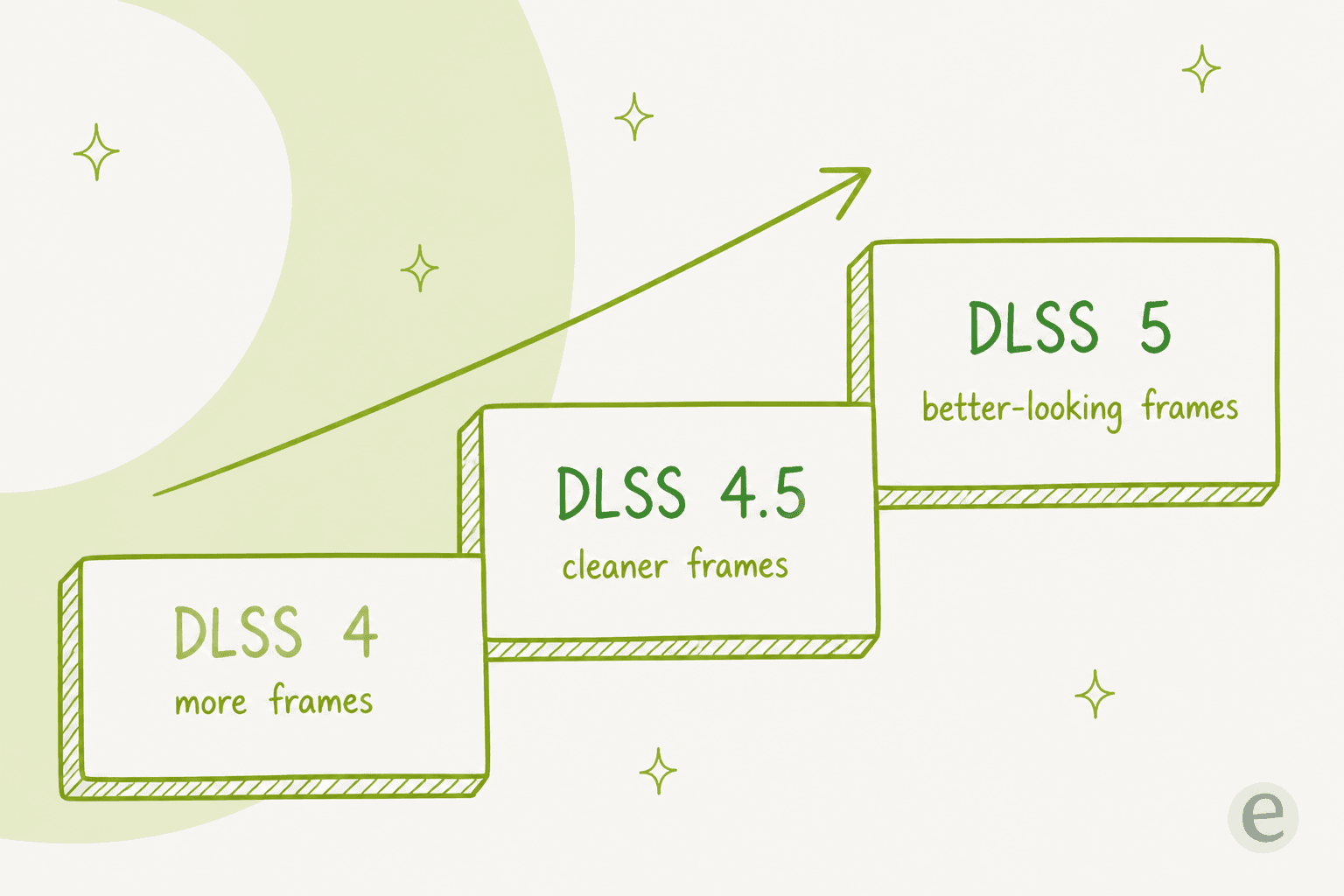
DLSS 4 arrived with the RTX 50 Series at CES 2025. It brought Multi Frame Generation and, quietly more important, swapped the old convolutional neural network for a transformer model in Super Resolution and Ray Reconstruction. That transformer swap is the upgrade almost everyone agrees was a clear win.
DLSS 4.5 is the current performance baseline. Per NVIDIA it introduced Dynamic Multi Frame Generation and a second-generation transformer model for Super Resolution and Ray Reconstruction. When people say DLSS makes games run faster today, this is the stack they mean.
DLSS 5 sits on top of all of it. It does not replace DLSS 4.5; it adds the neural rendering layer as an optional extra. So when a game says it "supports DLSS 5," in practice that means 3D-guided neural rendering is available on RTX 50 cards, running alongside the Super Resolution and frame-generation features you already had.
The practical upshot: if you are on an RTX 40, 30, or 20 card, DLSS 5 is not available to you, but the DLSS 4.5 transformer improvements mostly are, and that is the part that changes your image quality every day.
How 3D-guided neural rendering works
This is the part I find most interesting, because it is a clean lesson in how you make generative AI trustworthy enough to ship.
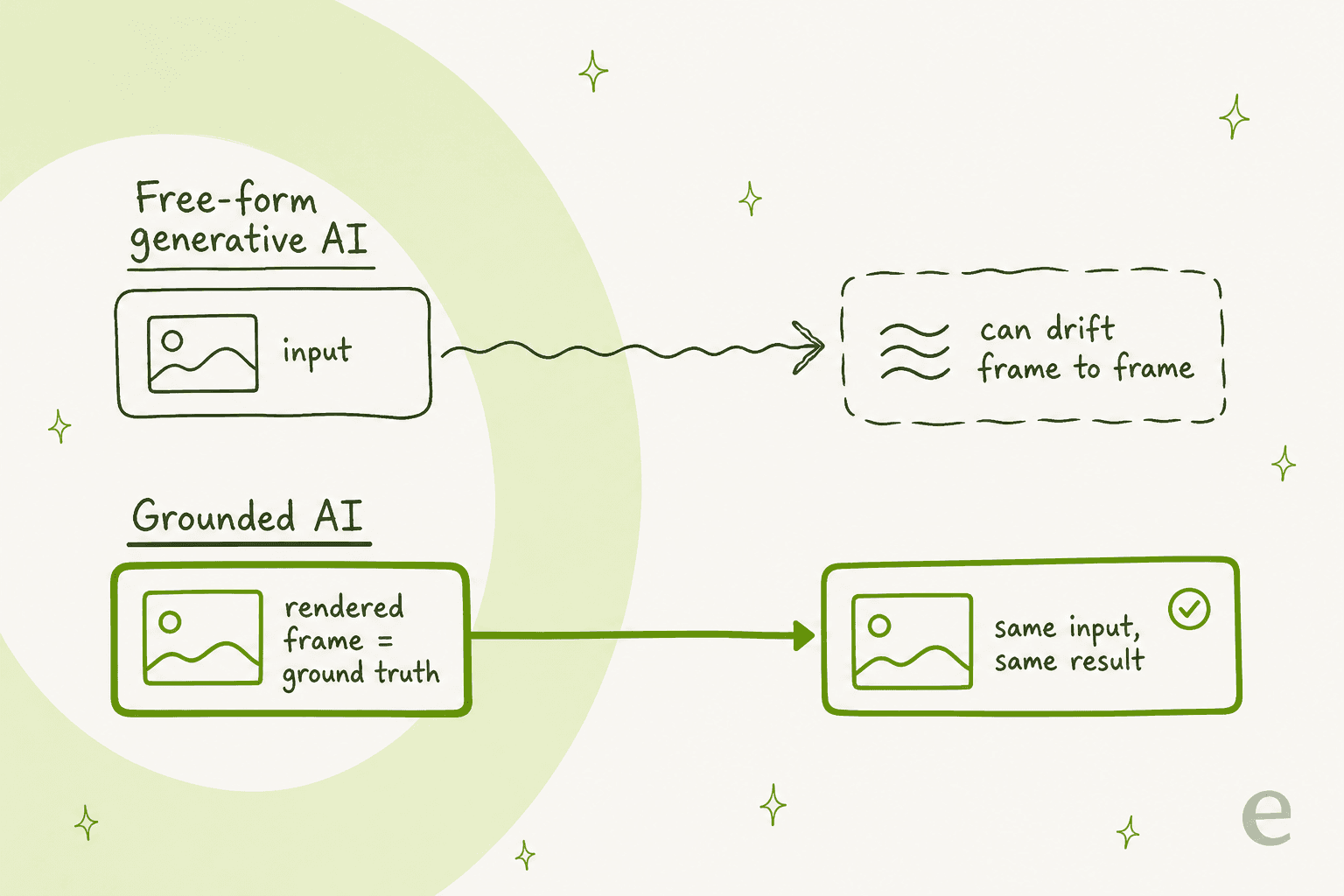
The obvious way to build something like this would be a text-prompted image model that "enhances" each frame. That would be a disaster in a game. Probabilistic models drift: a character's face would subtly morph from one frame to the next, and the whole scene would shimmer. NVIDIA's own explainer shows exactly that failure mode with a free-form generative model outputting different images from the same scene.
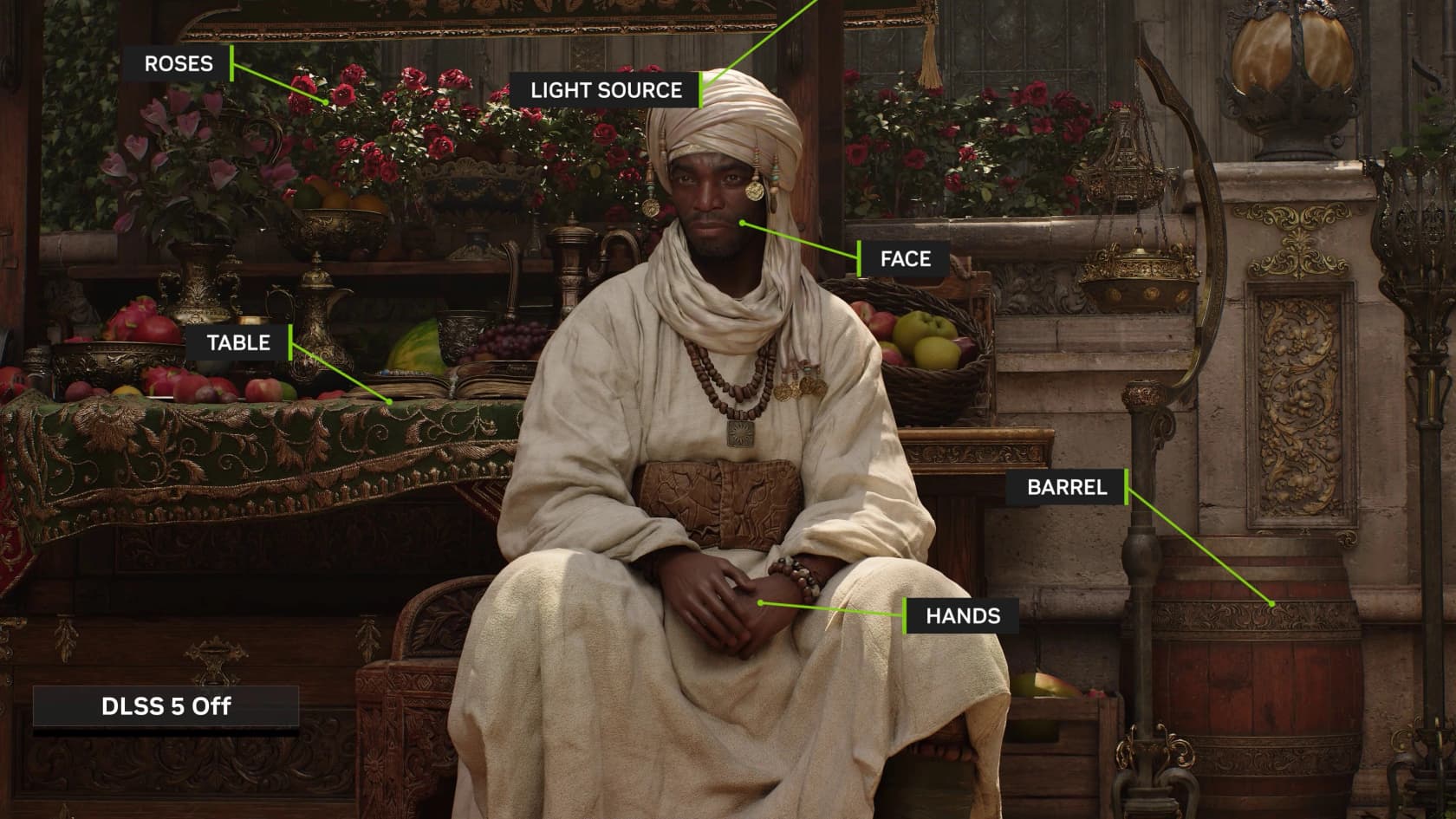
DLSS 5 avoids it by refusing to be free-form. It treats the engine's rendered frame, its geometry, textures, and lighting buffers, as an unyielding foundation rather than a loose suggestion. The neural network is trained to read that data, understand the scene at an object level (this is a face, that is a light source, those are roses), and add detail without inventing anything that was not already implied by the geometry. It runs deterministically: the same input frame produces the same output frame every time, and a strict one-frame-in, one-frame-out design plus the engine's motion vectors kills the temporal shimmer.
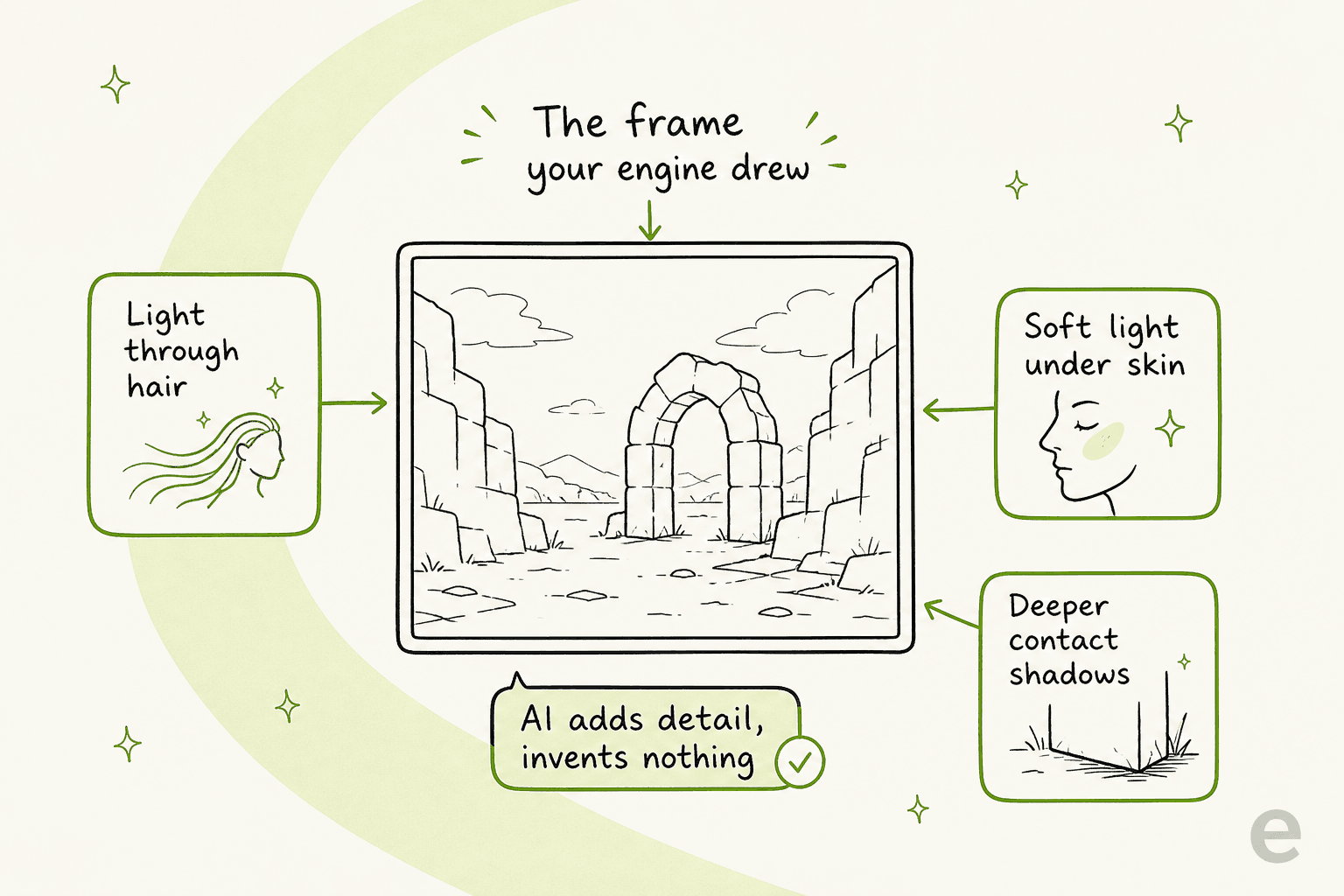
That anchoring is the whole trick, and it is a good one. DLSS 5 does not hallucinate because it is never allowed to guess from scratch. It is boxed in by a ground truth. That is the difference between a machine learning model that makes things up and one that is constrained by reality, and it is a pattern worth remembering well outside of graphics.
Which GPUs support DLSS 5?
The short version: DLSS 5's neural rendering layer is a GeForce RTX 50 Series exclusive, because it runs on the fifth-generation Tensor Cores those cards ship with. Every other RTX card still benefits from the DLSS 4.5 upscaling work, just not the new fidelity layer. Here is what your specific card actually unlocks.
If you are shopping and DLSS 5 is the deciding feature, an RTX 50 card is the only tier that unlocks it. If you already own a 40, 30, or 20 series card, the honest read is that the transformer upgrades reaching your card are the improvement most players actually feel day to day.
Does DLSS 5 actually look better?
Yes, and by more than I expected from a feature that ships as a single toggle. In NBA 2K27, developer Visual Concepts used DLSS 5 to show light passing through players' ears, natural skin lighting, and light catching hair, while preserving the scanned facial geometry of real athletes like Cade Cunningham and Tyrese Haliburton.

The part I appreciated most is that it is not a blunt filter slapped over the whole screen. Developers get art-direction controls, including a structure-intensity dial and per-object masking, so a studio can decide how much the AI leans in and where. Turn the dial up for more added detail, keep it low and the effect stays subtle. That control exists precisely because "an AI decides how your game looks" is the thing that makes some players nervous.
On games, NBA 2K27 is the launch title, and NVIDIA says more DLSS 5 titles are coming in the weeks and months after, with games like STAR WARS Zero Company and Onimusha: Way of the Sword sitting on the wider DLSS roadmap. As with any new rendering feature, the library will be thin at first and grow as studios adopt it.
The catch: DLSS 5 costs frames
DLSS 5 is impressive, but it is not free. Because it is a fidelity feature running on your GPU's Tensor Cores, it takes performance rather than giving it. That is the exact inversion of what "DLSS" trained everyone to expect, and it is why the community reaction has been split from day one.
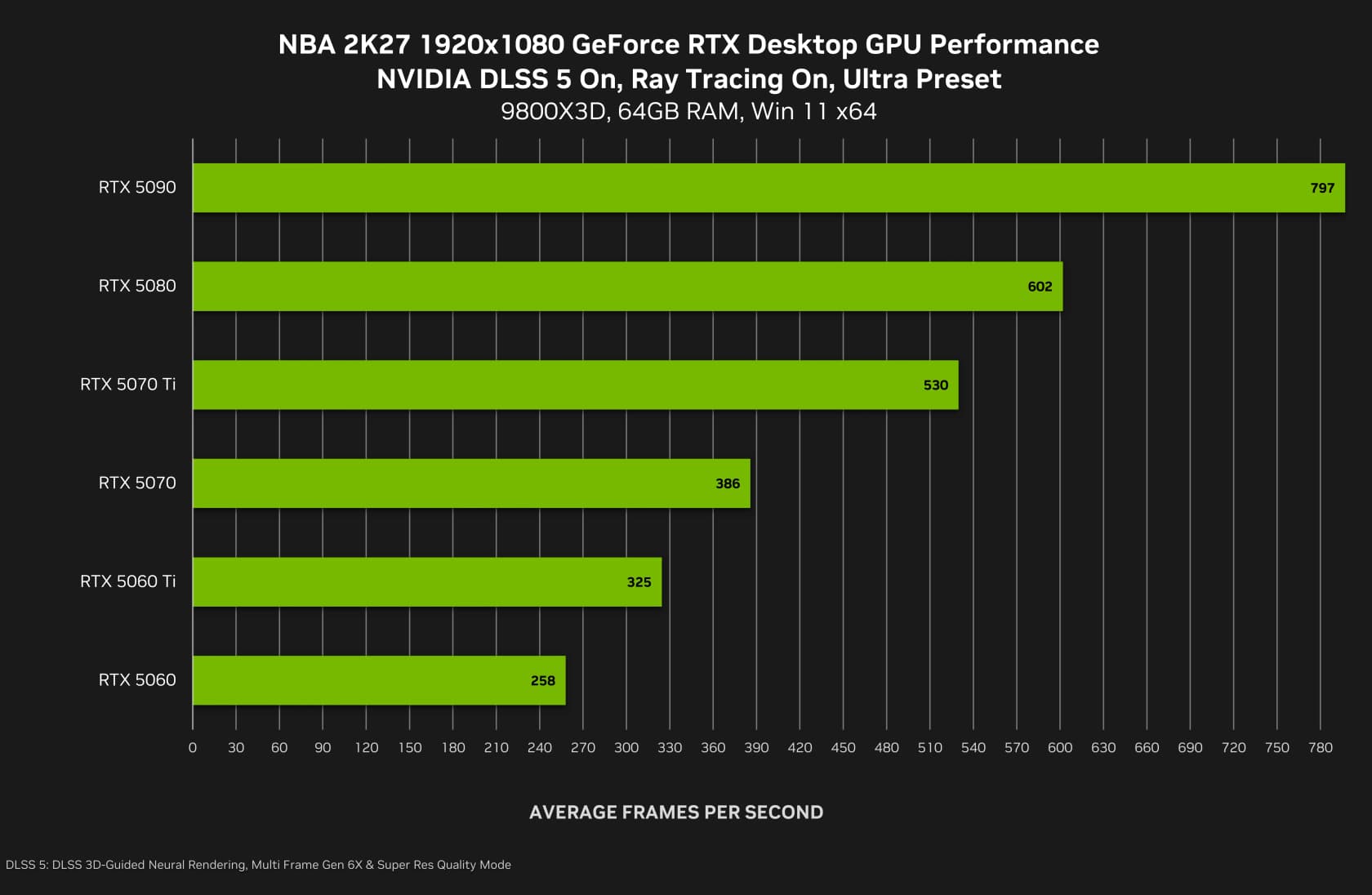
NVIDIA's own launch numbers show the ceiling is high if your card is: an RTX 5090 pushes 797 fps at 1080p in NBA 2K27 with the full DLSS 5 stack, while the RTX 5060 lands at 258. Those figures lean heavily on Multi Frame Generation, which carries its own long-running debate about whether AI-generated frames count as "real" performance.
Early hands-on reactions weigh the fidelity gain against that cost, and not everyone lands in the same place:
"Visually, unlike the jump from the CNN model to the Transformer, I'm not seeing enough improvement to justify this massive performance hit. Most of the time it's just a small sharpness boost (which can sometimes look overly sharp) and slightly reduced ghosting."
The other half of the split is philosophical, and it is the one specific to DLSS 5: should an AI layer change how a game looks after the artists signed off on it? NVIDIA positions DLSS 5 as something that honors artistic intent, and plenty of players buy that framing precisely because it is optional:
"It's an optional feature, game devs can choose to use it to enhance their in game art. They still have control over their original artistic vision. It's a tool that artists and companies can choose to utilize, the consumer in turn can choose if they want it enabled."
That is the honest state of it: a real new capability, a real frame cost, and an open question about taste that the structure-intensity controls are designed to answer.
How to turn DLSS 5 on
There is no configuration tax. On a supported game and an RTX 50 card, DLSS 5 is a single in-game toggle, listed in the video settings as DLSS Neural Rendering, right next to the upscaling and frame-generation options you already know.
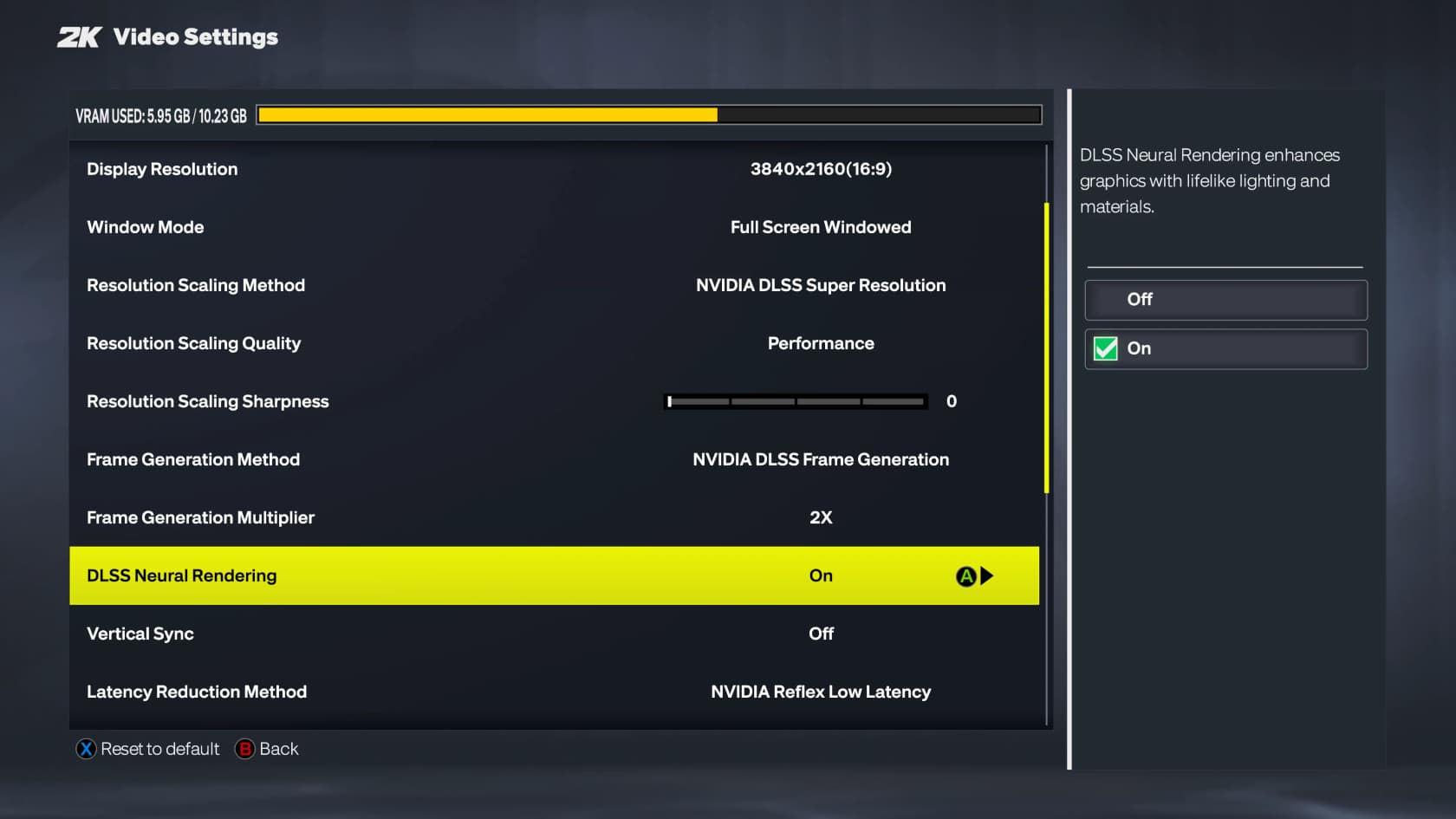
Make sure you are on the current Game Ready Driver that shipped alongside the feature, then decide with your own eyes. On a high-end card like a 5080 or 5090, you have frames to spare, so the visual upgrade is close to free. On a 5060 or 5060 Ti, check your frame rate first: if you are already fighting to hold a smooth number, the fidelity gain may not be worth the frames it costs.
One more note for anyone weighing whether to wait: NVIDIA says its optimization curve is not flattening, reporting a 5X gain in six months that moved DLSS 5 from needing dual RTX 5090s at announcement to a single card at launch, with more model updates promised through the fall. So the frame cost you see today is probably the worst it will ever be. For the full hands-on verdict, I wrote a separate DLSS 5 review.
What DLSS 5 says about AI that does real work
I spend my days shipping AI features, not graphics pipelines, and the thing that stuck with me about DLSS 5 is not the lighting. It is the design choice underneath it.
The reason DLSS 5 works is that it is not allowed to make things up. It is locked to the rendered frame as ground truth, so it enhances reality instead of hallucinating a new one. That is the same principle that separates AI you can actually deploy from a demo that looks great and quietly goes wrong. It is why preventing AI hallucinations is a grounding problem before it is a model problem, and why rule-based bots and AI agents behave so differently under pressure.
DLSS is infrastructure: a model that runs on your GPU and quietly does one job well. That is exactly how I think about where the real value sits. The model is the engine, and the useful product is the AI agent that is boxed in by a specific job and a specific source of truth.

That is the bet we make at eesel. eesel hires out ready-to-work AI teammates for defined jobs, and the AI helpdesk teammate is grounded the same way DLSS 5 is: it answers from your real help center and past tickets rather than a large language model guessing free-form, and you can simulate it against your own historical conversations before it ever touches a live customer, so you see how it will behave before you trust it. It is the difference that separates dependable AI customer service software from a demo that only holds up on the happy path. Different domain, same lesson. The useful AI is the kind that is boxed in by your reality, not the kind inventing its own. You can try eesel for free.
Frequently asked questions
Is DLSS 5 real, and when did it come out?
Yes. NVIDIA announced DLSS 5 in March 2026 and shipped it on September 3, 2026, alongside the NBA 2K27 launch and a new Game Ready Driver. It is a released feature, not a leak.
Is DLSS 5 a performance boost like older DLSS versions?
No, and this is the most common DLSS 5 misconception. The frame-rate features, Super Resolution and Multi Frame Generation, are now branded DLSS 4.5. DLSS 5 is a separate visual-fidelity layer that costs performance rather than adding it. If you want the deeper mechanics, they sit in the same family as other custom AI models tuned to a narrow, well-defined task.
What is 3D-guided neural rendering?
It is a deep learning model that reads the geometry, textures, and lighting the game engine already produced, understands the scene at an object level, and adds fidelity detail without inventing anything new. The "3D-guided" part is what keeps it deterministic and free of the shimmer a free-form image model would produce.
Can I get DLSS 5 on an RTX 4090 or RTX 3080?
No. The DLSS 5 neural rendering layer is exclusive to the RTX 50 Series because of its fifth-generation Tensor Cores. Older RTX cards still get the DLSS 4.5 transformer upscaling improvements, which is the upgrade most players notice day to day. The same "narrow model, narrow job" idea shows up across the best generative AI tools, where the useful ones are tuned tightly rather than left general-purpose.
What games support DLSS 5 right now?
NBA 2K27 is the launch title. NVIDIA says more are coming in the weeks and months after, with STAR WARS Zero Company and Onimusha: Way of the Sword on the wider roadmap. Expect the library to grow as studios adopt it.
Is the grounded-AI idea behind DLSS 5 used anywhere besides graphics?
Very much so. The same "anchor the model to a source of truth" pattern is what makes AI for customer service automation reliable enough to deploy, and it is why the best AI agents are the ones grounded in a real knowledge base rather than a general-purpose large language model answering from memory.