Machine learning
A branch of AI where systems learn patterns from data and improve at a task over time, instead of following rules written by hand for every case.
What machine learning means
Machine learning is a branch of artificial intelligence in which systems learn patterns from data and improve at a task over time, instead of following rules written by hand for every case. Rather than a programmer specifying every "if this, then that," the system is shown many examples and infers the rules itself.
A spam filter is the classic illustration: instead of someone listing every phrase that signals spam, the system learns from thousands of labeled emails what spam tends to look like, and keeps improving as it sees more. In customer support, that same idea is what lets software read an incoming ticket and recognize it as a refund request, an angry customer, or a duplicate, by learning from the thousands of tickets a team has already handled.
Why machine learning matters
Machine learning is the foundation underneath most of what people now call AI, and it matters because:
- It handles problems too messy for rules. Human language, tone, and behavior have too many variations to hand-code.
- It improves with data. More good examples generally mean better predictions.
- It generalizes. A trained model can handle inputs it has never seen in exactly that form before.
- It scales. Once trained, a model makes predictions at a volume no rules team could maintain by hand.
The contrast is sharpest when you put the two approaches next to each other on the same job, like sorting incoming support tickets.
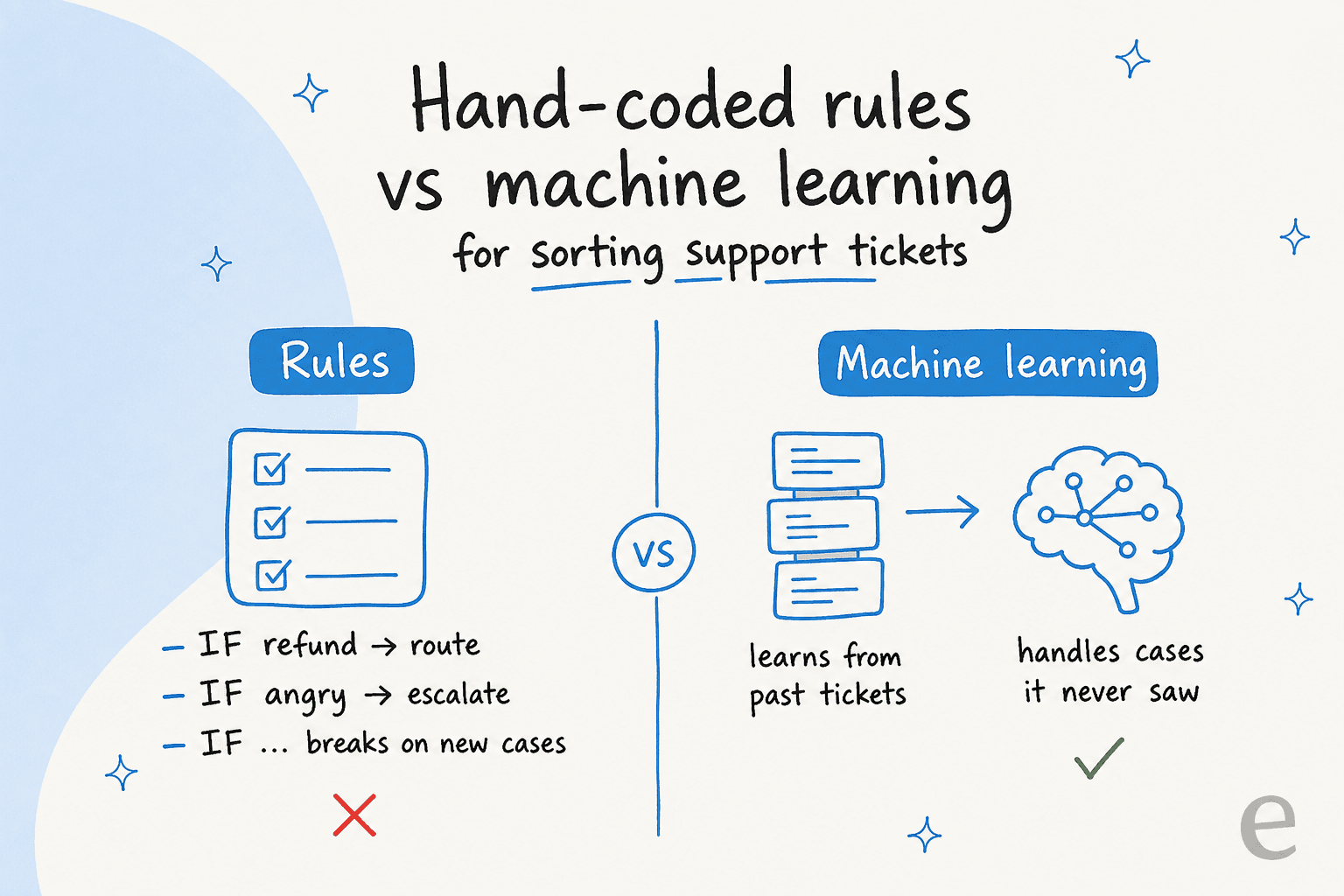
A rules approach works until a request arrives in a phrasing nobody anticipated, at which point the checklist falls over. A model trained on past tickets generalizes to wordings it has never seen, which is why support teams reach for machine learning once the variety of incoming questions outgrows what a rules list can cover.
How machine learning works
The core idea is to learn a model from data, then apply it to new inputs:
- Collect and label data. Gather examples, often with the correct answer attached (this is supervised learning).
- Train a model. An algorithm adjusts its internal parameters to map inputs to the right outputs as closely as it can.
- Evaluate. The model is tested on data it has not seen, to confirm it generalizes rather than memorizes.
- Predict. The trained model is applied to real, new inputs.
- Improve. As more data arrives, the model is retrained or refined.
In support, a tool like eesel AI leans on machine learning to read incoming tickets, match them to your existing knowledge, and learn the patterns in how your team has resolved similar requests before, so its answers sound like your team rather than a generic bot.
Machine learning in practice
A model is only as good as the data behind it. Biased, thin, or outdated training data produces biased, thin, or outdated predictions. In practice the work of machine learning is often less about the algorithm and more about getting clean, representative data into it, which in support means keeping your help center and past tickets accurate, because that is what the system learns from.
For a plain-English explainer, read machine learning in simple words.
Machine learning, applied to your tickets
eesel AI learns from your help center and past tickets to answer in your own voice.