Deep learning
A subset of machine learning that uses neural networks with many layers to learn complex patterns directly from raw data like text, images, and audio.
What deep learning means
Deep learning is a subset of machine learning that uses neural networks with many layers to learn complex patterns directly from raw data such as text, images, and audio. The "deep" refers to those stacked layers, each of which transforms the data a little more, so the network can build up from simple features to abstract ones.
Where older machine learning often needed a human to decide which features mattered, a deep network learns those features on its own. That ability to learn straight from raw input is why deep learning powers most of today's breakthroughs in language and vision, and in customer support it is the reason an AI can read a messy, free-text ticket and actually grasp what the customer is asking, rather than only matching exact keywords.
What makes deep learning different
Deep learning stands apart from earlier methods because of how it handles complexity:
- It works on unstructured data. Text, speech, and images are exactly what deep networks are good at, and that is most of what support teams deal with.
- It learns its own features. Less manual feature engineering, more learning end to end from examples.
- It scales with data and compute. Performance keeps climbing as models and datasets grow.
- It underpins modern AI. LLMs and image generators are all deep learning systems.
It helps to see what those stacked layers actually buy you when a ticket comes in.
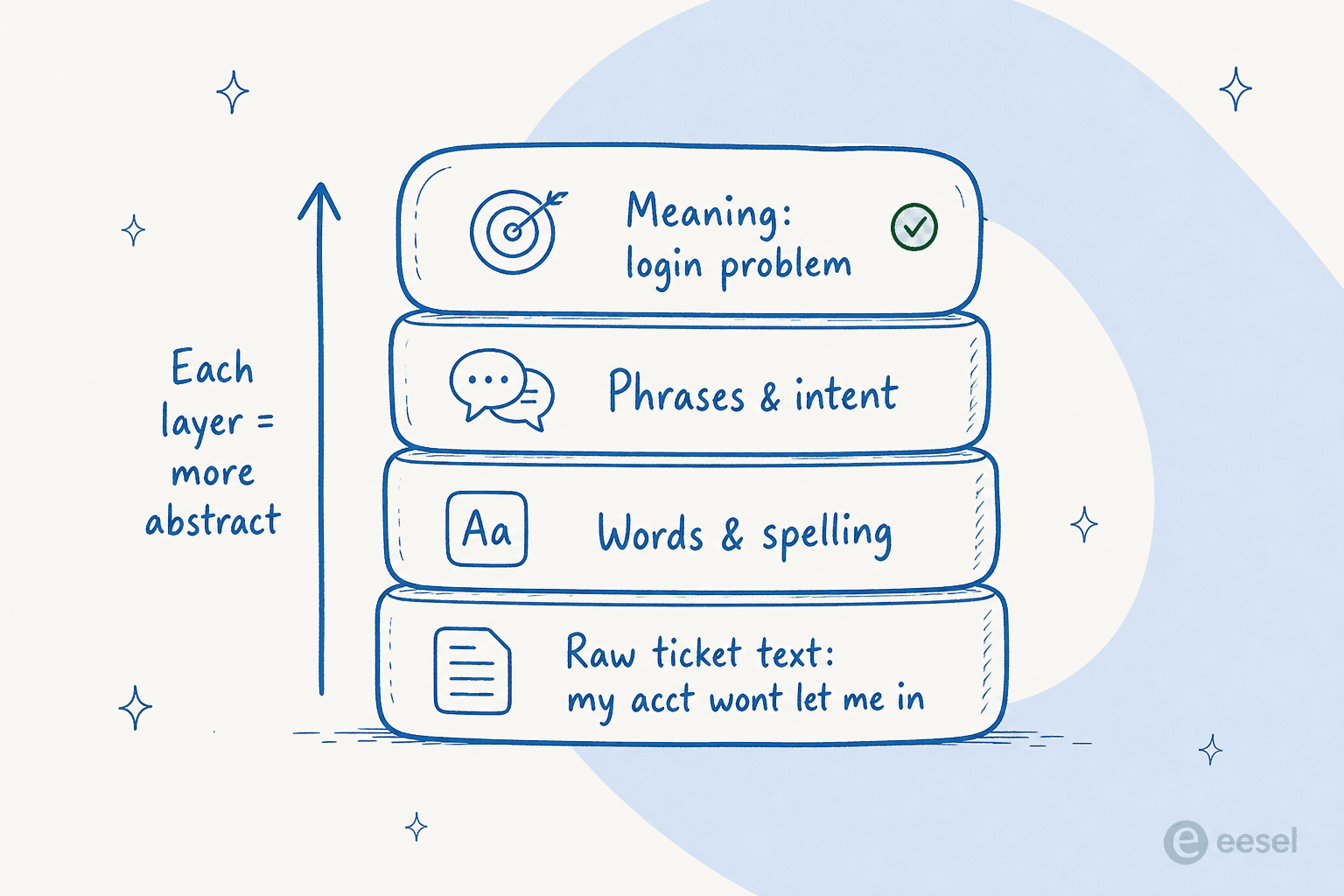
Each layer turns the messy input into something a little more abstract. A typo-ridden "my acct wont let me in" climbs from raw characters, to words, to intent, until the top of the stack reads it as a login problem.
How deep learning works
A neural network learns by adjusting the strengths of connections between many small units:
- Feed in data. Raw input enters the first layer of the network.
- Pass through layers. Each layer transforms the data, detecting progressively more abstract patterns.
- Produce an output. The final layer makes a prediction, like a classification or the next word.
- Measure error. The output is compared to the correct answer.
- Adjust and repeat. Through a process called backpropagation, the network tunes its connections to reduce the error, across many examples.
In support, the deep learning models inside a tool like eesel AI are what let it read a ticket written in natural language, understand its meaning, and match it to the right answer in your knowledge base, even when the customer never uses the "official" wording for their problem.
Deep learning in practice
Deep learning is powerful but demanding: it needs significant data and computing resources, and its decisions can be hard to interpret. For many everyday tasks the right question is not "is this deep enough" but "is this the simplest method that solves the problem well." In support, what matters is rarely the architecture and almost always whether the system is grounded in your real, current knowledge.
Deep learning behind your support AI
eesel AI runs on modern language models so it understands tickets in plain language and answers from your knowledge.