


The full eGain rate card
Everything below comes off eGain's pricing page, which carries a footnote that reads "Suggested list prices shown." Hold on to that footnote. It does real work later on.
| Product | Published price | Unit | What you are buying |
|---|---|---|---|
| AI Knowledge Hub | $25 | per user per month | The governed knowledge layer that grounds everything else |
| AI Agent | $0.50 or $25 | per resolution or per user per month | Customer self-service, or real-time guidance for agents |
| Evaluator | Request pricing | not published | Monitoring for knowledge accuracy and resolution quality |
| Composer | Free | to build and test | App builder; production billing follows the products your app calls |
| Connectors | $249 | per month | Integrations into contact centre, CRM, desktop, and AI platforms |
Five products and four different pricing shapes, with one of them undisclosed. That is not unusual for enterprise customer service automation or for the wider field of AI knowledge base tools, but it does mean the question "how much is eGain?" has no one answer until you know which products you are sitting on.
Two things stand out right away. First one, eGain publishes numbers at all. Compare that with Crescendo, which pulled its pricing page entirely, or the long list of AI customer service companies that will not name a rate before a call. Second, the two headline meters are counting completely different things, and the page will not tell you which one you want.
What Knowledge Hub actually gates
AI Knowledge Hub at $25 per user per month is the foundation product, and eGain is explicit that the rest of the suite is only as good as whatever sits inside here. It is the piece that unifies content across SharePoint, CRM knowledge, product docs, policies, and intranets into one governed source, which is the layer any helpdesk AI is only as good as.
eGain's own page puts three outcome numbers against it: a 37% increase in first contact resolution, a 30-point rise in Net Promoter Score, and a 50% improvement in speed to competence. These are vendor-reported figures on a vendor page, so weigh them like that. They are at least specific enough that a pilot could check them. The reference deployment they lead with is BT, running knowledge across 25 million customer conversations a year.
What the page does not publish is a seat minimum. No stated floor, no smallest-package number, and nothing that says whether a 10-seat deployment is something eGain would actually sell you. For a company whose customer base is Global 2000, the honest read is that $25 is an anchor price, and the real conversation starts at volume well above what a 10-person team represents.
The definition that decides your eGain bill
Here is the one sentence that matters more than every price on that rate card. Straight from the AI Agent product page:
"A Resolution is defined as a Conversation with a customer that is followed by 24 hours of silence. A Conversation is defined as an interaction with at least one response from the eGain AI Agent back to the customer after the first non-trivial customer utterance."
Read it twice. There are two conditions on the meter, and neither one of them is "the customer's problem was solved."
Condition one, the AI replied at least once, after the customer said something non-trivial. Condition two, nobody said anything for 24 hours after that.
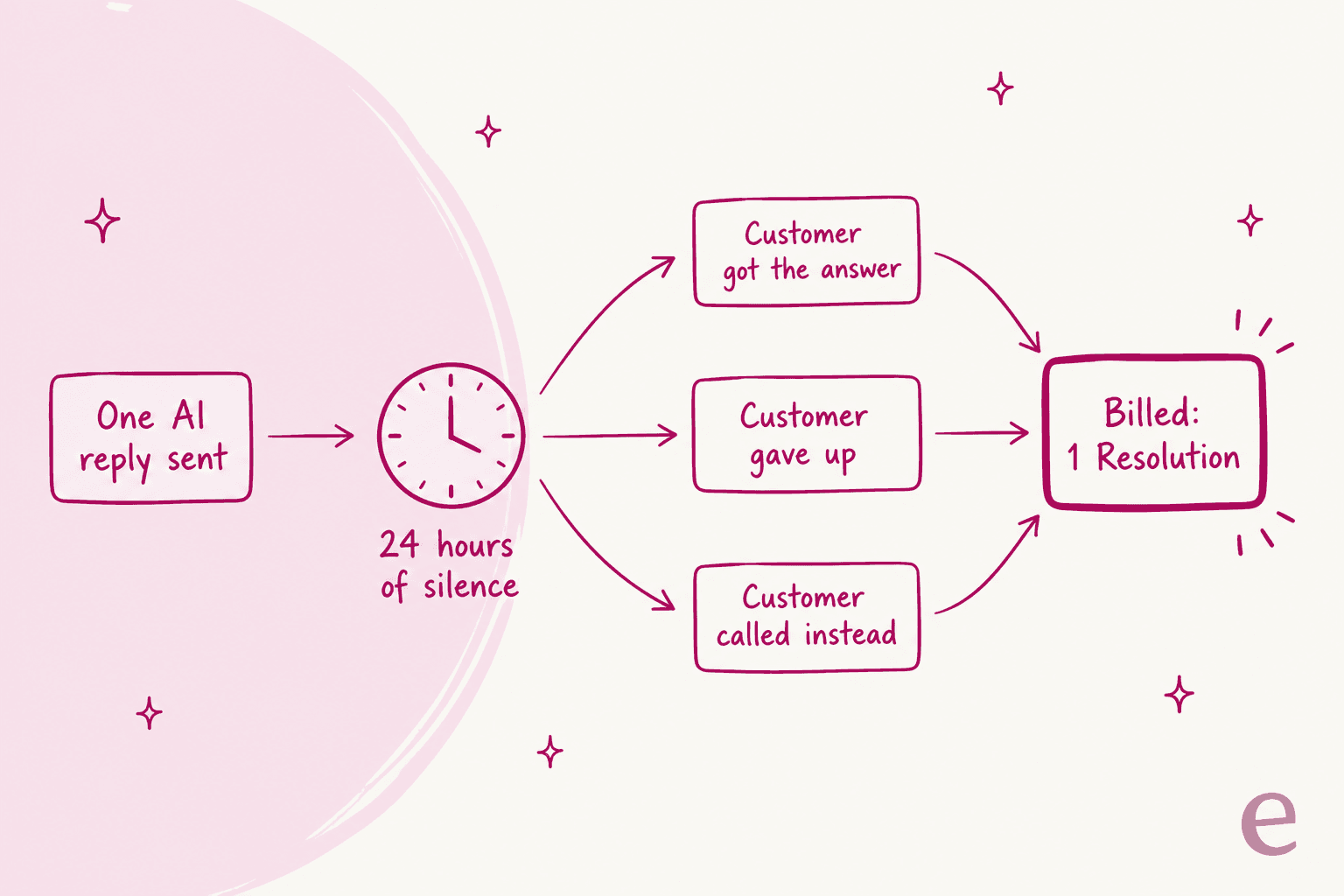
So three very different endings bill identically. The customer who got exactly the right answer and closed the tab. The customer who read a wrong answer and gave up. And the customer who abandoned the chat and called your phone line instead, which generates a second human-handled contact that you also paid for. All three are one resolution at $0.50.
I want to be fair on this, because it reads easily as a gotcha and it is not one. Silence is the only signal that a self-service widget reliably has. eGain is not hiding behind it either, they wrote the definition down and put it on the product page and into the FAQ, which is more than most vendors in this category will do. If you want to see the alternative, go looking for a published definition of a competitor's "resolution" and count how long it takes.
The problem is what a buyer assumes when reading the word. "Resolution" sounds like an outcome. It is a timeout. Model your bill on the assumption that you only pay when the AI succeeds and you will underestimate it by exactly whatever your failure rate is.
This is exactly the objection a CX lead at a 7,000-ticket-a-month DTC brand put to us on a call, and I have not heard it phrased better since:
"The AI will never be able to answer 100% of the questions, but if it tries and just answers 'sorry I don't know this,' I cannot go and check all my 7,000 tickets to see if the AI actually made a good answer, then the point is a little bit gone. I need an AI who is only handling the tickets that it's confident to handle and all the other ones, leave them alone."
His concern there was answer quality. It is also a pricing concern though, under any meter that fires on silence instead of success. A confident wrong answer produces the same 24 hours of quiet that a correct one does, and it bills the same. This is why we simulate every eesel rollout against a customer's historical tickets before it goes near live traffic. The failure rate becomes a number you saw, before it is a number you paid for.
The blocks are where the arithmetic changes
The $0.50 headline is not the way you buy. From the same page: resolutions are sold in blocks of 100 at $50 per block, per month. The FAQ adds three details that together matter more than the rate:
- Run out mid-month? "You will need to purchase additional Resolution blocks for that month."
- Refund for unused resolutions? "No."
- Costs beyond the per-resolution charge? "No."
That third answer is a good one and I will come back on it. The first two are the ones that reshape your bill.
Because blocks are monthly and prepaid and non-refundable, $0.50 is only what you pay when your volume lands exactly onto a multiple of 100. Every other month, you pay more than that. Plan for 1,000 conversations, buy 10 blocks for $500, and take 600: your effective rate is $0.83 per resolution, 67% above sticker. Undershoot in the other direction and you are topping up mid-month, at full price.
One of our own prospects, an email-security company on Freshdesk, burned through 200 interactions in a single day of testing and immediately started worrying about what that meant at scale. Under a block model that test day is two blocks gone, before you configured anything at all.
Plug your own numbers in:
The pattern the calculator makes obvious is that the meter works on both sides. Forecast high, you forfeit. Forecast low, you top up. That published $0.50 is the floor of a range and you only touch it by landing on a round hundred.
For comparison, here is a different shape. eesel's pricing is one fixed monthly price sized to volume, from $299 for 500 credits, where 1 credit is 1 ticket or chat handled. You pick a batch instead of sizing blocks of 100, and if you run out you can turn on overage with a monthly cap you set, at $0.80 per extra credit.
Per resolution or per user? There is a clean crossover
eGain sells AI Agent in two ways, $0.50 per resolution or $25 per user per month, and the page leaves that choice entirely with you. The arithmetic here is one division.
$25 divided by $0.50 is 50 resolutions.
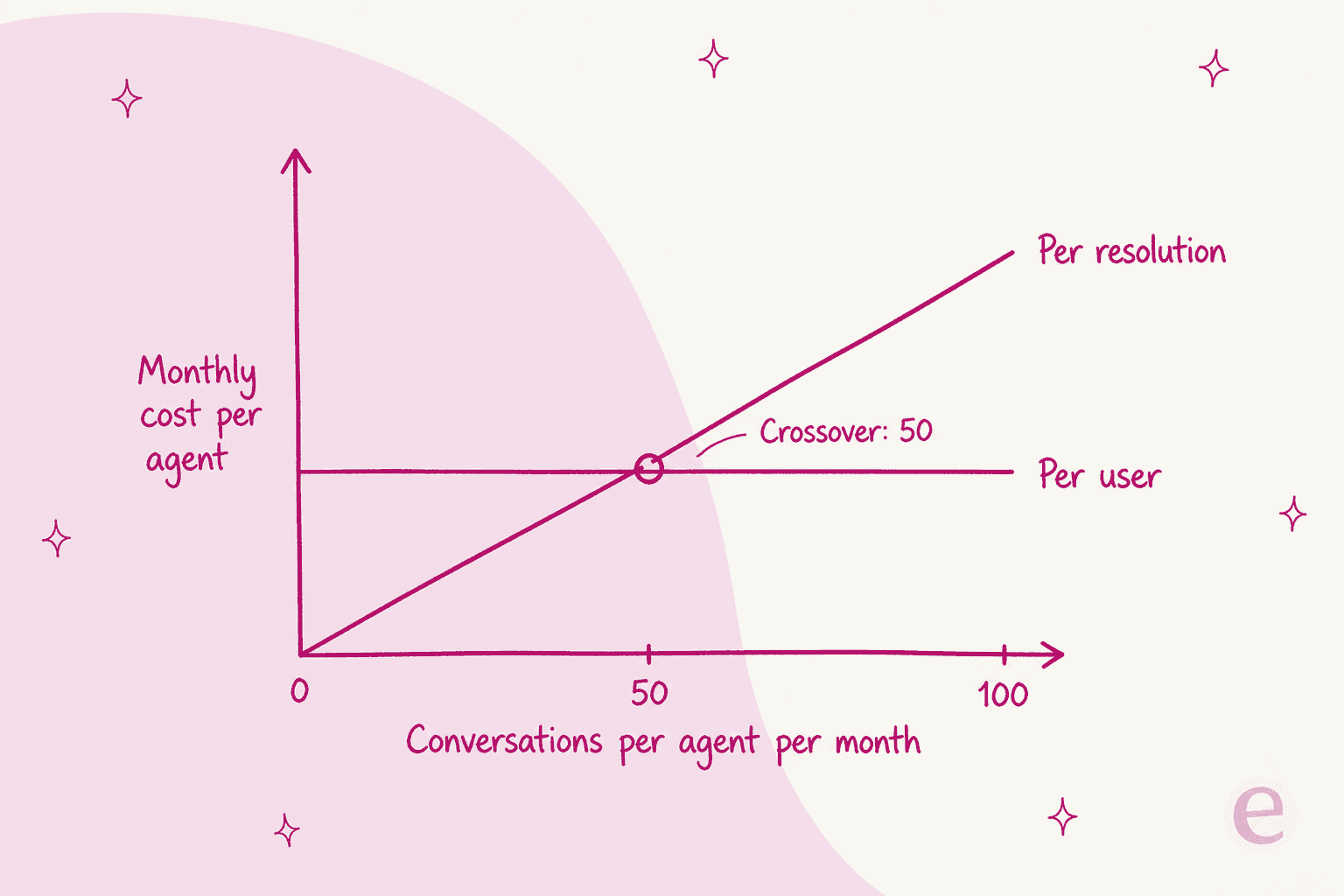
Above 50 AI-handled conversations per person per month the seat is cheaper. Below it, the meter is. And 50 is a low bar, an agent working full time on a normal queue clears that inside a fortnight, which means for contact centre work, eGain's own seat price beats its own headline per-resolution rate almost every time.
The two are not interchangeable though, and the split follows the product:
- AI Agent for Customer Self-Service faces your customers. There are no seats to count, so per-resolution is the only unit that makes sense.
- AI Agent for Contact Center guides your own staff in real time, closer to agent assist than to a chatbot. That is a seat-shaped product, and the $25 seat is where the money is.
Worth to flag: both product pages quote the same $0.50 and the same 100-blocks structure, so the per-resolution option gets offered even where the seat is obviously the better deal. Checking which side of 50 you sit on is a two-minute job, and plenty of buyers skip it.
What the self-serve AI Agent actually includes
The published feature set for AI Agent is short and it is specific, which I appreciate. From the product page:
- Five conversational AI agents
- 10 million characters per AI agent of content
- Content sources: docs (PDF, Word, HTML), websites, and the eGain Knowledge Portal
- Escalation to SMS, email, and phone, with no routing logic beyond the handoff itself, so AI escalation rules live wherever those channels land
- Analytics dashboards
- Technical support
Two of those are real ceilings that you should size against. Five agents and 10 million characters each is a fixed envelope rather than a per-plan slider, so a business with a dozen product lines that needs separate personas will bump into the agent count long before it bumps the character count.
The content sources line is the one I would be reading closest. Docs, websites, and eGain's own knowledge portal are the inputs. Past ticket history is not on the list. For a self-service widget that answers off published help content this is a reasonable scope, and it matches how most AI knowledge base products start out. It does mean the agent learns from what your team wrote for customers, not from how your team actually answered them, which is a different quality ceiling for any AI helpdesk chatbot.
That gap showed up hard on one of our own accounts. A support manager told us his entire knowledge base was written for administrators while every ticket came from end users, a straight audience mismatch that made published-content answers read as confusing no matter how good the retrieval was. His fix was to train on past tickets, because that is where the language customers actually use is living. It is also why we treat AI knowledge management and ticket history as two separate inputs rather than one.
On the self-serve product the trial is two weeks. Separately, eGain offers a no-cost 30-day guided pilot, "Innovation in 30 Days," run with its implementation team. If you are evaluating seriously then the pilot is the one to ask for. Two weeks of self-serve is thin for gathering enough volume to judge answer quality, especially against the self-service solutions you already have running.
Connectors, Evaluator, Composer: the lines that move the total
The AI Agent FAQ says there are no costs past the per-resolution charge, and for that standalone product it does appear to hold. The platform rate card is a different document though, and it carries three more lines.
Connectors at $249 a month
$249 a month is $2,988 a year. On a 25-seat Knowledge Hub deployment ($7,500 a year at list), that is a 40% uplift on your subscription for integration alone.
What it buys you is broad. eGain's April 2026 announcement split the family into four categories: Content Connectors (SharePoint, Confluence, CRM knowledge, conversation archives), Data Connectors, Experience Connectors (Salesforce and SAP desktops, Zendesk, Amazon Connect, Genesys, Talkdesk), and Process Connectors for identity, access rules, and policy. The same release added Model Context Protocol support and prebuilt connectors for Microsoft Copilot, Anthropic Claude, Google Gemini CLI, Cursor, Windsurf, VS Code, and Kiro.
What the pricing page does not say is whether the $249 is per connector or covers the lot. For a line item that can reach 40% of a mid-size subscription, that is the first question to put into writing. If you are already paying separately for Confluence AI or SharePoint access, worth checking what overlaps.
Evaluator is quote-only
Evaluator monitors knowledge accuracy, agent performance, and resolution quality. It is the only product on that rate card with no number against it, which is notable considering what it does: the tool that tells you whether your resolutions are any good is the one you cannot price without a call.
Under a meter that fires on 24 hours of silence, quality monitoring is not a nice-to-have. It is how you learn whether the resolutions you paid for were successes or abandonments. Putting it behind a quote makes the total cost of running eGain properly harder to model than those four published numbers would suggest.
Composer is free until it is not
Composer is free to build and test. eGain's own wording on what happens next: "When you move to production, pricing follows the underlying eGain products your app uses."
That is honest, and it is also unbounded. A Composer app that leans on AI Agent and on Connectors will inherit both meters. Free to prototype, then priced by whatever you wired it into, which is fine so long as you know it going in.
eGain pricing at real volumes
Here is what the published rates come to, using block rounding on the resolution meter and eesel's Teammate plan sized to the same volume (1 credit per ticket or chat).
| Monthly AI conversations | eGain blocks needed | eGain cost | Effective rate | Same volume on an eesel plan |
|---|---|---|---|---|
| 250 | 3 | $150 | $0.60 | $299 (500 credits) |
| 500 | 5 | $250 | $0.50 | $299 (500 credits) |
| 1,000 | 10 | $500 | $0.50 | $499 (1,000 credits) |
| 2,500 | 25 | $1,250 | $0.50 | $999 (2,500 credits) |
| 7,000 | 70 | $3,500 | $0.50 | Talk to us |
| 150,000 | 1,500 | $75,000 | $0.50 | Talk to us |
Two things to take from it. The rounding penalty only bites down at the small end, where 250 conversations costs $0.60 each because you cannot buy two and a half blocks. And the comparison flips with volume: at 250 conversations eGain's single small block is cheaper than a fixed eesel plan, the two land about even at 1,000, and from 2,500 a fixed plan comes in lower.
The 7,000 row is a real customer profile, a DTC brand running Gorgias whose team could not keep up with volume. The 150,000 row is also real, a multi-brand e-commerce operator scaling towards that number. Both of them are the volumes where the unit definition stops being pedantic and becomes a budget line.
For context against the rest of the market, the published per-resolution rates I can verify:
| Vendor | Published AI rate | Unit |
|---|---|---|
| eGain | $0.50 | Conversation followed by 24h silence |
| eesel | $0.38 to $0.60 | Credit (1 ticket or chat), fixed monthly plan |
| Crescendo | $1.25 | Per solve, plus a monthly floor |
| Zendesk | $1.50 to $2.00 | Automated resolution |
| Agentforce | $2.00 | Per conversation |
eGain has the cheapest published per-resolution rate among the per-resolution vendors on that list, and it is not close. eesel is priced as a monthly plan, so its per-credit cost depends on the batch you pick: about $0.60 per credit on the 500-credit plan ($299), falling to about $0.38 on the 5,000-credit plan ($1,899). At small volumes that is a real point in eGain's favour and I would not want the definition discussion to bury it.
It also narrows your shortlist on its own. Quote-gated vendors like Decagon and Sierra will not name a number before a call, and the same holds for Aisera.
Seat-priced suites are a different comparison again. In Kustomer and Help Scout, the AI line is bundled into a tier rather than metered separately, and Forethought now sits inside Zendesk. Neither shape gives you a per-conversation rate to model against eGain's.
Why "suggested list prices" is the most important footnote
That footnote at the bottom of the rate card is not boilerplate, and eGain's own filings show why.
In Q2 FY2026 results, eGain reported total revenue of $23.0 million and AI Knowledge Hub ARR of $48.4 million, up 27% year over year and 64% of total SaaS ARR. In the same release, CEO Ashu Roy named a new win: Achmea, a European insurance group, selecting eGain to support 21,000 users.
Run that at list. 21,000 users at $25 a month is $6.3 million a year, or 13% of the entire AI Knowledge Hub ARR from one customer. Possible. It would also be an extraordinary single deal for a company holding $48.4 million in product ARR. The more ordinary explanation is the one that footnote already told you, which is that at that seat count $25 is not the number anyone pays.
This is not a criticism, it is just how enterprise software works. eGain's own risk disclosures flag reliance on a relatively small number of customers for a substantial portion of revenue, which is the signature of large negotiated contracts. The practical takeaway for you: the published rate card is the ceiling for small buyers and the opening position for large ones. If you are bringing hundreds of seats, the list price is where the conversation starts.
One of our prospects had learned the same lesson from the other direction. A budget-conscious buyer told us on a call that a previous vendor's price had "more than doubled" on them, and they wanted a contractual price lock, offering to pay annually to get one. On a negotiated enterprise agreement, that ask matters more than the sticker.
What buyers cannot check about eGain pricing
One real limit worth to name here. When I went looking for other buyers' experience of the per-resolution meter, there was close to nothing to find.
The G2 listing for eGain Knowledge Hub is no longer live. The Capterra profile 404s. Reddit results for eGain are almost entirely press releases reposted by automated feeds in subreddits like r/Quantisnow and r/SECFilingsAI, not operators comparing bills. The customer voices on the pricing story are the three unnamed testimonials on eGain's own page, one of which does speak directly to it:
"Pricing per resolution really works for us. We are enhancing our agent with knowledge base content."
That is a real quote from a real customer, and eGain describes them only as a "Field Service Organization." It is a positive signal. It is also unverifiable, and it is the nearest thing to independent commentary on this meter that exists anywhere.
So the sourcing position is unusual: eGain's published documentation is better than most of this market, and its community footprint is thinner. You can read the definition, which is more than the competitors will let you do. What you cannot do is sanity-check your projected bill against somebody else's actual one. For a meter as definition-dependent as this, that is worth knowing before you sign, and it makes the 30-day guided pilot the load-bearing part of your evaluation rather than a formality.
Who eGain pricing fits
eGain is 25 years into knowledge management, sells to Global 2000 enterprises, and was named a Leader in the first Gartner Magic Quadrant for Customer Service Knowledge Management Systems. The pricing is shaped around that buyer, and the shape tells you who it suits.
A good fit if:
- Your problem is knowledge chaos across SharePoint, CRM, and intranets before it is ticket automation. That is what Knowledge Hub is built for, and it is eGain's strongest ground.
- You need one governed knowledge layer feeding several AI surfaces, including Copilot, Claude, and Gemini. The connector architecture is unusually broad and the MCP support is real.
- You are large enough to negotiate. At hundreds or thousands of seats, list price is a starting point and the guided pilot is free.
- Compliance and auditability are procurement gates. Process Connectors and Evaluator exist specifically for that, even if Evaluator is quote-only.
Look harder if:
- You want AI trained on how your team has actually answered tickets. Published content, websites, and the knowledge portal are the inputs; ticket history is not one of them.
- You are a small team. The $50 block floor is low, but the enterprise shape of Knowledge Hub, the unpublished seat minimum, and the quote-gated Evaluator all point away from a 10-person support desk.
- You need a bill you can forecast to the dollar. Prepaid non-refundable blocks plus a silence-triggered meter is forecastable, but only after you have measured your own abandonment rate.
- You want to prove it on your own history before go-live. The two-week self-serve trial and a pilot on scenarios are not the same thing as a dry run over your past tickets.
That last one is the difference I would be weighing hardest, and it is also where I would put my own product forward.
Where eesel fits if eGain is on your shortlist
Full disclosure, I work on eesel, so read this as the vendor's own comparison and not a neutral one. Here is what actually differs, put into the language of this post.
eesel is an AI teammate platform, and what you hire is a ready-to-work teammate for a specific job. For anyone comparing eGain, that job is the AI helpdesk teammate: it joins the queue you already run, on the helpdesk you already have, and works tickets alongside your team. On pricing, three concrete differences:
The unit is work done, not silence observed. eesel uses 1 credit per ticket or chat session that it handled, no matter how many messages went back and forth inside of it. A ticket handled is a ticket handled. There is no 24-hour timer deciding if the meter fires, so the credits you use map onto work you can point at.
One fixed monthly price, everything included. You pick a batch of credits (500 for $299 a month, 1,000 for $499, up to 5,000 for $1,899), with no blocks of 100 to size and no top-ups mid-month. Unused credits do not roll over, so pick the batch with some headroom, and you can move up or down any time. If you run out, you can turn on overage with a monthly cap you set ($0.80 per extra credit). There is no platform fee and no seat fee at all, and paying a year upfront gets you two months free.
It trains on your past tickets, and you can watch it work before it goes live. This is the one I would actually argue over. We have watched a confident-sounding bot quietly hand out wrong answers, and that is why every eesel rollout simulates against a customer's historical tickets first. You see the answers it would have sent, on your real traffic, before any customer sees one. Under any meter that bills on silence, knowing your failure rate in advance is the whole difference between a forecast and a guess.
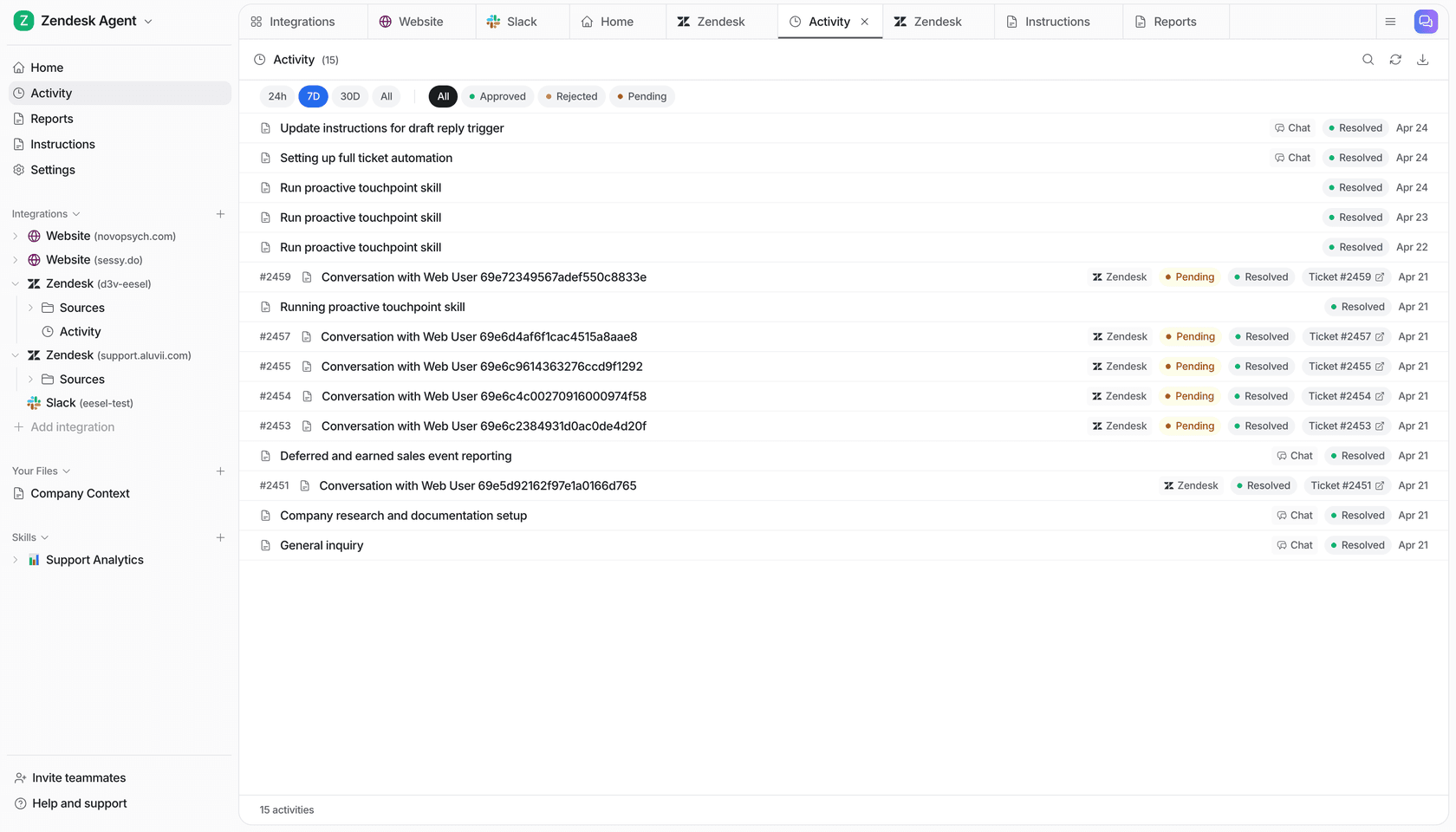
If you are shopping this category and want to size a bill without a sales call, eesel has a free plan with 100 credits, every feature included and no credit card. Try eesel, connect your helpdesk, and run it over your own past tickets to see what it would have resolved. If you would rather see it on your data with someone walking you through it, book a demo.
For the wider field, our roundup of the best AI helpdesk software covers the alternatives in more depth, and best AI teammates is the closest comparison set to eGain's own positioning.
If you are still deciding what shape of product you want, AI teammates explains the category, and the best AI agents covers the broader agent market outside support.
The short version
eGain pricing is more transparent than most of this market, and more conditional than the rate card lets on. Four numbers are published and one is not, and the thing that decides your bill is a definition rather than a price.
The rate itself is good. $0.50 per resolution is the cheapest published rate among the mainstream vendors, and eGain writing down what a resolution means is a real courtesy to a buyer. So read the definition and measure your own abandonment rate against it. Get the Connectors line priced in writing, ask what Evaluator costs, and take the 30-day guided pilot instead of the two-week trial. Do that much and eGain pricing becomes knowable, which is more than you can say for half the vendors on your shortlist.
Then go and check which side of 50 conversations per agent you land on, because eGain's own seat price may well be cheaper than its own headline meter.