The 10 best eGain alternatives in 2026, compared on what you actually pay

Kira

Katelin Teen
Last edited October 14, 2026
The one thing to check before you compare anything else
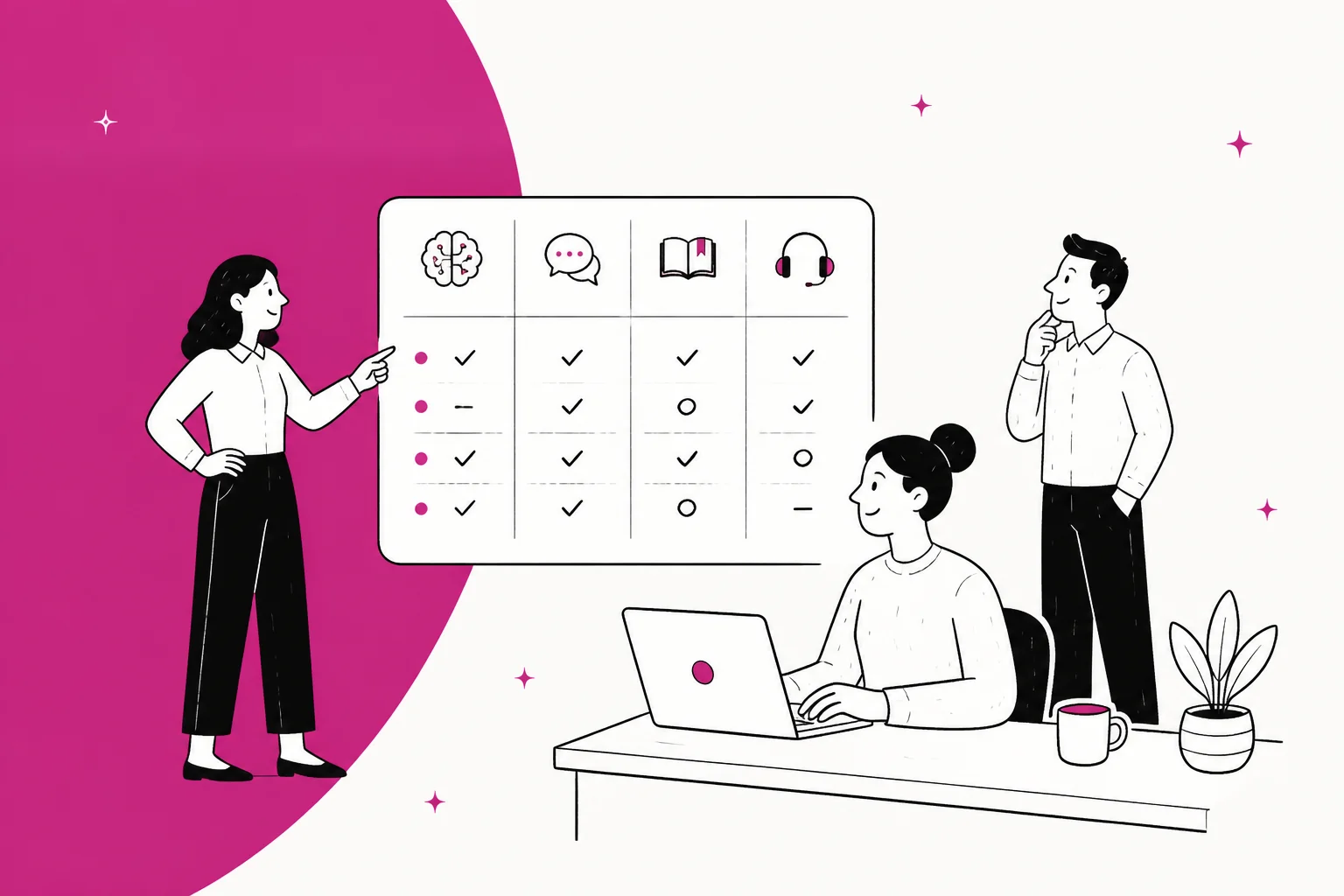
I build AI agents at eesel, and the question I get asked least often is the one that decides the invoice: what does this vendor count as one billable thing?
Every vendor on this list will quote you a rate. Almost none of them are counting the same event. eGain's meter fires when a conversation goes quiet for a day. Zendesk's fires only after an LLM checks whether the request was actually resolved. Freshdesk counts a 72-hour email window. Agentforce counts an action, or a conversation, depending on which billing model your org is on. eesel counts a ticket handled.
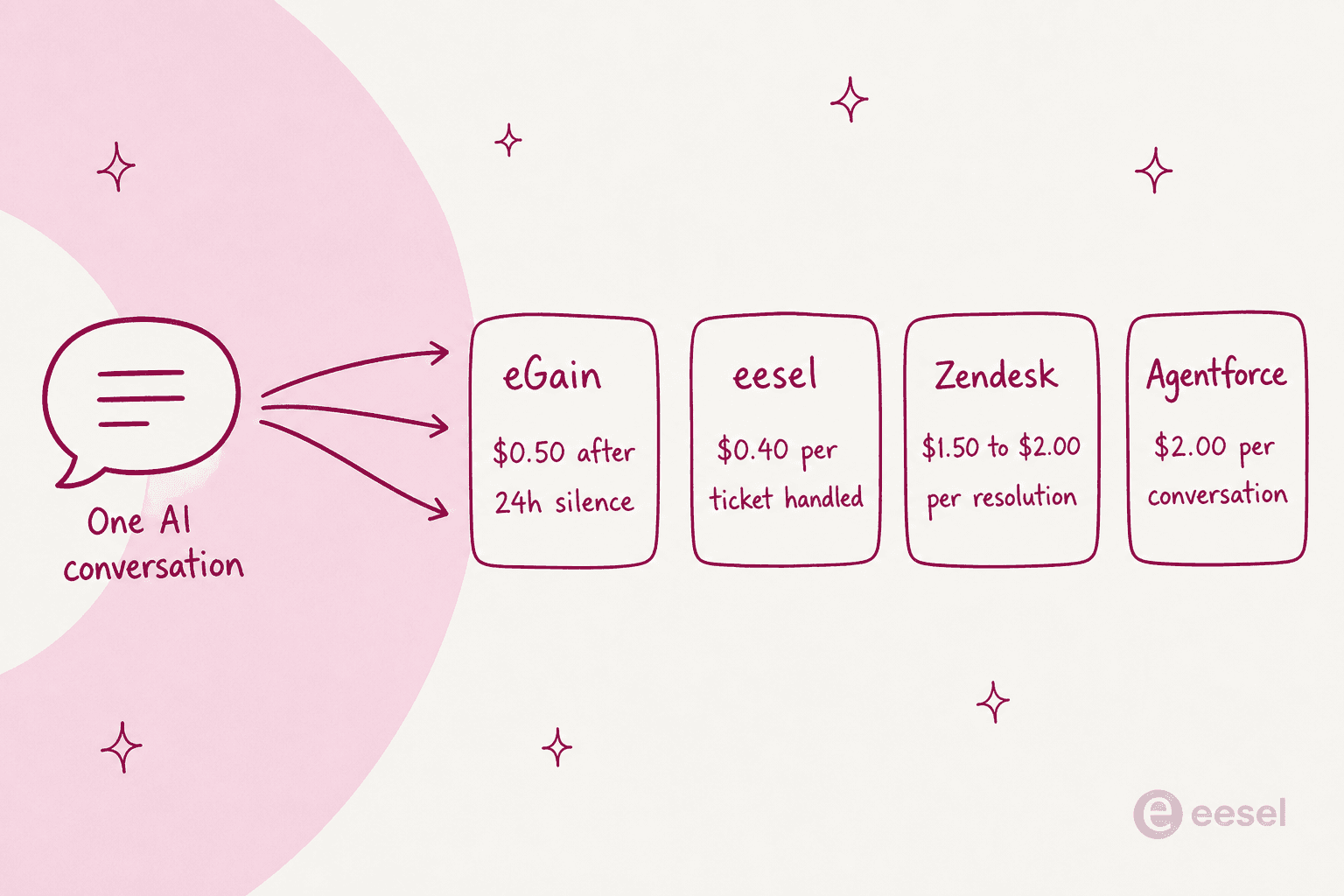
Here is why that matters more than the rate. On one of our own sales calls, a multi-company e-commerce operator scaling toward roughly 150,000 tickets a month started modelling his bill mid-conversation, mixed up per-interaction with per-ticket, and landed on about $30,000 a month before anyone could stop him. Same product, same published rate, wildly different number. The unit did all the work.
Decagon, a competitor on this list, says the quiet part out loud on its own pricing blog:
"You'll get into situations where a user is upset, leaves, and that gets counted as a resolution. You never want to be in a situation where you're arguing over what a 'resolution' is."
That is a vendor explaining why it avoids outcome billing. It also describes exactly what a silence-triggered meter does. So before you compare a single price below, write down your own monthly volume, your abandonment rate, and your spam rate, because those three numbers convert a rate card into a bill.
What eGain is actually good at
Being fair here matters, because a lot of "alternatives" posts skip it and the whole page reads as motivated.
eGain publishes more of its rate card than most of its competitors do. It also publishes the definition of its billable unit on its own AI Agent product page, which is rarer than it should be. Go and try to find a comparably precise definition from a quote-gated vendor and count how long it takes.
The knowledge product is the real asset. AI Knowledge Hub unifies content across SharePoint, CRM knowledge, product docs, policies, and intranets into one governed layer, which is the foundation any helpdesk AI sits on. eGain reports AI Knowledge Hub ARR of $48.4 million in its Q2 FY2026 results, up 27% year over year and 64% of total SaaS ARR. Its reference deployment is BT, running knowledge across 25 million customer conversations a year.
At $0.50, eGain holds the cheapest published per-resolution rate among the mainstream helpdesk AI vendors. Nothing below undercuts it on that specific meter except eesel's largest batches, at about $0.38 a credit on the 5,000-credit plan, and most of the field is two to four times higher.
So why do teams leave
Three concrete things, none of them about quality.
The meter fires on silence. A Resolution is a conversation followed by 24 hours of quiet, where the AI replied at least once after a non-trivial customer message. Three very different endings bill identically: the customer who got the right answer, the customer who got a wrong one and gave up, and the customer who abandoned chat and phoned you instead. All three are one resolution.
This gets sharper when you look at your own inbox composition. On a customer trial we ran on live Zendesk traffic for a German online jewelry retailer doing about 1,000 tickets a month, 22% of the inbox was spam. Our triage caught it at 100% with zero false positives. Under a silence-based meter, a spam message the AI politely answers once and nobody follows up on is, by definition, a billable resolution.
The blocks. Resolutions are sold in prepaid packs of 100 at $50, monthly, and unused ones are not refunded. Plan for 1,000, use 600, and your effective rate is $0.83, which is 67% above sticker. A US swimwear brand on Gorgias ran 12 successful test chats with us, liked the agent, then opened two cancel requests the moment they hit the billing page. The product was fine. The pricing shape lost the account.
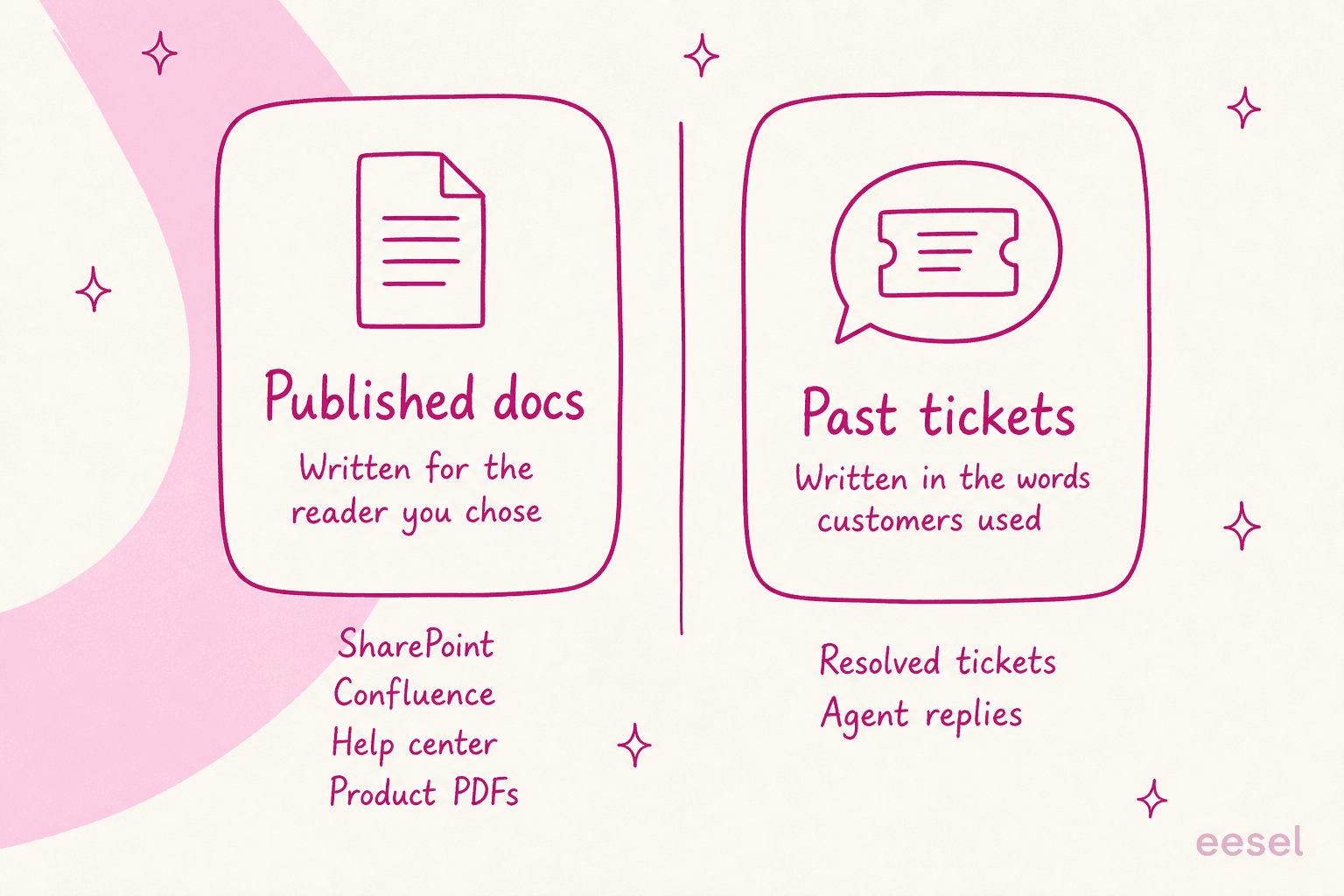
The sources. eGain's published content inputs for AI Agent are docs (PDF, Word, HTML), websites, and the eGain Knowledge Portal. Past ticket history is not on the list.
My colleague Amogh, who sits on most of our demo calls, put it plainly in a call note after yet another prospect asked for it:
"Also - past ticket training strikes again. Classic. People really, really, really want to train on past tickets."
The reason is not fashion. One support team we work with, a bus-tracking transit-tech company on Zendesk doing 200 to 250 tickets a month, had a knowledge base written entirely for administrators while every incoming ticket came from end-user riders. Retrieval worked fine. The answers still read wrong, because the source material was addressed to the wrong person. That is a gap no amount of knowledge base management fixes if tickets are off the input list.
One more honest limit worth naming: eGain's community footprint is thin. Its G2 listing is no longer live and the Capterra profile 404s, so you cannot sanity-check your projected bill against somebody else's actual one. That makes the free 30-day guided pilot the load-bearing part of your evaluation rather than a formality.
Which eGain alternative fits you
Pick the sentence that sounds most like your situation.
What is actually driving the switch?
Four common reasons, and where each one lands. Pick one.
You are replacing the knowledge layer, not the agent
GuruShelfStonly
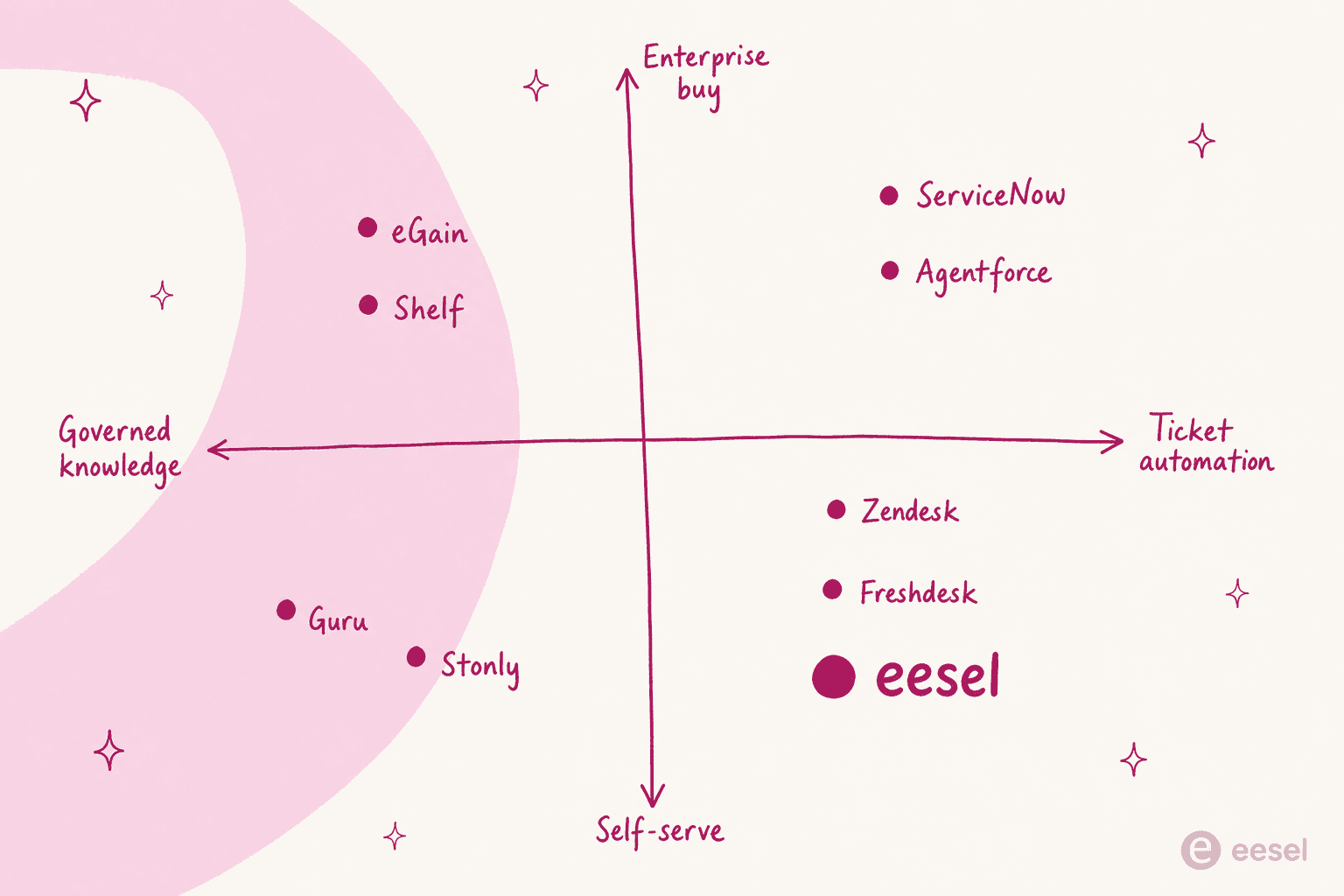
Guru governs internal knowledge and feeds cited answers into Slack, Teams, and via MCP into ChatGPT and Claude. Shelf is the one that actively hunts redundant, obsolete and trivial content so your AI stops quoting a 2023 refund policy. Stonly is the pick if your answers are really procedures, since it authors branching guides rather than articles. All three are quote-only.
You want ticket work done, and billed on work done
eeselZendeskFreshdesk
eesel sells a fixed monthly credit plan (1 credit per ticket or chat session handled, from $299 for 500 credits), trains on your past tickets, and replays them in a simulation before go-live. Zendesk only bills a resolution its own LLM verifies, which is the most buyer-friendly definition in this list. Freshdesk is the cheapest of the three to start on at $19 a seat with the first 500 AI sessions free.
You are shopping on published, checkable prices
Zoho DeskeeselFreshdesk
Zoho Desk is the cheapest published seat at $7 per user per month and gives the AI agents away, charging only for LLM tokens after 30 million free per month. eesel has no seat fee and one fixed monthly price, so the bill is the same in a quiet month as a busy one. Freshdesk sits between them at $19 with a $49 per 100 AI sessions meter.
Platform-native beats best-of-breed here
AgentforceServiceNow
Agentforce grounds its agents in your CRM data and bills either $0.10 per action on Flex Credits or $2.00 per conversation, and you cannot run both models in one org. ServiceNow prices per fulfiller seat by quote, and the autonomous ticket-closing agents sit on the Prime tier only. Both are enterprise buys with enterprise timelines.
The 10 best eGain alternatives, compared
Every price below is the vendor's own published figure, checked on 2026-09-01. Where a vendor publishes nothing, the table says so rather than guessing.
| Tool | Best for | Entry seat price | AI billing unit | Published AI rate | Trains on past tickets | Free trial | Rate card published |
|---|---|---|---|---|---|---|---|
| eesel | Ticket work, priced on work done | No seat fee | Ticket or chat session handled | From $299/mo (500 credits) | Yes | 100 free credits, no card | Yes |
| Guru | Governed internal knowledge | Not published | Not published | Not published | No | No | No |
| Shelf | Cleaning up knowledge rot | Not published | Not published | Not published | No | No | No |
| Stonly | Branching guided self-service | Not published | Guide views | Not published | No | 14 days | Partial |
| Zendesk | AI inside the helpdesk you run | $19 | LLM-verified automated resolution | $1.50 to $2.00 | No | Yes | Yes |
| Freshdesk | Mid-market budget with AI | $19 | 72-hour AI session | $49 per 100 sessions | No | 14 days | Yes |
| Zoho Desk | Cheapest published seats | $7 | LLM tokens | $1 per 1M tokens | No | 15 days | Yes |
| Agentforce | Salesforce-native shops | $5 plus credits | Action, or conversation | $0.10 or $2.00 | No | Foundations is free | Yes |
| ServiceNow | Enterprise IT service desks | Quote only | Assist | Not published | No | No | No |
| Decagon | AI-native CX with heavy QA | Quote only | Conversation, or resolution | Not published | No | No | No |
| eGain (incumbent) | Governed enterprise knowledge | $25 | Conversation plus 24h silence | $0.50 | No | 14 days plus 30-day pilot | Yes |
Two patterns fall out of that table. Only five of eleven publish a real rate card, which makes eGain's transparency a genuine differentiator rather than a footnote. And exactly one row says yes in the past-tickets column, which is the single sharpest split in the whole category.
Every item below follows the same shape: what it is, where it wins, where it does not, what it costs, and my take.
1. eesel
Best for: teams leaving eGain because of the meter, the blocks, or the sources.
Full disclosure, I work on eesel, so read this as the vendor's own entry and weigh it accordingly. Here is what actually differs, in this post's language.
eesel is an AI teammate platform, and what you hire is a ready-to-work teammate for a defined job. For anyone comparing eGain, that job is the AI helpdesk teammate: it joins the queue you already run, on the helpdesk you already have, and works tickets alongside your team.
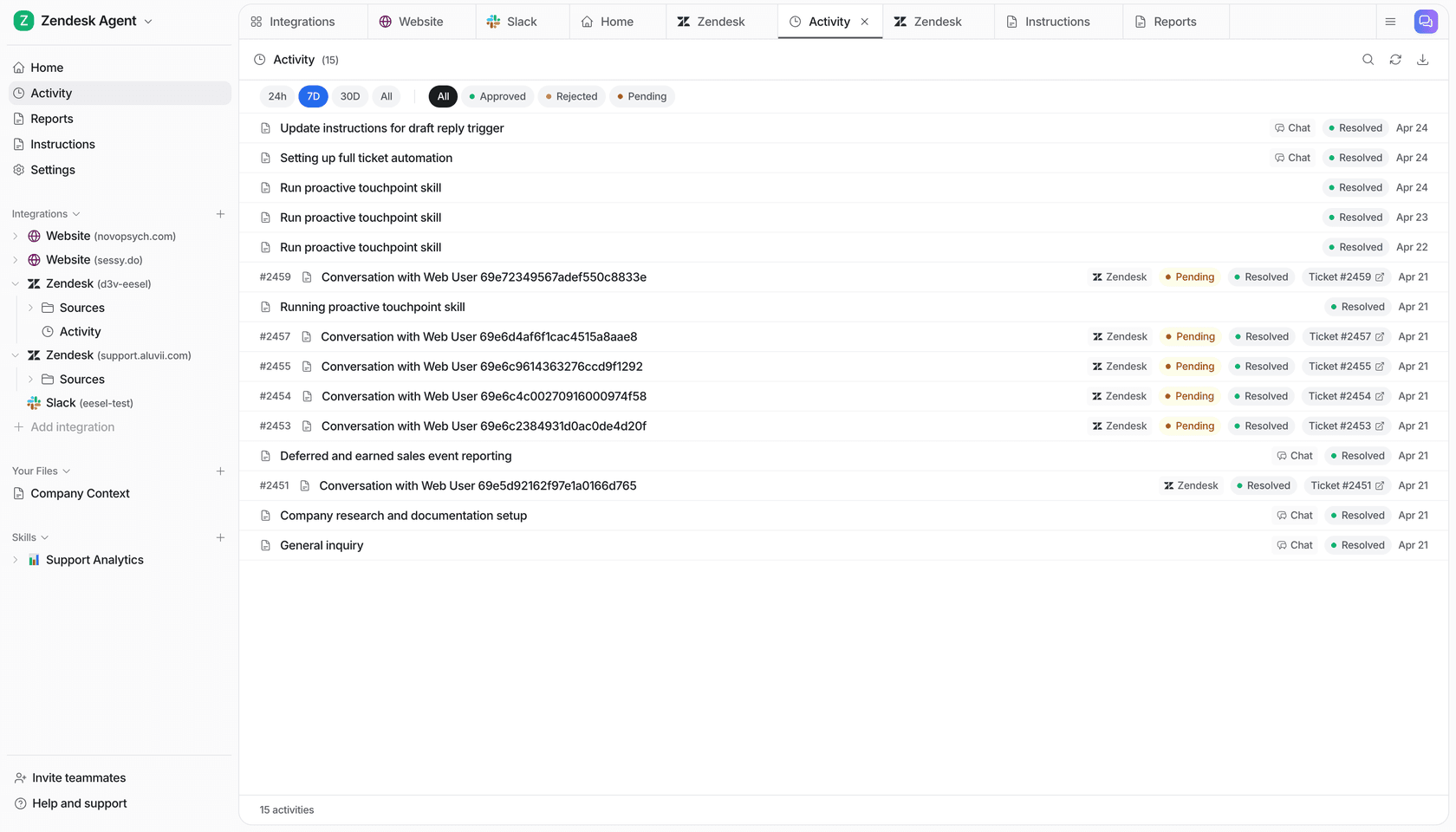
Where it wins. The unit is work done rather than silence observed. One ticket or chat session equals one task no matter how many messages went back and forth, so there is no 24-hour timer deciding whether the meter fires. You pick one fixed monthly credit batch, and if you run out you can turn on overage with a monthly cap you set, at $0.80 per extra credit. Unused credits do not roll over.
The bigger one is the dry run. We have watched a confident-sounding bot quietly hand wrong answers to real customers, including a Danish solar-energy provider whose agent invented subscription claims when its knowledge base had no match. That is why every eesel rollout simulates against a customer's historical tickets first. You see the answers it would have sent, on your real traffic, before a customer sees one. On the jewelry-retailer trial mentioned earlier, that dry run produced 93% triage accuracy and 100% spam detection as a number we saw, not a number we paid for.
Where it does not. eesel is not an enterprise knowledge governance suite. If your actual problem is 25 years of contradictory policy content across SharePoint and a compliance team that wants approval workflows on every article, eGain and Guru are built for that and eesel is not. SOC 2 Type II is certified, and HIPAA is available on request.
Pricing.
| Monthly credits | Price | Notes |
|---|---|---|
| 100 | Free | every feature, no card |
| 500 | $299 per month | 1 credit = one ticket or chat session, not per reply |
| 1,000 | $499 per month | same |
| 2,500 | $999 per month | same |
| 5,000 | $1,899 per month | more than 5,000: talk to us |
| Line | Price | Unit |
|---|---|---|
| Blog post draft | $4.00 | per generation |
| Platform and seat fees | $0 | none |
| Overage (optional, with a cap you set) | $0.80 | per extra credit |
| Pay a year upfront | Two months free | annual billing |
| Add-ons | From $199 per month | SSO and MFA; priority support from $299 per month; data residency $500 per month |
Dashboard questions are mostly free, and every feature is unlocked on the free plan with no credit card.
My take. If you are switching because of how eGain counts, this is the direct answer, and the simulation is the part I would actually argue over. If you are switching because your knowledge itself is a mess, fix that first with one of the next three and come back.
2. Guru
Best for: an internal knowledge layer that governs what every other AI tool retrieves.
Guru is the closest philosophical match to eGain's Knowledge Hub. It indexes more than 100 enterprise sources into one retrieval index and serves cited, permission-aware answers, positioning itself as the governed layer underneath whatever AI you already run.
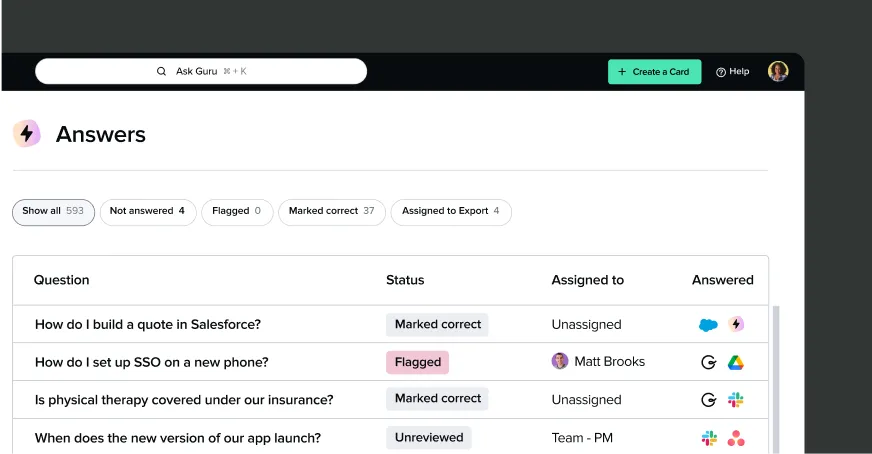
Where it wins. Knowledge Agents synthesise answers with an Answer Details lineage view, so a reader can see which source produced which sentence. Guru auto-generates documentation from conversations, meetings and tickets and routes drafts to subject matter experts for review, and claims automated verification handles roughly 80 to 90% of content upkeep. It ships an MCP server, so ChatGPT and Claude can query your governed knowledge directly. The review footprint is substantial at 4.7 out of 5 across 2,322 reviews on G2, and more than 10,000 companies use it.
Where it does not. Guru is internal-facing. It is not a customer-facing deflection bot, so it replaces half of eGain rather than all of it. Pricing has gone fully quote-only: the live page carries no tier names and no dollar figures, only "Book a call". There is no self-serve signup.
Pricing. Not published. Guru's own page frames it as "a platform and expertise solution, not just a per-seat tool", scoped per organisation.
My take. Pick Guru if your blocker is that nobody trusts the answer, not that nobody is answering. Pair it with a ticket-working agent rather than expecting it to be one. Our Guru alternatives roundup covers the near neighbours, and Guru vs Confluence is the comparison most teams run next.
3. Shelf
Best for: contact centres whose AI keeps quoting content that should have been retired.
Shelf has rebranded around ShelfOS and an AI Data Model, but the differentiated capability underneath is still content governance: continuously scanning repositories and flagging redundant, obsolete and trivial content before it poisons a GenAI answer.
Where it wins. Shelf is deliberately agnostic to whichever agent-assist, copilot or bot you run, so it slots underneath an existing stack rather than replacing it. Always-on ROT detection is the specific thing eGain's Evaluator is closest to, except Evaluator is the one product on eGain's rate card with no published price either. Shelf also ships Answer Assist for real-time agent guidance. Its named proof point is concrete: Mark Comber, Quality Manager at Intrum, reports a "25% reduction in average handle time in the first three months" on Shelf's own contact centre page.
Where it does not. Enterprise sales motion only, with no self-serve signup or trial anywhere on the live site. The single public number is a marketplace line item for one component, not the platform.
Pricing. Quote only on shelf.io. The Salesforce AppExchange listing shows $5 per user per month for the Salesforce Integration component, on a one-year contract with annual payment and a 25-user minimum, and the listing itself notes a separate core subscription is required.
My take. If you already know your content is the problem, Shelf is aimed squarely at that and eGain's equivalent is quote-gated too. Read our Shelf alternatives piece before you commit, and Shelf pricing for what buyers have reported paying.
4. Stonly
Best for: support content that is really a procedure with branches, not an article.
Stonly took a different bet from everyone else here. Its native format is the interactive, branching step-by-step guide rather than the knowledge article, and its AI layer sits on top of that structure.
Where it wins. Because the content is already a decision tree, the AI has structure to reason over rather than prose to summarise. AI Answers grounds responses in that structured content, Guided Answers detects intent and surfaces the right guide, and Business Process Agents automate multi-step resolutions end to end. Knowledge Agents run in the background drafting updates. Compliance is solid for the size: SOC 2 Type II, GDPR, and HIPAA. Metering is on guide views rather than seats, which is unusual and friendly to small teams.
Where it does not. The AI agents and every helpdesk integration (Salesforce, Zendesk, Freshdesk, Front) are Enterprise-only, so the tier that competes with eGain is the tier without a price on it. The published plan comparison shows features but no dollar amounts anywhere.
Pricing.
| Plan | Price | Notes |
|---|---|---|
| Basic | Free | 400 guide views a month, 5 published guides, 1 team member |
| Small Business | Not published | 14-day trial, 4,000 guide views, 5 team members |
| Enterprise | Not published | adds AI agents, helpdesk integrations, SSO, unlimited views |
Worth knowing: the trial auto-downgrades to the free Basic plan and keeps the guides you built, which is a nicer landing than most.
My take. Narrower than eGain by design, and better than it at the specific job of walking someone through a branching process. If your top ticket drivers are "how do I do X" rather than "what is your policy on Y", start here. It pairs well with a self-service strategy that is more workflow than library.
5. Zendesk
Best for: putting the AI inside the helpdesk your team already lives in.
Zendesk is the default comparison for almost every AI support purchase, and its AI billing has quietly become the most buyer-friendly definition on this page.
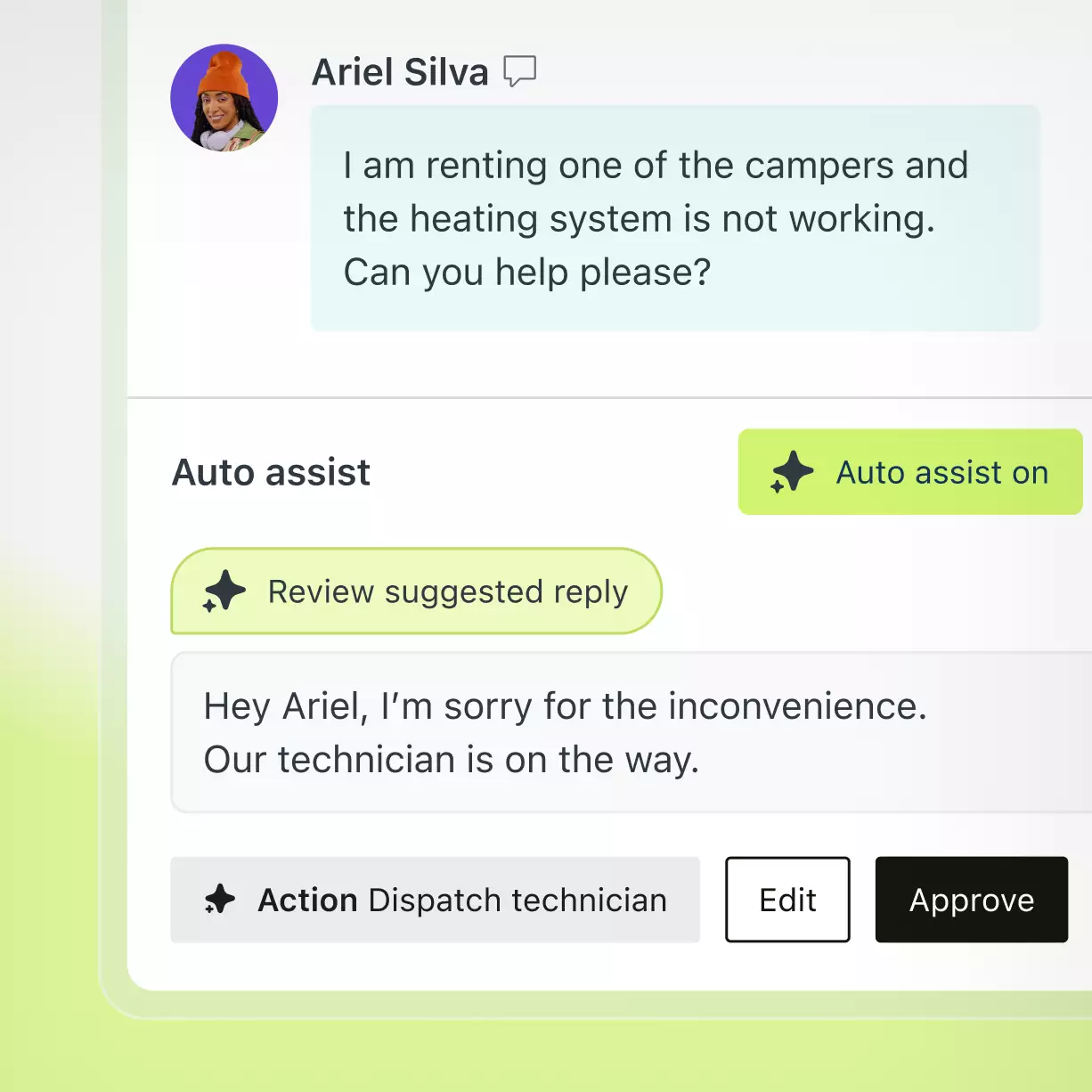
Where it wins. This is the direct answer to eGain's silence timer. Since automated resolution tiers landed in May 2026, Zendesk waits 72 hours for no follow-up and then has an LLM check whether the request was actually resolved. Only a pass is billable. An assisted escalation, where a human finished the job, does not bill. A contained resolution that fails the check does not bill either. Zendesk charges three to four times eGain's rate, and is the only vendor here that checks the outcome before charging you for it. The AI agents are built from natural-language procedures in a no-code builder and speak 80-plus languages.
Where it does not. The rate is high, and the included allowance is thin: 5 automated resolutions per agent per month on Support Team and Suite Team, 10 on Suite Professional. Copilot only attaches to Suite Professional and above at $50 per agent per month paid yearly, and its writing and summary tools are capped at 5 uses per agent per month with a hard ceiling of 500 per instance regardless of how many agents you have.
Pricing.
| Plan | Annual, per agent per month | Monthly |
|---|---|---|
| Support Team | $19 | $25 |
| Suite Team | $55 | $69 |
| Suite Professional | $115 | $149 |
| Suite Enterprise plus Copilot | Talk to sales | Talk to sales |
| Automated resolutions | $1.50 committed, $2.00 pay-as-you-go | flat across all priced tiers |
| Copilot add-on | $50 per agent per month | Suite Professional and above |
My take. If you are already on Zendesk, the verified-resolution meter is worth paying more per unit for, because you are buying a definition you can defend in a budget review. If you are not, the seat cost plus the AI cost stacks fast. Our Zendesk pricing breakdown has the full arithmetic, and eesel vs Zendesk AI is the head-to-head. eesel also connects to Zendesk directly if you want to keep the helpdesk and change the agent.
6. Freshdesk
Best for: mid-market teams who want AI deflection without an enterprise procurement cycle.
Freshdesk is the pragmatic middle of this list: real published pricing, a no-code agent builder, and a session meter that is generous inside a conversation.
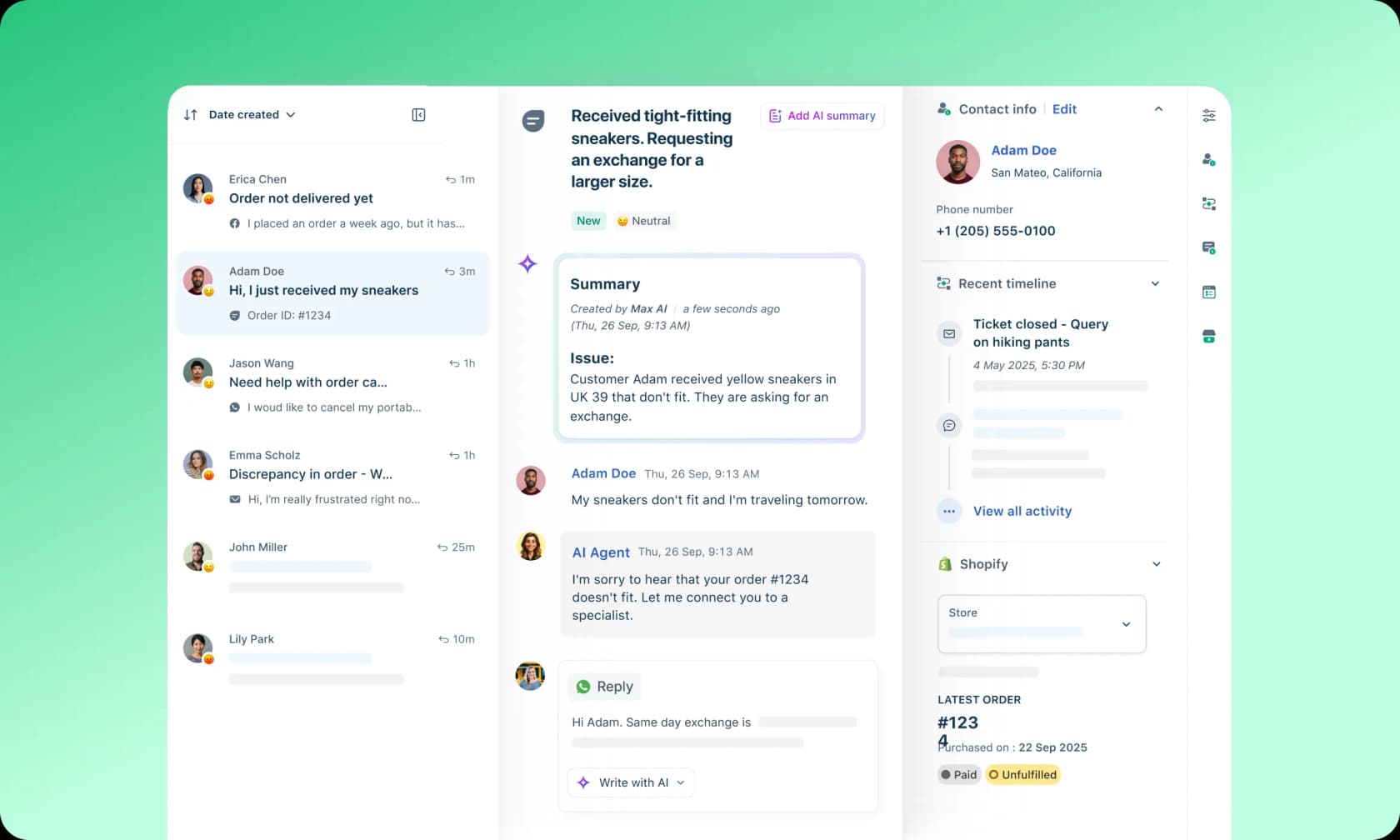
Where it wins. Freddy AI Agent is available on every tier including the $19 Growth plan, with the first 500 sessions free once per account, which is a real runway for testing. The email agent is the interesting piece: a session is a 72-hour window from the customer's first email, and every AI reply inside that window still counts as one session. For long email threads that is materially cheaper than a per-message meter. Building agents is no-code in AI Agent Studio.
Where it does not. Freddy AI Copilot, the agent-side assistant, is a $29 per agent per month add-on gated to Pro and Enterprise, so the $19 plan gets customer-facing AI but not agent-facing AI. Freddy AI Insights is Enterprise-only. And a correction worth flagging: the free plan that used to exist on standalone Freshdesk is no longer on the live pricing page as of 2026-09-01, so do not budget around it.
Pricing.
| Plan | Standalone Freshdesk | Freshdesk Omni |
|---|---|---|
| Growth | $19 per agent per month | $29 |
| Pro | $55 | $79 |
| Enterprise | $89 | $119 |
| Freddy AI Agent | $49 per 100 sessions, first 500 free | same |
| Freddy AI Copilot | $29 per agent per month, Pro and above | same |
My take. The best value on this list if you need both a helpdesk and an AI agent and you are not already on one. Read Freshdesk pricing for the tier detail and Freddy alternatives if the Copilot gating is the sticking point. eesel integrates with Freshdesk if you want the desk without the Freddy meter.
7. Zoho Desk
Best for: the cheapest published seats, with an AI meter you can compute yourself.
Zoho Desk restructured its AI tiers in August 2026, and the result is the most self-serve-friendly pricing in this comparison.
Where it wins. Zoho decoupled the agent from the model. The Zia AI agents themselves are free; you pay only for the tokens they burn, with 30 million free tokens a month on the standard model tier and $1 per million after that. Four pre-built agent personas ship out of the box: Support Specialist, Resolution Expert, Quality Manager, and Sentiment Analyst. You can also bring your own OpenAI or other provider key and pay that vendor directly with no Zoho markup. Seats start at $7 and there is a genuine free tier for three users.
Where it does not. The gating takes some reading. The knowledge base does not exist on Free or Express, starting only at Standard ($14). Zia AI Built-in lands at Professional ($23). Guided Conversations, the low-code self-service flow builder, is Enterprise-only at $40. And Zia trains on knowledge base articles plus optional open-domain data, with no direct connectors to Confluence, Google Docs, Slack, or Notion, which is a real gap against eGain's connector breadth.
Pricing.
| Plan | Per user per month, annual | AI at this tier |
|---|---|---|
| Free | $0, up to 3 users | none, no knowledge base |
| Express | $7 | AI Agents, 30M free tokens a month |
| Standard | $14 | Answer Bot, knowledge base unlocked |
| Professional | $23 | Zia AI Built-in, 40-plus language help centre |
| Enterprise | $40 | Guided Conversations, multi-brand help centre |
Light agents are $6 each on Professional and Enterprise, with 50 included on Enterprise. Fifteen-day trial, no card.
My take. Nothing else here is this cheap with this much AI. But eGain buyers are usually solving a knowledge-integration problem, and Zoho's missing connectors are exactly where that comparison falls down. Our Zoho Desk AI review goes deeper, and Zoho Desk alternatives covers the neighbours.
8. Salesforce Agentforce
Best for: Salesforce shops that want the agent grounded in CRM data by default.
Agentforce is Salesforce's agentic layer, and the pricing model changed enough in the last year that old comparisons are misleading.
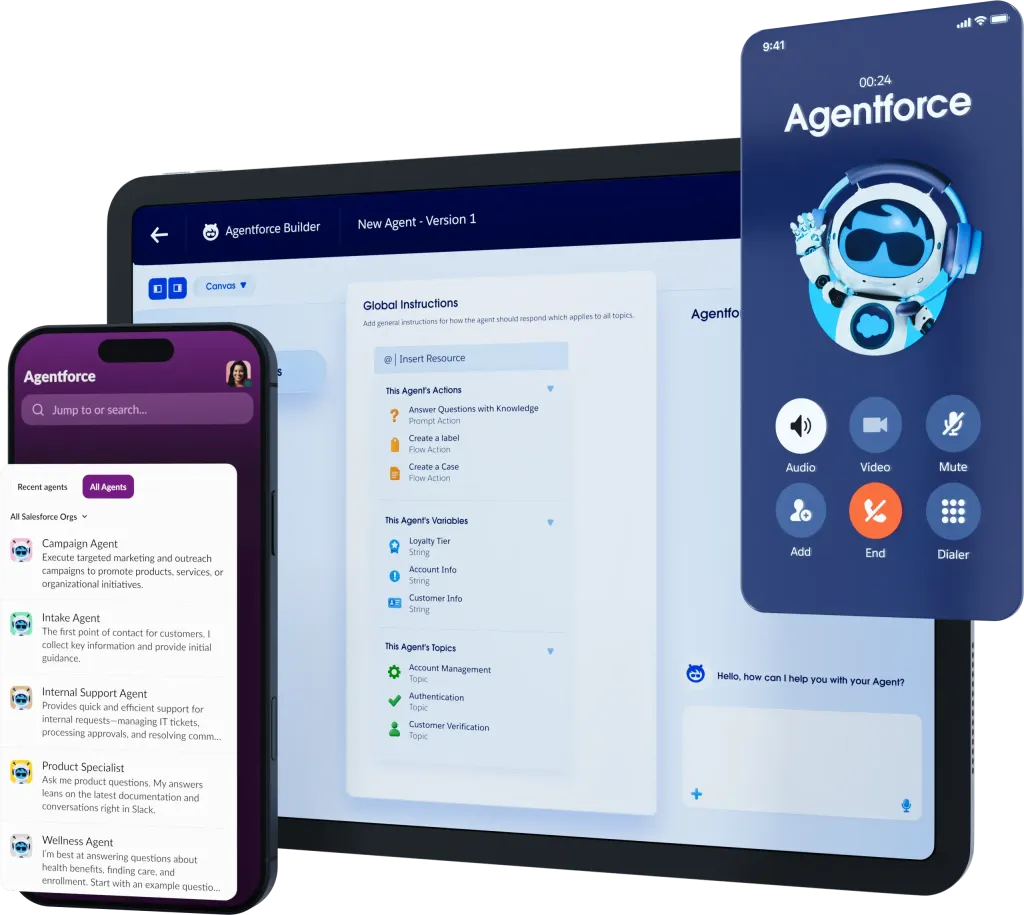
Where it wins. The Atlas Reasoning Engine grounds responses in CRM and Data 360 records, which is a data-adjacency advantage no standalone vendor can match if your customer record already lives in Salesforce. Flex Credits price an action at $0.10, and an interaction that triggers no actions is free, so a browsing customer who asks one question and leaves does not bill. Digital Wallet gives real-time spend tracking, which is more than most vendors here offer. Salesforce Foundations, including the builder itself, is free.
Where it does not. The two billing models cannot coexist: Salesforce states plainly that Flex Credits and Conversations will not be supported in the same org, so you pick one and live with it. Unused Flex Credits do not roll over, which is the same forfeiture problem eGain's blocks have. And the flat-fee route gets expensive quickly, with Agentforce 1 Editions starting from $550 per user per month.
Pricing.
| Line | Price | Unit |
|---|---|---|
| Salesforce Foundations | $0 | builder, Prompt Builder, Agent Script |
| Flex Credits | $500 per 100,000 credits | $0.10 per action |
| Conversations | $2.00 | per conversation, pre-purchase only |
| Agentforce User License | $5 per user per month | plus Flex Credits drawdown |
| Sales, Service, Field Service add-ons | $125 per user per month | flat, unmetered |
| Agentforce 1 Editions | from $550 per user per month | includes 2.5M credits per org per year |
My take. If you are a Salesforce shop, the grounding is worth more than the price difference and this is probably your finalist against eGain. If you are not, you are buying a platform to get an agent. Salesforce AI pricing has the full model, Agentforce alternatives covers the rest, and eesel works with Salesforce too.
9. ServiceNow
Best for: large IT service desks that need workflow, CMDB, and AI on one platform.
ServiceNow competes with eGain for the same Global 2000 buyer, usually on the employee-facing side rather than the customer-facing one.

Where it wins. Nothing else here brings workflow, configuration data, and agents into one system of record. The AI meter is now documented in public: ServiceNow's Now Assist overview, effective 23 July 2026, defines an assist as one summarisation, resolution note, or sentiment call, with a small agentic workflow under four tool calls costing 25, a medium one 50, and a large one 150. That is a more granular published definition than eGain gives for Evaluator.
Where it does not. No dollar figure appears anywhere on the live ITSM pricing page: three tiers, three "Get Custom Quote" buttons. The autonomous, ticket-closing agents (the L1 Service Desk AI Specialist and AI Agents for ITSM) are Prime-only, so the tiers below it get summaries and chat rather than resolution. Assists pool across production and sub-production instances, so your dev and QA testing draws down the same bucket as live traffic, and overage is invoiced. Billing is per fulfiller, but approvers and Employee Center Pro users are separately metered.
Pricing. ITSM Foundation, Advanced, and Prime, all quote-only per fulfiller seat. The legacy Standard, Pro, Pro Plus, and Enterprise SKUs reached end of sale on 1 July 2026.
My take. If IT is the buyer and the service desk is the workload, this is the platform answer and eGain is the knowledge answer, which is a real architecture decision rather than a shootout. If customer service is the workload, the Prime gate makes this expensive for what you get. See ServiceNow AI pricing for the tier detail. If the Prime gate is the blocker, Virtual Agent alternatives covers what else fits.
10. Decagon
Best for: AI-native CX teams that want testing and QA as first-class products.
Decagon is the newest shape on this list: an AI-native platform built around natural-language Agent Operating Procedures rather than a helpdesk with AI bolted on.
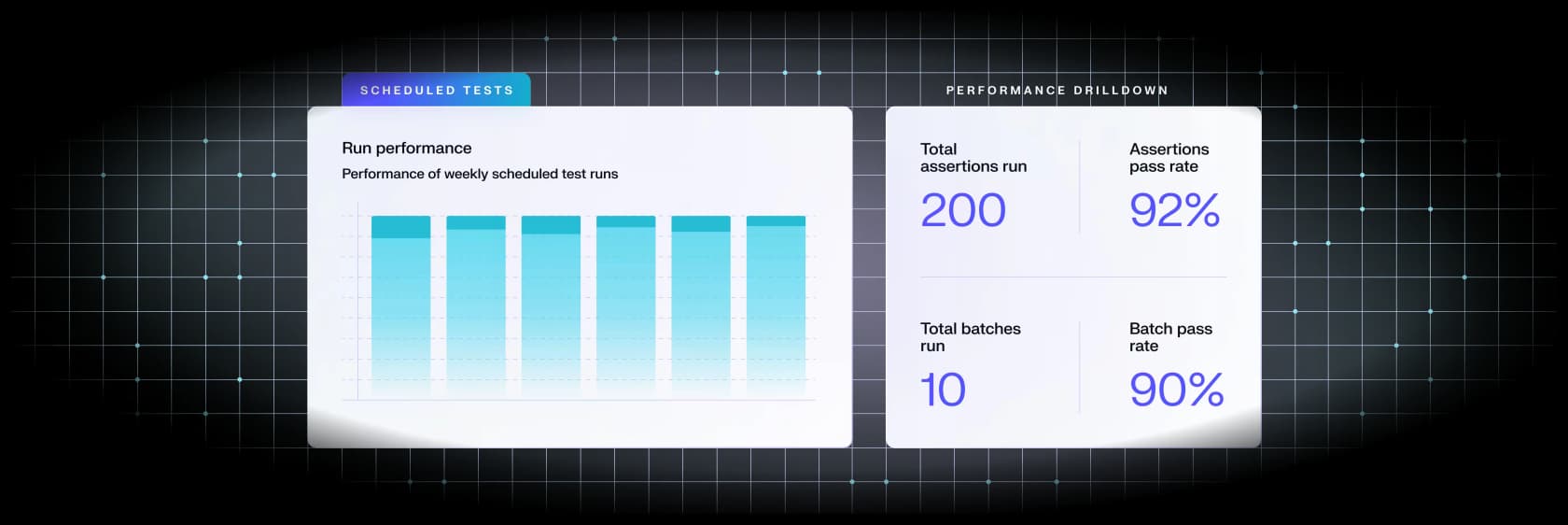
Where it wins. The QA tooling is unusually serious. Duet analyses conversations and auto-generates and refines the procedures. Watchtower runs always-on monitoring. Experiments A/B test against real live conversations after launch. Browser Actions let the agent operate across systems that have no API at all, which solves a real integration problem. Decagon Assist, an agent-assist layer for human reps, shipped on 19 August 2026. It is also the vendor most honest in public about the resolution-definition problem this whole post is about.
Where it does not. There is no pricing page at all: decagon.ai/pricing returns a 404, and every route leads to a demo form. No self-serve signup, no trial, no published tier structure, and the docs sit behind a sign-in wall. The Simulations feature auto-generates test scenarios rather than replaying your own historical tickets, which is a meaningful difference if a dry run on real traffic is what you are after. The public review footprint is small at 4.7 across 25 reviews on G2.
Pricing. Quote only. Decagon publishes the meters but not the rates: per-conversation, which it says the vast majority of customers choose, or per-resolution at a higher fixed rate with no charge for escalations.
My take. The most intellectually honest vendor here about billing units, and the least transparent about actual numbers, which is a strange combination. Worth a call if you have the volume and the patience. Decagon pricing has what buyers have reported.
Also worth a look
Three more that did not make the ten but solve a specific version of this problem.
- Ada is the enterprise deflection layer that sits on top of an existing helpdesk. Its own site is quote-only, but the Salesforce AppExchange listing publishes a real floor at $30,000 per company per year, which is the most useful number in this paragraph. It holds AIUC-1 certification and zero-data-retention LLM contracts.
- Kore.ai covers voice and digital in one platform. Its
kore.ai/pricingpage returns a 404, but developer docs still carry a $0.20 entry rate. Read the billing docs carefully: they define a session as a 15-minute window including idle time, so a 31-minute chat bills as three. See Kore.ai pricing. - Document360 is the pure knowledge base play, with Eddy AI bundled and a 14-day trial with no card. The AI Chatbot and AI Premium Suite are separately licensed add-ons rather than included. Pricing is a configurator that ends in a sales form. See Document360 pricing.
How to actually run this evaluation
Four things, in order, and none of them are "book five demos".
1. Write down your unit economics before you take a call. Monthly conversation volume, abandonment rate, and spam rate. Those three numbers turn every rate card above into a real bill. Without them you are comparing $0.50 to $1.50 as if they measure the same event.
2. Ask every vendor to define its billable unit in writing. eGain will, on a public page. Zendesk will. Salesforce will. The quote-only vendors will tell you on a call, which is fine, but get it in the contract rather than in a slide.
3. Insist on a dry run over your own history, not a scripted pilot. A CX lead at a DTC supplements brand running about 7,000 Gorgias tickets a month put the reason better than I can:
"The AI will never be able to answer 100% of the questions, but if it tries and just answers 'sorry I don't know this,' I cannot go and check all my 7,000 tickets to see if the AI actually made a good answer, then the point is a little bit gone. I need an AI who is only handling the tickets that it's confident to handle and all the other ones, leave them alone."
That is an answer-quality objection, and under a silence-based meter it is also a pricing objection. A confident wrong answer produces exactly the same 24 hours of quiet that a correct one does.
4. Price the integrations separately. eGain's Connectors are $249 a month, which on a 25-seat Knowledge Hub deployment is a 40% uplift on the subscription for integration alone. Whatever you shortlist, ask what the connector line costs before you compare subscription totals. The same logic applies whether the source you need wired up is Confluence, SharePoint, or Slack.
One last thing worth naming from the other side of the table. A budget-conscious buyer told us on a call that a previous vendor's price had "more than doubled" on them, and they wanted a contractual price lock, offering to pay annually to get one. On any negotiated enterprise agreement, that ask matters more than the sticker.
Try eesel
If you are on this page because eGain's meter, blocks, or document-only sourcing are the blockers, that is the exact gap eesel was built into.
eesel's AI helpdesk teammate plugs into the desk you already run, learns from your past tickets rather than only your published docs, and sells one fixed monthly price, from $299 for 500 credits (1 credit per ticket or chat session handled), with no prepaid blocks and no seat fee. Before it answers a single live customer, you run it against your historical tickets and read the replies it would have sent.
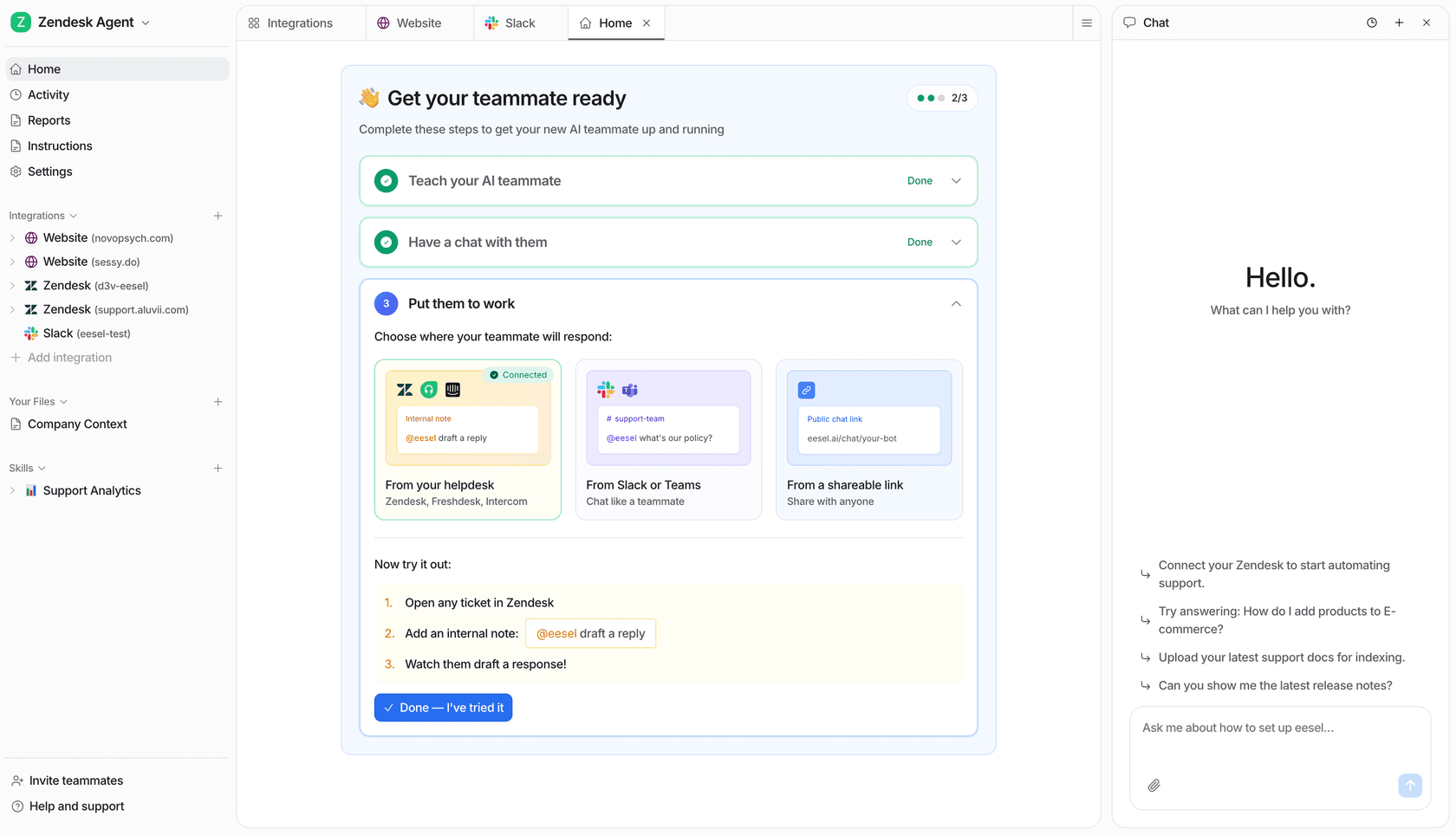
It starts with 100 free credits, with every feature unlocked and no credit card. Try eesel, connect your helpdesk, and run the simulation over your own history to see what it would have resolved. If you would rather see it on your data with someone walking you through it, book a demo.
For the wider field, the best AI helpdesk software covers the alternatives in more depth, best AI agents for customer service covers the agent layer specifically, and best knowledge management software covers the layer eGain actually leads in.
The short version
eGain is a good product with an unusual meter. It publishes more than its competitors, it is a Gartner Leader in the category it invented, and $0.50 is the cheapest published resolution rate in this market. None of that is in dispute.
What sends teams looking is that the meter fires on silence, the blocks are prepaid and non-refundable, and the AI reads your documents rather than your tickets. So pick your alternative by which of those three is actually your problem, not by which vendor ranks highest on a roundup.
If it is the knowledge, look at Guru, Shelf, or Stonly. If it is the price of a seat, look at Zoho Desk. If it is the platform, look at Agentforce or ServiceNow. If it is the meter and the sources, that is the one I would put eesel forward for, and I would judge it on the dry run rather than the rate.
Then go and check one thing on whatever you shortlist: ask the vendor what happens to your bill when the customer walks away unhappy. The answer tells you more about the contract than the price does.