


Disclosure: This article is published by eesel AI, a competitor of ServiceNow. We encourage you to read ServiceNow's own materials for their perspective.
ServiceNow is basically the king of the IT Service Management (ITSM) world, and it makes sense why. It is a massive, all-encompassing platform used by huge names like FedEx, Pepsico, and Visa. But it is definitely not the right fit for every team. I have talked to many people who are hunting for ServiceNow competitors because they are looking for more flexibility, a faster setup process, and a system that doesn't require specialized consultants for every minor adjustment.
If you are nodding your head because you have dealt with this, you are in the right place. I have spent a lot of time testing alternatives to find platforms that actually work without the enterprise-level complexity. This guide breaks down the top 6 ServiceNow competitors that are worth your time in 2026, whether you want something easier to use, built from the ground up with AI, or a platform that leverages a mature ecosystem.
What exactly is an ITSM platform and why look for ServiceNow competitors?
Before we get into the list, let's quickly chat about what we are actually looking at. IT Service Management (ITSM) platforms are basically the tools that help a company manage how they give tech support to their users, like employees or customers. You can think of it as the brain for all of a company's tech operations.
At its heart, an ITSM platform handles things like help desk tickets, managing incidents (when something breaks), figuring out why things broke, and handling software updates. The whole idea is to make IT support feel more organized and reliable.
While ServiceNow is the big name here, its style is to offer a giant, all-in-one package. As you will see, many modern ServiceNow competitors are focusing on being faster, friendlier, and a lot smarter, especially with how AI is changing things.
Why you might be looking for ServiceNow competitors
If you are reading this, you probably have a few frustrations already. ServiceNow is very powerful, but for many teams, that power comes with a lot of baggage. When you look at reviews and talk to users, the same few complaints always pop up.
For one, the cost is a huge hurdle. ServiceNow does not publish pricing (you need to contact ServiceNow for a quote), and the total cost can grow quickly as you add more features or users. This makes it really tough for smaller companies or even big ones that need to watch their budget.
Not many Enterprise Service Management systems that can compete at their level, but I know the price tag is too steep for SMB and they tend to look at silo proprietary solutions or Jira

Then there is the time it takes to actually get it working. Setting up ServiceNow is not something you do in a few days. It often takes months and a team of experts. According to G2, the average time to implement is 5 months. That is a long time to wait to see any value.
Finally, it is just hard to learn. The interface can feel old and confusing, and your team will likely need a lot of training to use it well. If you need to move fast, you probably cannot afford that kind of delay. These are the exact gaps that many ServiceNow competitors are trying to fill.
Our criteria for choosing the best ServiceNow competitors
To make sure this list is actually helpful, I did not just look for tools that have the same buttons. I looked for alternatives that actually fix the problems people have with ServiceNow. Here is what I looked for when picking these ServiceNow competitors:
-
How easy it is to use: Can you get started quickly? I looked for tools with simple interfaces that do not require a degree in engineering to set up.
-
AI and automation: Modern support should be about solving problems, not just moving tickets around. I looked for platforms that use AI to actually help agents and automate the boring stuff.
-
Clear pricing: Is the price fair and easy to understand? I preferred tools that are transparent about what they cost so you do not get hit with surprise fees.
-
Customization: The tool should work for you, not the other way around. I picked platforms that connect easily with tools you already use (like Slack or Shopify) and let you change things without writing code.
-
Growing with you: A good tool should work for a small team but still be strong enough if you grow into a huge company.
A quick comparison of the top ServiceNow competitors in 2026
| Tool | Best For | Starting Price | AI Features | Key Differentiator |
|---|---|---|---|---|
| eesel AI | Teams wanting an AI teammate | $0.40/task (pay-as-you-go) | AI Agent, Copilot, Triage, Chat | Plugs into existing tools, no-code setup |
| Jira Service Management | Agile teams in the Atlassian ecosystem | Free (up to 3 agents) | AI-powered virtual agent, suggestions | Deep integration with Jira Software |
| Freshservice | SMBs needing a user-friendly ITSM | $19/agent/month | Freddy AI Agent, AI Copilot, AI Insights | Intuitive interface and fast setup |
| Zendesk | Customer-centric support teams | $55/agent/month | AI agents, Copilot, intelligent routing | Strong focus on omnichannel customer experience |
| SolarWinds Service Desk | IT teams focused on asset management | $39/technician/month | AI ticketing automation | Comprehensive IT asset management |
| BMC Helix | Large enterprises needing deep ITSM | Custom | Cognitive automation, predictive insights | Enterprise-grade, multi-cloud management |
The 6 best ServiceNow competitors to consider in 2026
There are plenty of options out there, but these six really stand out for different reasons. Whether you want something that lives inside your current tools or a full enterprise replacement, there is something here for you.
1. eesel AI
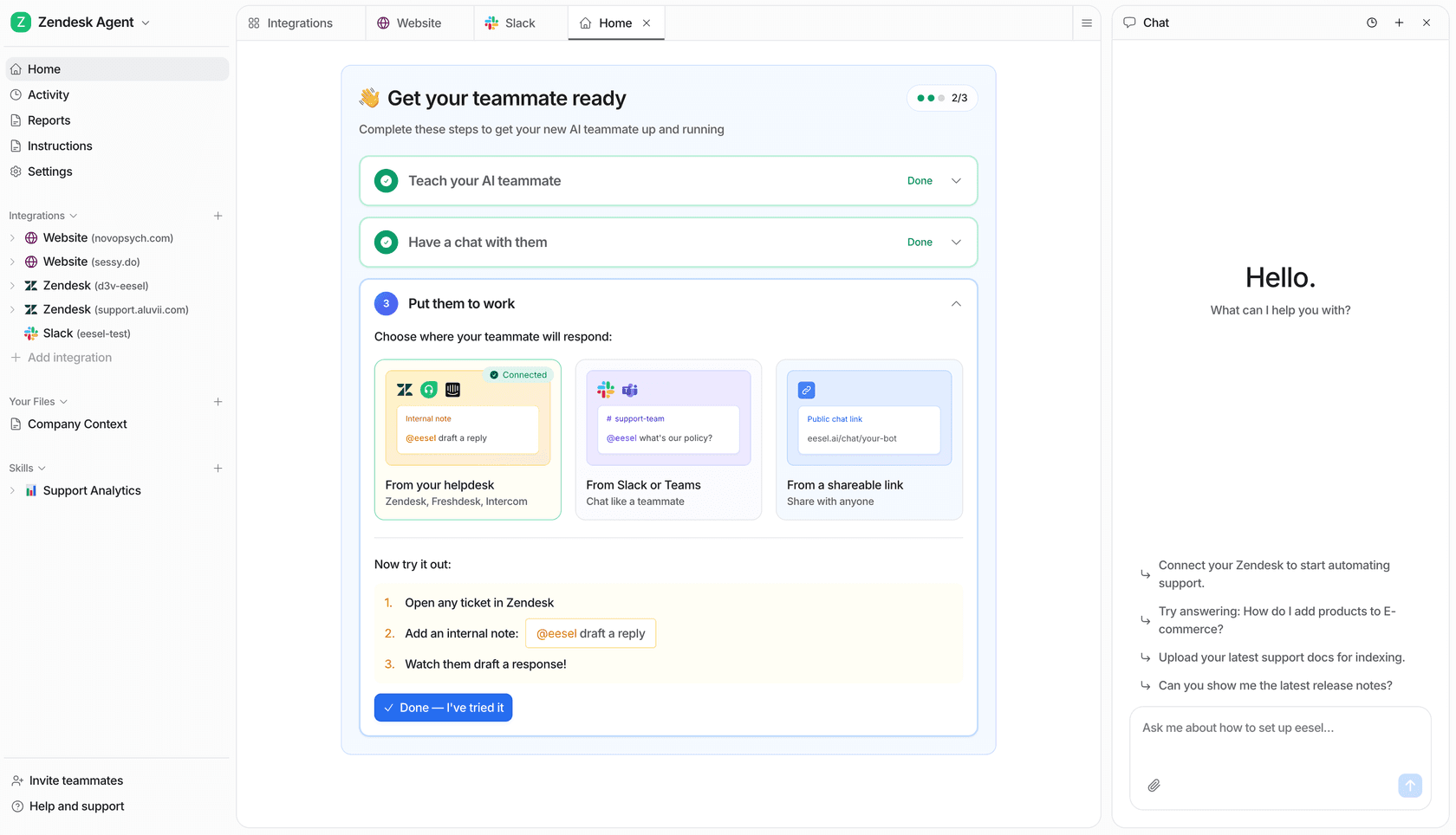
Instead of trying to be another giant ITSM tool you have to learn, eesel AI acts like an AI teammate. It does not replace the systems you already have. Instead, it plugs right into tools like Zendesk, Freshdesk, Jira, and Slack. It reads your old tickets, help articles, and internal docs (like Confluence or Google Docs) to help out. It can act as an agent that talks to customers, a copilot that helps your staff, or an internal assistant. You do not really "configure" eesel AI: you just invite it to the team like a new person.
Pros:
-
Ready in minutes: You can get eesel AI running almost immediately without needing a developer.
-
Safe to start: It begins by drafting replies for you to check first, so there is no risk of it saying something weird to a customer.
-
Learns from your data: It trains on your history and docs so it sounds like your brand. You "teach" it just by talking to it.
-
Test before you buy: You can run simulations on old tickets to see exactly how it would have handled them before you let it go live.
Cons:
- Because eesel AI works with your existing help desk, it is not a standalone ITSM tool. If you want to move away from your current ticketing system entirely, you would still need a basic one for eesel AI to live in.
Pricing:
eesel AI uses a pay-per-task model rather than per-seat billing, so costs scale with what you actually use.
- Regular tasks (support tickets, chat sessions): $0.40 each
- Heavy tasks (complex analysis, long-form output): $4.00 each
- Light tasks (dashboard lookups, simple queries): Free
- Free trial: $50 free credits, no credit card required
- Enterprise add-on: $1,000/month flat fee adds dedicated support, SSO, HIPAA compliance, and higher knowledge base limits
2. Jira Service Management
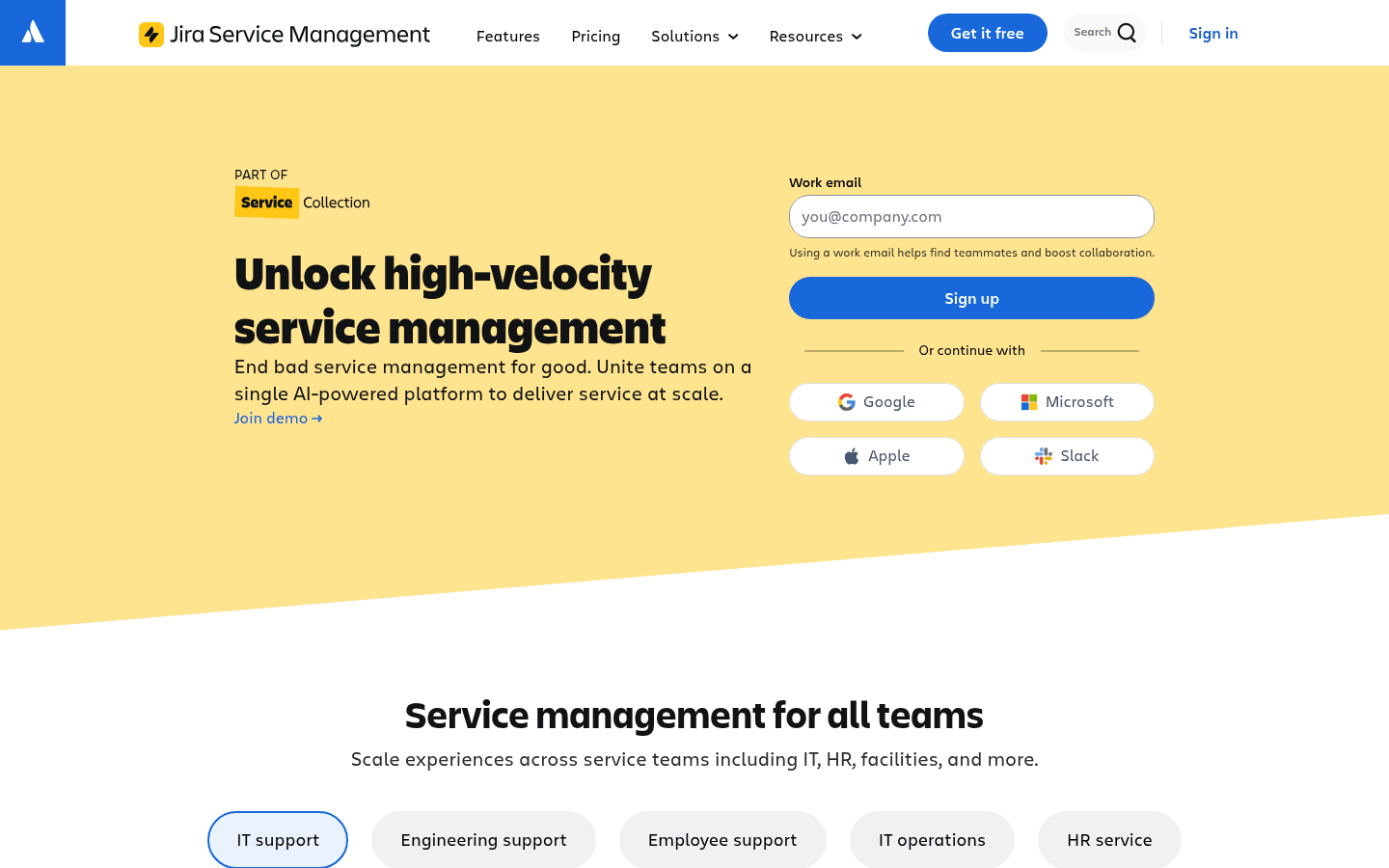
Jira Service Management is Atlassian's version of an ITSM, and it is the obvious choice if you already use Jira. It is a mature, reliable platform built to help IT and development teams work together better. It is one of the best ServiceNow competitors for teams that like to work in an "agile" way and need their tech teams to stay in sync.
Pros:
-
The best part is how it connects with Jira and Confluence. Everything from software bugs to IT tickets stays in one place.
-
It is very flexible and follows standard ITIL rules, making it a powerful choice for professional IT setups.
-
The vast Atlassian marketplace provides an impressive ecosystem of integrations and specialized tools.
Cons:
-
Because it is a professional, enterprise-grade tool, the interface is designed for power, which might require some initial familiarization for non-technical users.
-
Jira's flexible model means some specific features are managed through marketplace apps, allowing you to tailor the platform specifically to your team's needs.
Pricing:
-
Free: Good for up to 3 agents with the basics.
-
Standard: $20 per agent/month with more features.
-
Premium: $51.42 per agent/month, which adds AI and asset management.
-
Enterprise: Custom pricing for large organizations.
3. Freshservice
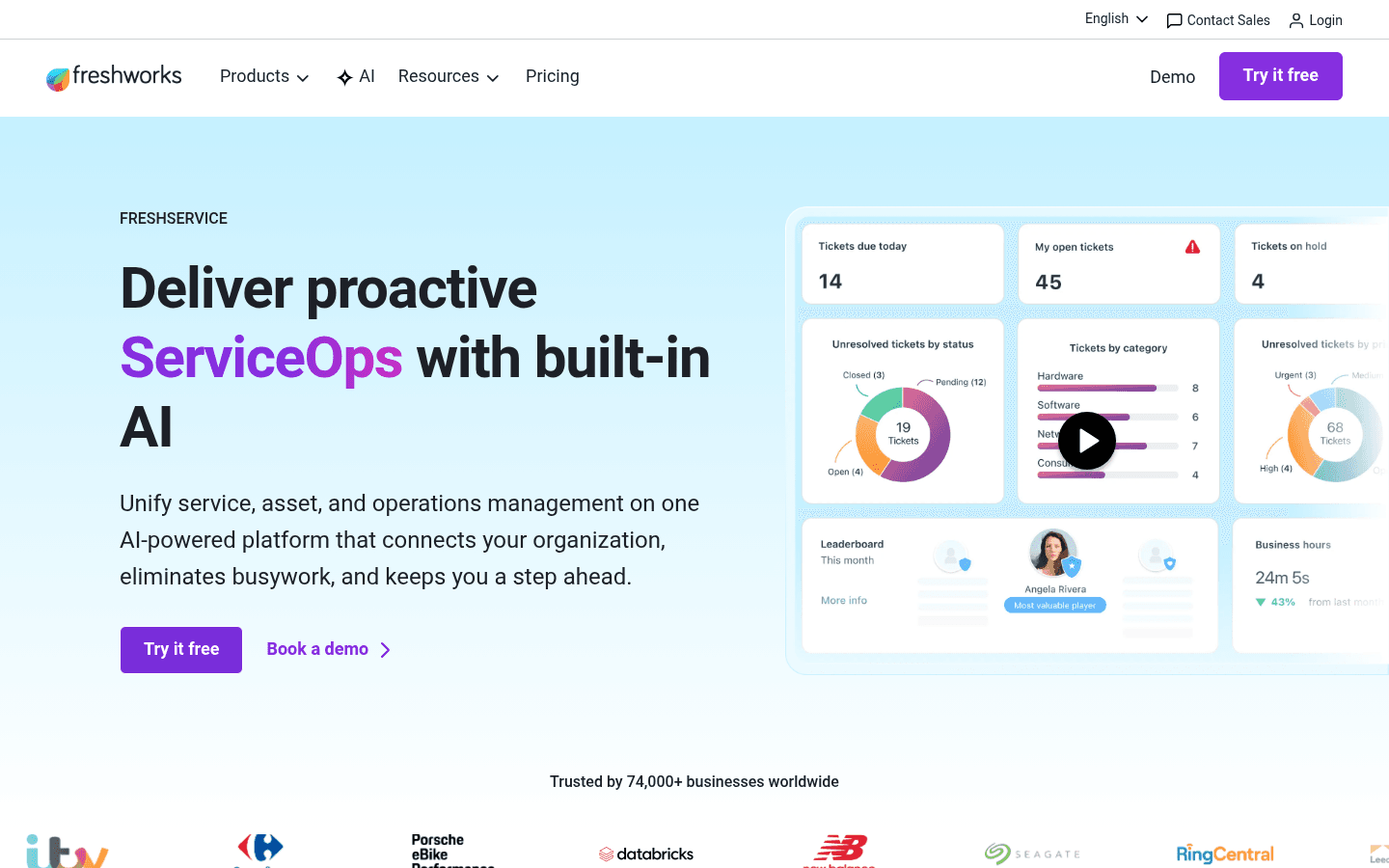
Freshservice is a cloud tool known for being user-friendly and quick to set up. It is often called one of the most intuitive ServiceNow competitors, making it perfect for medium-sized businesses that want power without complexity. It handles tickets, assets, and has some pretty good automation thanks to its Freddy AI.
Pros:
-
It is just simple. Your team can probably figure it out without a week of training.
-
The automation is strong, which helps cut down on the manual tasks IT teams handle daily.
Cons:
-
It is great for IT, but it does not always play nicely with specialized HR or recruiting software.
-
Some users have said that getting help from their support team can be a bit slow for highly specific technical problems.
Pricing:
-
Starter: $19 per agent/month (billed annually).
-
Growth: $49 per agent/month (billed annually).
-
Pro: $99 per agent/month (billed annually).
4. Zendesk
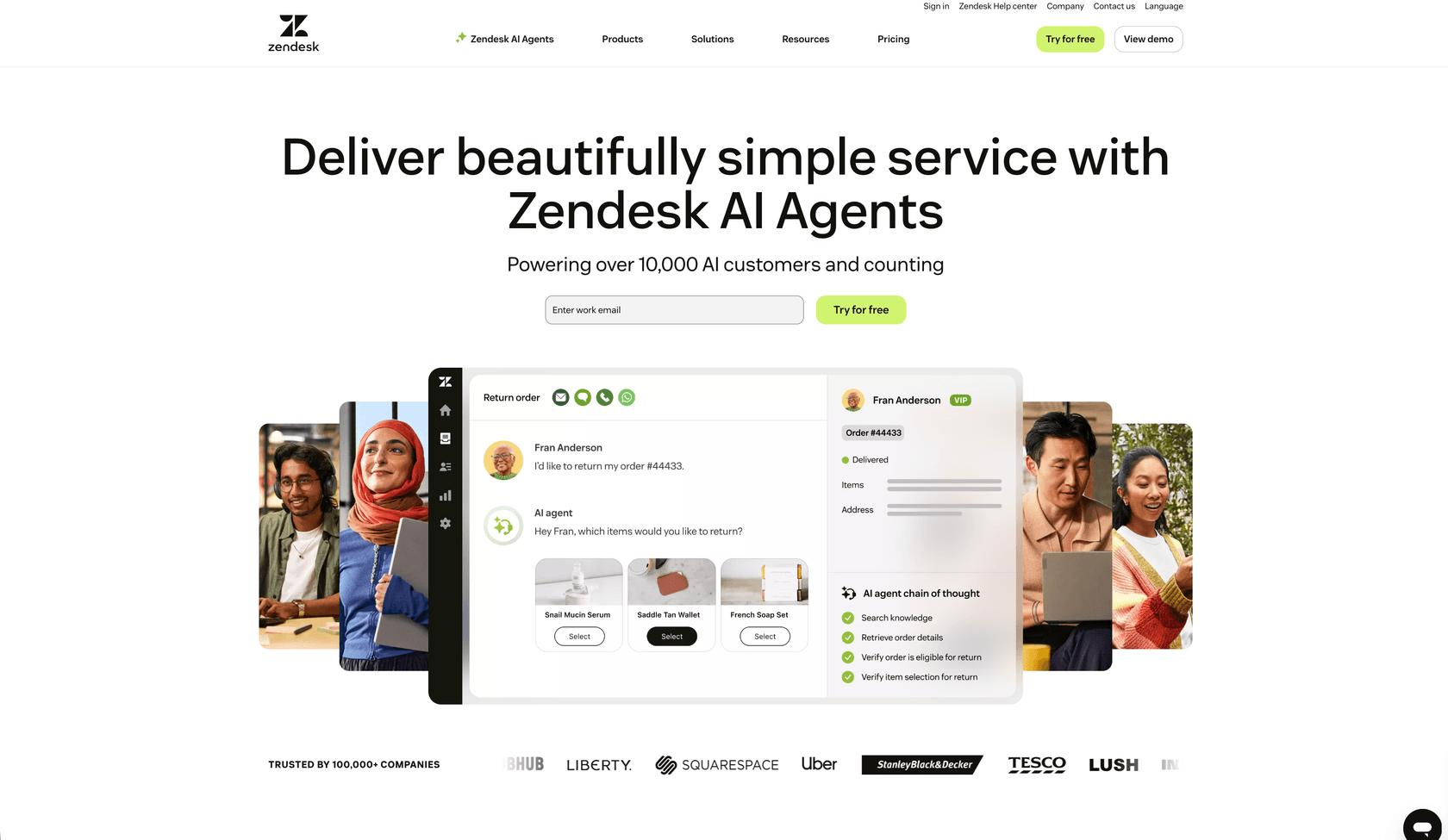
Everyone knows Zendesk for customer service, but it is actually a great ServiceNow competitor for internal IT support too. It puts all your emails, chats, and calls into one workspace. It is a mature, reliable platform built to scale, so it works whether you have five agents or five thousand.
Pros:
-
It is amazing at omnichannel support (handling customers wherever they are) and has a huge, impressive marketplace of apps to connect to.
-
The reporting is top-notch and enterprise-grade, so you always know how your team is doing.
Cons:
-
Zendesk prioritizes people-first communication, so teams needing deep hardware asset management may prefer to utilize its extensive marketplace for specialized integrations.
-
Advanced IT service features are accessible through Zendesk's tiered plans, designed to provide specific capabilities as your team grows.
Pricing:
-
Suite Team: $55 per agent/month (billed annually).
-
Suite Professional: $115 per agent/month (billed annually).
-
Suite Enterprise: $169 per agent/month (billed annually).
5. SolarWinds Service Desk
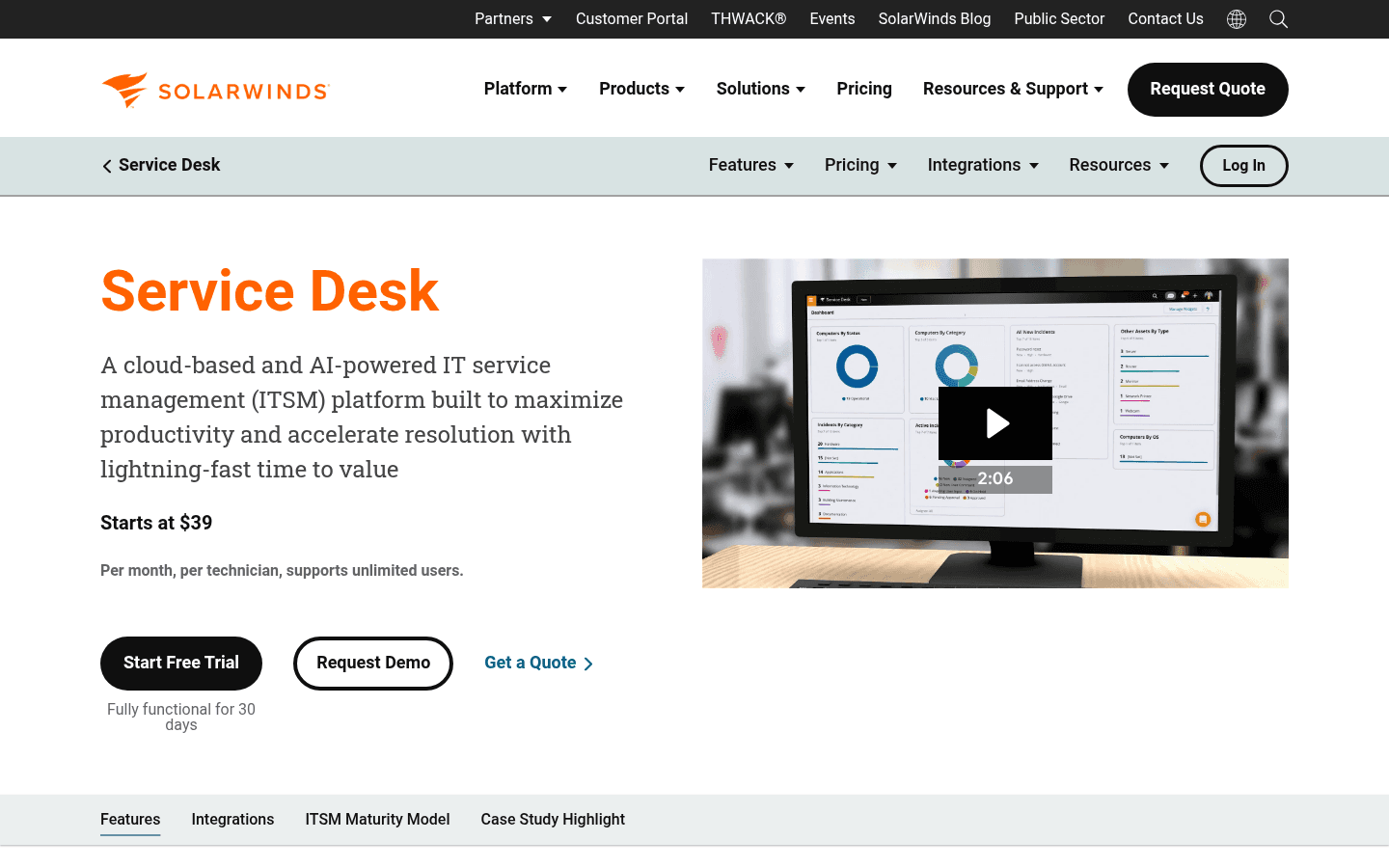
SolarWinds Service Desk is an AI-powered platform that gives you a full toolkit for IT. It is especially good at IT asset management, which means it is great at tracking laptops, software licenses, and contracts. It is a solid middle-ground for teams that need more than a basic help desk but do not want ServiceNow's complexity.
Pros:
-
It is relatively easy to get going and has lots of automation for things like routing tickets.
-
The asset tracking is really detailed and helpful for keeping tabs on company gear.
Cons:
-
The look of the tool feels a bit traditional, and finding your way around can be confusing at first.
-
Some of the best features are locked away in the most expensive tier.
Pricing:
-
Essentials: $39 per technician/month.
-
Advanced: $79 per technician/month.
-
Premier: $99 per technician/month.
6. BMC Helix
If you are looking for a heavy-duty, enterprise-level alternative, BMC Helix is the one. It uses a lot of AI and machine learning to predict when things might break and fix them before they do. It is built for massive, complex companies that need to manage IT across different cloud systems.
Pros:
-
The cognitive automation is very advanced. It helps you stop just reacting to problems and start preventing them.
-
It can run in the cloud, in your own office, or a mix of both.
Cons:
-
With great power comes a lot of work. Setting this up can be a long and detailed process.
-
Some users have mentioned that their support can take a while to get back to you.
Pricing:
- You have to contact sales to get a quote.
A few tips for choosing between ServiceNow competitors
Moving away from a platform like ServiceNow is a major move. Here are some simple tips to help you pick the right one:
-
Try it out first: Do not just sign a contract. Use the free trials. Get your team to actually try and solve a few tickets in the new tool to see if they like it.
-
Focus on what you actually need: It is easy to get distracted by fancy features you will never use. Ask yourself: What is the main goal? Is it faster replies? Less manual work? Pick the tool that does that one thing best.
-
Check your current tools: The best tool is one that talks to the software you already use. Make a list of your must-haves (like Slack or Jira) and make sure the new platform connects to them.
-
Look for a partner: During your trial, see how helpful the company is. If they are hard to reach now, they will be even harder to reach once you have paid them.
For a more visual breakdown of the top players in the market, this video offers a great overview of some of the best ServiceNow competitors and what makes each one unique.
Choosing the right ServiceNow competitor for your team
Picking among ServiceNow competitors is not just about saving money. It is about finding a tool that actually fits how your team works in 2026. While tools like Jira or Freshservice are great choices, the future is really about AI that works with you.
That is why eesel AI is so interesting. Instead of making you move everything to a new, rigid system, it just joins your current team as a smart assistant. It works within powerful ecosystems like Jira or Zendesk to handle the repetitive stuff and learns as it goes, so your human agents can focus on the hard problems.
If you are tired of just managing tickets and want to start actually solving them, give eesel AI a look. You can even try a free simulation to see how it would have handled your past tickets.
Frequently asked questions
Who are the main ServiceNow competitors for smaller businesses?
For smaller teams, Freshservice and Zendesk are often the top ServiceNow competitors because they are much easier to set up and have more affordable, transparent pricing.
Are there any free ServiceNow competitors available?
Jira Service Management offers a free version for up to three agents, making it one of the most popular ServiceNow competitors for teams just starting out with a $0 budget.
How do ServiceNow competitors compare when it comes to setup time?
Most ServiceNow competitors on this list can be set up in weeks rather than months. Tools like eesel AI can even be ready in minutes since they plug directly into your existing help desk.
Why are companies switching to ServiceNow competitors?
Many companies switch to ServiceNow competitors because they find ServiceNow too expensive, too complex to manage, or they are tired of needing expensive consultants for basic changes.


Article by
Kurnia Kharisma Agung Samiadjie
Kurnia is a software engineer and writer at eesel AI with two years of SEO experience, writing about AI tools, helpdesk software, and customer support. He pairs a developer's understanding of how these products are built with search-driven research into what actually ranks and resonates with the people searching for them.