
Disclosure: This article is published by eesel AI, a competitor of ServiceNow. We encourage you to read ServiceNow's own materials for their perspective.
ServiceNow is a giant in the enterprise world, and it's going all-in on AI. But if you've tried to figure out the actual cost of its AI offerings, you've probably found it's less like a price list and more like a maze. "ServiceNow AI pricing" isn't a single number you can look up. It's a suite of capabilities bundled across different product tiers, all priced through a custom-quote process.
If you're trying to understand what you'd actually pay, and what you'd get for it, this guide breaks down how ServiceNow structures its AI across ITSM and related products, what each tier includes, and what to expect before starting a sales conversation.
What is ServiceNow AI?
ServiceNow AI isn't a standalone product. It's an intelligence layer built into the broader ServiceNow platform. When people talk about ServiceNow AI, they're usually referring to several distinct components that work together.
From ServiceNow's product pages, here's what makes up the AI ecosystem:
-
AI Agents: Autonomous systems designed to reason, plan, and complete tasks across IT, customer service, HR, and other functions. ServiceNow describes them as capable of working proactively "without relying upon user inputs" (source), with multiple agents collaborating under an orchestrator to handle complex workflows.
-
Now Assist: ServiceNow's generative AI toolkit. It covers drafting content, summarizing incident reports or case notes, and surfacing answers from internal knowledge. It's available across ITSM, CSM, HR Service Delivery, and other ServiceNow product lines.
-
Agentic Workflows: High-level business goals assigned to teams of AI agents. The AI Agent Orchestrator coordinates multiple specialized agents to work toward that goal, handling multi-step tasks that a single agent couldn't manage alone.
-
AI Agent Studio: A development tool within the ServiceNow AI Platform for building and customizing AI agents. Agents are defined using natural language, with roles, goals, and guardrails configured without writing code.
-
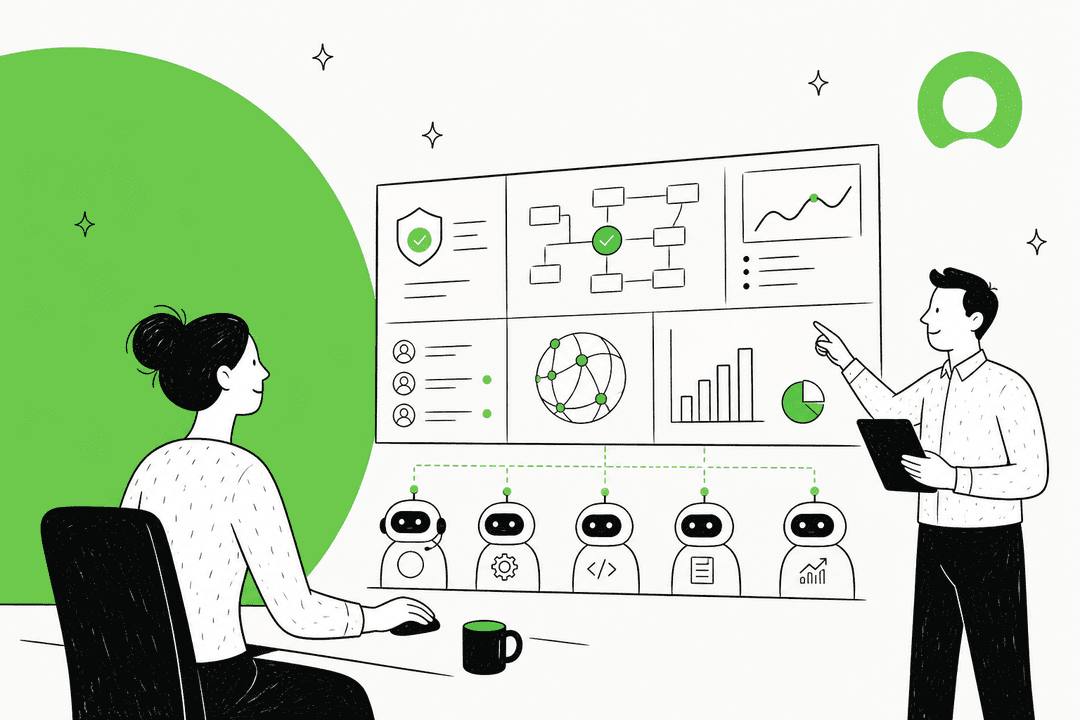
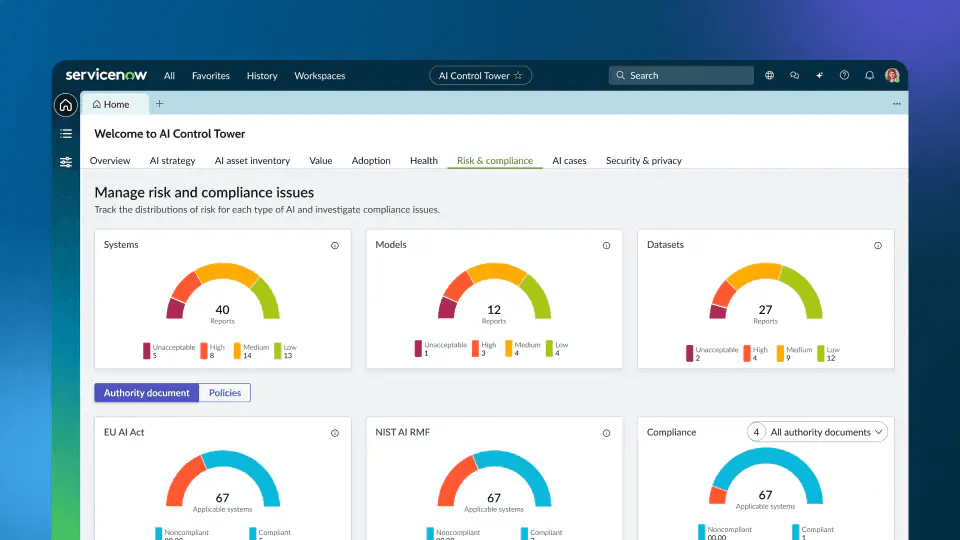
AI Control Tower: A governance dashboard that manages AI agents across your organization, whether built on ServiceNow or from third-party providers. It covers six modules including AI asset lifecycle management, risk and compliance management, and regulatory content for NIST AI RMF and EU AI Act frameworks.
ServiceNow AI pricing plans explained
Here's where it gets complicated. ServiceNow does not publish dollar pricing (source) for any of its products. Every plan requires a custom quote from the sales team. What ServiceNow does publish is the tier structure and feature inclusions, which tells you what's bundled at each level.
ServiceNow ITSM pricing tiers
For IT Service Management, ServiceNow currently offers three named tiers. AI capabilities scale significantly at each level, culminating in fully autonomous AI Specialists at the top.
| Feature | ITSM Foundation | ITSM Advanced | ITSM Prime |
|---|---|---|---|
| Core ITSM | Service Catalog, Incident Management, Asset/CMDB | Includes Foundation + Change, Problem, Major Incident, On-Call Management | Includes Advanced + DevOps Change Velocity, Digital Product Release |
| AI capabilities | Virtual Agent, Now Assist Foundation, Workflow Data Fabric, Moveworks for ITSM Foundation | AI Voice Agents, Now Assist Advanced, Moveworks for ITSM Advanced | AI Agents for ITSM, L1 Service Desk AI Specialist, AI Agent for Digital End-User Experience, Now Assist Prime, Moveworks for ITSM Prime |
| Analytics | Platform Analytics | Platform Analytics Advanced, Process Mining (10K records/year) | Process Mining (15K records/year) |
| Pricing | Custom quote | Custom quote | Custom quote |
The ITSM pricing page describes Foundation as "AI agents and skills that accelerate IT service delivery with task-based, always-on support," Advanced as "agentic workflows that automate complex IT processes, working side by side with your team," and Prime (the recommended tier) as "AI Specialists that independently manage IT workflows, make decisions, and drive results."
To get the fully autonomous AI agent capabilities (AI Agents for ITSM and the L1 Service Desk AI Specialist), you need the Prime tier. The lower tiers include meaningful AI, but the agentic features are reserved for the top.
ServiceNow AI for CSM and other products
ServiceNow CSM (Customer Service Management) follows the same model: tiered plans with AI bundled at each level, all priced via custom quote. Now Assist spans product lines including ITSM, ITOM, CSM, HR Service Delivery, and Field Service Management, and since the April 2026 restructure it is bundled into each line's tiers as a metered assist allowance rather than sold as a separate add-on. Each product line still carries its own custom quote.
Pricing is not publicly listed
To be direct: there is no price list on ServiceNow's website. Every plan, at every tier, for every product, is sized through a conversation with the sales team. All pricing inquiries go through the ServiceNow pricing page.
Third-party consultancies publish estimated ranges for ITSM licensing, but those figures are editorial estimates rather than published ServiceNow prices. If you need an actual number, contact ServiceNow directly.
What do you actually get with ServiceNow AI?
Say you move forward with a quote. What do these features actually do?
Autonomous AI agents and workflows
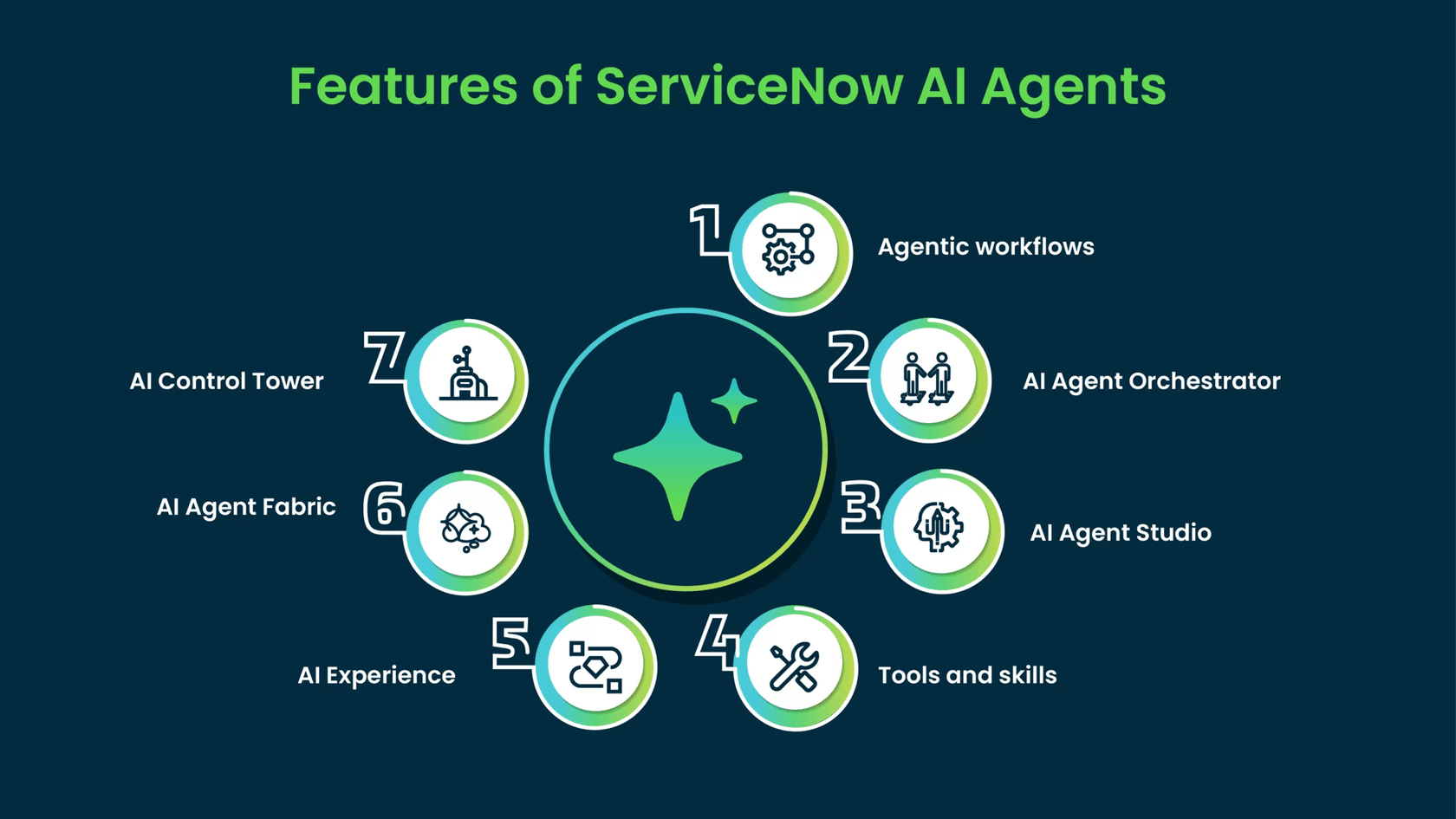
ServiceNow's AI agents are described as reasoning systems that plan multi-step tasks and execute them across departments. According to ServiceNow, agents pull data from "knowledge articles, historical incidents and cases, CIs from the CMDB, and information from other systems accessed with Workflow Data Fabric" (source) to do their work.
AI Agent Studio is the tool used to build and configure these agents. ServiceNow promotes it as a low-code interface where you define an agent's role, goals, and guardrails in natural language. It's built into the broader ServiceNow platform, which has its own complexity, but the design intent is to make agent creation accessible without deep coding skills.
A central platform for orchestration
The AI Control Tower addresses the challenge of managing many AI agents across a large organization. It's designed to govern both ServiceNow-native agents and third-party ones, giving a single view of AI activity. ServiceNow describes it as a way to "connect your AI strategy, governance, and management across the enterprise," covering asset lifecycle, risk and compliance, and content for regulatory frameworks.
This governance capability matters most for organizations running AI at scale across many departments and systems.
Deep integration capabilities
Integration Hub and Workflow Data Fabric connect ServiceNow workflows to other systems across the enterprise. Workflow Data Fabric includes Zero Copy Connectors that let AI agents access data from external sources without replicating it into ServiceNow. According to ServiceNow, this can deliver integration "up to 6x faster, slashing integration costs up to 70%" (source).
Trade-offs of ServiceNow's platform approach
A single unified platform for AI orchestration sounds compelling in theory. But committing to it has practical implications worth thinking through carefully.
Platform commitment and migrations
The ServiceNow model works best when a company builds core operations on the platform. The ITSM product page states that ITSM "unifies tools, systems, and data" (source) on one platform, which implies centralizing your knowledge base, support tickets, and asset data within ServiceNow.
For teams happy with their current help desk, whether Zendesk, Freshdesk, or another platform, this represents a significant decision about where your data lives. ServiceNow does offer Workflow Data Fabric and Integration Hub to connect external systems, and their documentation describes this as eliminating the need for extended custom integration work. Whether those integration options meet the specific needs of your stack depends on your data model and the systems involved.
Custom pricing and enterprise-scale costs
The combination of unpublished pricing and tiered packaging makes cost estimation difficult before a sales conversation. G2 reviewers note that the platform is "relatively expensive and the ROI tends to be clearer for larger organizations than for smaller teams." The same reviewers flag that AI features "can feel limited unless they are properly configured and licensed," a meaningful qualifier when evaluating whether top-tier capabilities justify the investment.
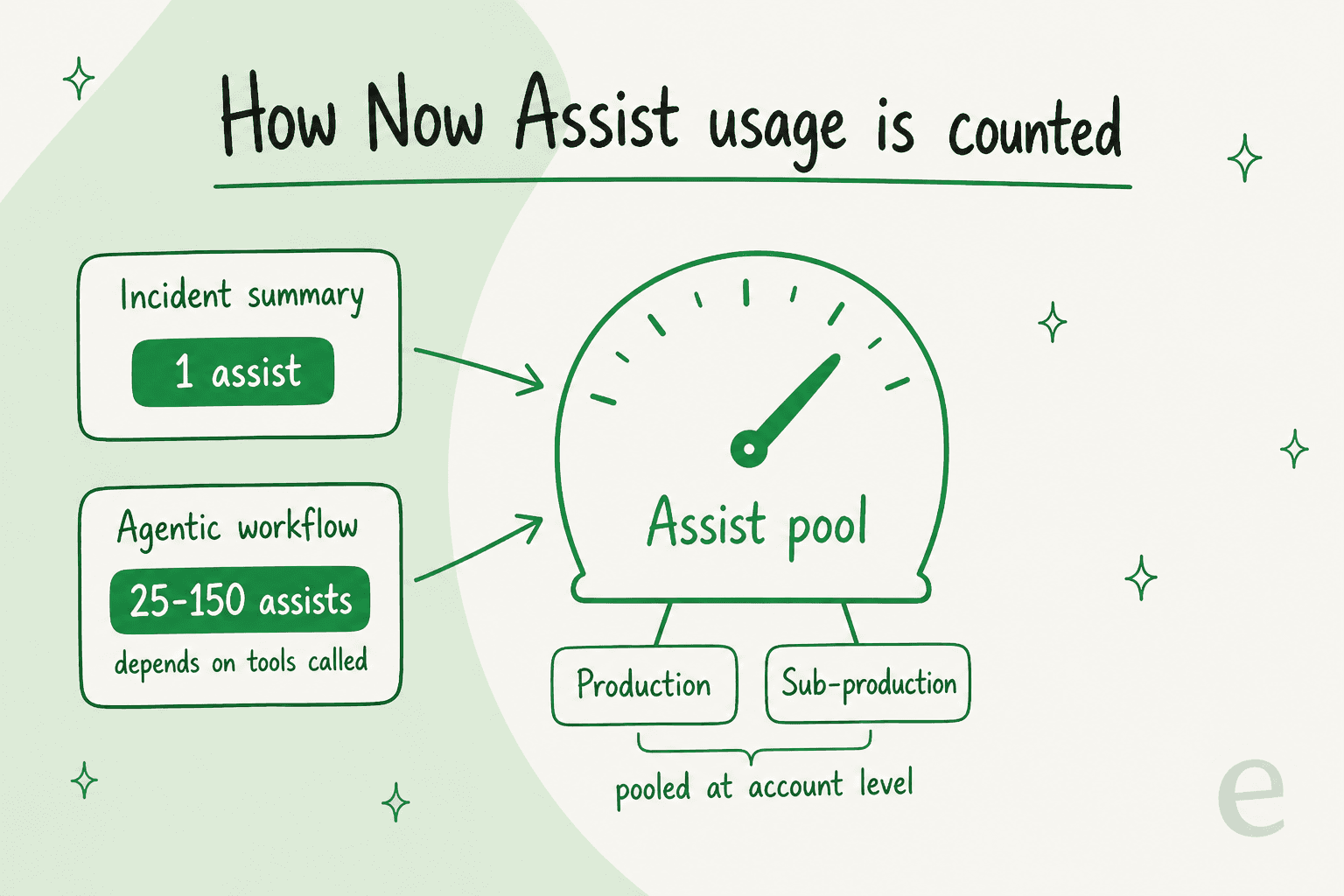
What ServiceNow does put a number on is consumption. Its Now Assist overview, effective August 24, 2026, prices an incident summary at one assist and a single agentic workflow at 25 to 150 assists depending on how many tools it calls, with assists pooled at the account level across production and sub-production instances. A small workflow (under 4 tool calls) costs 25 assists, a medium one (5 to 8) costs 50, and a large one (9 to 20) costs 150, and any actions past the first 20 start a new workflow.
A steep learning curve
ServiceNow promotes AI Agent Studio as a low-code tool, but the broader platform ecosystem is large. G2 reviewers consistently flag learning curve as a top drawback: 72 reviews specifically tag it as a con. The platform has extensive version-specific documentation, and managing AI features requires specific admin roles to configure and govern.
That investment in training, certifications, and potentially specialized administrators is worth factoring into total cost of ownership alongside the license fees.
eesel AI: a different path to support automation
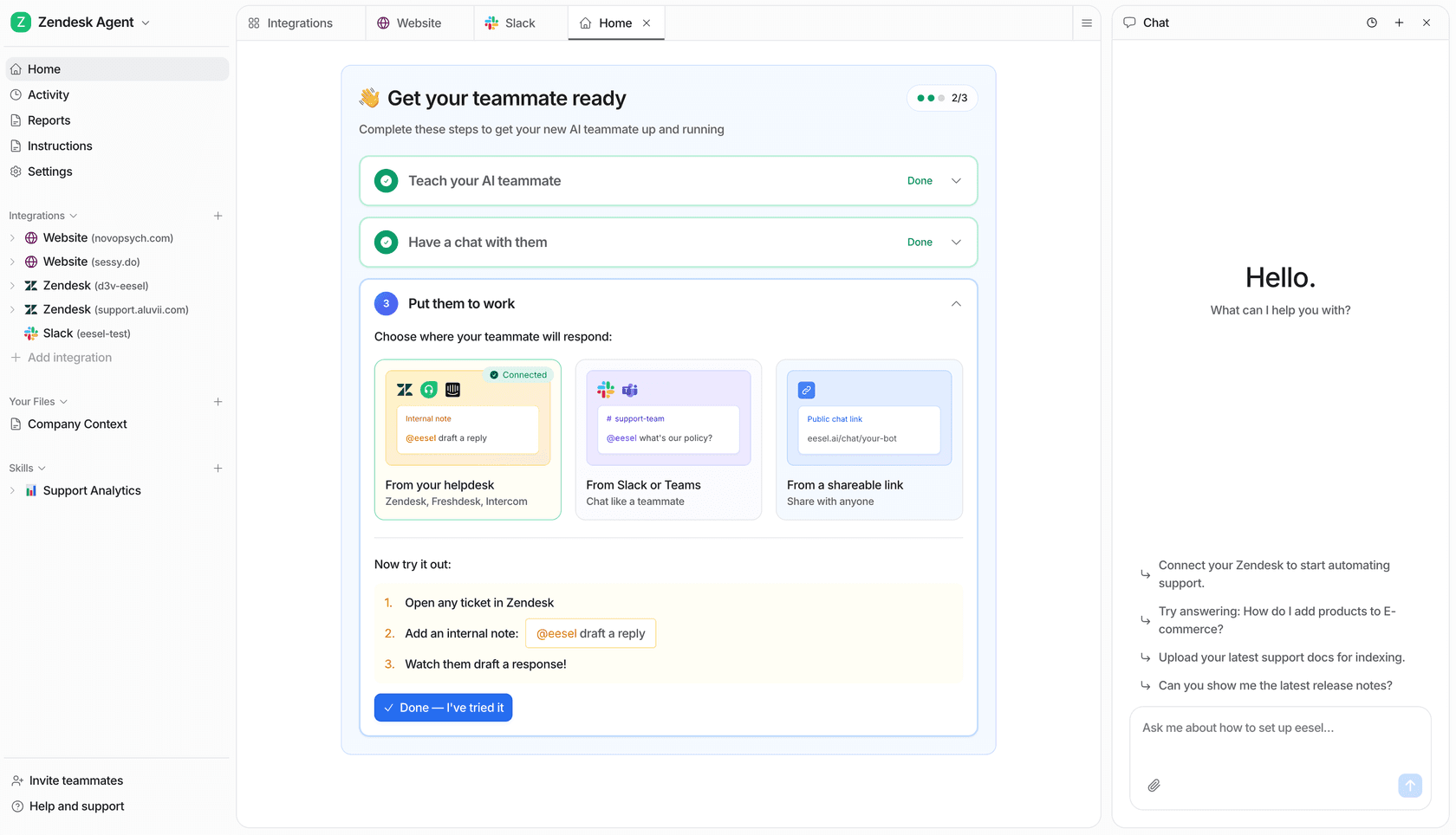
If the prospect of a platform commitment, a multi-stage sales process, and a learning curve gives you pause, there's a different approach. eesel AI is designed to add AI capability to the tools you already have, rather than asking you to consolidate onto a new platform.
Connect and start in minutes
eesel AI is built to be self-serve from day one. You connect your existing help desk (Zendesk or Freshdesk, for example) with a single click. No extended implementation cycle or developer time required.
Before going live, eesel AI lets you run the AI against thousands of your past tickets in simulation mode, seeing how it would have responded and getting a performance forecast. That makes it possible to validate the tool's value on your own data before any customer sees a single AI response.
Flexibility without platform lock-in
Rather than centralizing your data onto a new platform, eesel AI connects to where it already lives: Confluence, Google Docs, your existing support tickets. The AI trains on your actual knowledge and content from day one, without requiring a separate migration or data preparation step.
You can define a custom persona and configure automation rules through plain-language instructions, without building a specialized admin team to manage it.
Transparent, credit-based pricing
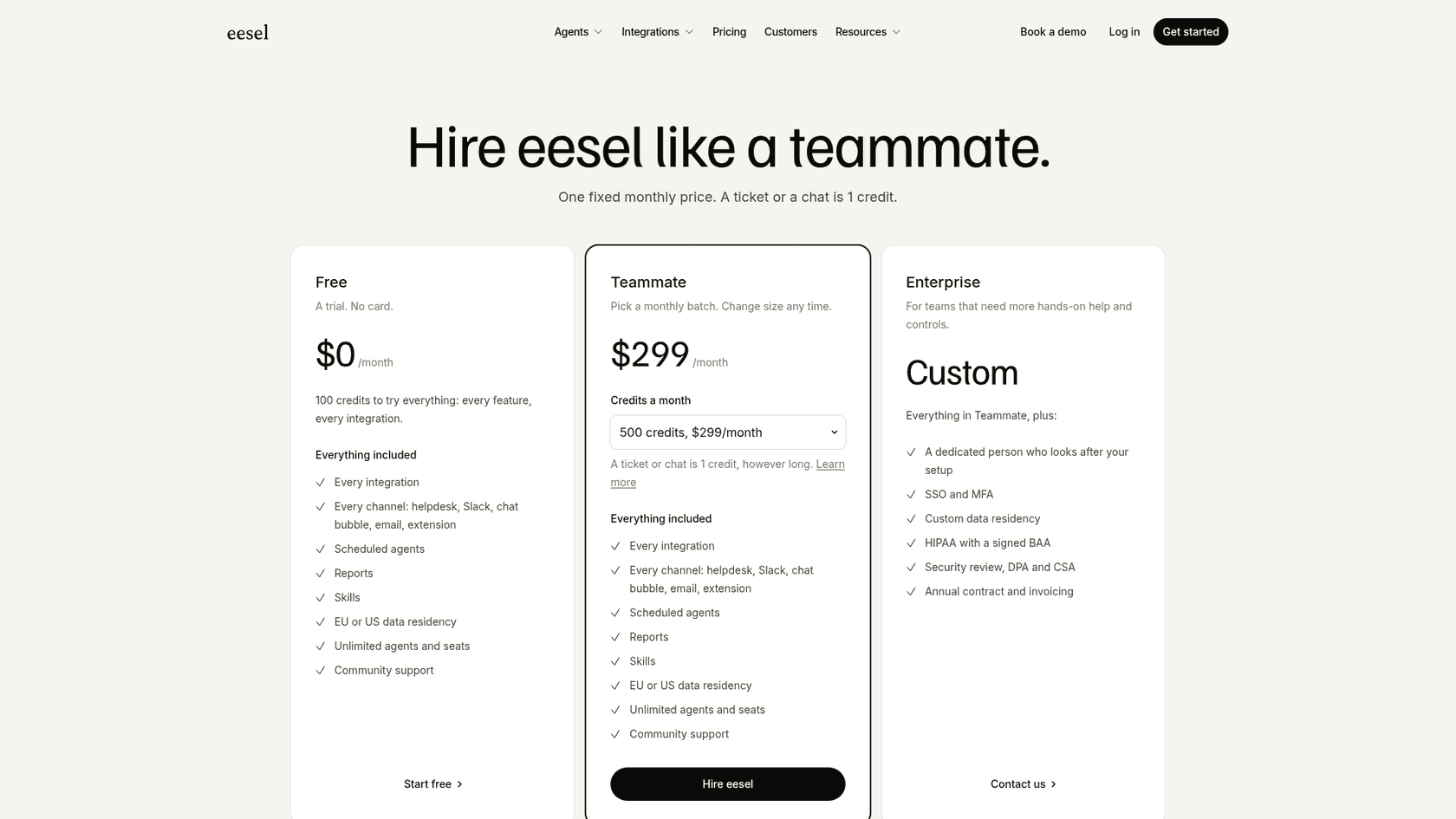
eesel AI uses credit-based pricing rather than per-seat licensing or custom enterprise contracts. You pay one fixed monthly price sized to your volume, and 1 credit covers one ticket or chat, however long.
| Monthly credits | Price |
|---|---|
| 100 | Free, no card |
| 500 | $299/mo |
| 1,000 | $499/mo |
| 2,500 | $999/mo |
| 5,000 | $1,899/mo |
There's no platform fee and no per-seat fee, every integration is included, and you can optionally turn on overage with a monthly cap you set. The free plan comes with 100 credits so you can test it on your own support queue without a credit card.
For teams that want cost predictability without a multi-stage enterprise sales process, that's a meaningful difference from the ServiceNow model.
Choose the right AI partner for your team
ServiceNow offers a deep AI platform built for enterprises running large-scale IT and customer operations. The capabilities are real: CANCOM reports an 80% ticket deflection rate (source), and Griffith University an 87% increase in self-service rate (source). The governance tools are comprehensive. The trade-offs are also real: platform commitment, unpublished pricing, and meaningful operational complexity.
For teams that want to add AI automation to an existing support stack without a platform consolidation or enterprise sales process, a focused tool like eesel AI offers a faster, more transparent path. The right choice depends on your scale, your existing infrastructure, and how much complexity your team is equipped to manage.
Ready to see what a simpler AI solution can do?
Explore how eesel AI can automate your support tickets and integrate with your existing tools in minutes. Start your free trial today.
Frequently asked questions
Why is understanding ServiceNow AI pricing so difficult for potential customers?
ServiceNow does not publish dollar figures for any plan or add-on on its public website. AI capabilities are bundled into tiered product plans (ITSM Foundation, Advanced, and Prime), each requiring a custom quote through ServiceNow's sales team. That multi-layer structure makes upfront cost estimation difficult without going through the full sales process.
What specific AI features are included in ServiceNow's AI pricing tiers?
ServiceNow's AI spans several products: AI Agents (autonomous task-completion across IT and customer service), Now Assist (generative AI for summarization and content generation), Virtual Agent (conversational chatbot), and AI Control Tower (governance and monitoring). Which features you can access depends on your chosen tier.
Do I need a specific base plan to access advanced AI capabilities?
Yes. The most advanced agentic features (including AI Agents for ITSM and the L1 Service Desk AI Specialist) are reserved for the ITSM Prime tier. Lower tiers (Foundation and Advanced) include foundational AI tools and Now Assist capabilities, but not the fully autonomous AI agent features.
Is ServiceNow AI pricing publicly available on their website, or do I need to contact sales?
ServiceNow does not publish pricing for any plan or AI feature publicly. To receive a quote, you must contact their sales team via the pricing inquiry page. This applies to all tiers (Foundation, Advanced, and Prime), including bundled AI capabilities like AI Control Tower.
Is ServiceNow AI pricing accessible for smaller businesses, or is it primarily for enterprises?
ServiceNow's platform is designed for large enterprises. G2 reviewers note that "the ROI tends to be clearer for larger organizations than for smaller teams" and that costs are "a real barrier." Teams with smaller support volumes may find fixed-price tools like eesel AI, which starts at $299 per month for 500 credits (1 credit per ticket or chat) with no platform fee, better matched to their scale.


Article by
Kurnia Kharisma
Kurnia is a software engineer and writer at eesel AI with two years of SEO experience, writing about AI tools, helpdesk software, and customer support. He pairs a developer's understanding of how these products are built with search-driven research into what actually ranks and resonates with the people searching for them.