Choosing between Guru and Confluence comes down to one question: how does your team actually work with knowledge? One is built for deep documentation and technical teams. The other focuses on quick, verified answers delivered right where work happens. Both are solid choices, but they serve completely different workflows.
If you are evaluating knowledge management platforms, you have probably realized it is not just about storing information. It is about how that information gets created, maintained, and accessed when someone needs it. This comparison breaks down what each platform does best, where they fall short, and which one makes sense for your specific situation.
At eesel AI, we think about knowledge management differently. Instead of building another wiki or card system, we built an AI teammate that learns from your existing conversations, tickets, and documents. But more on that later. First, the basics.
What is Confluence?
Confluence is Atlassian's team workspace and enterprise wiki platform. Launched in 2004, it has become the default documentation tool for engineering and product teams, with over 60,000 organizations using it worldwide.
Think of Confluence as a digital filing cabinet with superpowers. It organizes content into spaces and pages, creating hierarchical structures that work well for long-form documentation, project specifications, and technical knowledge. The platform recently added Rovo AI, which includes 20+ pre-built agents and 80+ app connectors to help draft content, summarize pages, and find answers across your knowledge base.
The real strength of Confluence is its integration with the Atlassian ecosystem. If your team already uses Jira for issue tracking, Bitbucket for code, or Trello for project management, Confluence connects seamlessly with all of them. You can link documentation directly to tickets, embed code snippets, and create a unified view of your projects.
User sentiment reflects this positioning. Teams praise Confluence as the "industry standard for technical knowledge management" and appreciate its power for engineering workflows. The common complaints? Search can be frustrating, navigation feels complex for non-technical users, and information can become outdated without active maintenance.
What is Guru?
Guru takes a fundamentally different approach to knowledge management. Founded in 2013, it positions itself as an "AI source of truth" that delivers verified answers within your existing workflows rather than requiring users to visit a separate platform.
Instead of pages and wikis, Guru uses a card-based structure. Each card contains a bite-sized piece of knowledge that subject matter experts can verify on scheduled cycles. This verification workflow is Guru's standout feature. It ensures information stays current rather than becoming documentation debt that no one trusts.
The platform delivers knowledge through a browser extension and Slack integration. When a sales rep is in Salesforce or a support agent is in Zendesk, Guru surfaces relevant cards based on the page they are viewing. No tab switching. No searching through folders. Just answers when and where they are needed.
Guru's AI capabilities, called Knowledge Agents, include Chat for conversational answers, Research for complex queries with citations, and an MCP Server that connects to external AI systems like Claude or Cursor. The company was recognized as a Best Agentic AI Software Product in 2026 and holds a 4.7/5 rating on G2.
Users consistently praise Guru for being "much cleaner and easier to navigate than Confluence" with better search and a more intuitive interface. The main drawback is pricing accessibility for smaller teams, which we will cover in detail below.
Guru vs Confluence: Feature comparison
Content structure and organization
Confluence organizes knowledge hierarchically. You create spaces for teams or projects, then build out pages with nested subpages. This structure works well for comprehensive documentation like technical specs, employee handbooks, or project wikis. The trade-off is that finding specific information often requires navigating through multiple levels or using search that does not always surface the right results.
Guru flips this model. Cards are self-contained units of knowledge organized into boards and collections. The flat structure makes information easier to find quickly, but it is less suited for long-form documentation that needs to flow as a cohesive narrative.
Integration philosophy
Confluence doubles down on the Atlassian ecosystem. The integration with Jira is particularly deep. You can link Confluence pages to epics, stories, and bugs, creating bidirectional relationships between documentation and development work. This is a major advantage if your team lives in Atlassian tools.
Guru takes a workflow-agnostic approach. Its browser extension works across any web application, delivering contextual knowledge based on what the user is viewing. The Slack integration is particularly strong, surfacing relevant cards during conversations. For teams that use a mix of tools or want knowledge delivered in their existing workflows, this approach reduces friction significantly.
AI capabilities
Both platforms have embraced AI, but with different priorities.
Confluence includes Rovo AI in all paid plans at no additional cost. You get 20+ pre-built agents for tasks like generating meeting summaries, creating page templates, and answering questions across your knowledge base. The AI focuses on content creation and retrieval within the Confluence environment.
Guru's Knowledge Agents emphasize verified, permission-aware answers. The Chat agent provides conversational responses with citations. The Research agent handles complex queries with guided research plans. The MCP Server connects Guru to external AI systems, letting tools like Claude pull from your governed knowledge layer. Every answer respects the permissions of your source systems and includes lineage tracking.
Verification and knowledge health
This is where Guru differentiates most clearly. Built-in verification workflows let subject matter experts claim ownership of cards and set review cycles. When a card needs updating, the owner gets notified. This creates accountability that keeps knowledge accurate over time.
Confluence relies on manual review processes. While you can set page restrictions and assign owners, there is no systematic workflow for ensuring content stays current. Information rot is a common complaint, especially in larger organizations where documentation sprawls across thousands of pages.
Pricing comparison
Confluence pricing
| Plan | Monthly Price | Annual Price | Key Features |
|---|---|---|---|
| Free | $0 | $0 | Up to 10 users, 2GB storage, Community Support |
| Standard | ~$6.05/user | ~$5.42/user | 250GB storage, Rovo AI included, local business hours support |
| Premium | ~$11.55/user | ~$10.42/user | Unlimited storage, 24/7 Premium Support, 99.9% uptime SLA |
| Enterprise | Custom | Custom | Unlimited storage, 24/7 Enterprise Support, 99.95% uptime SLA, Atlassian Guard included |
Confluence offers a 7-day free trial of Standard or Premium plans. The free tier is genuinely useful for small teams testing the platform.
Source: Confluence Pricing
Guru pricing
Guru has shifted to a consultative pricing model and no longer publishes per-seat rates on its website. According to their pricing page, "your investment is tailored to your organization's scale, knowledge complexity, and AI maturity."
What this means in practice is that Guru now sells packages that include:
- Full platform access with Knowledge Agents
- 100+ integrations and MCP delivery
- Verification workflows and automated knowledge maintenance
- A team of solution engineers for knowledge architecture design and AI agent configuration
- SOC 2 Type II, HIPAA, and GxP compliance
- SSO, SCIM, and role-based access
For smaller teams, this shift makes Guru less accessible than it once was. Historical pricing of $25/user/month with a 10-seat minimum created a $250/month floor, but current pricing requires contacting sales for a custom quote.
Source: Guru Pricing
Total cost analysis
For a team of 10 people, Confluence is free while Guru requires a custom enterprise quote. At 25 users, Confluence Standard runs about $135/month compared to Guru's likely custom pricing in the $500-1000+ range. The gap widens as teams scale.
The key insight is that Confluence offers predictable, transparent pricing that scales linearly with headcount. Guru's value proposition centers on expertise and outcomes rather than seat count, which appeals to larger organizations but creates friction for smaller teams.
Real user perspectives
Review platform data tells a consistent story about user satisfaction.
On TrustRadius, Guru scores 9.6/10 compared to Confluence's 8.0/10. On Capterra, Guru holds a 4.8/5 rating versus Confluence's 4.4/5. Software Advice gives Guru 4.8/5 across ease of use, value, and functionality compared to Confluence's 4.3/5.
Guru is much more user-friendly than Confluence overall. We actually moved our knowledge management from Confluence to Guru for our frontline agents.
Guru is much cleaner and easier to navigate than Confluence. Much cleaner interface. Better search. Cleaner organization.
Confluence users appreciate its power for technical documentation. One reviewer noted it is "the industry standard for technical knowledge management" and "has been used extensively by engineering teams for many years as a repository for information on projects."
Common complaints about Confluence focus on search functionality and navigation complexity. Users report that "information quickly became out of date" and "there weren't prompts to update it, so no one ever did."
Guru users consistently highlight the verification workflows and browser extension. The ability to "verify content and schedule review timelines, which helps ensure everything stays up to date" comes up repeatedly. The main criticism is pricing accessibility for smaller organizations.
Who should choose what
Choose Confluence if:
- Your team is already invested in the Atlassian ecosystem (Jira, Bitbucket, Trello)
- You need to maintain long-form technical documentation and project specifications
- You want predictable, transparent pricing with a generous free tier
- Your primary users are engineers or technical teams comfortable with wiki-style organization
- You need flexible external sharing options like public links and guest access
Choose Guru if:
- Your sales or support teams need quick, verified answers without leaving their workflow
- Knowledge accuracy and compliance are critical for your industry
- Your organization has a strong Slack culture and wants knowledge integrated there
- You prefer browser-based contextual delivery over visiting a separate platform
- You want built-in verification workflows to prevent documentation decay
- You have the budget for an enterprise-grade solution with expert implementation support
A modern alternative: eesel AI
Both Guru and Confluence approach knowledge management as a content repository problem. You create content, organize it, and hope people can find it when they need it. But what if the knowledge already exists in your organization, scattered across tickets, past conversations, and documents?
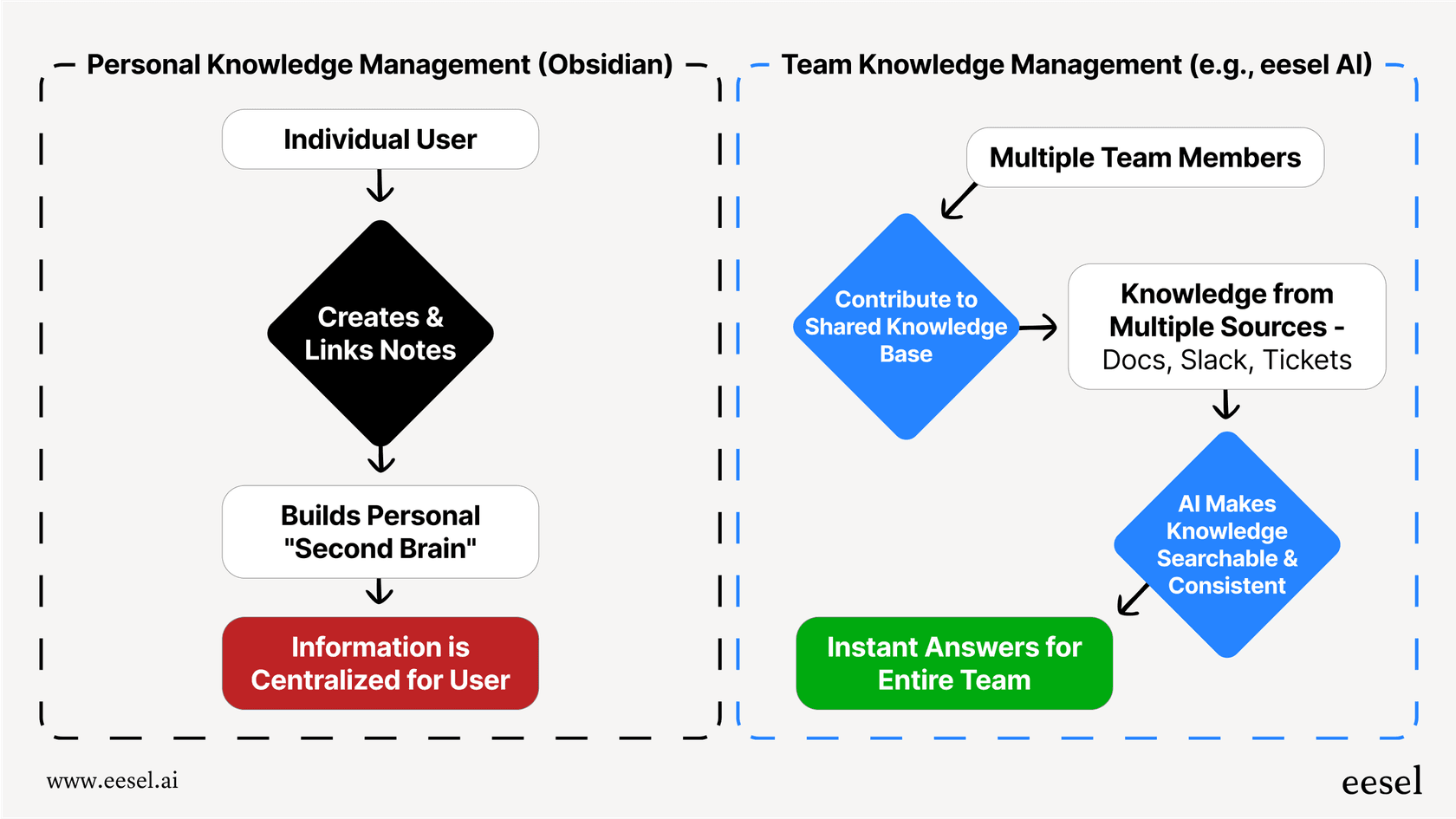
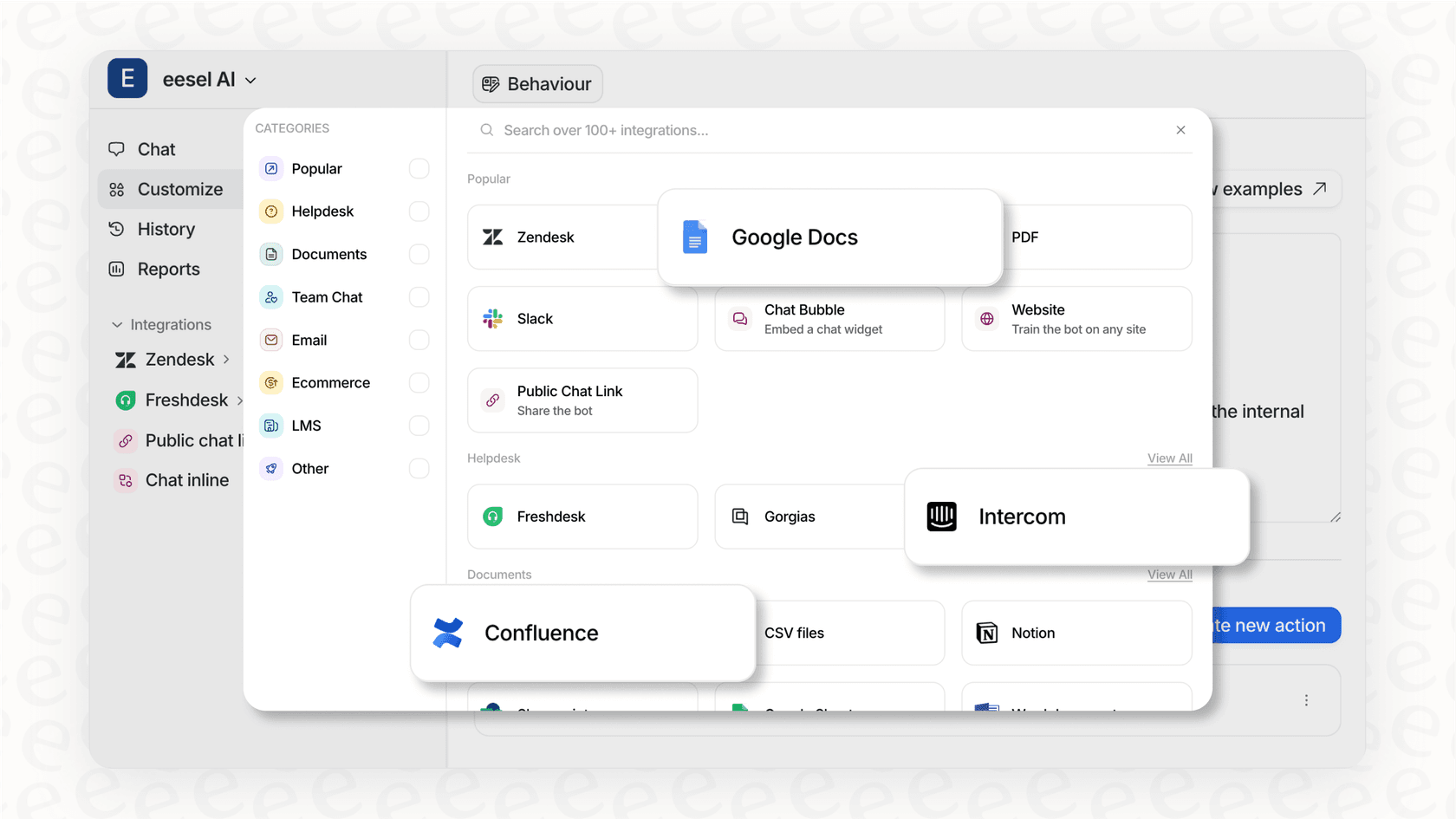
At eesel AI, we built something different. Instead of asking you to migrate everything into a new wiki or card system, our AI teammate learns from the tools you already use. Connect us to your help desk, Slack, Confluence, or Google Docs, and we immediately start understanding your business context, tone, and common issues.
Here is how we differ:
- No manual migration: We learn from your existing data rather than requiring you to rebuild your knowledge base
- Progressive rollout: Start with AI drafting replies for review, then level up to full autonomy as confidence grows
- Plain-English control: Define escalation rules and scope in natural language, not complex configurations
- Works everywhere: Integrate with Zendesk, Freshdesk, Slack, Microsoft Teams, and 100+ other tools
For teams that want AI-powered knowledge without the overhead of traditional knowledge management platforms, eesel AI offers a different path. You are not configuring a tool. You are hiring a teammate that learns your business and gets smarter over time.
Making your choice
The decision between Guru and Confluence ultimately comes down to your team's workflow and priorities.
If you are deeply embedded in the Atlassian ecosystem and need a robust wiki for technical documentation, Confluence is the obvious choice. Its free tier makes it accessible for small teams, and Rovo AI adds genuine value without extra cost. The trade-off is complexity and the risk of outdated information without active maintenance.
If your sales or support teams need quick, verified answers delivered in their existing workflows, Guru's card-based approach and verification workflows justify the investment. The user experience is cleaner, search works better, and the built-in knowledge health features prevent documentation decay. The trade-off is pricing accessibility and the need for expert implementation.
For teams that find neither approach quite right, modern AI alternatives like eesel AI offer a different model. Instead of building and maintaining a knowledge base, you connect to existing data sources and let AI learn from what you have already created. The teammate model means you start with guidance and level up to autonomy based on actual performance, not arbitrary timelines.
Whatever you choose, the goal is the same: getting the right information to the right person at the right time. The best platform is the one your team will actually use.