Podium pricing is $399 a month for Core and $599 a month for Pro, with Signature priced by quote. Podium's default contract is 12 months, billed annually in advance and auto-renewing, so Core is really a $4,848 first-year commitment once the $5 carrier fee is added, and closer to $6,400 with three phone users. Podium makes sense if you'll use reviews, texting, phones and payments together. If your real need is answering customer questions on chat and email, an AI helpdesk teammate like eesel does that month to month from $299. With the eesel CLI, an AI coding agent can add that chat to your site, load your FAQs and test the answers before customers see them.
Pick a plan, phone users and numbers to see Podium's monthly bill and what you commit to in year one.
How much does Podium cost per month?
Podium costs $399 a month on Core and $599 a month on Pro, according to Podium's pricing page. Signature has no public number and is built per business by the sales team. All three buttons say "Talk to Sales", so there is no self-serve checkout and no free plan.
I spend a lot of my week looking at what people type into search before they buy software, and "Podium pricing" is almost never a question about the $399. It's a question about the invoice. Podium's own FAQ says the monthly cost may vary based on industry, partnerships, integrations, volume and carrier fees, and that's the gap this post fills.
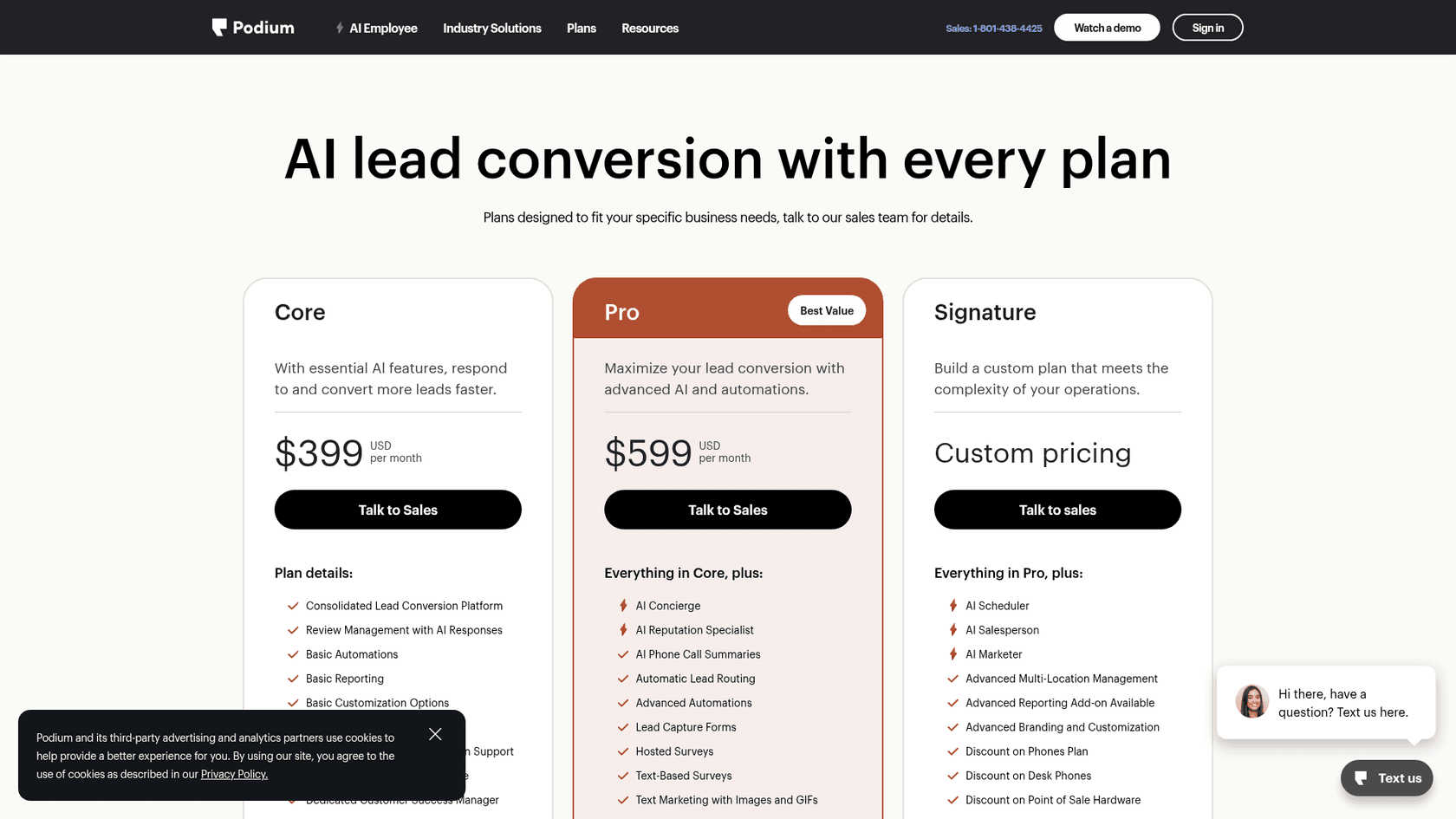
| Plan | Price (USD) | Bulk message credits | Phone numbers included | AI on top of the base | Best for |
|---|---|---|---|---|---|
| Core | $399/month | 250 a month | 5 | Review management with AI responses | One location that mainly needs texting, reviews and webchat |
| Pro | $599/month | 500 a month | 15 | AI Concierge, AI Reputation Specialist, AI call summaries | Teams that want automatic lead routing and text marketing with images |
| Signature | Custom | Custom | Custom | AI Scheduler, AI Salesperson, AI Marketer | Multi-location groups and businesses with complex operations |
Every plan comes with unlimited contacts, one-to-one texts, team members, conversation history and call recordings. Every plan also gets a dedicated customer success manager and one-on-one onboarding, which is part of why the floor is $399 rather than a per-seat price like the ones in Tidio's pricing. LiveChat's pricing follows that per-seat pattern too. One footnote applies to all three plans: HVAC businesses are told to contact sales for their own pricing.
What do you actually get on Core, Pro and Signature?
The plan cards read like a list of features, so here's how I'd group them by the job each plan does. Core is the "one inbox for every lead" plan. Pro adds the automation and AI that chase leads for you. Signature is for operators who run several locations and want custom billing and payment rates.
| Area | Core ($399) | Pro ($599) | Signature (custom) |
|---|---|---|---|
| Inbox and leads | Consolidated lead inbox for website and third-party leads | + Automatic lead routing, lead capture forms | + Advanced multi-location management |
| Reviews | Google, Facebook and industry review sites, AI review responses | + AI Reputation Specialist | Same as Pro |
| Texting and marketing | Text marketing, 250 bulk credits | + Images and GIFs, 500 bulk credits, advanced segmentation | Custom credit volume, bulk message discount |
| Carrier-verified messaging | $15/month extra | Included | Custom |
| Phones (add-on) | $30/$25 per user | $30/$25 per user | Discounted |
| Payments | Podium Payments (rates not published) | Lower processing fees | Custom processing rates |
| Support | Chat, phone, email, a dedicated CSM | Same | + Quarterly business reviews, priority phone support |
Two things stand out. First, the "Lower Payment Processing Fees" line on Pro and "Custom Processing Rates" on Signature tell you payments are part of the pricing story, but Podium doesn't publish the processing rates themselves on the Podium Payments page. If you'll run card volume through Podium, ask for the rate sheet in writing. Second, Pro bundles the high-volume carrier-verified messaging that costs $15 a month on Core, so if you'd add it on Core anyway, the real gap between the two plans is $185 a month, not $200.
Which Podium fees sit outside the plan price?
These are the line items that show up on a Podium invoice on top of the plan, all from Podium's pricing page and its FAQ.
| Fee | Price | Who pays it |
|---|---|---|
| Base 10DLC carrier fee | $5/month per location | All US locations |
| High-volume carrier-verified messaging | $15/month | Core (included on Pro) |
| Extra phone numbers | $5/month each | Beyond 5 on Core or 15 on Pro |
| Podium Phones seats | $30/user/month (1 to 4 users), $25/user/month (5+) | Anyone adding the phone system |
| Network optimization fee | $500 per location | Anyone adding Podium Phones |
| Extra bulk message credits | Not published; bought as an annual plan or one-time add-on | Anyone sending more campaigns than the plan includes |
| AI Employee | Quote only | Optional add-on to any plan |
| Automated AI review responses, AI Instant Answers | Listed as "add-on available", price not published | Optional |
| Advanced reporting | Add-on, price not published | Signature |
| Overage on capped usage | Podium's "then-current rates", not published | Anyone above the caps below |
The $5 10DLC fee is the one nobody can avoid in the US. 10DLC is the carrier registration system for business texting from normal 10-digit numbers, and Podium says the base fee covers 3 message segments per second and up to 2,000 T-Mobile messages per day per location. If you're new to how carriers charge for business texting, my guide to AI SMS support for ecommerce covers the basics, and the WhatsApp Business API pricing post shows how Meta meters the other big messaging channel.
Bulk messages work on credits. Per Podium's Bulk Message Credits article, one standard SMS up to 160 characters (or 70 with an emoji) to one contact is 1 credit, an MMS in the US is 3 credits, and credits expire at the end of each month. So Core's 250 credits is one plain text to 250 customers, or one picture message to about 83. If you hit the limit, Podium's FAQ says you can't send more bulk messages until next month unless you buy more. One-to-one replies and automated messages don't use credits.
What does "unlimited" cover, and where are the caps?
Podium's plan table says "Unlimited" a lot, and for contacts, one-to-one texts and team members it means it. The caps live further down, in a pricing FAQ called "Scope of Use limitations", and they apply to the parts of Podium that cost it real money to run.
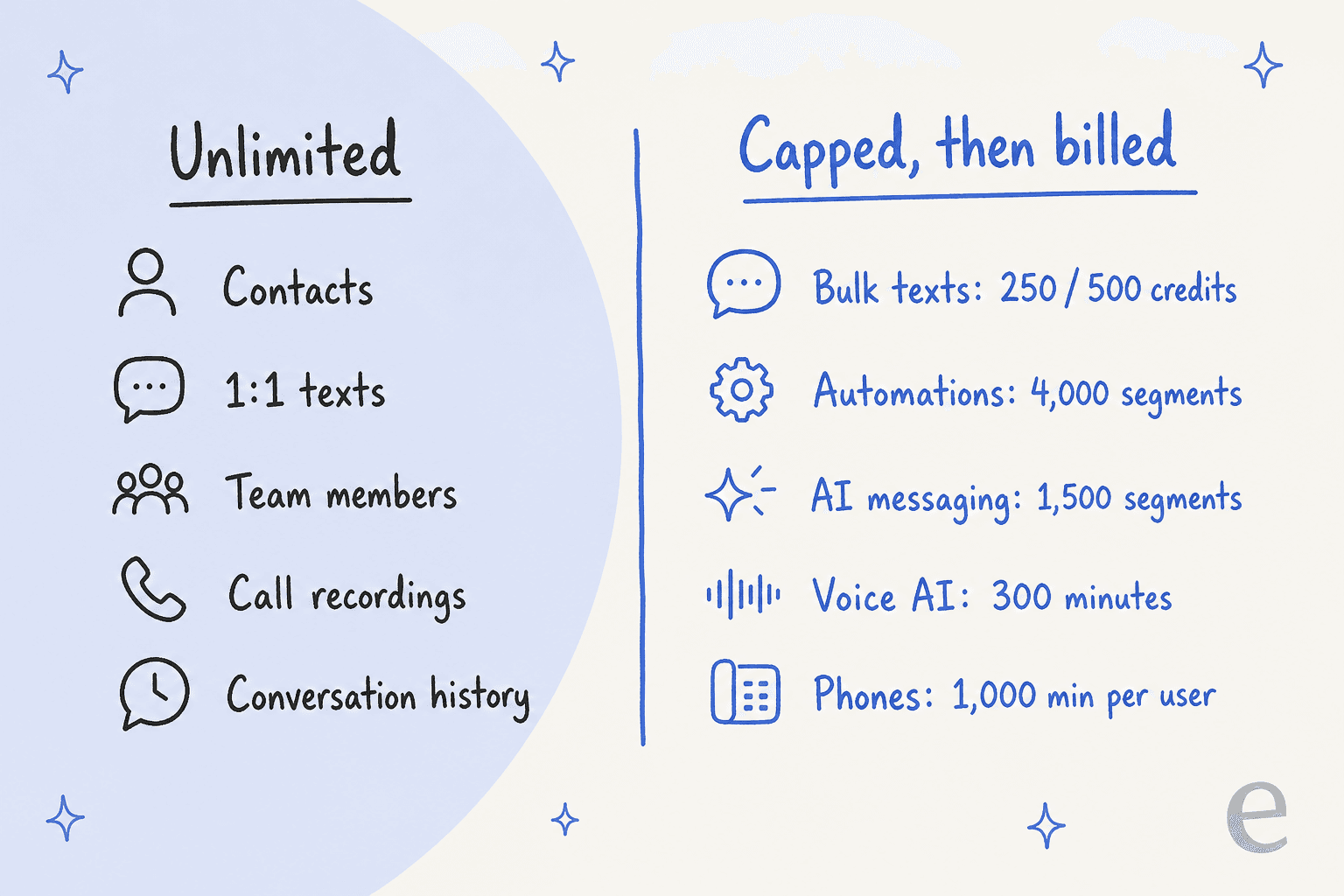
Here are the published caps:
- Automations: 4,000 segments per location per month, of which up to 1,000 may be MMS segments
- Voice AI: 300 minutes per month
- AI Messaging: 1,500 segments per month
- Phones: 1,000 minutes per user per month
Above those, Podium bills overages "at Podium's then-current rates", which aren't listed on the page. Its Acceptable Use Policy adds that anything marked unlimited is meant for "normal business use", and that actions taken through AI Services count toward your usage allocations the same way manual actions do. The 1,500 AI messaging segments is the cap I'd watch. Podium doesn't define an AI segment on the page, but if it works like a standard SMS segment of 160 characters, a chatty 400-character AI reply burns 3 segments. At 3 segments per reply, the cap covers about 500 AI replies a month.
That's the same trap I flagged in AI employee pricing: when the unit is a message or a segment, the bill depends on how talkative the AI is, which you don't control. eesel went the other way on purpose: one customer ticket or chat is 1 credit however long it runs.
What does Podium cost in year one?
The year-one number is the one to budget for, because Podium's Terms of Service bill subscription fees annually in advance by default. Here are three setups for a single US location, using only Podium's published prices.
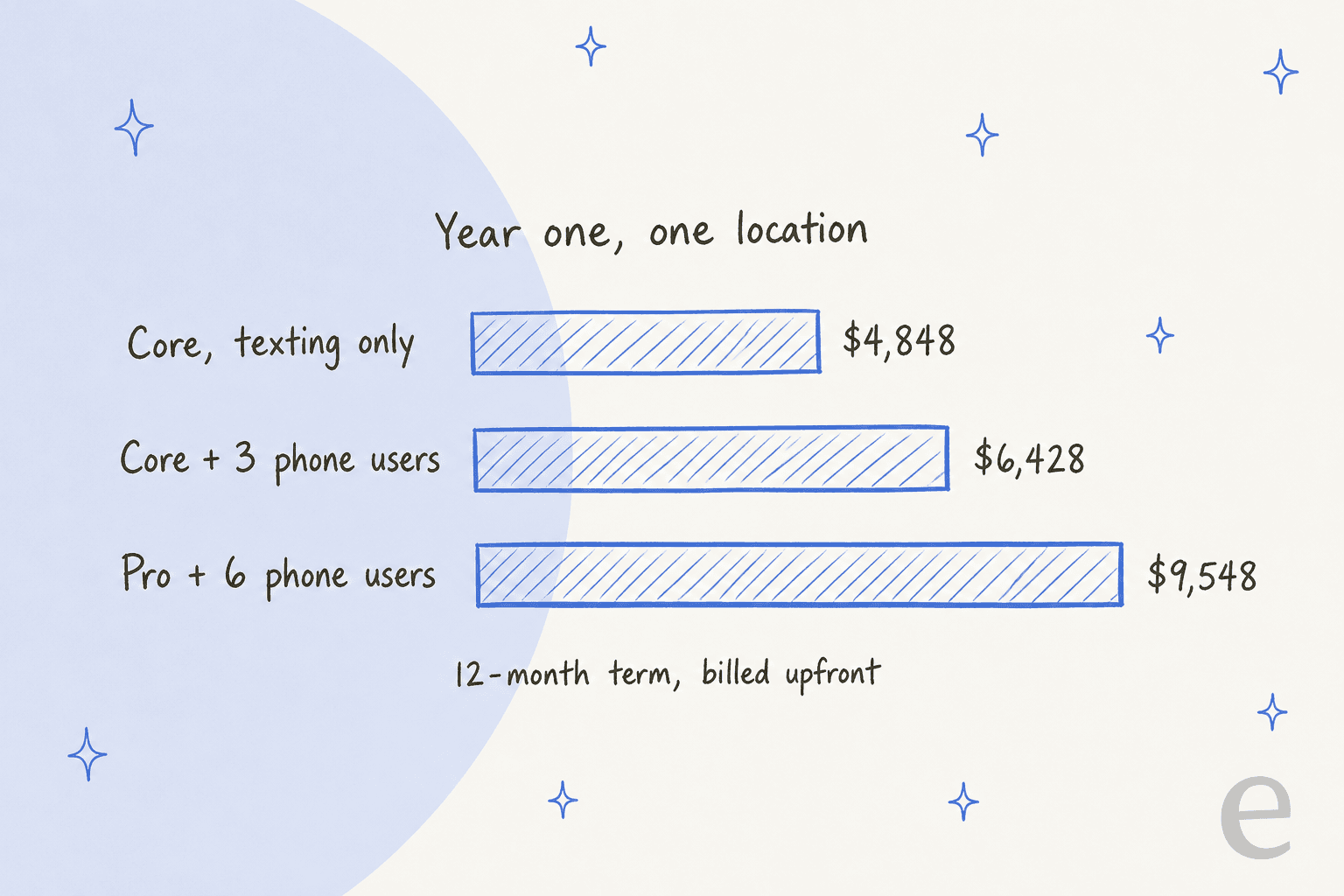
| Setup | Monthly | One-time | Year one |
|---|---|---|---|
| Core, texting only: $399 + $5 10DLC | $404 | $0 | $4,848 |
| Core + 3 phone users: $399 + $5 + 3 × $30 | $494 | $500 network fee | $6,428 |
| Pro + 6 phone users: $599 + $5 + 6 × $25 | $754 | $500 network fee | $9,548 |
I've counted the $500 network optimization fee once, since Podium lists it per location without saying it recurs. I've also left out the things Podium doesn't price publicly: extra bulk credits, overages, payment processing and AI Employee.
If the Core-plus-phones setup is close to yours, compare it with phone-first tools too. Aircall's pricing charges per seat with a seat minimum. Dialpad's pricing is per seat as well.
CloudTalk's pricing follows the same model, and my CloudTalk for small business post walks through the small-team math.
How do Podium's contract and renewal work?
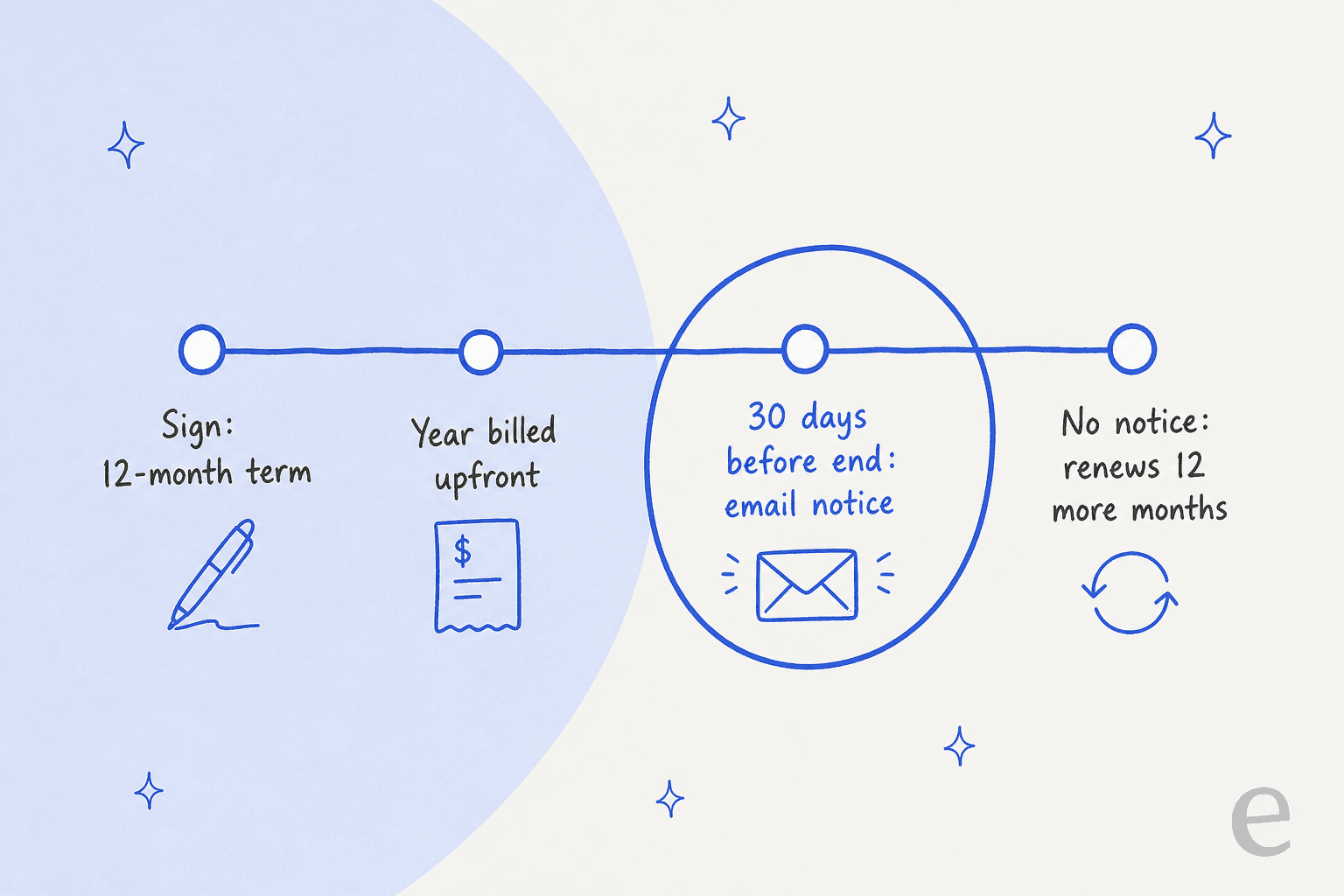
This is the part of Podium pricing that matters most and gets read least. Under section 8.1 of the Terms of Service effective 15 October 2026, unless your order form says otherwise:
- The initial term is 12 months, and it renews automatically for another 12 months.
- To stop the renewal you send written notice at least 30 days before the term ends, by email to support@podium.com.
- You agree to pay for the whole term. You can't cancel mid-term except for cause, like an uncured breach on Podium's side.
- Fees are non-refundable, and subscription fees are paid annually in advance by default.
Section 7.5 matters too. Podium can raise fees with 45 days' written notice, effective at your next term, and it can update published usage rates with 30 days' notice at any point in the term. Carrier fees can change any time. On one of eesel's own sales calls, a budget-conscious B2B hardware support team told the eesel team that a previous vendor's price had more than doubled, and the first thing they asked about was locking the price in writing. With Podium, that ask belongs in the order form before you sign.
The renewal clause is where most of the frustration in community threads comes from. One small business owner put it plainly:
"Podium has a auto renew feature a year at a time. We only received 13 google review in a year. When we were not satisfied and tried to discontinue, they would not let us out. You need to notify them in writing 30 days before the end of the contract."

To be fair to Podium, the 30-day notice rule is written into the terms, and plenty of B2B software works the same way. The fix is simple and boring: put the notice deadline in your calendar the day you sign. If annual commitments are a dealbreaker, check each tool's billing terms before the demo. My small business help desk roundup is a good starting list.
Help Scout's pricing is one to compare. So is Front, and Re:amaze is another shared inbox worth a look.
How much does Podium's AI cost?
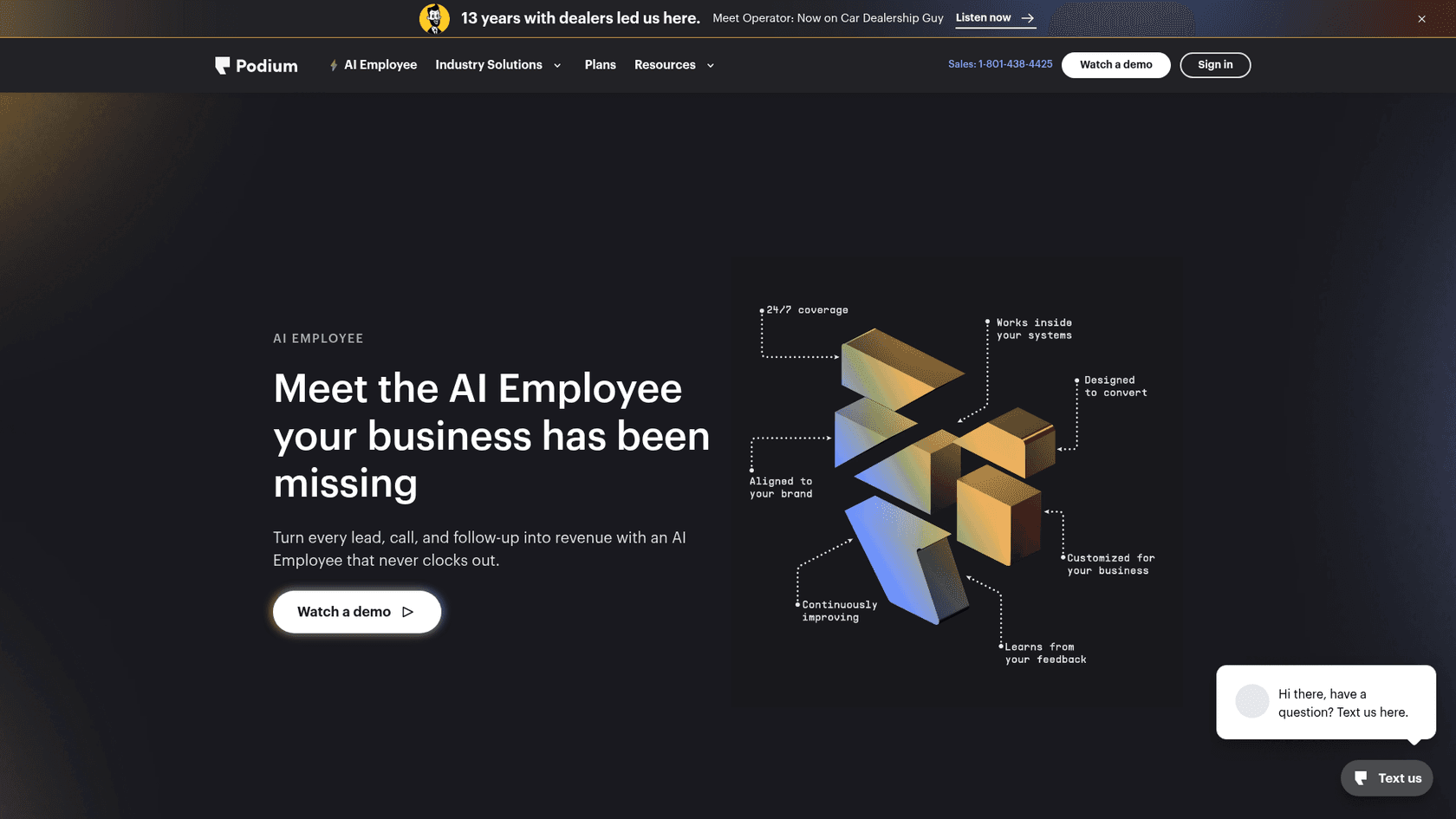
Podium has moved its whole pitch onto AI. The AI Employee page describes an assistant that responds to new leads 24/7, qualifies them, books appointments and sends reminders, with named versions for automotive, aesthetics and home services. The pricing page says you can add AI Employee to any plan, but it doesn't give a price.
What you can price from the public page:
- On Core: review management with AI responses. Podium also lists automated AI review responses and AI Instant Answers as add-ons.
- On Pro: AI Concierge, AI Reputation Specialist and AI phone call summaries.
- On Signature: AI Scheduler, AI Salesperson and AI Marketer.
- On every plan: the Voice AI cap of 300 minutes and the AI messaging cap of 1,500 segments a month.
So an AI-first Podium setup is quote-only on two fronts: the AI Employee itself and any usage above the caps. One user who has run it for over a year described the tuning work in a thread about Podium for texting and reviews:
"I feel like the AI agent is too expensive for the value it offers. You have to spend a lot of time with customer service to tweak the AI agent to not say things you dont want it to say."
That matches what I've seen across years of putting AI on live support queues. I've watched a confident-sounding bot give a customer the wrong answer, which is why every eesel rollout now gets simulated against past tickets before it talks to a real customer. Whichever AI you buy, ask how you test it before it goes live, and how you correct it when it gets something wrong. If you're weighing AI receptionists and voice agents specifically, my posts on the AI phone receptionist category and AI voice agents for support go deeper.
What do Podium users say about the price?
The pattern in community threads is consistent: people who use most of the suite tend to be happy, and people who bought it for one or two features feel the $399 floor. Here's the positive side from someone who rolled it out at scale:
"I actually implemented Podium when I was working full-time in healthcare to over 1500 individual locations. Given the scope of the project, their team was very helpful and the results were great. We were mostly using it for patient feedback."
And the price side, from a separate small business thread about Podium:
"Podium is kind of the industry standard and thus the most expensive."
Both are fair. Podium's onboarding, CSM and review engine are real strengths, and Podium's own customer stories lean on review growth for exactly that reason. The cost question comes down to how much of the platform you'll actually use. If review collection is the main draw, my roundup of customer feedback tools covers lighter options.
Is Podium worth it?
Podium is worth it when you'll use at least three of its pillars together: review requests, two-way texting, phones and text-to-pay. A furniture store or med spa that collects payments by text, chases Google reviews after every visit and routes calls through Podium Phones gets a lot for $494 to $754 a month, and gets one vendor to call when something breaks. If that's you, push for the Pro plan's included high-volume messaging and lower processing fees, and negotiate the renewal terms up front.
It's a harder sell when the real job is answering customer questions. If what you need is a fast, accurate reply on website chat, email or WhatsApp, you'd be paying $4,848 a year minimum for a suite where you mostly use the inbox. In that case, start with an AI chatbot for your website before a full suite. If texting is the channel that matters, my list of the best AI for SMS support covers it.
Not sure whether you need a bot or people? My AI chatbot vs live chat post walks through that choice, and if you want humans on chat, there's my guide to live chat software for your website.
When an AI helpdesk teammate is the cheaper fix
eesel doesn't replace Podium's review engine, phone system or payments, and eesel doesn't integrate with Podium. What it does is the job a lot of Podium buyers are really shopping for: answering every customer question, day and night, from your own website and documents, and handing anything serious to a person.
eesel is an AI helpdesk teammate. It answers in a chat bubble on your website and on WhatsApp, from the same knowledge and instructions.
If you already run a helpdesk, it works inside it too. Small teams on Zendesk use it to draft replies. Shopify stores on Gorgias let it look up the order before answering, and it plugs into Freshdesk the same way.
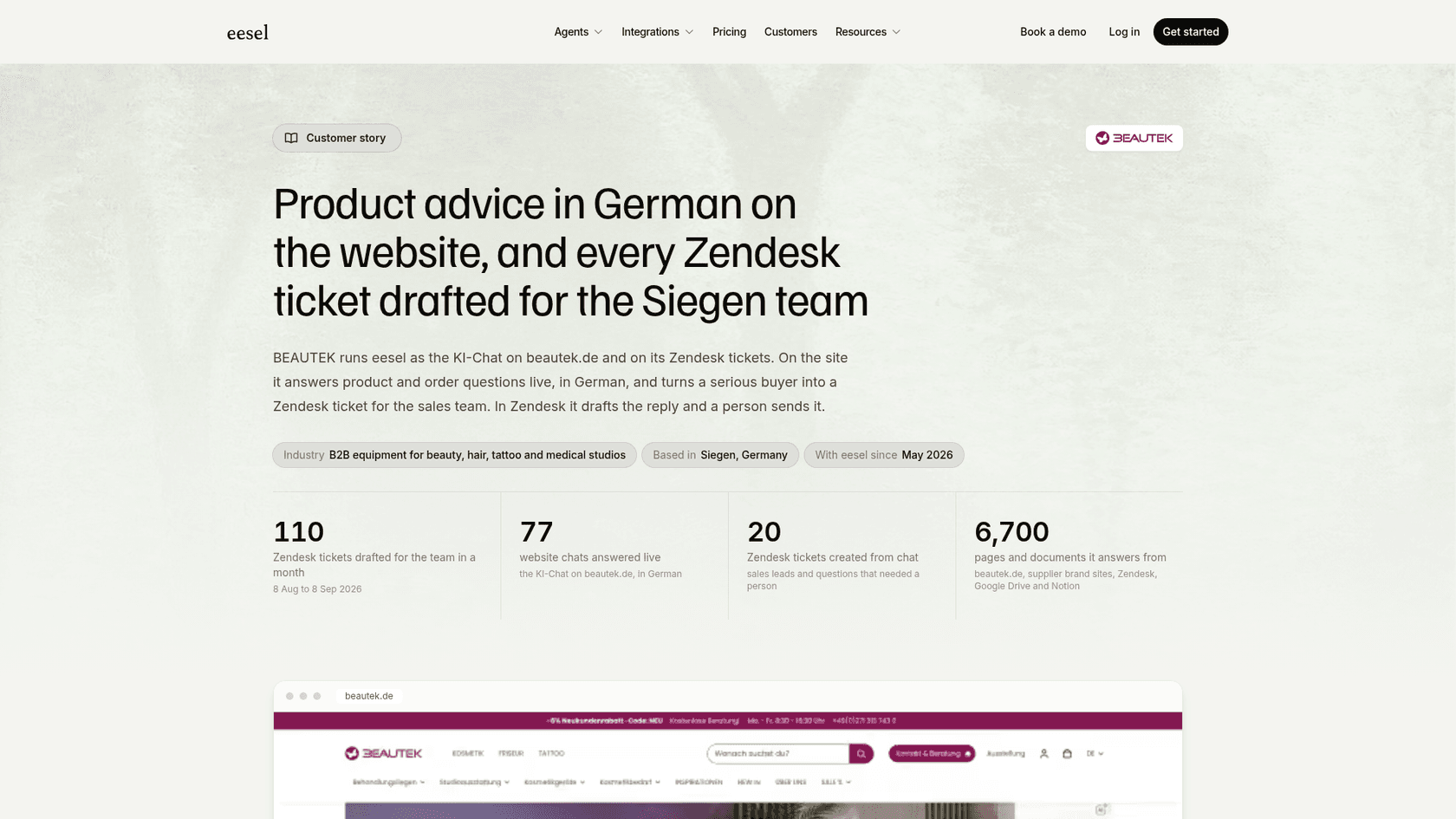
BEAUTEK, a German supplier of studio equipment, is a close match to the Podium use case. Its phone line is staffed weekday office hours, but its shop is open all the time. eesel runs as the chat on beautek.de, answers product and order questions in German, and turns a buyer asking for a quote into a Zendesk ticket tagged for the sales team. In one month it answered 77 website chats live and created 20 tickets from chat, most of them sales leads. That's the "never miss a lead after hours" promise, without a phone system attached.
For a store, Question Beauty shows the volume side. Its Facebook Messenger, email and website chat all land in Gorgias, and eesel handled 990 tickets in a month, sent 960 replies itself and closed 280 without a person. Refunds, complaints and wholesale requests always go to the team with a note.
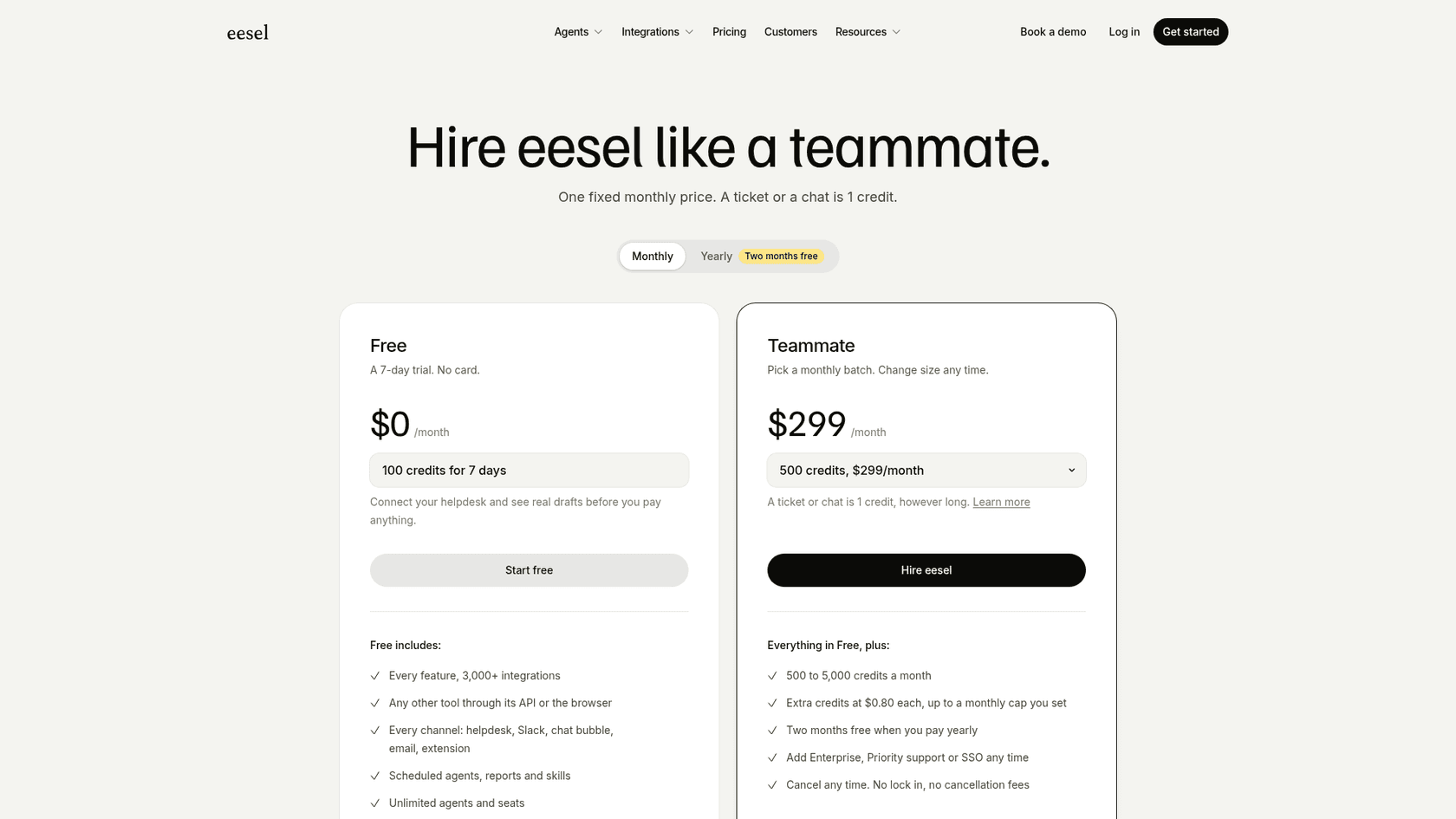
The pricing is the other difference. On eesel's pricing page, the Teammate plan starts at $299 a month for 500 credits, where one ticket or chat is 1 credit however long it runs. There's a 7-day free trial with 100 credits and no card, and you can cancel any time with no lock-in. If you want more options, my roundup of AI agents for small business compares them side by side. For the bigger platforms, see the best AI employee list.
Try eesel
If you're looking at Podium mainly to stop missing customer questions after hours, try the cheaper fix first. eesel joins your website chat, email or helpdesk in a few minutes, learns from your own pages and past replies, and answers like a new hire who has already read everything. You can run it on your real questions for a week before paying anything, and if it doesn't fit, you haven't signed a 12-month contract to find out.