

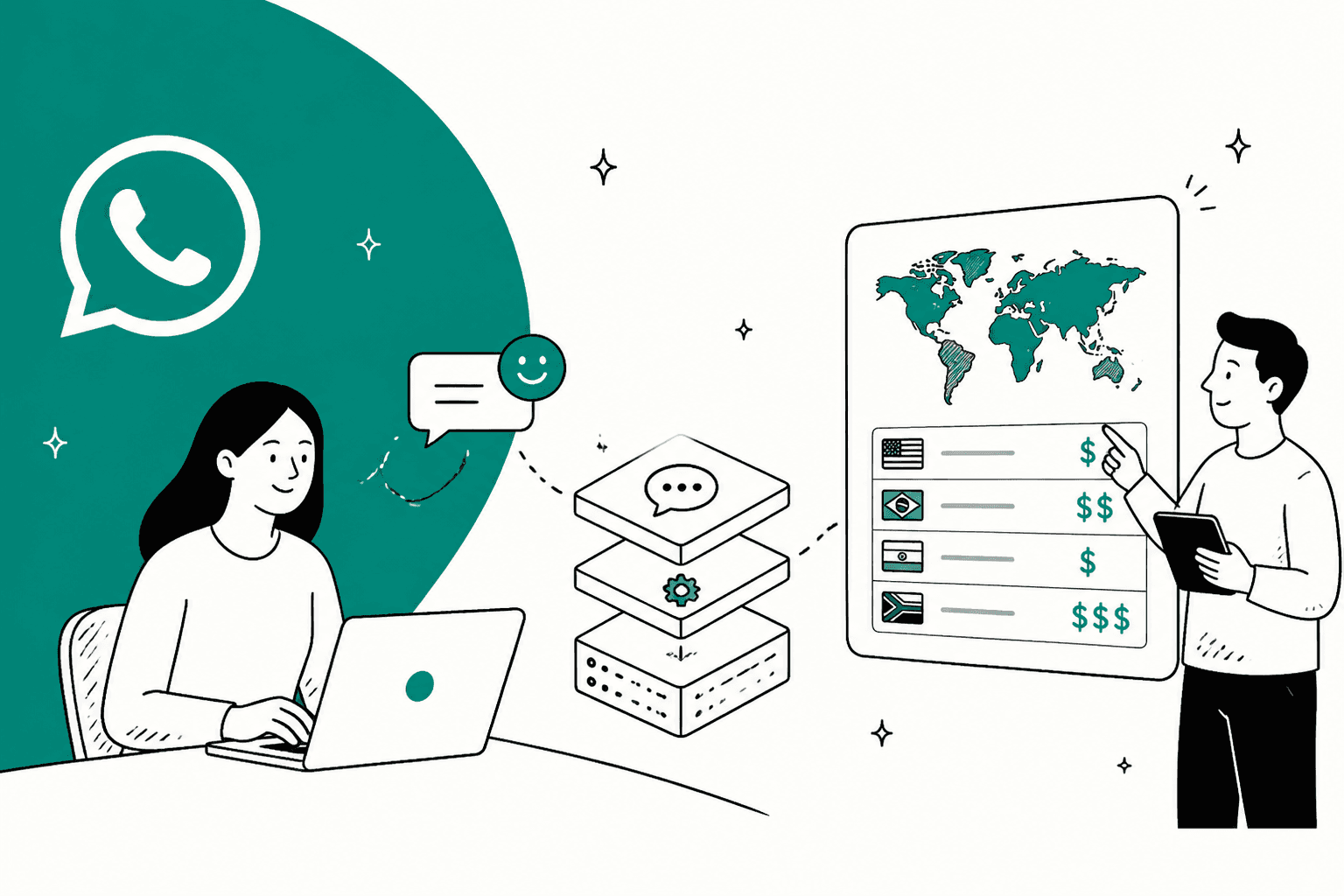
WhatsApp Business API pricing is a per-message fee from Meta, set by message category and the customer's country, plus whatever your provider adds on top. On Meta's October 1, 2026 rate card, a support reply to a US customer costs $0.0034, a US marketing template $0.025, and the same marketing message to Germany $0.1365.
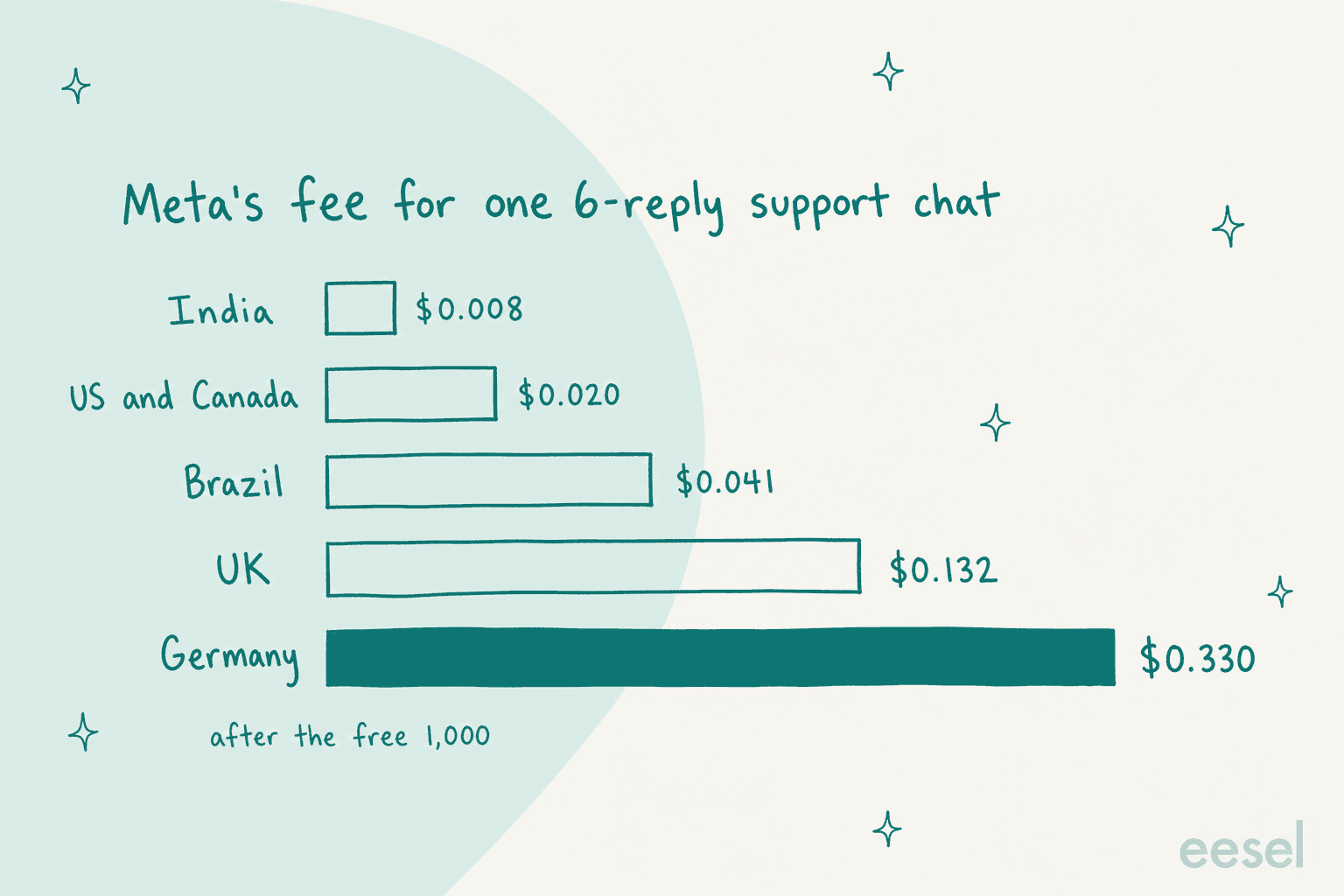
The big 2026 change is that support replies are billable again. Since October 1, each business phone number gets 1,000 free service messages a month, and every reply after that is charged. For an AI agent that answers in five or six messages per chat, that turns every conversation into several line items.
The provider layer moves the bill more than most people expect. Twilio adds $0.005 per message in both directions, Freshworks adds 20%, and respond.io passes Meta's price through at cost. If you're putting AI on the number, look for one priced per conversation rather than per reply. eesel counts one credit per conversation, however many messages it takes.
How much does the WhatsApp Business API cost?
The WhatsApp Business API costs nothing to access. You pay Meta for each delivered message you send, at a rate set by the message category and the recipient's country code, and you pay your provider for the software around it. Messages customers send you are free.
I've spent two years on SEO, and this keyword is a good example of a search where the top results answer a smaller question than the one being asked. Most pages give you the rate card. The person typing "WhatsApp Business API pricing" usually wants to know what their monthly bill will be, and that depends on three layers, not one. eesel has been putting AI agents on live support queues for years, and from where I sit WhatsApp keeps showing up as a hard requirement. One German multi-shop Shopify and Zendesk store put WhatsApp on its must-have list before anything else on its first call with eesel, and Germany happens to be one of the most expensive markets on Meta's card.
Meta switched to per-message pricing on July 1, 2025, and it only charges for messages that are actually delivered. Every message carries exactly one category and at most one charge. Since July 1, 2026 there are five categories:
| Category | What it is | When you can send it | How Meta charges |
|---|---|---|---|
| Marketing | Template: promotions, offers, surveys | Any time | Fixed rate per country, the priciest template |
| Utility | Template: order updates, receipts, appointment reminders | Any time | Fixed rate, volume tiers at high volume |
| Authentication | Template: one-time passcodes | Any time | Fixed rate, volume tiers; some markets add an international rate |
| Service | Free-form reply, no template | Only inside the 24-hour window | Fixed rate after 1,000 free per number per month |
| Meta Business Agent | Reply written by Meta's own AI agent | Inside the 24-hour window | $2.00 per 1M tokens, worldwide |
The 24-hour customer service window opens when a customer messages you and resets with each new customer message. Inside it you can reply freely. Outside it you can only send an approved template, which is where marketing and utility costs come from.
What are Meta's WhatsApp rates by country in 2026?
Meta's rate card has 47 markets as of October 1, 2026: 39 named countries and 8 regions such as "Rest of Western Europe". The country is set by the customer's phone number, not by where your business is. These are the USD list rates per delivered message from Meta's rate file, effective October 1, 2026:
| Market | Marketing | Utility | Authentication | Service (after free 1,000) |
|---|---|---|---|---|
| US and Canada | $0.0250 | $0.0034 | $0.0034 | $0.0034 |
| United Kingdom | $0.0635 | $0.0220 | $0.0220 | $0.0220 |
| Germany | $0.1365 | $0.0550 | $0.0550 | $0.0550 |
| France | $0.0859 | $0.0300 | $0.0300 | $0.0300 |
| Netherlands | $0.1597 | $0.0500 | $0.0500 | $0.0500 |
| Spain | $0.0707 | $0.0200 | $0.0200 | $0.0200 |
| Rest of Western Europe | $0.0592 | $0.0171 | $0.0171 | $0.0171 |
| India | $0.0118 | $0.0014 | $0.0014 | $0.0014 |
| Indonesia | $0.0411 | $0.0250 | $0.0250 | $0.0250 |
| Brazil | $0.0625 | $0.0068 | $0.0068 | $0.0068 |
| Mexico | $0.0397 | $0.0085 | $0.0085 | $0.0085 |
| United Arab Emirates | $0.0576 | $0.0157 | $0.0157 | $0.0157 |
| South Africa | $0.0379 | $0.0095 | $0.0095 | $0.0095 |
Two patterns jump out of the full file. First, the service rate equals the utility rate in every market, so a support reply and an order-update template cost the same. Second, the spread between countries is huge. The Netherlands charges 13.5x India's rate for a marketing message and Germany charges almost 40x India's rate for a support reply.
Volume tiers bring utility and authentication rates down, but only at high volume and only for those two categories. In North America, utility messages stay at the $0.0034 list rate up to 80,000 a month, drop 5% from 80,001, and reach 25% off above 6,000,000, per Meta's volume tier file. Tiers are counted per business portfolio, per market, per month. Marketing and service messages never get them.
What changed in WhatsApp pricing on October 1, 2026?
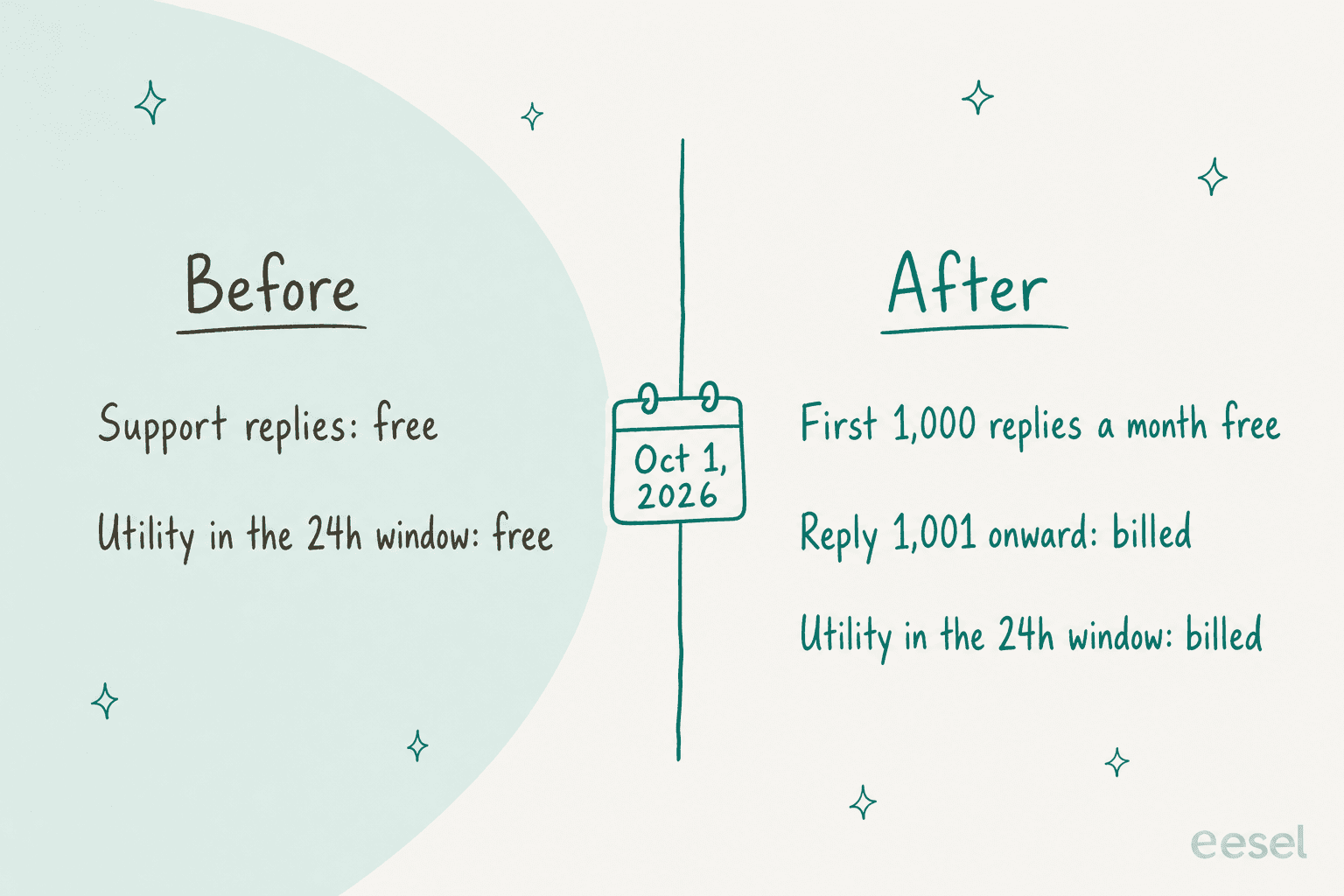
Three things changed on October 1, 2026, and the first one is the reason most support teams are re-doing their maths:
- Service messages are charged again. They had been free since November 1, 2024. Now each business phone number gets
1,000free service messages a month with no roll-over, and Meta charges from the 1,001st (Meta pricing). - Utility templates inside the 24-hour window are no longer free. They became free on July 1, 2025, and are billed again as of October 1, 2026.
- 40 rates moved, including
9markets pulled out of "Rest of" regions into their own rows.
Zendesk's own announcement to its customers names "automated chatbots or AI-driven flows that send high volumes of replies" as the setups most likely to see a meaningful cost change. That matches what operators said when Meta announced it. One builder who resells API access described a client's reaction:
"Right? Way to kill an entire eco-system. Just had a meeting with a client that sends 300k service messages a month, and he was literally speechless. They already pay around USD 1K a month for templates, which is totally reasonable, but the increase is gonna be monumental."

The timing frustrated people as much as the price. Meta can only change prices on January 1, April 1, July 1 and October 1, with one month's notice for rate changes, and Zendesk told its customers the October rates were expected on September 1.
"Three months of notice for a change of this magnitude, with the actual prices announced just one month before it takes effect? That's not enough time for anyone to re-architect a business around it."
For the full history of these rules, my post on Meta's policy changes covers the AI provider rules from January 2026 too.
When is a WhatsApp message free?
Meta lists exactly two cases where it does not charge for a message a business delivers, and a few more things that are simply never billed:
- Messages customers send you. Inbound messages are always free.
- The first 1,000 service messages per number per month. The tier resets monthly at midnight in your account's timezone. If you have no payment method on file, Meta delivers those 1,000 and then stops delivering service messages until you add one.
- The free entry point window. When a customer messages you from a Click to WhatsApp ad on the Android or iOS app and you reply inside the 24-hour window, that reply is free and opens a window that "may remain open for up to 7 days" (Meta pricing). Marketing, utility, authentication and service messages are all free inside it.
- Governments and non-profits. Eligible ones keep service messages free beyond the 1,000 tier through December 31, 2027.
One conflict to know about: Zendesk's October announcement still describes "the 72-hour free window" for ad clicks, while Meta's current page says up to 7 days. Meta's page is the one that sets the bill, so I'd plan on Meta's wording and check your provider's invoices against it.
The 1,000 free messages sound generous until you count replies instead of conversations. Question Beauty, a cosmetics brand on Gorgias, has eesel send about 960 replies a month across Messenger, email and chat. On WhatsApp, a month like that would just about fit in one number's free tier. A store with 2,000 chats a month and five replies each sends 10,000 service messages, and 9,000 of them get billed.
What do WhatsApp providers add on top of Meta's price?
Almost nobody connects to Meta's API with no software in between. You either build on the Cloud API yourself or use a provider, which Meta now calls a Solution Partner, formerly a BSP. Each provider handles Meta's fees differently, and that choice can matter more than the country you sell in.
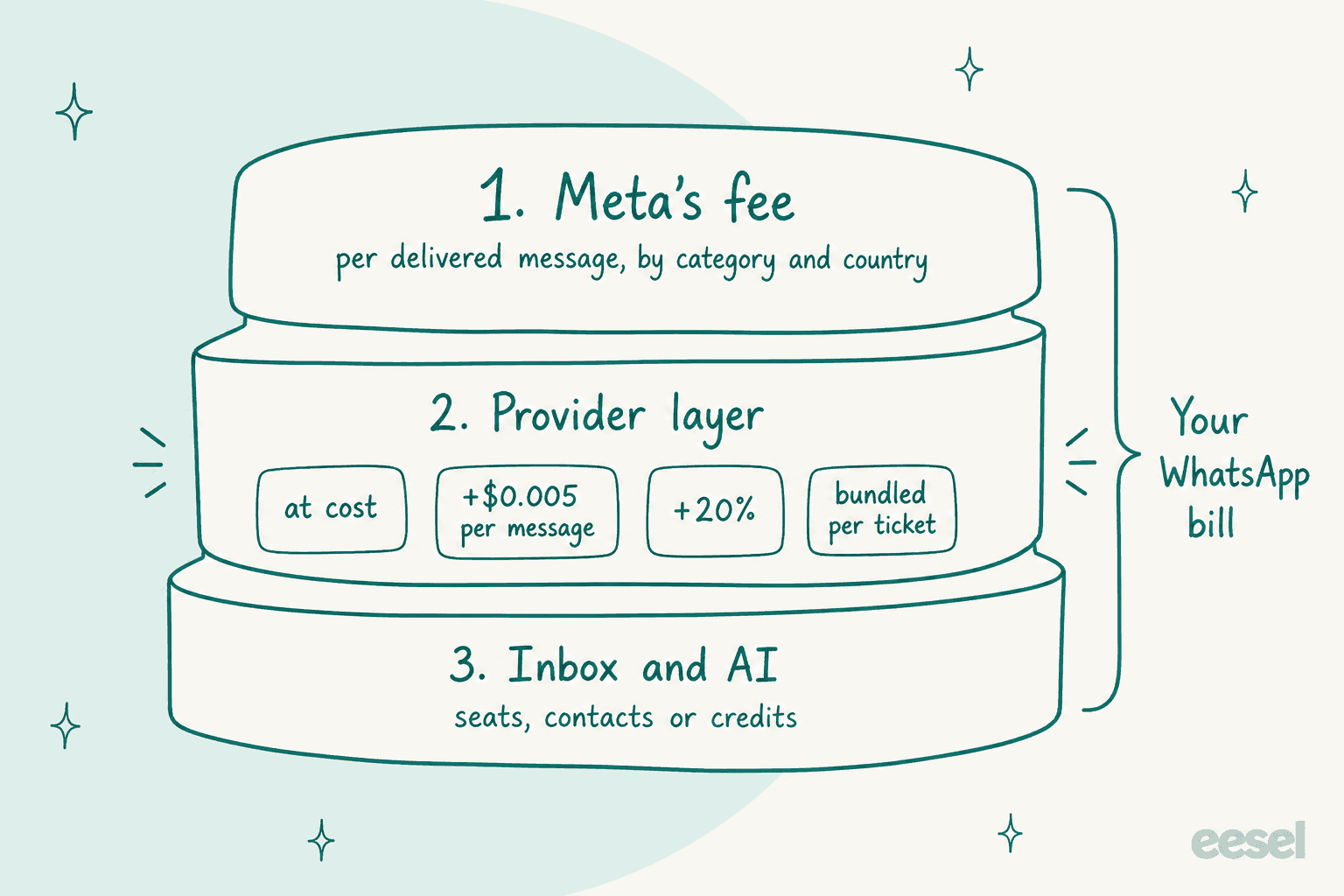
How the billing relationship works decides who invoices you. A Solution Partner has a credit line with Meta and can bill you for API usage directly. A Tech Provider has no credit line, so you add your own card and Meta bills you, while the Tech Provider bills only for its software (Meta partners overview). The second setup is the easiest one to audit, because Meta's invoice is the rate card.
Here's how the main options handle Meta's fees, checked against each vendor's own page on October 27, 2026:
| Provider | Platform fee | How Meta's fees reach you | Source |
|---|---|---|---|
| Meta Cloud API, direct | None | Meta bills you at the rate card | Meta |
| respond.io | From $79/month yearly | At Meta's price, "doesn't charge additional fees" | respond.io calculator |
| 360dialog | From €49 per number per month | Plus Meta's messaging fees | 360dialog pricing |
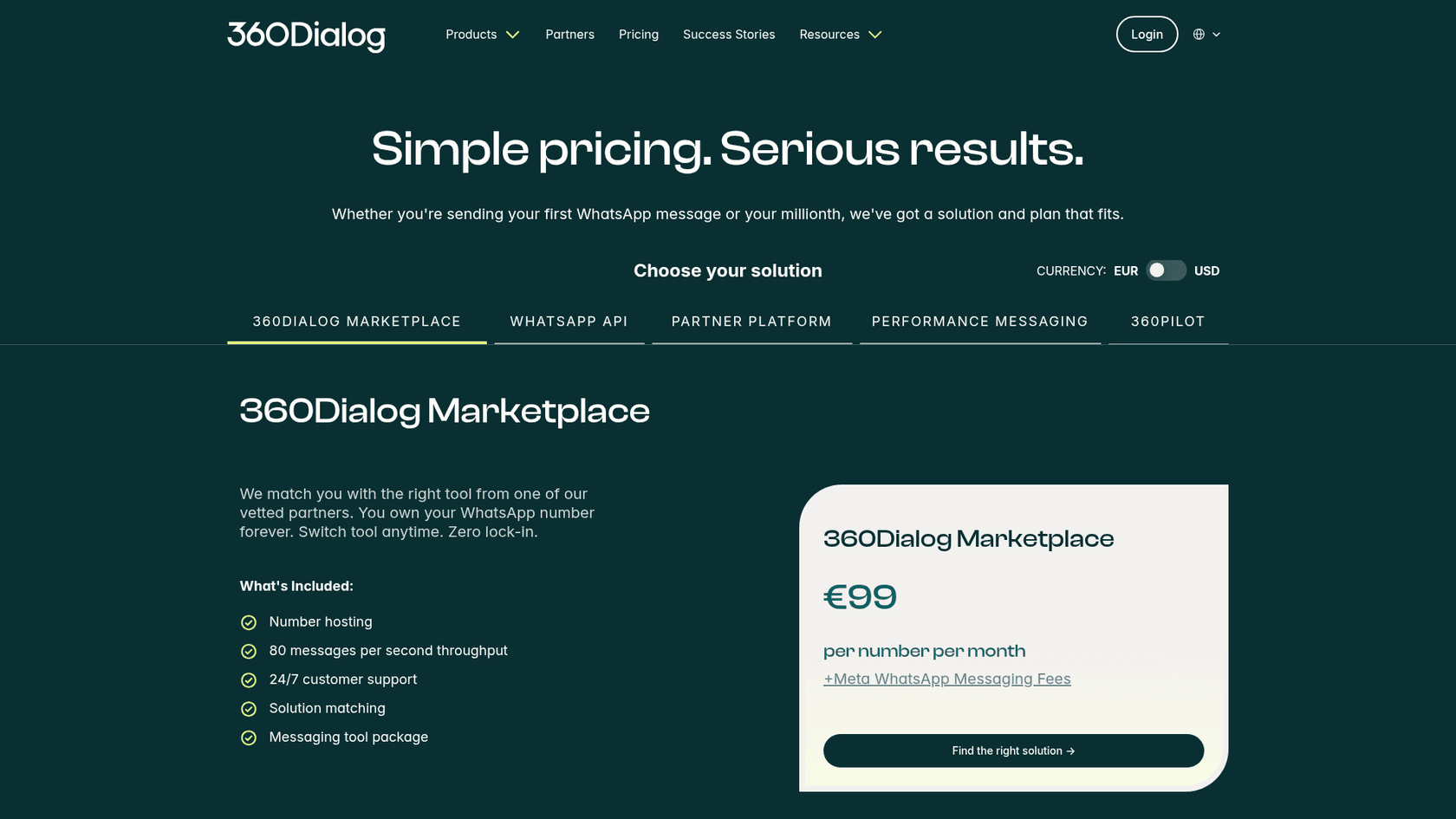
| Twilio | None | Meta's fee plus $0.005 per message, inbound or outbound | Twilio pricing |
| Freshdesk Omni | Per agent | Meta's fee plus a 20% markup | Freshworks docs |
| Wati | From $59/month yearly | Own rate card, about 1.2x Meta on service, 1.6x on marketing | Wati pricing |
| Gorgias | Per ticket, from $10/month | Billed as helpdesk tickets | Gorgias help center |
| Zendesk | Per agent | Separate from Zendesk fees, rate not published | Zendesk announcement |
The row that surprises people is Twilio. Its per-message fee is flat and charged on messages you receive as well as send, so on US support traffic Twilio's $0.005 is bigger than Meta's own $0.0034 service rate.
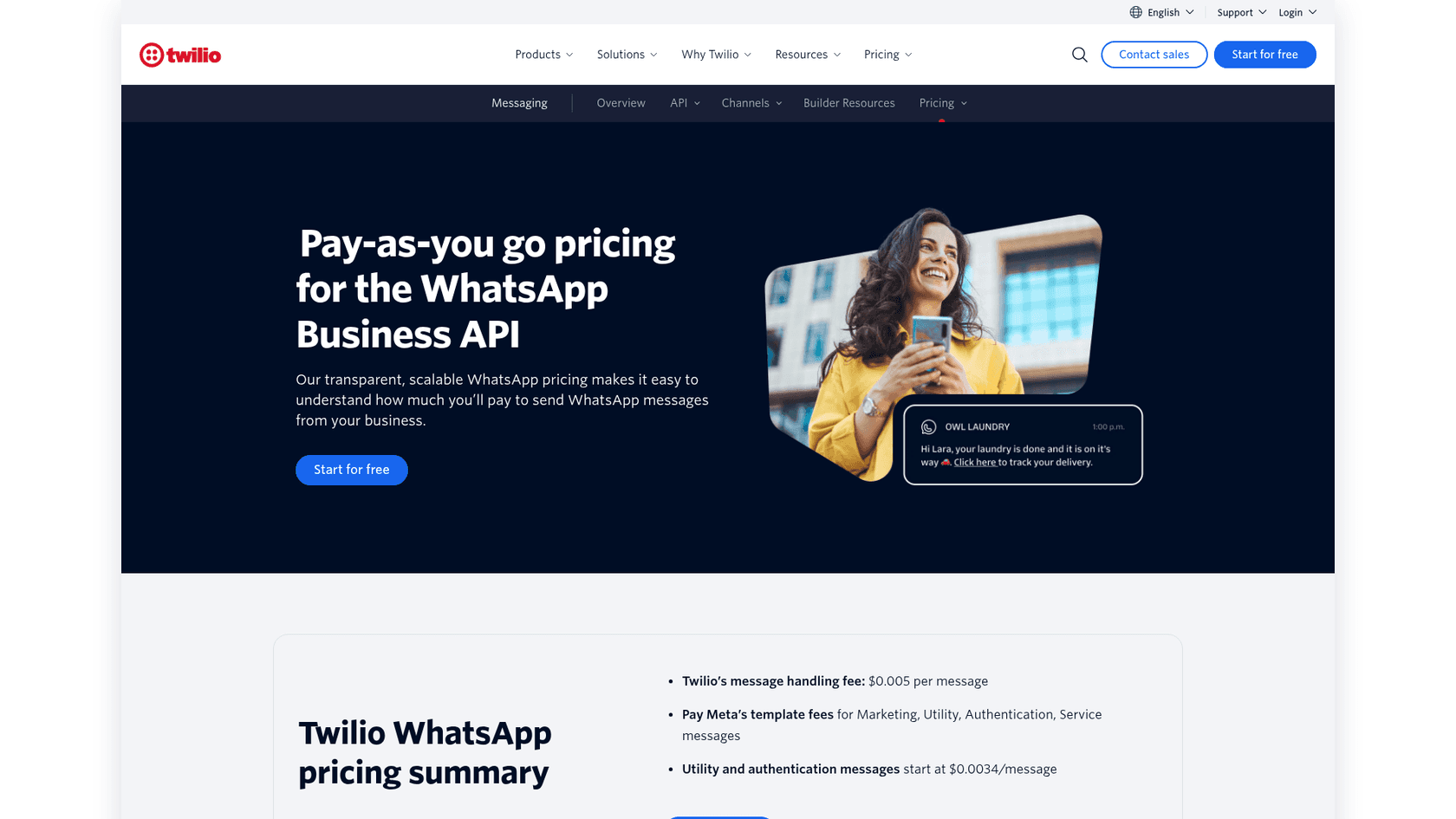
At the other end, 360dialog charges per number instead of per message. Its Regular WhatsApp API plan is €49 per number per month, Premium is €99 with an inbox and automation add-ons, and Scale is €500, each plus Meta's fees. For high-volume senders a flat fee per number is easier to forecast than a percentage.
Wati's numbers come from its October 1, 2026 rate card for Growth and Pro plans: a US service message is $0.0041 against Meta's $0.0034, and a US utility message is $0.0061, about 1.8x. Business plans get an extra discount. I've broken this down in my Wati alternatives guide too. The community advice is blunt about it:
"only use providers who allow you to directly connect to the cloud API and pay your own bills directly to Meta."
That's fair as a default, with one caveat from another operator in the same community: going direct means you also give up any inbox, because "the webhook takes over routing" (Reddit). Whoever replies to customers still needs somewhere to do it, which is why most teams end up on a WhatsApp customer service platform or a helpdesk channel anyway.
What does WhatsApp support really cost per month?
Rate cards are hard to reason about, so here's one buyer priced across five markets. The store handles 2,000 support chats a month on one number, with five replies per chat, and sends 3,000 order-update utility templates. That's 10,000 service messages, 9,000 of them billed after the free tier.
| Market | Service (9,000 billed) | Utility (3,000) | Meta total per month | Add 5,000 marketing |
|---|---|---|---|---|
| India | $12.60 | $4.20 | $16.80 | +$59.00 |
| US and Canada | $30.60 | $10.20 | $40.80 | +$125.00 |
| Brazil | $61.20 | $20.40 | $81.60 | +$312.50 |
| United Kingdom | $198.00 | $66.00 | $264.00 | +$317.50 |
| Germany | $495.00 | $165.00 | $660.00 | +$682.50 |
Now the same US and German store on different providers. For Twilio I've assumed the customer sends five messages per chat too, so 10,000 inbound messages on top of 13,000 outbound.
| Provider route | US monthly messaging cost | Germany monthly messaging cost | Platform fee on top |
|---|---|---|---|
| Meta direct, respond.io (at cost) | $40.80 | $660.00 | respond.io from $79/month |
| Freshworks (+20%) | $48.96 | $792.00 | Omni seats |
| Wati (own rate card) | $55.20 | $891.00 | from $59/month |
| Twilio (+$0.005 each way) | $155.80 | $775.00 | None |
In the US, the provider layer can be bigger than Meta's whole fee. Twilio adds $115 to a $40.80 Meta bill there. In Germany the picture flips: Meta's fee is so large that a percentage markup like Freshworks' 20% costs more than Twilio's flat fee, and Wati's 1.8x utility rate is the most expensive route of the four. The right provider depends on your market as much as on features.
Gorgias works differently again. WhatsApp messages there are billed as helpdesk tickets, so those 2,000 chats would count as 2,000 tickets, which is the Pro plan at $300/month billed yearly on the Gorgias pricing page, alongside the rest of your ticket volume. My Gorgias pricing breakdown covers how tickets get counted.
To run your own numbers, pick your market and plug in your volumes:
The number to watch is "replies per chat". Cutting it from five to three saves more than most provider switches, because every reply after the free 1,000 is its own charge. That's an argument for an agent that answers the whole question in one message rather than in a string of short ones.
How much does AI on WhatsApp cost?
Running AI on WhatsApp stacks two charges: Meta's per-message fee for every reply the AI sends, and whatever the AI vendor charges. Meta's pricing page says service messages "can be powered by a 3rd-party AI solution or people", and its own worked example spells out the meter: "Since there are 5 delivered messages, there are 5 charges" (Meta pricing).
Meta now sells its own AI too. Meta Business Agent replies are billed at $2.00 per 1M input and output tokens, which Meta estimates at 20,000 to 25,000 tokens per message, or about 4 to 5 cents. There's no free tier and no volume discount, and they're charged even inside free ad-click windows. Meta's page compares 10,000 AI replies in Brazil at roughly $400 to $500 on its agent against about $968 for a third-party AI on service messages. That second number is Meta's estimate of a competitor's cost, so I'd treat it as a sales argument rather than a benchmark. Operators noticed the incentive:
"Yes. I think it is a play to force their AI agent. As their AI agent costs money for tokens, if they let service messages be free, 3rd parties can compete with their agent. if they charge for the service messages that automatically makes it costlier for businesses to run 3rd party agents as costs can be double (3rd party agent + delivery fee)."
The thing to check on any AI vendor is the billing unit. If the AI is priced per message or per reply, you pay twice for every extra message: once to Meta, once to the vendor. If it's priced per conversation or per resolution, a chatty exchange costs you Meta's delivery fee and nothing more. Per-resolution tools like Zendesk AI at $1.50 to $2.00 and Freddy AI sessions sit in this second group, which I compare in my AI customer service cost breakdown.
eesel for WhatsApp counts one credit per conversation, "including all back and forth with a customer on WhatsApp". On the pricing page that's $299/month for 500 credits, or $1,749/month for 5,000, so between about $0.35 and $0.60 a conversation depending on the plan.
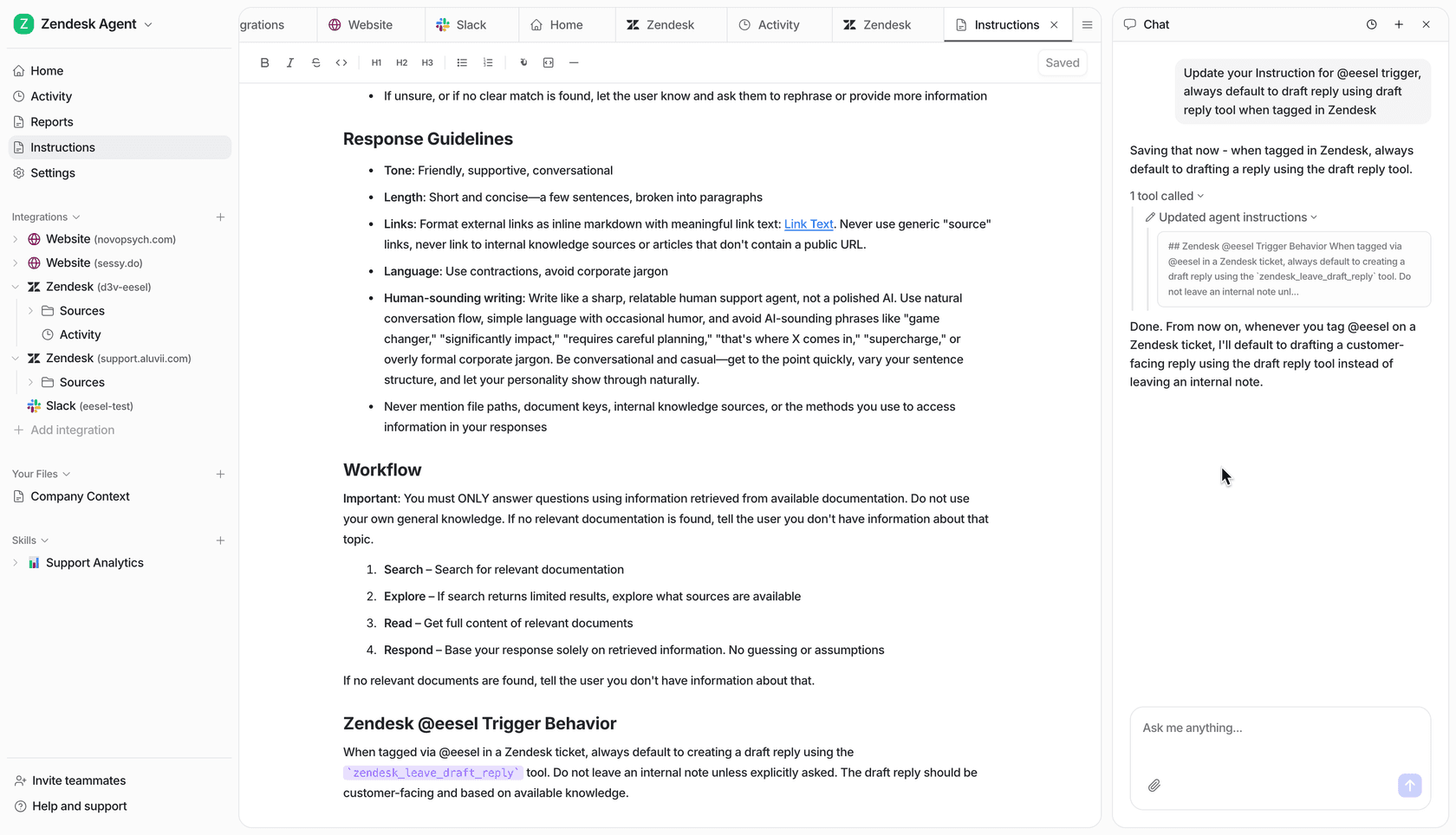
Meta's message fees are still billed by Meta or your provider, which is why the replies-per-chat number above matters. On price alone, Meta Business Agent is close: a six-reply chat at 4 to 5 cents a message is about $0.24 to $0.30 in tokens. I'd be straight about that. The difference is what the agent knows and where it hands off: eesel answers from your help center, docs and past tickets, and passes anything it shouldn't answer to email, Zendesk or Freshdesk, where your team already works.
That handoff is where the money is. Rúngne, a Norwegian climbing apparel store, runs three eesel agents on about 2,100 Gorgias tickets a month across email, chat and social. Around one ticket in seven gets answered by eesel on its own, and about 580 more a month get a draft reply that a person reads and sends. That split is the one I'd copy on WhatsApp: the AI sends replies only where the answer is in the docs, and a person handles the rest.
How do you keep a WhatsApp API bill down?
The levers that actually move the bill, roughly in order of how much they save:
- Pick the provider for your market. On US support traffic a flat per-message fee dominates; in Germany or the Netherlands a percentage markup does. Run your volumes through the calculator before you sign.
- Answer in fewer messages. Every reply past the free 1,000 is a line item, so one complete answer beats three short ones. This is also the strongest case for AI ticket deflection on WhatsApp that resolves the question rather than chatting about it.
- Use Click to WhatsApp ads for acquisition. Replies in the free entry point window are free for up to 7 days, templates included.
- Check how your provider bills utility templates. Order updates sent inside an open window are now billed, and markups apply to them too. See my guide to Shopify WhatsApp order notifications for what most stores send.
- Add a payment method before you hit 1,000. Without one, Meta stops delivering service messages once the free tier runs out, which looks like a broken inbox to your customers.
If WhatsApp is new for you, my overview of the WhatsApp Business API covers setup, messaging limits and the coexistence option, and the best AI for WhatsApp support roundup covers the agents themselves.
Try eesel on your WhatsApp number
Since October, every WhatsApp support reply has a price, so the AI on your number should earn each one. eesel joins your WhatsApp Business number in under five minutes, answers from your help center, docs and helpdesk history in 80+ languages, and hands anything it shouldn't answer to your team in email, Zendesk or Freshdesk. You pay one credit per conversation, not per reply, and you can test it against real questions before customers see it.
Want an AI teammate on WhatsApp that won't send five messages where one will do? Try eesel free with 100 credits, no card needed.