


Wati pricing is $59 a month for Growth and $119 for Pro, billed yearly ($69 and $149 month to month), with Business now "Custom" on the US page. That is the software fee only. Every WhatsApp message is billed on top from a prepaid wallet, and AI agents (Astra) cost another $99 or $399 a month.
The number most Wati pricing breakdowns skip is the message rate. I put Wati's own October 1, 2026 rate card next to Meta's list-rate file for the same date, and Wati's Growth and Pro rate is 1.6x Meta's for marketing messages and about 1.8x for utility messages, in every market I checked. For a US store sending 10,000 promos a month, that gap alone ($150) is bigger than the Pro plan.
If your WhatsApp is mostly customers asking for help, the message markup barely matters; the AI does. eesel answers WhatsApp from your past replies and Shopify orders and bills per conversation, not per AI reply. Question Beauty runs it across Messenger, email and chat: 960 replies a month sent on its own, 290 orders looked up first.
My work at eesel is on the integrations side, so a big part of my week goes to reading other vendors' API docs and billing pages, mostly to see what actually happens under the marketing copy. For this post the pricing cards were only the start. I also pulled the PDF rate card that Wati links from them and Meta's own list rates, then Wati's help center billing articles plus 15 user reviews that talk about money. Below is what a Wati bill really looks like.
How much does Wati cost in 2026?
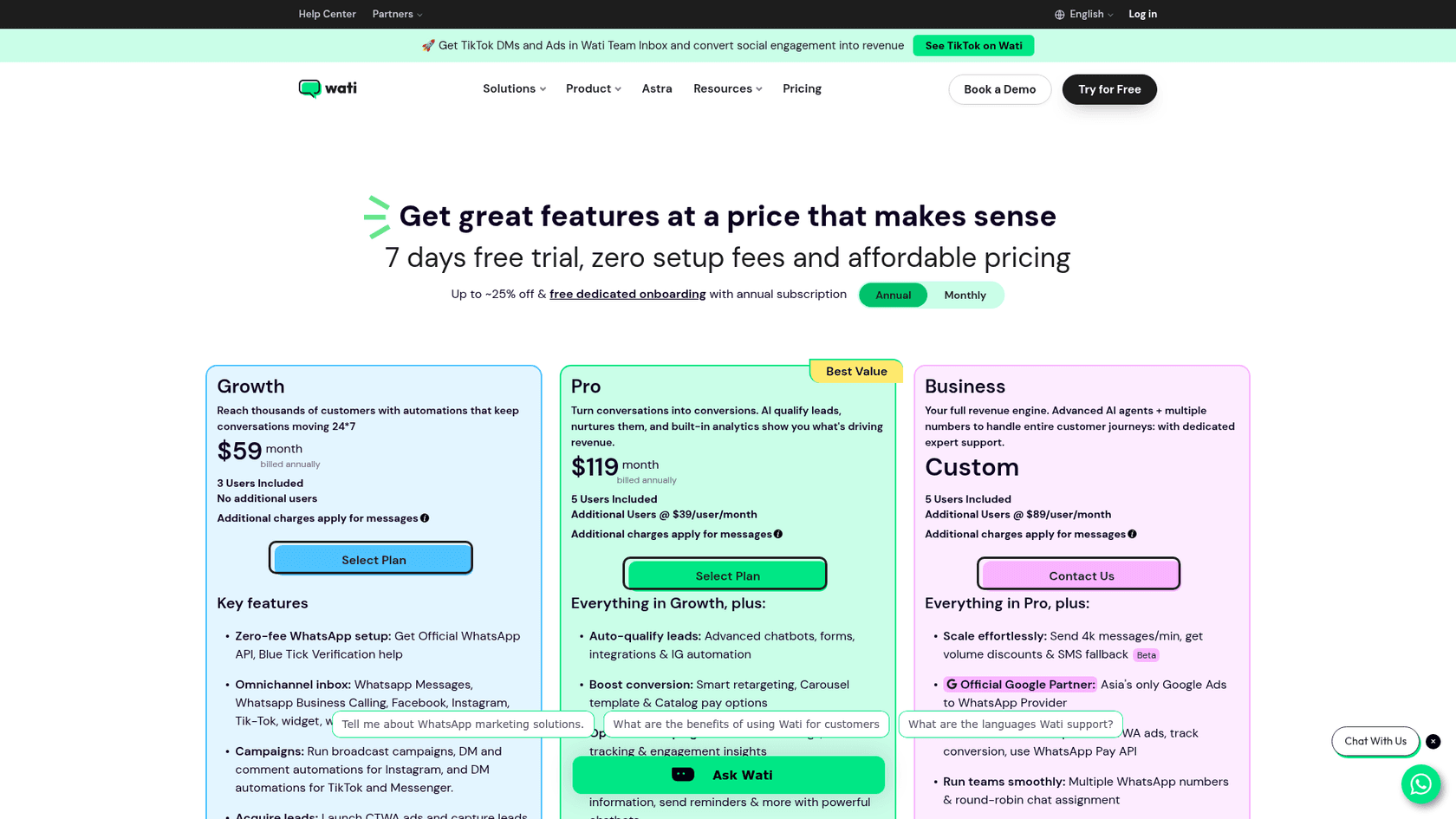
Wati sells three plans, and on every one of them you find the same small print: "Additional charges apply for messages." The table below follows the Wati pricing page as it stood on October 26, 2026, in USD.
| Growth | Pro | Business | |
|---|---|---|---|
| Billed yearly (per month) | $59 | $119 | Custom |
| Billed monthly | $69 | $149 | Custom |
| Users included | 3, no extra users | 5 | 5 |
| Extra user | n/a | $39/user/month | $89/user/month |
| Broadcasts | 15k/month | Unlimited | Unlimited, volume discounts |
| Automation triggers | 1,000/month | 2,000/month | 5,000/month |
| Integrations | 2 commerce/CRM | 5, incl. HubSpot | Unlimited, incl. Salesforce |
| API calls | 10k/month, no webhooks | 200k/month, limited webhooks | 20M/month, extensive webhooks |
| AI Co-pilot credits | 250/month | 500/month | 1,500/month |
| Astra AI agents | No | Yes, priced separately | Yes, priced separately |
| WhatsApp numbers | 1 | 1, extra numbers $29/month | Multiple, round-robin |
| Support | 24x5 email | 24x7 email and chat | Priority 24x7, dedicated CSM |
Some things the cards don't spell out clearly:
- The yearly discount is smaller than the banner. The page says "up to ~25% off" for annual billing, but in USD the math works out to 14% on Growth ($69 to $59) and 20% on Pro ($149 to $119).
- Business still has a price, it's just not on the US page. On September 28 the card was showing $279 a month billed yearly. Now it says "Custom" with a Contact Us button, and yet it still lists extra users at $89 each. Wati's own localized pages still show a Business price, so I'd expect a quote somewhere in that range.
- Growth caps you at three people. Growth has no extra seats to buy, so the moment you add a fourth agent you're pushed to Pro.
- Trial and setup. Every plan has a 7-day free trial and "zero setup fees." Hands-on onboarding is its own custom-priced service, unless you pay yearly.
What the plan fee buys is the WhatsApp Business API connection and a shared team inbox, along with broadcasts, no-code chatbots and integrations. It doesn't buy a single message, though, and that's where the real bill starts.
What does Wati charge per WhatsApp message?
Messages at Wati are billed from a prepaid wallet of credits. Its help center says those credits "cover the costs associated with Meta's pricing structure" and that the exact per-country charge shows up in the app when you top up credits. The public version of it is a PDF rate card that's linked from every plan card, headed "Cost per message and minute call in USD for Growth/Pro Plan," dated October 1, 2026.
Meta, for its part, publishes its own list rates for the same date, linked from its WhatsApp pricing docs. When you put the two files side by side, the pattern holds up pretty consistently:
| Market | Marketing (Wati) | Marketing (Meta list) | Utility (Wati) | Utility (Meta list) | Service (Wati) | Service (Meta list) |
|---|---|---|---|---|---|---|
| United States / Canada | $0.0400 | $0.0250 | $0.0061 | $0.0034 | $0.0041 | $0.0034 |
| United Kingdom | $0.1016 | $0.0635 | $0.0396 | $0.0220 | $0.0264 | $0.0220 |
| India | $0.0189 | $0.0118 | $0.0025 | $0.0014 | $0.0017 | $0.0014 |
| Brazil | $0.1000 | $0.0625 | $0.0122 | $0.0068 | $0.0082 | $0.0068 |
| Germany | $0.2184 | $0.1365 | $0.0990 | $0.0550 | $0.0660 | $0.0550 |
| Indonesia | $0.0658 | $0.0411 | $0.0450 | $0.0250 | $0.0300 | $0.0250 |
| UAE | $0.0922 | $0.0576 | $0.0283 | $0.0157 | $0.0188 | $0.0157 |
| Mexico | $0.0635 | $0.0397 | $0.0153 | $0.0085 | $0.0102 | $0.0085 |
Sources: Wati rate card for Growth/Pro; Meta's USD list rates, both effective October 1, 2026. Authentication messages are priced the same as utility on both cards.
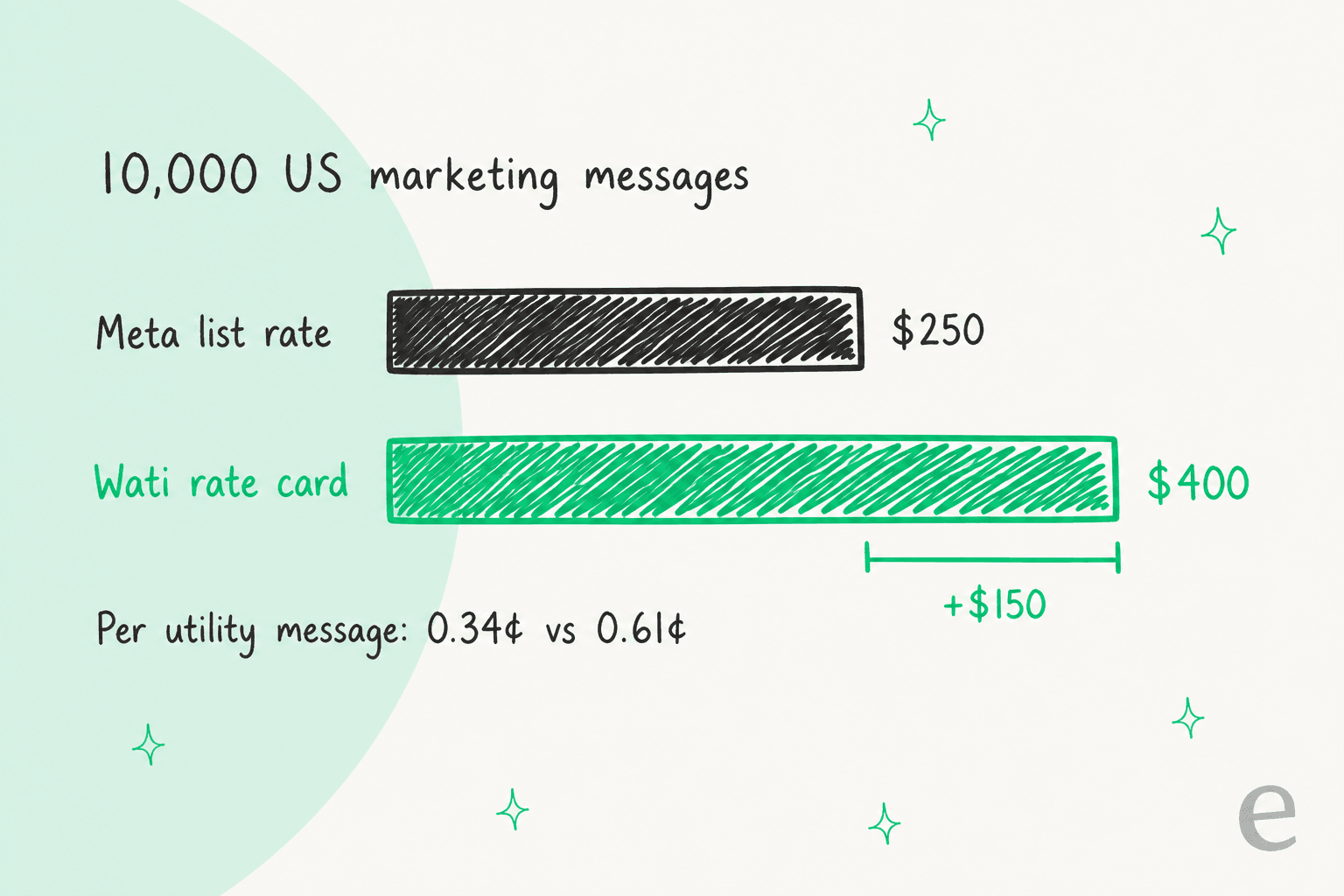
So on Growth and Pro, marketing messages cost 1.6x Meta's list rate, utility and authentication about 1.8x, and service replies about 1.2x. Wati doesn't call the difference a markup anywhere, and to be honest it's normal for a reseller to earn something on usage. The rate card does say Business customers get "an additional discount on top of this rate," which is likely part of the Business sales pitch.
There are two caveats worth keeping in mind so this stays fair. First, Meta gives volume discounts on utility and authentication once you send at high volume, and I haven't modelled those for either side. Second, some platforms charge a platform fee and then pass Meta's rate through at cost, so it's the total you should compare, not only the per-message line. For contrast, Zoko has you pay Meta directly at Meta's rates, while respond.io and SleekFlow each have their own approach.
If you're shopping around, ConvertWay and ManyChat split plan and message fees in yet another way.
Two things on Wati's card are free: the first 1,000 service messages each month, and conversations that start from a click-to-WhatsApp ad. Calls that your customers start cost nothing too. Calls started by the business are billed per minute (UK $0.0134), and those aren't available in the US or Canada at all.
What changed on October 1, 2026?
Meta changed its rules again, and this time it's support teams who feel it the most. Since July 1, 2025 WhatsApp bills per message instead of per conversation. Service replies (anything you send inside the 24-hour window after a customer writes in) had been free from November 2024. From October 1, 2026, service replies are charged after the first 1,000 per number per month, and utility messages sent inside an open window are charged too, per Meta's pricing docs.
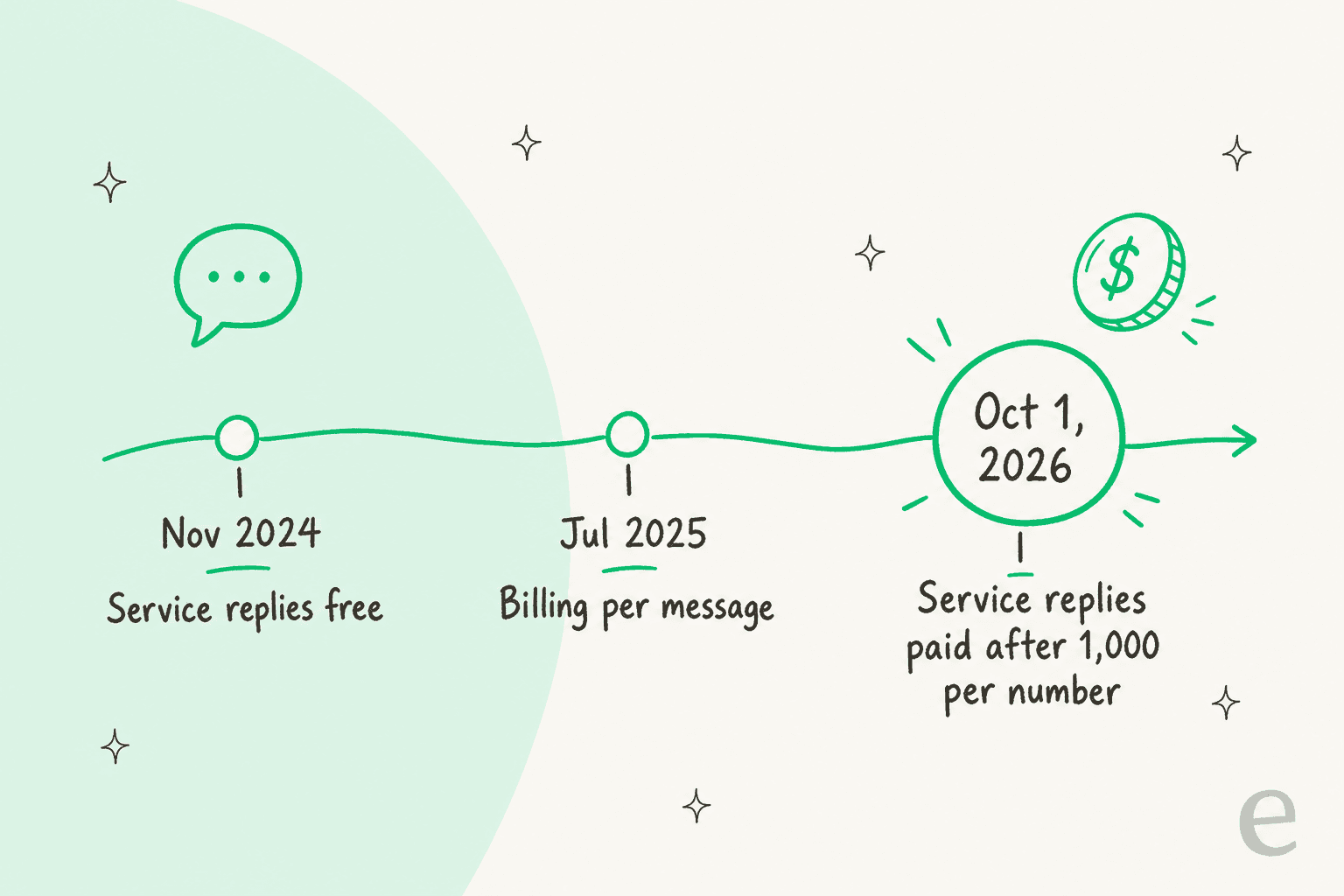
Wati's pricing structure article confirms the change: after Meta's 1,000 free service messages per number, replies are billed per message. For a support-heavy team it's a new line on the bill, although in most markets a small one: 3,000 extra US replies cost $12.30 on Wati's card. My post on Meta's latest changes goes deeper into the rules. Meta's separate AI chatbot policy also matters if you plan to run a bot.
If you sell in these markets, two more dates are worth noting: Meta says India accounts must move to rupee billing by December 31, 2026, and Brazil accounts to reais by June 30, 2027.
How much does Wati's AI cost?
Wati has two separate AI meters, and honestly it's easy to mix them up.
AI Co-pilot credits come with every plan: 250 on Growth, 500 on Pro and 1,500 on Business each month. Co-pilot is there to help your human agents with summaries and translations. If you need more, extra credits start at $30 a month for 1,000. According to Wati's help center, unused AI credits expire on your monthly billing date, so stockpiling them is not an option.
Astra AI agents are the autonomous part, meaning the bot that answers customers on its own. Astra is sold as a separate product with its own pricing page, and from the Wati side you only get it on Pro and up.
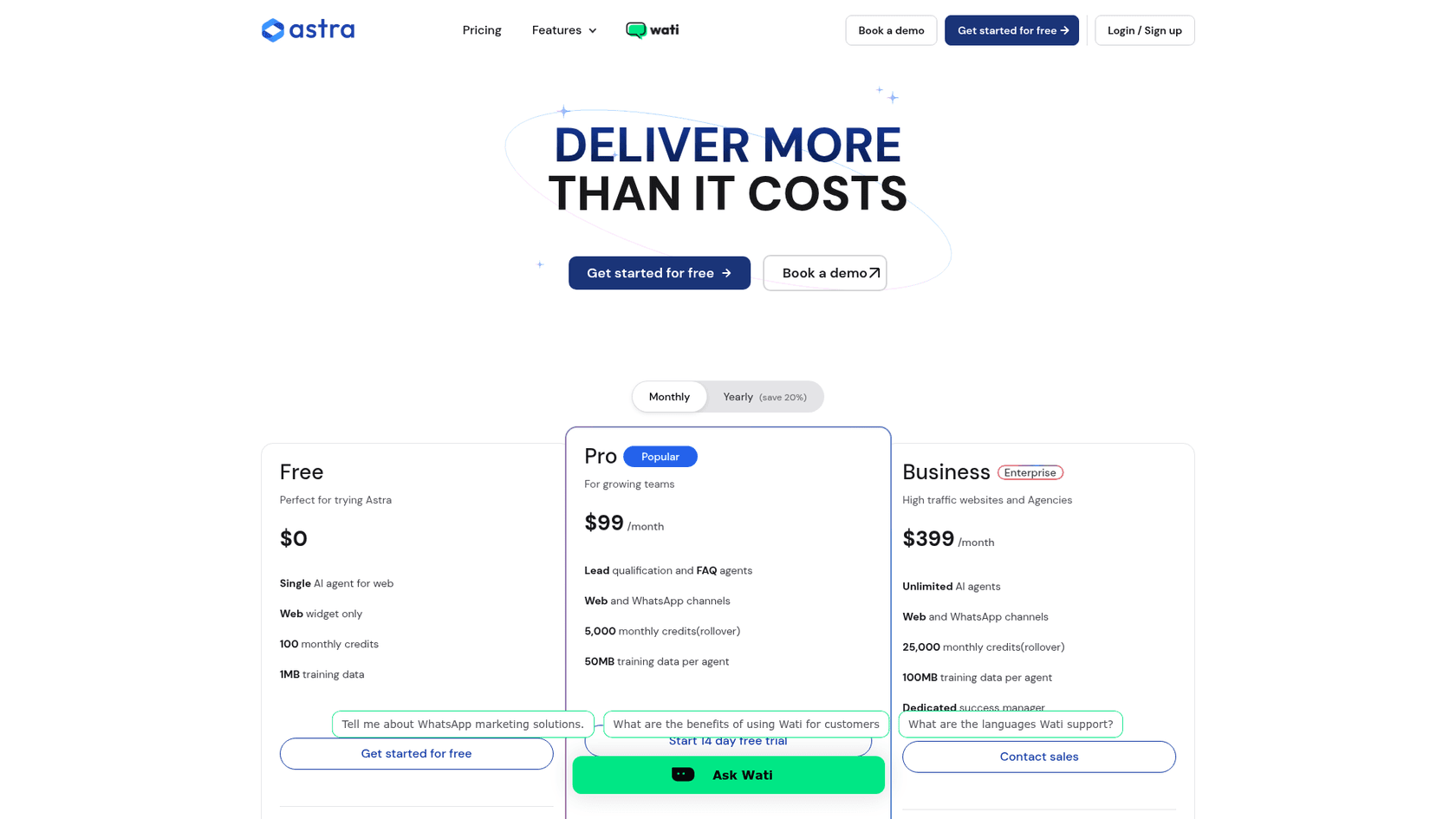
| Astra plan | Price | Credits/month | AI agents | Channels | Seats |
|---|---|---|---|---|---|
| Free | $0 | 100 | 1 | Web only | n/a |
| Pro | $99/month | 5,000 (rollover) | 3 | Web and WhatsApp | 3 |
| Business | $399/month | 25,000 (rollover) | Unlimited | Web and WhatsApp | 10 |
The billable unit is the part you need to understand. Astra charges 1 credit per simple text response, 3 credits for a rich response (images, PDFs, tables) or action, and 5 credits per minute of a voice call. Extra credits cost $20 per 1,000, and they stay valid for 3 months. So if the agent sends four plain answers in a WhatsApp conversation, that uses 4 credits, and by my arithmetic Astra Pro covers roughly 1,250 of those conversations a month before you start buying top-ups.
There's one inconsistency I'd ask sales about. The Astra page says Pro credits roll over, but Wati's help center says AI credits expire monthly. The same help article also notes that the bundled Wati + Astra pricing is India-only for now.
What add-ons and fees sit on top of Wati pricing?
In the add-ons section, the pricing page lists the following, all of them monthly:
| Add-on | Price | Notes |
|---|---|---|
| Automation triggers | $40 for 1,000 | When you run out, Wati says you "have to respond to your customers manually" |
| AI Co-pilot credits | $30 for 1,000 | Help center lists a 2,000-credit minimum for the AI add-on |
| Extra WhatsApp number | $29 per number | Business adds round-robin across numbers |
| Shopify integration | $4.99 | Needed for some Shopify features |
| Extra users | $39 (Pro), $89 (Business) | Growth can't add users |
| Dedicated onboarding | Custom one-time fee | Included with yearly plans |
| Technical account management | Custom annual fee | Business yearly only |
| Professional services | Custom hourly fee | Custom automations and AI agents |
Automation triggers tend to be the add-on people run into first. Every chatbot run counts toward them, so Growth's 1,000 a month goes quickly if a welcome flow fires on each new chat. If you're on HubSpot you'll need Pro anyway, and for Salesforce it has to be Business.
What does Wati really cost? Two worked examples
Below are two teams of the kind I'd expect to show up on a Wati sales call, priced using the numbers above.
Team A: a US Shopify store that runs WhatsApp campaigns and wants an AI agent. Pro billed monthly, 3 agents, 10,000 marketing messages, 2,000 order updates and 3,000 support replies a month, plus Astra Pro.
- Pro plan: $149
- Marketing: 10,000 x $0.0400 = $400.00
- Utility: 2,000 x $0.0061 = $12.20
- Service: 2,000 billable (after 1,000 free) x $0.0041 = $8.20
- Astra Pro: $99
- Total: $668.40 a month
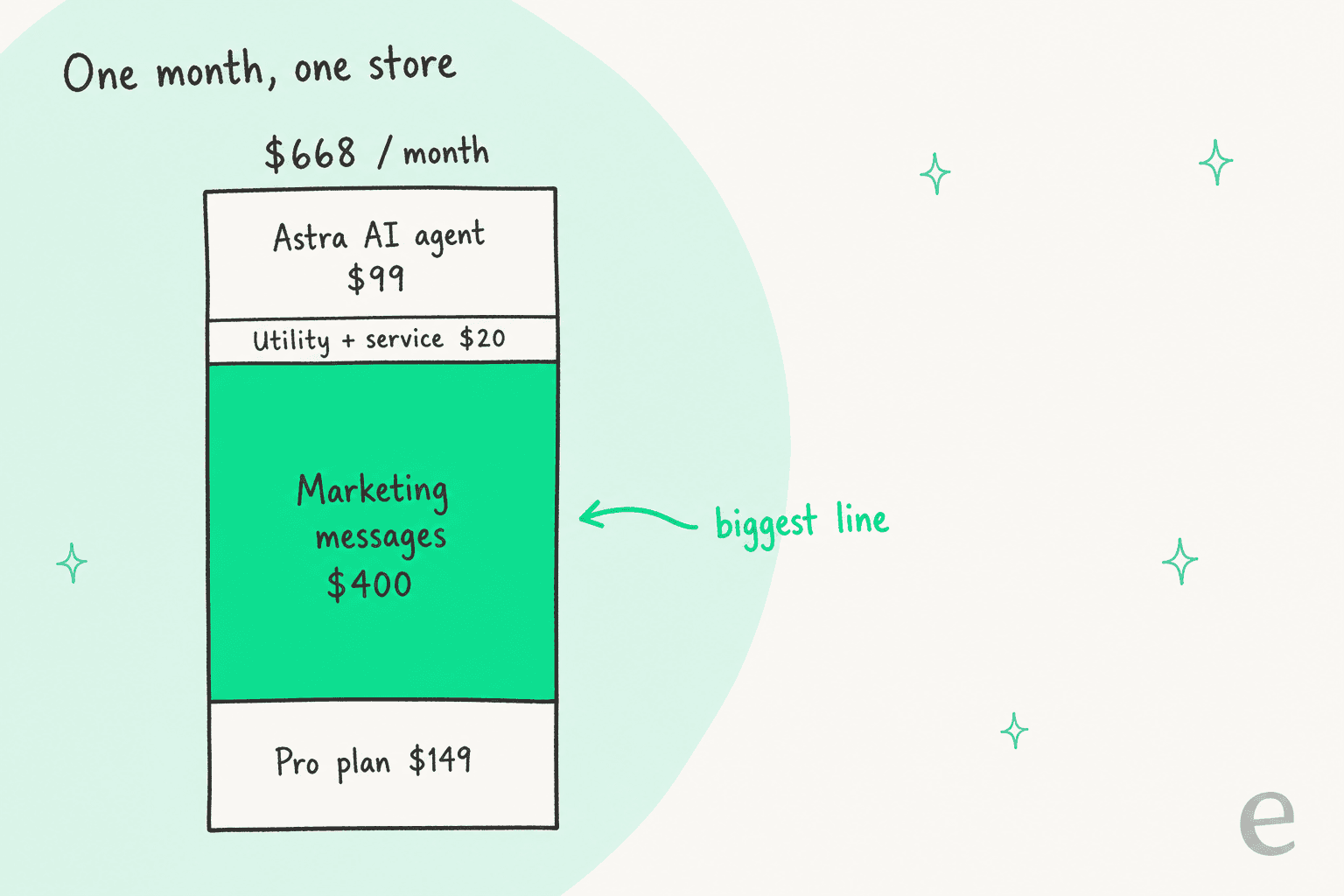
The plan is only 22% of that bill. At Meta's list rate the same messages would come to $263.60 instead of $420.40. That's a $156.80 difference, bigger than the Pro plan itself.
Team B: a support-only team in the US, three agents, no campaigns. Growth billed monthly, 4,000 support replies and 500 order updates a month.
- Growth plan: $69
- Service: 3,000 billable x $0.0041 = $12.30
- Utility: 500 x $0.0061 = $3.05
- Total: $84.35 a month
For Team B the message markup comes to about $3.45 a month, which is basically noise. Where it gets real is the AI. If Team B wants a bot to answer those 4,000 replies, it has to move to Pro ($149) and add Astra Pro ($99) on top, and that takes the bill to $263.35 a month, about 3x.
If you remember one thing about Wati pricing, make it this split: broadcast-heavy teams pay for the message rate, while support-heavy teams pay for the AI.
You can plug in your own numbers below. The calculator uses the rate card and the Meta list rates from above, for Growth and Pro in USD.
If those totals look high compared to other tools, my chatbot cost guide helps put them in context. I used the same approach in my breakdowns of Trengo pricing and Tidio pricing.
Does Wati's price change by country?
Yes, and by quite a lot. Depending on where you visit from, Wati's pricing page loads a different plan list, with the prices in local currency. On October 26, 2026 I checked which plans Wati serves for each country:
| Country | Growth (monthly) | Pro (monthly) | Business (monthly) |
|---|---|---|---|
| United States, UAE | $69 | $149 | $349 |
| United Kingdom | £59 | £129 | £289 |
| India | ₹2,999 | ₹6,499 | ₹18,499 |
| Brazil | R$369 | R$749 | R$1,849 |
| Indonesia | Rp930.000 | Rp1.875.000 | Rp4.750.000 |
India also gets an Enterprise plan at ₹107,999 a month, which the other markets don't show. One Trustpilot reviewer had asked for exactly this, writing that the "price could ve been country based." In fact it already is, even if the US page now hides the Business number behind a sales call.
What do users say about Wati's pricing?
Wati scores 4.6/5 on G2 across 517 reviews and 4.6 on Capterra across 207, so most people seem to like the product. When it comes to money, G2's own tags count 61 mentions of "Expensive," 49 of "Cost" and 36 of "Pricing Issues." Trustpilot sits lower at 3.0 across 273 reviews, and cancellation and subscription are among its top topics.
The complaints fall into two kinds. The first kind is plain price versus value, and it often comes from small teams who feel the good features sit on the higher plans:
"Most of the time, opening the platform takes too long. I think the loading time could be better. On the other hand, they are constantly integrating new features, but almost all new features are only available for higher-value plans, and honestly, the cost is too high for the use we give it."

This same reviewer has been on Wati for over three years, which says something about switching costs. Another G2 reviewer managed to name both meters in one line:
"The cost per person for using Wati is high. The cost per message is also more than I would like."
The second kind is about billing mechanics, and those are the ones I would read before signing a yearly plan. One four-year customer described a downgrade that didn't stick:
"Three weeks before my renewal, I downgraded my account directly on their website, just as I had done in past years. However, Wati has quietly changed how this works: if you have active features (like chatbots) exceeding the lower plan's limits, the downgrade silently fails at the renewal date. Instead of automatically deactivating those features (like in the past) or blocking the downgrade outright until the account fits the limits, their system lets you proceed and then defaults to charging your card for another full $950 annual renewal."

To be fair to Wati, that reviewer says they did get the money back in the end. There are also customers who are happy with the price:
"Additionally, the price is affordable, allowing us to use Wati without financial difficulties, and the user-friendly interface makes it easy for my team to use."
What should you check before you pay?
Most of these come straight from Wati's help center, and they are the kind of thing you usually only learn after the first invoice arrives:
- Refunds. Wati's refund policy says paid subscriptions are non-refundable, including partial periods, upgrades, downgrades and unused time, unless the law says otherwise.
- Cancelling. There is no cancel button. Instead you contact the billing team with your client ID at least 3 days before renewal. The account becomes inaccessible right away after that, so export your chatbots and templates, plus your contacts, first.
- Plan changes. A new plan is charged as soon as you pick it. If your chatbots go over a lower plan's limits, clean them up before you downgrade.
- Wallet balance. USD accounts keep a minimum $10 balance (₹500 in India). When the wallet runs dry, campaigns and automated messages stop until you top up, so it's worth turning on auto recharge if your bot handles support.
- AI credits. Co-pilot credits expire monthly. Size Astra based on your real reply volume, because every AI answer costs a credit.
If you're moving support off WhatsApp Business App onto the API, my guide to automating WhatsApp support covers the setup, while WhatsApp for ecommerce goes into the store-specific flows.
Is Wati worth the price?
For a team that uses WhatsApp mainly as a sales channel, Wati is a solid pick. Broadcasts, click-to-WhatsApp ads, catalogs and Shopify cart recovery all come in the box, and the inbox is easy to learn. In India, Indonesia and Latin America the local plan prices are competitive as well. Do budget for the message rate, though, because at 1.6x Meta's list on marketing it's usually the biggest line once you send at volume. If you're sending hundreds of thousands of messages, ask about Business: the rate card promises an extra discount there, and Wati advertises deals above 1 million messages a month.
If your WhatsApp is mainly customers asking for help, I would look harder. The plan gets you an inbox, but the AI that answers on its own is a second product with a second bill. It's also locked to Pro and up and metered per response. Teams on Zendesk, Freshdesk or Gorgias can often bring WhatsApp into the helpdesk they already pay for, and add AI there instead.
When most of your chats are "where's my order," an order-tracking AI that reads Shopify will save you more than any plan downgrade would. For the wider field, see my roundups of the best WhatsApp chatbots and Zoko alternatives.
Whatever you pick, there's one test I'd run before going live: replay last month's real customer questions through the bot and actually read the answers. A bot that sounds confident but gets order details wrong will cost you more than any rate card.
Try eesel for WhatsApp support
If the main reason you were pricing Wati is so an AI could answer customers, eesel is the AI helpdesk teammate built for that job. Once you connect your WhatsApp Business number, it answers from what your team already knows, like your help center and docs, and your past replies.
Before answering an order question it looks up the order in Shopify, and it replies in the customer's language.
Billing works in a different way from Astra. A WhatsApp conversation counts as 1 credit no matter how many replies it takes, and eesel pricing starts at $299 a month for 500 credits, with 100 free credits to try it. Meta's message fees still apply whichever tool you use. eesel doesn't do broadcasts or cart recovery, so if you need campaigns, keep Wati or another tool for those.
Question Beauty shows what that looks like on a real store: 990 tickets a month across Messenger, email and chat, 960 replies sent by eesel on its own and 290 Shopify orders checked before answering. You can test the agent on past conversations before any customer sees a reply. Try eesel on last month's WhatsApp questions and see what it would have said.