

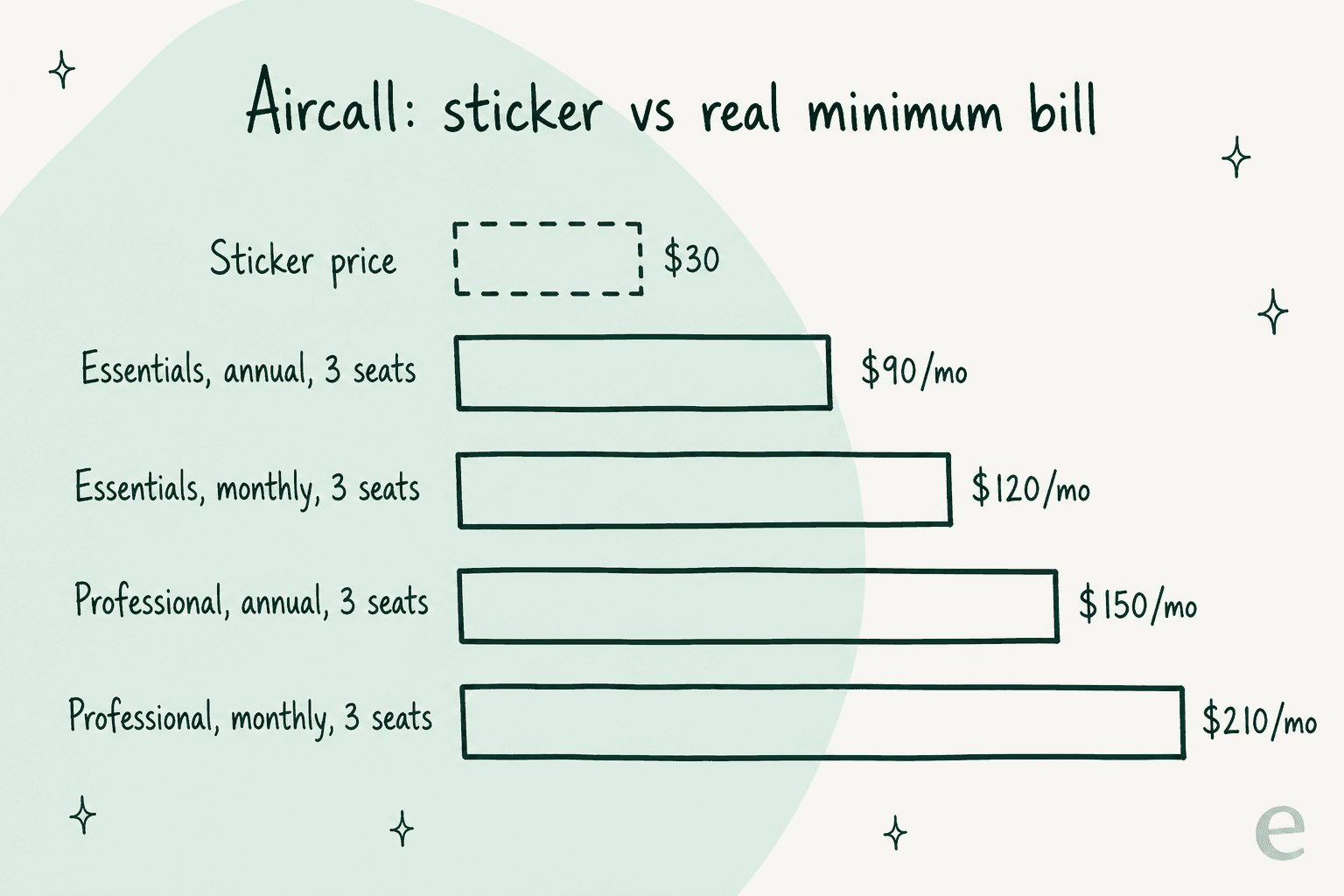
Aircall pricing is $30 per seat a month on Essentials and $50 on Professional, billed annually, with Enterprise quote-only. Every plan has a 3-seat minimum, so the smallest real bill is $90 a month, or $120 if you pay monthly. Add-ons are what move the bill: a 10-seat support team with AI Assist Pro, Analytics+ and voice minutes lands near $1,390 a month. If most of your volume is email and chat, an AI helpdesk teammate like eesel handles that queue for a flat credit price with no seats, leaving the phone line for calls that need a person.
Pick a plan, seats and usage to see the monthly Aircall bill, with the cheapest voice and messaging bundle chosen for you.
How much does Aircall cost per month?
Aircall costs $30 per seat a month on Essentials and $50 per seat on Professional when you pay annually, according to Aircall's pricing page. Paying month to month raises those to $40 and $70. Enterprise has no public price and needs at least 25 seats.
I spend most of my week looking at what support teams search for before they buy, and "Aircall pricing" is almost never about the $30. The real question underneath it is "what will my invoice say once my team is on it?" That's the number this post builds toward.
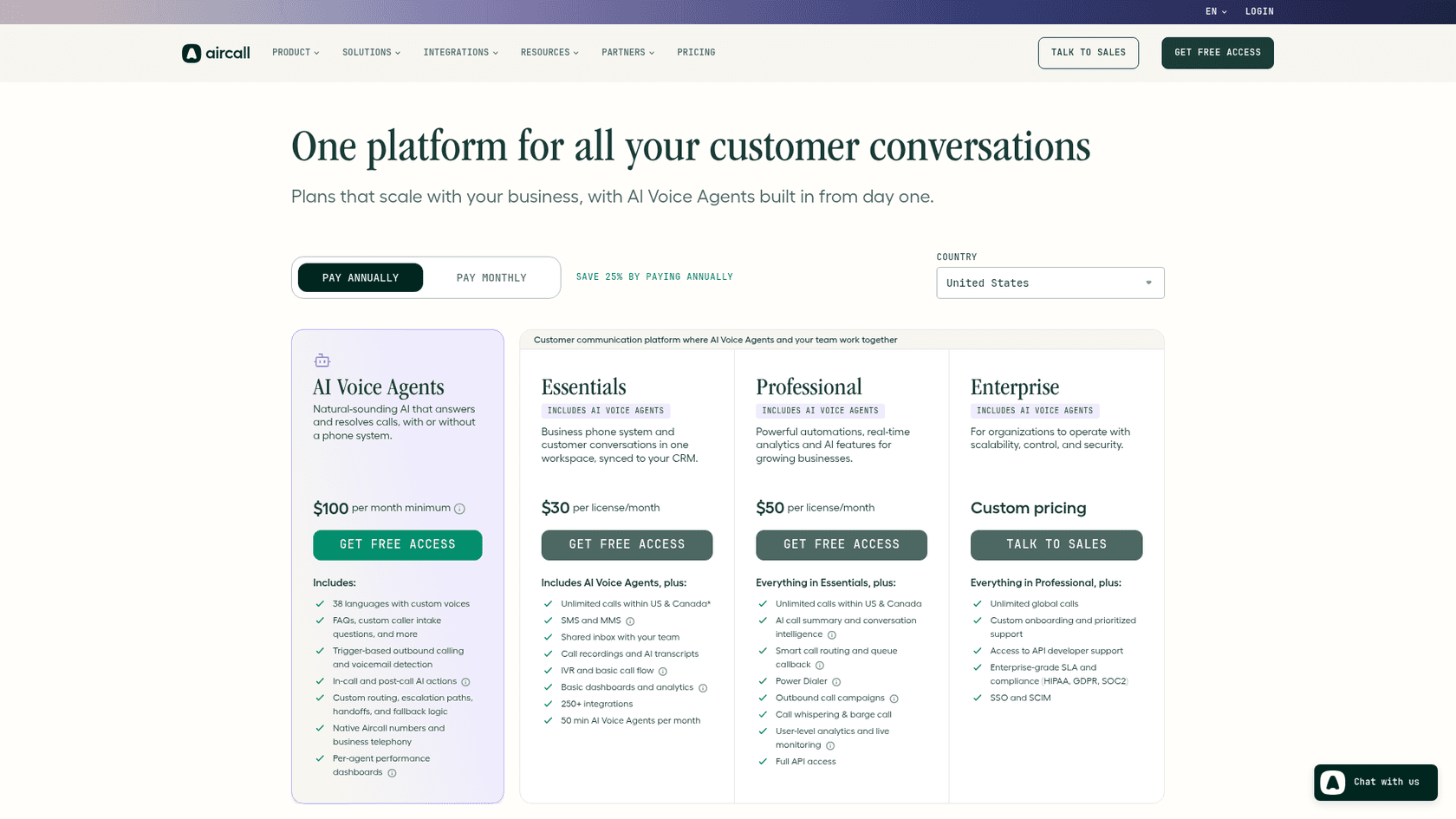
| Plan | Annual billing | Monthly billing | Minimum seats | Smallest bill (annual) | Best for |
|---|---|---|---|---|---|
| AI Voice Agents (standalone) | $100/month minimum | $125/month minimum | n/a | $100 | AI phone agent without Aircall's phone system |
| Essentials | $30 per seat | $40 per seat | 3 | $90 | Small teams that need a shared business line |
| Professional | $50 per seat | $70 per seat | 3 | $150 | Support and sales teams that want routing, coaching and AI summaries |
| Enterprise | Custom | Custom | 25 | Quote only | Larger teams that need an SLA, SSO and SCIM, and compliance paperwork |
Aircall labels annual billing as a 25% saving. On Essentials that's exact ($40 drops to $30), and on Professional it's a little better ($70 drops to $50, about 29%). The seat minimum is the part people miss. Aircall's own FAQ says all plans require a minimum of 3 licenses regardless of billing cycle, so a solo founder still pays for 3 seats.
There's no free plan and no stated trial length. The button on Essentials and Professional says "Get free access", and the FAQ confirms a free trial exists without naming a day count. If you're comparing against other phone tools, Dialpad's pricing and CloudTalk's pricing follow the same per-seat pattern, so the minimum seat count and add-ons are where they actually differ.
Helpdesk-native phone options like Zendesk Talk and Freshdesk Contact Center price differently again, because the phone seat rides on top of a helpdesk seat.
What changed in Aircall pricing in November 2026?
Aircall rebuilt its pricing page in early November 2026 (the page's structured data is dated 2 November). Seat prices did not move. The AI side did:
- AI voice minutes got cheaper. Pay-as-you-go dropped from $0.49 a minute to a flat $0.29 a minute. The old 500 and 2,500-minute bundles are gone, replaced by 1,000, 3,500 and 10,000-minute bundles.
- A standalone AI Voice Agents plan appeared. It costs a $100 monthly minimum on annual billing and works "with or without a phone system", so you can run Aircall's voice agent on top of another provider's lines.
- "Custom" is now "Enterprise" and its card now names SCIM plus HIPAA, GDPR and SOC 2 compliance.
- The monthly seat floor came down. The page used to say monthly billing needed 4 licenses. It now says 3 for every billing cycle.
- The $9 AI Assist add-on card is gone from the page. The comparison table still marks Essentials' AI summaries as an "AI Assist add-on", but no price is shown next to it any more.
If you priced Aircall from a blog post written before November, re-check the voice agent maths. A 2,500-minute month that cost $1,225 on the old pay-as-you-go tiers now comes to $725 at list.
What do the Essentials, Professional and Enterprise plans include?
All three plans share the basics: unlimited calls within the US and Canada, SMS and MMS, a shared inbox, call recording with AI transcripts, IVR, 250+ integrations, and 50 AI Voice Agent minutes a month. The differences are about routing, coaching, retention and admin.
| Feature | Essentials | Professional | Enterprise |
|---|---|---|---|
| Price per seat (annual) | $30 | $50 | Custom |
| Max teams | 3 | Unlimited | Unlimited |
| AI call summaries and conversation intelligence | Add-on | Included | Included |
| Smart routing and queue callback | No | Yes | Yes |
| Power Dialer and outbound call campaigns | AI Voice Agent campaigns only | Yes | Yes |
| Call whispering, barge and live monitoring | No | Yes | Yes |
| Salesforce Sales and Service Cloud integration | No | Yes | Yes |
| Messaging API | No | Yes | Yes |
| Call recording access | Up to 1 year | Unlimited | Unlimited |
| Analytics history | 6 months | 6 months | Unlimited (Analytics+) |
| International outbound calls | Contact sales | Contact sales | Unlimited |
| SLA | No | No | Yes |
| SAML SSO and SCIM | No | No | Yes |
| Priority support and API developer support | No | No | Yes |
Live monitoring and whispering are what most teams use for call center quality assurance, so that row alone often justifies Professional.
Two other rows decide most buying calls. The first is the 3-team cap on Essentials: if support, sales and billing each need their own call routing, a fourth team pushes you to Professional. The second is Salesforce. HubSpot, Zendesk and Pipedrive connect on Essentials, but Salesforce needs Professional, and the deeper Salesforce Voice experience is a separate $30 per seat on top. If your support team lives in Salesforce Service Cloud, budget $80 a seat before any AI.
How is Aircall's AI priced?
Aircall sells AI two ways: per-seat assistants that help your agents, and metered agents that handle conversations on their own. The per-seat side is predictable. The metered side scales with usage, and it's billed by the minute or by the conversation, not by whether the AI solved anything.
AI Assist and AI Assist Pro (per seat)
AI Assist covers call summaries, key topics, talk-to-listen ratios, trending topics, call scoring and the AI and Transcription API. It's included on Professional and Enterprise and listed as an add-on on Essentials.
AI Assist Pro costs $49 per seat a month on any plan. It adds real-time transcription, custom call summaries, playbooks, live prompts and automated scoring with your own questions. On a 10-seat team that's $490 a month, nearly as much as the Professional seats themselves. For comparison, helpdesk vendors price their own AI per resolution or per seat, which the breakdowns of Zendesk AI pricing and HubSpot AI pricing walk through.
AI Voice Agents (per minute)
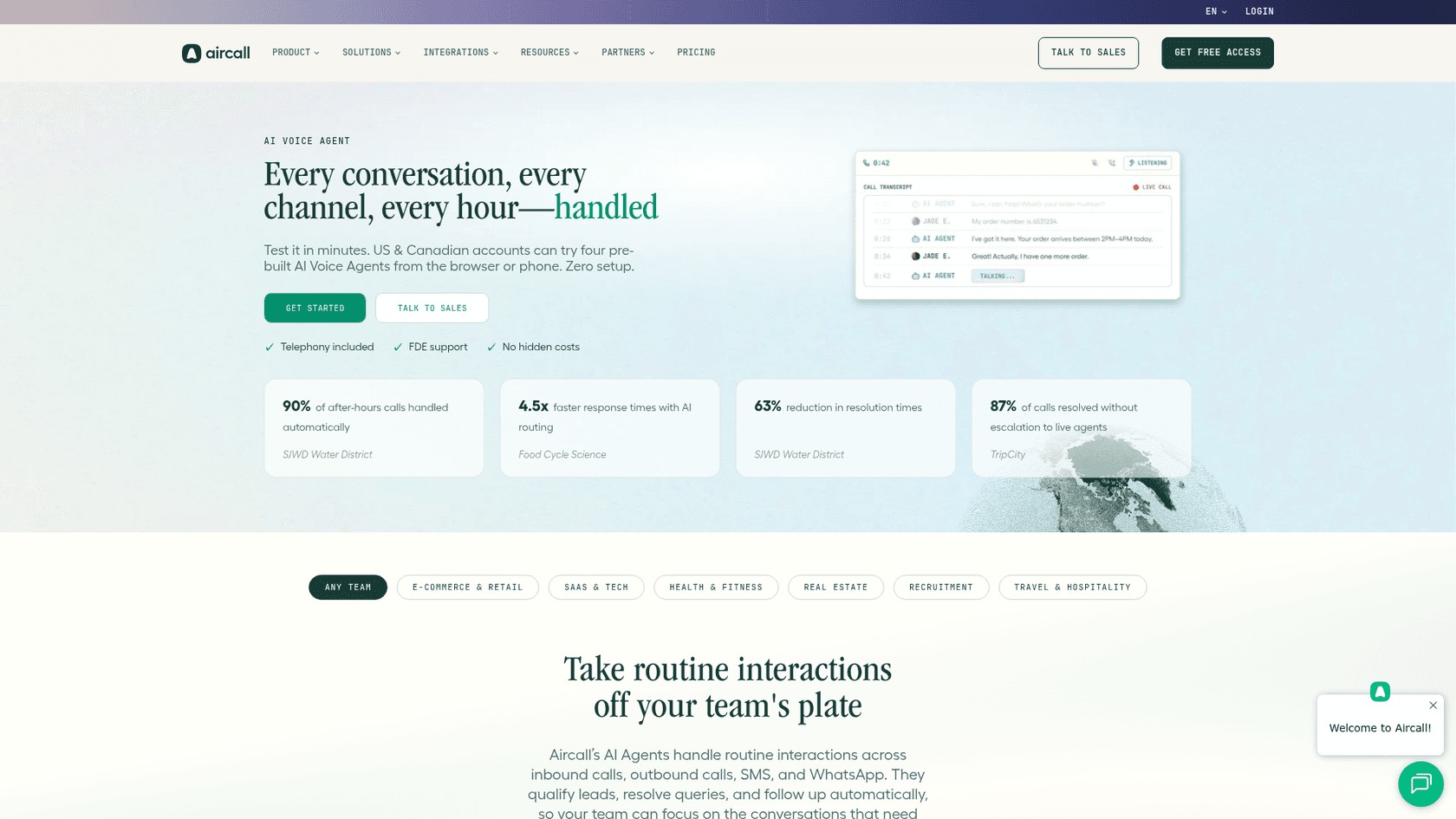
The voice agent answers calls, books appointments, transfers to a person with context and logs the call to your CRM. Every plan includes 50 free minutes a month, plus 100 at sign-up.
| Option | Price | Effective rate per minute |
|---|---|---|
| Included on every plan | 50 minutes a month (plus 100 at sign-up) | $0 |
| Pay-as-you-go | $0.29 per minute | $0.29 |
| 1,000-minute bundle | $250 a month | $0.25 |
| 3,500-minute bundle | $805 a month | $0.23 |
| 10,000-minute bundle | $1,900 a month | $0.19 |
| Over 50,000 minutes | Custom | From $0.12 |
Bundles bill monthly on an annual term, per Aircall's voice agent page, so a bundle is a 12-month commitment even though the invoice is monthly. Aircall's own calculator shows the trade-off: 2,500 minutes costs $725 on pay-as-you-go, or $685 on the 1,000-minute bundle plus $0.29 overage.
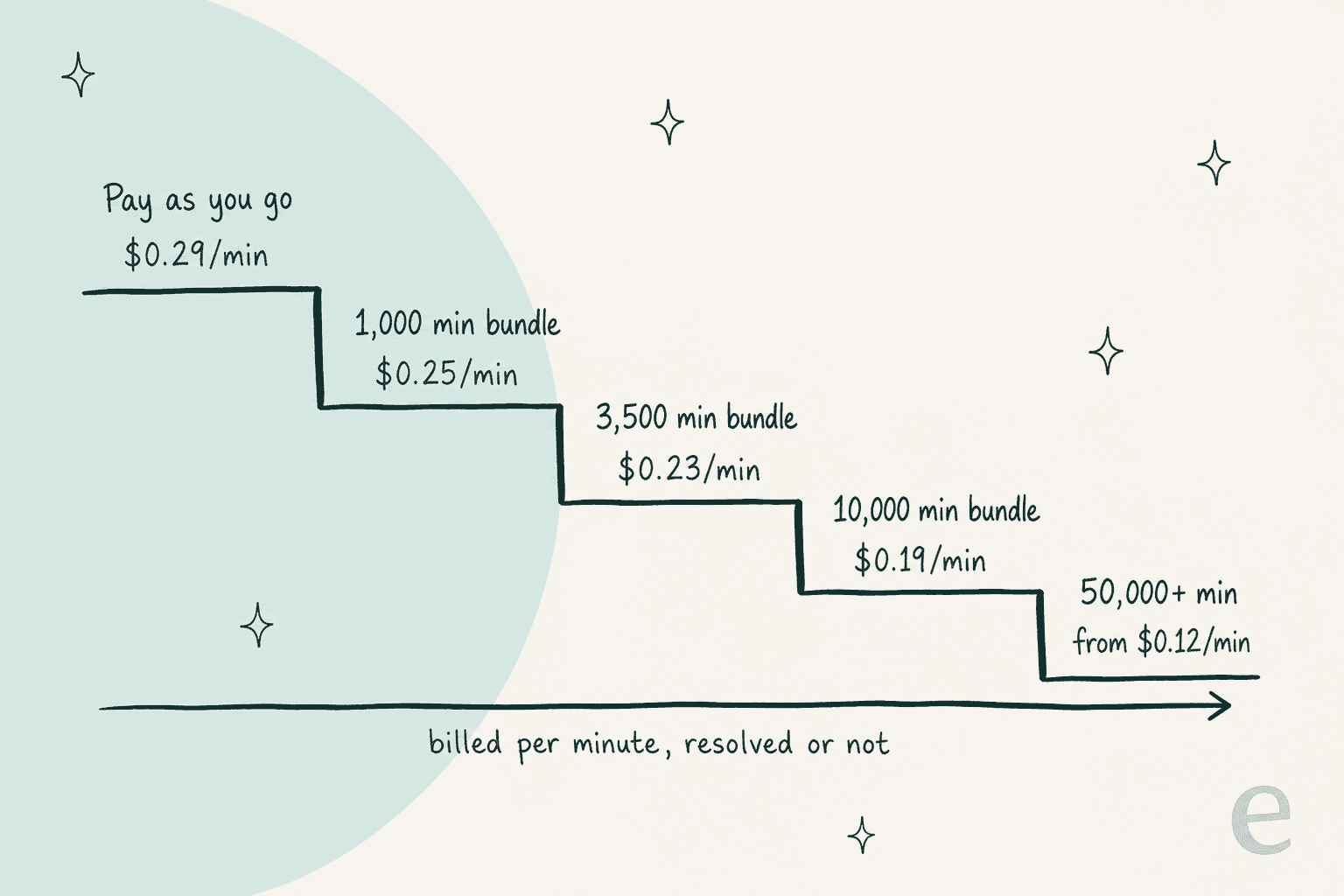
The unit to watch is the minute. A six-minute call where the caller gets frustrated and asks for a person still bills six minutes, which is $1.74 at the pay-as-you-go rate. Aircall publishes strong customer numbers on the same page (it quotes 87% of calls resolved without escalation for one customer), but your own mix decides your bill. A queue full of "where's my order?" calls is cheap. A queue full of billing disputes that end in a transfer is not. The guide on whether AI can answer phone calls goes deeper on which call types suit a voice agent, and the AI voice agent explainer covers how the handoff to a person works.
AI Messaging Agents (per conversation)
The messaging agent replies over SMS and WhatsApp on your business numbers. A conversation starts at the first AI reply and closes after 30 minutes without activity.
| Option | Rate per conversation | Package total |
|---|---|---|
| Free allowance | 100 conversations | $0 |
| Pay-as-you-go, first 1,000 | $0.35 | n/a |
| Pay-as-you-go, after 1,000 | $0.29 | n/a |
| 1,000-conversation bundle | $0.25 | $250 |
| 10,000-conversation bundle | $0.15 | $1,500 |
Standard SMS and WhatsApp carrier fees are charged on top, so the per-conversation rate isn't the whole cost. If WhatsApp is your main channel, WhatsApp Business API pricing covers what Meta charges per message.
Which Aircall add-ons raise the bill?
Add-ons are where a $30 seat turns into an $80 or $100 seat. Here's every priced add-on on the page today.
| Add-on | Price | Unit | What you get |
|---|---|---|---|
| AI Assist Pro | $49 | per seat / month | Live transcription, playbooks, live prompts, custom scoring |
| Analytics+ | $15 | per seat / month | Unlimited history, drill-downs, exports, heatmaps (included on Enterprise) |
| WhatsApp in Aircall | $10 | per seat / month | WhatsApp Business messaging next to calls; WhatsApp message fees extra |
| Aircall for Salesforce Voice | $30 | per seat / month | Call controls inside the Salesforce Omni-Channel widget |
| Additional phone number | $6 | per number / month | 1 local or toll-free number is included per plan |
| Number Reputation Dashboard | $0.03 | per check | Shows whether carriers label your numbers as spam |
| Branded caller ID | $0.08 | per call per brand | Your brand name on outbound calls (via sales) |
Two smaller limits matter if you text customers. Aircall's SMS footnote now caps outbound texts at 4,000 per user a month (inbound is unlimited), and MMS is US and Canada only. International outbound calling on Essentials and Professional is quote-based, so a team calling Europe or Australia should get that rate in writing before signing.
What does Aircall cost for a real team?
Here's what the list prices add up to for four common setups, all on annual billing.
| Team | What's on the account | Monthly bill |
|---|---|---|
| 3-person startup | 3 Essentials seats | $90 |
| 5-person support team | 5 Essentials seats, voice agent on the free 50 minutes | $150 |
| 10-person support team | 10 Professional seats (AI summaries included) | $500 |
| 10-person team, full AI stack | 10 Professional + AI Assist Pro + Analytics+ + 1,000-minute voice bundle | $1,390 |
| 10-person team plus messaging | Same as above + 5,000 AI messaging conversations pay-as-you-go | $2,900 + carrier fees |
| 25+ seats | Enterprise | Quote only |
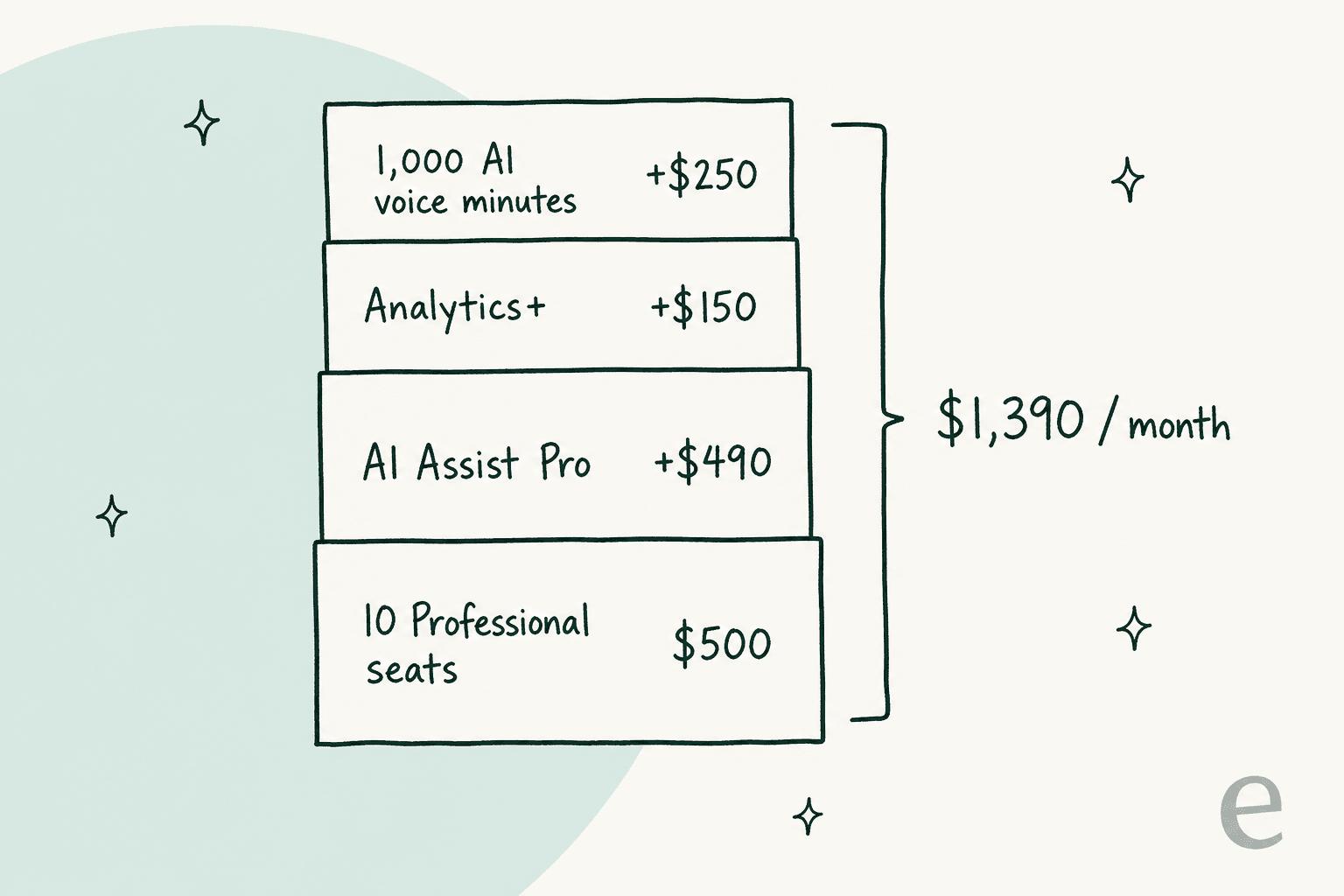
The stack above is the pattern I'd plan for. Seats are less than half of a fully kitted-out Aircall bill. The 5,000-conversation row works out as 1,000 at $0.35 plus 4,000 at $0.29, which is $1,510 before carrier fees. The 10,000-conversation bundle costs $1,500 flat, so from about 5,000 conversations a month it is already the cheaper option, and the gap widens fast after that.
For context on where phone fits in the wider budget, the breakdown of AI customer service costs and the call center ROI guide cover the per-contact maths across channels. Call center automation is the other lever: fewer minutes per call means fewer seats.
What do Aircall users say about the price?
The pattern in user comments is consistent: people like the product and notice the price. The most common version is a short "worth it, but not cheap".
"Been using Aircall for almost 2 years. Doesn't come cheap, but it's the one that gives us better control of the activities."

The sharper complaints are about plan gating. A plumbing business owner on r/VOIP wanted texting automation, which matches the Messaging API that only starts on Professional:
"I want texting API automation abilities, which are only in the more expensive version for reasons."
The other side of that is the very small user who only needs calls and texts and feels the 3-seat floor:
"I search an application like aircall, but less expensive. The thing with aircall is that, I only use 2 of the most basic options: texting and calling. I don't need more."
Not everyone sees it as pricey. This one comes from a customer support director at a small business, in a G2 review marked as a seller invite, so I'd give it less weight than the Reddit comments:
"...For our business, the price is the most competitive."

My read: Aircall is priced for teams that use what Professional unlocks. If you only need a line and a text inbox, you're paying for a lot you won't touch.
What costs are easy to miss on an Aircall quote?
Most of these are on the pricing page, just not on the plan cards.
- The seat minimum. 3 seats on Essentials and Professional, 25 on Enterprise. A 2-person team pays for 3.
- AI is metered by usage, not outcome. Voice bills per minute and messaging per conversation, whether or not the AI closed it.
- Bundles lock in for a year. Voice bundles are monthly billing on an annual term, so size them on a quiet month, not your busiest.
- Retention limits on the cheaper plans. Essentials keeps call recordings for up to a year, and both Essentials and Professional keep 6 months of analytics. Longer history means Analytics+ or Enterprise.
- Enterprise-only essentials. An SLA, SAML SSO, SCIM and priority support all sit behind the 25-seat Enterprise tier.
If you're also running a helpdesk, remember its seats are a separate line. Aircall plugs into tools like Zendesk, Freshdesk, Gorgias and HubSpot, and each one bills its own agents.
Is Aircall worth the price?
For a support team of 5 to 20 people that takes real phone volume, yes. Aircall is quick to set up, it drops into the helpdesk you already have, and $50 for a Professional seat with AI summaries included is fair for what you get: smart routing, queue callback, whispering and live monitoring. I'd start on Professional, leave AI Assist Pro off for the first month, and turn on the voice agent with pay-as-you-go minutes before committing to a bundle.
Where I'd slow down:
- Very small teams. If two people answer the occasional call, the 3-seat floor makes Aircall a $90 to $120 line for a phone you barely use.
- Teams whose volume is mostly written. If 80% of contacts arrive by email and chat, a per-seat phone system isn't where the savings are.
- Teams that need an SLA or SSO. That's Enterprise, 25 seats minimum, with no public price.
If you're comparing Aircall against Dialpad specifically, the Dialpad review covers the day-to-day differences, and if you're already on Zendesk, Zendesk's voice AI agents are worth pricing alongside Aircall's.
If you're still deciding between phone-first platforms, the roundups of the best AI voice agents and the best AI for phone support compare the options on the same terms.
How do you keep the Aircall bill from growing?
The cheapest Aircall minute is the call that never needs to happen. Most "where's my order?" and "how do I reset this?" calls start because the customer couldn't get a quick answer in writing first.
I see this a lot on eesel's side. One prospect, a direct-to-consumer supplements brand handling about 7,000 tickets a month on Gorgias and Shopify, already had Aircall on its phones. What it came to eesel for was the written queue: it wanted more than half of those tickets resolved without a person.
Beautek, a German equipment supplier for beauty and medical studios, is a clean example of how this plays out. Its phone line is staffed 8:30 to 16:30 on weekdays. eesel runs the chat on its website around the clock and drafts replies on its Zendesk tickets. In one month it answered 77 website chats live, drafted 110 Zendesk tickets for the team, and turned 20 chats into tickets for the team. Every chat answer points people to the team's phone number for anything important, so the phone line gets the conversations that need it.
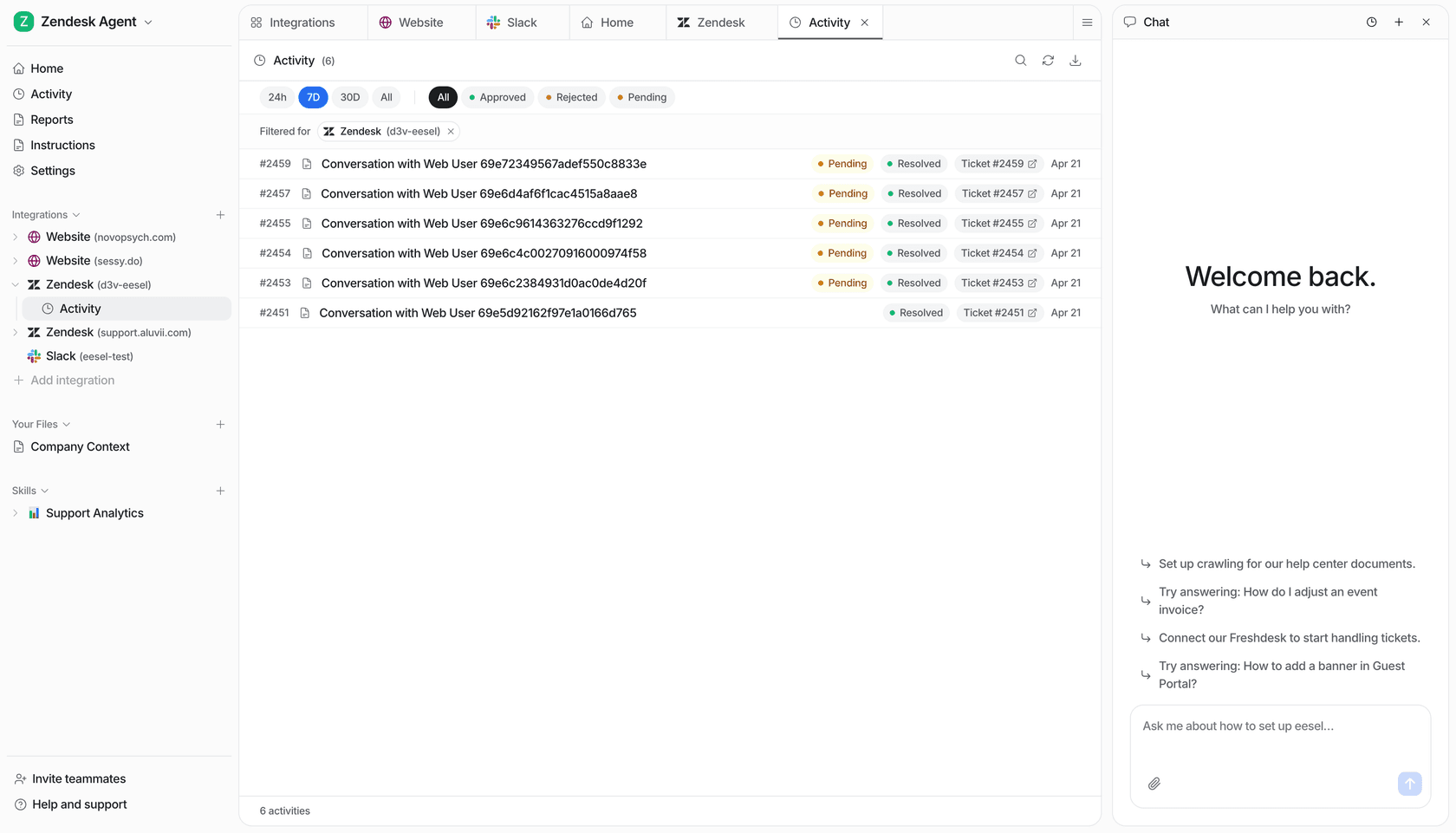
Call logs often land in the same helpdesk too. Luxedo runs eesel on Gorgias and set it to skip phone-call records entirely, so nothing is spent drafting replies to calls the team already handled. That kind of rule is what keeps phone and written support from double-billing each other.
If you sell online, AI phone support for ecommerce and the Gorgias phone integration guide show how calls and tickets share one queue.
The guides on AI for weekend support coverage and AI for support staffing cover the same idea from the staffing side.
Try eesel next to Aircall
Aircall runs your phones. eesel is the AI teammate for the written queue sitting next to it: it works inside Zendesk, Gorgias, Freshdesk or HubSpot, learns from your past tickets and help center, and drafts or sends replies on email and chat so fewer customers reach for the phone.
eesel pricing is a flat monthly credit batch, $299 for 500 tickets or chats, with no per-seat fees, so it doesn't grow with your headcount the way phone seats do.
You can start with 100 free credits, no card needed. Try eesel on a slice of last month's tickets and see which ones it would have answered before they turned into calls.