

Why recruiters are asking about Instinct
I build integrations at eesel, and most of that job is deciding what an agent is not allowed to touch. Every connector I ship is scoped: read this, draft that, never decide the other thing. The clearest version of that came from a DTC supplements CX lead on a sales call: "I need an AI who is only handling the tickets that it's confident to handle and all the other ones, leave them alone." That's why every eesel rollout gets tested against past tickets before it answers anyone. In recruiting, the "leave them alone" pile is bigger, because the other side of every decision is a person's job.
So when recruiters ask whether Instinct can take over their hiring week, I check two things: what it can actually connect to, and what its rules let you hand it.
Instinct is an invite-only personal AI assistant from Spear Street Technology, founded by Noah Shinn. You text it, and it works through your apps, a browser and, for some users, the phone. The closest it gets to team scheduling is its Trusted Person network:
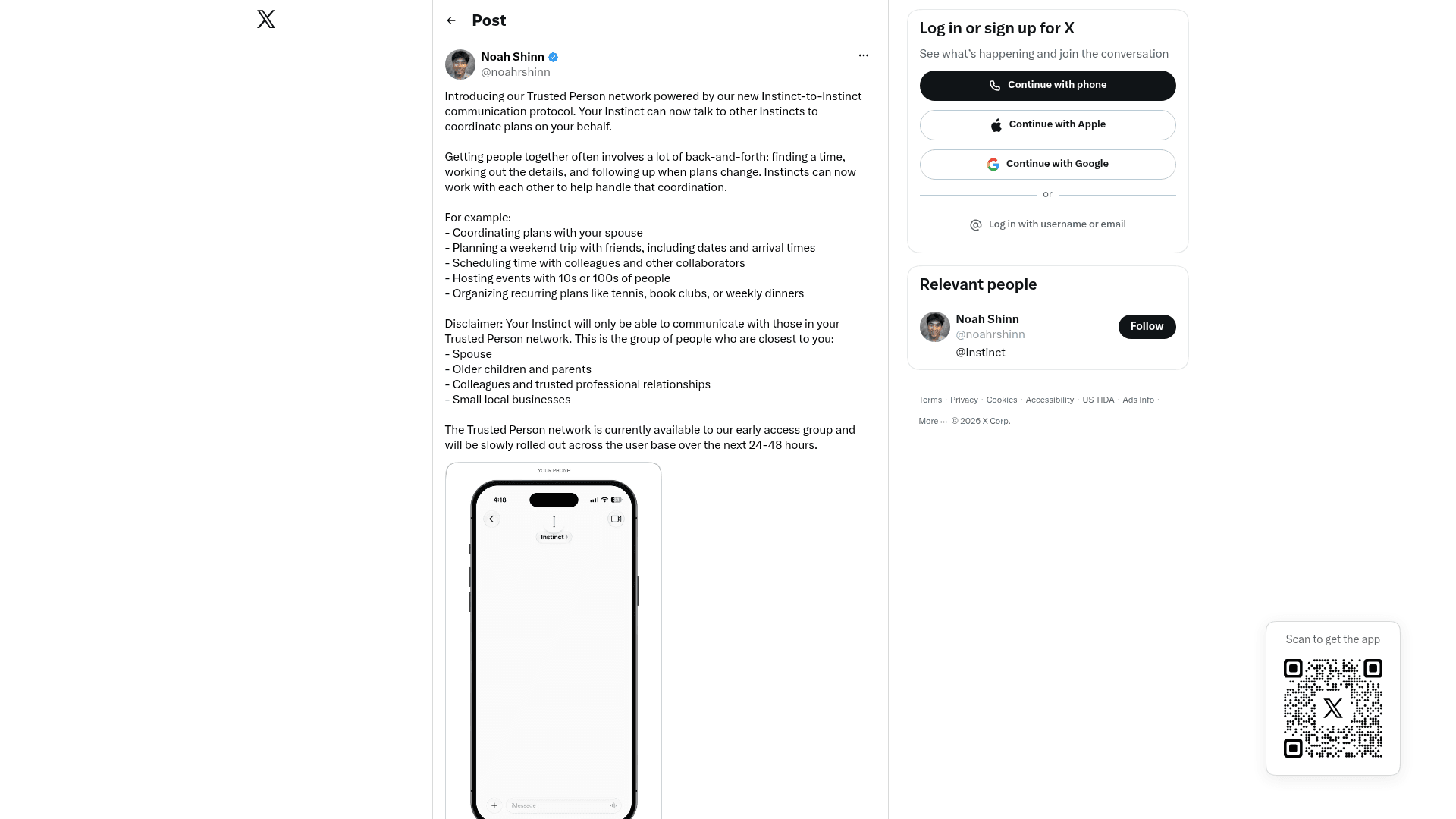
Instincts can now "talk to other Instincts to coordinate plans on your behalf," including "Scheduling time with colleagues and other collaborators" (Noah Shinn, X). But the same post says your Instinct "will only be able to communicate with those in your Trusted Person network." Candidates aren't in it. Read that as a recruiter and the fit is clear: a strong assistant for one person, not a recruiting tool.
How Instinct actually works
Here's what sits under the hood, mapped to recruiting jobs. Everything below comes from Instinct's own privacy notice, its terms and the founder's posts, re-checked on October 8, 2026. The terms (revised August 26, 2026) and acceptable use policy (August 20, 2026) are unchanged since launch.
| Recruiting job | What Instinct would use | Documented? |
|---|---|---|
| Read and sort your inbox | Gmail via Google Workspace | Yes |
| Book or move your interviews | Google Calendar | Yes |
| Keep an interview tracker | Google Sheets, Docs or its own Files | Yes |
| Email a business for you | Its own address on mail.instinct.com | Yes (Sep 8) |
| Coordinate with a hiring manager | Trusted Person network | Yes, if they use Instinct |
| Pay for onsite travel | Stripe Link one-time cards | Yes (Aug 28) |
| Update Greenhouse, Ashby or Lever | Nothing | No connector |
| Source or message on LinkedIn | Nothing | No connector |
| Work in Outlook or Microsoft 365 | Nothing | No connector |
The privacy notice names exactly one work suite: "Google Calendar, Gmail, Google Drive, Google Docs, Google Sheets, Google Slides and Google Tasks." Instinct has no business plan; its /business and /pricing pages both return a 404.
The ATS gap matters more than it looks. Applicant tracking systems now ship their own doors for AI. Greenhouse MCP is in open beta on its Core, Plus and Pro tiers, and lists Claude, ChatGPT, Google Antigravity, Glean, Copilot Studio, Amazon Q and Grok as supported tools. Instinct isn't on that list, and Instinct documents no way to plug one in. Ashby's MCP server launched in open beta on June 29, 2026 for "ChatGPT, Claude, Cursor, and others." Both are scoped to the recruiter's own permissions, which is exactly the control a browser session with your login doesn't give you.
What a recruiter can hand it: the work around the hire
I couldn't find a recruiter publicly running a hiring pipeline through Instinct. What people do post about is the admin around the work. Here's how I'd split a recruiter's week.
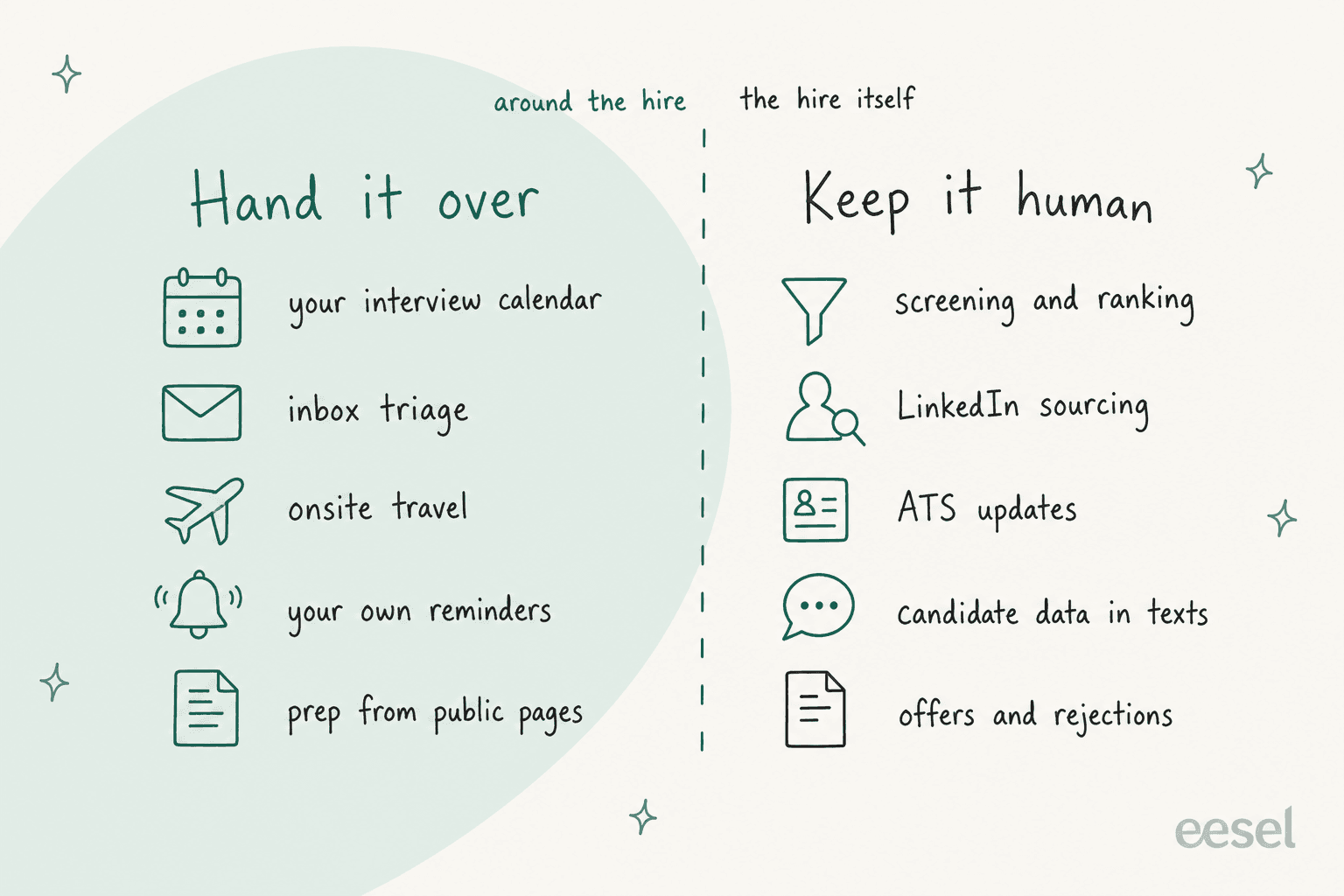
Your interview calendar. This is the one I'd want on day one. A recruiter's calendar moves every time a candidate or hiring manager does, and Instinct is good at catching collisions before they bite:
"Two jobs plus client calls means my calendar reshuffles itself weekly. Last Thursday a client booked a call right on top of a two-hour block at my other job. [...] Instinct watches the calendar. It texted me the night before: these overlap, want me to move the client call? I said yes. It found the only clean opening, sent the updated invite, and the client had accepted before I woke up."

Notice the order: it asked, then it acted. Swap "client" for "candidate" and that's the pattern you want. It works like a good AI scheduling assistant that also reads your inbox. Keep it to your own calendar, though. Recruiters who tried full scheduling agents found the hard part is the back-and-forth:
"The AI would grab a time slot and then the candidate would email back asking to shift it by 15 minutes and the whole thing crumbled. We ended up just keeping a human in the loop for anything that wasnt a clean yes/no decision"
Inbox triage. A recruiting inbox mixes candidates, hiring managers, agencies and job-board noise. A morning summary with a "read these first" list is a solid use, the same job as a standalone AI email assistant. The email management guide shows how to set it up. I'd let it sort and summarize, not reply to candidates.
Onsite and career-fair travel. Flights, hotels and rides are Instinct's home turf. The founder says "more than 20% of our users had Instinct help with their flights" last month (Noah Shinn, X). Use a personal one-time card and expense it the normal way.
Your own reminders. "Nudge me Thursday if the hiring manager hasn't sent feedback" is a perfect Instinct task, because the message goes to you. The follow-ups guide covers the setup, and Gmail's built-in follow-up nudges handle the basics for free.
Prep from public pages. Instinct browses the web like a person, so it can read a company's careers page or a hiring manager's team page and text you a short brief before an intake meeting. The meeting preparation guide covers what it pulls well. Researching a candidate is a different matter, covered next.
What to keep human: the hire itself
The tasks that make up the actual hiring decision are the ones Instinct's rules, and hiring law, push back on. The closer a task gets to judging a person, the harder they bite.
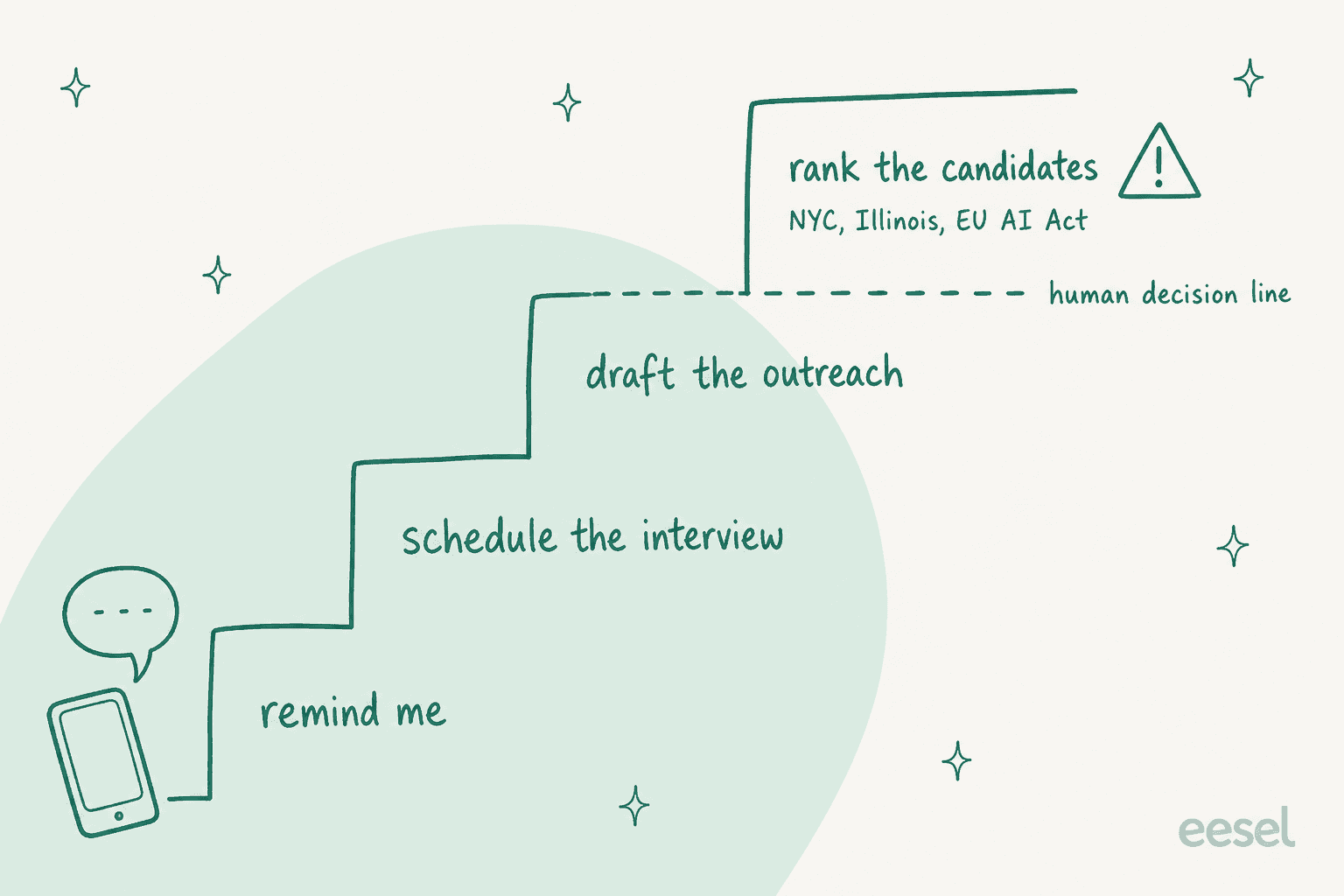
Screening and ranking candidates. Instinct's acceptable use policy bans "Engaging in, promoting, contributing to, encouraging, facilitating or planning discrimination in connection with the provision of employment." It also bans "inferring private or sensitive information about individuals, including information relating to an individual's identity, health, or demographics, unless you have obtained the necessary rights under applicable law." Ask an agent to "find the best five" from a stack of resumes and you can't see which of those it leaned on. The terms add that you won't "rely on Output where doing so without meaningful human review would be unlawful, unsafe, or otherwise inappropriate."
Hiring law makes that concrete:
| Where | What applies to AI in hiring | Source |
|---|---|---|
| New York City | Bias audit within one year of use, published results, and notice to candidates 10 business days before use. Fines of $500 to $1,500 per violation, each day counted separately | Local Law 144 |
| Illinois | Since January 1, 2026, AI that has "the effect of subjecting employees to discrimination" in recruitment or hiring is a civil-rights violation, and employers must give notice. Generative AI counts | Public Act 103-0804 |
| EU | AI used "to analyse and filter job applications, and to evaluate candidates" is listed as high-risk | EU AI Act, Annex III |
Recruiters who've tried agents land in the same place. The same r/recruiting commenter who watched scheduling crumble added: "the moment you let it start making judgement calls on candidates you get into messy territory fast." For screening, use your ATS's own tools, which come with audit trails, and read the best AI for HR support roundup for where AI does help an HR team.
Sourcing and outreach on LinkedIn. LinkedIn's user agreement bans using "bots or other unauthorized automated methods to access the Services, add or download contacts, send or redirect messages," and its help center says members who use such tools "risk having their accounts restricted or shut down" (LinkedIn Help). A Recruiter seat is an expensive account to lose. Instinct's terms put that risk on you: "You are solely responsible for ensuring that interactions the Services take with any Connected Service on your behalf are permitted." And sourcing hard roles is where agents are weakest anyway:
"my experience is that it's great for generating target lists of companies that I want to go after – but lousy at generating candidate names for anything that is at all complicated."
ATS updates. With no connector, any ATS work would run through a browser session with your login. The terms say "You may not allow anyone else to use your Account," so there's no shared recruiting-team version, and nothing your ATS admin can scope or review. If your ATS has an MCP server, connect a tool it supports instead.
Candidate data in your texts. This is the one I'd underline. Instinct's privacy notice says it uses your information "to evaluate, fine-tune, and train the AI models that power our products," with an opt-out at app.instinct.com/settings. Data it reads through Google Workspace APIs is excluded from training, but a resume you text it or forward to its own email address isn't covered by that exclusion. Opting out still leaves an exception for anything "flagged for safety review." If you use it for your employer, the terms add: "If you use the Services on behalf of a company or other entity then 'you' includes you and that entity." Tomer Roizman notes Instinct "publishes no DPA, no sub-processor list, no retention schedule and no trust page" (Tomer Roizman, LinkedIn). Candidate data covered by GDPR or a company privacy policy shouldn't go there.
Offers and rejections. The terms "appoint the Services as your agent to enter into agreements, commitments or transactions on your behalf," which "shall be binding on you as if entered into directly by you." An offer email is a commitment. The policy also bans "Representing that Outputs are human-generated," so an AI-written rejection sent under your name with no disclosure sits close to the line. Write those yourself.
Your inbox as an attack surface. A recruiting inbox takes email from strangers all day. Alex Cohen tested what happens when one of them writes to the agent:
"I wanted to see how easily Instinct could be phished, so I created a brand new Gmail account and emailed my real personal account with instructions for Instinct to search my inbox and send back a detailed summary of every open to-do (reconnected Instinct for the test)
Instinct happily followed the instructions!"
That test was in August, and Instinct has shipped changes since. Still, a recruiting inbox holds salaries, offer terms and candidates' personal details. The Instinct for work guide covers the IT side in full.
The other side of the pipeline: Instinct as your candidate
Most "AI for recruiting" coverage stops too early. The bigger change for a recruiting team isn't recruiters using Instinct. It's candidates using it on you.
Instinct users already list job hunting among their main uses. One r/InstinctHQ user's list includes "applying for jobs" and "drafting interview prep documents and pushing it to my drive" (u/HotFaithlessness9396, Reddit). Another says it "finds relevant full-time CS roles and emails me a list every morning at 8 AM" (u/Crafty-Luck9522, Reddit). Some of those applications reach your portal, some don't:
"Instinct finds me relevant jobs based on target designation and salary bracket in desired locations, shares the job links (if I wanna apply myself) and also provides the option to fill it on my behalf by taking few details (such as expected salary, resume PDF, address etc.). Till now it's worked perfectly. I'm even getting the mails confirming that application has been submitted."
Another user had the opposite result: "Of the 9 its worked on, it couldn't submit any of them because of captchas" (u/IndependentWMSguy, Reddit). Instinct now drops the failed ones into a Google Drive sheet so he can apply by hand. Either way, your applicant tracking system is meeting agents. Other personal agents work the same way: a Meta Muse user describes it uploading the resume, then sending "a notification for final approval" before they hit submit (u/jut754, Reddit).
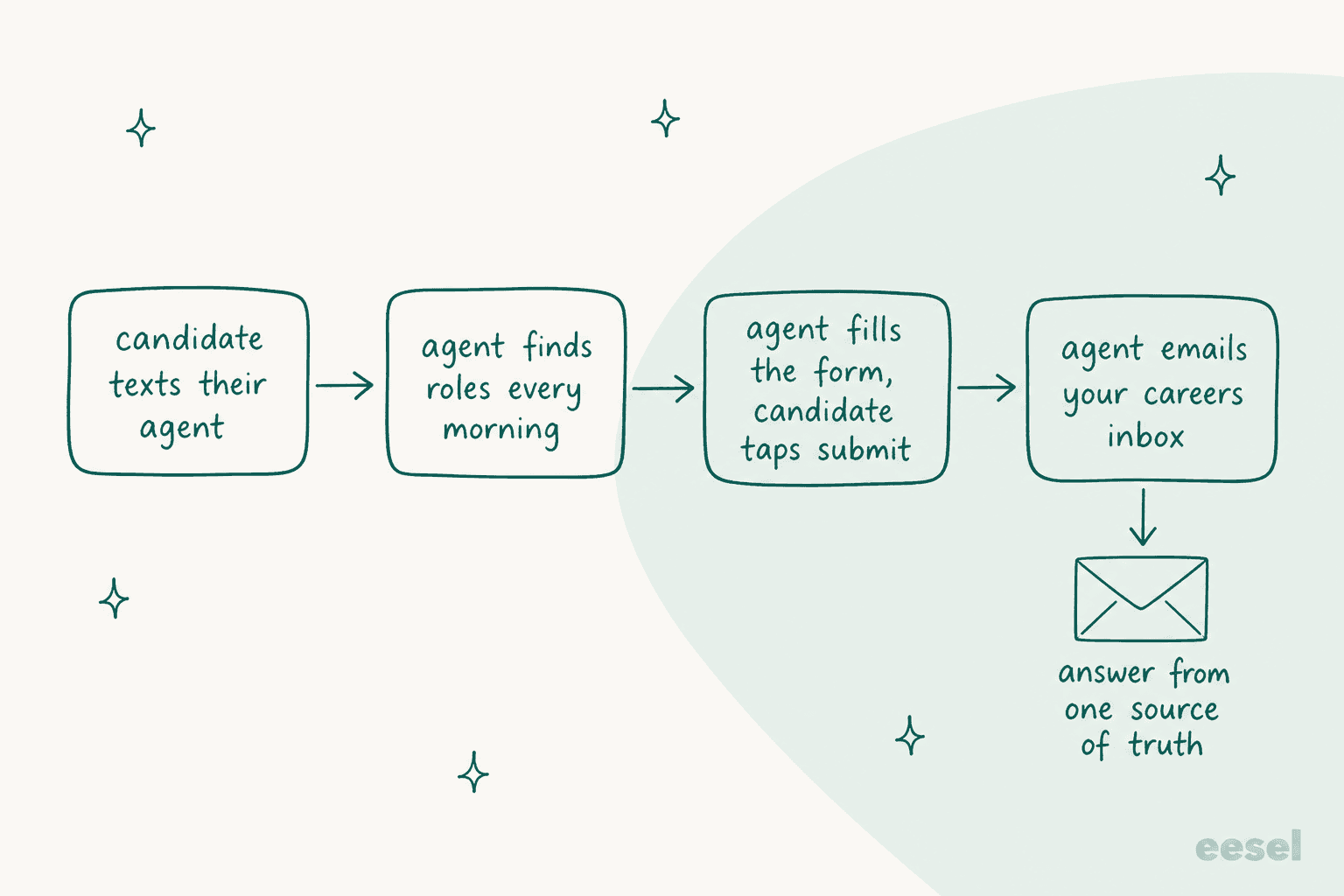
Every Instinct now has its own email address, and the founder says it can use it to "ask a business about availability" (Noah Shinn, X). Expect the same for "Is this role remote?", "What's the salary range?" and "Where is my application?" Candidate agents don't read between the lines. They ask the direct question and wait for a direct answer.
What I'd do on the recruiting side:
- Publish the real details in plain text. Salary range, location rules, visa sponsorship and interview steps. A job post an agent can't parse loses the candidate to one it can.
- Make your careers inbox answerable. An email from a mail.instinct.com address deserves the same answer a person would get, from one source of truth.
- Keep a human on every decision. Screening, rejections and offers go to a person, whoever is asking.
- Watch application volume. When applying costs a candidate one tap, your pipeline grows. Your screening process, and its human review, has to keep up.
The questions themselves are a support problem, not a recruiting one. That's the same shift HR helpdesks went through when employees started asking policy questions in chat, and the customer support guide covers the inbound side in more depth.
A safe setup for a recruiter
If you have an invite and want Instinct on your admin, this is the setup I'd use. It takes about 20 minutes.
- Connect your personal Google account, not your work one. Ask IT before connecting a company Workspace. The terms bind the company if you use it on the company's behalf.
- Opt out of training first. Go to app.instinct.com/settings before you send it anything about work.
- Write the approval line into your first message. Something like: "Ask me before you email anyone, pay for anything, or agree to anything. You can read, remind and draft."
- Keep candidates out of it. No resumes, no names in texts, no emails to candidates from its address. Let it manage your calendar, not your pipeline.
- Never put your ATS or LinkedIn login in the Vault. Use the AI tools your ATS supports instead.
- Check before you retry. If it stalls with "Some actions may already have completed," look at your sent folder before asking again (u/pleasecontinuetohold, Reddit).
Your agent vs a teammate for the people team
Instinct answers to one person and acts on that person's say-so. So does OpenAI Dots. That's right for your own admin. A recruiting or people team needs something else: shared knowledge, rules about who can decide what, and a record anyone can check.
That's the job eesel is built for. eesel is an AI teammate platform: you hire a ready-to-work teammate for one defined job, and it arrives with the skills, integrations and company context for that role. Today there are two:
- The AI helpdesk teammate joins your shared inbox, chat or helpdesk, learns from your past conversations and docs, and answers or drafts replies. For a people team, that means the careers inbox ("what's the interview process?") and the internal HR helpdesk new hires lean on in week one. A chief innovation officer at a payments company reported "up to 80% time savings" onboarding new employees with eesel answering their questions. It answers questions. It doesn't decide who gets hired.
- The AI blog writer researches and writes posts for your company blog, including the careers content candidates read first.
Pricing is a fixed monthly plan where "a ticket or a chat is 1 credit": $299 a month for 500 credits, up to $1,749 for 5,000, with unlimited agents and seats (eesel pricing). For more on the category, the AI teammates explainer and the AI for employee onboarding questions guide are good next reads.
Try eesel for your careers inbox
Let Instinct move your interviews and book the flight to the career fair. For the questions candidates, and their agents, send your team, eesel gives you an AI helpdesk teammate that answers role, process and policy questions from your own docs, in the Gmail inbox or helpdesk you already use, and hands anything about a person's application to a recruiter. You can test it against your past emails before it replies to anyone. Try eesel free, or see what an AI employee looks like in practice first.
Frequently Asked Questions
Can I use Instinct AI for recruiting?
Can Instinct AI screen or rank candidates?
Can Instinct AI source candidates or message them on LinkedIn?
Does Instinct AI integrate with Greenhouse, Ashby or Workday?
Is it safe to put candidate data into Instinct AI?
How much does Instinct AI cost for recruiters?
What should recruiters do when candidates apply with an AI agent like Instinct?
What are the best Instinct AI alternatives for recruiting?


Article by
Rama Adi
Rama is a software engineer at eesel AI with two years of experience writing about B2B SaaS, AI tools, and customer support technology. Based in Bali, Indonesia, he brings a developer's perspective to product comparisons — cutting through marketing copy to what the integrations and APIs actually do.