GLM-5.4 is Z.ai's new flagship, released on 23 November 2026 to GLM Coding Plan subscribers only, so you cannot yet call it by API, price it per token, or download the weights. In Z.ai's own tests it beats GLM-5.3 in 51.1% of comparisons, but there is no benchmark table, and the company admits it can fall into long "marathon thinking" loops. My verdict: use it today if you already pay for a Coding Plan, and wait for an API price before building on it. For a support queue, a model like this is only the engine, which is the part eesel's AI helpdesk teammate wraps and tests for you.
What is GLM-5.4, and when did it ship?
GLM-5.4 is the latest flagship from Z.ai (the lab formerly known as Zhipu AI), and the launch post is dated 23 November 2026. It is the first GLM model built on a Loop Transformer, and Z.ai says it reaches the intelligence of 2T to 3T parameter models. The model docs list a 1M-token context window, 128K maximum output, and text, image, video, and file input with text output.
One honest note on method. I have not run GLM-5.4 myself, because there is no API to call and a Coding Plan seat would only tell me about coding tools, not the support work most eesel readers care about. This review is built from Z.ai's docs and pricing pages, peers' own price cards, and what practitioners said on launch day. When the API opens I will rerun it against real support tickets. If you want to do that yourself with a coding agent, the eesel CLI lets Claude Code or Codex upload approved help-center articles to an eesel agent and ask it test questions before anything goes live, although connecting the helpdesk itself still needs someone with admin access to approve it.
Z.ai's lead on the launch, Zixuan Li, kept the announcement short:
"GLM-5.4 is now available to all GLM Coding Plan users. New vision capabilities and stronger all-round coding performance."
What is a Loop Transformer, and why does it matter?
A normal transformer runs each layer once per forward pass. In a Loop Transformer, a group of layers with shared weights runs several times, so the model gets a deeper network without more parameters. GLM-5.4 loops 28 layers of the GLM-5 base model for two iterations, and Z.ai's write-up says the base sits at 750B scale.
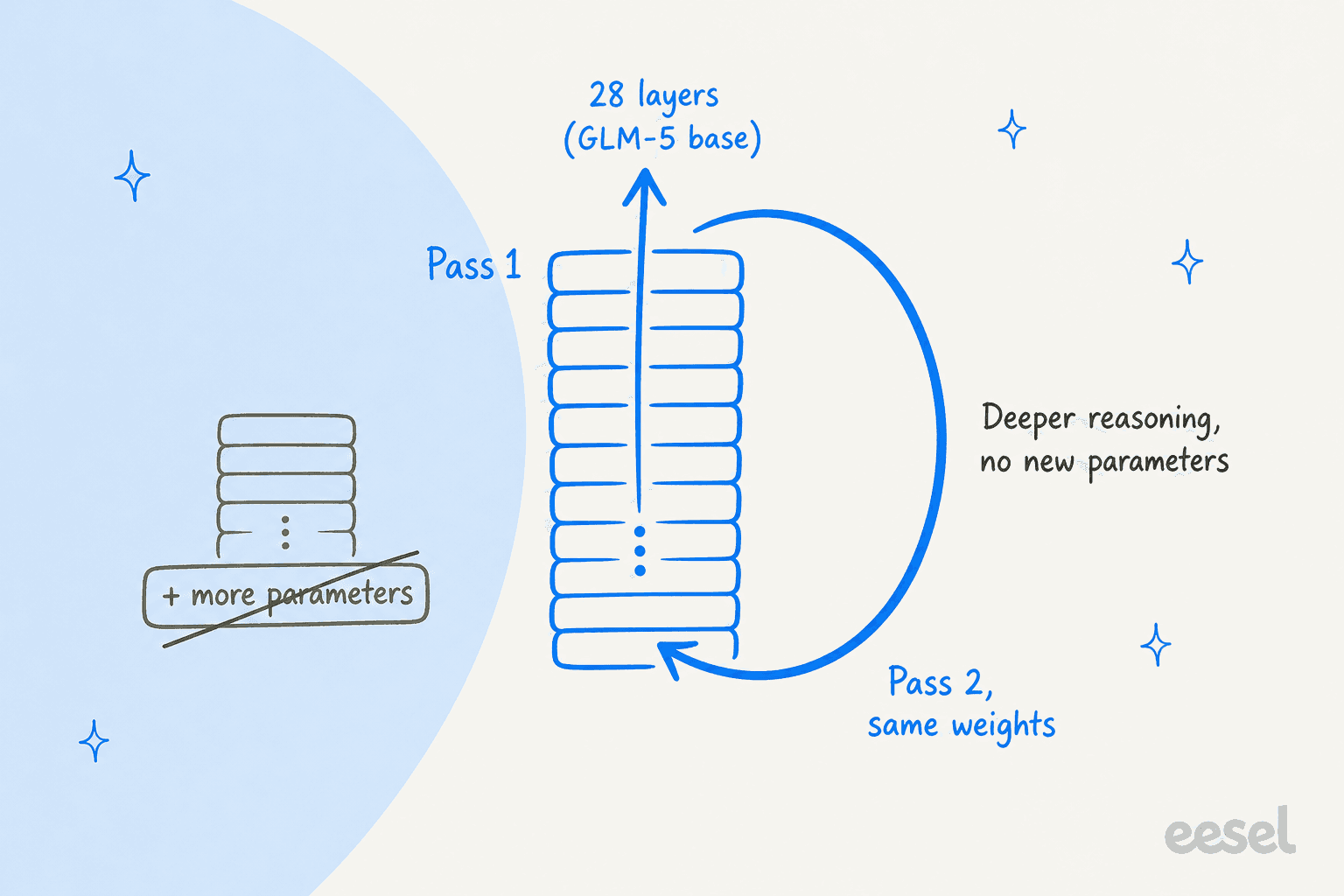
Why a buyer should care is the cost angle. Z.ai says an extra loop adds only one sliding window of KV cache instead of a full copy, which keeps the cost of serving 1M-token contexts "well under control" compared with GLM-5.3. Its controlled test on a 30B model found about 10% more training compute bought clear gains, and average output length fell 10 to 14% on benchmarks like GPQA-Diamond, because some reasoning moves into the loop instead of into visible tokens. That 30B result is the only like-for-like evidence in the post. It is not a result for GLM-5.4 itself.
How good is GLM-5.4, really?
Z.ai published one chart for the flagship: a win-rate comparison on its own evaluations. It does not say which tasks the evaluation covers.
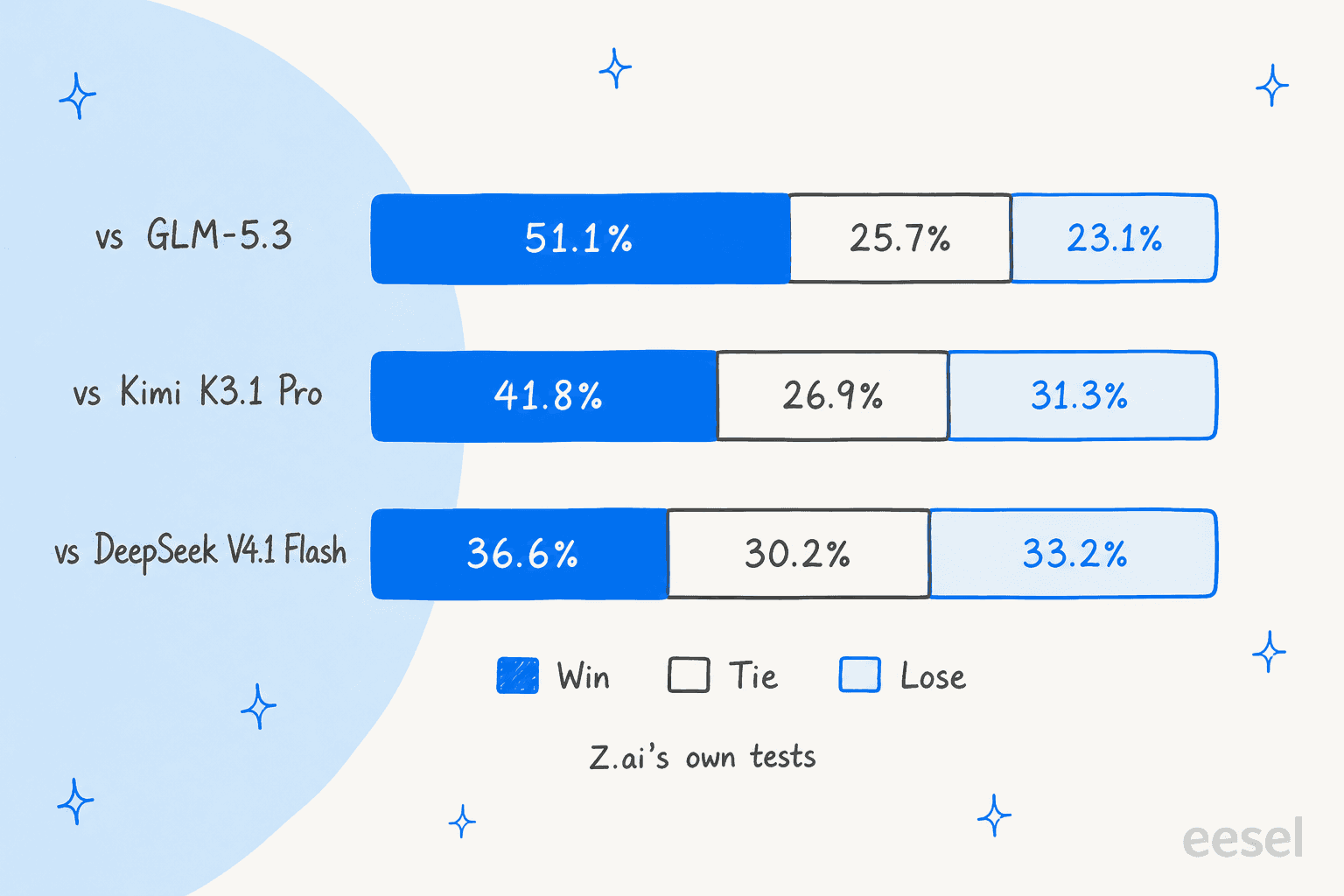
Read the chart for what it is. GLM-5.4 wins 51.1% against GLM-5.3, 41.8% against Kimi K3.1 Pro, and 36.6% against DeepSeek V4.1 Flash, and the DeepSeek matchup is almost a coin flip once you count the 30.2% ties and 33.2% losses. A model that ties or loses in roughly six of ten comparisons against a cheap Flash model is good, not dominant. For comparison, my Kimi K3.1 Pro review found a near-frontier thinker with slow hands, and the DeepSeek V4.1 Flash overview shows why that cheap rival is hard to beat on price.
The community noticed the missing scores right away. On the launch thread, which collected 1,169 points and 380 comments, the first reply read:
"Hard to say how good this is without benchmarks, I'm guessing they're not impressive or else they would have included the scores?"

Others read it more kindly. One commenter said they would applaud a lab for not chasing benchmarks and that any step over GLM-5.3 would make it an outstanding coding model:
"I'd rather applaud them for not benchmaxxing. Besides, if it's even slightly better than GLM-5.3, then there's no doubt that it's an outstanding coding model."
The one weakness Z.ai names itself is overlong thinking. A practitioner on the same thread described what that feels like across Chinese reasoning models in daily use, and it is the line I would tape above any evaluation plan:
"It's becoming reaally hard using chinese models with their 'marathon thinking' sessions... constantly second guessing themselves even when working with the simplest of things (conceptually) is very annoying and time to completion is dramatically higher compared to frontier unless you're dealing with ridiculus tps performance."
My read: wait for Artificial Analysis to list it. As of today its model page for GLM-5.4 returns a 404, so there is no independent score or cost-per-task figure to lean on.
How much does GLM-5.4 cost?
There is no per-token price to quote, and I will not guess one. What exists today is the Coding Plan, which Z.ai prices from $18 a month and applies a credit formula per model. GLM-5.4 is cheaper to run on the plan than GLM-5.3:
| Plan model | Input credit multiplier | Cached input | Output |
|---|---|---|---|
| GLM-5.4 | 4.6 | 1.1 | 16 |
| GLM-5.3 | 6.9 | 1.7 | 24 |
That is two thirds of GLM-5.3's credits per token, which lines up with Z.ai's claim of 1.5 times the weekly quota. On the Lite plan (10,000 weekly credits), Z.ai estimates 72 to 146 million GLM-5.4 tokens a week at a 95% cache hit rate. Off-peak usage is charged at half the credit rate, and peak hours are Monday to Friday, 14:00 to 18:00 Singapore time.
The harder question is what it will cost on the API. The only anchor is the Z.ai price list, where GLM-5.3 is $1.40 input and $4.40 output per million tokens. Here is how that and the current peers compare, using a stated workload of my own: 1,000 support conversations with 3,000 input and 500 output tokens each, so 3M input and 0.5M output tokens, before any reasoning tokens.
| Model | Input / output per 1M | Cost for that workload | Source |
|---|---|---|---|
| Claude Opus 5.5 | $4 / $20 | $22.00 | Anthropic |
| Claude Sonnet 5.5 | $2 / $10 | $11.00 | Anthropic |
| GPT-6.2 Sol | $2 / $10 | $11.00 | OpenAI |
| Kimi K3.1 Pro | $2 / $10 | $11.00 | Moonshot |
| Qwen 3.8 Max | $2 / $6 | $9.00 | Qwen Cloud |
| GLM-5.3 | $1.40 / $4.40 | $6.40 | Z.ai |
| DeepSeek V4.1 Flash | $0.15 / $0.60 off-peak | $0.75 | DeepSeek |
| GLM-5.4 | not published | unknown | Z.ai |
Every price is copied from the vendor's own page, linked in the table's last column. DeepSeek's peak-hour rates are double the off-peak ones shown.
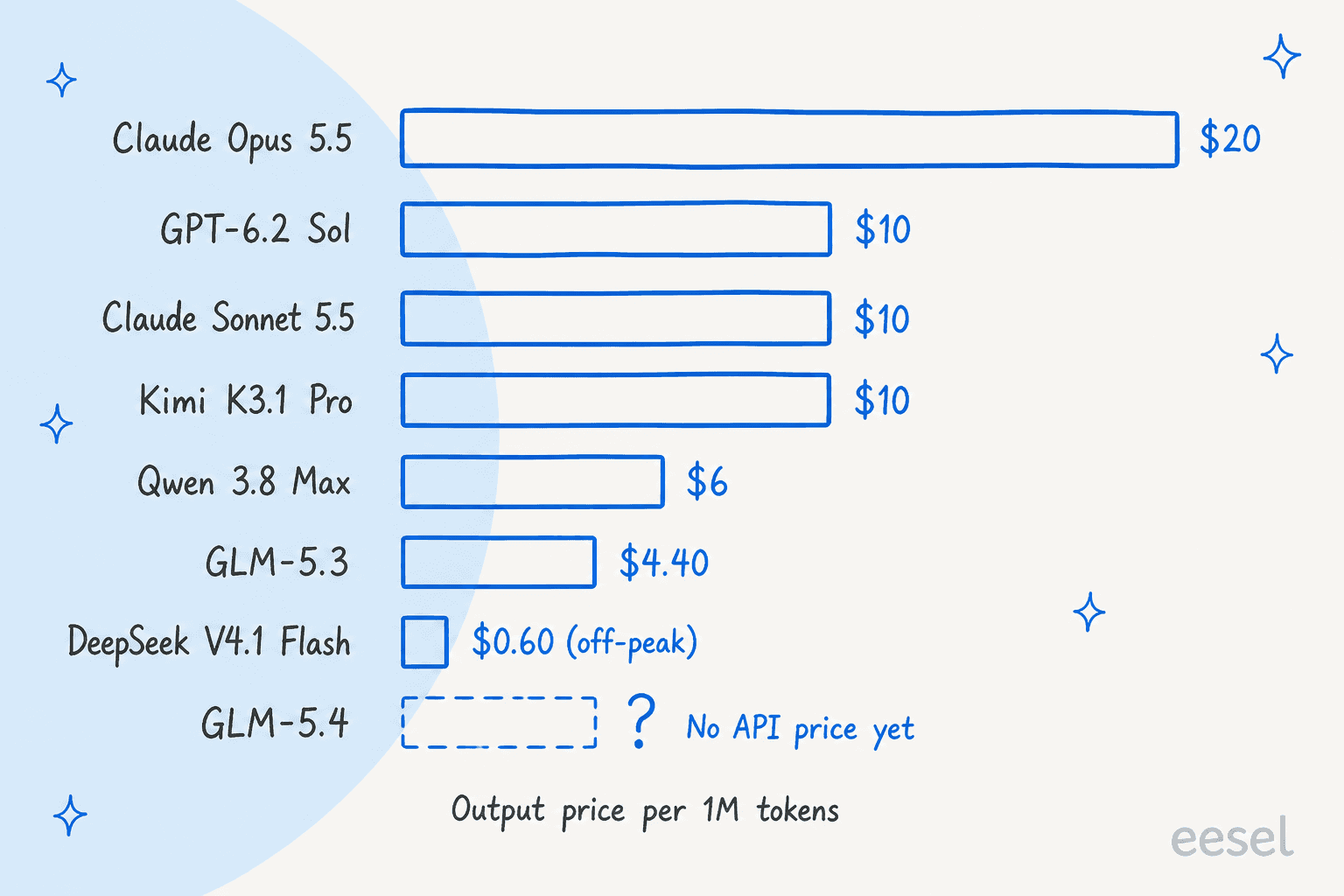
Z.ai's own pricing history suggests GLM-5.4 will land at or above GLM-5.3, since GLM-5.1, 5.2, and 5.3 all sit at the same $1.40 input and $4.40 output. That is a pattern, not a price. Whatever it is, a looping model that thinks long can spend many output tokens per task, so the sticker rate will not be the whole bill.
How fast is GLM-5.4?
Z.ai quotes up to 200 tokens per second off-peak, and 70 to 80 at peak load, and says it needed kernel-level work to keep a looping model that quick. Those are vendor figures on its own infrastructure, so I would treat them as a ceiling until a third party measures them. The more useful question for a support queue is time to a finished answer, and that depends on how long the model thinks before it writes, which is exactly the "marathon" complaint above.
Can I self-host it, and where does my data go?
Not today. Z.ai says it plans to release the weights after completing safety hardening, without a date, so the open-source angle that made earlier GLM releases popular does not apply yet. I would not assume the license either: older GLM weights shipped under MIT, but the GLM-5.4 license has not been published.
For hosted use, Z.ai's privacy and data terms state that it generally provides services from Singapore and that customer data is generally processed there. If you have EU or healthcare commitments, read my notes on AI support data residency and the GLM legal-model post before you route tickets anywhere. Hosted-model choice is a compliance decision first and a price decision second.
Should a support team use GLM-5.4?
Not directly, and not yet. A support reply has to be grounded in your help center, follow your refund and escalation rules, and hand off to a person at the right moment. None of that comes from the base model. eesel has spent years putting AI agents on live support queues, and the lesson that cost us the most is that a confident wrong answer looks identical to a right one until you test it, so every rollout is simulated against historical tickets first. That is why I keep saying a model is infrastructure and the teammate is the product. I wrote about this split in AI teammates and in the guide to handoff best practices.
This is what that looks like when it works. SamCart runs one eesel agent on its Freshdesk tickets and a second on its website chat, each answering from roughly 280 help-center articles, with the ticket agent stepping back as soon as a teammate picks it up. The model underneath can change. The grounding, the handoff rules, and the testing are what keep the replies right.
A cheap, fast model swap is also exactly where regressions hide. Before any model change reaches customers, I want it run against historical tickets first, which is the idea behind AI support simulation testing and benchmarking an AI support agent. If GLM-5.4 turns out cheap and accurate on your tickets, you want to learn that in a test, not from a customer.
Who should use GLM-5.4, and who should wait?
- Use it now if you already have a Coding Plan and work in Claude Code, ZCode, or a similar tool. GLM-5.4 costs two thirds of the credits of GLM-5.3 per token, and Claude Code users can point it at their existing workflow.
- Wait for the API if you are choosing a model for a product or a support agent. Without a price, a rate limit sheet, or a data agreement for the API, you cannot cost it or sign it off.
- Wait for independent scores if you rely on benchmarks to choose. The only public number for the flagship is a vendor win-rate chart.
- Look at GLM-5.3 Flash instead if you need a cheap model today: its pricing is public, and the GLM-5.3 Flash alternatives list shows the cheaper options.
- Skip it if you need self-hosting, since there are no weights yet.
Where I come down: GLM-5.4 is an interesting architecture bet from a lab that has shipped open weights before, and the credit cut is real. It is not yet a model you can buy, test, or audit the way you can the others in the table.
Try eesel for support teams that don't want to pick a model
If your real goal is fewer tickets in the queue, you do not need to choose between GLM, Claude, and GPT. eesel's AI helpdesk teammate plugs into Zendesk or Freshdesk in minutes, learns from your help center and past tickets, and can be simulated on your own history before it replies to a real customer. Start with the eesel pricing page or book a demo.