Transformer model
A transformer is a neural network architecture that uses a mechanism called attention to weigh the relationships between all parts of an input at once.
What a transformer model means
A transformer is a neural network architecture that uses a mechanism called attention to weigh the relationships between all parts of an input at once, rather than reading it strictly left to right. Introduced in 2017, it became the foundation for nearly every modern large language model because it captures context across long stretches of text while remaining efficient to train at scale.
The core idea is self-attention: for each unit of input, usually a token, the model computes how much every other token should influence its meaning. The word "it" in a sentence can attend to the noun it refers to several words back, so the model builds a representation that reflects the whole context, not just neighboring words. Because these attention calculations run in parallel across the sequence, transformers train far faster on large datasets than the older recurrent designs they replaced.
Transformers are the architecture under the hood of the AI that powers modern support tools, though that detail sits well below the surface of what a customer or agent ever sees.
Why transformers matter
- Attention captures long-range context. The model can link words far apart in a passage, which is what lets it follow a long ticket thread or a multi-paragraph policy.
- Parallel processing scales. Because the architecture handles a whole sequence at once, it trains efficiently on massive datasets, which made very large models practical.
- It generalizes across tasks. The same architecture underpins translation, summarization, classification, and generation, so one design serves many uses.
- It enabled the LLM era. The jump in capability that produced today's generative AI came largely from scaling up transformers.
- It extends beyond text. Variants of the architecture also handle images, audio, and code, which is the basis of multimodal systems.
Attention is easier to grasp when you watch it work on a single sentence.
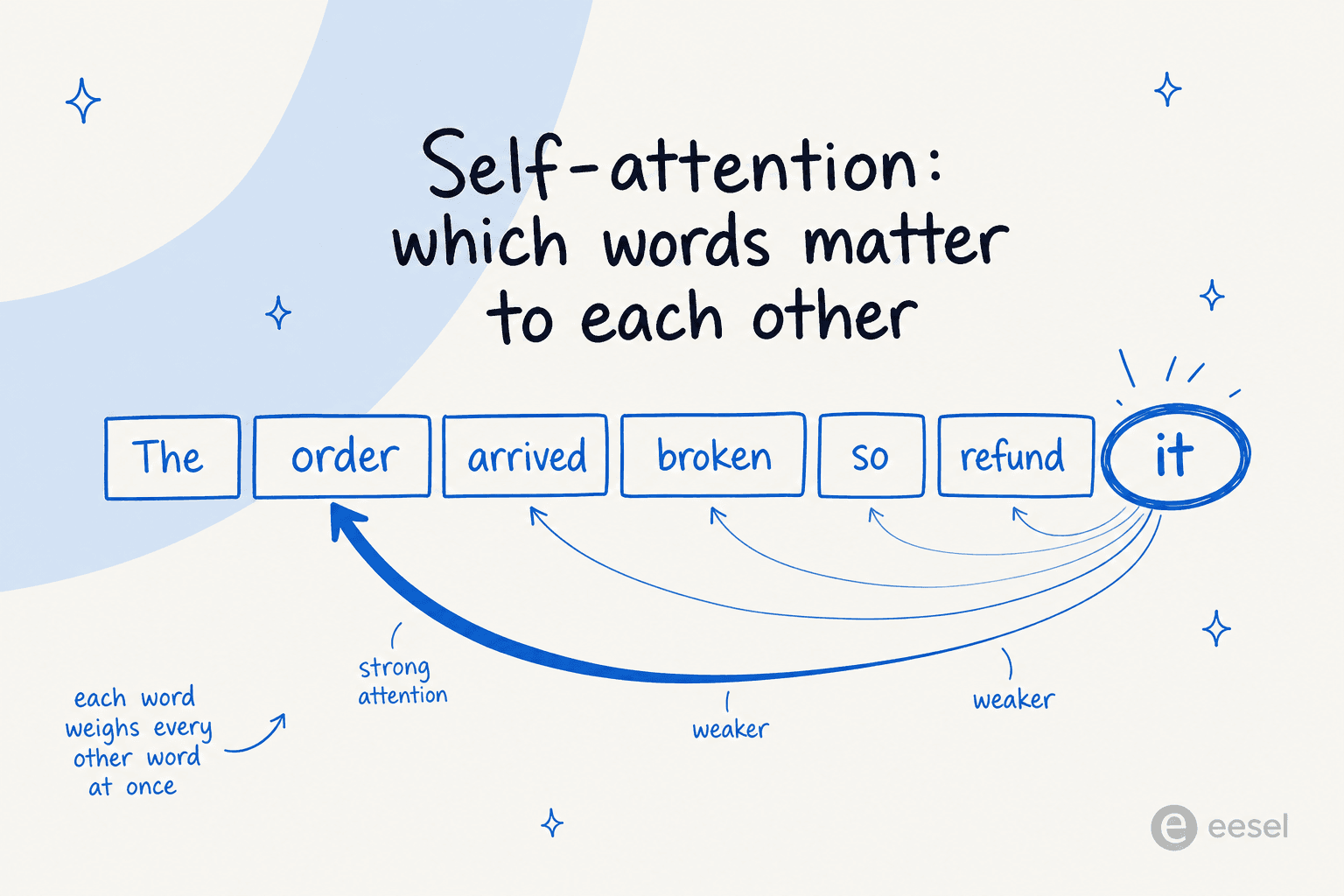
Reading "the order arrived broken so refund it," the model has to figure out what "it" points to. Self-attention lets every word weigh every other word at once, so "it" leans heavily on "order" and only lightly on the rest.
How a transformer works
- Tokenize and embed. The input text is split into tokens and each is turned into a numeric vector, an embedding, that represents its meaning.
- Add position information. Because attention has no inherent sense of order, positional signals are added so the model knows the sequence of tokens.
- Apply self-attention. For every token, the model weighs how much each other token matters and builds a context-aware representation.
- Stack and refine. These attention layers repeat many times, each one refining the representation, before the model predicts the most likely next token.
The models a support agent like eesel AI runs on are transformer-based, but the architecture is just the engine. What makes the answers reliable in practice is grounding: the model is pointed at your help center and past tickets so its strong language understanding is applied to your facts rather than its general training.
Transformers in practice
For most teams the architecture is an implementation detail, not a decision point; you choose a model by its capability, cost, and latency, not by confirming it is a transformer (it almost always is). What is worth knowing is why the architecture matters: its grasp of long context is exactly what lets an AI read a messy, multi-message conversation and respond to the real question, and its scale is why grounding the model in your own knowledge, rather than relying on what it absorbed in training, is the part that actually determines accuracy.
The architecture behind support AI
eesel AI runs on transformer-based models, grounded in your knowledge so the answers stay tied to your facts.