


What Custify costs, as best anyone can establish
I write a lot of these breakdowns. Our Zendesk pricing teardown went a similar route. But "custify pricing" is one of those search queries where every result lets the reader down. Most pages will either say "contact sales" and stop there, or they repeat a number without saying where it came from. So I went looking properly, and the honest answer turned out better than I expected.
Below is every real figure I can stand behind, and what kind of source each one is.
| Figure | What it covers | Source type | Where |
|---|---|---|---|
| $499 / month | Yearly Standard plan | Vendor-published, live today | Tooltip on Custify's ROI calculator |
| $5,988 / year | Same thing, annualised | Vendor-published, live today | Hard-coded in that page's JavaScript |
| 899$ / month | Up to 3 seats, package price | Vendor-maintained listing | Custify's SourceForge listing |
| $199 / month | Starter, up to 2 seats | Vendor-published, removed 2022 | Archived pricing page |
| $499 / month | Standard, up to 5 seats | Vendor-published, removed 2022 | Same archived page |
| $400 to $1,800 / user / year | Category band across the shortlist | Buyer who collected the quotes | r/CustomerSuccess |
| 7% average discount | What the quote moves by | Reviewer-reported | G2 pricing overview |
| $0 | Setup and onboarding fees | Vendor-published, live today | Custify's pricing FAQ |
Two of those numbers belong to Custify itself, published today, on surfaces Custify controls. On disclosure that already puts it ahead of most AI churn prevention vendors. It is a much stronger position than "contact vendor for pricing" would suggest, and the first one is worth walking through properly, since it is the most useful thing in this whole article.
The number Custify still publishes, in a tooltip
Custify runs an ROI calculator which asks for your revenue, your customer count, churn rate and CSM salaries, and then shows a savings breakdown back to you. One row inside that breakdown is labelled "Cost of Custify".
The information icon sitting next to that row carries a tooltip. The text of it, verbatim:
Assumption based on yearly Standard plan ($499 / month)
So that is Custify stating its own price, on custify.com, in August 2026. Not archived, not third-party, and no leak involved. It just sits in a tooltip instead of on the pricing page.
The page's JavaScript backs this up. Inside the calculator's bundle the cost row gets computed as this.cost_custify=Math.round(100*(5988/(...))), where the literal 5988 is the annual cost of Custify divided into your total projected savings so it produces a percentage. The same bundle sets up its currency formatting as Intl.NumberFormat("en-US",{style:"currency",currency:"USD"}), so the unit here is US dollars. $5,988 a year is $499 a month.
Two things make this more than just a curiosity. First one, $499 is exactly what the archived pricing page charged for Standard before the numbers came down, which suggests the rate has been stable rather than quietly climbing. The second is that it is flat. The calculator never scales that figure by seats, or CSM headcount, or customer count or revenue. Move every slider on the page and the cost input still stays at $5,988. Flat rates like this are rarer than they look, as our Help Scout pricing notes show.
I would not walk into a call and treat that as a binding quote, to be clear. Custify has not confirmed it on the pricing page anywhere, and a quote for a 40-CSM org is obviously not landing at $499. But as an anchor for a small or a mid-sized team, it is the best one available, and it came from Custify themselves.
What the pricing page actually says
The live pricing page is headed "Flexible Pricing, Endless Possibilities", and under that heading sits a "Get a custom quote" form which asks for name, work email and phone.
Behind it there is no self-serve path at all. custify.com/signup returns a 404, and custify.com/faq is doing the same. There is also a /reduced-plans-for-startups page, which sounds promising, until you see it is a byte-identical copy of the pricing page with no discount stated on it. Quote-gating in this shape is the norm across customer retention technology, it is not some Custify quirk.
What the page does confirm is useful, and I want to give Custify the full credit on the parts which are unambiguous:
- No setup fees. The FAQ answer there is "No, we don't charge any setup fees for our customers", and it has said this continuously since 2019.
- Concierge onboarding is included, described as free with the Standard plan, and it runs about four weeks with a dedicated CSM plus an integrations engineer and a shared Slack channel.
- New integrations are added free whenever Custify judges that they make sense for its customer base.
- Support is in-app and also email, staffed by customer success people instead of a ticket queue.
That last cluster is the part which buyers actually valued. One buyer who compared Custify against Vitally put the implementation support straight into the price column:
"We also caught the sales rep from Vitally saying they will help us with the implementation and integration, but in reality what that meant was 1x zoom call and a video materials. The guys from Custify offered unlimited calls and they also offer a Technical AM, on top of the CSM"

On a quote-only platform, unlimited implementation calls and a technical account manager are part of what the number is buying. Worth to price them in when you compare against a cheaper tool that just hands you a help doc. We take the same view on onboarding in our SaaS onboarding software comparison.
Custify used to publish a full rate card
This is the part which reframed the whole article for me. Custify was not always quote-only. And the Wayback Machine keeps a clean record of the change.
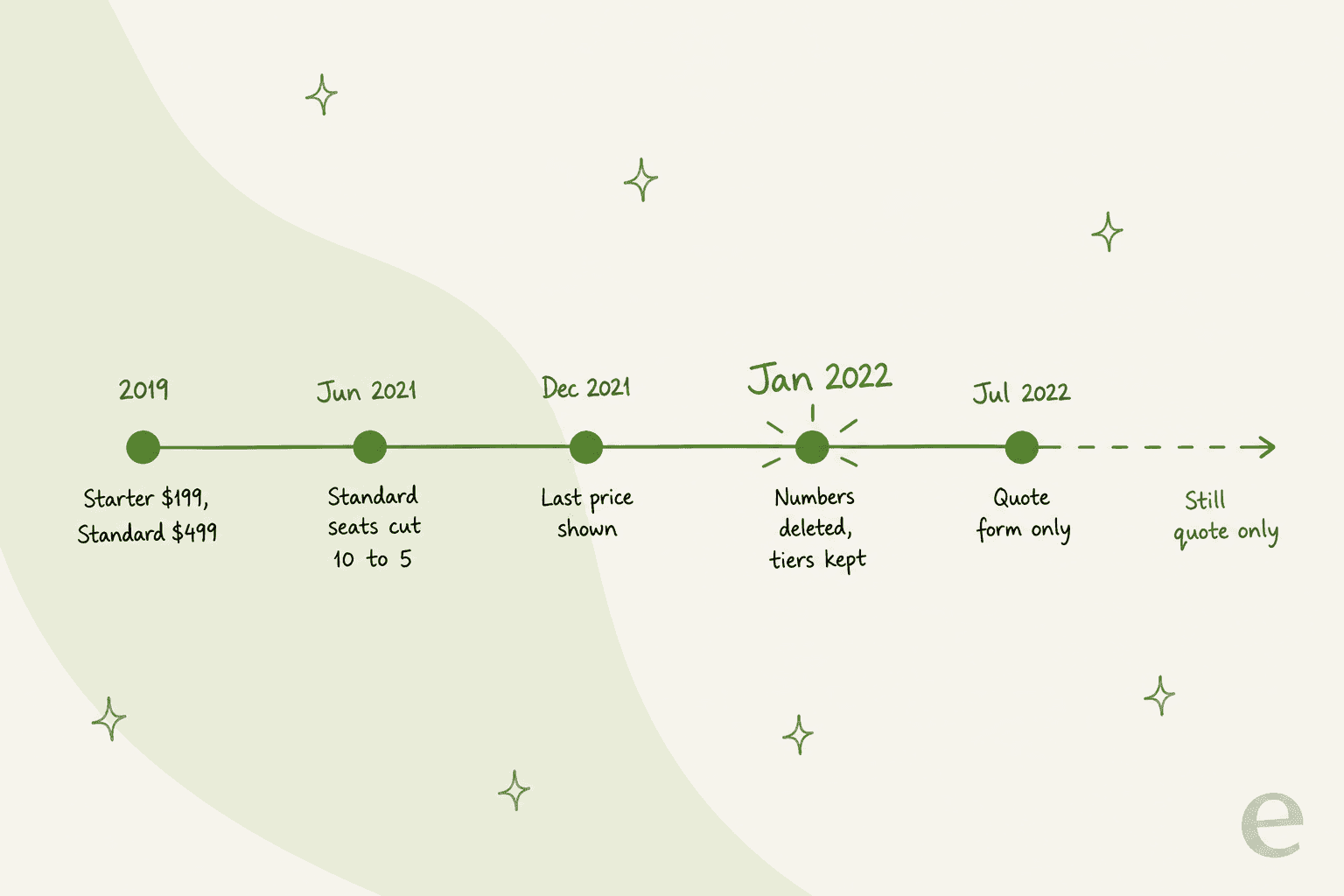
In August 2019 the page led with "starting at $0.12 per monthly active user" over a slider, and it named three tiers:
| Plan (2019) | Price | Seats | Notes |
|---|---|---|---|
| Starter | $199/month | Up to 2 | Support included, API access |
| Standard | $499/month | Up to 10 | All integrations, unlimited event history, personal onboarding |
| Enterprise | "Let's talk" | Unlimited | Custom integrations, SLA |
That same snapshot also promised a 14-day free trial with no credit card, and it defined a monthly active user quite precisely, an end user with any Custify activity in the last 30 days, where inactive users are not contributing to the price.
By June 2021 the prices were holding, but the packaging had tightened up. Standard's seat cap halved from 10 to 5. The per-MAU headline was gone, the default billing cycle now stated as yearly, Starter's event history capped at 6 months, and the trial had softened into "a free trial can be possible, contact us for more details."
The 3 December 2021 snapshot is the last one carrying a dollar figure. By 20 January 2022 those same three tier cards were still sitting there, same plan names, same seat caps, same feature comparison table, only the dollar amounts simply deleted. Then by July 2022 the page had become the quote form which it still is today.
So the answer to "why won't Custify tell me the price" is not that it never had one. It had one for three years at least, and then stopped. The same drift shows up across customer success vs customer service tooling as vendors keep moving upmarket.
There is a fair irony to sit with here, and I will let Custify's own words carry it instead of editorialising. Custify's about page still lists out what customer success software should be: "It should be flexible to any needs and it should give Customer Success Agents the chance to configure everything according to their needs. It should be fair and transparent in pricing."
What actually drives the bill
Even with no public rate card, the commercial shape is legible enough once you read the right documents. There is three things which scale a Custify contract.
Seats are the primary meter. Custify's master services agreement caps usage at "up to the number of users or seats set forth in the Order", and it separately names "increases in usage, users or seats" as the axes which change fees. Every published packaging signal is pointing the same way. The 2019 tiers sold seat bands, and today's only named plan is "Standard", capped at up to 3 seats on both Custify's HubSpot listing and on its SourceForge listing. Worth to note that a "User" in the agreement includes contractors too, and Custify reserves an audit right on the count.
Usage is a named axis that is never defined. The agreement lists usage as one thing which can increase your fees, then it never says what unit the thing is measured in. Historically that was monthly active users. Today no public definition exists, and that makes it the single most important thing to nail down in writing before you sign anything.
API throughput is tier-gated. Custify's API docs state that "If you're not on a special enterprise plan, API calls are limited to 100 requests per 10 seconds." If your plan is to sync a large customer base, or to push product events at volume, then that ceiling becomes a pricing conversation and not a technical footnote. Same trap I flagged in our Freshdesk API notes. Documented limits sitting alongside it: 250 custom fields, 255-character strings, and batch sizes of 3 synchronous or 100 asynchronous.
Worth knowing on the compliance side as well, since certifications often push buyers up a tier. Custify holds SOC 2 Type 2 and ISO/IEC 27001, it publishes an SCC-based DPA, encrypts at rest with AES-256, and runs annual third-party penetration tests. HIPAA or a BAA appears nowhere on the site, which rules it out for some healthcare buyers. And there is a small contradiction to clear up on a call, the pricing FAQ says data is stored in Germany, while the security page says AWS in US-Ohio or EU-Frankfurt with EU-only residency available on request.
For whatever it is worth, the product you get for that money is well-liked. Custify runs 4.7/5 across 527 reviews on G2, and 4.9/5 across 135 reviews on Capterra, with Value for Money specifically sitting at 4.9. The 59 integrations cover the stack which most CS teams already have, Salesforce, HubSpot, Stripe, Zendesk, Freshdesk, Segment, Slack, Mixpanel, Snowflake and BigQuery among them. If your team is weighing that up against a customer service CRM, the overlap is worth mapping out before you buy both.
The contract terms nobody puts in the quote
If you only read one section before a Custify call, then make it this one. I pulled these out of Custify's master services agreement, last updated 17 November 2025. None of them is unusual for enterprise SaaS. All of them are things a self-serve buyer would not be expecting.
| Clause | What it says | Why it matters |
|---|---|---|
| Term | One-year minimum, auto-renewing | You are committing a year, not a month |
| Invoicing | Annually in advance, card charged on day one | The full year leaves your account up front |
| Cancellation | Orders non-cancelable, fees non-refundable | Changing your mind in month three costs the year |
| Non-renewal notice | 15 calendar days' written notice | Miss it and you have renewed for another year |
| Clause 4.3 | Custify "is free to establish the Fees at its own discretion" at renewal | Renewal increases are uncapped |
| Late payment | Suspension or termination after 10 days | A short AP delay can pause the service |
| Uptime | 99.95%, credit-only, after two consecutive missed months | One bad month earns nothing |
| Liability | Capped at 12 months of fees | Standard, but worth knowing |
| Governing law | Romanian law, Bucharest courts | Relevant for US procurement teams |
| Clause 10.1 | Pricing is defined as Confidential Information | This is why no customer has published theirs |
That last row explains the entire research problem. Not one G2 reviewer, Capterra reviewer or Reddit commenter names a Custify dollar figure anywhere, and the reason is not that nobody knows it. It is that the contract they signed treats the number as confidential. When a category's pricing goes invisible, this is usually the mechanism behind it.
The 15-day non-renewal window is the one I would put a calendar reminder against. Combine it with clause 4.3 and the practical exposure is this, you miss the window by a week and you are locked into another year at a rate which Custify sets. Not unique to Custify, that. But it is the opposite of how customer service automation tools are increasingly sold, and the notice period is worth negotiating up to 30 or 60 days while you still hold some leverage. The same clause-reading pays off in our Salesforce Service Cloud pricing breakdown.
Sanity-check the quote you get
Since the whole problem here is that you cannot compare your quote against anything, here is a small tool which does that comparison for you, against every public anchor in this article. Put in what you were quoted, and how many seats it is covering.
Two things to do with the output of it. If your quote lands far above the band, ask for the order to itemise seats separately from usage, since the agreement treats them as separate axes and only one of the two is ever defined. If it lands below instead, check the seat count on the order against the number of people who will actually log in, because contractors count as users and Custify holds an audit right. Seat drift is the quiet cost line in every customer service ticketing system contract.
What everyone else in this category charges
Custify's opacity is worth judging in a context, and the context is that almost nobody in customer success publishes a price at all. I checked ten platforms.
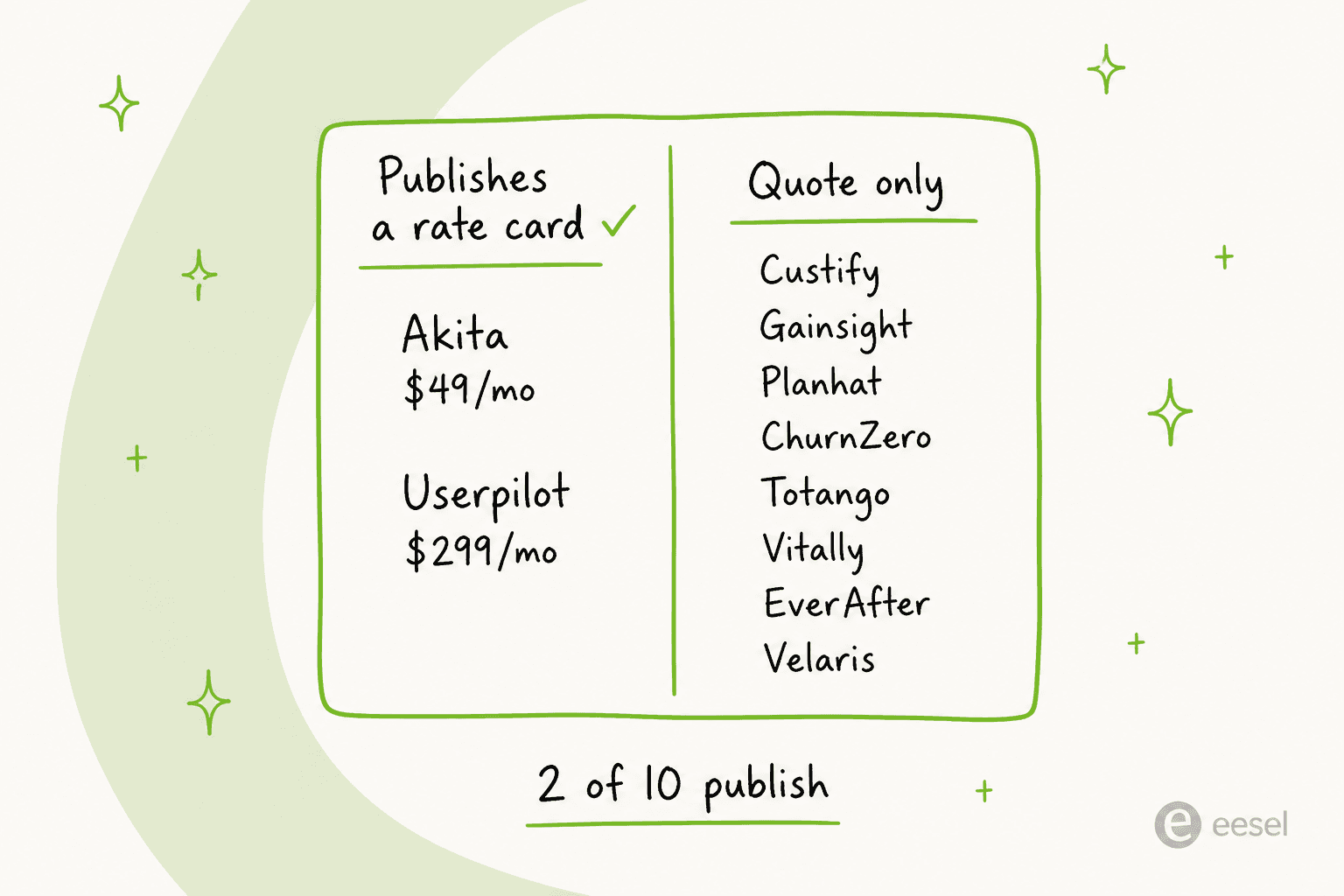
Akita is the outlier here, refreshingly so: $49, $99 and $499 a month, then $29 a month per extra integration and $29 a month per extra full-access user, 20% off for annual prepay, month to month, no setup or cancellation fee. Userpilot publishes $299 a month for Starter, at 2,000 monthly active users and 3 seats.
Everyone else routes you to a form. Gainsight names its tiers without prices. Every call to action on Planhat is "Enquire". ChurnZero's /pricing returns a 404 page, with no pricing URL anywhere in the nav either. Totango publishes package contents but not the prices, which is still more than most do, Enterprise being 10 practitioner seats, 2,000 accounts and 5 teams. Catalyst does not exist independently any more and now sits inside Totango as one of three SKUs. For the AI-first end of the same market, our AI tools for customer success roundup covers who does what.
The good news is that buyers will publish what the vendors will not. This thread is the single most useful page on the public internet for this category:
"Gainsight, for 10 CSMs, 5 Viewer+ seats, and 3 Viewer seats, the lowest quote was 26K USD, FY-end, Jan-31st, 99$ per new user. ChurnZero, for exact same as above (minus Viewer seats), we were quoted at 40k."
Elsewhere in that same thread, Planhat came in at $33,000 for close to 50 users, on a base price plus a per-account fee and no per-seat licence, while Catalyst landed at about $35,000. Set against those, the $499 to $899 band puts Custify at a fraction of the enterprise options, which matches what buyers say about it anyway. One buyer who ran the full comparison chose on exactly that basis:
"I second Custify. We've been using for over a year now and it's been great. We also reviewed Catalyst, Gainsight and Vitally. Gainsight was double the price and seemed way more demanding to implement […] We liked Vitally that it had a similar price to Custify but feature wise, everyone from ohr team found Custify to be superior."
G2's own numbers agree with that. Reviewers rate Custify 46% less expensive than the customer success category average for small business, and 47% less for mid-market. Oddly enough, the same page also shows perceived cost at the top of G2's scale, which is what happens when a product is cheap next to Gainsight and still expensive next to a spreadsheet. That gap between sticker and perceived value is exactly the thing our AI vs human agent cost math tries to settle.
Four numbers that are not Custify's price
Search "custify pricing" and you will hit a few very confident figures which fall apart the moment you open the page. Since the whole point of this article is to save you that checking, here they are.
€119 or $119 per user per month. This one appears attached to Custify in Capterra's alternatives rail. Open up the rendered page though, and the figure belongs to Customerscore.io, a competitor whose block sits directly beneath Custify's. So, not Custify's price.
$12,000 per year. This one shows up inside a search snippet for Capterra's customer retention software page. The rendered Custify block on that page carries ratings and features, and no starting price at all. The figure belongs to a neighbouring product instead.
$199 a month plus $1,000 to $5,000 in setup fees. The $199 part is the real 2021 Starter price, four years dead now. The setup fees get contradicted by Custify's own FAQ, which has said there are none since 2019. Half-true and half-invented, that is the worst kind of number to plan around.
"$899 a month, per multiple independent sources." The $899 is real enough, but there is exactly one source for it, Custify's own SourceForge listing. Several blogs recirculate the figure, and one of them multiplies it into "around $10,800 a year", which is just 899 × 12. Cite the listing, not the echo of it.
I would also treat any article which gives you a precise Custify quote without naming a document as fabricated. Same failure mode we untangled when writing up Aisera pricing. The Ada CX pricing page had it too. The contract makes that number confidential, so nobody who actually paid it is going to publish it.
What buyers say the money buys
The reviews are consistent, and they are consistently kind. Custify's Capterra Value for Money score sits at 4.9 out of 5 across 128 ratings, with the overall at 4.9 across 135 reviews. The most direct statement of all on price as a decision factor:
"Custify delivered the best bang-for-buck, and we ultimately chose Custify based on price."

That review lists ChurnZero, Planhat and Gainsight CS as the alternatives which were considered. The most balanced review gives you both halves:
"Overall I feel like it's a good product for the price point and I can see that they are continually working to improve. They are very receptive to customer feedback."
Its cons are worth reading right next to the price, since they are the recurring ones: "The UX is a bit clunky, not always intuitive. Often what would be a simple task in another platform takes multiple clicks." A Reddit commenter who tested it in August 2026, two years on, landed in the same place: "custify we tried for a month and it was fine but the UI felt clunky and our newer CSMs kept getting lost in the workflows." Two independent sources, two years apart, and the same complaint. Adoption friction is a real cost line, which is why we weigh it heavily in every AI copilot review.
The freshest price-adjacent review, from August 2026, places it quite precisely: "Good fit for a mid-sized CS team that has outgrown spreadsheets but doesn't need the cost or complexity of an enterprise suite." That is the honest positioning of it, and it matches a Reddit thread from the same month, where a two-CSM team leaving ChurnZero tested Custify and said it "felt very mid-market". Someone then asked the obvious follow-up, whether that meant the pricing or the setup complexity or the product itself. Nobody answered. The gap between "mid-market" as a compliment and "mid-market" as a price bracket is one our AI copilot for customer service review runs into constantly.
One more thing about the AI layer, since it is the newest part of the product and also the part most likely to carry its own separate meter later on. Right now Custify's AI features page contains no plan language, no credit language, no metering language at all, and the DPA's sub-processor list names only AWS and MongoDB, with no LLM provider on it. Meanwhile the agreement's definition of "Software" reserves the right to price new features separately. So ask whether AI is included at your renewal rate, in writing. Unpriced AI layers have a habit of turning into metered ones, as our Agentforce pricing write-up shows.
How to find any quote-gated vendor's real number
The method which surfaced Custify's price is reusable, and I have used it enough times by now to lay it out properly. When a vendor's pricing page is just a form, the number is usually still sitting somewhere that the marketing team forgot to sweep.
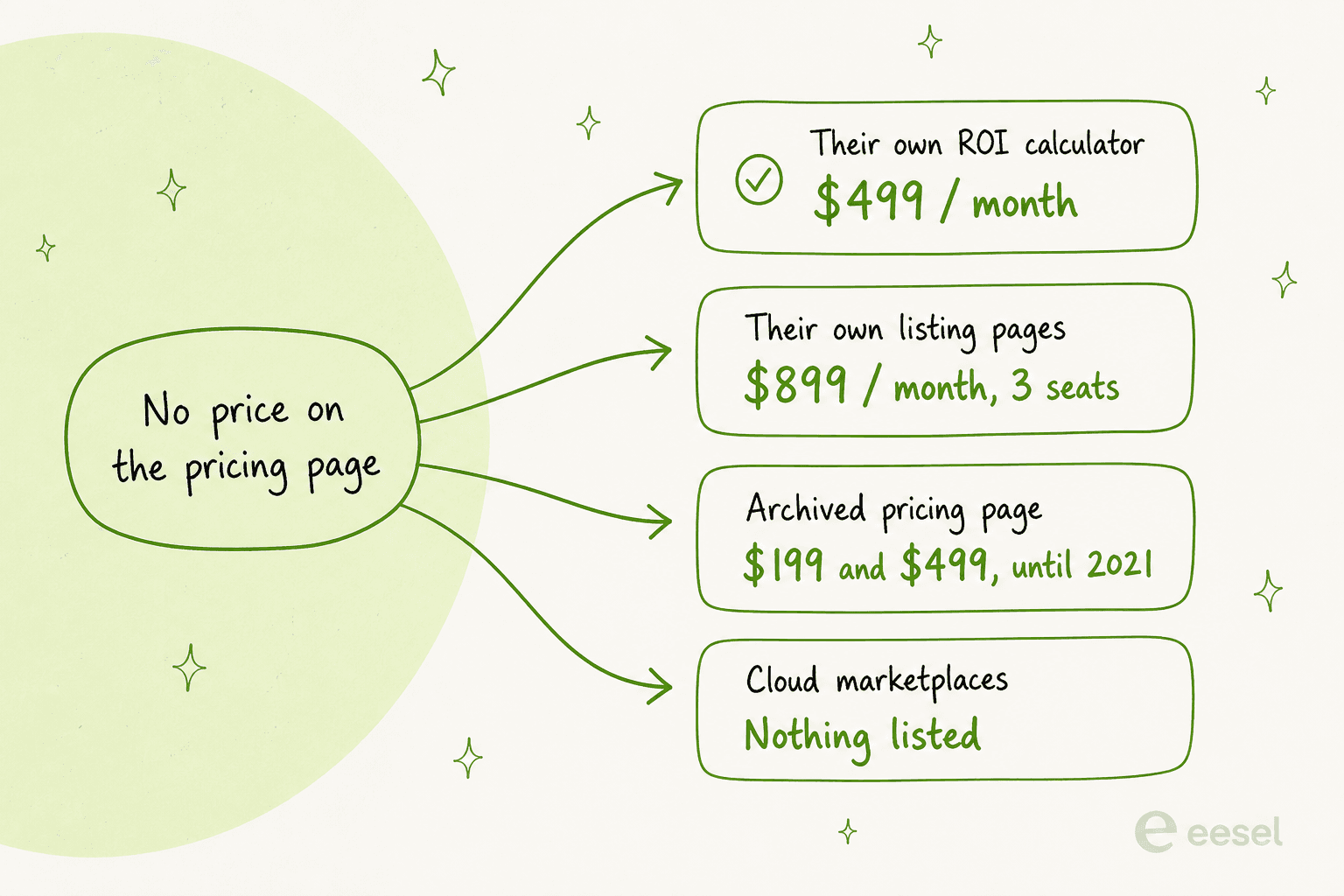
- Their own ROI or savings calculator. These ones need a cost input before they can produce a payback figure, and that input is almost always the real list price. Check the tooltip first, then go into the page's JavaScript. This is what yielded $499.
- Their own listing pages. Vendors fill in a "starting price" field on SourceForge, G2, Capterra, HubSpot's marketplace and on the cloud marketplaces, and those forms get maintained by someone who is not the person that took the number off the website. This is what yielded $899.
- The Wayback Machine on
/pricing. Most quote-gated vendors did publish once. The archived tiers will tell you the packaging shape and the order of magnitude, even when the figures themselves have aged. - Buyer threads with the quote in them. r/CustomerSuccess and r/sysadmin carry real contract values which no review site will. Search the vendor name together with a dollar sign. It is the same sourcing discipline behind our HubSpot pricing breakdown. The Front pricing numbers came out this way too.
All four together took me about an hour, and produced more than any sales call would have inside the same time. Worth doing before the call and not after, because walking in with an anchor is the difference between negotiating and just being quoted at. Our Zoho Desk pricing write-up used every one of these four steps.
Try eesel
Everything above is a lot of work just to answer one question, what will this cost me. That question is the reason I work on eesel. A different job to Custify, to be clear about it. Custify watches account health so that CSMs can act before a customer churns. eesel is an AI helpdesk agent which resolves the support tickets and chats those same customers send in, inside Zendesk, Freshdesk, HubSpot, Slack or Front. If churn signals are your problem, then Custify is a reasonable buy. If ticket volume is the problem, keep reading, and our AI customer support overview covers the wider category.
The part worth stealing from here is the pricing model. eesel publishes the whole rate card on a single page: one fixed monthly price sized to your volume, from $299 for 500 credits, no seats, no platform fee. A ticket or chat counts as one credit no matter how many replies it takes, so your own bill is computable in about ten seconds.
| Credits per month (1 credit = 1 ticket or chat) | Price |
|---|---|
| 500 | $299/mo |
| 1,000 | $499/mo |
| 2,500 | $999/mo |
| 5,000 | $1,899/mo |
Route only 200 of your 1,000 monthly tickets to the AI and only those 200 use credits. That is the arithmetic which our AI ticketing system guide walks through end to end.
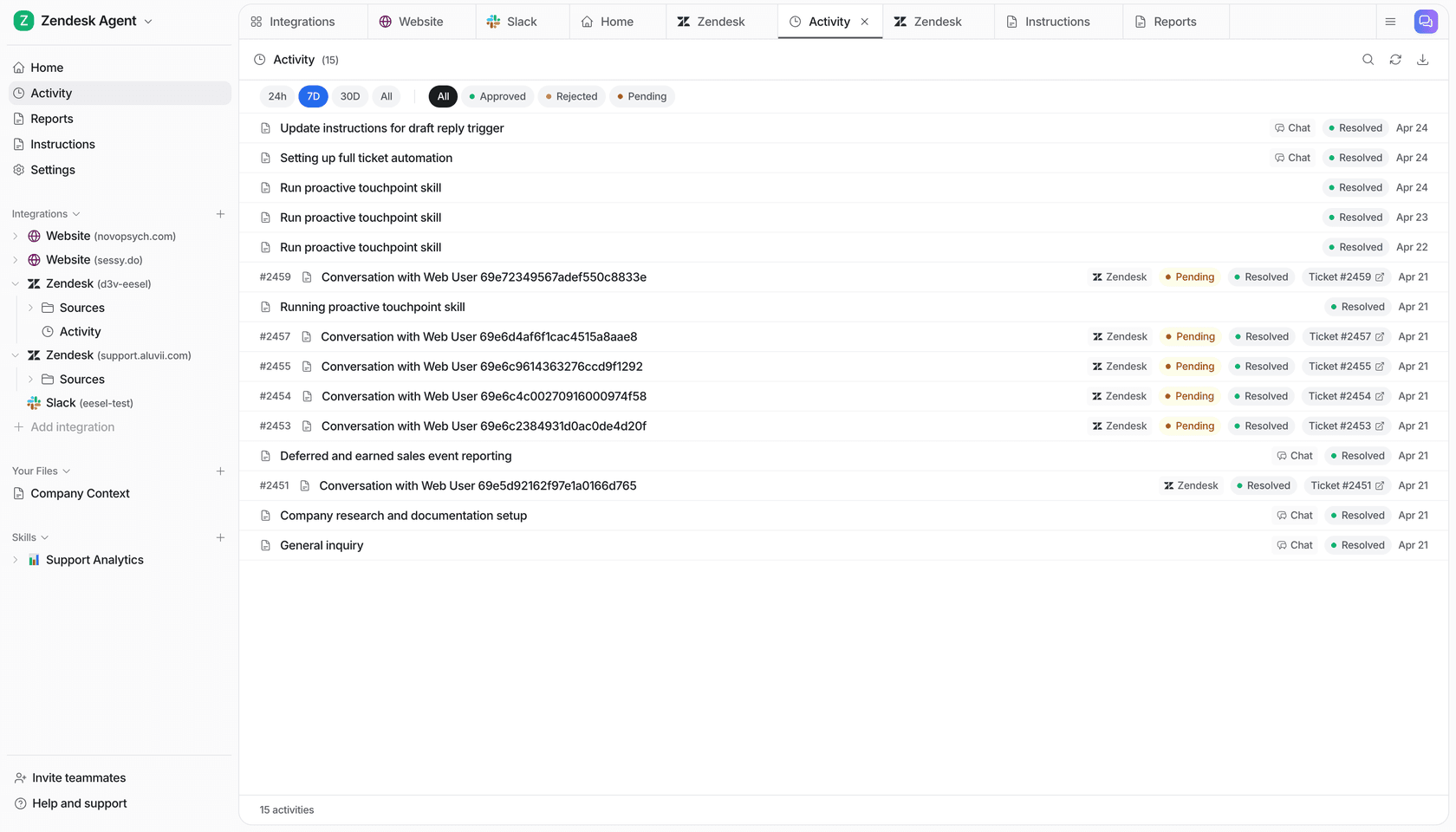
We keep one dimension, credits, because every extra dimension makes the bill harder for a buyer to compute in their own head. That is not a marketing position, it is a scar, and the same scar sits behind our customer service automation software picks. I have watched a team run twelve successful test chats, land on a billing page they could not price, then file two cancellation requests inside the hour. The product worked fine. The pricing page was the churn event.
So the model runs the other way round. A free plan with 100 credits, every feature unlocked and no credit card. If you run out of credits, agents pause until they reset, or you can turn on overage with a monthly cap you set yourself at $0.80 per extra credit, instead of quietly billing past it. Move up or down any time. Predictability is the whole point of it, and it is what our customer service KPIs guide says to budget against. The upsells are published with numbers on them: pay a year upfront and get two months free, and add-ons such as SSO and MFA from $199 a month, priority support from $299 a month, and data residency at $500 a month.
The other half is that you can prove it before you pay, and that is the step which most AI customer service automation rollouts skip over. eesel simulates against your own historical tickets, so you get to see the resolution rate on your real backlog instead of on a scripted demo. Answer quality traces straight back to your AI knowledge base, which is why we test on real history first. Gridwise saw 73% of tier-1 requests resolved in the first month, after seeing results during a 7-day trial. Same instinct as walking into a Custify call with the $499 anchor already in your hand: know the number before somebody tells you what it is.
Try eesel free, or go read the pricing page first. It has actual prices on it.