


Inkling 2 Mini's headline number is cost per task: Artificial Analysis scores it 20, tied with Qwen3.8-27B, at $0.59 per task against $3.53 and 9.0 minutes per task against 34.5. It is a 26.4B-parameter looped model under Apache 2.0 that fits in about 20 GB. The trade is knowledge: the lab calls it less capable than Inkling 2 Small across most evaluations, and it states wrong facts more confidently.
For support teams, that makes it a fast, cheap engine that still needs grounding in your help center and a test on past tickets, which is the job eesel does around whichever model you pick.
What is Inkling 2 Mini?
Inkling 2 Mini is the smaller sibling of Inkling 2 Small in Thinking Machines Lab's second generation, announced on November 20, 2026. It has 26.4B total parameters, takes text and images in, writes text out, and ships with open weights. Its Hugging Face model card lists Apache 2.0 and a 1M-token context.
I build features and AI agents at eesel, so when a new model lands I read how it is built before I read the benchmark table. Mini is unusual there, which I cover below. It is also why eesel has a command line tool: with the eesel CLI, an AI coding agent can upload approved knowledge such as exported help articles and saved replies, change the support agent's instructions, and ask test questions before anything goes live, whichever model sits underneath. Connecting the helpdesk itself still needs someone with admin access to approve it.
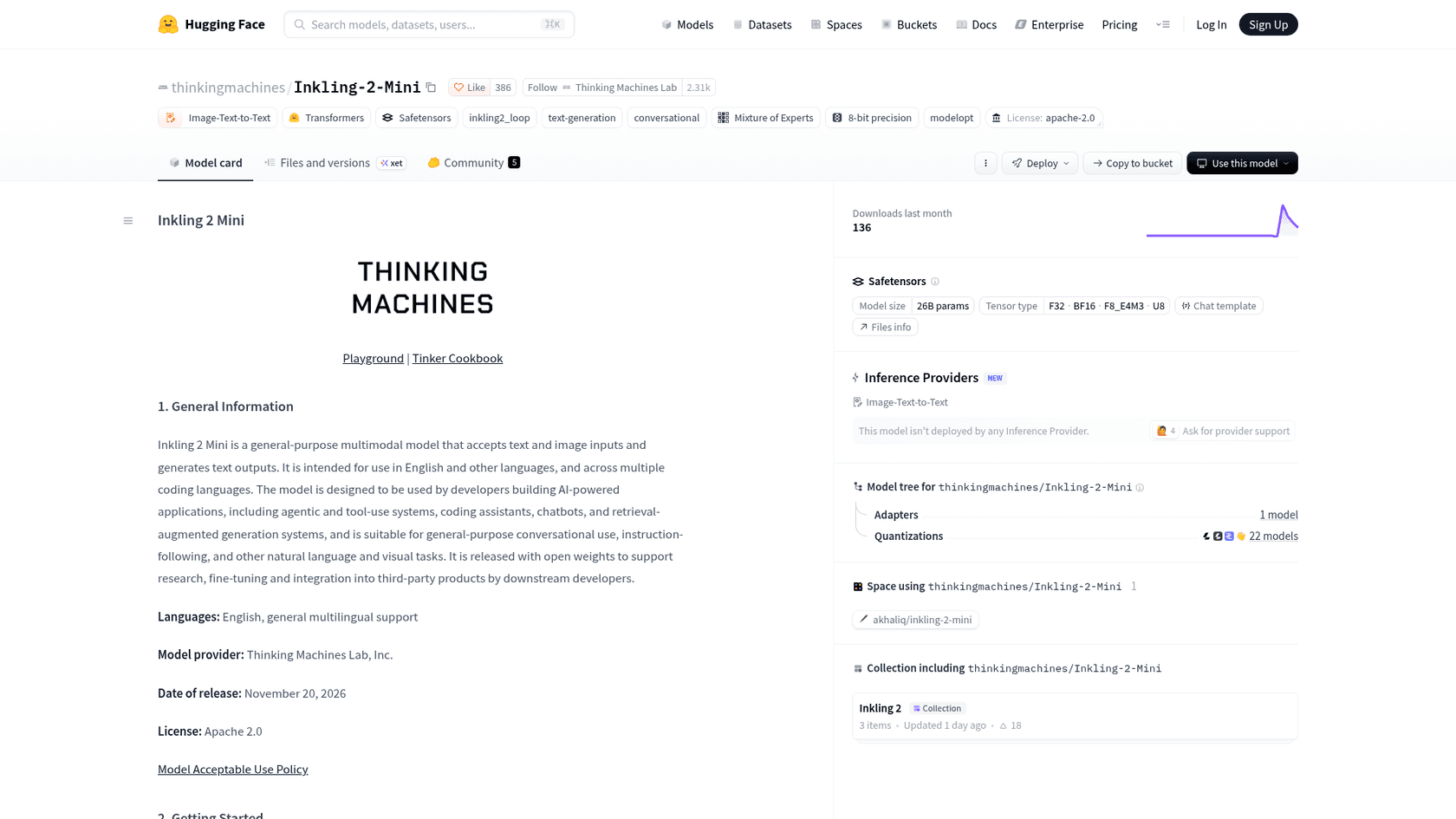
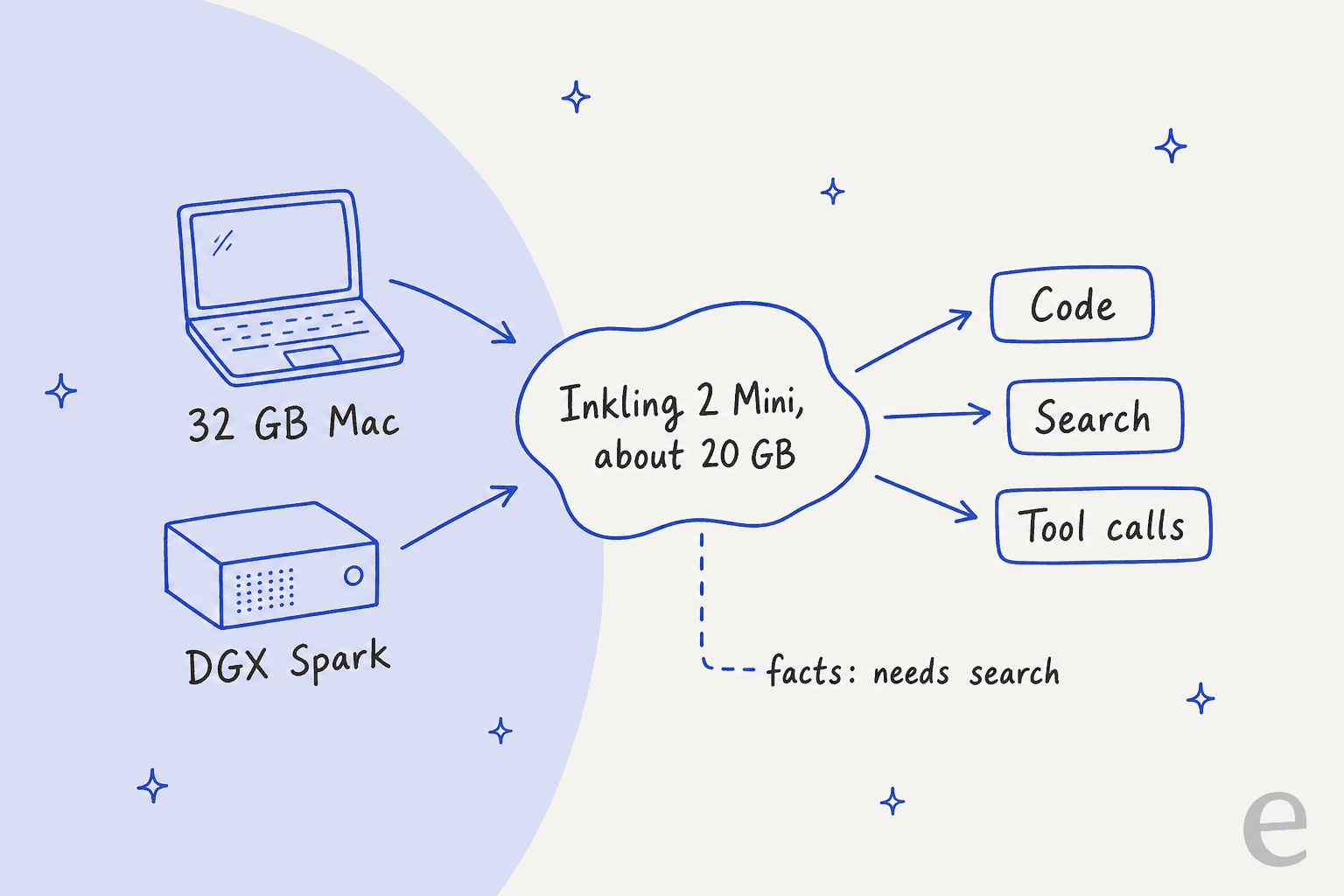
The numbers that matter on the card: 3.4B parameters active per token, a checkpoint of about 20 GB, and a research variant called TML-d24-varloop-research that lets you pick how many loop passes the model runs. The card lists one NVIDIA DGX Spark or Apple silicon with 32 GB of memory as the target hardware.
One thing to flag early. The announcement text says 3.4B active parameters, while its spec table and Artificial Analysis say 5.4B. Both are right in their own way: 3.4B are stored and active, and 5.4B is the count once you add the layers that run three times.
How does Inkling 2 Mini compare with Inkling 2 Small?
Mini is smaller, cheaper per task and faster, and it is weaker on most tests. Specs come from each model card, prices from the Tinker pricing page, and scores and speeds from Artificial Analysis's Small and Qwen3.8-27B pages, plus the Mini page shown below.
| Inkling 2 Mini | Inkling 2 Small | Qwen3.8-27B | |
|---|---|---|---|
| Released | Nov 20, 2026 | Nov 5, 2026 | Aug 2026 |
| Total / active params | 26.4B / 3.4B (5.4B with loops) | 594B / 17B | 27B |
| Input | Text, image | Text, image | n/a |
| Context (card) | 1M | 1M | n/a |
| License | Apache 2.0 | Apache 2.0 | n/a |
| Input / cached / output per 1M | $0.15 / $0.015 / $0.50 | $0.30 / $0.03 / $1.00 | $0.50 / n/a / $3.00 |
| AA Intelligence Index v5.0.1 | 20 | 31 | 20 |
| Output speed (AA) | 280 tokens/s | 118 tokens/s | 53 tokens/s |
| Time to first answer token (AA) | 9.7s | 39.7s | 144.1s |
| Minutes per AA index task | 9.0 | 21.2 | 34.5 |
| Cost per AA index task | $0.59 | $1.18 | $3.53 |
| Output tokens in the index run | 161M | 154M | not compared |
The Qwen column is Artificial Analysis's own listing and "n/a" means I did not verify that cell. Two caveats on the Mini column. First, Mini is not on Tinker's serverless inference list, and Artificial Analysis shows no public API for it, so its cost per task is the Tinker sampling rate applied to measured tokens, not a price you can buy today. Second, Mini wrote 161M tokens in the index run, more than Small's 154M and nearly double the 85.7M median Artificial Analysis cites for comparable models. It says plainly that the model is very verbose.
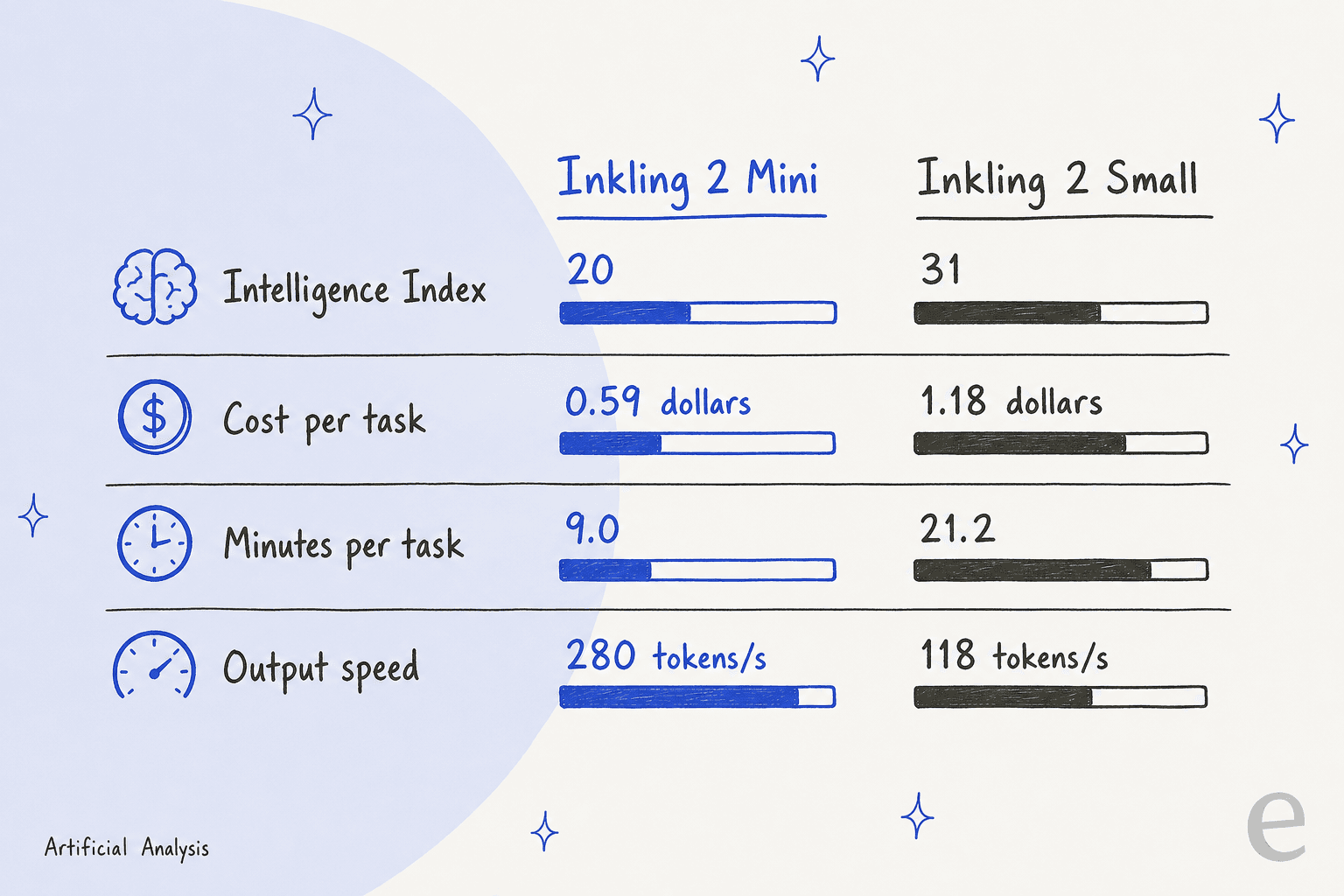
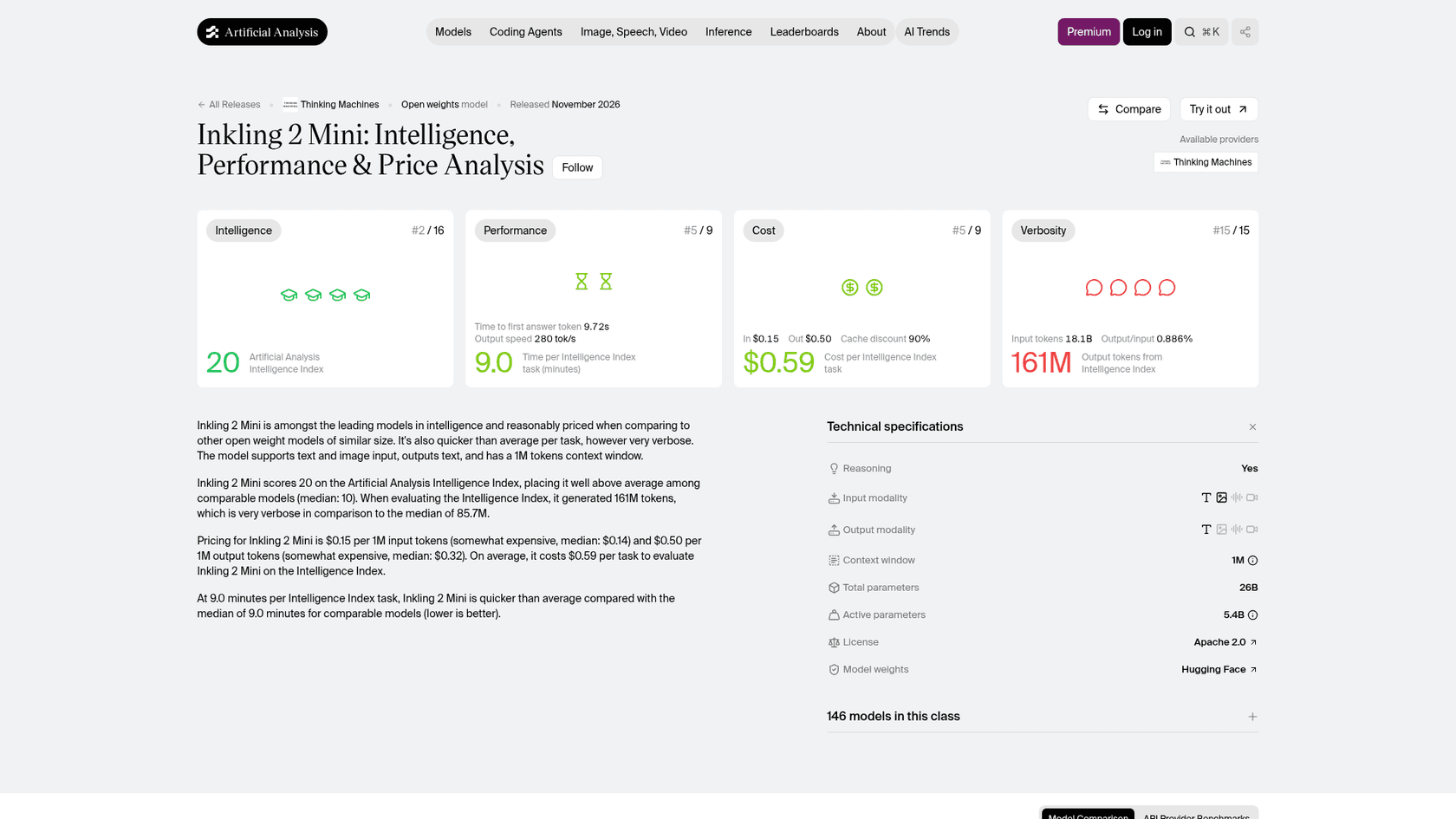
Mini scores 11 points below Small and costs half as much per task. The lab's own card puts it more bluntly: the model is "less capable than Inkling 2 Small across most of our evaluations", with the largest gaps on factual recall. The exception is long agentic work, where the lab says Mini "approaches" Small on its PMPP-Hard test. The older family members are covered in the Inkling, Inkling-Small and Inkling 2 Small posts.
One correction to the Small picture I wrote earlier. At launch Small's weights were closed. They have since appeared on Hugging Face under Apache 2.0, and Artificial Analysis now lists DeepInfra, Nebius and Together as hosts, with speed and cost figures that moved because of it. I use today's figures above.
How does a looped model work?
A looped transformer reuses the same layers more than once per token. Inkling 2 Mini stores 24 layers in four blocks of six, and the two middle blocks run three times, so each token passes through 48 layer applications. The model card says looping the middle layers beat looping the last layers on 27 of 28 evaluations.
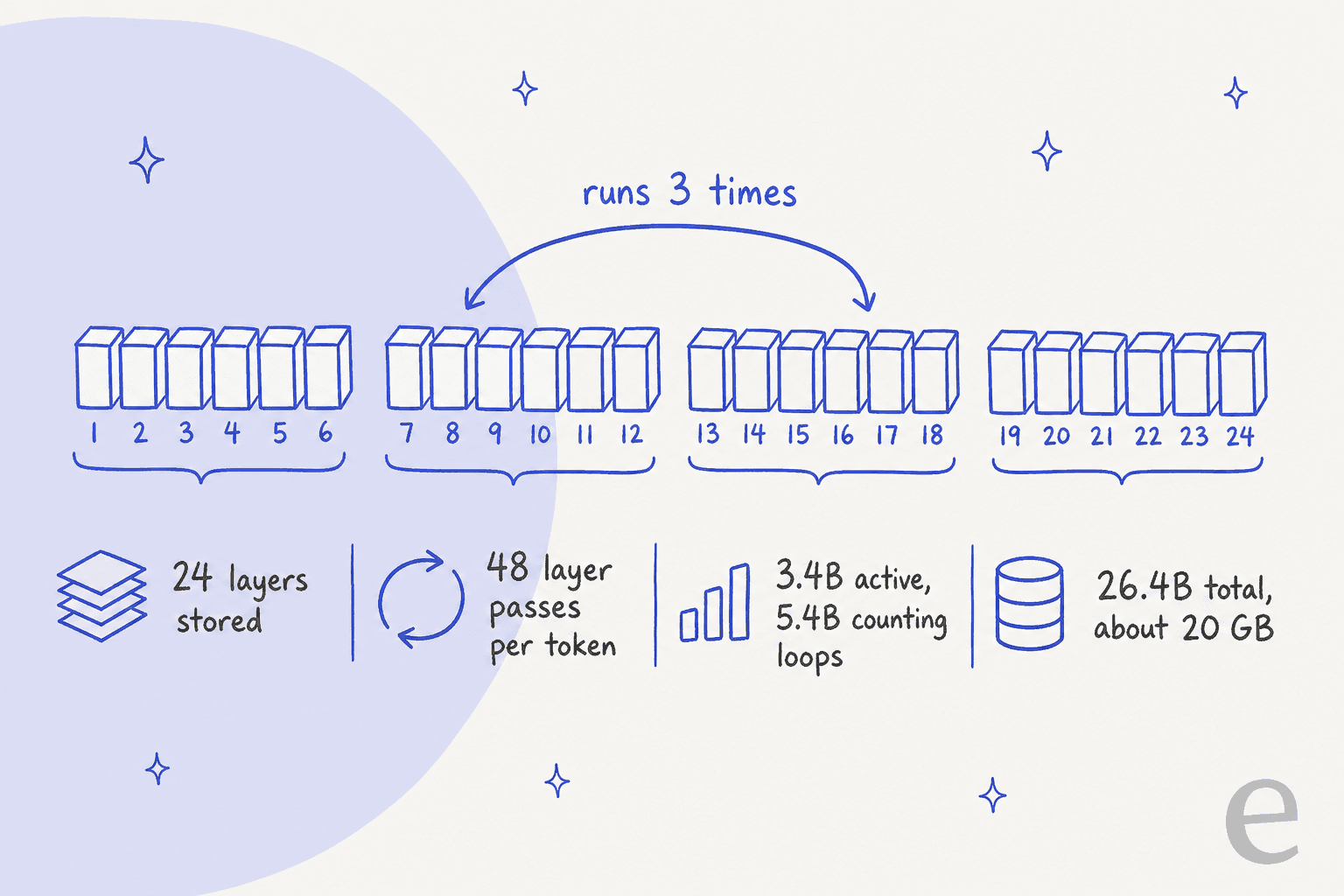
The point is memory. Phones, laptops and small servers are limited by how many weights they can hold, not by how much arithmetic they can do. Reusing layers buys extra thinking per token without growing the file. Three further details from the card:
- Training. Expert layers were trained in NVFP4 (4-bit) from pretraining through reinforcement learning, and the last four layers in 8-bit, so the shipped weights match the trained ones with no conversion step.
- Shrinking. The lab pruned the model from 384 experts to 128 per layer partway through training, then healed it with 1T tokens of distillation from a larger internal Inkling model.
- The catch. Looping does not add knowledge. The lab writes that knowledge is mostly a function of total parameter count, so facts do not improve with more passes.
That last line is the one to keep in mind for the rest of this post.
What does Inkling 2 Mini cost?
On Tinker, Inkling 2 Mini samples at $0.15 per 1M input tokens, $0.015 per 1M cached input tokens and $0.50 per 1M output tokens. Fine-tuning ("train") is $0.75 per 1M tokens at 64K context and $1.50 at 256K. Inkling 2 Small is exactly double on the sampling side. Prices come from the vendor's Tinker pricing page; I did not use any third-party price.
Three things change the real bill:
- Serverless is not open for Mini. The pricing page limits serverless inference to Inkling 2 Small, Inkling and Inkling-Small, and the OpenRouter page shows no price. Today the realistic routes are Tinker sampling or your own hardware.
- Verbose output eats the saving. Per-token price is half of Small's, but Mini writes about as many tokens per task, so the per-task gap to Small is about 2x, the same ratio as the per-token prices. Output tokens are the unit that decides the bill.
- Local is a different bill. On your own machine the cost is hardware and time, not tokens, which is the case the lab built Mini for.
For a support budget view, the AI customer service cost guide shows how model price sits next to seats, resolutions and setup.
Where does Inkling 2 Mini fall short?
Knowledge, multi-turn chat and terminal sessions. The lab reports its own gaps, which is worth crediting. On its own card, Mini's AA-Omniscience non-hallucination rate is 63.4%, so when it does not know an answer on that test, it guesses instead of saying so a little over a third of the time. The card also puts Mini behind Qwen3.8-27B on MultiChallenge (50.0%) and ComplexConstraints (33.4%), and tied at a low 5.6% on Terminal Bench 4.0.
Early users noticed the same pattern. One Hacker News tester ran a coding prompt with tools off:
"The model burned through 19200 thinking tokens on this task (which was the hard limit I had set) and didn't finish."

The same user said that with search allowed it got to a solution but still used the wrong hook name. Another commenter was blunter about agent benchmarks:
"Big fan of open weights but those Terminal Bench numbers are pretty abysmal."
The launch thread reached 473 points and 72 comments on Hacker News, and most of the praise was about size and speed, not accuracy. The lab's reading is that Mini "overcomes the knowledge gap" by using search and tools, which fits what that tester saw: it did better once it could look things up.
Where Mini does lead is agentic work that is mostly search and tool calls. The lab reports 79.2% on SWE-bench Verified (bash only), against 77.8% for Qwen3.8-27B, plus 79.0% on BrowseComp and 82.7% on MCP Atlas. Those are the lab's numbers, run on its own harness, so I would wait for outside runs before treating them as settled. Gemini 3.8 Flash, DeepSeek V4 Flash and Kimi K3 are the larger hosted options if you do not need local weights.
Can you run Inkling 2 Mini on a laptop?
Yes, and that is the real headline for most developers. The model card says one DGX Spark or an Apple machine with 32 GB or more of unified memory is enough, and quantized GGUF builds exist for llama.cpp, Ollama and similar apps. The lab also cites a Stanford efficiency study on a DGX Spark, where Mini scored 0.703 on its intelligence-per-watt measure against 0.430 for Qwen3.6-35B-A3B.
Real-world speed is less clear. The lab did not publish a tokens-per-second figure for its laptop demo. A Hacker News user with an older machine reported:
"I'm getting 20 tokens/s running the 4-bit version on my 2021 M1 Max MacBook pro with 64Gb."
Another commenter noted that llama.cpp needed a separate pull request to add looped support, so a stale runtime may not load the model. For other runtimes, see llama.cpp alternatives. The 280 tokens per second Artificial Analysis lists is a hosted measurement, not what a laptop will do.
Is Inkling 2 Mini worth using for support?
It is worth testing as an engine, not as an agent. A support agent is a model plus your docs, your tools, your handoff rules and a way to check it before customers see it. Mini's pitch (cheap, fast, strong with tools) fits the tool-heavy parts, and its weakness (confident wrong facts) is the part you cannot leave unsupervised. A hallucination in a refund answer costs far more than the tokens you saved.
That is why eesel treats the model as swappable. An AI helpdesk teammate joins your existing queue, learns from your help center and past tickets, and is simulated against historical tickets before it goes live, so a new engine is judged on your questions, not on a lab's table. SamCart is a good example of the setup. It runs one agent on Freshdesk tickets and another on its website chat, both answering from about 280 help center articles. On tickets the agent replies only until a teammate takes over, and a request for a person ends its turn. None of that depends on which model sits underneath.
If you want to try Mini yourself, give it a bounded job first:
- Pick a narrow task, such as drafting replies from a fixed article set.
- Cap output and turns, as the model card recommends, because the minimum reasoning setting does not fully turn reasoning off.
- Replay past tickets and compare against your human answers, as in AI support simulation testing and AI support agent testing.
- Limit what it can do, using the ideas in AI support agent permissions.
- Watch it after launch, with the traces described in AI support agent observability.
For a wider shortlist, support ticket model picks and best AI customer support agents compare models and products on support-specific tests, and the Freshdesk AI agent guide shows what a helpdesk-native option looks like.
Want a model you can swap without rebuilding your support setup? Try eesel: it works like a new hire that plugs into your helpdesk in minutes, already knows your help center, and is tested on your past tickets before it talks to a customer.
What else should you read?
Tracking the Inkling family? These are the closest reads:
- The Inkling 2 Small review, the nearest comparison to this post.
- The Inkling-Small review and the Inkling review for the first generation.
- Inkling-Small alternatives if you are choosing between small open models.
- Glossary entries on large language models, fine-tuning, AI agents and RAG.