

Inkling 2 Small is Thinking Machines Lab's second-generation model: 594B total and 17B active parameters, a 31 on the Artificial Analysis Intelligence Index against 13 for Inkling-Small, and $0.30 in / $1.00 out per 1M tokens. The jump is real in coding agents, vision, and document work, and the 73.3% non-hallucination rate shows the factuality cliff narrowed. Two catches: weights are closed until the promised Apache 2.0 release, and the maker says chat is not its strength. I'd treat it as an engine, and put grounding, handoff, and simulation around any model that talks to customers, which is the part eesel handles.
What is Inkling 2 Small?
Inkling 2 Small is a Mixture-of-Experts model that Thinking Machines Lab announced on November 5, 2026, with 594B total parameters and 17B active per token. Per the model card, it is a 48-layer decoder that routes each token to 8 of 384 experts, takes text and images, and outputs text. The name is a little misleading. "Small" is relative to the 975B Inkling, and it is more than double the size of last July's Inkling-Small, which was 276B total and 12B active.
I read this as the first model in a new generation rather than a refresh. The lab says it comes from more efficient pre-training (8.4T tokens, then 3.8T of newer data) and one joint reinforcement learning run of 1,075 steps and 17M+ rollouts over nine days on 2,048 GPUs. Training ran natively in NVFP4, the 4-bit format from NVIDIA Blackwell.
| Spec | Inkling 2 Small | Source |
|---|---|---|
| Released | Nov 5, 2026 | Model card |
| Parameters | 594B total, 17B active | Model card |
| Inputs / output | Text and image in, text out (no audio) | Announcement |
| Context | Up to 1M tokens (64K and 256K on Tinker serverless) | Model card, Tinker docs |
| Price | $0.30 in ($0.03 cached), $1.00 out per 1M | Tinker docs, Artificial Analysis |
| License today | Tinker Terms of Use; Apache 2.0 promised | Announcement |
How much better is Inkling 2 Small than Inkling-Small?
On the same ruler, a lot better. Artificial Analysis now lists Inkling-Small at 13 on its v5.0.1 Intelligence Index and Inkling 2 Small at 31, ranking it fourth of 29 comparable models. One caution from me: my Inkling-Small review quoted a 40 from the older v4.1 index, and the two scales are not comparable. Always compare scores within one version.
The price of that jump shows up elsewhere. Artificial Analysis measures $1.18 per index task against $0.20, and 15.7 minutes per task against 7.0, and calls the new model "notably slow" and "very verbose" at 154M output tokens against 71.6M for its predecessor.
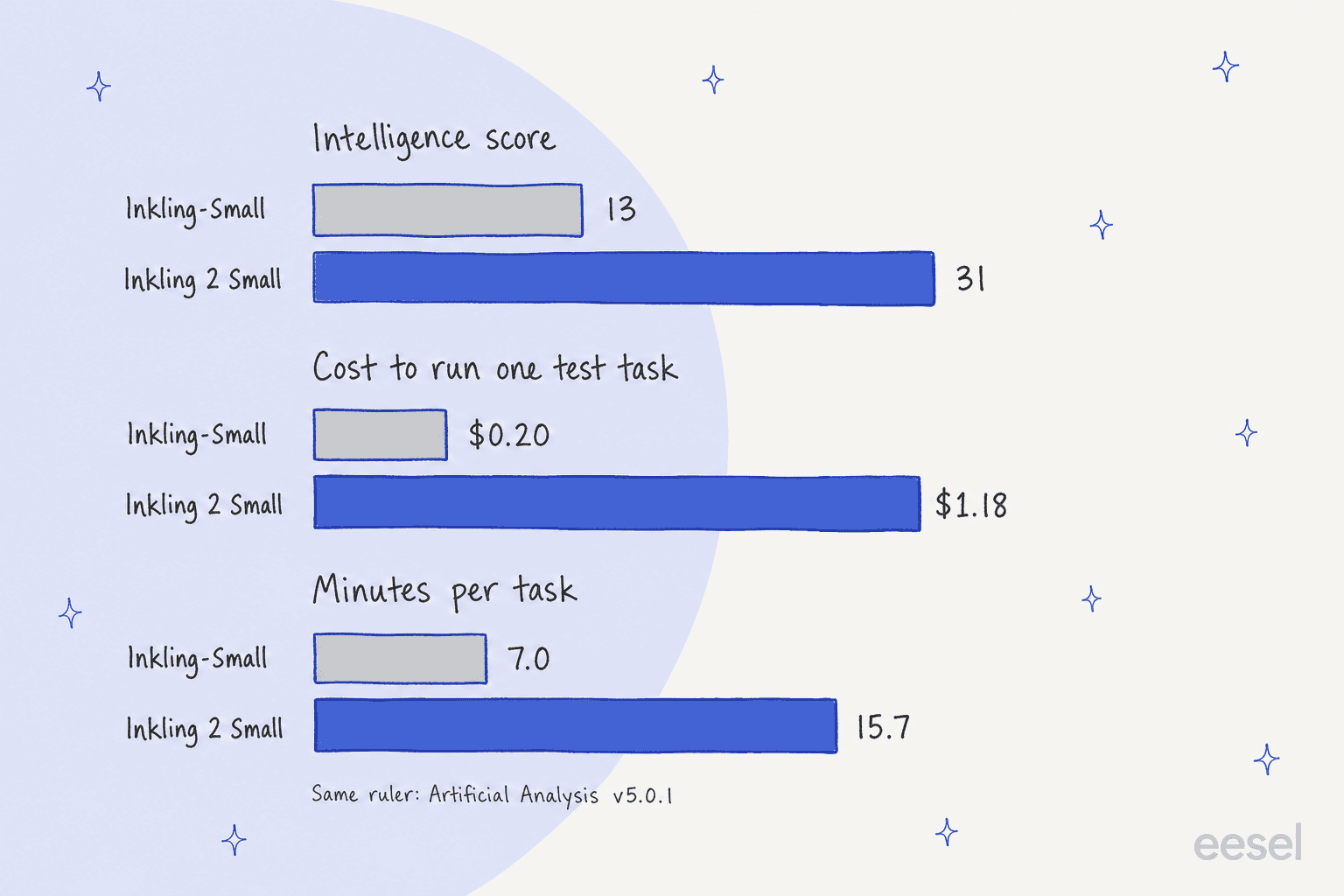
So the real trade is not "same model, newer". It is more than double the score, roughly six times the cost per hard task, and twice the wall-clock time. For a coding agent that runs for hours, that is a fair deal. For a support queue where a customer is waiting, the 28.8 second time to first answer token that Artificial Analysis records matters more than the 159 tokens per second.
Where does Inkling 2 Small actually beat its rivals?
Mostly vision and finance, with coding close behind DeepSeek. These are Thinking Machines' own numbers, so treat them as the vendor's best foot forward, but the vendor also prints rows it loses, which is rarer than it should be.
| Benchmark (vendor-reported) | Inkling 2 Small | GLM-5.3-Flash | DeepSeek V4.1 Flash | Muse Spark Open | Kimi K3 |
|---|---|---|---|---|---|
| FrontierCode v2.0 | 25.4% | 14.2% | 28.5% | 7.6% | 17.3% |
| DeepSWE v1.1 | 72.1% | 63.4% | 77.0% | 60.0% | 68.5% |
| Vibe Code Bench v1.1 | 81.6% | 30.8% | 87.7% | 76.2% | 85.0% |
| MMMU Pro | 81.6% | 79.0% | 80.6% | 80.9% | 80.5% |
| JobBench | 70.5% | 60.7% | n/a | 61.8% | 54.3% |
| Vals Legal Index | 73.9% | 71.1% | 71.9% | 68.5% | 71.7% |
| Vals Finance Index | 61.5% | 55.8% | 60.9% | 53.0% | 58.0% |
On the independent side, the vendor's model card puts the AA Index at 30.6 for Inkling 2 Small, behind DeepSeek V4.1 Flash at 32.6 and Claude Haiku 5.5 at 36.5, and just under Gemini 3.8 Flash at 30.8. In other words, it sits mid-pack among current flash-tier models on the independent index, and its edge is in specific areas.
The most useful single result for builders is autonomy. Thinking Machines had it train a 4B model on Tinker to forecast time series for 4 hours 17 minutes and $426 of a $500 budget, and the trained model made about 15% less error than the base on unseen data. That is the headline use case: long-horizon agent work, not answering a refund question.
Does Inkling 2 Small still make things up?
Less than before, and less than most of its peers, but it is not zero. This is the section I would read first if you are putting a model in front of customers. Thinking Machines trained it with uncertainty-sensitive rewards on question answering, so it is rewarded for saying it does not know.
On AA-Omniscience v1.1, the vendor reports a net score of 16.1 and a 73.3% non-hallucination rate, the highest in its comparison table. AA defines that as one minus the hallucination rate. The net score trails Muse Spark Open's 25.8, which tells me the model gets there partly by abstaining rather than by knowing more.
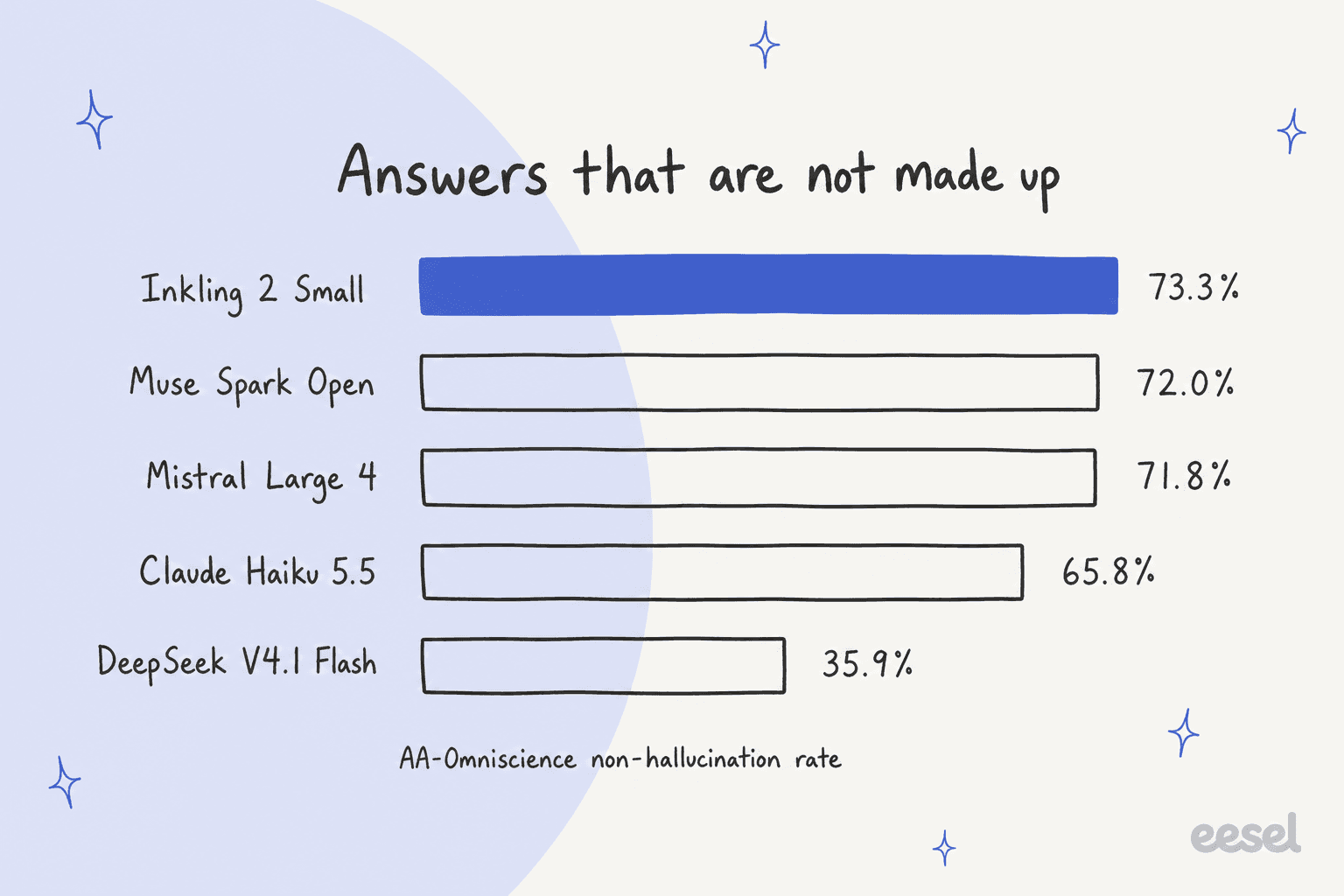
I can't give you a clean before-and-after against Inkling-Small. My earlier reading of -9.0 on AA-Omniscience came from an older version of that benchmark, and the new v1.1 isn't published for the old model in the sources I could check. What I can say is that the vendor's own model card still warns of hallucination, and recommends human oversight for high-stakes outputs. For a support context, AI hallucinations in support are a system problem, and a 73% rate is a good start rather than a finish line.
What does Inkling 2 Small cost to run?
$0.30 per 1M input tokens ($0.03 when cached) and $1.00 per 1M output tokens, on both Tinker's serverless table and Artificial Analysis. Fine-tuning training is $1.50 per 1M tokens at 64K and $3.00 at 256K, and checkpoint storage is $0.10 per GB per month.
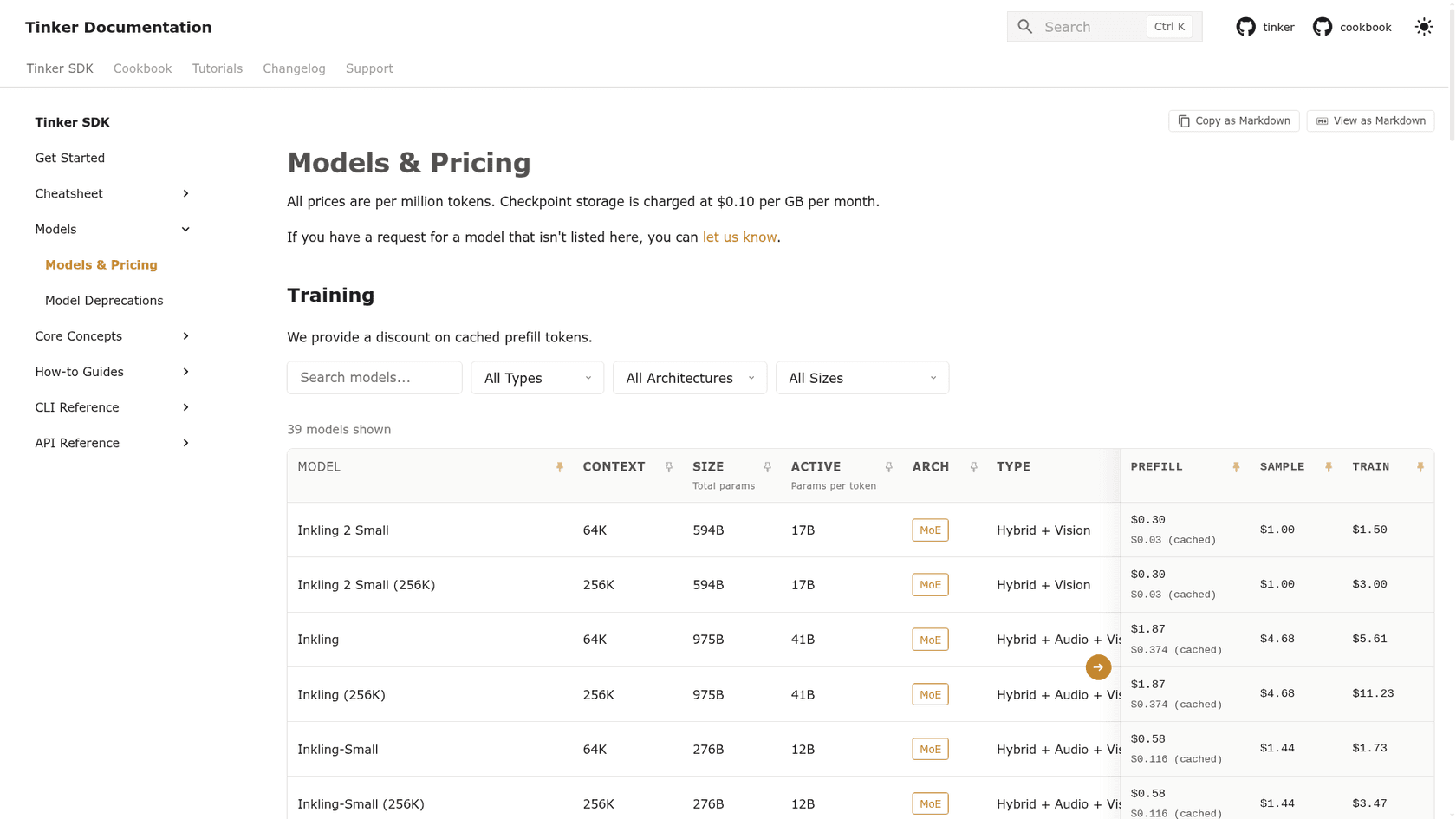
Here is what that looks like for one buyer. Assume a team with 10,000 support conversations a month, each carrying 6,000 input tokens (system prompt plus retrieved help articles) and 800 output tokens. Those token counts are my assumption, not a vendor figure.
| Scenario | Input cost | Output cost | Monthly total |
|---|---|---|---|
| Inkling 2 Small, no caching | 60M x $0.30 = $18.00 | 8M x $1.00 = $8.00 | $26.00 |
| Inkling 2 Small, 4,000 tokens cached | 40M x $0.03 + 20M x $0.30 = $7.20 | $8.00 | $15.20 |
| Inkling 2 Small, thinking triples output (2,400 tokens) | $18.00 | 24M x $1.00 = $24.00 | $42.00 |
| Inkling-Small at its $0.30 / $1.20 Tinker rate | $18.00 | 8M x $1.20 = $9.60 | $27.60 |
Raw tokens are a rounding error next to the cost of a human ticket, which is why I'd care more about cost per resolution than per-token price. One production caveat from the Tinker docs: serverless inference is in beta, and teams that want production use are asked to email for a waitlist. As of November 8, the OpenRouter listing I checked only showed Inkling-Small, and Artificial Analysis states "No publicly available API" for the new model.
Is Inkling 2 Small open weights?
Not today. Thinking Machines is following the approach in its safe path to open weights post: closed on Tinker first, then Apache 2.0 weights "next week" after external safety testing and red-teaming, and wider platforms "in the coming weeks". I could not find the weights live on Hugging Face as of November 8, so I'm treating the Apache 2.0 license as a promise, not a fact. If you are planning a self-hosted deployment alongside open-source AI agents, wait for the release before you size GPUs; 594B parameters is heavy even at 17B active.
What are Inkling 2 Small's weak spots?
The vendor lists three itself, and the first two matter for support:
- It "is also less optimized for the chat experience": worse organization of content, overuse of slashes, and overreaction to mental health and other safety-related queries.
- It "is not the most succinct communicator" and does not always pick the best tool, especially in codebases with many skills.
- It does not support audio input, which Inkling-Small did. If you were planning voice support, look elsewhere.
The over-refusal is visible in the safety numbers too. On FORTRESS the model's Overrefusal Score is 20.4, against 3.6 for GLM-5.3-Flash and 6.9 for DeepSeek V4.1 Flash. In a support setting that is the model refusing a perfectly normal question. The upside is on alignment: the lab reports misbehavior of 14.9 against 66.8 for Inkling and 75.2 for Inkling-Small on its internal evaluation, with destructive actions at 4.7 (lower is better).
What do people say about Inkling 2 Small?
The Hacker News thread hit 289 points and 92 comments by November 8, and the mood is cautious optimism. There are also Reddit threads on r/LocalLLaMA and r/singularity, but I only saw them as search snippets, so I am not quoting them.
"The best open models today have been "good enough" to do most knowledge work for a few months. This might be the first US one good enough too. That's a big deal. Open weight US based Opus 5.5 within 12 months."

"Very refreshing to see benchmarks where the reporting team is not the clear winner. They are claiming to be better than GLM 5.3 flash, which is impressive if it holds up outside of benchmarks."
"So basically comparable to DS4.1? But why bother to make something we already have?"
I land between the first and third quotes. It is comparable to DeepSeek on coding, but it wins on vision and carries a US-based, safety-tested story that some buyers need.
Would I put Inkling 2 Small on a support queue?
Not on its own, and that is true of every model. I work on eesel, which has spent three-plus years putting AI agents on live support queues, and the lesson is that the model alone never decides whether an answer is safe. What decides it is what sits around the model: grounding in your help center, an abstain-and-hand-off path, and a test against old tickets before launch.
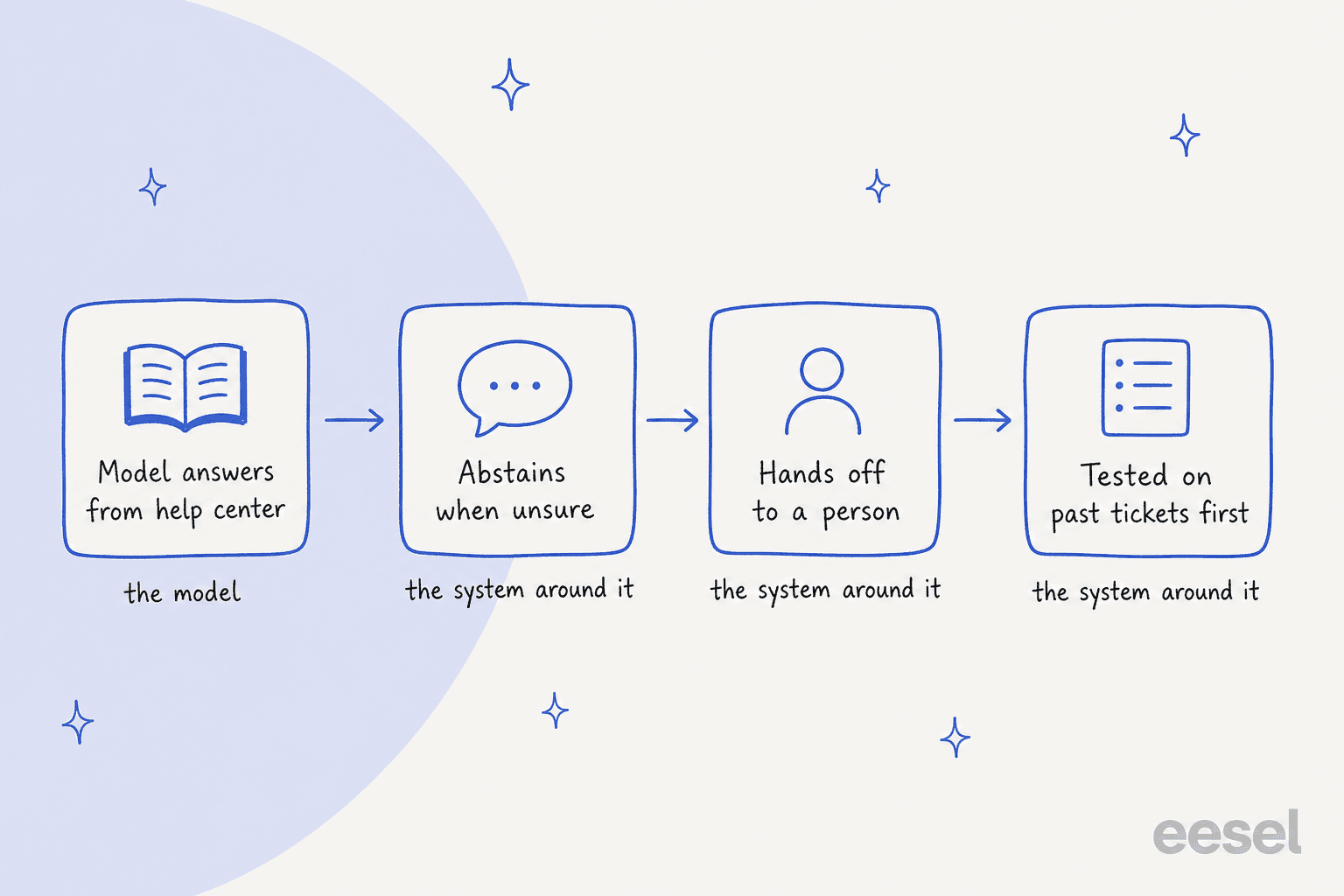
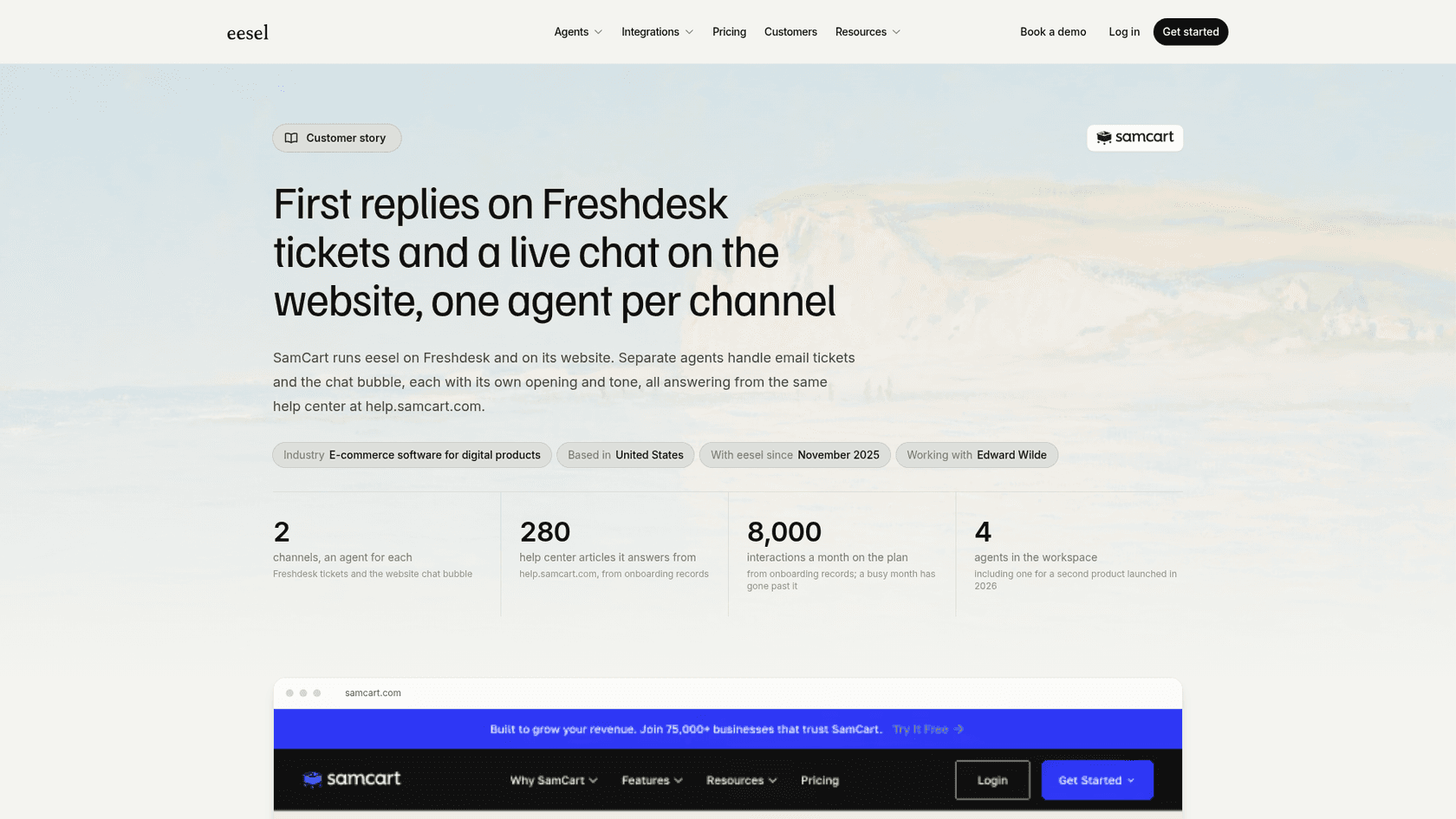
SamCart is a good example of the shape. It runs one agent on Freshdesk tickets and another on its website chat, both answering from roughly 280 help center articles. On tickets the agent replies only when no person is assigned, and when a seller asks for a human or the question is beyond the help center, the ticket is tagged for handoff and the agent stops. That design works whichever model is underneath. Compare it with AI escalation management and my guide to testing an AI agent before launch.
Where Inkling 2 Small could matter for a support team is the layer behind the queue: triaging, drafting internal summaries, reading screenshots customers attach, and long-running research on ticket data. With the eesel CLI, an AI coding agent could upload approved knowledge, such as exported help articles and macros, and then ask test questions and check the answers before anything goes live. Connecting the helpdesk itself still needs someone with admin access to approve it, and I'm not claiming eesel runs this specific model.
Verdict: who should use Inkling 2 Small?
- Pick it if you build coding or research agents, need open-weights-class vision at $0.30/$1.00, or want a US-developed model you can fine-tune on Tinker.
- Wait if you need audio, a self-hosted deployment today, or a production SLA, since weights are pending and serverless is a beta.
- Skip it as a bare customer chat model. The vendor says chat is its weak spot and the over-refusal numbers back that up.
My bottom line: Inkling 2 Small closes most of the capability gap and a good part of the factuality gap, but it trades speed and cost per task for it. If you are shopping the neighbourhood, my Kimi K3 review is the third close comparison after the two DeepSeek and GLM reviews above, and the Inkling-Small alternatives roundup covers the rest.
Try eesel
If your real goal is fewer unanswered tickets rather than a better model, Try eesel. It is an AI helpdesk teammate that joins your existing queue, answers from your help center, hands off to a person when it is unsure, and is simulated against your past tickets before it replies to anyone. See the pricing page, or read how SamCart set up two agents on Freshdesk.
Frequently Asked Questions
Is Inkling 2 Small worth it?
31 on the Artificial Analysis Intelligence Index against 13 for Inkling-Small, at $0.30 input and $1.00 output per 1M tokens. For a customer-facing chat bot it is a maybe, because its own maker says it is less tuned for chat. My short Inkling 2 Small review: strong engine, still needs a hallucination-proof support setup around it.How much does Inkling 2 Small cost?
$26 in raw tokens. For the full cost picture beyond tokens, see AI customer service cost and cost per resolution.