
What BlueTweak actually charges
I have spent the last three-plus years watching teams put AI agents on live support queues at eesel, and the single most reliable way to lose a deal in customer service automation is a billing page that surprises someone. One trial user of a competing tool ran twelve clean test chats, watched the agent perform well on every one, then opened the billing page and immediately filed a cancellation request. Nothing about the product had changed between minute eleven and minute thirteen. Only the arithmetic had.
So let's do the arithmetic on BlueTweak properly, starting with the number on the card.
There is exactly one plan, named BlueTweak, with no Starter/Pro/Enterprise ladder and no quote-only row. The pricing page headline is "Simple Pricing. All Channels Included," and the billable unit is the agent seat.
| Billing term | Price per agent, per month | Annual total per agent | Notes |
|---|---|---|---|
| Billed annually (default view) | €65 | €780 | Carries a -10% tag; this is the marketed number |
| Billed monthly | €72 | €864 | Never written into the page; computed by the toggle script |
| Currency | EUR only | No USD or GBP option exists | |
| Free tier | None | 14-day trial, no credit card | |
| Minimum seats | Not published | Sizing guidance is "20 to 100 agents" | |
| Contract minimum | Not published | Beyond the annual/monthly toggle |
The €72 figure is worth pausing on, because it is not printed anywhere on the page. The pricing card loads in the annual state by default, and the monthly price is calculated in the browser. The toggle script is unusually candid about it in its own comment: the base price "represents the discounted yearly price," and monthly is derived as Math.round(basePrice / 0.9). So the number BlueTweak markets is the discounted one, and a buyer holding "€65" against a rival's no-commit monthly rate is comparing an annual commitment to a month-to-month one. Committing annually saves €84 per agent per year, about 9.7%.
The billable unit, and the three meters on top
Every helpdesk vendor makes one decision that shapes your entire bill, and it is the choice of billable unit. It is the number I'd check first on any tool in a best AI helpdesk software shortlist. Zendesk bills automated resolutions. Freshdesk bills sessions. Front bills conversations, tiered by outcome. BlueTweak bills seats, then meters three specific AI actions separately.
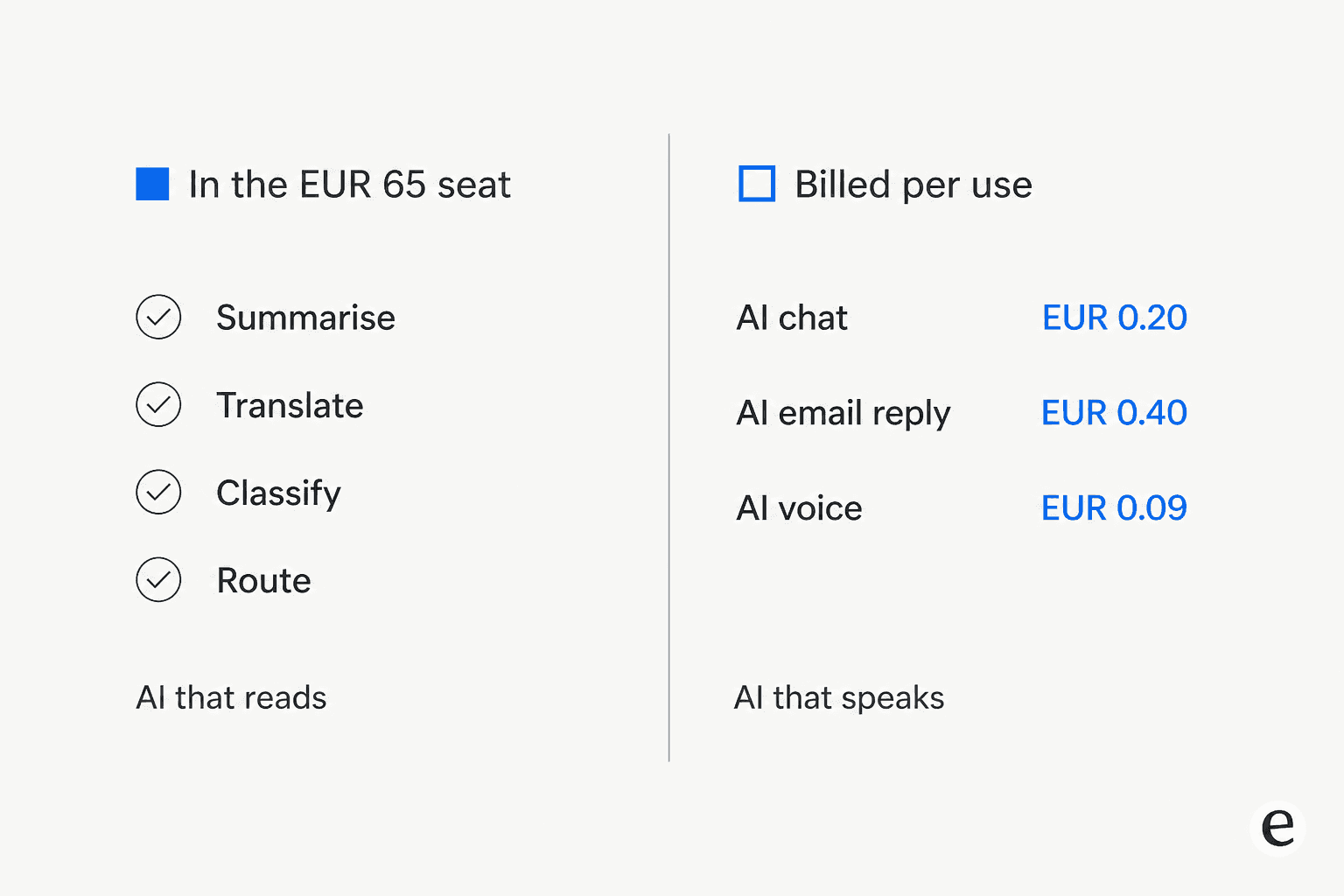
The split is consistent once you see it. AI that reads is in the seat; AI that speaks is metered.
| AI add-on | Billing trigger, verbatim from the page | Rate | Unit |
|---|---|---|---|
| Conversational AI, Chat | "Billed only when conversational AI fully resolves a conversation without humans." | €0.20 | per chat session |
| AI Proposed Reply, Ticket | "Billed per usage when agents use AI-generated email responses." | €0.40 | per email thread |
| Conversational AI, Voice | "Billed only when conversational AI completes a call without agent intervention." | €0.09 | per minute |
Two of the three are resolution-gated, which is the buyer-friendly choice. A chat the AI half-answers before handing off costs nothing. A call an agent has to rescue costs nothing.
The email meter is different, and it is the one I would model hardest before signing. €0.40 fires whenever an agent uses an AI-generated reply, not when the AI resolves anything. The human is still there, still reading, still approving, still sitting in a €65 seat. So on the email channel the AI is an addition to the cost of the agent rather than a substitute for one. That is a defensible design for a copilot, and BlueTweak is upfront that a person makes the final call: the AI reply feature is draft-and-approve, and the homepage says "the final decision always stays with a person on your team, not the model." That is the copilot end of the AI agents versus chatbots spectrum, not the autonomous end. It is just worth knowing you are buying a faster agent, not a smaller team.
There is a smaller wrinkle in how this is described. The features index tells you "each feature is included in the platform, and is not a separate add-on," and the pricing page's own meta description promises "no per-channel add-ons or hidden usage fees." Both are true of the platform, and the comparison page scopes the promise carefully to "core platform features." But a reader who only ever sees the feature pages will not learn that three usage meters exist, because the meters appear on the pricing page and nowhere else.
What the €65 buys you
Now the generous half of the ledger, because the bundle is the actual story here and it is a good one.
The CCaaS platform page states the commercial argument in one line: "There is no base product with add-ons: voice, AI, QA, WFM, and analytics are all part of the same workspace from day one."
Inside the seat, per the pricing page's own inclusion list:
- Channels: email, chat, voice, and three native social channels (Facebook Messenger, Instagram, WhatsApp), plus web forms
- Ticketing: internal notes, macros, SLAs, skills-based routing, custom agent roles
- Knowledge: a knowledge base that also publishes as a branded help center from the same content store
- Contact center: IVR, call transcription, call summarisation
- Ops tooling: workforce management, a quality module with scorecards, a survey platform, prebuilt and live analytics
- Passive AI per channel: translation across 100+ languages, summarisation, spam identification, sentiment analysis, and intelligent routing
That WFM and QA line matters more than it looks. Those two are the classic upsell in contact center software, and getting quality assurance without a premium tier is a real saving for a 40-seat operation that would otherwise buy it separately. The three social channels being native rather than a bolt-on is the same story: social inbox tooling is usually its own spend.
The data location options row is quietly useful too, and it pairs with the compliance posture. BlueTweak is ISO 27001 certified and GDPR compliant, and its own security page is an honest enumeration rather than a badge wall. What is absent from that page is equally checkable: no SOC 2, no HIPAA, no PCI DSS, and no published uptime SLA. For a European mid-market buyer, ISO 27001 plus GDPR is the standard pairing and clears procurement. For a US enterprise buyer, SOC 2 is usually the gate, and it isn't there yet.
Where the price lands once the AI is actually running
Here is the part a bare tier grid hides. Take a 10-seat team on annual billing, running all three meters at moderate volume: 2,000 AI-resolved chats, 1,500 AI-assisted email threads, and 3,000 AI-completed voice minutes a month.
| Line item | Calculation | Monthly |
|---|---|---|
| Seats | 10 × €65 | €650 |
| AI chat | 2,000 × €0.20 | €400 |
| AI email replies | 1,500 × €0.40 | €600 |
| AI voice | 3,000 × €0.09 | €270 |
| Total | €1,920 | |
| Effective per agent | €1,920 ÷ 10 | €192 |
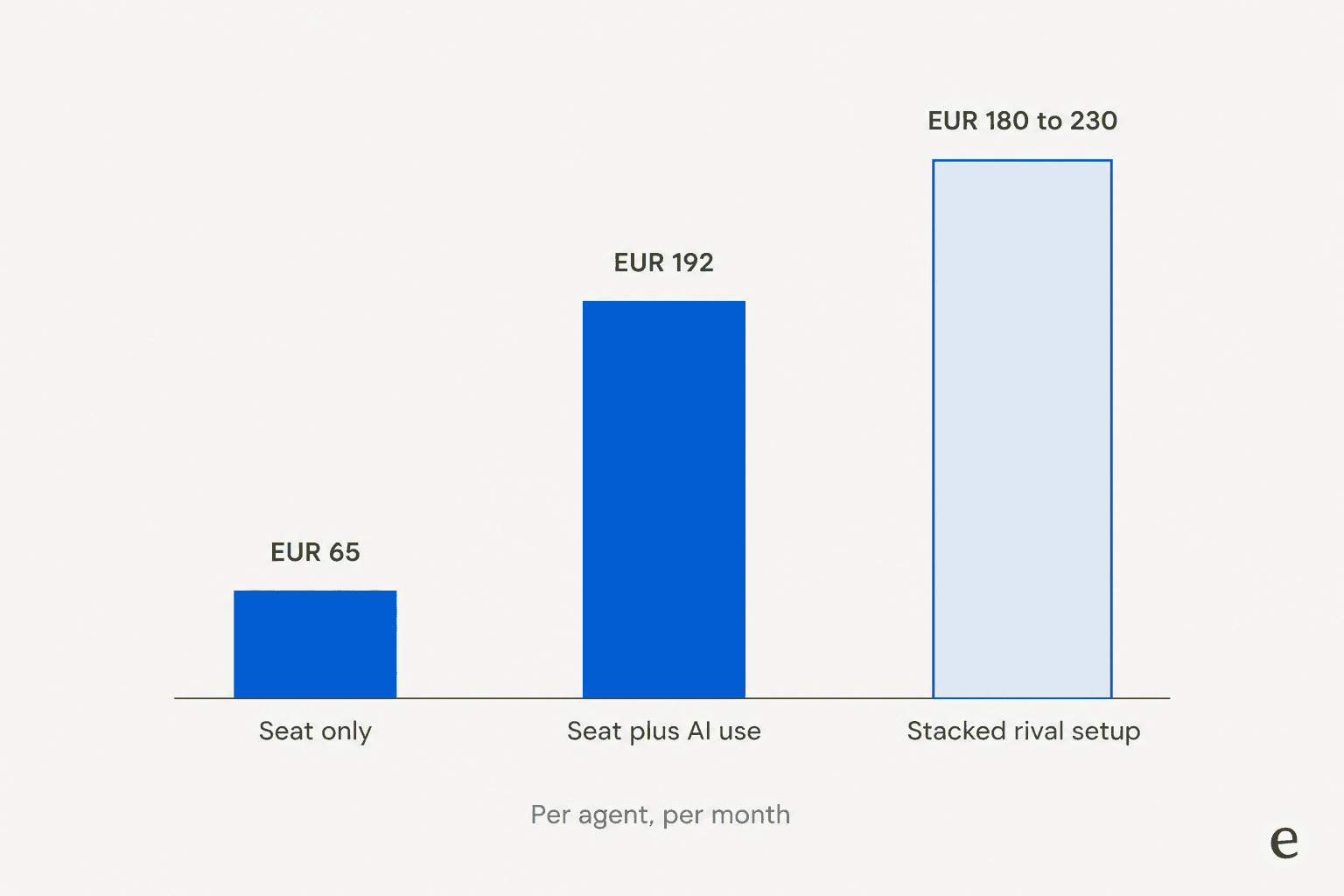
€192 per agent per month sits inside the €180 to €230 band BlueTweak attributes to a stacked Zendesk build on its comparison page. I want to be fair about what that does and does not prove. The €180 to €230 figure is BlueTweak's own estimate of a competitor's configuration, unsourced and unbroken-down, so it is a marketing claim rather than a benchmark. And the volumes I picked are mine, not theirs. Change the mix and the total moves a lot.
But the shape of the finding holds: the seat is not what moves your BlueTweak bill, the meters are. Which means the €65 headline is doing roughly the same job as every other vendor's entry price in this category, which is to get you comparing the wrong number.
Plug in your own numbers rather than mine:
How it compares to the rest of the category
Entry prices in this market are close enough to be noise. The billing unit is where the real difference sits, so that is the column to read first.
| Platform | Entry seat price | AI billing unit | AI rate | Free tier | Simulation before go-live |
|---|---|---|---|---|---|
| BlueTweak | €65/agent/mo annual, €72 monthly | Seat, plus 3 usage meters | €0.20 chat, €0.40 email, €0.09 voice min | No | No |
| Zendesk | $19/agent/mo annual (Support Team) | Automated resolution | $1.50 committed, $2.00 pay-as-you-go | No | Inline tester; sandbox is Enterprise |
| Freshdesk | $19/agent/mo annual (Growth) | Session (a time window) | $0.49 per session | No | Yes |
| Front | $25/seat/mo annual | Conversation, tiered by outcome | $0.05 / $0.39 / $0.89 | No | Yes |
| Help Scout | $25/user/mo annual | Resolution | $0.75 per resolution | Yes, 5 users | Yes |
| Zoho Desk | $7/user/mo annual (Express) | In-seat; Zia is Enterprise-only | Enterprise at $40/user/mo | Yes, 3 users | Not published |
| HubSpot Service Hub | $7/seat/mo commit-monthly | Conversation resolved, via credits | ~$0.50 per resolution | Yes, 2 users | Yes |
| Tidio | $24.17/mo annual (Starter) | Lyro conversation | $0.50 per conversation | Yes | Yes |
| eesel AI | No seat fee | Ticket or conversation handled | $0.40 per ticket | $50 free usage | Yes, over past tickets |
Two things jump out. First, BlueTweak is the most expensive seat on this table by a wide margin, and it should be, because that seat carries WFM, QA, IVR, surveys and voice that most of the others sell separately or not at all. Comparing €65 to Zendesk's $19 without adding the Workforce Engagement bundle and the Contact Center add-on would be an unfair read.
Second, BlueTweak is the only row with no simulation step. Freshdesk, Front, Help Scout, Tidio and HubSpot all let you dry-run the AI before it touches a customer. Nothing on BlueTweak's platform, chat, voice or ticketing pages describes testing against historical tickets before go-live; the pre-launch story is knowledge grounding plus escalation instead. That is a product gap rather than a pricing one, but it is a pricing risk, because the meters start the day you flip the switch. The same check is worth running on any tool you shortlist, whether that's a Gorgias alternative or a Freshdesk alternative.
The wider field prices differently again, and it's worth a glance if BlueTweak's shape doesn't fit. At the enterprise end sit tools like Gladly. Well under BlueTweak's seat sits LiveAgent. And Chatwoot is open source, if you are willing to host it yourself.
What buyers actually say about seat pricing versus usage pricing
This is the argument BlueTweak's price card sits inside, and support practitioners have been having it loudly for a year.
The case for seats is simplicity, and it is a real case:
"They don't care how many tickets/emails/chats you have it's all based on the level and number of agent accounts. Obviously you will likely need more agents to manage more tickets. I have 3 agents for an average 200 tickets per month, super technical IT support."

Under per-seat, your ceiling is human throughput, not a meter, and the agent versus AI cost comparison stays legible to a CFO. That predictability is exactly what BlueTweak is selling.
The case against is that "resolved" is a word vendors get to define. Here is the sharpest version of it, from the founder of My AskAI, a competing vendor, so read it with that in mind:
"Every vendor has a different definition of 'resolved.' Some will consider it resolved if there's been a reply in 24 hours, 48 hours, or 72 hours, while others will use their own algorithms to decide whether something's been resolved or not."
And on Hacker News, the pushback on outcome pricing is blunter still:
"This is an article written by a company/llm trying to justify huge increases to the pricing structure. Oh! Yknow that thing we were charging you $200 a month for now? We're going to start charging you for the value we provide, and it will now be $5,000 a month. Meanwhile, the metrics for 'value' are completely gamed."

The most useful warning in the whole sweep came from a sysadmin thread rather than a pricing one, and it applies whichever model you pick:
"The scary part is how easy it is for these products to bullshit metrics for the executives. Like, put a chatbot in front of the support portal? Wow, it handled 5000 issues this month! 5000 tickets that didn't hit our EXPENSIVE human help desk staff! Now, only 1 of those interactions was useful and the other 4999 times people had to circumvent the bot to open a ticket, or just gave up."
Worth saying plainly: BlueTweak's two resolution-gated meters dodge the worst of this. You are not billed for a chat the AI fluffed. But the €0.40 email meter has no outcome gate at all, and that is the one where the deflection rate you report to your exec team and the number on your invoice have nothing to do with each other. If you're building that number properly, our ticket deflection guide covers what to count.
The question a seat price cannot answer
Here is the reframe I would want a buyer to walk away with, and it is not a knock on BlueTweak so much as a fact about the shape of the contract.
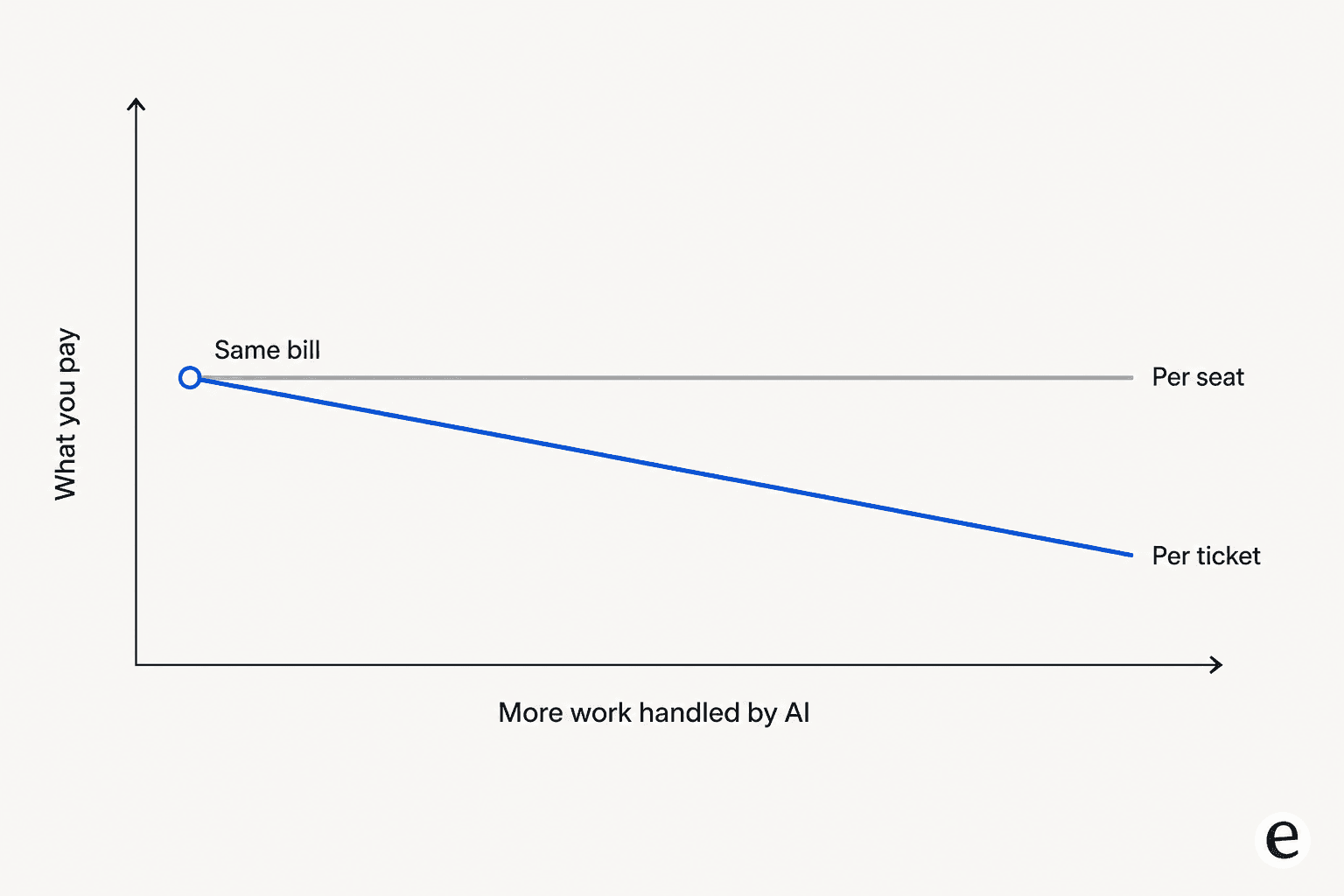
Automating support has one financial goal: the same volume costs less to serve. Under a per-seat contract, the only lever that moves your bill is headcount. If the AI takes 30% of your queue and you keep every agent, you have bought capacity, not savings, and the invoice is identical. That's the whole reason teams set out to automate customer support in the first place. Under per-ticket pricing, the bill tracks the work routed to the AI, so it can actually fall.
BlueTweak's own numbers make this concrete rather than theoretical. Its homepage claims 20% automation of routine questions and "one minute saved per chat," which is a conservative, credible claim for a copilot-shaped product and I respect it for not inflating to a 70% deflection number. But 20% of routine questions plus a minute per chat is a productivity story, not a headcount story. Priced per seat, it should be.
And once you know BlueTweak is a spin-off of Conectys, the global BPO whose about page describes the launch as its own, the pricing model stops looking accidental. A BPO sells seats. Its internal tooling was built to make a floor of agents faster, and its CEO says the same in his own words. The €65 seat is not a pricing oversight; it is the product's DNA showing through. Which also tells you who it fits.
The market is drifting the other way, for what it's worth:
"There are a ton of companies abstracting basic usage pricing to 'outcome based pricing'… They are betting an outcome based metric is more durable, since the value stays there, even if the underlying costs (like MCP calls) change/decrease. Expect to see much more outcome based pricing from vendors over the next 18-24 months. They know seat-based pricing is dead, and need to better justify usage pricing."
What the price card leaves out
A few gaps I'd want answered on the demo call before signing anything.
The FAQ that doesn't answer. The pricing page asks three of the four questions a buyer most wants answered: "Do I pay €65 per channel?", "Is there a minimum contract?", and "Do you offer trials?" All three answers render the same boilerplate paragraph about translating 100+ languages. Only the fourth, on enabling AI features later, carries a real answer. Reading the plan copy, "Email, Chat, and Voice – with all core features included," the intended answer to the per-channel question is clearly no. But you have to infer it, and the trial length is only findable on a separate page.
The integration count. The integrations page names four native connectors, Shopify, Salesforce, UiPath and ElevenLabs, plus Zendesk compatibility for migration. The homepage FAQ adds HubSpot, so call it four confirmed and a fifth claimed. Everything else goes through an open API with API-key auth. That is a defensible number for a platform that means to be your stack rather than sit beside it, and the three social channels are native rather than connectors. It is still a very different proposition from a marketplace-driven AI ticketing system, and if a tool you depend on isn't on that list, the integration is a project with a cost attached that no price card carries.
The paperwork. There is no public documentation site. docs., developers. and support. subdomains do not resolve, and /docs, /api, /changelog and /status all return 404; BlueTweak says endpoint references and connector details are shared "during the evaluation phase." The published terms are website terms, where Service is defined as the website itself, so there is no public clause covering payment, renewal, notice period, termination or service credits. For a €780-per-agent annual commitment, all of that arrives in a contract you can only read after booking a demo. It is a small irony that a vendor selling a knowledge base and a branded help center runs neither for itself.
The absence of independent reviews. BlueTweak has zero reviews on G2 and zero on Capterra, and no Trustpilot listing at all. Its category peers carry thousands. I'm not reading that as a quality signal, because a focused mid-market vendor with a BPO parent and named logos like Aeroitalia, Tradeville and FlyOne can be excellent and simply not run a review-site motion. But it does mean that for a €780-per-agent annual commitment, every claim you can check traces back to BlueTweak's own site, and the reference call is doing more work than usual.
Who BlueTweak's pricing is right for
Buy it if you run a 20 to 100 seat multilingual contact center, your volume is voice-heavy, and you are currently paying separately for a helpdesk, a WFM tool, a QA tool and a translation workaround. Consolidating four line items into €65 is a genuine saving, and the ISO 27001 plus GDPR pairing clears European procurement. The four-week go-live target is realistic for a platform this focused, the escalation handoff design is sound, and multilingual support across 100+ languages in the base price is the strongest single item in the bundle.
Skip it if your headcount is fixed and your goal is to serve more volume without hiring, because a per-seat contract cannot express that outcome. Skip it if you need SOC 2 or HIPAA today, which usually points at the enterprise end of the market. Skip it if you're under 20 agents, since BlueTweak says so itself. And skip it if you need to dry-run the AI against your own ticket history before it answers a customer, because that step does not exist here.
Negotiate hard on the email meter. It is the only one of the three that bills regardless of outcome, and at €0.40 a thread it is the most expensive per event. If your team is email-first, model it at your real thread volume before you sign, not at a demo-day estimate.
Try eesel AI on the queue you already have
If the thing you're actually trying to buy is a smaller bill rather than a faster agent, the billing unit has to change, not just the vendor. That's the bet behind eesel AI: it plugs into the helpdesk you already run, learns from your past tickets and help docs on day one, and bills 40¢ per ticket it handles, with no seat fee, no platform fee and no minimum. Route 200 of your 1,000 monthly tickets to it and you pay for 200.

The part I'd point a BlueTweak evaluator at specifically is simulation. Before anything goes live, eesel replays the agent over your historical tickets so you can see coverage by theme, find the gaps, fill them, and re-run. We built that because we have watched a confident-sounding bot quietly give wrong answers, and reading a resolution rate off your own archive beats trusting a launch. Gridwise saw 73% of tier-1 requests resolved in the first month on that basis, with results landing inside a 7-day trial. It's free to start with $50 of usage and no credit card.
Frequently Asked Questions
How much does BlueTweak cost per agent?
Does BlueTweak pricing include AI, or is AI an extra?
Is there a free version of BlueTweak?
What is BlueTweak pricing for a small team?
How does BlueTweak pricing compare to Zendesk?
Can you buy BlueTweak without talking to sales?
What is the cheapest way to add AI to a support queue?


Article by
Kurnia Kharisma
Kurnia is a software engineer and writer at eesel AI with two years of SEO experience, writing about AI tools, helpdesk software, and customer support. He pairs a developer's understanding of how these products are built with search-driven research into what actually ranks and resonates with the people searching for them.