

ERNIE 5.5 Flash is a 280B-parameter open-weight base model from Baidu, with 14B active per token, released on 5 November 2026. On Baidu's own table it beats DeepSeek V4 Flash Base on 26 of 30 tests. But it is a pre-training checkpoint: there is no chat or tool-use version, no hosted API price, and the licence excludes the EU, UK and South Korea. For a helpdesk agent, wait for the post-trained model. This is the model; eesel is the employee.
What is ERNIE 5.5 Flash?
ERNIE 5.5 Flash is a sparse mixture-of-experts transformer model from Baidu. What Baidu shipped on 5 November 2026 is ERNIE-5.5-Flash-Base, the checkpoint "at the end of pre-training, before any mid- or post-training." Baidu says that is deliberate: developers can take the weights and choose where to train them next.
I work on eesel's AI agents, so the first thing I check with any model launch is what stage of training the weights are in. Here the answer is the earliest usable stage, and that changes almost everything about how you should read the rest of this post.
The spec sheet, from Baidu's model card:
| Spec | ERNIE-5.5-Flash-Base |
|---|---|
| Total / active parameters | 280B / 14B per token |
| Layers | 43 (1 dense, 42 mixture-of-experts) |
| Experts | 512 routed (top 10 per token) plus 1 shared |
| Pre-training data | 33.5T tokens |
| Context | 128K in training, 1M for fine-tuning and inference |
| Modality | Text only |
| Weights | FP8 and BF16 safetensors |
| Vocabulary | 201,216 tokens |
| Licence | ERNIE 5.5 Flash Base Model License v1.0 |
Only about 5% of the parameters work on any one token, which is how a 280B model can run like a 14B one. This is the same trade DeepSeek V4 Flash makes at 284B total and 13B active.
What is new about the design?
Baidu's technical blog is mostly about cost: how much memory a long context eats, and how cheaply you can keep training. Four choices stand out.
- Cheap attention. One layer in seven keeps full-context attention. The rest use "Heavily Compressed Attention," which stores a single cache entry per 128 tokens, so the context window costs far less memory.
- Several routers per layer. Instead of one router picking experts, each mixture-of-experts layer uses several independent ones, on the argument that a single router's scores are a weak guide to which expert helps.
- Built-in speculative decoding. The model's final layer doubles as a draft model, a design Baidu calls ECHO, so faster generation does not need a separate helper model.
- Code and long documents in the data. Pre-training leans on repository-scale code and long-context data, including commits, pull requests and code reviews.
None of this tells you whether the model is nice to talk to. It tells you the model was built to be cheap to fine-tune and serve, which is what a base release is for.
Is ERNIE 5.5 Flash a chat model?
No, and that is the most important fact about it. The weights are the pre-training checkpoint, and Baidu says the post-trained ERNIE 5.5 Flash "will follow." No date was given. The model card says it is served through the completions endpoint, meaning you send text and it continues the text, with no chat format.
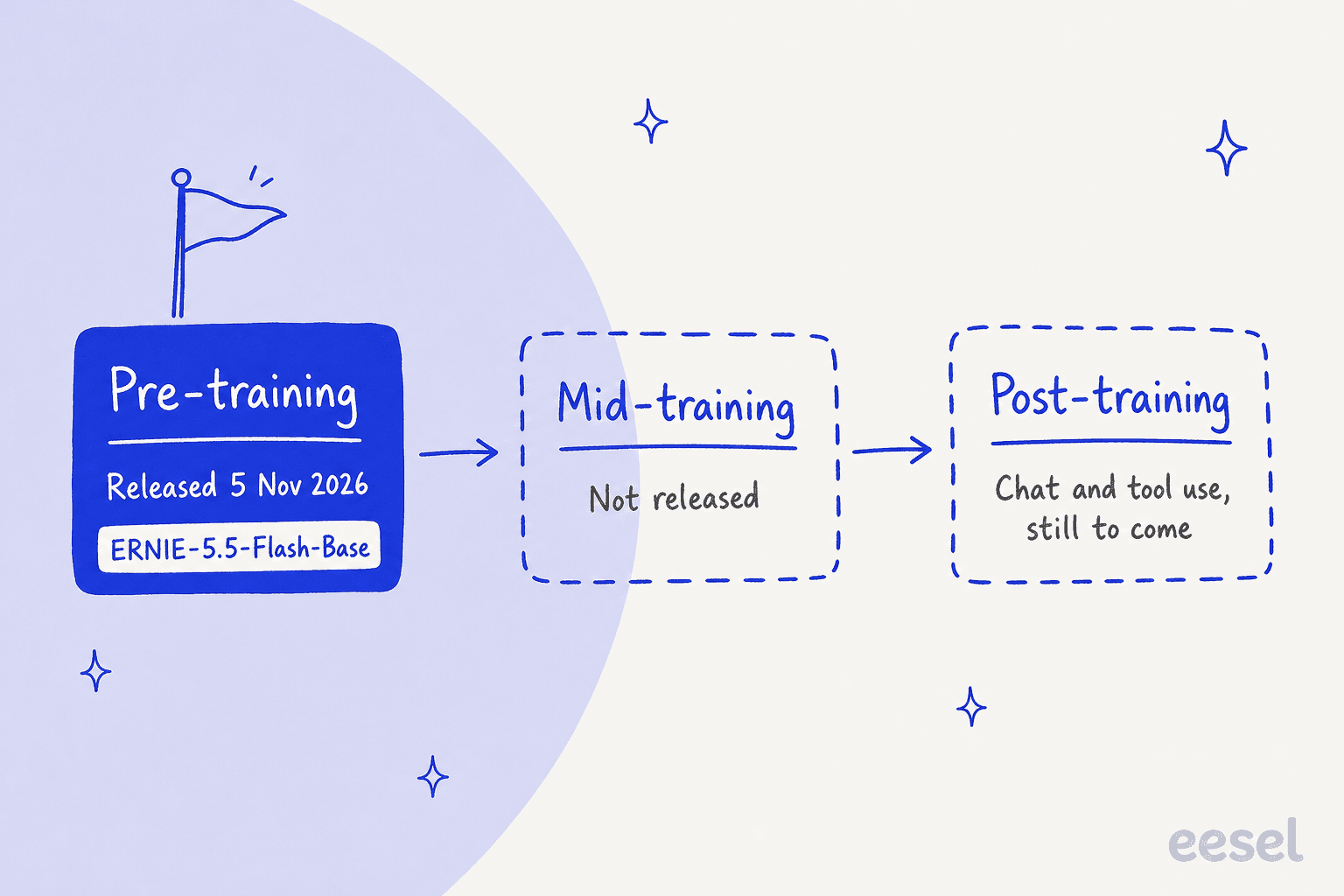
A post-trained model is the one that follows instructions, stays in a persona, calls tools and says no. Baidu's flagship line is separate: the ERNIE 5.1 release is dated 9 May 2026, and ERNIE 5.0 is a 2.4 trillion-parameter multimodal model. ERNIE 5.5 Flash is a different, efficiency-focused line, and for now only its raw ingredients are public.
One Hacker News commenter put the practical meaning plainly in the launch thread, which reached 162 points:
"It's not instruction finetuned, so no, it's not good to use for anything like coding agents."

What do ERNIE 5.5 Flash's benchmarks say?
On Baidu's table, the base model wins most rows. Baidu compared it with three other base models, DeepSeek-V4-Flash-Base (284B total, 13B active), Hy3-preview-Base (295B, 21B) and MiMo-V2.5-Base (310B, 15B), "all evaluated with the same pipeline, prompts and few-shot settings." Against DeepSeek, ERNIE scores higher on 26 of the 30 rows.
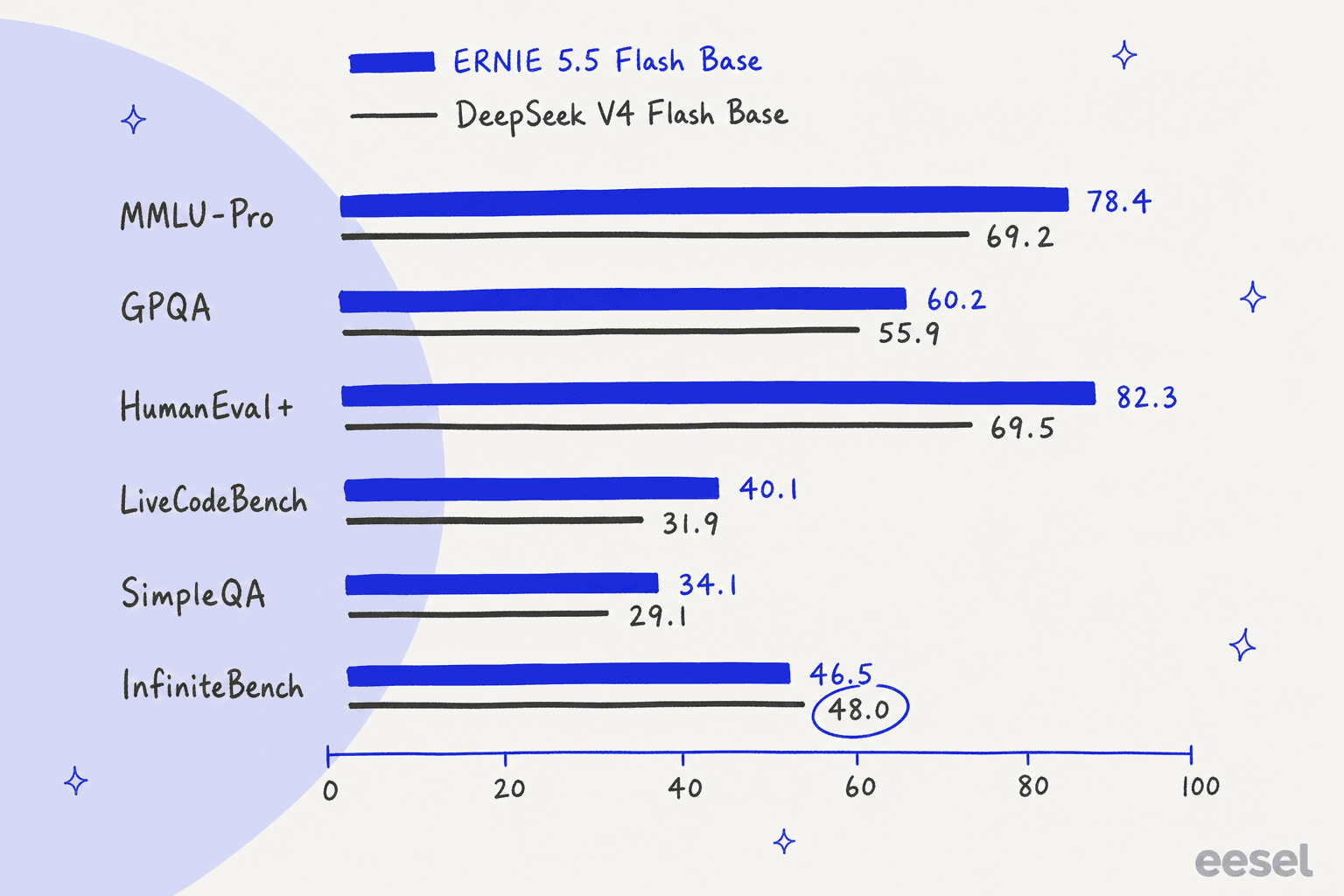
Here is a slice of the full table, including every row where ERNIE lost to DeepSeek:
| Benchmark | ERNIE 5.5 Flash Base | DeepSeek V4 Flash Base |
|---|---|---|
| MMLU-Pro | 78.4 | 69.2 |
| GPQA | 60.2 | 55.9 |
| HumanEval+ | 82.3 | 69.5 |
| LiveCodeBench | 40.1 | 31.9 |
| RepoQA (long context) | 91.7 | 81.0 |
| SimpleQA | 34.1 | 29.1 |
| ChineseSimpleQA | 73.0 | 75.3 |
| INCLUDE-lite (multilingual) | 79.5 | 79.8 |
| HELMET-Rerank (long context) | 56.2 | 60.0 |
| InfiniteBench (long context) | 46.5 | 48.0 |
Three reasons to hold these numbers loosely:
- They are Baidu's own runs. I could not find an independent evaluation. Artificial Analysis has no ERNIE 5.5 page yet.
- They are base-model tests. Few-shot knowledge and code benchmarks measure what pre-training built. They do not measure whether the model follows a system prompt or finishes a multi-step task.
- The rival is not the newest one. A Hacker News commenter noted that Baidu compared against the older V4 Flash base, "essentially two versions behind" the latest DeepSeek Flash.
"They're comparing it to Deepseek-v4-Flash, not 4.1 and not the 4.1 1017 update, so essentially two versions behind the latest version of Deepseek Flash."
The fair read is that pre-training looks strong, especially on code and knowledge, and that the long-context rows are mixed. Whether that survives post-training is the open question.
How much does ERNIE 5.5 Flash cost?
The weights cost nothing to download, and there is no Baidu API price to quote. The Hugging Face page said, when I captured it, that the model "isn't deployed by any Inference Provider," and I found no OpenRouter listing either.
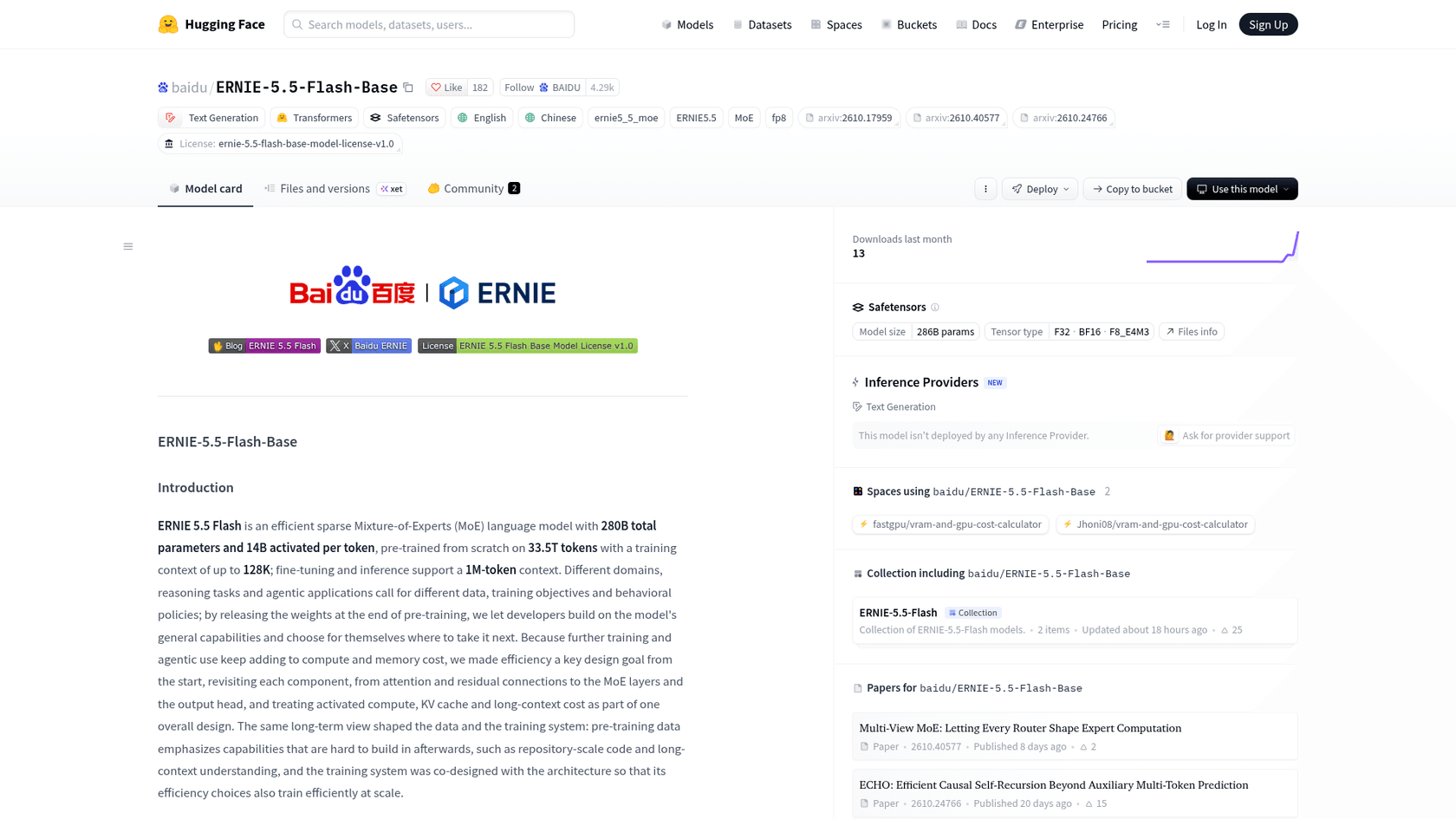
So the real cost is hardware and engineering. Hugging Face lists 286B parameters, and FP8 weights take about one byte each, so by my arithmetic you need roughly 286 GB just to hold the model before any KV cache. Baidu's own launch commands are set up for four-way parallelism: --tp 4 for SGLang and --data-parallel-size 4 for vLLM.
To see where that leaves you against hosted options, here is a stated workload: 10,000 support conversations a month, 3,000 input and 500 output tokens each, which is 30M input and 5M output tokens, with no caching and no reasoning tokens. Prices come from each vendor's own page.
| Model | Input / output per 1M tokens | Monthly bill for that workload |
|---|---|---|
| ERNIE 5.5 Flash | No hosted price published | Your own GPUs |
| Claude Haiku 5.5 (prompts up to 100K) | $0.10 / $0.50 | $5.50 |
| GPT-6 Luna | $0.10 / $0.50 | $5.50 |
| Qwen3.8-Flash (international) | $0.15 / $0.47 | $6.85 |
| DeepSeek V4.1 Flash (off-peak) | $0.15 / $0.60 | $7.50 |
| DeepSeek V4.1 Flash (peak hours) | $0.30 / $1.20 | $15.00 |
| Gemini 3.8 Flash (to 31 Dec 2026) | $0.75 / $3.75 | $41.25 |
Those are tiny bills. At this volume, hosted tokens will almost certainly cost less than running a multi-GPU server around the clock, though I have not priced the hardware. Self-hosting an open model pays off for other reasons, such as keeping data on your own network or training a model into your house style, and a fine-tune is exactly what a base model is for. Deeper pricing posts are at DeepSeek V4.1 Flash pricing and Claude Haiku 5.5 pricing.
Who is allowed to use ERNIE 5.5 Flash?
Fewer people than the word "open" suggests. The ERNIE 5.5 Flash licence is Baidu's own agreement, and four clauses matter in practice.
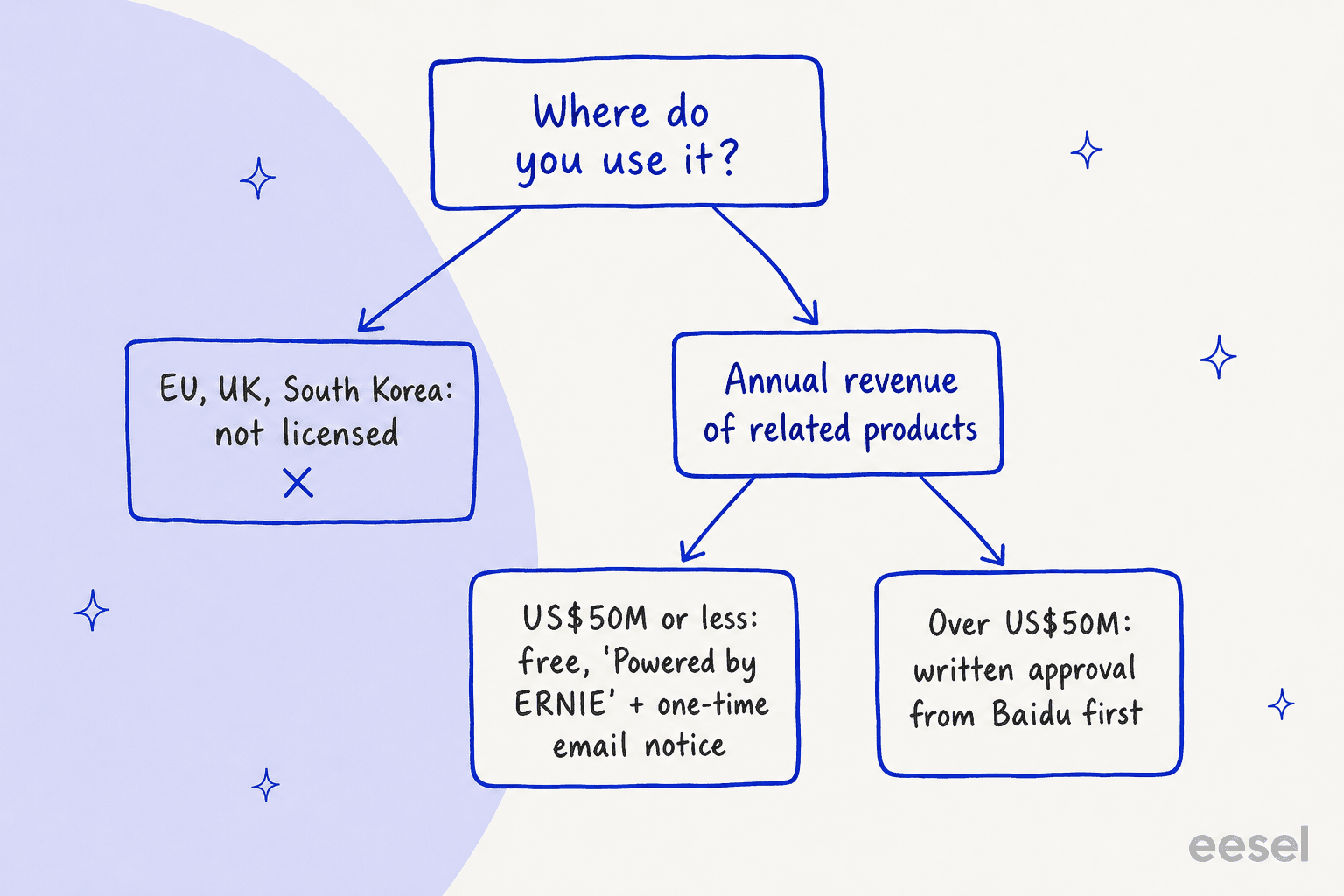
- Territory. The grant covers everywhere "other than the European Union, the United Kingdom and South Korea." Section 5.3 also bars using the model's outputs outside that territory.
- Revenue. Commercial use is free of licence charges up to US$50 million in annual revenue of the related product, counted across affiliates. Above that, you need Baidu's written authorization before you start.
- Attribution. A commercial product must display the exact words "Powered by ERNIE" in its interface, website or documentation, and you send Baidu a one-time notice by email.
- No distilling. Section 5.5 forbids using the model or its outputs to improve any other AI model, apart from the model's own derivatives.
Developers noticed. On Hacker News the licence was the main complaint:
"The license seems really restrictive for something intended to be built on. Entire countries are forbidden to use it at all (European Union, the United Kingdom and South Korea), and you are responsible for making sure no one in those places uses your derivative."
One commenter had a more relaxed read, arguing the exclusion is a way to avoid regulatory risk rather than something Baidu plans to police. Either way, if your customers are in Europe, it is your problem to solve, and the EU AI Act guide and data residency guide show how much weight that carries in support.
Fans of base models had plenty to like, too:
"Absolutely glad to see the release of a base model, I think the trend away from that has been an issue for the field."
How do you run ERNIE 5.5 Flash outside China?
You download the weights and serve them yourself, if your location is inside the licence territory. The weights are on Hugging Face and ModelScope in FP8, with a BF16 copy as well.
- SGLang: the prebuilt image is
lmsysorg/sglang:dev-ernie-55-flash, launched with--tp 4 --attn-dp-size 4. - vLLM: version 0.32.0 plus Baidu's vLLM-ERNIE plugin, with
--data-parallel-size 4. - Context: both servers accept up to 1,048,576 tokens, and the training context was 128K.
- Fine-tuning: Baidu points to a Megatron Bridge example from NVIDIA.
There is no hosted shortcut yet. If you only want a cheap, hosted Flash-tier model today, the table above is your shopping list, and the Qwen 3.8 Flash review covers one of them in depth.
Is ERNIE 5.5 Flash a fit for a helpdesk AI agent?
Not today. I would not put this checkpoint anywhere near a customer queue, for four reasons.
- It does not follow instructions yet. A support agent has to obey a system prompt, use guardrails, and know when to escalate. Those are post-training behaviours, and they are the part that is missing.
- There is nothing to call. No hosted endpoint means you carry the serving cost, the uptime and the security review yourself.
- The licence blocks European customers. A support team in Copenhagen or London cannot use the outputs under the grant as written.
- Nobody has measured it on support work. Baidu's table has no τ-bench-style policy-following test, no tool-use test and no hallucination rate.
The model is also the smaller half of the job. Even a perfectly post-trained version would still need a knowledge base, handoff rules, retrieval and a way to check replies before customers see them. That is the real cost behind build versus buy, and the reason a model alone never becomes a support agent. My short rule: this is the model; eesel is the employee.
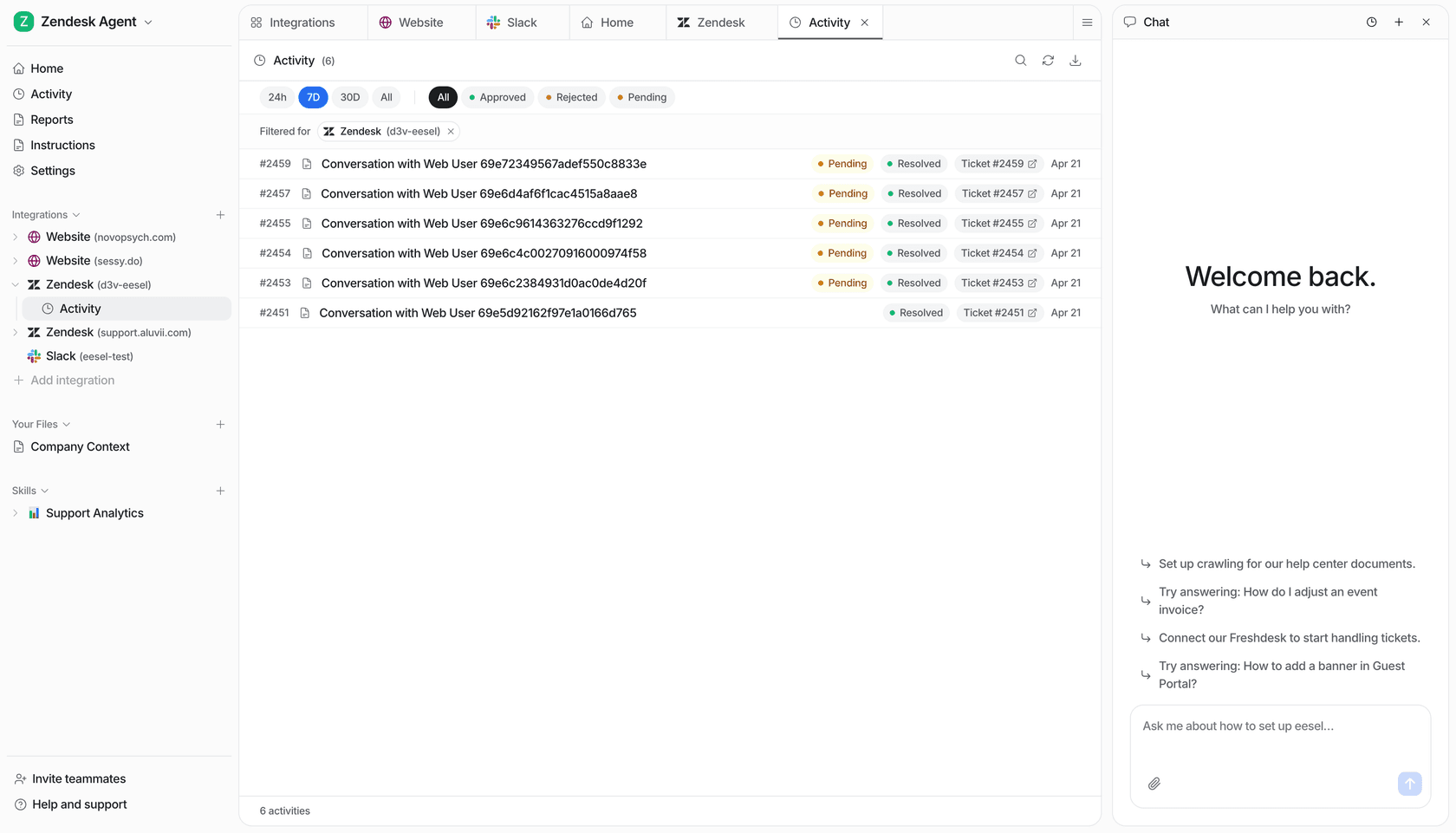
eesel is an AI teammate platform, and its AI helpdesk teammate joins the queue you already run in Zendesk, Freshdesk, Gorgias and others. eesel has spent years putting AI on live support queues, which is why every rollout is simulated against your historical tickets first. You read what the teammate would have said before it answers anyone.
Timengo, a Danish secure email company, runs eesel on Freshdesk. The teammate drafts replies in Danish from about 5,300 past tickets and help center articles, prepared 300 tickets in one month and wrote 180 draft replies. A support engineer reviews and sends every one, and eesel never sends on its own. SamCart runs one agent on Freshdesk tickets and another on website chat, both answering from about 280 help center articles. The ticket agent replies only while no person is assigned, and steps back once a teammate picks it up.
That "steps back" behaviour is the kind of thing a base model has not been taught. It is also why I would watch for the post-trained ERNIE 5.5 Flash rather than judge this release as an agent. When it lands, our guide to choosing an LLM for support and the best model for support tickets show what to test first, and hallucination prevention is the part that bites.
If you like working from a terminal, the eesel CLI is worth a look. With it, an AI coding agent can upload approved knowledge such as exported help articles and macros, edit the teammate's instructions, and ask test questions to check the answers before anything goes live. Connecting the helpdesk itself still needs someone with admin access to approve it. There is more in managing agents from the terminal.
Who should use ERNIE 5.5 Flash?
Here is my take after reading Baidu's blog, model card and licence in full:
- Try it if you are a research team or a company outside the EU, UK and South Korea that wants a strong, efficient base to fine-tune. A 14B-active mixture-of-experts model with a 1M context is a good starting point, and a base checkpoint is what you want for fine-tuning.
- Wait if you want a chat or agent model. Baidu has promised one without a date, and outside tests will tell you more than a vendor table.
- Skip it if you serve European customers, or if you only need cheap hosted tokens. DeepSeek V4.1 Flash, Claude Haiku 5.5 and GPT-6 Luna are ready today.
- Compare it with the other open models if you are shopping around: Kimi K3, GLM 5.3 Flash and Ripple-65B each trade differently on size, price and licence.
The summary I would give a colleague: ERNIE 5.5 Flash is a promising ingredient. The pre-training numbers are strong on Baidu's own table and the cost-saving design is real, but the chat model is missing and the licence has geographic limits.
Try eesel
If you came to ERNIE hoping a new open model would take tickets off your team, you can skip building the support layer yourself. eesel's AI helpdesk teammate plugs into Zendesk, Freshdesk, Gorgias and more in minutes, learns from your past tickets, and shows you how it would have answered them before it goes live. Plans start at $299 a month, and there is a free tier to test on.
Try eesel for free.