


Why Black Friday breaks even good support teams
The sales numbers get the headlines, but they're really a proxy for the ticket numbers that follow. Shopify's own BFCM 2025 recap reported $14.6 billion in sales across the weekend, up 27% year over year, from more than 81 million shoppers, with sales peaking at $5.1 million per minute. Nearly 95,000 merchants hit their single best sales day ever, on the same weekend, which means tens of thousands of small ecommerce support teams got hit with their biggest ticket day of the year simultaneously.
The knock-on effect on support inboxes is the part that actually breaks a small support team. Zendesk's own benchmark data shows retail ticket volume climbs about 42% during the holiday season, with tickets-per-agent up roughly 17% in the same window, and Shopify's own data cites a 79% average spike in the first week of December, right after BFCM promotions land. UncommonGoods is a clean before/after: 2,000 emails a week in a slow period, 2,400 emails a day at peak, an 8x jump that pushed the team from 20 full-time reps to 100 seasonal hires just to hold a 2-hour response time, the kind of gap a customer support automation layer is built to close.
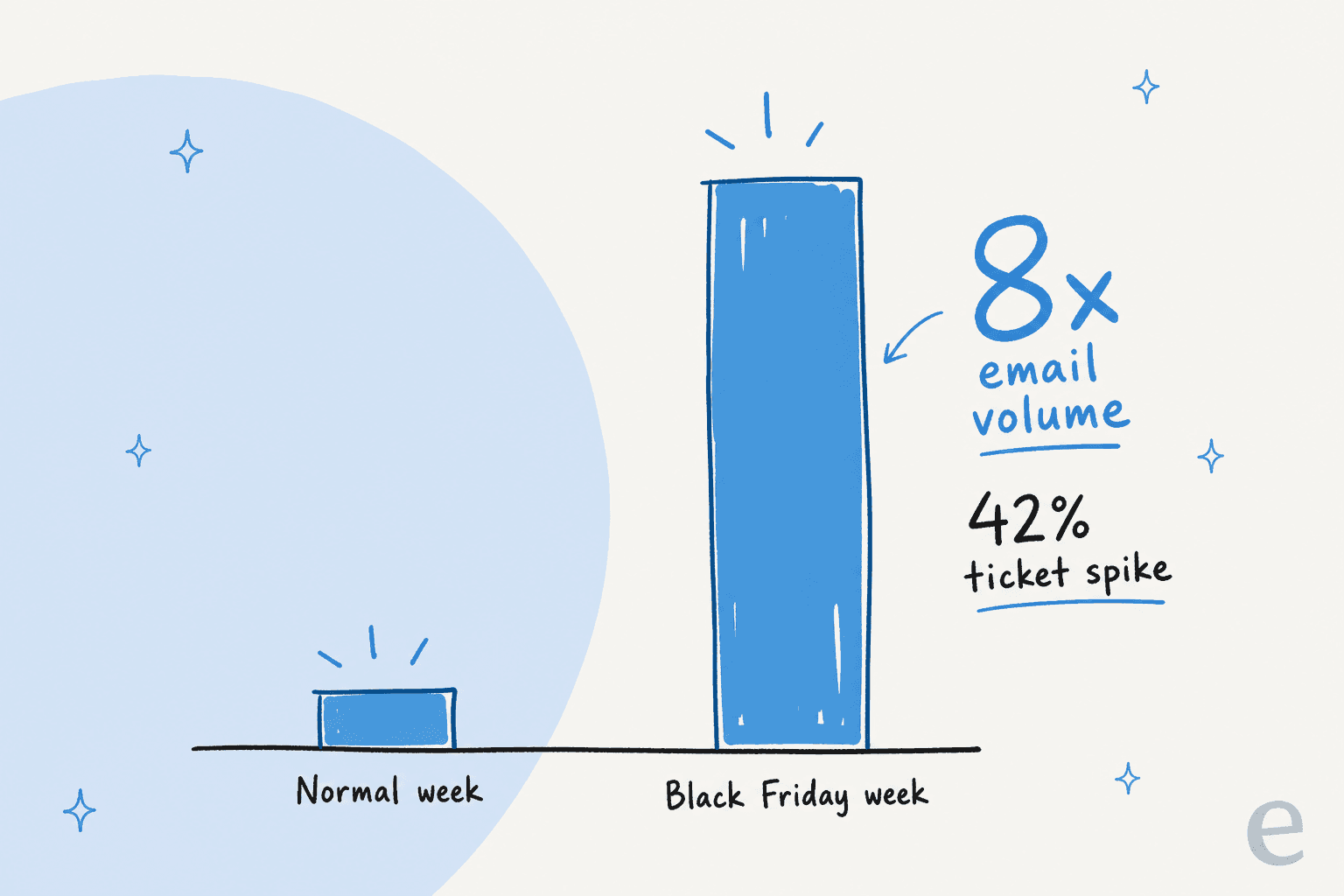
The gap between a normal week and Black Friday week, per Zendesk's holiday-season benchmark and UncommonGoods' own case data.
The consequence of not planning for that gap is measurable, not just anecdotal. Zendesk's own Benchmark data on travel companies (a similarly seasonal vertical) found CSAT dropped 11% between October and December, tracking almost exactly against a 96% jump in support requests over the same window. The companies that avoided the slump had a median of 11 active agents; the ones that struggled had a median of 3. Headcount, or its automated equivalent through Zendesk ticket automation or a similar AI agent, is the actual variable.
And the cost of getting it wrong is concrete. A named operator, Maurizio Isendoorn, posted on LinkedIn about a Black Friday where his store did $21M in sales alongside 847 unread support tickets, and had to refund $620K to existing customers once response times had degraded too far to save the relationships. That's not a small-team problem, that's a $21M-revenue-team problem, which tells you volume alone doesn't excuse it.
The four messages that eat the most time
Across every vendor's own BFCM guidance, the same four ticket types dominate the queue: order-status and delay questions, backorder/restock notices, refund and return requests, and the catch-all "where is my order" ping. Gorgias's own macro documentation lays out the standard skeleton ecommerce teams build for exactly this, the same skeleton a macro template library on any helpdesk should follow, and it's worth copying the structure even if you write your own wording.
Order delay and "not yet shipped" messages
The instinct is to apologize first. Don't. Lead with the concrete answer, then the apology if one's warranted:
"Your order is confirmed and being processed. Because of Black Friday volume, ship times are running 2-3 days longer than usual this week. You'll get a tracking number the moment it moves, no need to follow up before then."
Gorgias's own template set splits this into separate macros for shipped (pre-fills tracking and auto-tags the ticket), not shipped within the processing window (gives an expected ship date), and already shipped, can't cancel (explains the order moved before a change request landed). Three different templates for three different facts, tagged and routed the way Gorgias tags or Zendesk ticket views would organize them, because a single generic "we're on it" reply is exactly what generates the follow-up ticket that doubles your queue.
Backorder and restock notices
Gorgias's "item restocked" macro is built to be sent in bulk the moment a pre-ordered or out-of-stock item comes back, and it's commonly paired with a small discount code as a goodwill gesture for the wait. The separate pre-order/backorder macro sets expectations up front rather than leaving the customer guessing:
"This item is on backorder and expected to ship by [date]. Your card won't be charged again, this is the same order, we'll email tracking as soon as it leaves the warehouse."
Refund and return requests
This is the category where tone matters most, and the vendor data backs that up. Gorgias's own research found returning customers make up just 21% of a typical brand's customer base but generate 44% of its revenue, which is the actual argument against friction-heavy refund policies during a return surge. A refund reply that works:
"Your return is approved, no need to explain further. Refund will post to your original payment method within 5-7 business days, and here's your prepaid return label: [link]."
Gorgias's macro set breaks this into full refund, partial refund, and refund shipping cost as a goodwill gesture, plus a separate damaged item macro that requests a photo before committing to a resolution. Having three distinct refund macros ready before the rush means an agent (or an AI) isn't drafting refund language from scratch on ticket four thousand.
WISMO ("where is my order")
This is the highest-volume, lowest-value ticket type, and most of it is preventable. A support operator on Reddit described manual order-tracking replies as eating three hours of their day, mostly because Shopify already auto-emails tracking info the moment an order ships, meaning the ticket often duplicates information the customer already has sitting in their inbox. The fix is routing WISMO to self-service tracking first, and reserving a human (or AI) reply for the cases where tracking genuinely looks stuck. A chat bubble on the order-status page catches most of these before they ever become a ticket:
"Checked your tracking, it shows [status] as of [time]. Carriers are running behind industry-wide this week, but if it hasn't moved by [date + 2 days], reply here and we'll open an investigation with them directly."
Which Black Friday message do you need right now?
Click through the four scenarios above to jump straight to the template that matches your ticket.
Get ahead of it: proactive beats reactive every time
Every vendor's own BFCM playbook lands on the same conclusion, and it's worth taking seriously precisely because it shows up everywhere independently. Gorgias's Director of Support, Bri Christiano, put it plainly: publish your shipping cutoffs and return policy on the checkout page, in order confirmation emails, in your knowledge base, and in a site banner, all before traffic ramps, not during it. Gorgias's own data shows brands that push automation and self-service past 60% of volume nearly triple their ticket throughput while human agent hours grow only 6%, which is the efficiency case for building the FAQ layer, backed by real customer service automation, ahead of the rush rather than firefighting through it.
A good knowledge base tool is the actual infrastructure behind that FAQ layer, not a nice-to-have.
Zendesk's own holiday-rush guidance backs this with harder numbers: 60% of customers actually prefer self-service over talking to an agent, and Zendesk cites Le Tote cutting chat volume 60% while holding 94% CSAT just by adding a self-service widget, and Dollar Shave Club resolving up to 20% of tickets automatically with its Answer Bot. For the average retailer, Zendesk estimates that kind of deflection saves agents 6 hours and gives customers back 663 hours of collective waiting time, the same math behind most AI customer support savings arguments.
Klaviyo's own BFCM data adds the timing dimension: 24% of shoppers start buying before Black Friday itself, and the busiest send hour last year was 9-10am ET on Black Friday, with 420 million messages going out in that single hour. That means a shipping-cutoff message published on Black Friday morning is already late for a quarter of your customers.
Real staffing patterns from Shopify's own guide to holiday customer service, drawn from real CX leads, show this plays out operationally, not just in policy. Magnolia's former guest services manager, Sam Goff, described block-scheduling agents through batches of tickets rather than a free-for-all queue, the kind of workload view a help desk dashboard normally handles. Boll & Branch's former CX director, Lauren Donnelly, routes outsourced agents to the "easy wins" so internal staff can focus on the harder cases. And First Pier's founder, Steve Pogson, drafts all of December's messaging in advance specifically so the team isn't scrambling for wording mid-surge: "The goal is not to wait for the last minute but to have everything ready and scheduled."
The pricing trap: why per-resolution AI gets expensive exactly when you need it most
Here's a detail that doesn't show up until the invoice lands. If your AI ticket automation tool or AI customer service tool bills per resolution rather than on a fixed monthly plan, your bill scales against you exactly when volume spikes, which is the worst possible time for a pricing surprise.
I pulled this from a real cost comparison eesel's team ran for a prospect evaluating per-resolution pricing against a flat-rate model. At 1,000 tickets a month and an 80% resolution rate, the per-resolution model came out to $792 a month. Scale that same 80% resolution rate to a realistic Black Friday month of 4,000 tickets, and the bill jumps to $3,168, a 4x cost increase tracking the 4x volume increase, with no ceiling.
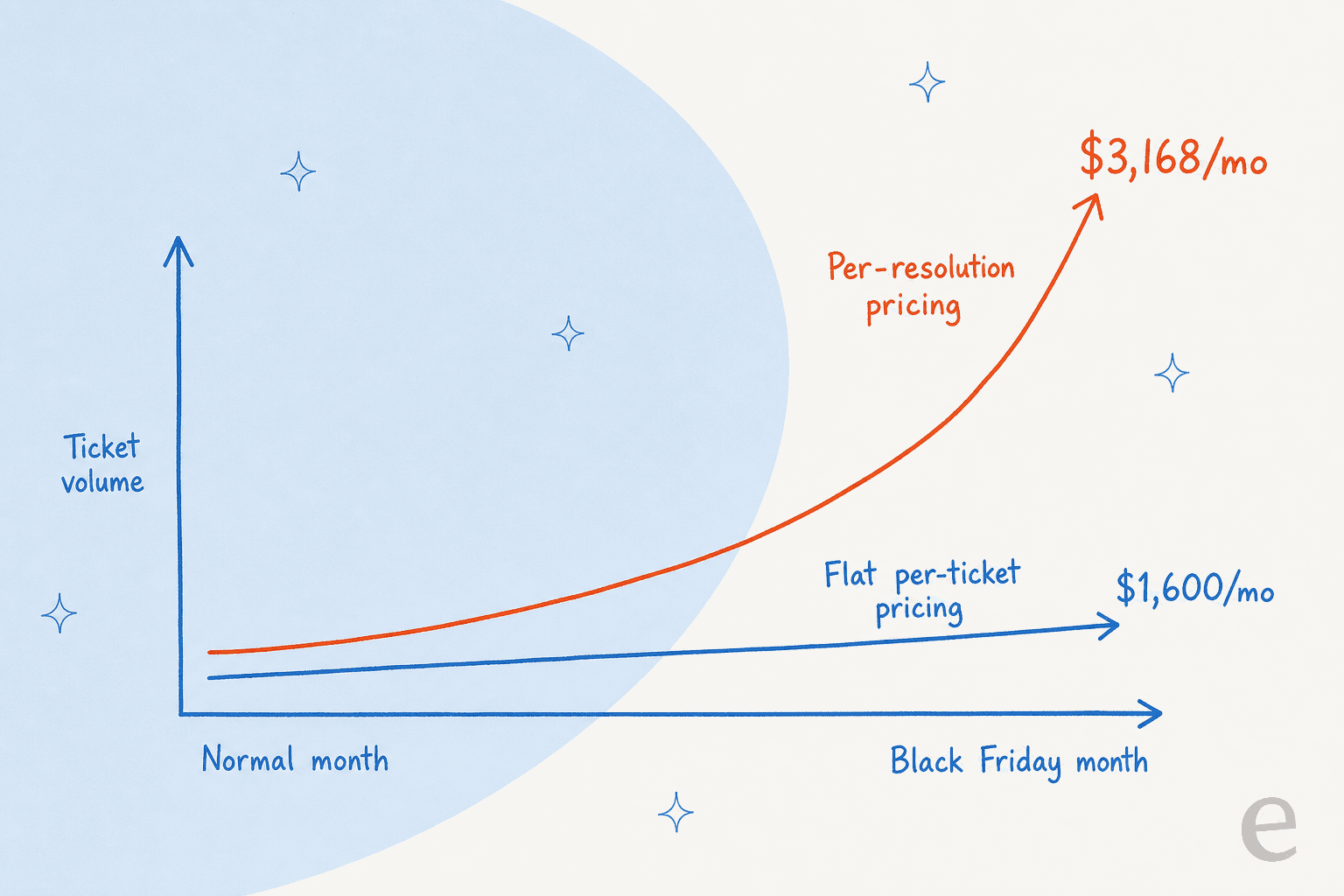
Same volume spike, two billing models: per-resolution pricing punishes the exact month you can least afford a surprise invoice.
This is exactly why eesel's own pricing is a fixed monthly plan, with 1 credit per ticket or chat session, no platform fee and no per-seat charge, an approach worth comparing against any helpdesk AI roundup that only quotes the sticker price. A normal 1,000-ticket month is the $499 plan, and the same 4,000-ticket Black Friday month is the $1,899 plan, roughly 60% of what the per-resolution model charges at the same volume, and you can move back down after the spike.
One eesel customer running a DTC supplements brand with seasonal products through Gorgias and Shopify, doing roughly 7,000 tickets a month with a high season running November through May, put the underlying concern this way when evaluating automation: "I need an AI who is only handling the tickets that it's confident to handle and all the other ones, leave them alone." Predictable pricing and predictable AI chatbot behavior turn out to be the same ask.
How AI actually handles the surge without losing the personal touch
The honest failure mode with automation isn't that it answers wrong, it's that a bad answer at scale is worse than a slow answer at scale. That's the thing I've watched break trust fastest in three-plus years of putting an AI agent on live support queues: a bot that answers confidently and incorrectly does more damage than one that says nothing, the same failure mode covered in this AI chatbot troubleshooting guide. Gorgias's own CEO, Romain Lapeyre, makes the same point in Shopify's guidance: a bot-answered ticket shouldn't be treated as automatically closed, the team should still verify the reply landed correctly, ideally with a clean AI-to-human hand-off.
The fix eesel's customers actually use is confidence-based routing: the AI answers immediately when it's confident, and hands off to a human when it isn't, instead of guessing either way.
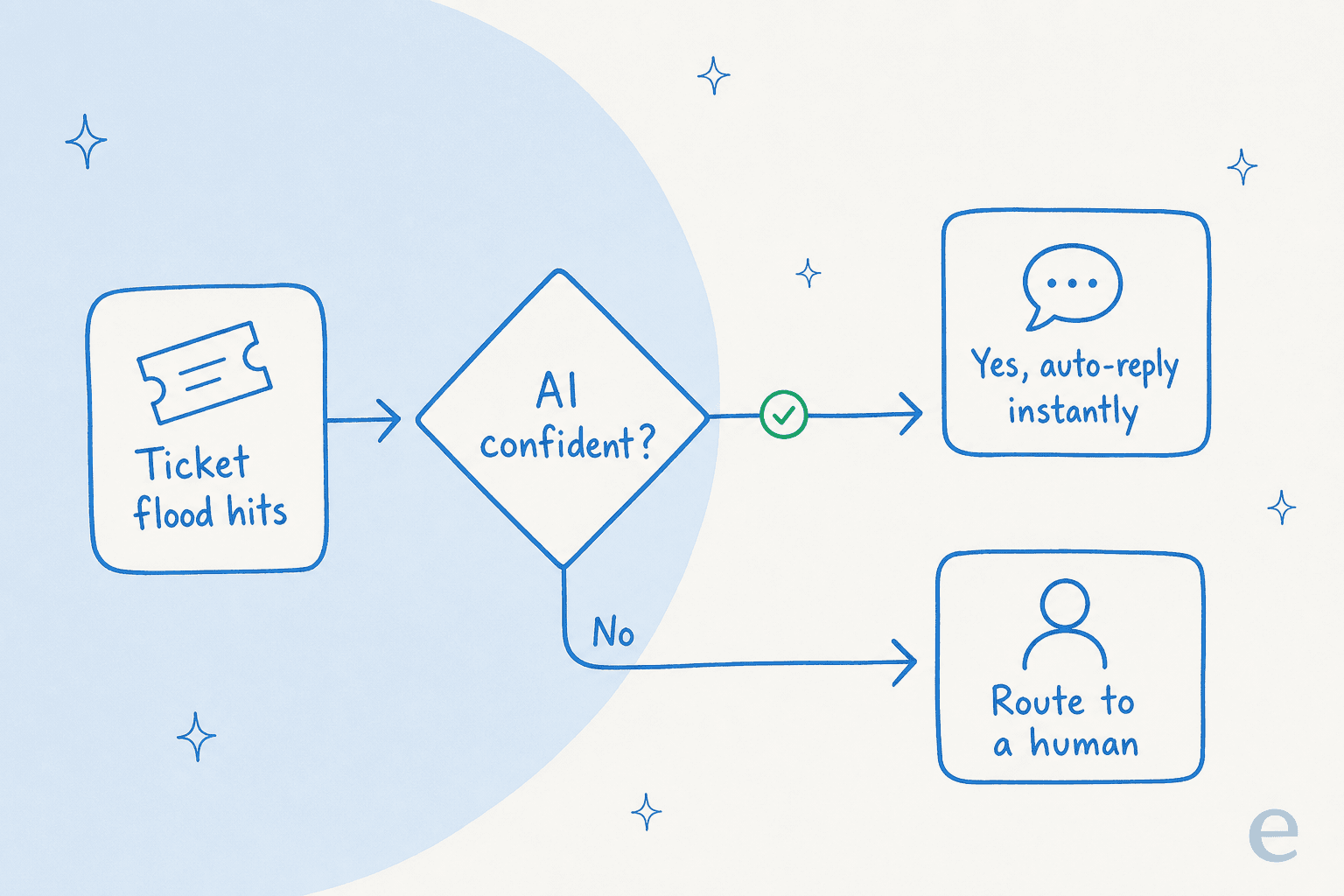
Confidence-based routing: the mechanism that lets automation scale during a ticket flood without guessing on the tickets it shouldn't.
This isn't a theoretical workflow. Gorgias's own BFCM customer story with Cornbread shows what it looks like in production: ticket volume doubled year over year during BFCM 2025, and the AI Shopping Assistant handled 400% more tickets than the prior year while cutting first response time from over two minutes down to 21 seconds, and CSAT held flat despite the volume, the exact kind of result covered in this ecommerce AI roundup. On G2, an ecommerce brand described its peak-season load as "500+ daily queries across time zones" before adopting an AI support tool that cut response time from 8 hours to 3 minutes and resolved 91% of tickets automatically, letting the brand shrink its support headcount from 8 people down to 2-3 even at peak volume, a trade-off worth weighing in any AI vs. human agent cost comparison.
Salesforce's own Shopping Index found the same shift at a much larger scale: agentic customer-service conversations grew 55% week-over-week during UK Cyber Week 2025, and the volume of AI agent actions, updating delivery addresses, initiating returns, surged 70% in the same window, taking that administrative load off human teams entirely.
Before any of that goes live, though, the step that actually earns trust is testing it against real history first. This is the part of the process I'd never skip: run the agent against your last 1,000 real tickets before Black Friday, not during it, and see exactly where it's strong (WISMO and refund status tend to score highest) and where it needs a human backstop (anything touching a policy exception or an angry repeat customer). That's the same simulation-first approach behind eesel's helpdesk agent, distinct from a generic AI helpdesk software pick that skips the testing step, and it's the reason a rollout on November 20th doesn't feel like a live experiment on November 28th.
"The AI will never be able to answer 100% of the questions, but if it tries and just answers 'sorry I don't know this,' I cannot go and check all my 7,000 tickets to see if the AI actually made a good answer. I need an AI who is only handling the tickets that it's confident to handle and all the other ones, leave them alone."
- a CX lead at a DTC supplements brand running ~7,000 Gorgias tickets a month through its high season
Staffing math: how many agents (or how much AI) you actually need
Gorgias's own forecasting method is straightforward: estimate this year's order volume using last year's BFCM numbers plus growth trends, multiply by your historical contact rate to get expected ticket volume, then divide by tickets-resolved-per-agent to find the gap. Gorgias uses 40-60 resolved tickets per agent per day as the healthy benchmark.
Run that math against UncommonGoods' real numbers: a jump from 2,000 weekly emails to 2,400 daily emails is roughly 16,800 tickets a week at peak versus 2,000 in a slow week, an 8x increase that the team met with a 5x staffing surge, from 20 full-time reps to 100 seasonal hires. Zendesk's own workforce-management research warns that understaffing during peak season can drive customer defection to competitors as high as 65%, which is the real cost of under-forecasting this math, and the reason AI customer support cost savings get evaluated against seasonal hiring rather than year-round headcount.
Seasonal hiring at that scale isn't realistic for most small support teams, whether they run on Zendesk, Gorgias, or Help Scout, and it's also the reason a growing share of that gap gets closed with automation instead of headcount, per the deflection numbers cited above from Gorgias, Zendesk, and Salesforce. Either way, the forecasting exercise is the same: know your multiplier before the multiplier hits your Shopify support inbox, not after.
Try eesel for Black Friday
I've spent three-plus years watching AI run on live support queues at eesel, and the pattern that shows up every November is consistent: teams that pre-build their WISMO, backorder, and refund templates, then let an AI agent handle the volume with confidence-based routing, come out of Black Friday with flat CSAT and a predictable bill. Teams that scramble mid-surge get the $21M-in-sales, 847-unread-tickets outcome instead. Paper Culture, an ecommerce brand, runs nine separate AI bots through eesel specifically to smooth out its own seasonal support fluctuations, which is the same problem this post is about.
eesel's helpdesk agent plugs into Gorgias, Zendesk, and Shopify, along with channels like Help Scout and WhatsApp. It learns from your past tickets and macros before it ever answers a live one, and uses fixed monthly plans from $299 for 500 credits (1 credit per ticket or chat), no platform fee, no seat charge, so a 4x Black Friday month means moving up a plan, not a pricing penalty stacked on top.
You can simulate it against your own ticket history before go-live, which is exactly the step that turns "we hope this works during the rush" into "we already know where it's strong." Tulipy runs four separate ecommerce brands through the same setup, and Brytesoft automates its Zendesk support for software-key sales at similar scale, both proof this holds up outside a single storefront.
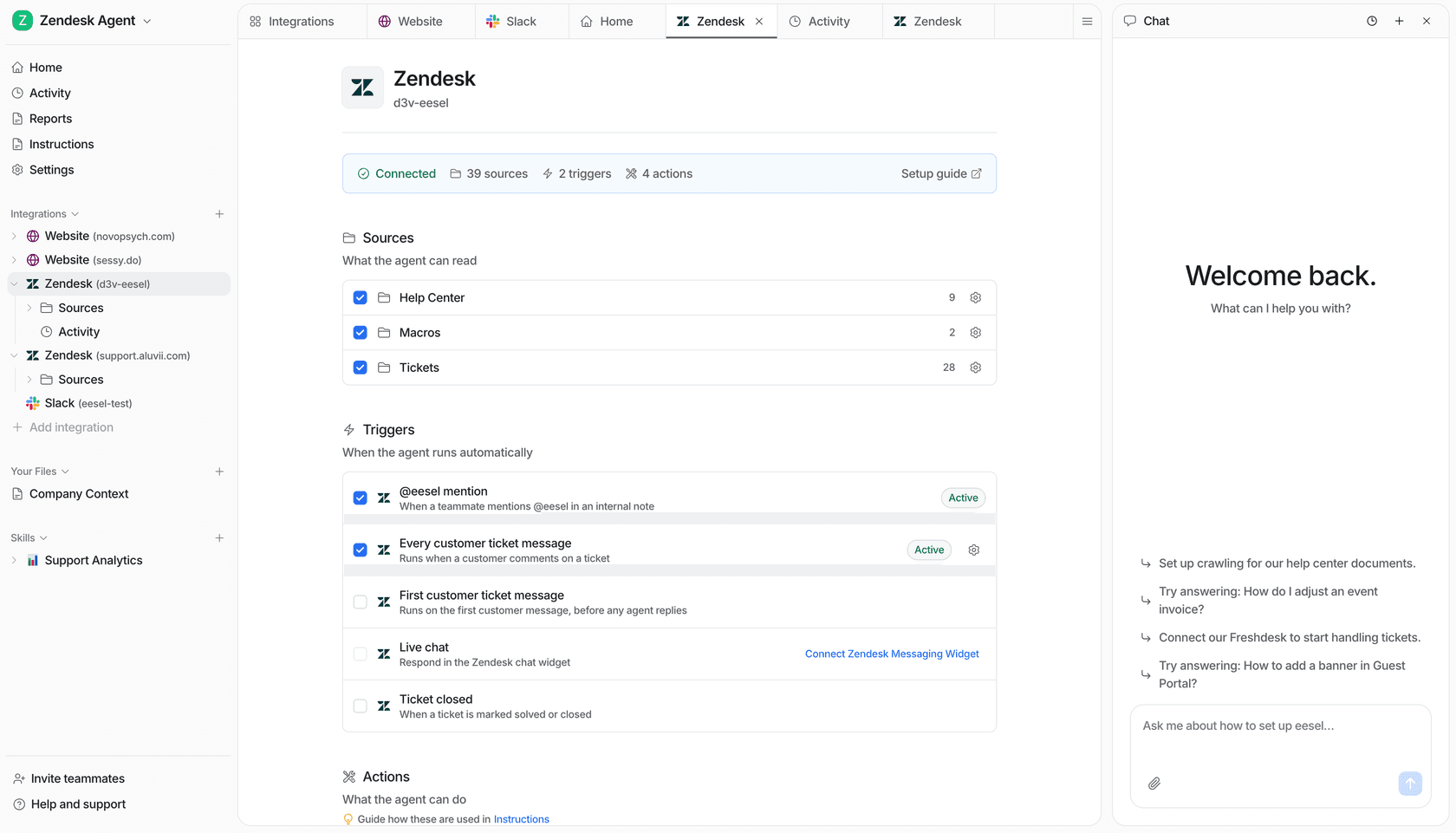
The eesel dashboard, showing a connected Zendesk integration syncing ticket activity, as taken from eesel.
If you're on Shopify or Gorgias and doing anywhere close to a few thousand tickets a month, worth trying before the next spike hits rather than during it.