What "generative AI in retail" actually means
For years, "AI in retail" meant recommendation engines and rule-based bots. A recommendation engine matched products to browsing history. A rule-based chatbot walked shoppers down a scripted decision tree: "Press 1 for orders, press 2 for returns." Useful, but rigid. The moment a shopper phrased something off-script, the bot dead-ended.
Generative AI is a different mechanism. Instead of matching against fixed rules, a large language model reads free text, understands intent, and generates a response, whether that's a product recommendation, a paragraph of copy, or an answer to a support question. It doesn't need every path scripted in advance. That's the shift, and it's why the old AI agent vs rule-based chatbot comparison matters so much for retail teams deciding what to buy.
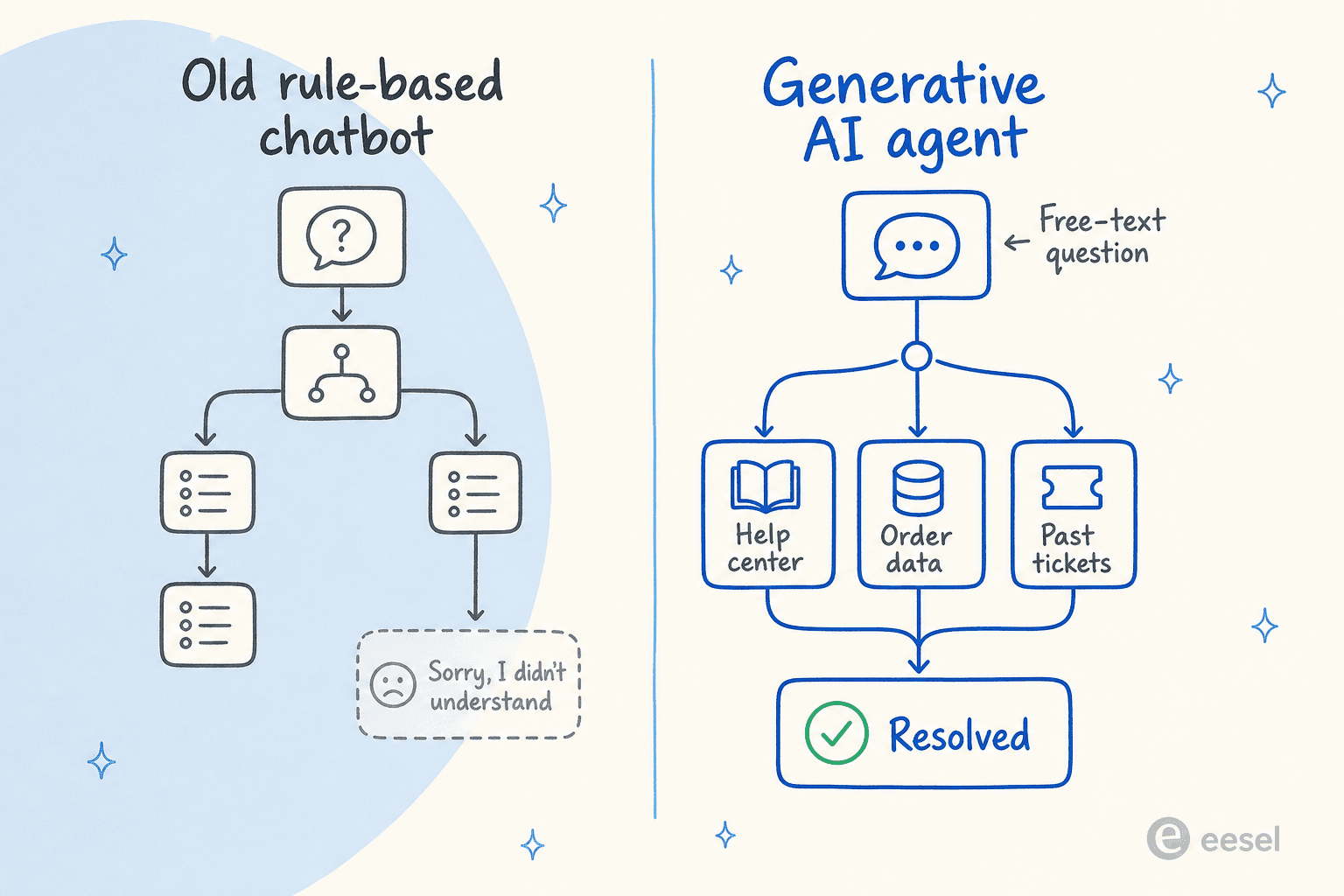
The practical upshot: a generative agent can handle the long tail of oddly-worded questions that a scripted bot never could, because it reasons about the question instead of matching keywords. For a retail catalog with thousands of SKUs and endless edge cases, that's the whole game.
Where generative AI shows up across retail
Generative AI is touching most corners of a retail business now. It's worth mapping them before zooming in, because they don't all deliver the same return.
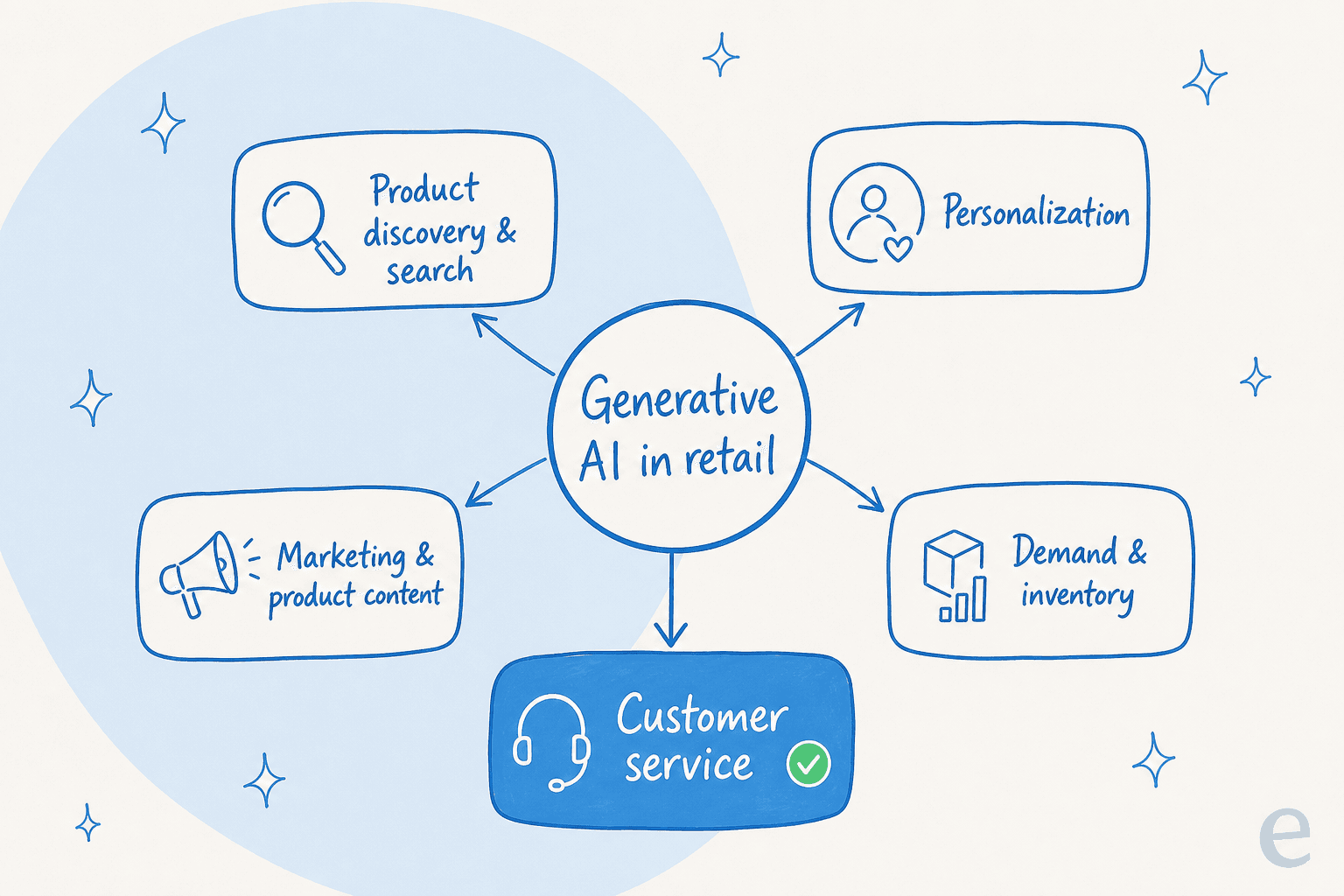
- Product discovery and search. Natural-language search and AI shopping assistants let shoppers ask "a warm jacket for a rainy hiking trip under $150" instead of clicking through filters. Shopify's own shopping assistant guide is one flavor of this.
- Personalization. Generative models write tailored recommendations, email subject lines, and on-site copy per segment. This is conversational commerce creeping into every touchpoint, and part of the broader benefits of conversational AI.
- Marketing and product content. Drafting product descriptions, ad copy, and blog posts at catalog scale. Real, but it's a content-efficiency play, not a revenue engine on its own.
- Demand and inventory. Forecasting and merchandising assistants that summarize sales patterns in plain language.
- Customer service. The one I'd bet on first. It's measurable, the tickets are repetitive, and the ROI shows up in weeks, not quarters. Automated support ticket triage makes the returns easy to prove to a skeptical boss.
The reason customer service leads isn't hype. It's that support is where retail has clean, high-volume, repetitive work sitting next to a clear knowledge source (your help center) and a clear system of record (your orders). That's the ideal shape for a generative agent.
Zooming in: retail customer service automation
This is where I live, so let me be specific about what generative AI actually does on a retail queue, and where it earns its keep.
A huge share of ecommerce tickets are the same handful of questions: where's my order, I want to return this, my refund hasn't shown up, is this covered under warranty, do you ship to my country. A generative AI customer service chatbot can resolve most of those end to end, because the answer lives in data it can reach: the order record in Shopify, the policy in your help center, the pattern in your past tickets. It's the same engine whether you call it a Shopify helpdesk or an ecommerce AI chatbot.
Here's the honest part, and it's the thing every AI vendor glosses over. As one DTC supplements CX lead put it during a call with us:
"The AI will never be able to answer 100% of the questions. I need an AI who is only handling the tickets that it's confident to handle, and all the other ones, leave them alone."
That's exactly right, and it's the whole design principle. The value isn't a bot that answers everything. It's a bot that answers what it's sure of and gets out of the way on the rest. When we ran a trial with a German jewelry ecommerce brand (Zendesk plus Shopify, ~1,000 tickets a month across eight languages, handled without anyone prompting it per-language), the draft usefulness broke down like this: returns and refunds 93.8%, warranty claims 96.4%, product inquiries 100%, refund status 100%. Triage accuracy was 93%, and spam detection was 100% with zero false positives on an inbox that was 22% spam.
None of those numbers require the AI to be a genius. They require it to be reliable on the boring stuff and honest about its limits. That combination is what makes ticket triage and order-related chat the fastest-paying corner of generative AI in retail. Plenty of companies already use AI for customer service this way.
How a generative retail agent actually works
If you're going to trust an AI with customer-facing replies, it helps to know what happens between the shopper's message and the response. It's less mysterious than it looks.
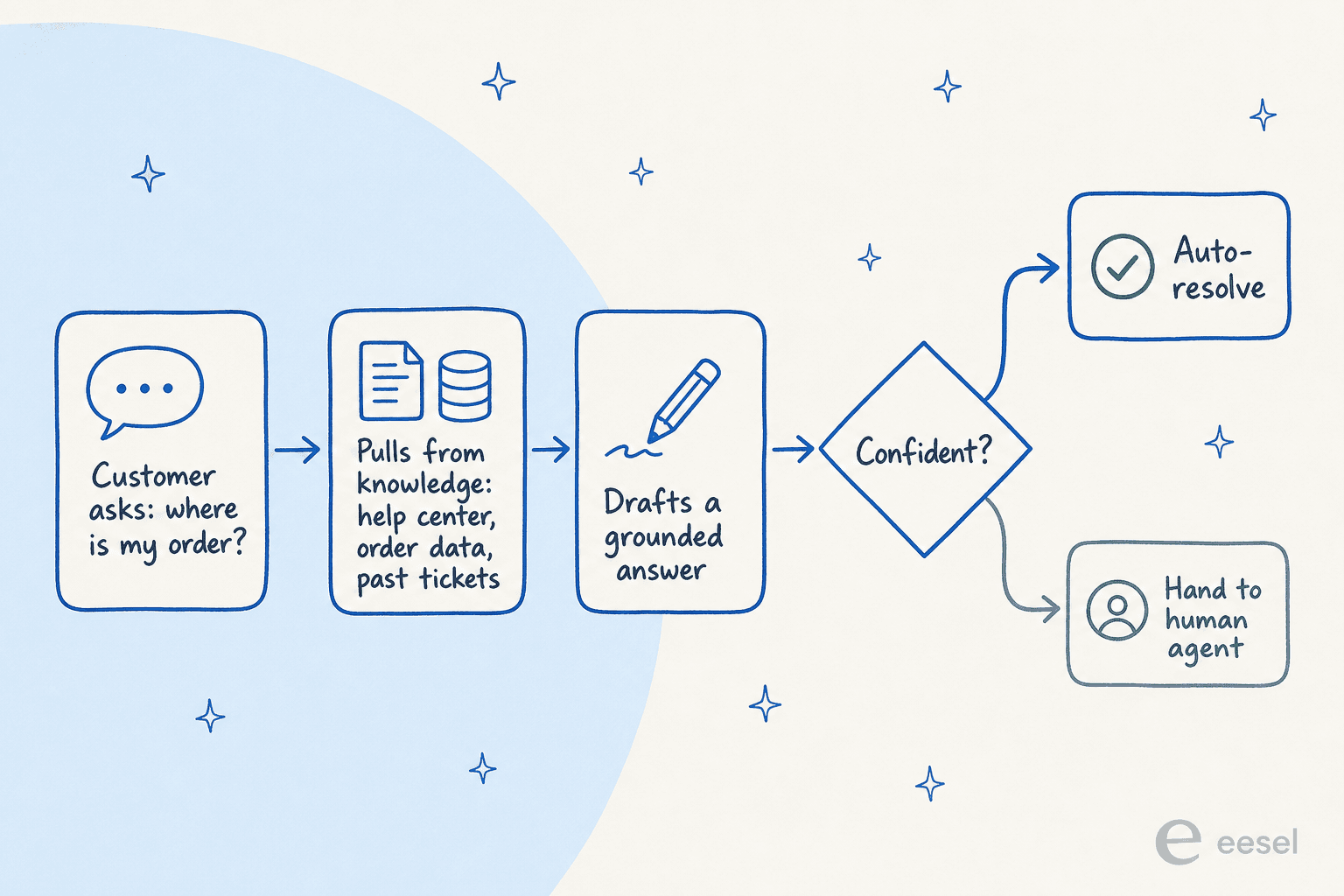
The agent reads the shopper's question, then retrieves the relevant facts from its connected sources: your knowledge base, the live order data, and your history of past tickets. It drafts an answer grounded in those facts (this retrieval step is what keeps it from making things up), then it checks its own confidence. High confidence, it resolves. Low confidence, it hands off to a human with the context attached. This is the mechanism behind good conversational AI for retail, and it's why training on your own knowledge base matters more than any model choice.
The knowledge piece is doing the heavy lifting. A generative model with no access to your data is just a confident stranger. The same model wired into your help center and order system is a teammate who actually knows your policies. That's the difference between a gimmick and something you'd put in front of paying customers, and it's why we always tell teams to think about their knowledge sources first.
Getting it right (and where it goes wrong)
I've seen enough rollouts to know the failure modes. Here's what separates the retail teams that get real value from the ones that quietly switch the AI back off.
Don't let it answer everything on day one. The single biggest objection I hear from retail buyers is control, and they're right to raise it. A confident-sounding bot giving wrong return policies is worse than no bot. The fix is boring: scope what the AI is allowed to auto-handle, exclude the ticket types you're not ready for, and widen the scope as trust builds. This is why we simulate every rollout against a store's historical tickets before it ever touches a live customer, so you can see the resolution rate and catch bad answers safely.
Plan for seasonal spikes. Retail volume isn't flat. A flower-delivery brand we work with does most of its year around Valentine's and Mother's Day; a supplements brand peaks November through May. Generative AI shines exactly here, because it absorbs a spike without you hiring temp agents, but only if you've validated it on the categories that spike. It's elastic capacity you don't have to staff up for, which is a big part of the Shopify AI pitch for seasonal stores.
Watch the total cost, not the sticker. Per-message and per-resolution pricing create anxiety and punish you for busy months. Usage that maps to something you already count (a ticket) is predictable. eesel is $0.40 per ticket with no seat fee, which is how that Shopify sleepwear brand lands around $1.07 per ticket at ~700 tickets a week. Run your own AI agent vs human agent cost math before you commit, and be wary of any model that charges you more for a good month.
Don't over-build. Plenty of teams reach for "we'll build our own on the raw model API." As one customer told us about that path, they didn't want something they'd "have to maintain." For most retail teams, build vs buy tilts hard toward buy, because the hard part isn't the model, it's the integrations, the confidence routing, and the reporting.
Try eesel for retail support
If the support queue is where you want to start (and I think it should be), eesel is a generative AI agent built for exactly this. It plugs into Shopify, Gorgias, and Zendesk, reads your help center, order data, and past tickets, and resolves the repetitive questions while routing the rest to your team. You can simulate it on your own historical tickets first, so you see the resolution rate before it answers a single real customer. It's usage-based at $0.40 per ticket, no per-seat fee, free to try.

Generative AI in retail is going to keep spreading into search, personalization, and content. But if you want a use case you can measure this quarter, the ecommerce helpdesk is where the payback is real and the risk is controllable. Start there.
Frequently Asked Questions
What is generative AI in retail?
How is generative AI different from a normal retail chatbot?
What can generative AI do for ecommerce customer service?
Will generative AI give shoppers wrong answers?
How much does generative AI for retail support cost?
Do I need to replace my helpdesk to use generative AI?
How do I train a generative AI agent for my store?



Article by
Riellvriany Indriawan
Riell is a designer and writer at eesel AI with about two years of experience researching CX platforms, AI chatbots, and helpdesk software. She combines her design background with a sharp eye for how these tools actually look and feel in practice — making her comparisons unusually visual and user-focused.