


What "retail customer service AI" actually has to do
Before any shortlist, it's worth being honest about the job. Retail support isn't open-ended conversation. It's a small set of very high-volume, low-value tickets repeated thousands of times, and AI in customer service only earns its keep in retail when it handles these end to end:
- WISMO ("where is my order?") the single biggest ticket type in ecommerce. Agents burn 60-70% of their time on it, per Salesforce, and it's unanswerable without live tracking data.
- Returns and refunds shoppers want to start a return, check refund status, or swap a size.
- Stock and product questions "is this back in the black, medium?" needs the live catalog.
- Order changes cancel, change address, add an item before it ships.
Notice what every one of those has in common: the answer lives in your store, not your FAQ. That's why a generic customer service chatbot trained only on help articles falls flat in retail. It can explain your return policy, but it can't tell a specific shopper where their specific parcel is.
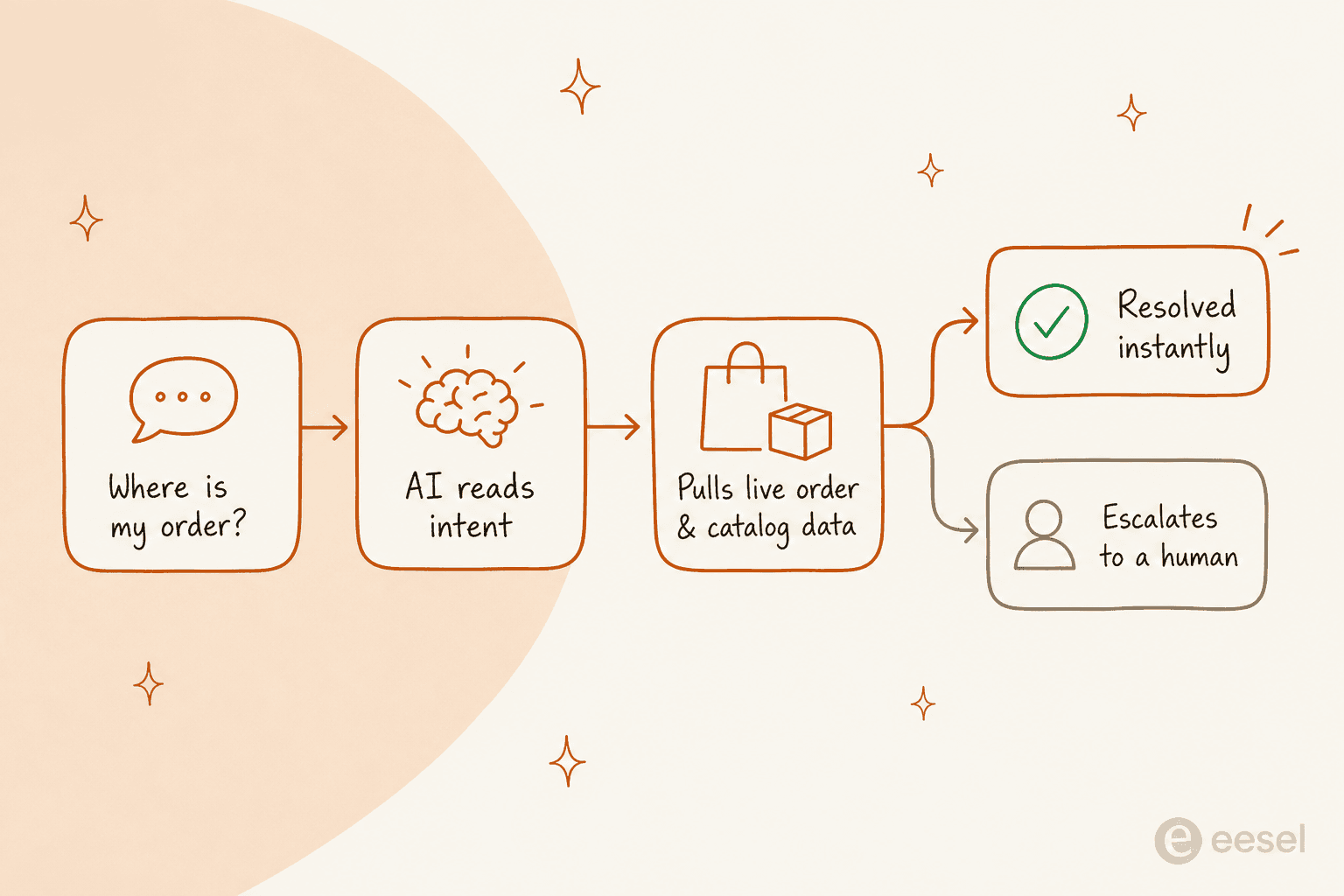
The other half of the job is knowing when to stop. A shopper who's already frustrated about a late order does not want to argue with a bot, so the handoff to a human matters as much as the answers. One anonymized DTC lead I've seen put the whole thesis in one line:
"The AI will never be able to answer 100% of the questions. I need an AI who is only handling the tickets that it's confident to handle, and all the other ones, leave them alone."
a DTC supplements CX lead
That's the bar. Confident on the routine stuff, honest about the rest.
What separates a good retail AI from a bad one
Once you've looked at enough of these, the buying criteria collapse into a short checklist. If a tool misses the top two, it doesn't matter how good the marketing page looks, it will fail on your busiest day.
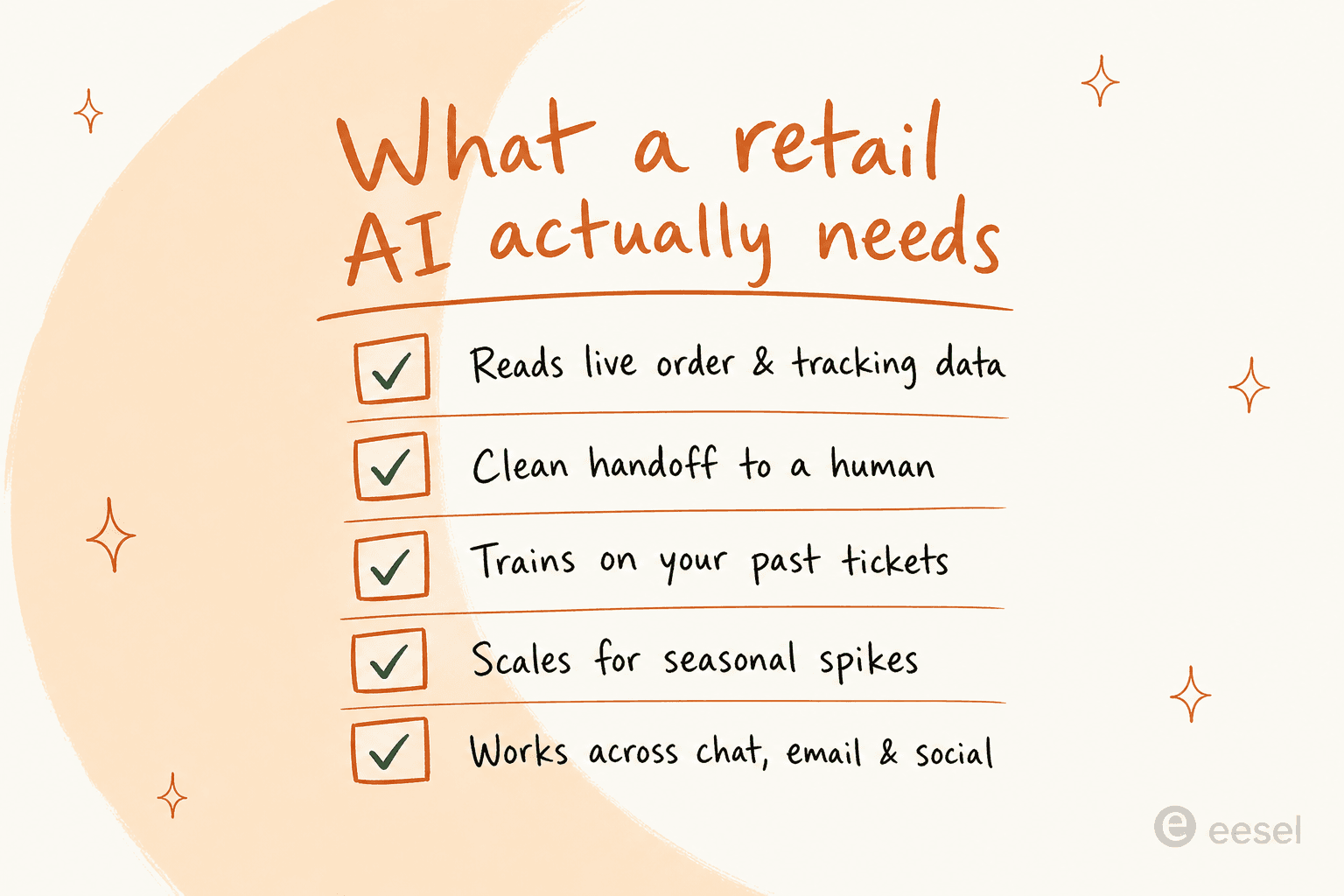
- Reads live order and catalog data. Non-negotiable. This is the whole difference between answering WISMO and deflecting it into a queue. Check that it connects to your store, not just your help center.
- Trains on your past tickets. Your historical tickets already contain the right answers, phrased in your voice. A tool that trains on that history is accurate on day one; one that starts from a blank prompt guesses.
- Clean human handoff. It should escalate the moment confidence drops, with the full context attached, rather than looping the shopper.
- Scales for seasonal spikes. Black Friday is exactly when your team is drowning and your AI has to hold. Per-seat tools punish you here; usage-based ones flex.
- Works across channels. Chat, email, and increasingly WhatsApp and Instagram DMs. Retail conversations don't stay in one box.
The trap most stores fall into is picking on tone and conversational polish, which every modern tool now has, and skipping the boring plumbing that actually determines resolution rate. As one shopper vented on r/CustomerService:
"A lot of companies seem to have taken their old, crappy, non-LLM chat bots that have been around for decades and tried to convince everyone that they're now 'AI' bots capable of doing more than just performing a horribly word-stemmed search of their never-updated customer help database."

The lesson: judge these on whether they can see your order data, not on how nicely they say hello.
The best AI for retail customer service in 2026
Here's the shortlist, sorted roughly by how well each fits a typical online store. The table lays out the deciding dimensions, then I'll give a short verdict on each.
| Tool | Best for | Billing model | Reads live store data | Trains on past tickets | Free trial |
|---|---|---|---|---|---|
| eesel | Most stores; works on top of any helpdesk | From $299/mo (500 credits), no per-seat | Yes (Shopify, WooCommerce, helpdesk) | Yes | Yes |
| Gorgias | Shopify-native stores already on Gorgias | AI Agent included on every plan, billed per automated interaction on top of ticket-volume plans | Yes (Shopify-native) | Partial | Yes |
| Freshdesk (Freddy) | Teams standardized on Freshworks | Per-seat + session-metered Freddy | Via apps | Partial | Yes |
| Zendesk AI | Larger teams already on Zendesk | Per-seat + per-automated-resolution add-on | Via apps | Partial | Yes |
| Shopify (Sidekick / Inbox) | Tiny stores wanting free & native | Bundled with Shopify plan | Yes (native storefront) | No | With plan |
| Ada | Enterprise, multilingual at scale | Quote-only, resolution-based | Via custom build | Yes | Demo-gated |
| Tidio (Lyro) | Small stores on a budget | Conversation-based tiers | Limited | Partial | Yes |
A few notes before the verdicts. I've deliberately left the price column as a billing model rather than a single sticker number, because the unit is what actually bites you. Per-resolution vs per-conversation vs per-seat are not the same purchase, and a "cheap" per-conversation tool can cost more than a per-resolution one once you count the conversations that never resolve.
eesel: the one I'd deploy first
eesel is the pick for most stores because it sidesteps the biggest constraint in the table: it doesn't make you switch helpdesks. It layers on top of Zendesk, Freshdesk, Gorgias, or a plain Shopify store, trains on your past tickets and help docs, and reads live order data so it can actually answer WISMO. You can simulate it against your historical tickets before it ever touches a customer, which is the step I wish every tool forced.
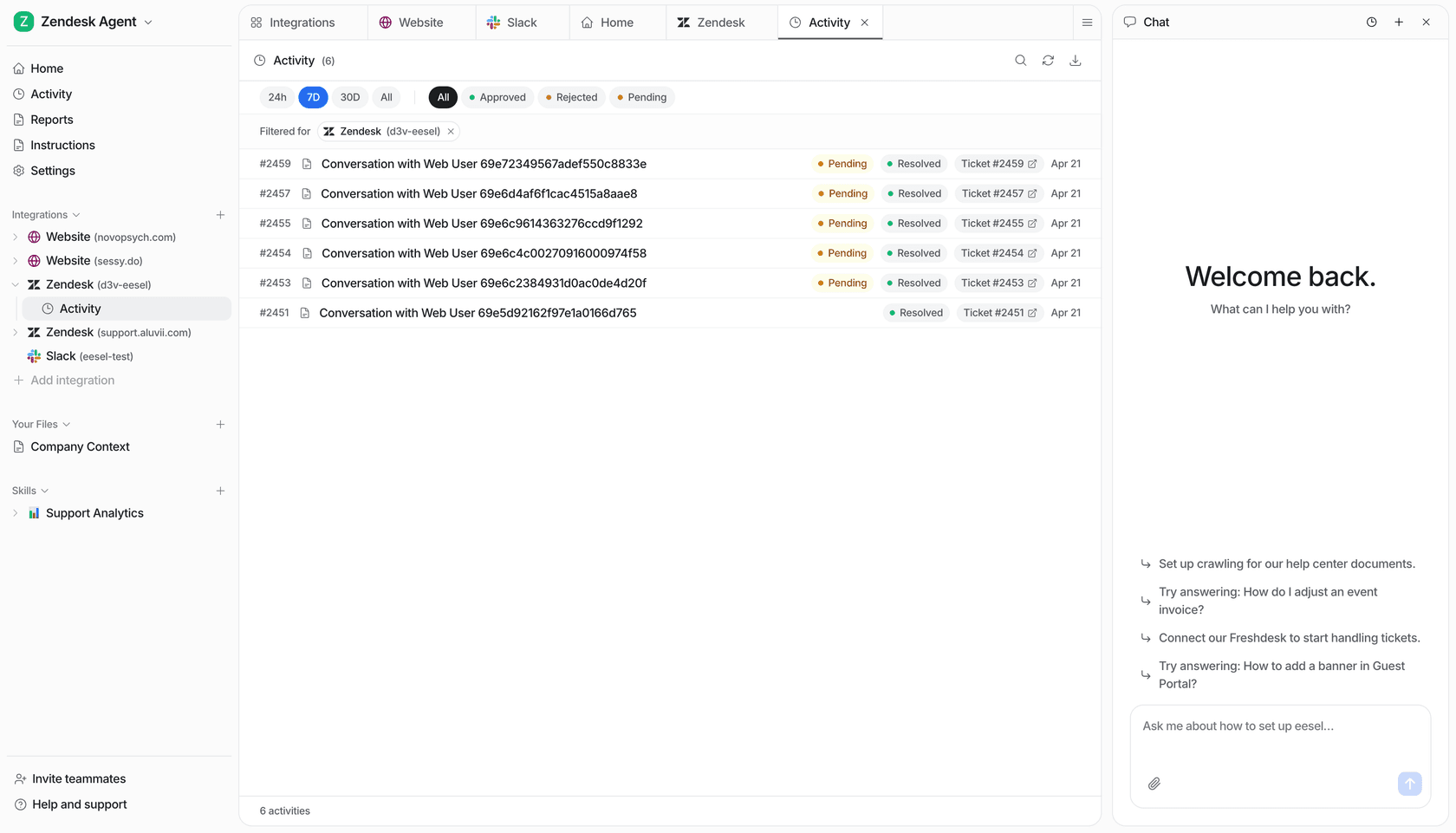
Pricing is a fixed monthly plan from $299 for 500 credits with no per-seat fees, so a seasonal spike can be covered by a bigger batch or capped overage ($0.80 per extra credit), not a renegotiated contract. The results back the pitch: a gig-economy analytics app on Zendesk resolved 73% of tier-1 requests in its first month, after a 7-day trial, per our tier-1 deflection breakdown.
Verdict: best for almost any store that wants live-data answers without ripping out its helpdesk. Skip it only if you specifically want an all-in-one helpdesk and AI in one bill.
Gorgias: strong if you're already on it
Gorgias is built for ecommerce and its Shopify integration is genuinely deep, it reads orders and can trigger actions like refunds natively. If you already run your support on Gorgias, its AI Agent is a natural next step and worth trialing first.
The catch is billing: the automated interactions are billed on top of the ticket-volume plan, so you're paying on two meters, and it only makes sense if Gorgias is already your helpdesk. For a store on a different stack, adopting Gorgias just for the AI is a big switch. Our Gorgias integrations roundup covers the ecosystem.
Verdict: best for Shopify stores already living in Gorgias; overkill as a reason to migrate.
Freshdesk and Zendesk AI: fine if that's your helpdesk
Both Freshdesk's Freddy and Zendesk's AI agents are competent, and if you're already standardized on one, turning on the native AI is the path of least resistance. Zendesk in particular has a mature AI agent setup.
Two things to watch. First, both charge for AI on top of already-per-seat plans, so the total cost of ownership climbs fast. Second, retail order data usually comes through an app connector rather than being native, so verify the Shopify link does what you need before committing. This is often where a layer like eesel on top makes more sense than the native option.
Verdict: best when you're locked into that helpdesk anyway; price out the AI add-on carefully first.
Shopify Sidekick and Inbox: free, native, limited
If you're a tiny store, Shopify's own Sidekick and Inbox are free with your plan and natively see your catalog and orders. For low volume, that's a perfectly reasonable starting point.
The ceiling is real, though: it's storefront-focused, doesn't train on your ticket history, and won't span email or other helpdesk channels. You'll outgrow it the moment support volume gets serious. Our Shopify customer support roundup goes deeper.
Verdict: best for a first bot on a small store; not a long-term support engine.
Ada and Tidio: the enterprise and budget ends
Ada sits at the enterprise end, multilingual, resolution-based, and quote-only, which means real onboarding effort. It's a fit for large retailers with the team to run a custom build, less so for a mid-size store that wants to be live this week.
Tidio's Lyro is the budget end, conversation-based pricing that's friendly for small stores, but its store-data depth is more limited than the ecommerce-native options. Good for a lean shop, thinner once you need real order actions.
Verdict: Ada for enterprise scale, Tidio for a shoestring budget; most stores land between them.
Where these tools quietly fall apart
The positioning below is the mental model I keep coming back to. Almost every "AI retail support" tool clusters somewhere on two axes: is it a true AI agent or a scripted bot, and does it read your live order data or ignore it. The tools worth deploying live in the top-right.
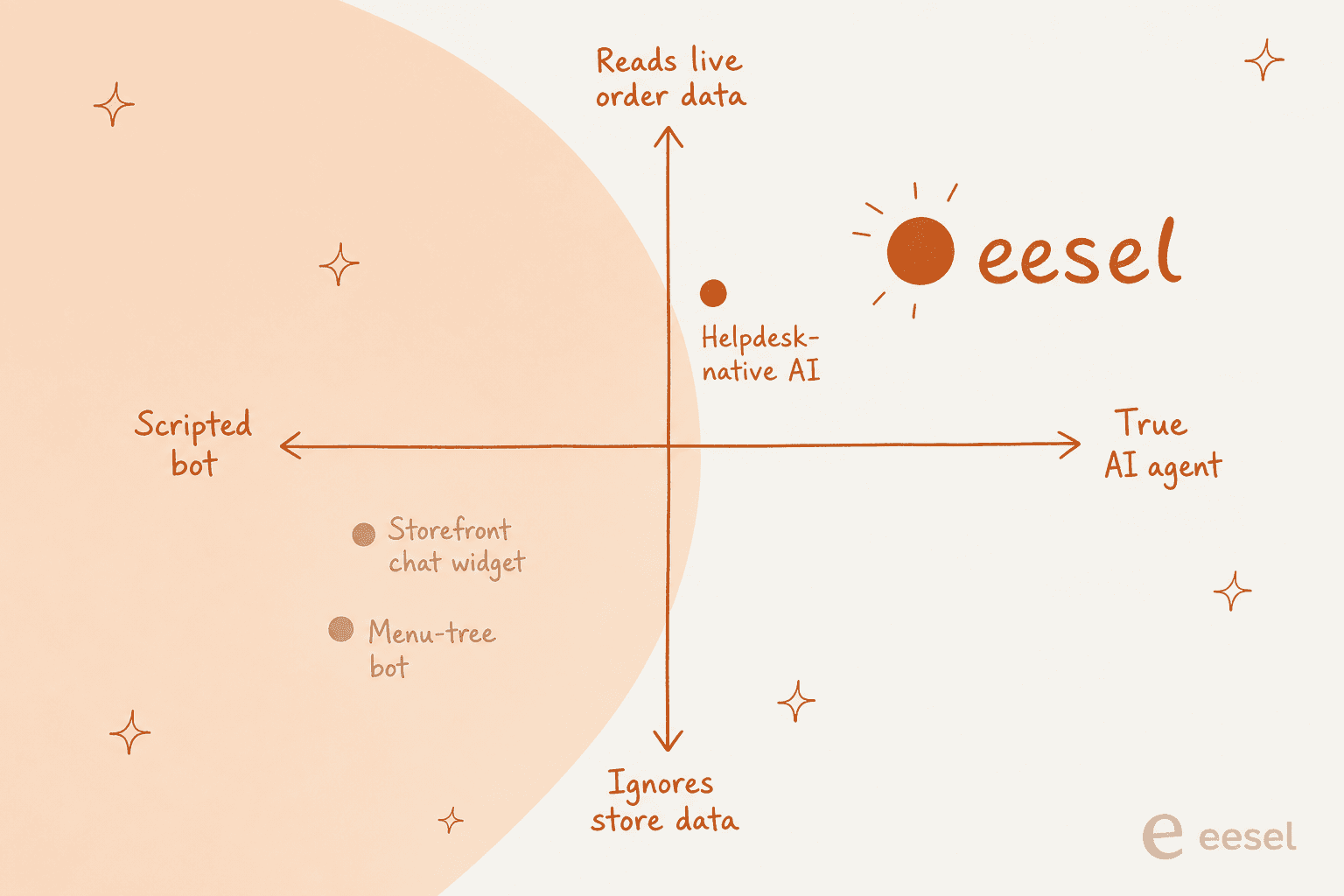
The failure I see most is a tool that's a genuinely good AI agent but never got wired into the store, so it answers policy questions beautifully and deflects every actual order question. The second most common is the opposite: a native storefront widget that sees the order but is really a menu tree, so it can't handle a free-text question. You want both quadrants at once, which is a smaller list than the marketing suggests.
A real-world checkpoint on what "good" looks like: in a trial for a German online jewelry retailer running around 1,000 tickets a month on Zendesk and Shopify, the AI hit 93% triage accuracy and 100% spam detection, with returns and refunds draft usefulness around 94%, all worth tracking as AI support metrics. That's the profile of a tool that's actually reading the store, not guessing.
How I'd roll one out without torching trust
Picking the tool is half the job. The rollout is where retail AI earns or loses customer trust, and it's worth doing in this order:
- Connect your store and helpdesk first. Order data before anything else, that's what unlocks WISMO.
- Train on past tickets, then simulate. Run the AI over your historical tickets and read what it would have said before it goes live. This is the single step that prevents the confident-wrong-answer disaster.
- Start on one narrow job. Turn it loose on order tracking only, prove the resolution rate, then widen to returns and stock. Don't boil the ocean.
- Set the handoff rules explicitly. Define what it must escalate (angry shoppers, refunds over a threshold, anything it's unsure about) and check the human gets full context.
- Watch deflection, not volume. Track the share of conversations fully resolved without a human and the metrics that actually matter, not raw message counts.
Do it in that sequence and the AI reads as a helpful upgrade rather than a wall between shoppers and your team. Skip the simulation step and you'll find out about the wrong answers from a customer, which is the expensive way.
Try eesel for your retail customer service
If you want an AI that answers "where is my order?" from the real order rather than a canned policy line, eesel is where I'd start. It plugs into Shopify, WooCommerce, and your existing helpdesk, trains on your past tickets, and lets you simulate against historical tickets before a single customer sees it, so you know the resolution rate up front. Billing is a fixed monthly plan from $299 for 500 credits with no per-seat fees, which means a Black Friday spike is covered by optional overage with a cap you set, not a renegotiated contract.
It's free to try, and because it layers on top of what you already run, you can have it answering order questions the same afternoon.