7 best Smartsupp alternatives for ecommerce AI support in 2026

Rama Adi

Katelin Teen
Last edited October 22, 2026

Why do online stores look past Smartsupp?
Credit first. Smartsupp is a Czech live chat and multichannel inbox that's been around since 2013, and it's rated 4.7 out of 5 from 1,081 G2 reviews. The live chat installs in minutes on WordPress, WooCommerce, PrestaShop or Shopify, the inbox pulls in WhatsApp, Messenger and email, and the per-seat prices are fair for a small team. My Smartsupp review scored it 3.5 out of 5, and most of the half-points it lost were on the AI.
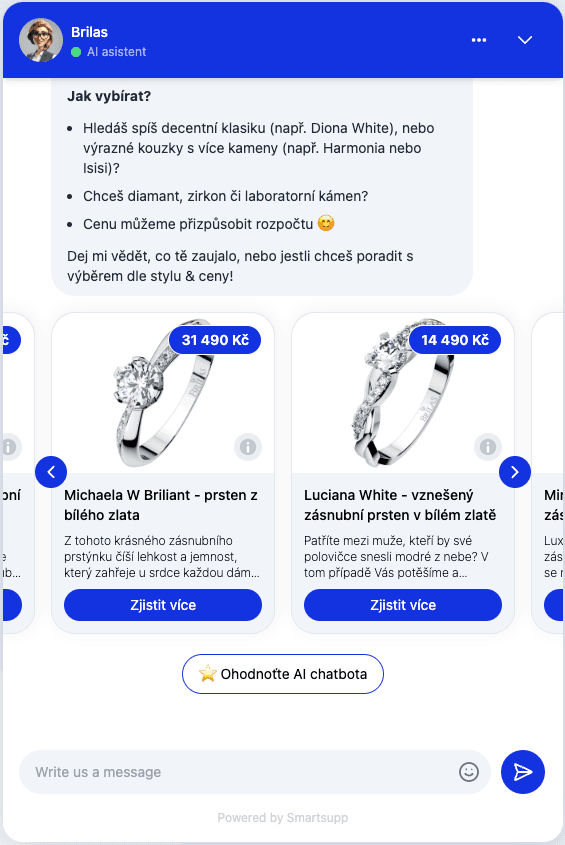
Mira is a shopping assistant, and a decent one. It learns from up to 20 website scrapes, an XML product feed of up to 30,000 products, five text blocks and 30 custom Q&A pairs, then answers with product cards like the ones above. The reasons stores compare it anyway are specific:
1. It answers, but it can't check an order. Mira knows your catalog and policies, not your customers' orders. It can tell a shopper your return window; it can't tell them where parcel #40218 is. Stock comes from the product feed, only for direct product questions.
2. It lives in one place. The Mira introduction says it runs in the chat widget on your website. WhatsApp, Messenger and email reach your human agents in the inbox, with no AI on them.
3. The handover leaves your helpdesk out. Smartsupp's Mira FAQ is direct about it: Mira "doesn't create tickets in third-party tools like Freshdesk or Zendesk." It sends the transcript and contact details to an email address you choose. Live handover to an agent works only during the business hours you set.
4. It doesn't learn from your conversations, and it can't share a site with Flows. The FAQ says Mira "does not currently learn from conversations directly", so you train it with Q&A pairs. And per the Flows vs Mira guide, "Mira AI and a classic Flow can't be active on the same website at the same time."
5. Small stores feel the price of each add-on. One shop owner put it plainly on G2:
"The price would be more friendly for start. We just start our eshop with low cashflow."

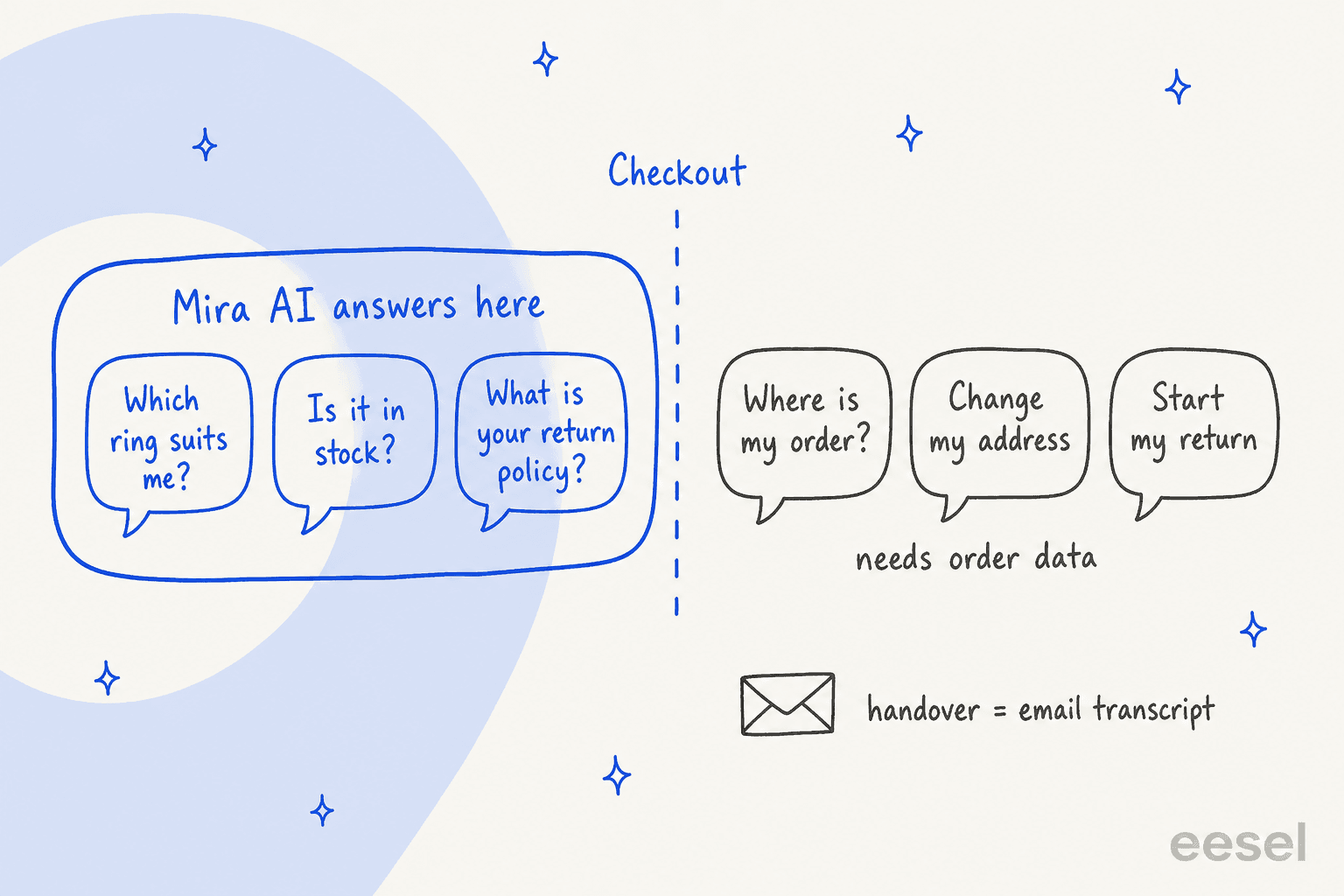
That picture is the whole decision. If most of your chats sit on the left of that line, Mira may be enough, and you should fix its knowledge before you switch (more on that below). If your inbox fills up with the questions on the right, you need a tool that can read the order.
How I picked these alternatives
I build eesel's integrations, so I read each tool by what it actually connects to: what the AI can read, what it can change in Shopify or your store, and where the conversation goes when the AI stops. I read every vendor's own pricing page on 22 October 2026, plus their docs, listings and recent reviews.
Before writing, I asked ChatGPT the question a store owner would ask: "I run an online store and use Smartsupp for live chat and its Mira AI assistant. What other tools should I look at if I want something that handles more of our customer questions automatically?" It searched 21 websites and shortlisted Gorgias, Tidio Lyro, Zendesk AI and Ada, plus one tool I've left out of this list. Its best advice was to look for AI that can "look up real order information" and "carry out routine support tasks", and to measure successfully resolved conversations, not chats answered. I agree, so this post is built around that test.
I added three tools a Smartsupp buyer would also weigh: Crisp (the closest European live chat peer), Shopify Inbox (the free baseline for Shopify stores) and eesel. One rule I held: every price below comes from the vendor's own page, never from a review site.
Which tools do the task, not just answer?
Here's ChatGPT's task table, filled in from each vendor's own docs, listings and product pages. It's the table I'd want before a single demo.
| Customer asks | Smartsupp Mira | Tidio Lyro | Gorgias AI Agent | Zendesk AI agents | Ada | Crisp | Shopify Inbox | eesel |
|---|---|---|---|---|---|---|---|---|
| "Where is my order?" | No order data | Answers order tracking | Order status skill | With actions you connect | Order lookup and carrier tracking | Shopify data for agents; AI via workflows you build | Order lookup | Looks up the Shopify order |
| "Change my address" | No | Not listed | Address change skill | With a procedure you set up | Shown updating Shopify | Via webhook workflows | No, answers only | Hands to your team with the order found |
| "Start a return" | Explains the policy | Not listed | Start a return skill | With a procedure you set up | Shown generating a return label | Via webhook workflows | Explains the policy | Explains the policy, hands off with a note |
| "Talk to a person" | Live chat in office hours, else email transcript | Same Tidio inbox | Same Gorgias ticket | Same Zendesk ticket | Your helpdesk | Same Crisp inbox | Human hand-off in Inbox | A ticket in Zendesk, Gorgias or Freshdesk |
| Channels the AI covers | Website widget | Website chat | Chat and email in Gorgias | Messaging, email, voice | Chat, email, WhatsApp, SMS, voice and more | Chat and connected channels | Online store chat | Website chat, email, helpdesk tickets |
"Not listed" means I couldn't find it in the vendor's own docs or listing, not that it can't be built. Tidio's listing mentions "Native Shopify actions" on its Lyro plan without naming them, so ask in the demo.
The practical point: three of these tools act on orders out of the box (Gorgias, Ada, and Zendesk once you set up procedures), three answer from your content and look things up (Tidio, Shopify Inbox, eesel), and Crisp gives you the building blocks. My guide to WISMO automation covers the where-is-my-order flood specifically, and can AI handle refunds covers the returns side.
Smartsupp alternatives compared
| Tool | Best for | Starting price (monthly) | Free plan | AI billed on | Order actions by AI | Helpdesk | Security listed |
|---|---|---|---|---|---|---|---|
| Smartsupp (baseline) | Live chat plus product Q&A | $24 Solo + Mira $20 per 100 | Yes, 25 conversations, 1 operator | Mira conversations, per 100 | None | Its own inbox; emails transcripts | GDPR |
| Gorgias | Shopify stores with order-heavy support | $40 with AI Agent | No, free trial | Tickets plus $0.85 to $1.00 per automated interaction | Order status, returns, address change, cancel | Is the helpdesk | SOC 2 Type II, HIPAA |
| Tidio | Closest swap: chat, inbox and AI | $29; Lyro from $39 | Yes, 50 conversations | Lyro AI conversations | Order tracking answers; Shopify actions on Lyro | Built-in inbox | SOC 2 report, GDPR |
| Zendesk | Growing teams that want one platform | $69 per agent (Suite Team) | No, 14-day trial | Agent seats plus $1.50 to $2.00 per automated resolution | Procedures and actions you set up | Is the helpdesk | HIPAA support listed |
| Ada | Enterprise volume across markets | Quote only | No | Annual contract | Order lookup, address change, returns | Hands off to yours | SOC 2, HIPAA, GDPR, PCI DSS |
| Crisp | Flat price for a whole team | $45 per workspace | Yes, 2 seats, no AI | Included AI credits per plan | Via workflows and webhooks | Built-in shared inbox | Not on pricing page |
| Shopify Inbox | Free AI chat on Shopify | $0 | Yes | Nothing | Order lookup | None | Shopify platform |
| eesel | AI inside the helpdesk you already run | $299 for 500 credits | 100 credits to try | Tickets and chats (1 credit each) | Order and product lookups | Works inside Zendesk, Gorgias, Freshdesk | SOC 2 Type II underway, DPA, EU or US data |
What will each one cost you?
Entry prices tell you almost nothing here, because these eight tools meter eight different things.
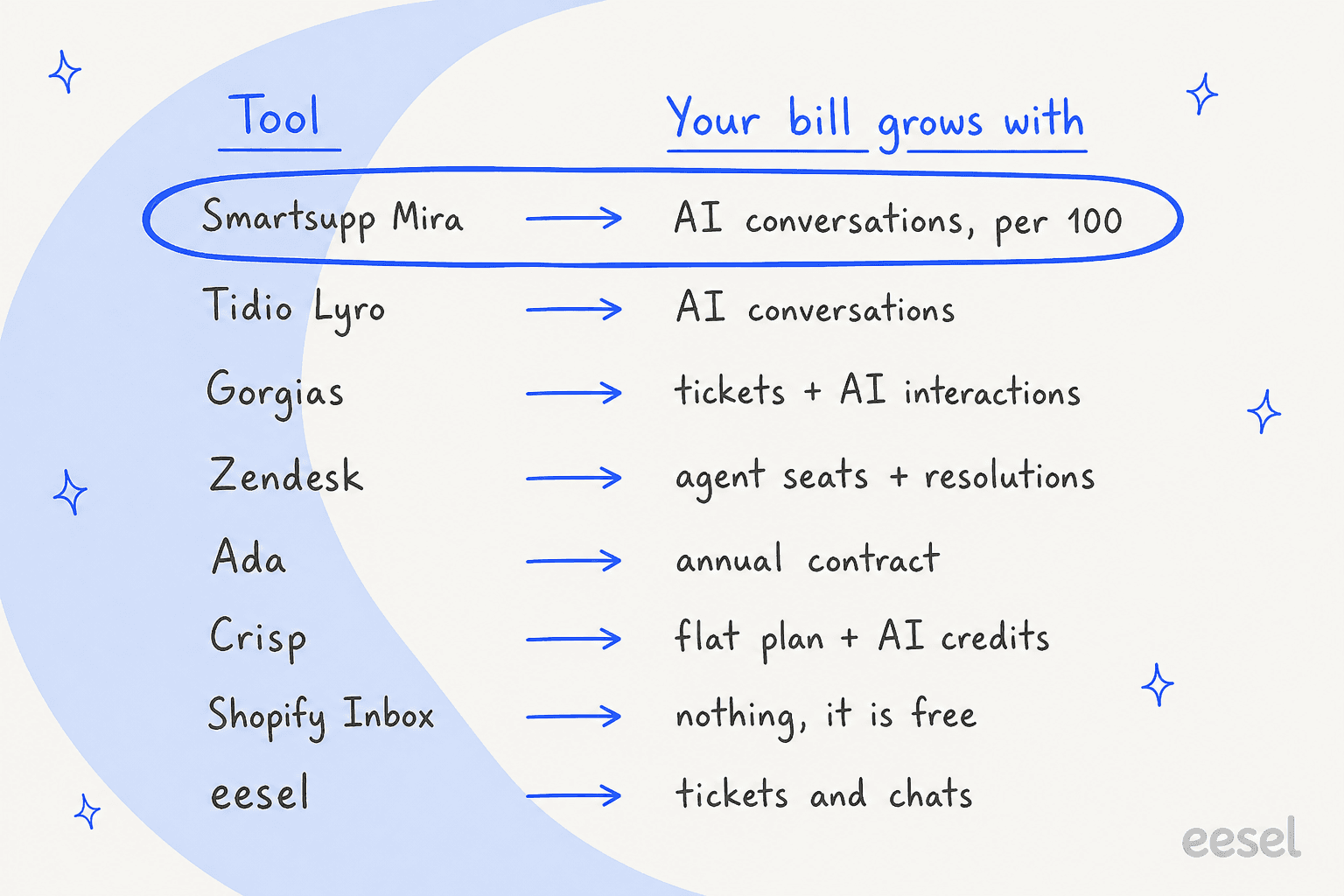
The meter decides which kind of growth hurts. Smartsupp and Zendesk charge per seat, so hiring a fourth person costs money; Gorgias, Crisp's included credits and eesel don't. Smartsupp counts every visitor session Mira responds to, while Zendesk only bills when its AI resolves a request without a person. And Mira simply stops when its quota runs out, until you top up or the month resets. My post on deflection vs resolution explains why those units aren't interchangeable.
Plug in your own numbers. Every figure is a list price from the vendor's own page on 22 October 2026.
At the defaults (3 people, 500 AI conversations), Smartsupp is the cheapest paid tool at $135, and it stays cheap: even at 2,000 AI conversations it's $435. The others cost more because they do more after checkout, which is the trade you're actually making. My guide to chatbot cost has more on reading these meters.
1. Gorgias
Best for: Shopify stores whose chats are mostly "where is my order?" and "can I return this?", and who want one helpdesk for every channel.
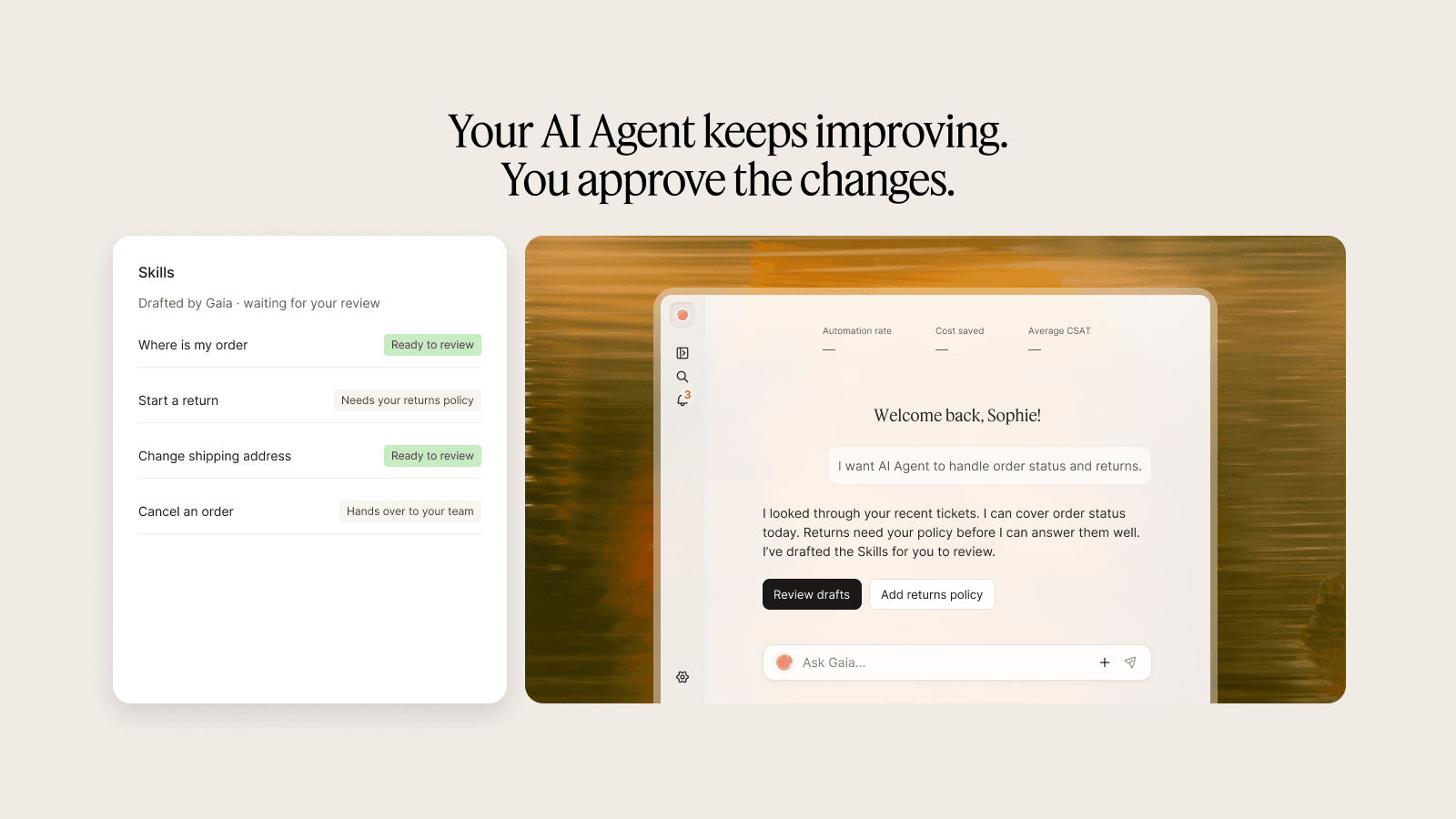
Gorgias was ChatGPT's first pick "for ecommerce operations", and it's mine for a Shopify store that has outgrown answering. Its pricing page describes AI Agent as "resolving support questions instantly, converting shoppers with personalized chat, and automating actions like returns, order tracking, and more."
What it does that Mira doesn't
- Acts on Shopify orders. The listing image above shows AI Agent skills for where-is-my-order, starting a return, changing a shipping address and cancelling an order. My breakdown of Gorgias AI actions walks through each one.
- One helpdesk behind the chat. Email, chat, SMS, voice and social land in one place, with the Shopify order next to each ticket, so a handoff stays in the same ticket.
- Not priced per seat. The helpdesk "scales from 50 to 5,000 tickets a month, never priced per agent", which helps a team that's growing headcount.
Where it falls short
- Two meters. You pay for tickets and for each automated interaction ($1.00 on Starter, $0.90 on Basic and Pro, $0.85 on Advanced). At 500 AI chats a month, the calculator lands at about $593 against Smartsupp's $135.
- Shopify-first. Gorgias is built around Shopify, so on WooCommerce or PrestaShop check which AI Agent skills cover your platform before you commit.
- A bigger move. You're replacing your inbox, not adding an AI to it, so plan for a migration.
Pricing
| Plan | Monthly | Billed yearly | Tickets included | Automated interactions | Extra |
|---|---|---|---|---|---|
| Starter | $40 ($10 helpdesk + $30 AI Agent) | Monthly only | 50 | 30 | $0.40 per ticket, $1.00 per interaction |
| Basic | $90 | $77/mo | 300 | 30 | $40 per 100 tickets, $0.90 per interaction |
| Pro | $550 | $471/mo | 2,000 | 190 | $36 per 100 tickets, $0.90 per interaction |
| Advanced | $1,430 | $1,227/mo | 5,000 | 530 | $36 per 100 tickets, $0.85 per interaction |
Helpdesk-only plans start at $10 a month. My Gorgias pricing guide covers the details.
What users say
"The AI agent handles a solid chunk of routine inquiries on its own, which has freed up our team to focus on more complex issues."

"While the AI is not always fully accurate yet due to occasional hallucinations, we're hopeful ongoing improvements will help it provide accurate and helpful support the vast majority of the time."
My take: Pick Gorgias if you run Shopify and your chat volume is mostly order questions that Mira can't touch. Skip it if your store isn't on Shopify, or if your team is happy in its current helpdesk. My Gorgias review and list of Gorgias alternatives go further.
2. Tidio
Best for: small teams that want the closest swap: live chat, an inbox and an AI agent in one app, with sales flows on top.
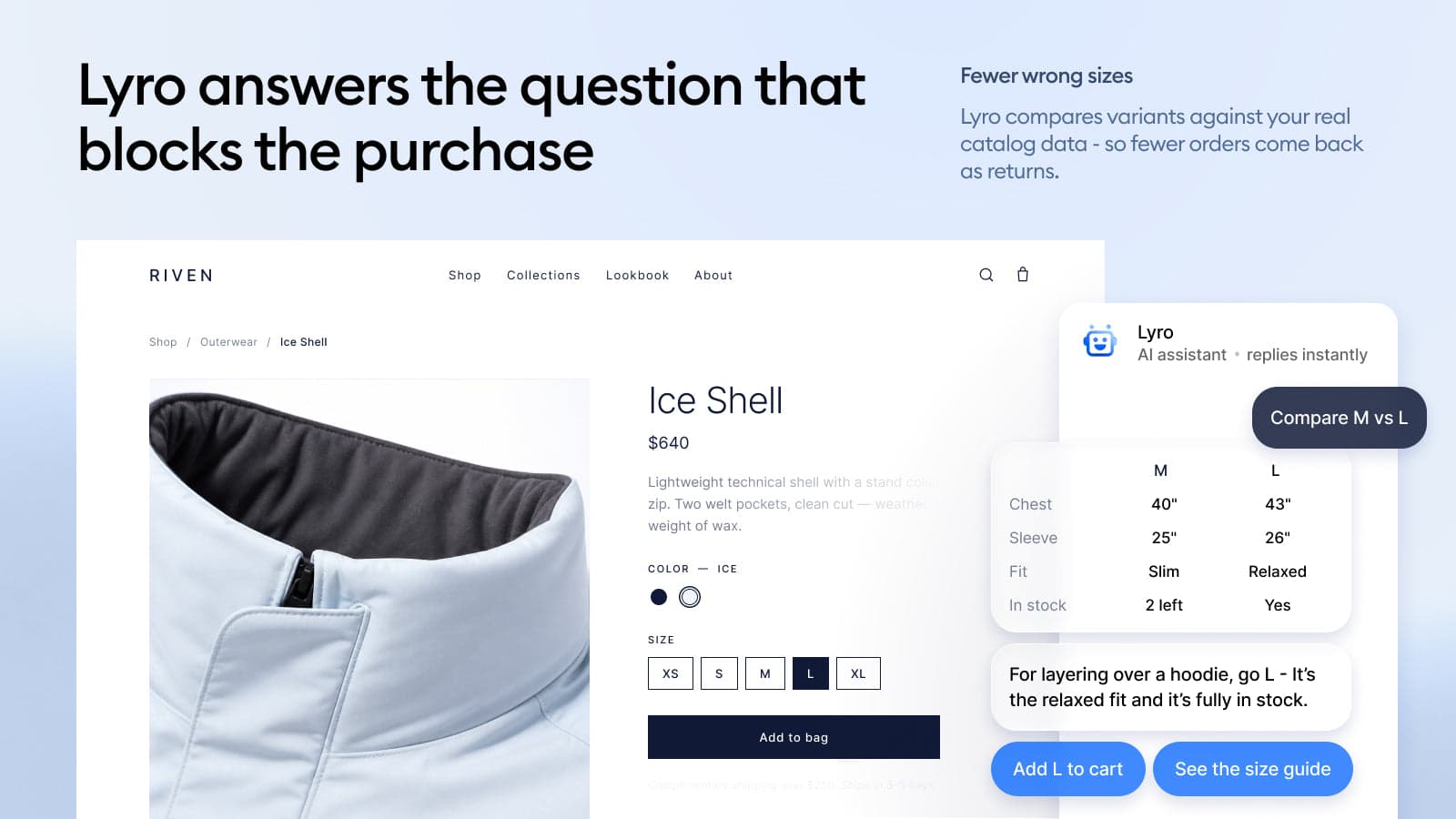
Tidio is the tool ChatGPT called a "straightforward upgrade" that keeps the live chat model, and it's the most Smartsupp-shaped tool on this list. It holds 4.8 from 1,355 reviews on its Shopify listing. Its AI agent, Lyro, is priced as its own product next to the chat app.
What it does that Mira doesn't
- Answers order tracking. The listing says Lyro "answers FAQs and order tracking day and night", and the Lyro plan lists "Native Shopify actions" and "Lyro Actions & MCPs".
- Recommends and adds to cart. The listing image above shows Lyro comparing sizes with an Add to cart button, the same selling job Mira does with product cards.
- Runs alongside Flows. Tidio pairs Lyro with no-code Flows for offers and questions, where Smartsupp makes you pick one per website.
Where it falls short
- Per-conversation billing climbs fast. On Tidio's pricing page, Lyro runs from $39 for 50 conversations to $700 for 1,000 a month, and above that is a custom quote. That's $0.70 a conversation at 1,000, against Mira's $0.20.
- The Free plan's 50 Lyro conversations are one-time, not monthly.
- Two or three line items. The helpdesk, Flows and Lyro are priced separately, so the bill takes some reading. My Tidio pricing post untangles it.
Pricing
| Plan | Monthly | Billed yearly | What's included |
|---|---|---|---|
| Free | $0 | $0 | 50 billable conversations, 50 Lyro conversations (one-time), 100 Flows visitors |
| Starter | $29 | $24.17/mo | 100 billable conversations |
| Growth | From $59 | From $49.17/mo | From 250 billable conversations |
| Plus | From $300 + usage | n/a | Custom conversations, premium support |
| Lyro AI Agent | $39 (50) to $700 (1,000) | From $32.50/mo | AI conversations: $75 for 100, $140 for 200, $350 for 500 |
Every paid plan has a 7-day free trial.
What users say
"We've been using Tidio's Lyro AI Agent along with their automated Flows and have been very happy with the results. Our AI resolution rate is around 90%, which has helped us significantly reduce the number of customer service inquiries our team needs to handle manually."
"There is still room for improvement, particularly in making AI responses more flexible and improving customization options for automation."
My take: Pick Tidio if you like Smartsupp's shape but want order-tracking answers and Flows running next to the AI. Skip it if you'll run more than a few hundred AI chats a month, where Lyro costs over three times Mira per conversation. My Tidio review and Gorgias AI vs Tidio AI comparison help with that call.
3. Zendesk
Best for: teams that want one platform for chat, email and voice, with AI agents that follow written procedures across your systems.
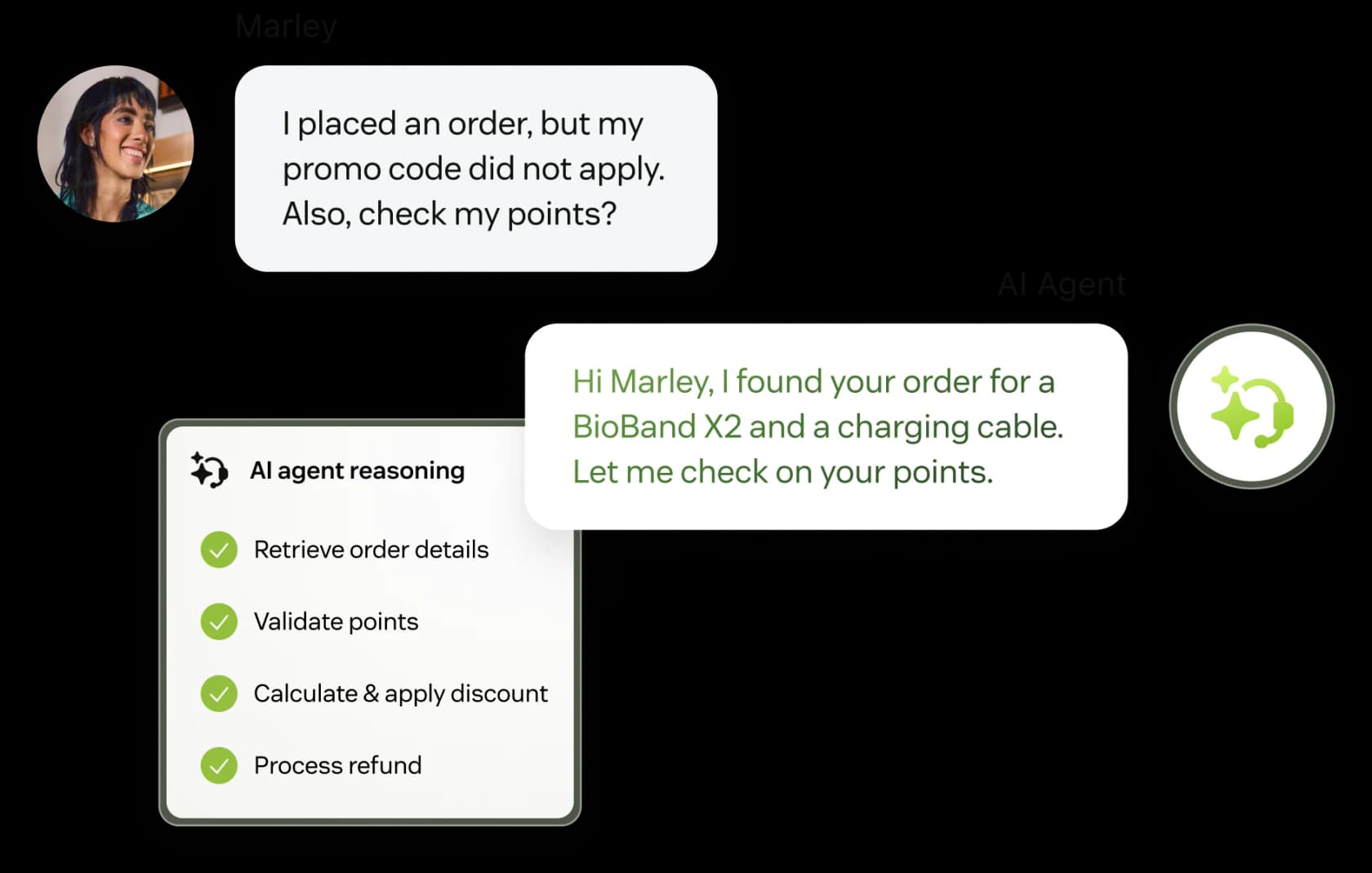
Zendesk is the step up when your store becomes a support operation. Its AI agents page covers messaging "across web, mobile, and social", email and voice, and says you can "describe workflows in natural language and generate procedures dynamically." With Forethought, it also sells standalone AI agents for teams on other helpdesks.
What it does that Mira doesn't
- Takes actions you define. Agents can be given "access to your tools and systems to take action", so an order lookup or a cancellation is a procedure you write once. My guide to Zendesk AI agents covers the setup.
- Every channel, one ticket. Chat, email and calls share one agent workspace, so the handoff Mira does by email becomes a ticket your team picks up.
- Built-in QA. Every AI interaction can be scored, which matters once AI is answering thousands of customers.
Where it falls short
- Seats plus resolutions. Suite Team is $69 per agent a month ($55 billed yearly) with 5 automated resolutions per agent included, then $1.50 per committed resolution or $2.00 pay-as-you-go. For 3 people and 500 AI conversations, that's about $935 a month.
- Setup is real work. Procedures and actions need someone to write and test them; it isn't a scrape-your-site-and-go tool.
- "Resolution" is Zendesk's definition. Some admins question what counts, as the second quote below shows.
Pricing
| Plan | Monthly (per agent) | Billed yearly (per agent) | Included automated resolutions | Extra resolutions |
|---|---|---|---|---|
| Support Team | $25 | $19 | 5 per agent a month | $1.50 committed, $2.00 pay-as-you-go |
| Suite Team | $69 | $55 | 5 per agent a month | $1.50 committed, $2.00 pay-as-you-go |
| Suite Professional | $149 | $115 | 10 per agent a month | $1.50 committed, $2.00 pay-as-you-go |
The pricing page pitches Support Team as core ticketing and Suite Team as the plan for teams "ready to unify support channels and automate resolutions with AI Agents", which is the one a chat-first store needs. My Zendesk AI pricing breakdown covers the add-ons.
What users say
"I think between Zendesk's native AI and their advanced action flows it's insanely powerful now [...] To give an example we run 24/7 physical space operation and our bot pulls codes for access, cancels bookings, moves bookings and can tell us all the context we need on a customer."

"who knows if the bot is just leaving the customer hanging and marking it as a resolution."
My take: Pick Zendesk if you're building a support team, not just answering a chat bubble, and you have someone to own procedures. Skip it if you're a 1 to 3 person shop: three Suite Team seats are $207 a month before a single AI resolution, against $35 for Smartsupp Plus. My Zendesk AI overview goes deeper.
4. Ada
Best for: high-volume brands selling in several markets and languages, with a budget for an annual contract.
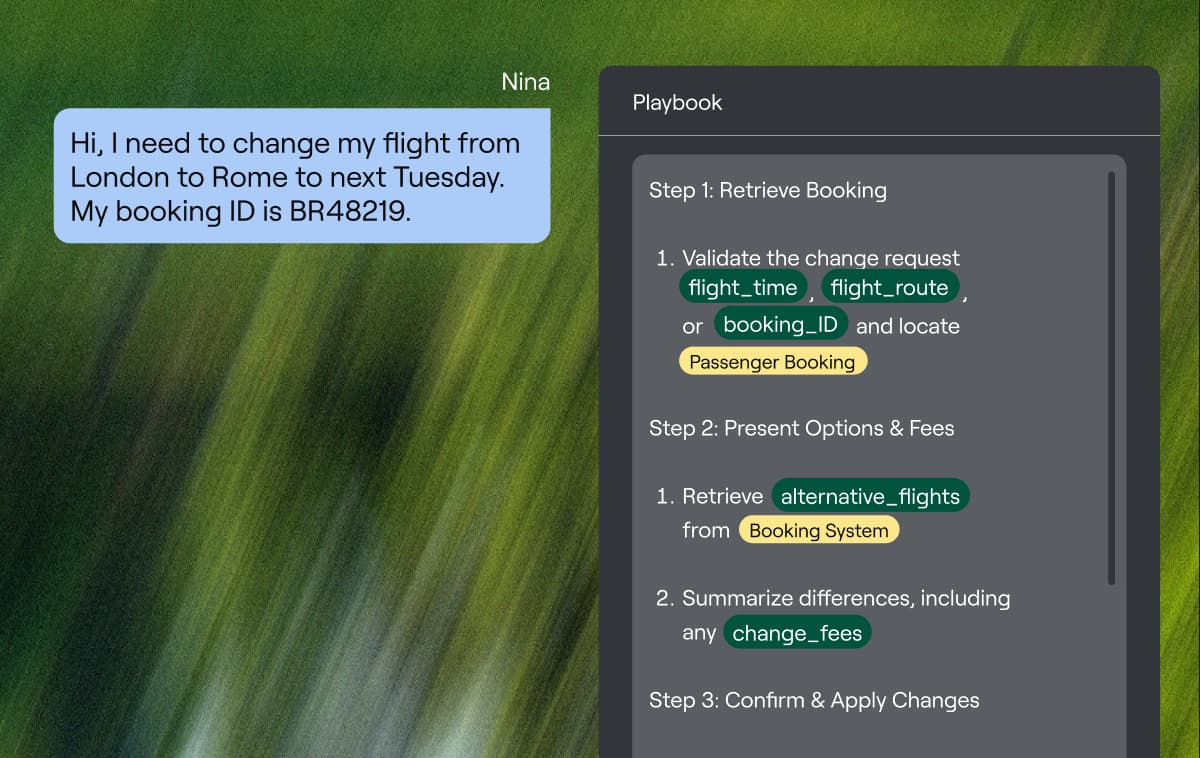
Ada is the enterprise pick on ChatGPT's list, for "high volume, multi-market" support. Its platform page claims 550+ enterprise AI agents deployed, 6.4 billion customer interactions handled and an 84% automated resolution rate, which is Ada's own figure. The Playbooks above are how you script multi-step tasks; the example happens to be a travel booking, and the same page's ecommerce demo shows an order lookup, a Shopify address change and a return label.
What it does that Mira doesn't
- Does the task on every channel. The platform's Conversation Hub lists voice, email, chat, Messenger, WhatsApp, SMS, Instagram and in-app, where Mira covers one widget.
- Playbooks for multi-step work. Structured steps like "Retrieve Booking" and "Confirm & Apply Changes" turn a policy into an action. My guide to Ada Playbooks explains how they're built.
- Enterprise security. The pricing page lists SOC 2, HIPAA, GDPR and PCI DSS badges.
Where it falls short
- No public pricing. The pricing page is a demo form that asks for annual ticket volume, starting at "less than 50K". My look at Ada pricing covers what's known.
- Built for big teams. "Trusted by 350+ global enterprises" is the pitch, and a store answering a few hundred chats a month isn't the buyer.
- No store-owner self-serve. You book a 30-minute call before you see the product on your data.
Pricing
| Plan | Price | How it's sold |
|---|---|---|
| Ada AI agent | Not published | Annual contract after a custom demo, scoped by ticket volume |
What users say
"Used to work for a company paying ~300k+ for Ada.cx, it's expensive [...] I would stick with Zendesk messaging and answer bot."
The figure in that quote is one person's account, not a price Ada publishes.
My take: Pick Ada if you handle tens of thousands of conversations a year across markets and want AI that acts on orders on every channel. Skip it if you're choosing between Smartsupp plans today; you'll be talking to the wrong sales team. My Ada review and list of Ada alternatives cover the middle ground.
5. Crisp
Best for: small teams that want a flat-priced shared inbox for chat, email, WhatsApp and Instagram, with an AI agent included in the plan.
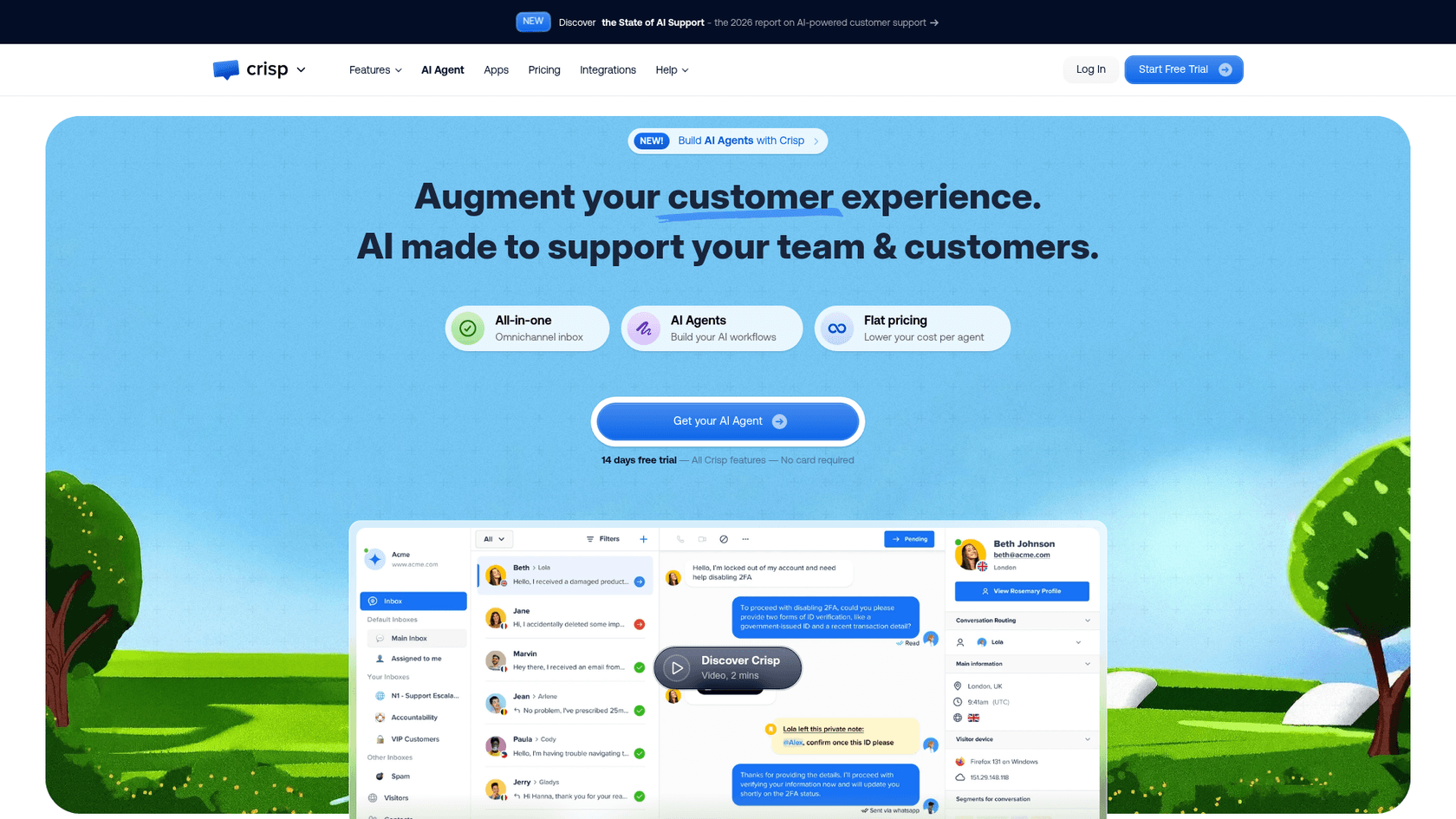
Crisp is the closest European peer to Smartsupp: live chat first, a shared inbox, and an AI agent built in. Its pitch is flat pricing per workspace, and the pricing page says so directly: "you pay a single, consistent price regardless of the number of conversations you have each month."
What it does that Mira doesn't
- Learns from past conversations. Crisp's AI page lists your knowledge base, website, uploaded files and your Crisp conversations as training sources, which Mira can't use.
- AI across channels. The plans connect WhatsApp Business, Instagram DMs, SMS and email to the inbox, and the chatbot builder is described as "omnichannel".
- Shopify, WooCommerce and PrestaShop sync. Order and customer data sits next to each conversation, and webhook actions let you wire the AI into your own systems.
Where it falls short
- Order actions are yours to build. The AI-agent blocks and webhooks are building blocks; there's no ready-made "start a return" skill like Gorgias has.
- AI credits are capped per plan. Mini includes about 90 automated conversations, Essentials about 450 and Plus about 1,350. The pricing page doesn't list the rate past that.
- The mobile app lags. One G2 reviewer, below, says the app is missing the newer AI features.
Pricing
| Plan | Monthly (per workspace) | Seats | Included AI credits |
|---|---|---|---|
| Free | $0 | 2 | None |
| Mini | $45 | 4 | $5, around 90 automated conversations |
| Essentials | $95 | 10 | $25, around 450 automated conversations |
| Plus | $295 | 20+, $10 per extra agent | $75, around 1,350 automated conversations |
Yearly billing is available from the app, and nonprofits and students get 50% off. My Crisp pricing and Crisp AI posts go deeper.
What users say
"I already have a chatbot connected to claude ai but I needed the live chat part so that staff could easily respond when they are available."

"For many years the experience with the Crisp app, if it even worked, was just not great. Today, it's better, but it still lacks almost all new features Crisp has shipped the last two years: no way to trigger Hugo conversations, there's no AI implemented in the app at all."
My take: Pick Crisp if you have 4 to 10 people on chat and want one flat bill with AI included. Skip it if you need order actions on day one without building workflows. My list of Crisp alternatives has its closest rivals.
6. Shopify Inbox
Best for: Shopify stores that want free AI answers with order lookup, and a baseline to measure every paid tool against.
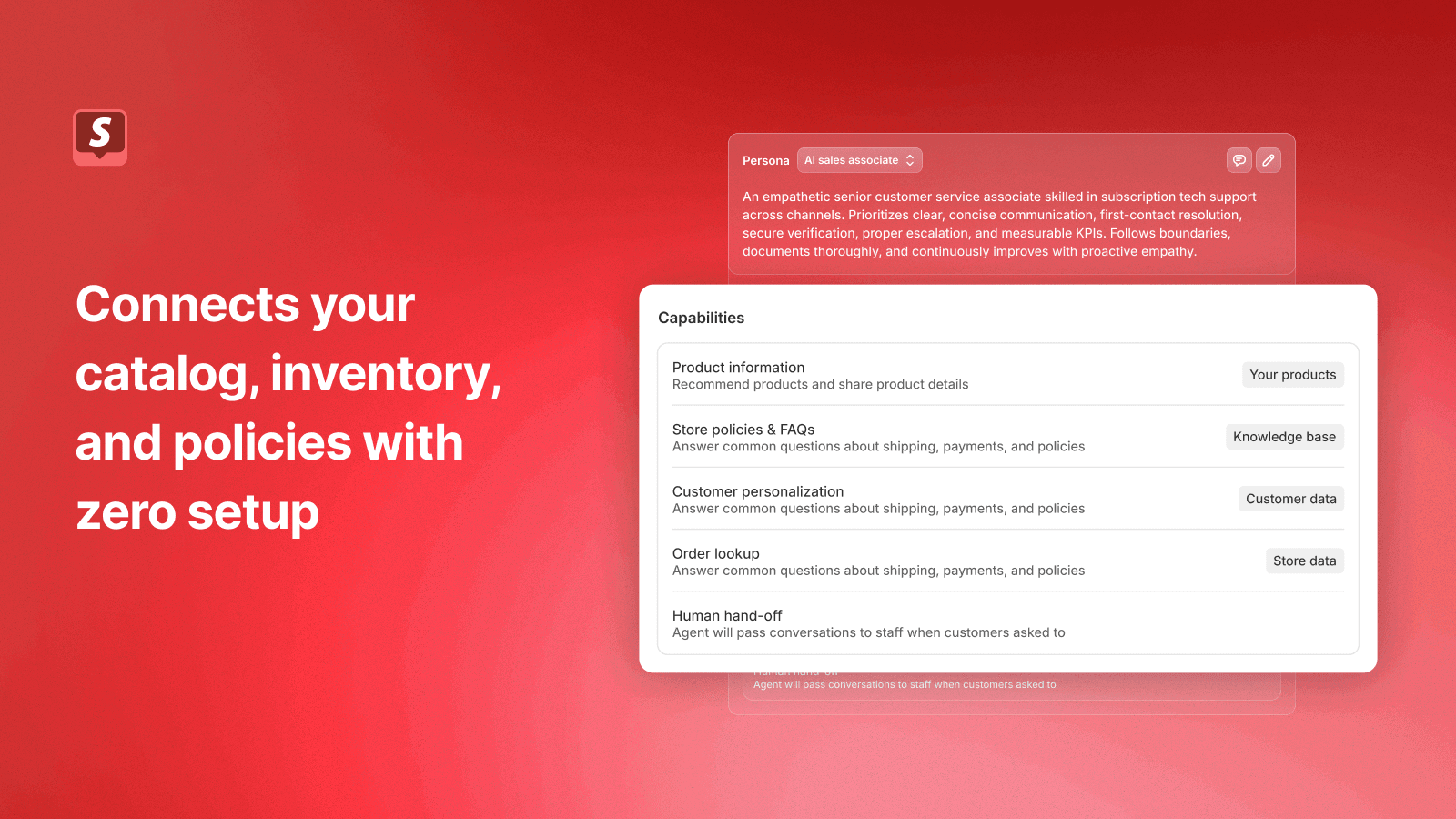
Shopify Inbox is Shopify's own chat app, with 4.6 from 5,806 reviews. The listing describes an "AI-powered sales associate" that "learns from your catalog, policies, and store content", and when buyers sign in with Shop, it personalizes replies using their purchase history.
What it does that Mira doesn't
- Looks up orders, for free. The settings above list order lookup and human hand-off as built-in capabilities.
- No meter at all. No conversation quota to run out of, so it never goes quiet mid-month the way Mira does at its limit.
Where it falls short
- Shopify only. If your store runs on WooCommerce, PrestaShop or WordPress, which Smartsupp supports, this isn't an option.
- Answers only. It looks up orders but doesn't change them, and there's no helpdesk link, WhatsApp or email.
Pricing
| Plan | Monthly | What's included |
|---|---|---|
| Shopify Inbox | Free | Online store chat, AI sales associate, order lookup, human hand-off |
My guide to Shopify Inbox covers setup.
What users say
"This is good, requires a little learning. Would be great if it could take other actions additional to answering, for example, making a note on the order if it refers to one."
My take: On Shopify, run Inbox for two weeks before paying for anything. If it covers your order questions, Smartsupp's live chat plus Inbox's AI might be all you need. My list of Shopify live chat apps has the other free options.
7. eesel
Best for: stores that already run a helpdesk and want AI on the website chat that checks the order and hands off inside that helpdesk.
Full disclosure: this is my team's product, and I build its integrations, so weigh my view accordingly. eesel is an AI helpdesk teammate. It answers your website chat, works the ticket queue inside Zendesk, Gorgias or Freshdesk, and connects to Shopify so it checks the order or product before it replies. There's no Smartsupp integration, so this is a replacement for Mira, not an add-on to it.
What it does that Mira doesn't
- Hands off as a helpdesk ticket. At BEAUTEK, a German supplier to beauty and tattoo studios, frustration, legal questions or a request for a person create a Zendesk ticket with the conversation attached. In one month eesel answered 77 website chats in German and created 20 Zendesk tickets, most of them sales leads.
- Learns from your past tickets, not only your site, so answers sound like your team. My guide to training AI on past tickets explains why that matters.
- Looks up the order first. At Question Beauty, a cosmetics brand on Gorgias and Shopify, eesel handled about 990 Gorgias tickets in a month, looked up 290 Shopify orders before answering and closed 280 tickets without a person.
- One bot per store, in any language. Nordbutiker runs a bot for each of four brands across Sweden, Norway, Denmark and Finland, on Zendesk tickets and the website chat bubble.
Where it falls short
- It's not a shopping assistant. There are no product carousels or proactive sales pop-ups like Mira's product cards or Tidio's Flows.
- It costs more than Mira for pure product Q&A. 500 chats a month is $299 on eesel against $100 of Mira conversations. Pay for eesel when the tickets after checkout are the problem.
- No Smartsupp link, and young reviews. You'd move the website chat to eesel's widget. Its Shopify listing has 4 reviews (5.0) and still shows older prices; the plans below are from the pricing page. SOC 2 Type II is underway, not complete.
Pricing
| Plan | Monthly | Credits included |
|---|---|---|
| Free | $0 | 100 to try |
| Teammate 500 | $299 | 500 |
| Teammate 1,000 | $499 | 1,000 |
| Teammate 2,000 | $849 | 2,000 |
| Teammate 5,000 | $1,749 | 5,000 |
| Enterprise | Custom | Custom |
A ticket or chat is 1 credit "however long", per the pricing page. Sizes in between are listed there, extra credits are $0.80 each if you turn overage on, a year upfront gets two months free, and there are no seat fees.
What users say
With only 4 Shopify reviews, the customer stories are the better evidence: named stores, their helpdesk, and what the agent did in a real month.
My take: Pick eesel if your team lives in Zendesk, Gorgias or Freshdesk and you want the website chat and the ticket queue answered by one AI that hands off inside that tool. Keep Smartsupp if your chats are mostly product questions and Mira handles them. My eesel vs Gorgias AI comparison shows how the two fit together.
Check Mira before you switch
ChatGPT's most useful advice was the least exciting: first check whether Mira's knowledge sources can be improved. I'd do that before any demo, because a migration costs more than an afternoon of training.
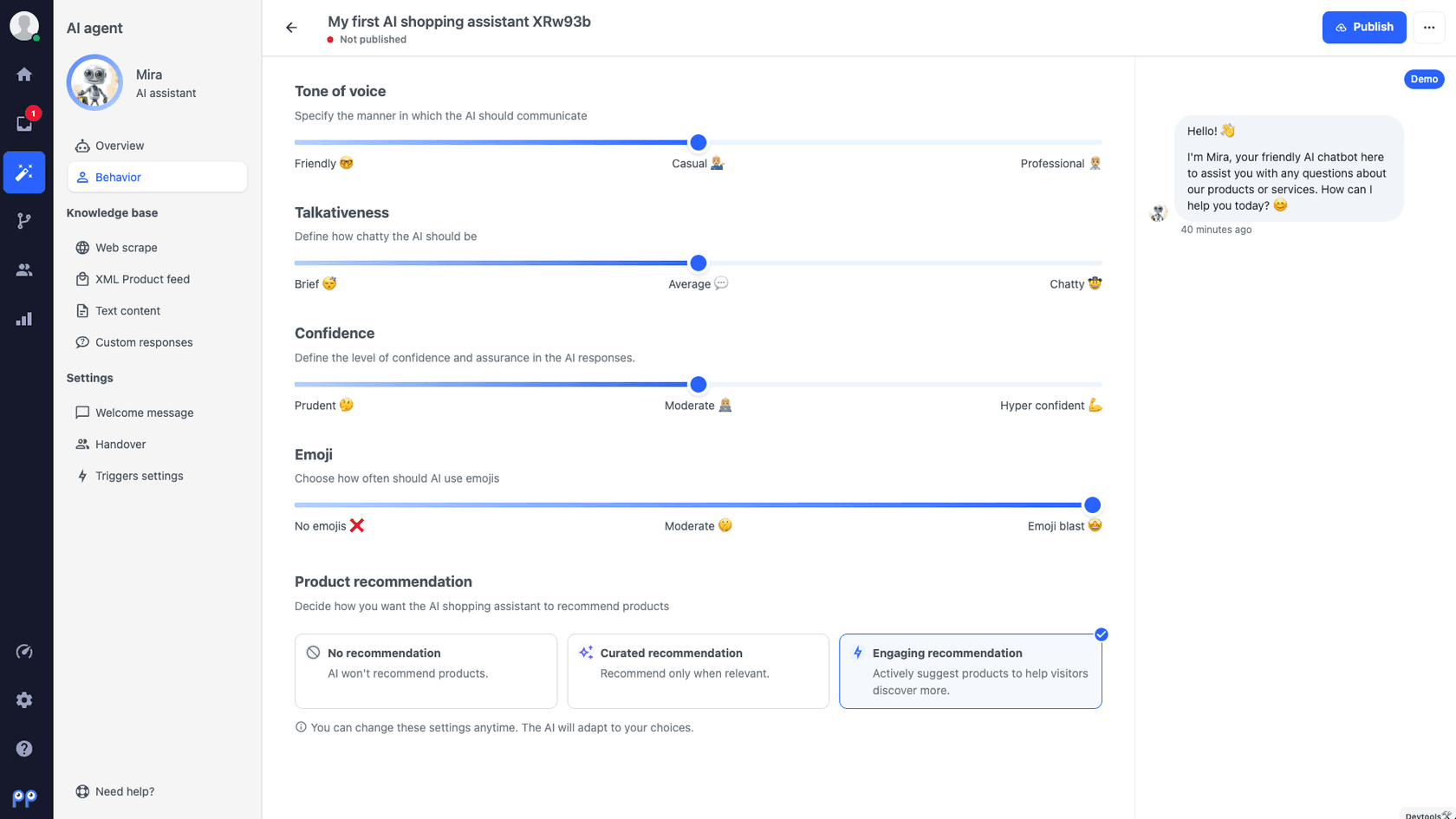
Here's the afternoon:
- Use all 20 web scrapes. Point them at your shipping, returns, warranty and FAQ pages, not only the homepage.
- Load the full product feed. Mira reads up to 30,000 products from an XML feed, which is where its stock answers come from.
- Write the 30 custom Q&A pairs from your most-asked chats. Since Mira doesn't learn from conversations, this is the only way it picks up what your team already knows.
- Set the handover email to your helpdesk's inbound address, so the transcript lands as a ticket rather than in someone's personal inbox.
If you've done all four and your inbox is still full of order questions, that's your answer. My guide to AI hallucinations covers what to look for when a bot answers confidently from thin knowledge.
How to test a Smartsupp alternative with real chats
Score each tool on whether it did the task, not only on whether it answered. That's the column most demos skip.
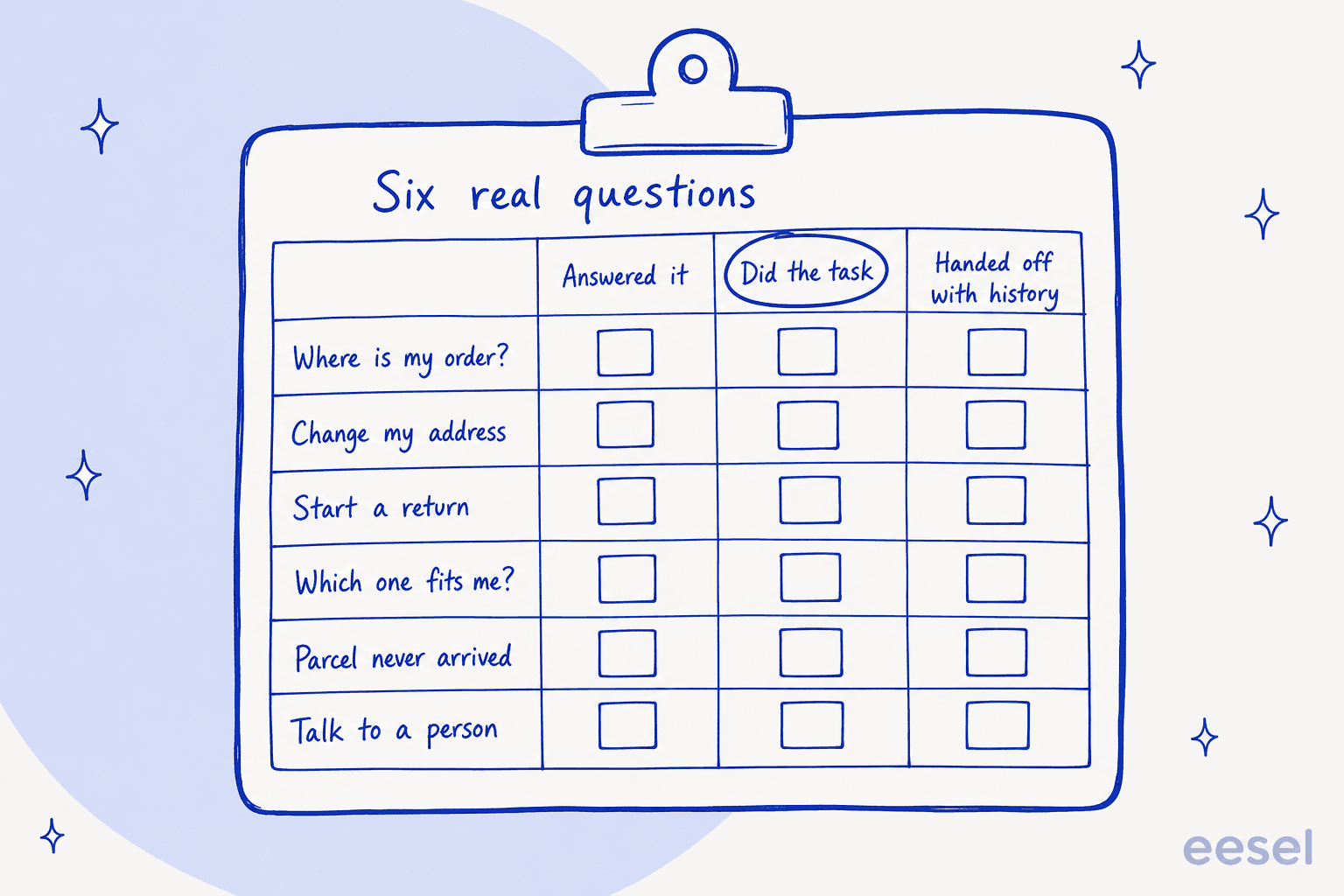
Here's the test I'd run, in about a week:
- Pull 25 real chats from your Smartsupp history, weighted to what you actually get: order status, address changes, returns, product fit and "I want a person".
- Run the same 25 through two finalists. Count the ones each tool resolved, the ones it answered correctly but couldn't act on, and the ones it got wrong.
- Run the full handoff loop. Ask for a person, reply as the agent, then write back as the customer. Check it's still one thread with the history. My guide to chatbot escalation shows what good looks like.
- Time the widget. A Belgian buyer who trialled eesel ran a methodical 67-question evaluation, found the answers solid, and still walked away because our chat widget was slow and kept getting stuck. I'd rather you catch that in a trial than after launch, with any tool, mine included.
- Test in every language you sell in. A German jewelry brand that trialled eesel on Zendesk and Shopify, at about 1,000 tickets a month, had customers writing in eight languages. My guide to multilingual support covers what to check.
- Price it at your real numbers in the calculator above, including your busiest month.
Which Smartsupp alternative should you pick?
- Your chats are mostly order questions, on Shopify: Gorgias.
- You want the same shape with more AI: Tidio, or Crisp if you'd rather pay one flat price for the team.
- You're building a multi-channel support team: Zendesk now, Ada when volume reaches enterprise scale.
- You want to spend nothing on Shopify: Shopify Inbox.
- You already run Zendesk, Gorgias or Freshdesk: eesel on your website chat and inside that helpdesk.
- Your chats are mostly product questions: stay on Smartsupp and train Mira properly.
If I ran a store on Smartsupp today, I wouldn't switch for price, because Mira is one of the cheapest AI meters going. I'd count how many of last month's chats needed an order looked up or changed. If it's a handful, I'd keep Smartsupp. If it's most of them, I'd test Gorgias and eesel side by side. For more options, see my roundups of AI for ecommerce support, AI for returns and other live chat alternatives.
Try eesel for chats that need the order
If Mira handles your product questions but the order questions keep landing in a transcript email, that's the gap eesel fills. It answers your website chat, checks the Shopify order before it replies, and hands anything it shouldn't decide to your team as a ticket in Zendesk, Gorgias or Freshdesk, the way BEAUTEK runs it on beautek.de.
Try eesel free with 100 credits, connect Shopify and your helpdesk, and see how it answers last month's real chats before a customer sees a single reply.
Frequently Asked Questions
What are the best Smartsupp alternatives for an online store?
If you want AI that acts on orders, start with Gorgias, then look at Zendesk or Ada as volume grows. If you want the closest like-for-like swap for live chat plus AI, test Tidio and Crisp. Shopify Inbox is the free baseline, and eesel adds an AI teammate to the helpdesk you already run. My Smartsupp review covers what you'd be replacing.
Is there a cheaper alternative to Smartsupp?
Only Shopify Inbox, which is free for Shopify stores. Smartsupp's Mira AI costs $20 per 100 conversations ($16 billed annually), which is cheaper per AI conversation than Tidio's Lyro, Gorgias or Zendesk at the list prices in my calculator. My guide to chatbot cost explains why the meters differ.
Which Smartsupp alternative can look up orders?
Gorgias AI Agent has skills for order status, returns and address changes, Ada's platform demo shows order lookups and Shopify address updates, and Shopify Inbox and eesel both look up the order before answering. Mira works from your website pages and product feed, not order data. My guide to Shopify order data explains the setup.
Does Smartsupp's Mira AI work with Zendesk or Freshdesk?
No. Smartsupp's help center says Mira doesn't create tickets in Freshdesk or Zendesk; it sends the transcript and contact details to an email address you choose. If your team works in a helpdesk, an AI that lives inside it, like eesel for Zendesk, keeps the handoff in one ticket.
How much do Smartsupp alternatives cost?
For a 3-person team with 500 AI conversations a month, Smartsupp Plus with Mira is $135. At the same volume, list prices put Crisp at $295, eesel at $299, Tidio at $379, Gorgias at about $593 and Zendesk at about $935, while Ada is quote-only. My post on deflection vs resolution explains why those units aren't equal.
Can a Smartsupp alternative answer on WhatsApp and email too?
Yes. Mira runs only in your website chat widget, while Zendesk's AI agents cover messaging, email and voice, Ada covers chat, email, WhatsApp, SMS and voice, and eesel answers website chat and email tickets inside your helpdesk. My guide to WhatsApp support for ecommerce covers that channel.
How do I test a Smartsupp alternative before switching?
Take 20 to 30 real chats from your Smartsupp history and run them through two finalists: order status, an address change, a return, a product question and a request for a person. Score whether each tool did the task, not only whether it answered. My guide to testing an AI agent has the full checklist.