

What a retail queue is actually made of
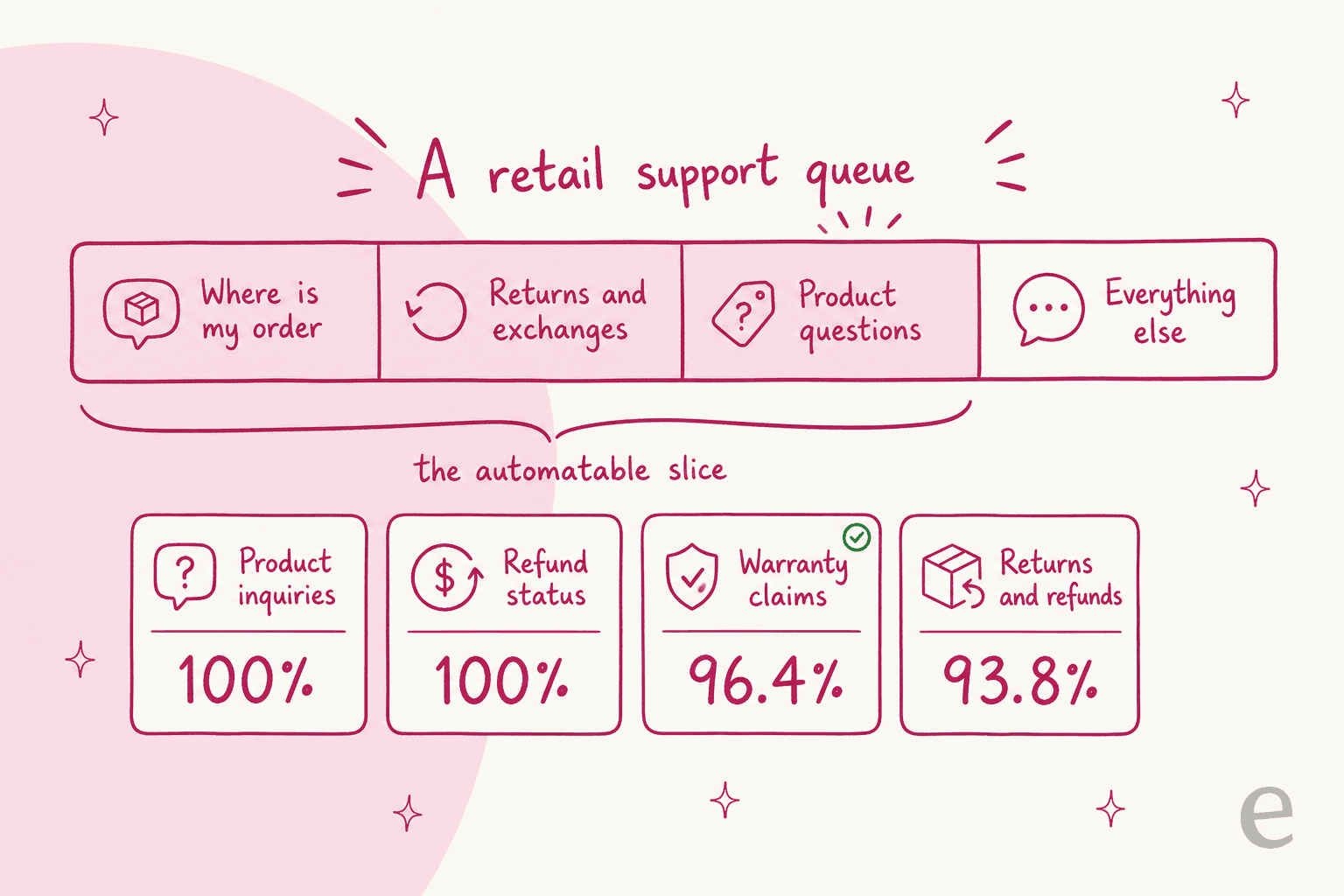
I spend my days in a support queue, and retail queues have a shape you can set your watch by. Order status. Returns and exchanges. "Does this run small?" Then the long tail of everything else.
The shape matters because it decides how much of the work is automatable, and it decides that long before you get to comparing feature lists. When we ran a trial on real traffic for a German online jewelry retailer doing about 1,000 tickets a month on Zendesk and Shopify, we scored every AI draft against what a human actually sent. The category numbers came out like this: product inquiries 100% useful drafts, refund status 100%, warranty claims 96.4%, returns and refunds 93.8%. Triage accuracy across the whole inbox was 93%, and spam detection hit 100% on the 22% of the inbox that was junk.
Here's the part that vendors leave out of the case study. In that same trial, only 12% of drafts went out as-is, and the factual error rate was 7%. The drafts were directionally right 88% of the time and still needed a human hand on most of them, because a wrong shipping date is worse than a slow one. That's the honest version of "AI handles your tier-1". Brilliant on the repetitive slice, supervised everywhere else, and worth measuring yourself before you sign anything. Our guide on AI hallucinations in support covers what to do about the 7%.
The reason to care about the mix at all is that the automatable slice is also the biggest slice. One ops lead at a DTC supplements brand running about 7,000 Gorgias tickets a month against 30,000 orders told us he came in wanting a copilot and left knowing he needed something that could resolve at least half his email volume on its own: order tracking, subscription changes, basic product questions. A multi-brand operator doing 500+ tickets a day put it more bluntly: refunds, unsubscribes, and order tracking are the whole job.
The two meters on your November invoice
Every tool in this roundup bills you twice. It's the second bill that surprises people.
Meter one is the platform: a per-seat fee (Zendesk, Help Scout, Gladly, Zoho Desk, Re:amaze, Richpanel) or a per-ticket allowance (Gorgias, Tidio). Meter two is the AI: per resolution, per session, per engaged conversation, per interaction. Peak season pushes both needles at once, and since AI overage rates sit above the bundled rate almost everywhere, the spike costs you more per unit than the baseline ever did.
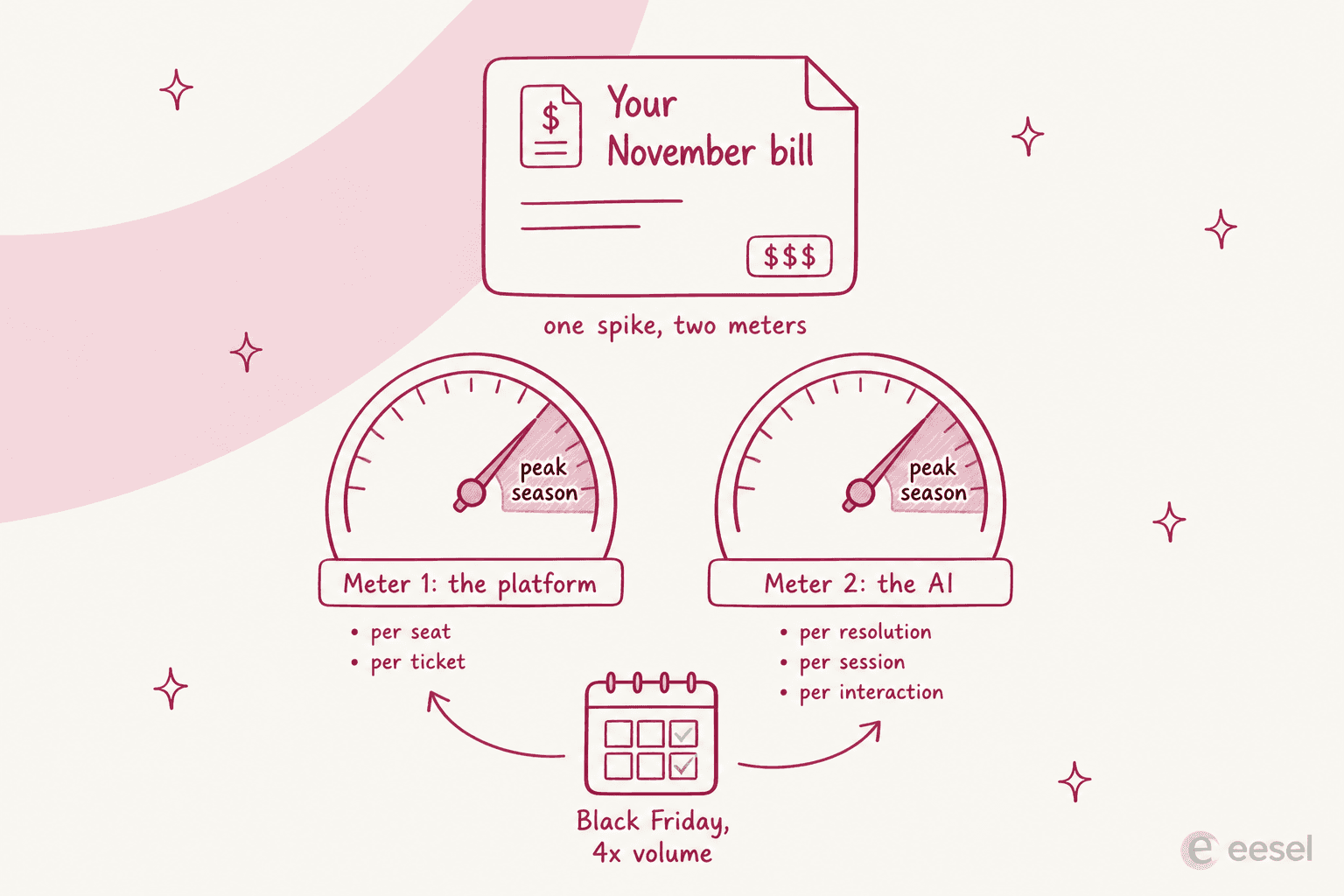
Gorgias is the clearest example, and to its credit the numbers are all printed on the pricing page. The Pro plan bundles 190 automated interactions inside a $171/mo AI component, which works out to about $0.90 each. Every interaction past 190 costs $1.50. So the month your volume triples is also the month your per-unit price climbs about 1.7x.
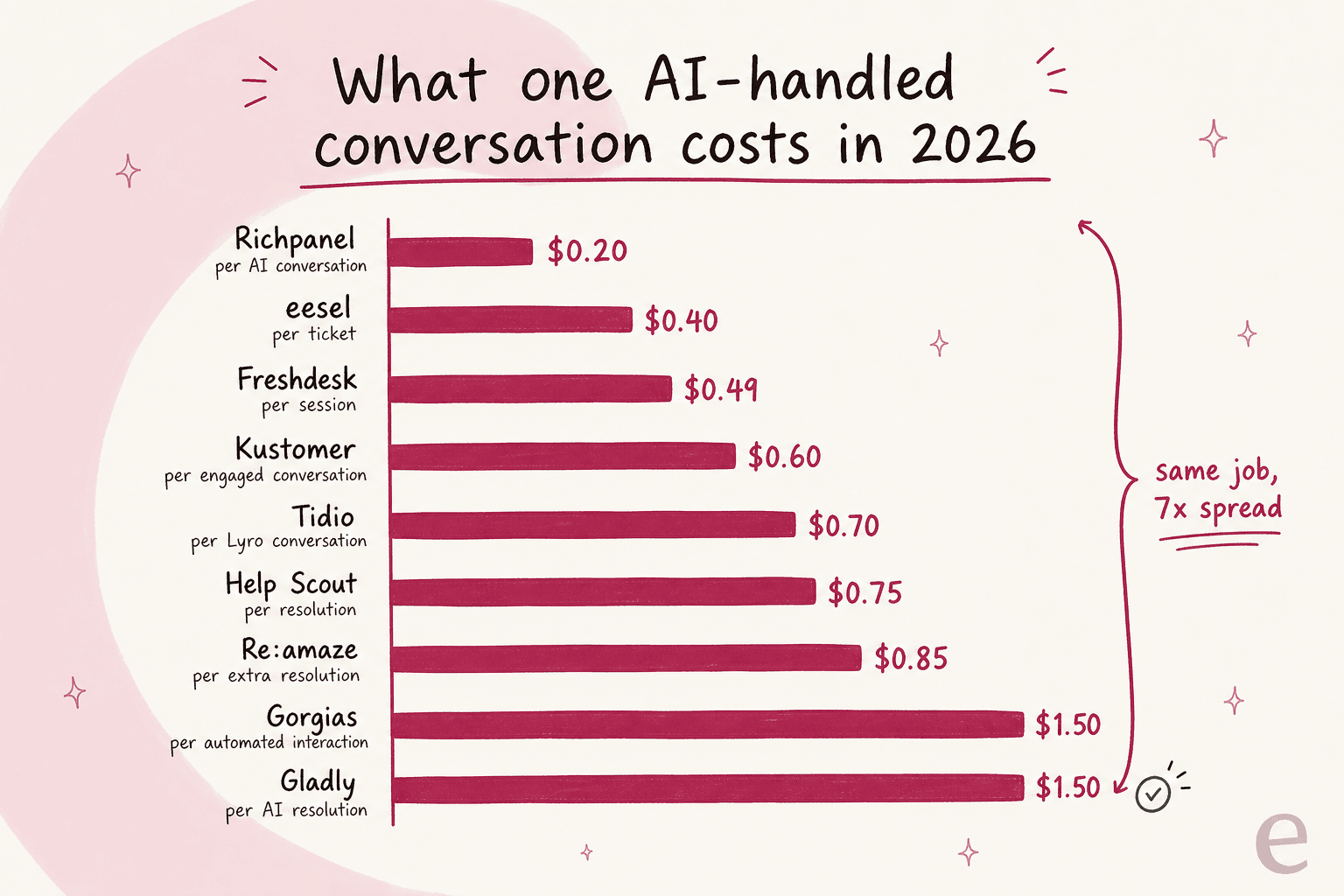
The unit itself is where the real money hides. "Per resolution", "per session", "per engaged conversation", "per ticket". None of these are the same thing, and they're not even close. Kustomer bills $0.60 per engaged conversation, which fires whether or not the customer's problem got solved. Freshdesk's email sessions are a 72-hour window, so every AI reply inside that window is one session. Help Scout counts one resolution per conversation, and only if the customer does not escalate or click "I still need help."
Work out your own peak-season number
Plug your real volume in. The calculator below runs the published 2026 rates for the main billing models and shows what a normal month and a 4x November look like side by side.
At the default settings (2,000 tickets, 60% AI, 5 seats), the spread between the cheapest and the most expensive model is over $1,800 a month for the same work. In a 4x November it is over $7,000.
How I picked these ten
Four filters, in this order:
- Does it read the store? Order lookup, catalog, subscription state. A helpdesk with no commerce connector is a generic inbox, and this list is not about generic inboxes.
- Can it act, or only answer? Cancelling an order, starting an exchange, changing a shipping address. Answering "here is our return policy" is table stakes; doing the return is not.
- Is the AI price published? Two vendors here hide it completely, and I say so rather than repeating a competitor's teardown as fact.
- What did real users say? Reddit, G2, Capterra, and Trustpilot, with permalinks. Vendor case studies are marked as vendor claims.
I run eesel's support queue, so obviously I have skin in the game on item one. I've tried to be straight about where the others beat us, and where the honest answer is just "buy theirs instead."
The comparison table
| Tool | Best for | Entry price | Billing unit | AI rate (2026) | Store connectors | Takes actions? | Channels beyond email/chat | Free tier | G2 |
|---|---|---|---|---|---|---|---|---|---|
| eesel | AI on the helpdesk you already run | $0 to start | Per ticket / chat session | $0.40 per ticket | Shopify, WooCommerce, Magento, BigCommerce, Amazon, Recharge | Yes (tracking, returns, escalation) | WhatsApp, Slack, in-app chat | $50 credit, no card | Not listed |
| Gorgias | Shopify-native DTC brands | $40/mo | Tickets + automated interactions | $1.50 per interaction over bundle | Shopify, WooCommerce, BigCommerce (not Starter), Magento (Pro+) | Yes (returns, tracking, discounts) | SMS, voice add-ons, TikTok Shop, WhatsApp | Trial only | 4.6 |
| Richpanel | Cheapest real AI per conversation | $99/seat/mo | Seat + AI conversation | ~$0.20 per AI conversation | Shopify-first, migration from 4 helpdesks | Yes (subscriptions, refund claims) | Self-service portal | Demo only | Not published |
| Gladly | High-touch retail brands | $120/seat/mo (Shopify plan) | Seat + AI resolution | $1.50 per resolution, $0.25 per assist | Shopify, Klaviyo, 50+ | Yes (cancel, return, price adjust) | Voice, SMS, social | 30-day trial | 4.7 |
| Kustomer | High-volume DTC with a customer timeline | Quote only | Seat + engaged conversation | $0.60 per engaged conversation | Not documented publicly | Yes | Voice, SMS, WhatsApp, Instagram | No | 4.4 |
| Zendesk | Enterprise retail with complex routing | $19/agent/mo | Seat + automated resolution | Not published | Marketplace apps | Yes | Voice add-on, social | Trial only | 4.3 |
| Freshdesk | Value on a mixed retail and IT queue | $19/agent/mo | Seat + Freddy session | $0.49 per session over 500 | Shopify, Stripe, PayPal | Limited | Voice, social | Trial only | 4.4 |
| Tidio | Small stores that want chat first | $0 | Conversations + Lyro conversations | $0.70 per Lyro conversation | Shopify, WordPress, Squarespace | Yes (order updates) | Instagram, Messenger | 50 conversations/mo | 4.6 self-reported |
| Re:amaze | Small multi-store operators | $29/member/mo | Seat + AI resolution | $0.85 per extra resolution | Shopify App Store listing | Order Bot only | Social, SMS, push | Trial only | 4.6 |
| Zoho Desk | Budget multi-brand retail | $0 | Seat + bundled tokens | Bundled (30M tokens/mo) | Not documented | Limited | WhatsApp, Instagram, Telegram, Line | 3 users | Not published |
One note on that table. Two of these ten won't tell you what a seat costs, and that's a real data point, not a formatting gap.
1. eesel
Best for: teams who like their helpdesk and want the AI layer without a migration.
What it does
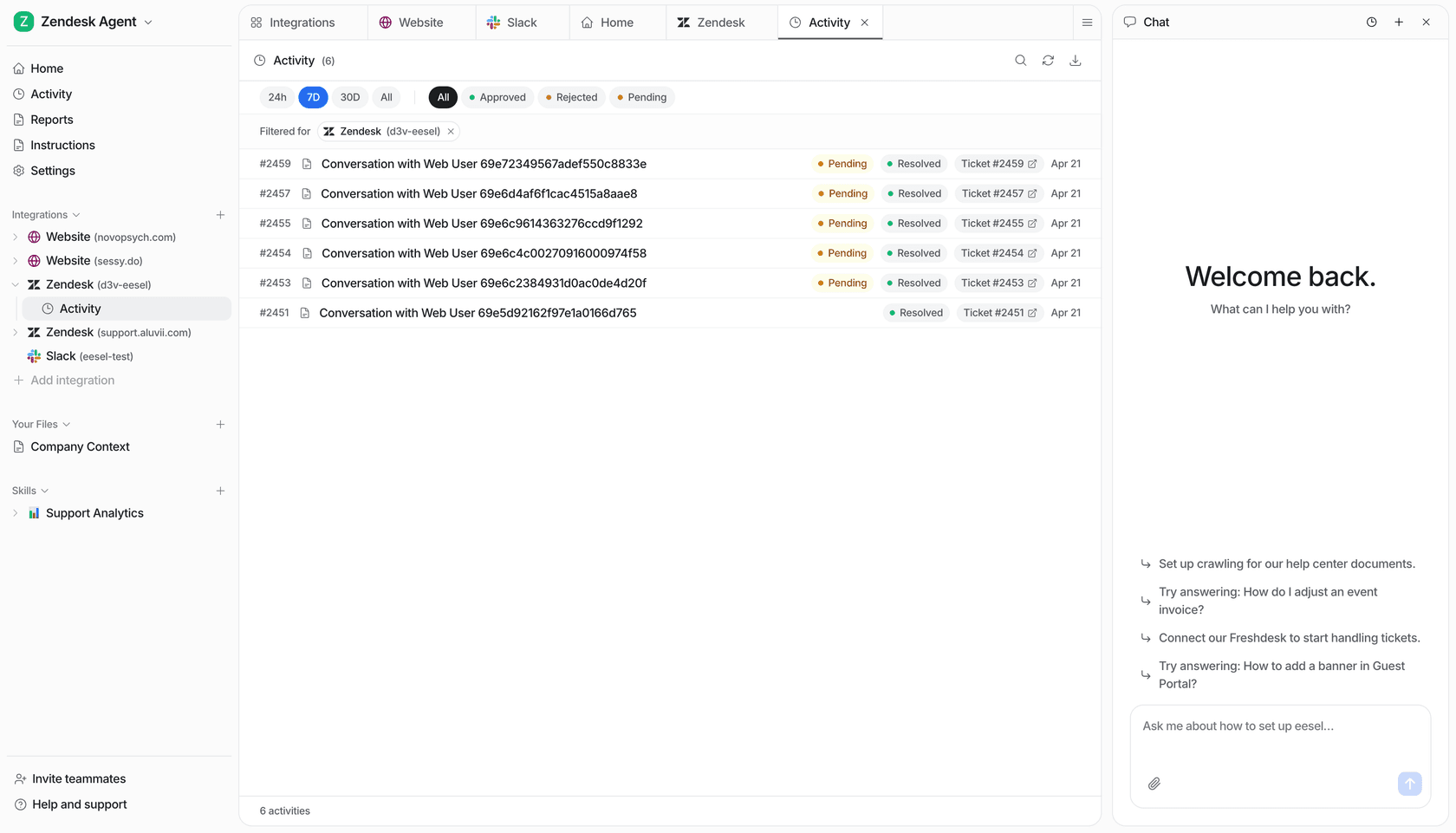
eesel is not a helpdesk. It joins the one you have as an AI teammate: inside Gorgias it reads tickets, drafts and sends replies, adds internal notes, updates tags and status, and pulls Shopify order data into every reply. On a storefront it runs as an ecommerce agent that knows the catalog: stock and variant checks, product comparisons, order tracking with carrier status, return processing, and escalation rules you set in plain language ("always escalate if someone mentions a chargeback").
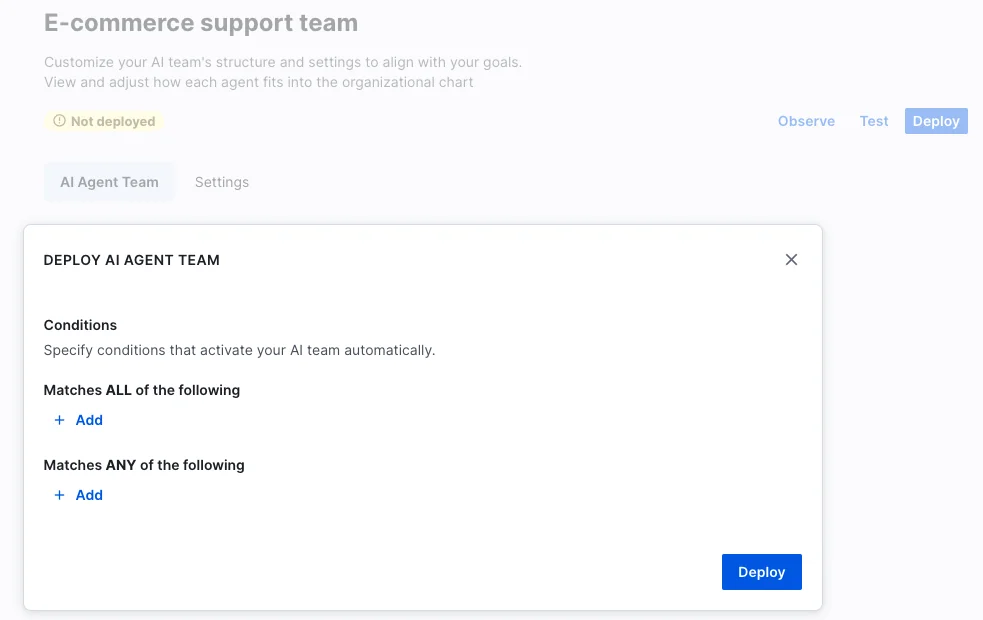
The part I'd want to know as a buyer is the simulation. Before it answers a single live customer it replays against your historical tickets, so you see what it would have said. We built that because we've watched confident bots give wrong answers, and a wrong shipping promise costs you more than a slow reply ever will.
Pricing
| Item | Price |
|---|---|
| Support ticket or chat session | $0.40 each |
| Seats | None |
| Platform fee | None |
| Free trial | $50 of usage, no card required |
| Annual commit | 25% off at $300/mo |
| Enterprise | $1,000/mo flat, plus usage |
One ticket is one task no matter how many messages it takes, and tickets your humans handle are never billed. Spend is capped by a monthly limit (default $250) that pauses the agent rather than surprising you.
Where it wins
Nobody has to change tools, which is the whole point. The Shopify integration reports 80%+ time savings for store teams in the first month and about 30 minutes to connect, across 500+ stores. Gradual rollout is the other advantage: route 200 of your 1,000 monthly tickets to AI and you pay for 200.
Where it falls short
We're the AI layer. Not the inbox, not the phone system, not the CRM. If you don't have a helpdesk yet then you need one of the others on this list as well, and two bills is two bills. There's no published G2 profile to point you at either, and our voice story is thin next to what Gladly or Kustomer can do.
Our take: the right pick when your helpdesk is fine and the queue is what hurts. If you're shopping because the helpdesk itself is broken, buy that first and add us after.
2. Gorgias
Best for: Shopify and Shopify Plus brands that want one platform and one bill.
What it does
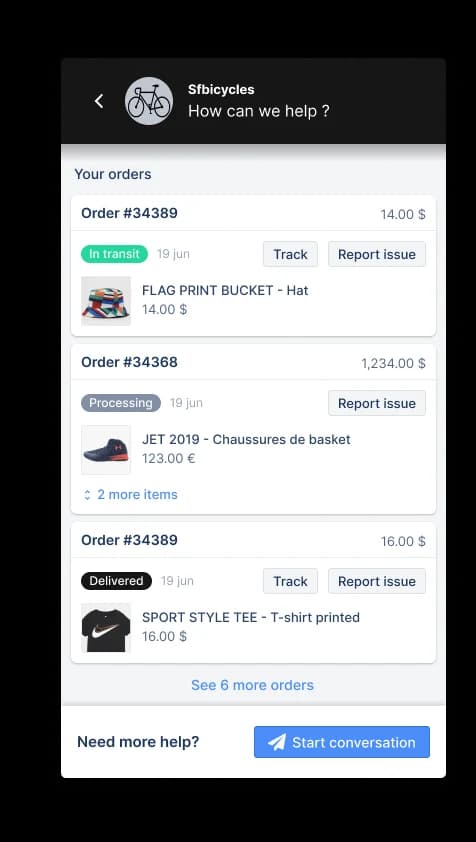
Gorgias is the ecommerce helpdesk most Shopify brands try first, and it claims to power customer conversations for 40% of Shopify brands. Its AI Agent is pre-trained on 18+ verticals and takes actions (cancel, discount, apply), with Flows and Order Management doing the structured work. There are 254 apps in the library and support for TikTok Shop, WhatsApp, Facebook, and Instagram on every plan.
Pricing
| Plan | Monthly | Annual (per mo) | Tickets included | Automated interactions | Ticket overage | AI overage |
|---|---|---|---|---|---|---|
| Starter | $40 | Monthly only | 50 | 30 | $0.40 | $1.50 |
| Basic | $90 | $77 | 300 | 30 | $0.40 | $1.50 |
| Pro | $550 | $471 | 2,000 | 190 | $0.36 | $1.50 |
| Advanced | $1,430 | $1,227 | 5,000 | 530 | $0.36 | $1.50 |
| Enterprise | Custom | Custom | 5,000+ | Custom | - | - |
Voice starts at $25/mo and SMS at $17/mo, both as add-ons.
Where it wins
No per-seat billing at all: 500 user seats on Basic and above. The commerce depth is real, and the customer proof is specific. Orthofeet's customer service lead is quoted saying they aimed for 30% automation in 30 days and are now above 50%. The community read matches:
"If a meaningful chunk is WISMO, address changes, cancels, refunds, exchanges, Gorgias usually feels worth it because the agent can do the work inside the ticket with Shopify context right there."

Where it falls short
Two meters, two overage rates, and that AI overage is the highest here. Starter is really a demo tier: 50 tickets, 3 seats, no brand voice or guardrails, no AI Actions. Magento only appears on Pro and Advanced, and BigCommerce is missing from Starter entirely. The API ceiling of 2 requests per second on every self-serve plan bites if you build custom automation.
Our take: the strongest all-in-one for a Shopify brand under 5,000 tickets a month. Model the $1.50 interactions honestly before you sign, because that line, not the plan fee, is what moves in December. Our Gorgias alternatives piece covers the exits.
3. Richpanel
Best for: stores that want the lowest published cost per AI conversation.
What it does
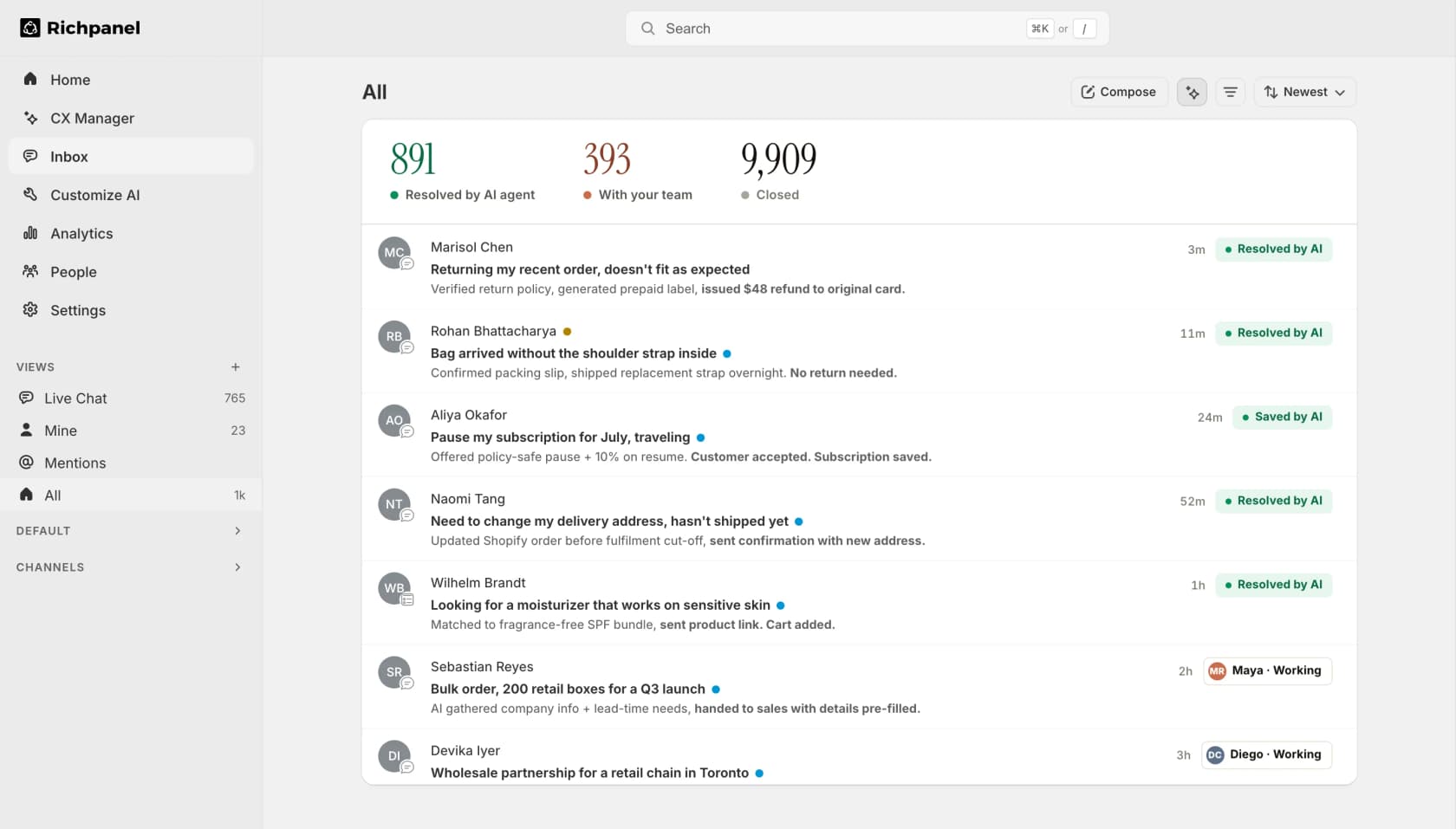
Richpanel is ecommerce-first and leans harder on self-service than anyone else here. Its AI resolves end to end: order tracking with live carrier context, subscription cancellations and pauses with save offers, refund and damage claim verification, and catalog-driven product recommendations. A migration wizard imports from Zendesk, Gorgias, Help Scout, and Kustomer.
Pricing
| Item | Price |
|---|---|
| Helpdesk seat | $99/seat/month |
| AI conversations | From $200 per 1,000 |
| Average AI cost | ~$0.20 per conversation, audited June 2026 |
| Example bill | $299/mo for 1 seat + 1,000 AI conversations |
| Annual | 17% off |
Where it wins
That $0.20 average is a third of what most rivals charge per conversation, and Richpanel is upfront that it is billed on actual token use, so complex conversations cost more. The self-service portal is the other differentiator, cited at a 65% resolution rate on its own customer work. There is also a guarantee: 50% AI resolution in 30 days or your money back.
Where it falls short
There's no self-serve entry at all. You book a demo, and the guarantee comes with a condition, which is letting Richpanel build the AI on your real data first. Seats are the most expensive per-seat line in this roundup at $99, so a five-person team starts at $495/mo before a single AI conversation. Independent review data is thin: G2's page was inaccessible, and the strongest social proof is vendor-curated.
Our take: the value pick if your volume is high and your headcount is low. At five or more seats the $99 line eats the AI savings, so run the numbers at your actual team size. See Richpanel pricing for the full breakdown.
4. Gladly
Best for: premium retail brands where the phone still matters.
What it does
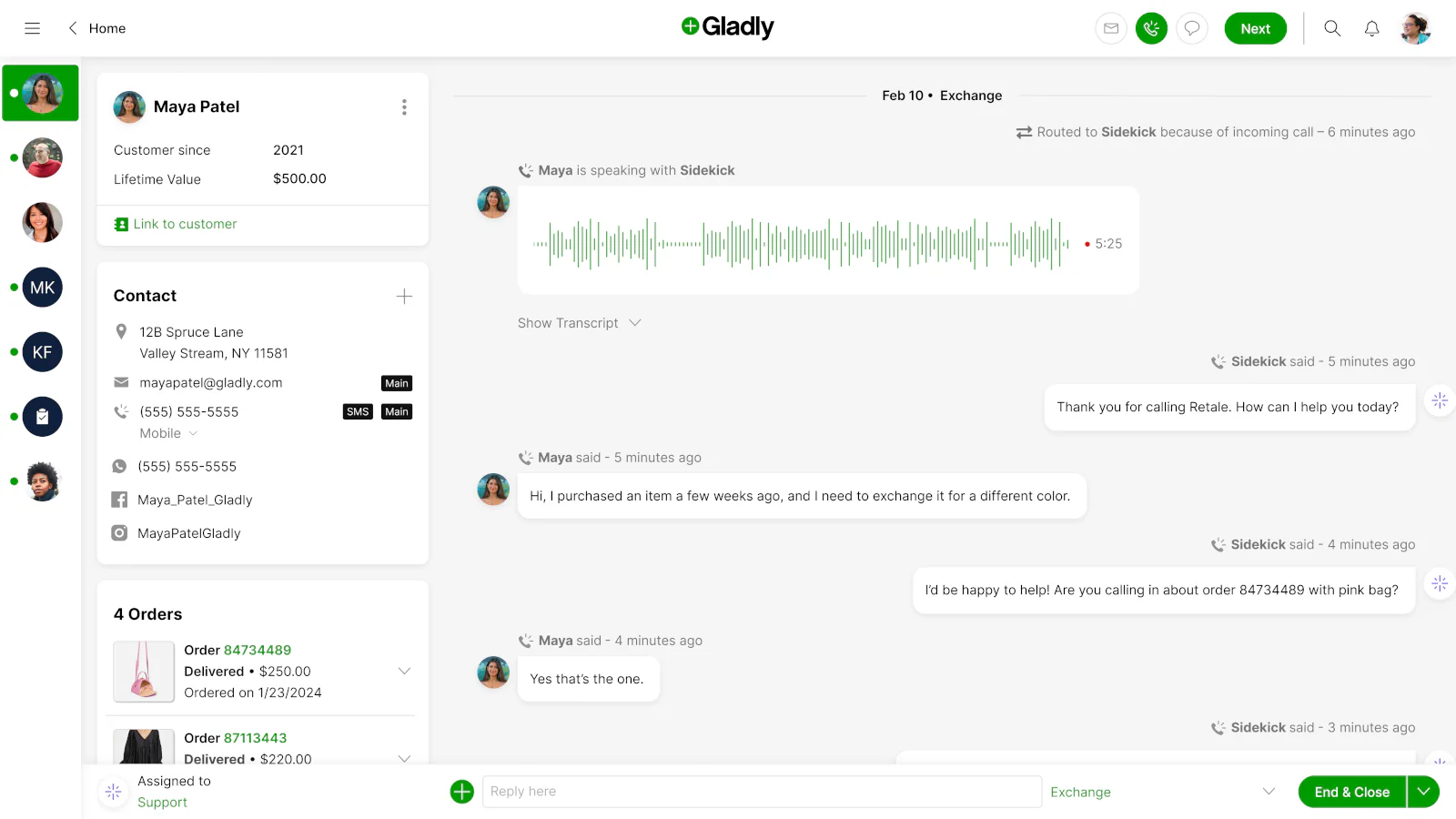
Gladly is built on a people-not-tickets model: one lifelong conversation per customer across chat, voice, email, SMS, and social, rather than a stack of unrelated tickets. Its Sidekick AI takes real actions (cancel order, return or exchange, price adjustment) and does Shopify product recommendations. The customer list is the pitch: TUMI, Ulta, UGG, Crate & Barrel, HOKA, Nordstrom, Bombas, Rothy's.
Pricing
| Item | Price |
|---|---|
| Team member (Shopify plan) | $120/month |
| AI Resolution | $1.50 |
| AI Assist | $0.25 |
| Sidekick on Voice | $0.06216/minute |
| Free trial | 30 days, 100 AI interactions, 1 seat |
| Core platform seats | Not published |
The Shopify App Store listing is the only place Gladly publishes numbers. Third-party sources quote seat prices between $169 and $210 a month with 10 to 45 seat minimums, and they contradict each other, so treat them as rumour.
Where it wins
Real omnichannel, a 4.7 G2 rating across 1,112 reviews, and Sidekick does the retail actions rather than describing them. One ecommerce director's review captures the appeal:
"On top of that, the Sidekick chatbot has been a huge asset. It helps customers with returns, order tracking, and other self-service needs, freeing up our agents to focus on higher-level, more personalized conversations that truly impact the customer experience."

Where it falls short
Cost is the consistent complaint, and reporting is the consistent gripe. A G2 reviewer put the first one plainly: "To be quite frank, gladly is very expensive. The per-user cost may be very expensive to a mid-sized company and they lack a flexible plan." On reporting, a CX manager in retail said the structure "feels too segmented, requiring users to pull information from multiple areas rather than having access to a holistic, consolidated data view."
Our take: worth it for brands whose customers call, whose AOV is high, and whose CX budget is a line item rather than a rounding error. Everyone else should look at Gladly alternatives first.
5. Kustomer
Best for: high-volume DTC that needs the whole customer history on one screen.
What it does
Kustomer's model is a customer timeline rather than a ticket queue: order history, loyalty tier, and churn risk in one view, across chat, email, SMS, WhatsApp, Facebook, Instagram, and its own voice product. The retail roster is deep, including Turo, Everlane, Skims, MeUndies, and Vuori.
Pricing
| Item | Price |
|---|---|
| Seats | Quote only |
| AI Agents for Customers | $0.60 per engaged conversation |
| AI Agents for Reps | $40 per user/month |
| Storage overage | $50/GB/month |
| HIPAA compliance | +$25/user/month |
The public pricing page is now a two-step ROI estimator that routes to sales. The $89 and $139 seat figures floating around the internet come from a competitor's teardown, not from Kustomer.
Where it wins
The AI numbers are real where brands have published them: Vuori reports 70% of chat conversations fully automated with Kustomer AI. G2 sits at 4.4 across 555 reviews, and the data model suits subscription and marketplace retail well.
Where it falls short
You can't compute total cost from public information. Full stop. Billing on "engaged conversation" means the meter fires whether or not the customer got an answer. And evaluation friction is real, as one r/CustomerSuccess commenter noted:
"They also don't allow you to just install the app on Shopify and trial it for 14 days which is a big flag for me."
Another flagged the voice channel as "incredibly buggy," with dropped calls and routing failures.
Our take: a strong platform hidden behind an opaque sales process. If you are under 20 agents, the Kustomer alternatives list will save you three discovery calls.
6. Zendesk
Best for: large retail orgs with complex routing, brands, and compliance needs.
What it does
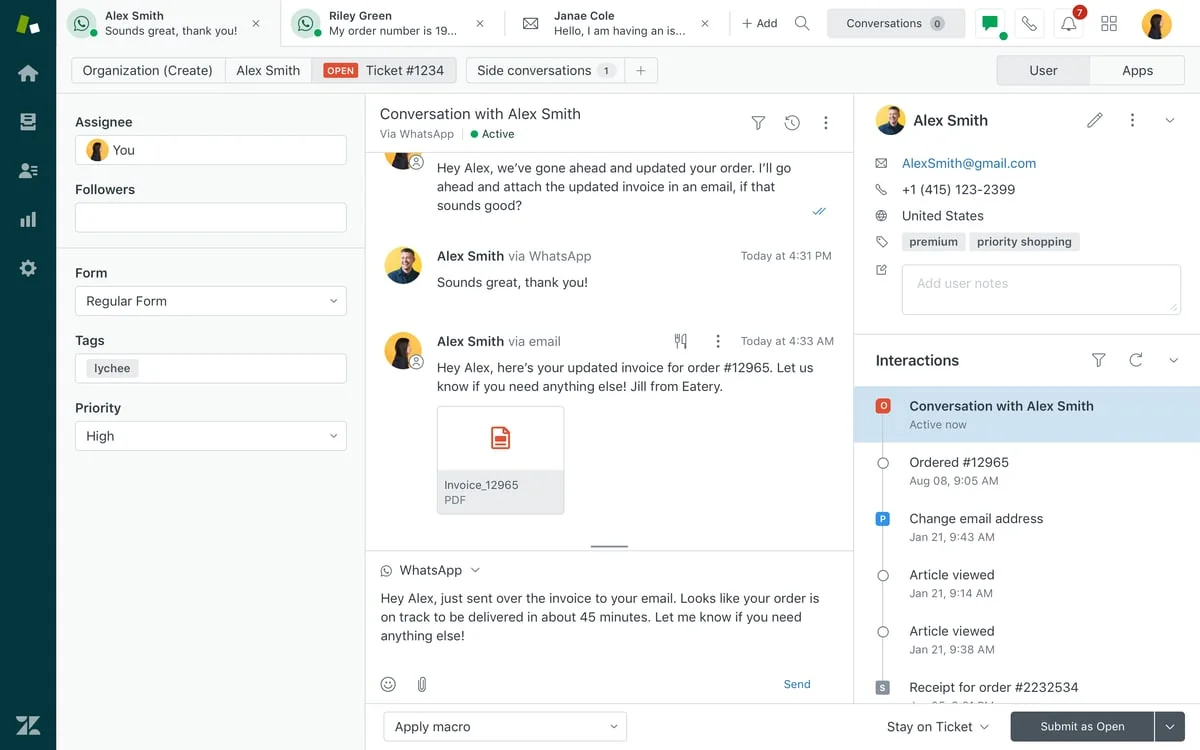
Zendesk is the default enterprise helpdesk, and for retail its value is the routing and reporting rather than any commerce-native cleverness. AI agents are bundled into every Suite plan and bill on automated resolutions, with App Builder, Action Builder, and Voice metered on consumption.
Pricing
| Plan | Price per agent/month (annual) |
|---|---|
| Support Team | $19 |
| Suite Team | $55 |
| Suite Professional | $115 |
| Suite Enterprise + Copilot | Quote only |
| Copilot add-on | $50/agent/month |
| Contact Center add-on | $83/agent/month |
Where it wins
Depth. Nothing else here handles multi-brand routing and SLA policies and reporting at Zendesk's level, and the marketplace fills most of the commerce gaps. G2 has it at 4.3 across 6,964 reviews, which is the largest sample in this roundup by an order of magnitude.
Where it falls short
The per-resolution AI rate is not published, so budgeting means a sales call. Customers who have had that call are not thrilled with the answer:
"From what I can see in regards to this new 'Automated Resolution' pricing model, we'll be paying about $1.50 ~ $1.20 per resolution. And what Zendesk counts as a resolution can be ... subjective... If you have 500 AR per week, the bill blows out to be $650, where there wasn't a charge before."
Copilot stacks on top of seats, taking Suite Professional to $165 per agent per month. And it is not retail-native: there is no Shopify connector in the base product, so the order data arrives via an app you configure yourself. An ecommerce operator running multiple brands told us he tried the native AI and found it expensive and inadequate, then wanted to switch "yesterday."
Our take: right for retail at enterprise scale, oversized for a store doing 1,000 tickets a month. If the platform is fine and only the AI disappoints, Zendesk AI alternatives is the cheaper fix.
7. Freshdesk
Best for: teams covering both a storefront queue and internal IT on one budget.
What it does
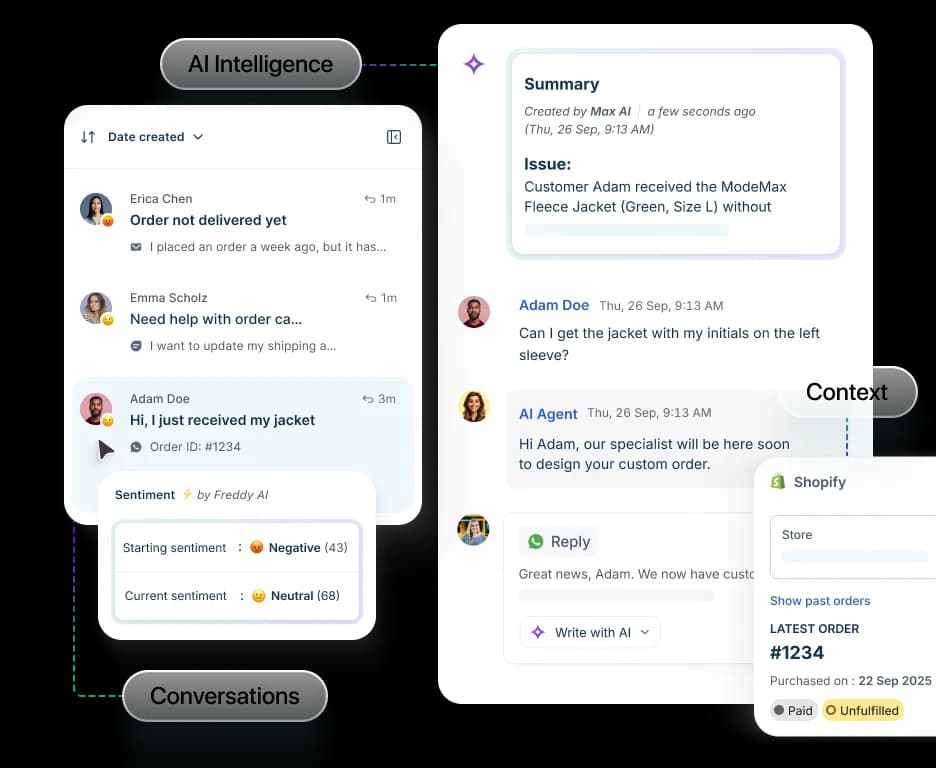
Freshdesk is the value play: solid ticketing, a decent knowledge base, and marketplace connectors for Shopify, Stripe, and PayPal. Freddy AI Agent handles customer-facing conversations, and Freddy Copilot drafts for agents.
Pricing
| Item | Price |
|---|---|
| Growth | $19/agent/month |
| Pro | $55/agent/month |
| Enterprise | $89/agent/month |
| Freddy AI Agent | 500 sessions included on every plan, then $49 per 100 |
| Freddy Copilot | $29/agent/month, Pro and Enterprise only |
| Connector app tasks | $80 per 5,000 |
Where it wins
The 500 included Freddy sessions are the most generous free AI allowance here, and they land on every tier including the $19 one. At $0.49 per extra session it is also mid-pack on rate. G2 puts Freshdesk around 4.4 across roughly 3,750 reviews.
Where it falls short
The session mechanic confuses people, understandably: on email, one session is a 72-hour window, so a customer who replies four times in three days is still one session, and a fifth reply on day four is a new one. Community reports are mixed on accuracy, including a Reddit account of AI that "worked for very simple tickets but anything slightly complex got misclassified." Copilot is Pro and up, so the cheapest plan is customer-facing AI only.
Our take: the best price-to-capability ratio for a mixed queue. For a pure Shopify storefront, Gorgias or Richpanel understands your data better out of the box. Full numbers in our Freshdesk pricing guide.
8. Tidio
Best for: small stores that want a chat widget live this afternoon.
What it does
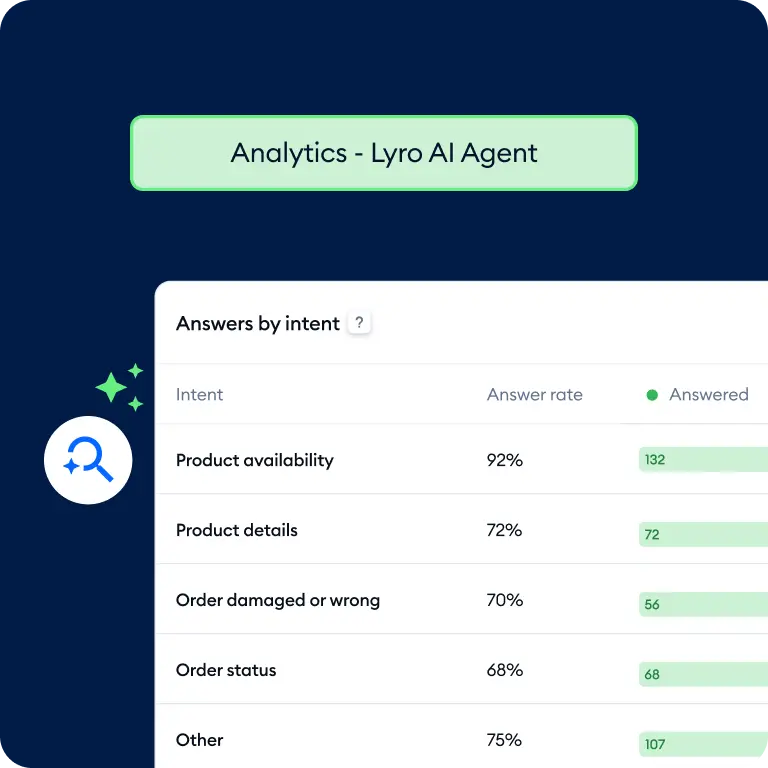
Tidio is chat-first, with the Lyro AI agent layered on top. Lyro Smart Actions perform order updates and lead qualification through live system integration, and product recommendations pull from your store catalog. Native integrations named on the homepage are Shopify, WordPress, and Squarespace. Retail names on the customer list include Under Armour, The Body Shop, and Stanley.
Pricing
| Meter | Entry | Ladder |
|---|---|---|
| Customer Service conversations | Free: 50/mo | Starter $29 (100), Growth from $59 (250) up to $349 (2,000) |
| Lyro AI conversations | $39/mo for 50 | Flattens at $0.70 each from 200 up; $700 for 1,000 |
| Flows (visitors reached) | Free to 100 | $29 (2,000) up to $299 (100,000) |
| Branding removal | ~$20/mo on Growth | Free on Plus and Premium |
Where it wins
Speed to live, and seats do not cost extra: 10 of them on Free, Starter, and Growth. One small-store operator on Reddit described getting a widget and a basic FAQ bot running "within like an hour," and called the free plan "actually usable."
Where it falls short
Three meters is two too many, in terms of anything a small store wants to think about. A conversation Lyro starts and a human finishes burns both a Lyro conversation and a billable conversation. The 50 free Lyro conversations are a one-time grant, not monthly. And Lyro Connect, which puts Lyro on an external helpdesk, is gated to Plus and Premium. Pricing frustration shows up in the community:
"Just had a conversation with tidio, their pricing is so off and hidden, "free tier" is just a trap includes most services that are billed separatedly once you want to scale."
Our take: great under 250 conversations a month, awkward above 1,000 where the ladder hands you to sales. Compare with Tidio Lyro alternatives before you scale into it.
9. Re:amaze
Best for: small operators running a few storefronts on one inbox.
What it does
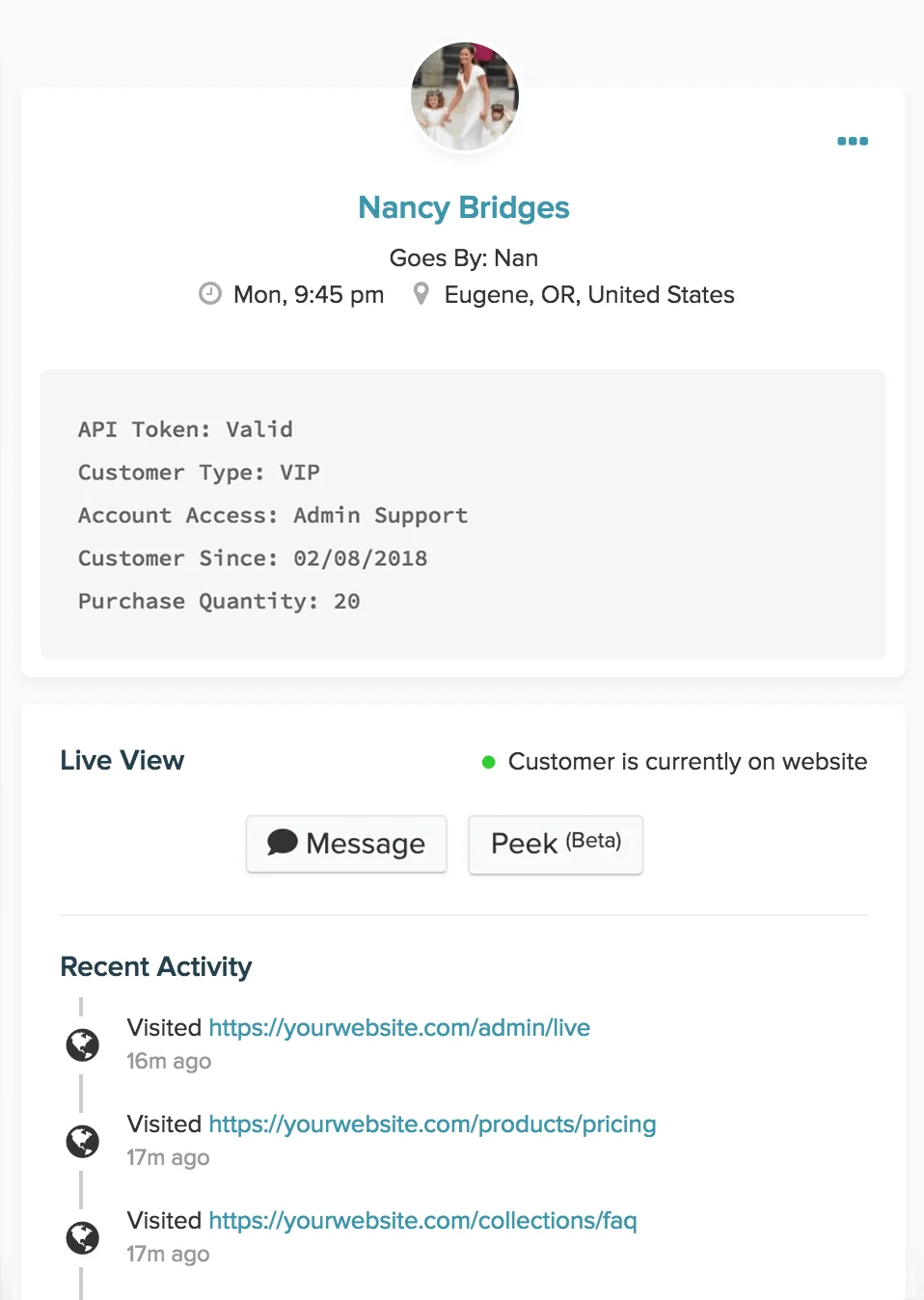
Re:amaze puts order and shopping data inside the conversation, so an agent sees the order number, items, and history without leaving the message. Order Bot and Welcome Bot ship on every paid tier, and a live dashboard shows real-time shopper activity. The AI Agent is still labelled beta.
Pricing
| Plan | Monthly | Annual (per mo) | AI resolutions included |
|---|---|---|---|
| Starter | $59 flat | - | Not listed |
| Basic | $29/member | $26.10 | 5 per user |
| Pro | $49/member | $44.10 | 10 per user |
| Plus | $69/member | $62.10 | 20 per user |
Extra resolutions are $0.85 each on every tier. Starter is unlimited team members but caps at 500 responded conversations a month.
Where it wins
It's cheap, it's quick, and reviewers like the breadth of it. G2 has it at 4.6 across 140 reviews and Capterra at 4.8 across 53. One head of product summed up the appeal:
"Re:amaze allows me to do a lot with minimal time and money investment... It's a real Swiss Army Knife of customer engagement."
Where it falls short
The included AI is tiny: 10 resolutions per user per month on Pro means a five-person team gets 50 before the $0.85 meter starts. The AI is beta. And the rough edges are real, per reviewers: a knowledge base editor that cannot upload images, and social integrations that "regularly has some 'issues' which cause it to break."
Our take: good value for a store under 500 conversations a month. Past that, the per-user AI allowance is too small to matter and you are paying $0.85 a pop. Details in our Re:amaze review and how much Re:amaze costs.
10. Zoho Desk
Best for: budget-conscious retail running several brands and a lot of channels.
What it does
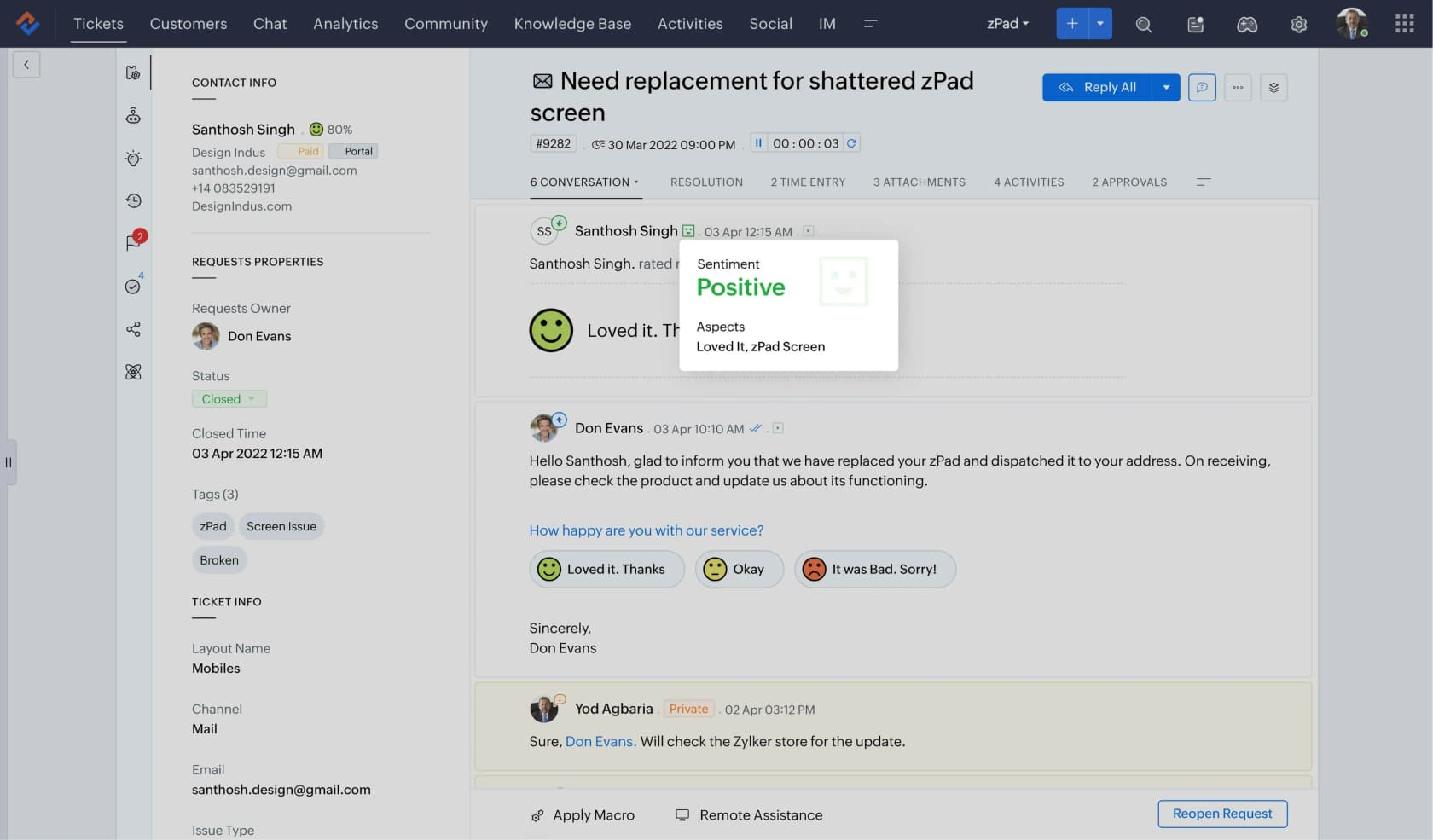
Zoho Desk buys more channels per dollar than anything else here. Instagram, Facebook, and X arrive at the $7 tier; WhatsApp, Messenger, Telegram, WeChat, and Line at $14. Multi-brand help centers are an Enterprise capability, which matters if you run several storefronts.
Pricing
| Plan | Price per user/month (annual) |
|---|---|
| Free | $0, 3 users, email only |
| Express | $7 |
| Standard | $14 |
| Professional | $23 |
| Enterprise | $40 |
| Light users | $6 each, Professional and Enterprise |
AI is bundled rather than metered: 30M free tokens a month for AI Agents from Express up, plus a bring-your-own-key option for OpenAI or DeepSeek where you pay the model provider directly.
Where it wins
Nothing else gives you WhatsApp and five other messengers for $14 a seat. Bundled AI tokens mean no per-resolution meter to model, and BYOK is a different answer to AI pricing than anyone else here gives.
Where it falls short
The AI features are ladder-gated in a way that is easy to misread: AI Agents at Express, Answer Bot at Standard, Zia at Professional, Guided Conversations at Enterprise. Bot chat inside the self-service widget is Enterprise-only even though the widget starts at Standard. There is no documented commerce connector, so order data is a build-it-yourself job.
Our take: the best channel coverage per dollar in retail, as long as you accept that your AI stops at answers and does not touch orders. Full tier map in our Zoho Desk pricing guide.
Three more worth knowing about
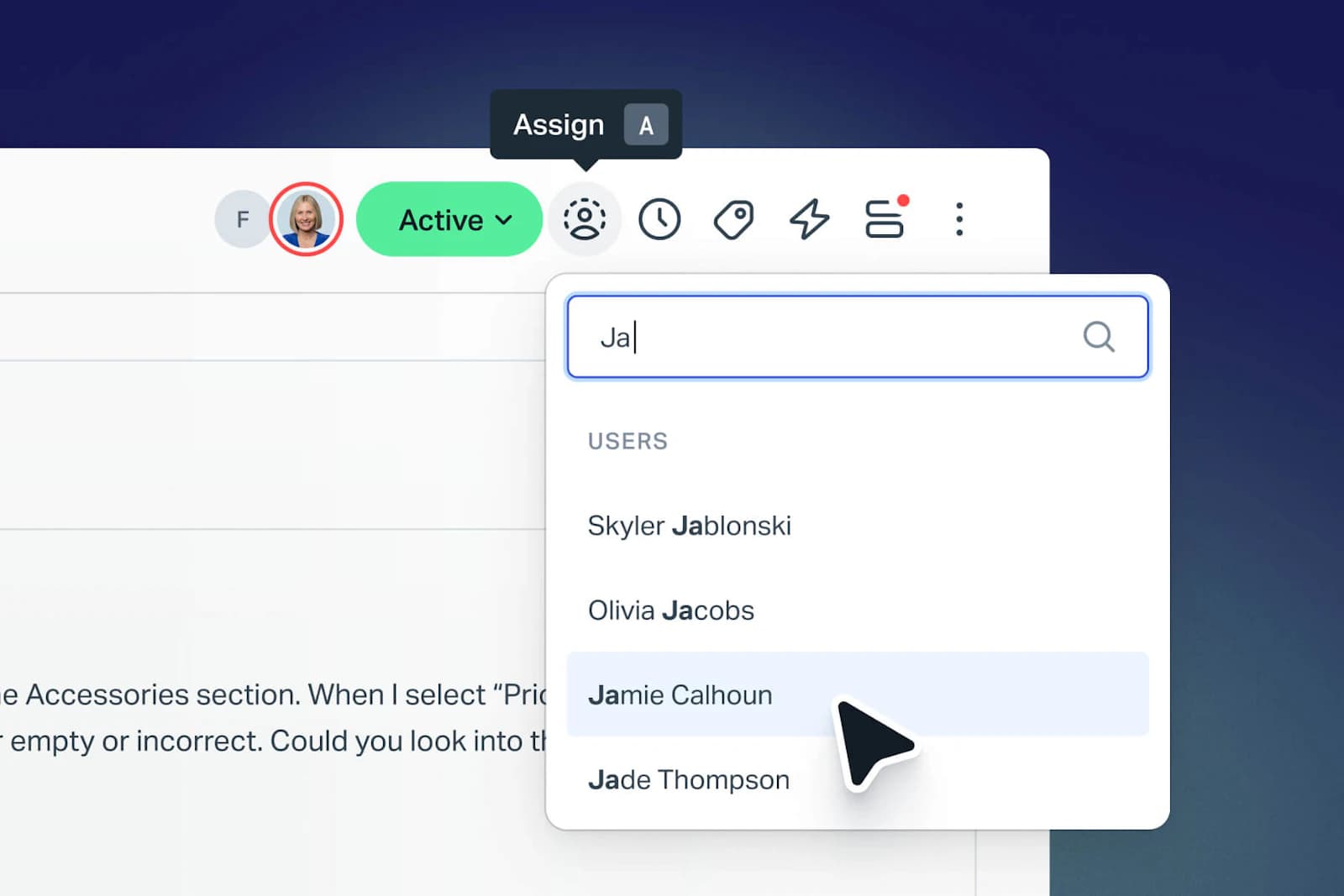
Help Scout is the cleanest email-first inbox on the market at $25 to $75 per user per month, with AI Answers at $0.75 per resolution and three months of unlimited AI Answers when you start. It has no retail-specific features at all, which is either fine or disqualifying depending on your queue. Worth noting it experimented with per-contact billing in April 2025 and reverted to per-seat in November.
Shopify itself is the layer underneath most of these tools, and its plan pricing shapes your options: Basic $29/mo annual, Grow $79, Advanced $299, Plus from $2,300. Carrier-calculated shipping rates are gated to Advanced and up, which matters if you want accurate delivery answers in support. See our Shopify pricing breakdown.
A dedicated order tracking chatbot is worth considering if WISMO is your only real problem. It's a smaller purchase than a helpdesk and solves the biggest slice on its own.
What 2,000 tickets a month actually costs
Assume 2,000 tickets, 60% handled by AI (1,200 conversations), and five agents. Published rates only.
| Tool | Monthly | What it includes |
|---|---|---|
| eesel | $480 | AI only, on top of your existing helpdesk |
| Zoho Desk Professional | $115 | Seats + bundled AI tokens |
| Freshdesk Pro | $618 | 5 seats + 700 extra Freddy sessions |
| Richpanel | ~$735 | 5 seats + ~1,200 AI conversations |
| Zendesk Suite Professional | $575 + AI | AI resolutions not published |
| Re:amaze Pro | $1,223 | 5 seats + 1,150 extra resolutions |
| Help Scout Plus | $1,125 | 5 seats + 1,200 resolutions |
| Gorgias Pro | $2,065 | Plan + 1,010 interactions over bundle |
| Gladly (Shopify plan) | $2,400 | 5 seats + 1,200 AI resolutions |
| Kustomer | $720 + seats | AI only; seat price unpublished |
Two things jump out. The spread on identical work is roughly 5x. And the cheapest lines on that table (Zoho Desk, eesel) are cheap for opposite reasons: one bundles the AI and limits what it can do, the other unbundles the platform entirely.
Now multiply by four for November. Gorgias Pro goes to $9,625: $550 for the plan, $6,915 as 4,800 interactions run past the 190 bundle, and another $2,160 in ticket overage at $0.36 once you clear 2,000. eesel goes to $1,920. Zoho Desk stays at $115 because the tokens are bundled, right up until you find out what AI that cannot touch an order is worth on the day 8,000 people ask where their parcel is.
How to roll one out before peak season
The failure I see most often: a store buys in October and goes live in November. Do it in this order instead.
- Pull last year's peak volume, not last month's. Your baseline is a lie for eight weeks of the year.
- Count your ticket mix before comparing tools. If WISMO and returns are 60% of it, buy for order access first and inbox features second.
- Replay the AI on historical tickets before it touches a live customer. Any vendor that cannot simulate against your own past tickets is asking you to test in production during your busiest month.
- Start narrow. Order status only, then returns, then product questions. Our ticket deflection guide covers the sequencing.
- Set the handover rule in writing. Confidence threshold, ticket types excluded, and what happens at 2am. The AI handover checklist covers the thresholds.
- Cap your spend. Every usage-based tool here lets you set a limit. Set it before Black Friday, not after.
- Measure resolution, not deflection. A conversation the customer abandoned is not a resolution, and the two get conflated constantly, including by the vendor doing the billing:
"the subjective part in the resolutions. who knows if the bot is just leaving the customer hanging and marking it as a resolution... the bot just didn't help the customer in anyway. they got agitated and abandoned the chat and it was considered a resolution"
Read AI resolution rate and AI CSAT before you accept anyone's dashboard number.
One other thing worth saying here. Buyers stall on trust, not on price. Nobody wants a bot answering everything from day one. The teams that get this right pick the boring 30% of tickets, automate those properly, then expand.
Try eesel on the queue you already have
If your helpdesk is fine and the queue is what hurts, you don't need a migration in Q4. eesel joins Gorgias, Zendesk, or Freshdesk as an AI agent, reads your Shopify catalog and orders, and handles the WISMO and returns slice at 40¢ per ticket with no seat fees and no platform charge. Before it replies to anyone, it replays against your historical tickets so you can see exactly what it would have said, which is how our Gorgias customers get to 85%+ tier-1 resolution in about a week.
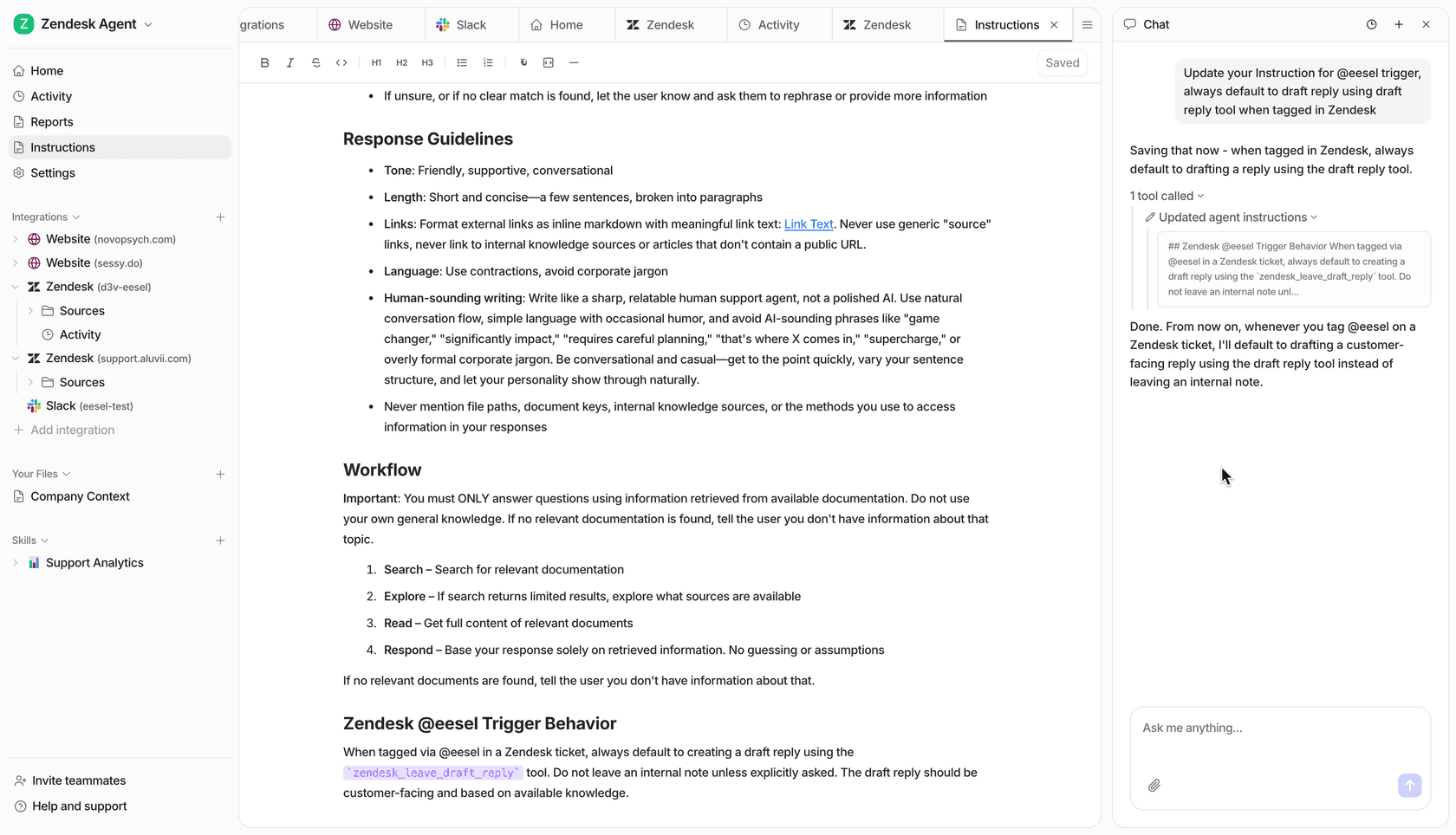
Start with $50 of free usage, no card. Route 200 tickets at it, see what comes back, then decide.
Frequently Asked Questions
What is retail customer service software?
How much does retail customer service software cost in 2026?
What is the best retail customer service software for a Shopify store?
Can retail customer service software handle returns and exchanges automatically?
What happens to my retail support software bill during Black Friday?
Is free retail customer service software good enough for a small store?
Do I need to replace my helpdesk to add AI to a retail queue?



Article by
Riellvriany Indriawan
Riell is a designer and writer at eesel AI with about two years of experience researching CX platforms, AI chatbots, and helpdesk software. She combines her design background with a sharp eye for how these tools actually look and feel in practice — making her comparisons unusually visual and user-focused.