
Jira Service Management has no built-in scorecard that grades agent replies against your own criteria. What Atlassian gives you is customer ratings (CSAT), an agent-versus-team CSAT report, and, for its own AI, Rovo Agent Evals and live conversation review. For per-ticket rubric scoring, I'd add a Marketplace app like Service Quality Review (human reviewers, AI-found evidence, about $39 a month at the listing's default estimate) or an eesel review job that scores closed requests and leaves its reasons in an internal note. With the eesel CLI, an AI coding agent can upload your rubric and policy docs and ask test questions to check the answers before a review run touches real requests. Connecting Jira itself still needs someone with admin access to approve it.
Does Jira Service Management have AI quality assurance?
Not in the sense most support leads mean. I read Atlassian's Jira Service Management and Rovo pages on 2026-11-22 looking for a feature that grades a reply against a rubric, and I found four things that check something nearby, plus a gap where the scorecard would go.
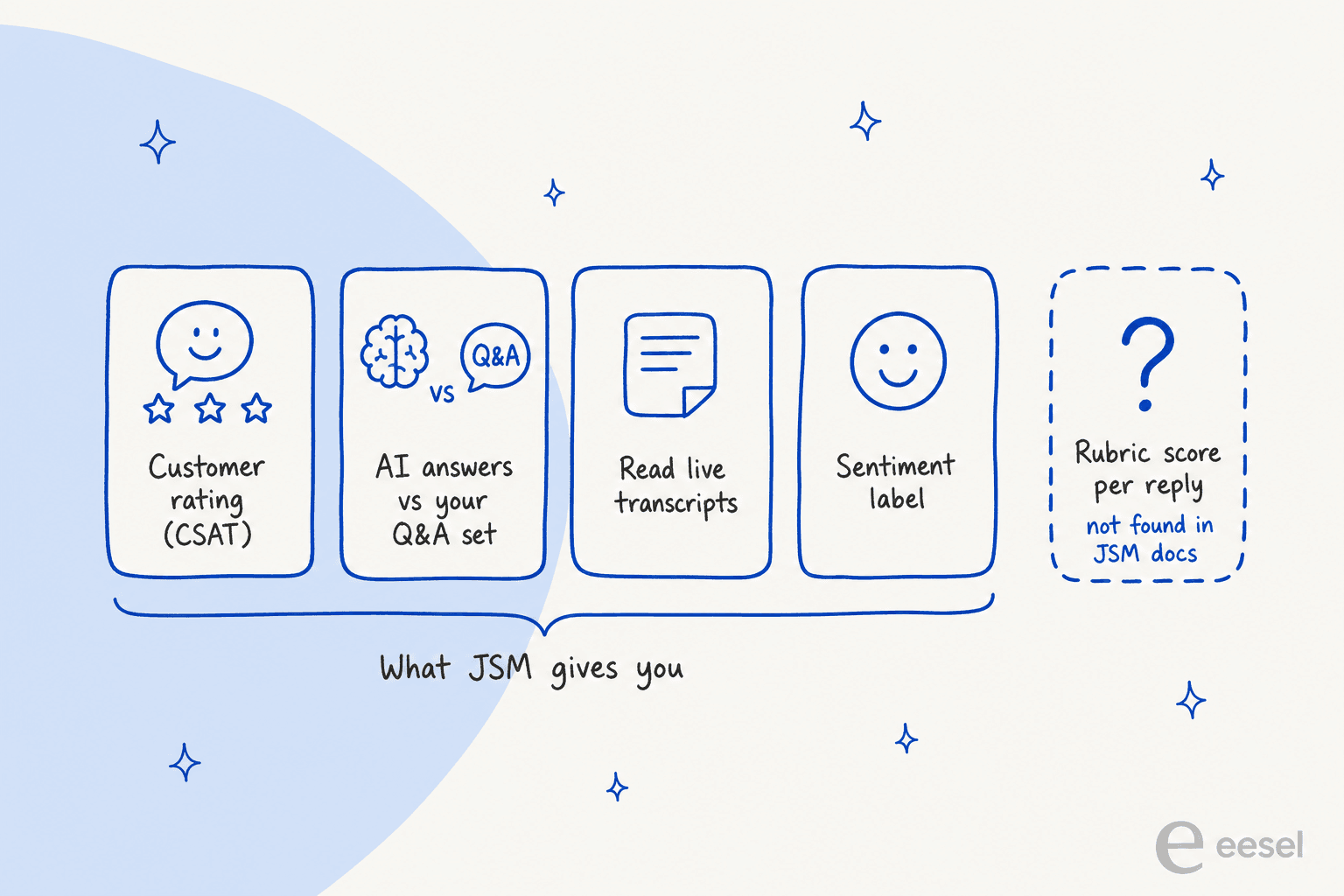
The split that matters is who or what is being judged. Atlassian's tools judge the customer's outcome (a rating) or Atlassian's own AI (an eval set). None of them says whether your human agent followed your refund policy.
| What it is | What it checks | Plan and gating | Source |
|---|---|---|---|
| CSAT and satisfaction reports | The customer's rating, average by team or by agent | Turn on feedback in project settings | Atlassian trends doc |
| Customer sentiment | Positive, Neutral or Negative on each request | Premium or Enterprise, with AI enabled | Sentiment doc |
| Virtual service agent test mode and Conversations page | Intent matches, AI answers, escalations, CSAT per conversation | Virtual service agent plans | Test mode doc |
| Rovo Agent Evals | A Rovo agent's answers against a CSV of questions | Studio, on a published agent | Atlassian announcement |
| Live conversation review | Transcripts and thumbs feedback on a Rovo agent's chats | Org admin or Studio admin enables it | Rovo doc |
| Rubric score per human reply | Not found in Atlassian's docs | n/a | n/a |
I build integrations at eesel, so I read these pages asking what each one reads and what it writes. The pattern is steady: Atlassian built the testing tools around its AI, and left grading humans to the Marketplace.
What does CSAT tell you about agent quality?
It tells you how customers felt, which is useful and different. The default satisfaction report shows the average rating for your team, and Atlassian describes a custom report that compares an agent's score with the team's, which it says helps "identify agents who would benefit from further training".
Two limits show up in Atlassian's own pages. A support article says the standard report "aggregates results and limits filtering", so slicing by request type or organization means exporting issues to CSV and pivoting them yourself. Atlassian tracks a better export as feature request JSDCLOUD-4749. And a rating only exists when the customer answers.
A team asked for exactly this on the Atlassian Community in 2024, and the answer pointed back at CSAT:
"We aren't so much looking to track customer satisfaction here, as we are to evaluate the quality of the service our agents provide."
CSAT measures the outcome, QA measures the handling, and a polite agent can still promise a refund the policy does not allow. For the sentiment side, see AI sentiment analysis for support.
How do you test and monitor JSM's own AI?
Here Atlassian has done real work, and it is the part of "AI QA" that does exist natively. There are three layers, in the order you'd use them.
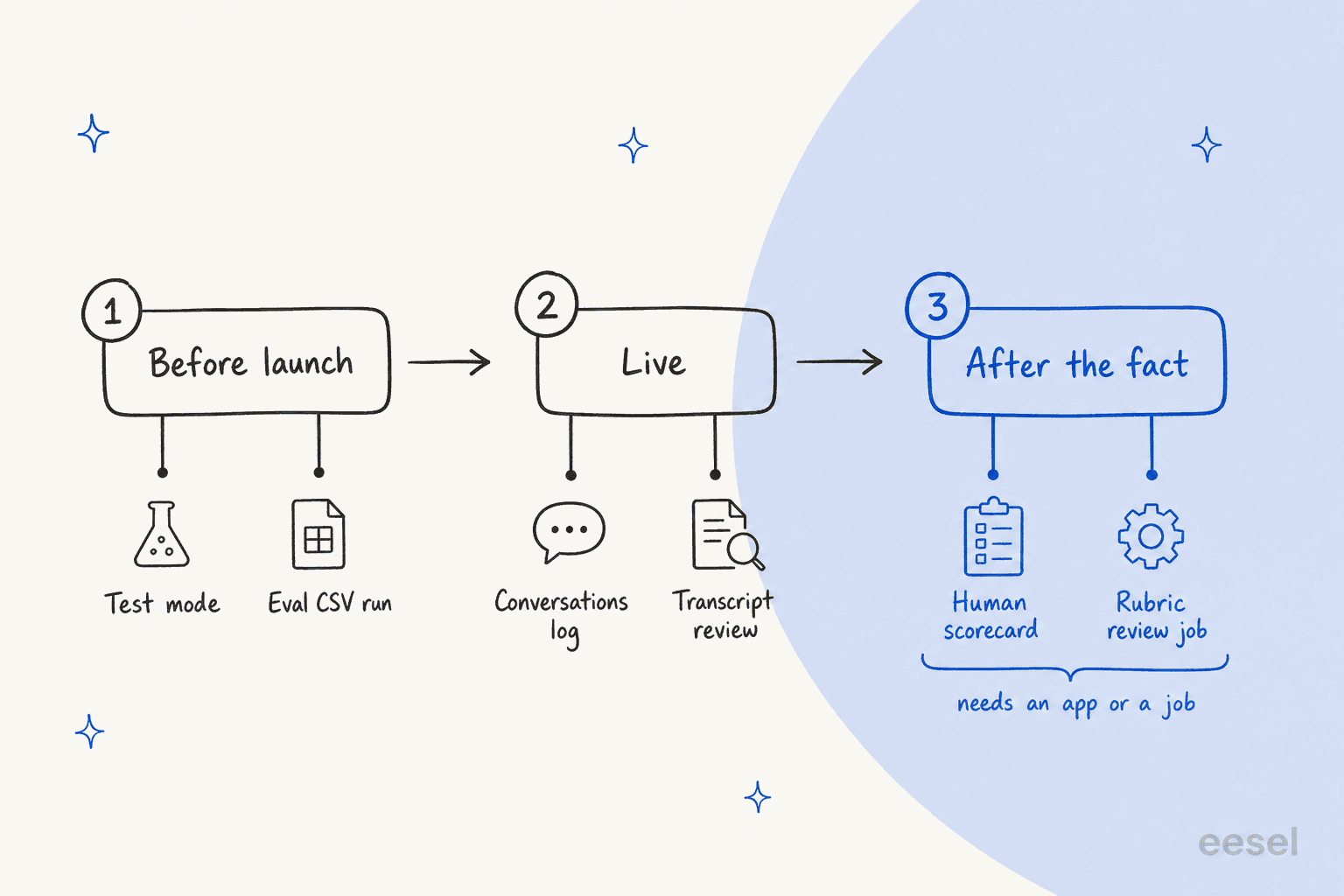
Before launch. Test mode lets you try intents and AI answers before customers see them. Atlassian says test conversations are not counted in performance statistics, but the virtual service agent still creates real issues, so clean those up. For Rovo agents, Agent Evals launched on 2026-03-05 with three modes:
- Response Accuracy. You upload questions and ideal answers as a CSV, and an LLM judge compares your agent's replies with them and returns pass or fail plus feedback.
- Resolution Rate. You upload questions only, and an LLM marks each interaction Resolved or Unresolved.
- Manual Testing. You run a batch of questions and read the answers side by side.
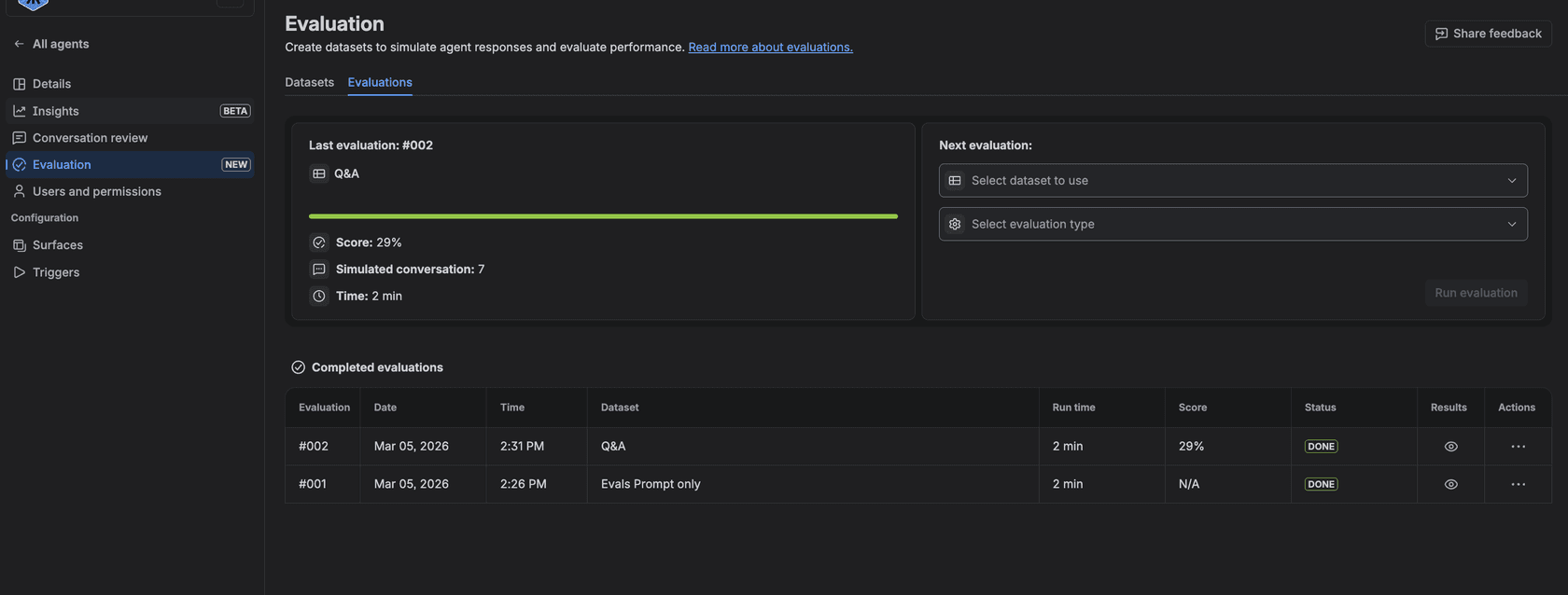
That screenshot is Atlassian's own example, and a 29% score on a first run is a fair reminder of why you test. The announcement does not say whether eval runs use Rovo credits, so ask before you run a big set. I found no mention of dataset versioning in the post either, although a partner asked about it in the comments.
While live. The virtual service agent's Conversations page logs each chat as Matched, AI answered or Unassisted, and as Escalated, Resolved or Closed, with a CSAT column. It only shows portal, help center and Slack conversations today. Atlassian's own tip is to filter AI-answered chats that were escalated or rated low, because that "might indicate that your knowledge base is out of date". In the help center, admins also get Performance figures for conversations, matched, resolved and CSAT.
For Rovo agents, live conversation review is newer. The feature request for it (ROVO-356) was marked fixed on 2026-09-03. Agent creators and managers can read transcripts and see thumbs-up or thumbs-down and written feedback on individual messages. Users see a privacy notice, and the page gives a 30-day retention period (a later line on the same page says 28 days for message feedback, so check which applies). Before it shipped, an admin put the problem plainly:
"I can't see the customers converstaions or initial messages... I don't really now how to improve rovo if I can't see on which conversations it didn't perform well"

The gap. One request is still open: JSDCLOUD-15987, filed in February 2025, asks for detailed virtual service agent reports in the project's Reports section, covering both intent recognition and AI-generated responses. It is unresolved with 5 votes. My earlier look at the product's AI is in JSM AI evaluation.
Which Marketplace apps score agent tickets?
I found one app built for it, and it is new. Service Quality Review by Magnascale is a Cloud app, partner supported, on version 2.2.0 released 2026-11-06. The listing shows no installs yet, so treat it as early.
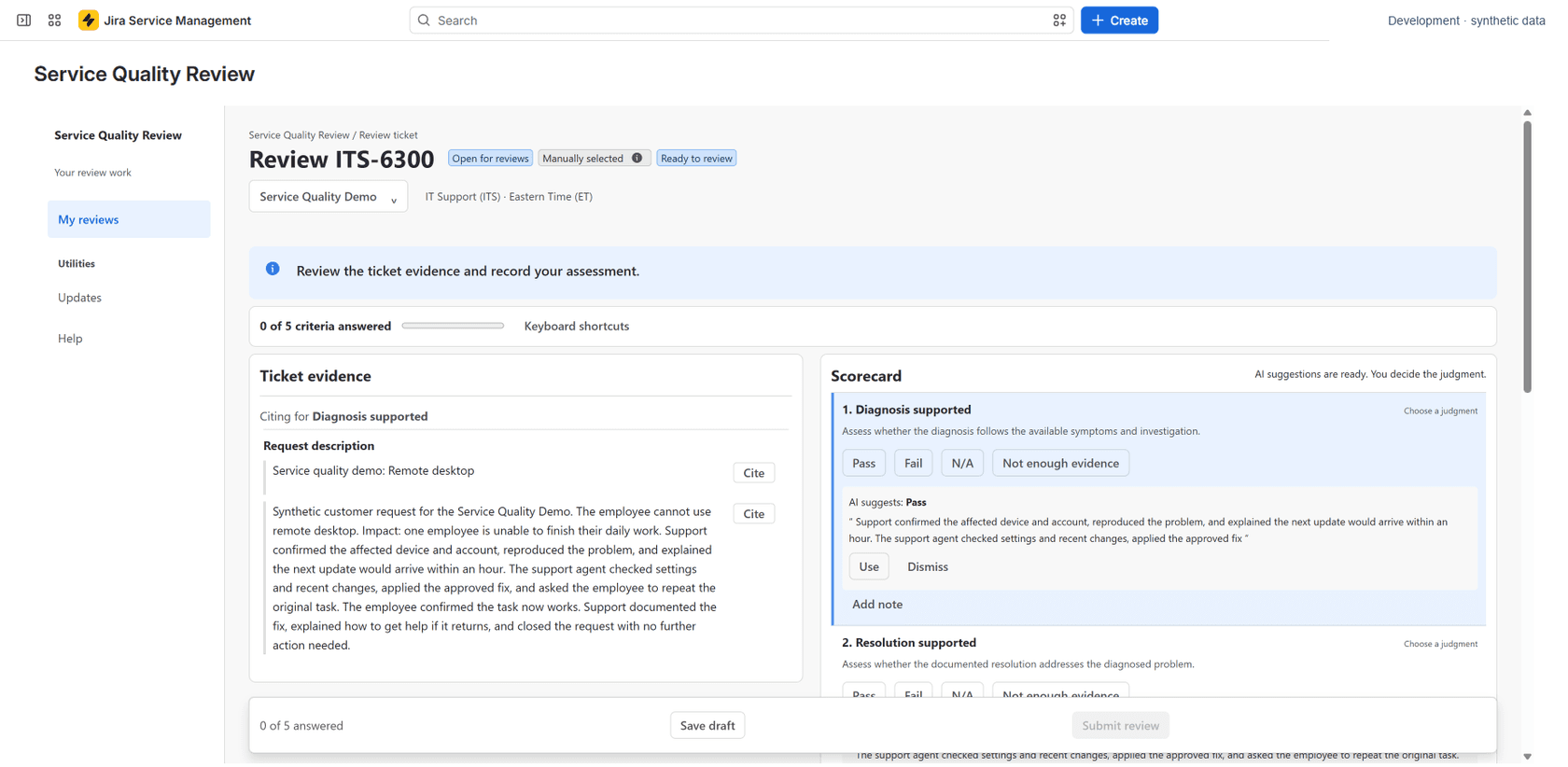
What the listing and the partner docs say it does:
- Criteria and sampling. Managers set versioned criteria and choose tickets by random sample, minimum coverage per agent, targeted rules or by hand. Samples are frozen and labelled, with self-review checks.
- Human decisions, AI evidence. AI finds quoted ticket passages that support or contradict a criterion, and flags mixed or insufficient evidence. Per the docs, "people make and submit every assessment", and it runs on Atlassian-hosted Forge LLMs.
- Calibration and follow-up. Reviewers can compare blind reviews of the same ticket, group reviews into findings and create the corrective Jira work.
- Price. The pricing tab showed an estimate of $39 a month, or $3.90 per user on average, at its default user count. Your number depends on how many people have access.
This is the closest thing to a QA program inside JSM, and its design is sound: a score is read alongside how many tickets were assessed, and "a lack of evidence is neither a pass nor a fail". The tradeoff is labour. Humans still read every sampled ticket, which is the point of a review, but it caps how many you cover. My support QA tools roundup compares the wider market.
What about the big QA vendors? MaestroQA's site now redirects to Rippit, and the integrations page I read names Zendesk, Freshdesk, Gorgias, Salesforce and Kustomer (beta) among its data sources. It lists "Jira and Confluence" only as an assistant connector, and names no Jira Service Management ticket sync. I found no Jira Service Management support on the Zendesk QA pages I read either. Check with each vendor before you plan around either.
What does QA cost on Jira Service Management?
CSAT is included. Everything else adds a line item, and the Atlassian lines are the per-agent plan and the Rovo credit pool.
| Item | Price | Notes |
|---|---|---|
| JSM Standard | $26.90 per agent a month (1 to 15 agents) | 250 Rovo credits per user a month, per Atlassian's licensing page |
| JSM Premium | $61.60 per agent a month (1 to 15 agents) | 700 credits per user, plus sentiment and the virtual service agent |
| Extra Rovo usage | $0.01 per credit from December 3, 2026 | Per Atlassian's usage doc |
| Service Quality Review | $39 a month at the listing's default estimate | $3.90 per user average, Marketplace listing |
| eesel | From $299 a month for 500 credits | No per-seat fee, pricing page |
My arithmetic, not a quote: a 10-agent Premium team pays about $616 a month at list price. Add the review app's $39 estimate and the bill is about $655 before reviewer time. The Atlassian figures are per agent; credits are pooled across the organisation and reset monthly. For the full Atlassian side, see JSM pricing and Atlassian Intelligence cost.
How does eesel review Jira Service Management requests?
eesel is an AI helpdesk teammate that joins the JSM queue as a service desk agent. I'll stick to what its JSM docs say, because they are more precise than the marketing page.
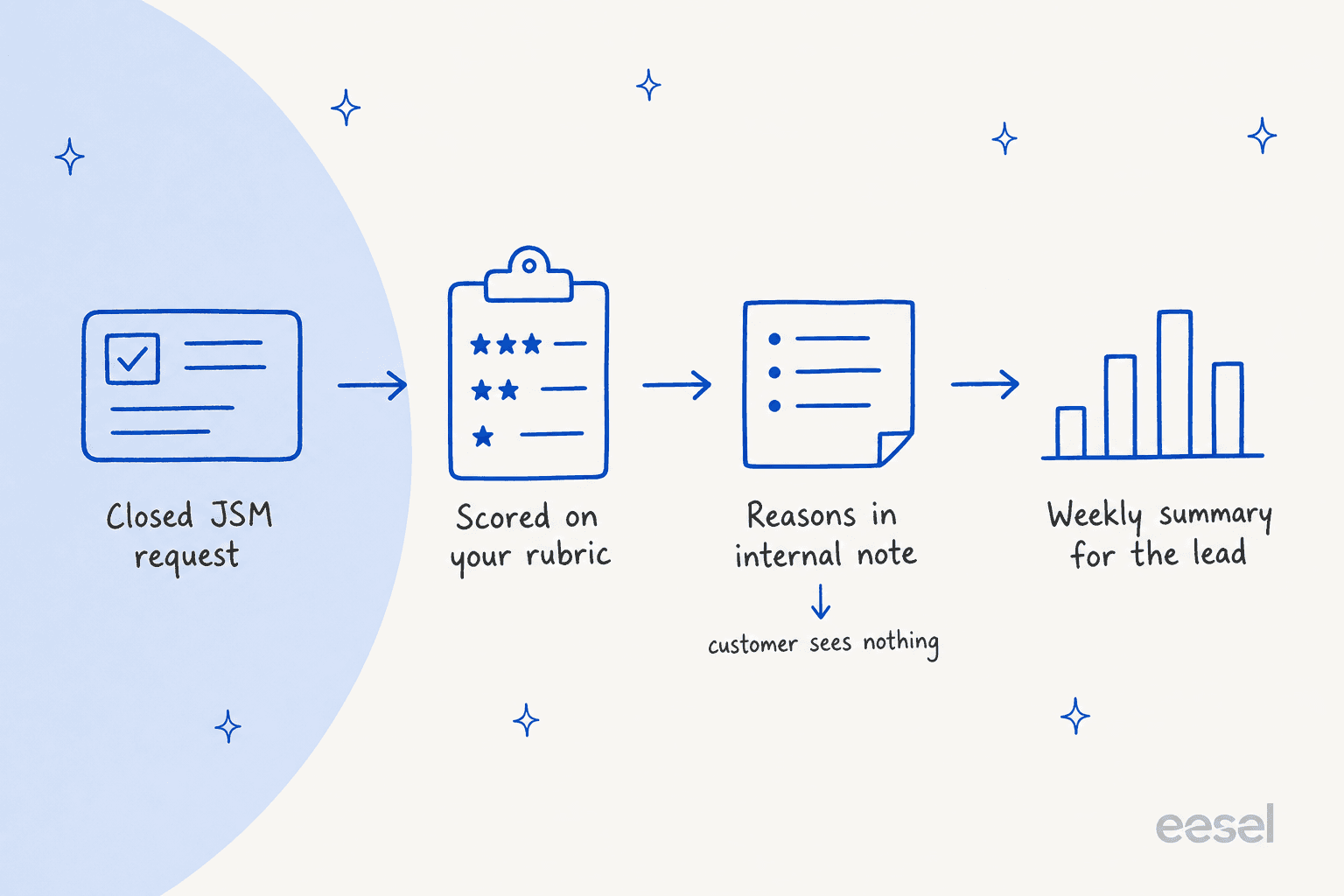
The docs list the pieces a review job needs:
- It reads the whole request. Fields, every comment marked public or internal, and custom fields by name.
- It searches past requests with JQL, so a job can pull "resolved last week in project IT".
- It leaves an internal note that only your team sees, with a separate action for public replies.
- It shows its work. The Activity page lists what it searched, each action, who approved it and its reasoning, and you can ask for a written report or put one on a schedule.
- You set the permissions. Each action can run alone, ask for approval or stay off.
So the job I'd run is a weekly scheduled review: eesel searches resolved requests, scores each on a rubric written in plain words, and leaves reasons in an internal note for the lead. That fills the gap Atlassian leaves, and it reads every ticket rather than a sample.
The limits matter. The docs show no setting that writes a score to a dedicated field, so I would have it write the score and reasons into the note, or into a label. It reads past issues live rather than learning from them. I have not seen published accuracy numbers for rubric scoring, so calibrate it against a few reviewers before you trust the scores, the way you would with any support QA calibration exercise. I also have not confirmed how a review run is metered against credits.
The same habit applies when AI writes the replies. smava handles about 27,000 Zendesk tickets a month with eesel agents that each have one job. The drafting agent's only output is a draft with Approve and Reject buttons, and a person decides, while the rules it must follow sit in plain-text instructions that the team can edit. That is QA built into the workflow: every draft is reviewed before a customer sees it. My guides to reviewing AI support conversations and AI support agent observability cover the routine.
How would I run QA on Jira Service Management?
This is what I would do in the first month, cheapest first:
- Turn on CSAT in project settings, and build the agent-versus-team report. Export to CSV through JQL when you need a slice the report cannot give.
- Write three to five criteria that you can see in a ticket, such as "checked the plan before promising a refund". Use QA feedback examples for wording.
- Sample 10 resolved requests per agent each week, by hand, in a Marketplace app, or with an eesel review job. Weight the sample toward low CSAT and escalated requests.
- Calibrate. Have two people score the same 10 tickets and settle every disagreement, then fix the criterion behind it.
- If you run Atlassian's AI, test it first. Build an eval set from real questions (Atlassian suggests mixing common, critical and edge cases) and rerun it after each knowledge base change.
- Track outcomes beside scores, such as first response time, resolution rate and escalation rate, before coaching anyone on a number.
For the wider method, AI support quality assurance covers judging an AI agent before and after launch, and AI for support agent performance covers fair scorecards. How other helpdesks handle it: Freshdesk, Zendesk and Zoho Desk.
Is JSM's built-in QA enough?
For testing Atlassian's own AI, mostly yes, and it improved a lot in 2026: Evals in March, live conversation review in September. If you run the virtual service agent or a Rovo agent, use them, and fix the knowledge base before you blame the model.
For grading people, no. There is no scorecard, no sampling and no calibration in the product, and CSAT cannot tell you whether the agent followed policy. My take: start with CSAT and a hand-built sample this week, trial Service Quality Review if you want reviewers working inside Jira, and add an eesel review job when sampling 10 tickets per agent stops being enough. If you are still choosing tools, my best AI for JSM list and JSM AI alternatives cover the options, and I wrote up two neighbouring jobs, ticket triage and ticket summaries.
Try eesel for QA on Jira Service Management
If your JSM plan has no scoring for agent replies, an AI helpdesk teammate like eesel can review last week's resolved requests against your rubric, leave its reasons in an internal note, and send the lead a summary. It connects with an Atlassian API token, with nothing to install from the Marketplace. Start with a review that only writes notes, compare them with your own scores for a week, then decide what it gets to do. Try eesel free for 7 days.