Escalation rate
Escalation rate is the percentage of support interactions that get handed off to a higher tier, a specialist, or a manager instead of being resolved at first contact.
What escalation rate means
Escalation rate is the percentage of support interactions that get handed off to a higher tier, a specialist, or a manager instead of being resolved by the first person or system that handled them. It is calculated by dividing the number of escalated interactions by the total handled, over a chosen period. A request escalates when the first responder lacks the knowledge, permission, or authority to resolve it and routes it to someone who has them.
In customer support, escalation rate is a measure of how often the front line can finish what it starts. A high rate means a large share of tickets bounce upward, which adds handling time, frustrates customers who have to re-explain, and consumes scarce senior capacity. A low rate, paired with healthy satisfaction, means problems are being solved at the right level the first time.
Why escalation rate matters
Escalation rate is a window into where a support operation is strong and where it leaks:
- Each escalation adds cost and delay. A handed-off ticket means a second person ramps up on the context, which lengthens resolution time and raises the cost of that ticket.
- It exposes knowledge gaps. Topics that escalate often usually point to missing documentation or under-trained front-line agents, not to inherently hard problems.
- It is the inverse of first-tier success. A rising escalation rate is the mirror image of a falling first contact resolution rate, so the two should be read together.
- It guards quality, not just speed. Some escalations are correct and necessary; the goal is the right rate, not zero, because forcing a wrong answer to avoid a handoff is worse than escalating.
- It sizes your senior team. Escalation volume against specialist capacity tells you whether tier-two and tier-three staffing matches real demand.
It helps to look past the single number and ask what is actually pushing tickets upward. Most escalations cluster into a handful of causes, and they are not equal in size.
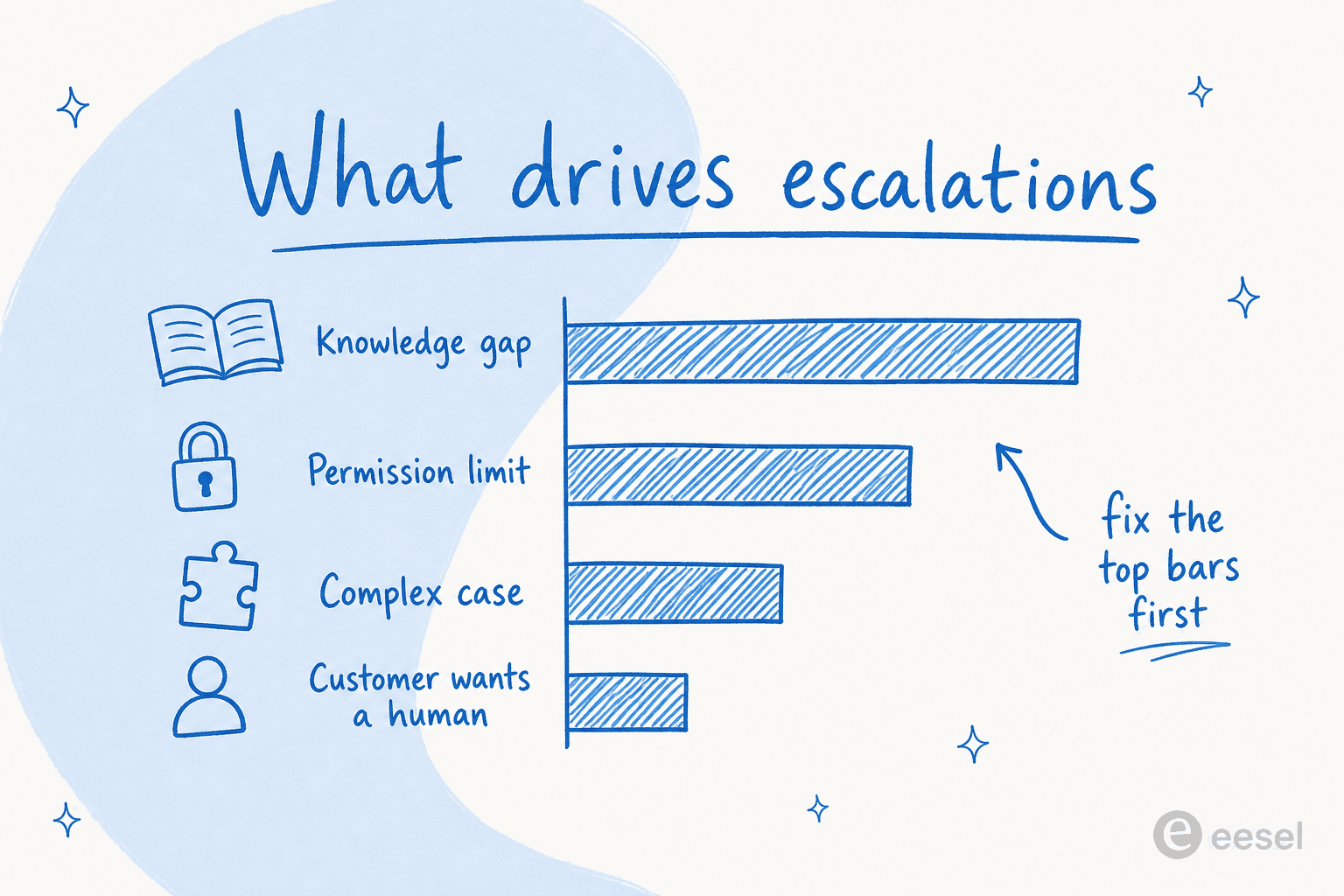
Knowledge gaps and permission limits usually dominate, which is good news: both are fixable with better documentation and clearer routing rules. The "customer wants a human" slice is the one escalation type you often want to keep, since forcing those into a bot answer hurts more than it helps.
How escalation rate works with AI
When an AI agent sits at the front of the queue, its escalation rate is one of the most important numbers to watch. The pattern looks like this:
- Attempt. The agent reads the request and checks whether it can resolve it from trusted knowledge.
- Confidence check. It evaluates how sure it is, using a confidence score against a threshold.
- Resolve or escalate. Above the threshold it answers and closes the ticket; below it, it hands off to a human.
- Handoff with context. When it escalates, it attaches the conversation history and what it already tried, so the human does not start cold.
A support agent like eesel AI is tuned so this handoff is clean: it resolves the questions it can answer confidently from your help center and past tickets, and escalates the rest with context attached. The aim is not the lowest possible escalation rate but the right one, where everything resolved was resolved correctly and everything escalated truly needed a person.
Escalation rate in practice
Operators read escalation rate alongside satisfaction, never alone. A rate that drops while CSAT holds steady is a real win. A rate that drops while CSAT slips is a warning that tickets which should have escalated were instead closed with a weak answer. The most useful view segments escalations by reason and by topic, because that turns a single number into a punch list: the recurring escalation causes are exactly the documentation gaps and permission limits worth fixing first.
We go deeper on this in our guide to escalation quality.
Escalate only when it counts
eesel AI resolves what it can confidently answer and escalates the rest to a human with full context, so handoffs are clean instead of constant.