Quality assurance in customer service has traditionally meant manually sampling a tiny fraction of conversations and hoping it represents the whole. Zendesk QA takes a different approach. It uses AI to review 100% of your customer interactions automatically, giving you complete visibility into support quality without the manual overhead.
This guide breaks down what Zendesk QA is, how it works, what it costs, and whether it's the right fit for your team. We'll also look at how it compares to alternatives like our AI agent solution that combines quality assurance with autonomous resolution.
What is Zendesk QA?
Zendesk QA is an AI-powered quality assurance platform that Zendesk acquired from Klaus in 2024. It's designed to help customer service teams evaluate and improve the quality of their support interactions across all channels.
Here's the problem it solves: traditional QA processes typically involve managers manually reviewing 2-5% of customer conversations. That small sample might catch obvious issues, but it misses the vast majority of interactions where problems (or great service) actually happen. It's like trying to understand a movie by watching two random minutes.
Zendesk QA flips this model. Instead of sampling, it uses AI to analyze every single conversation automatically. The system scores interactions based on criteria you define, identifies conversations that need human attention, and gives you data-backed insights to coach your team.
The platform is built for QA managers, support leaders, and customer service teams who want to move beyond gut feelings and actually understand what's happening in their support operations. It integrates directly with Zendesk's broader ecosystem, including Support, Suite, and their AI agent products.
How Zendesk QA works: Key features explained
AutoQA: Automated scoring for every conversation
AutoQA is the core engine of the platform. It uses AI to evaluate all customer interactions across your channels: email, messaging, live chat, phone, and even conversations handled by AI agents.
The system comes with predefined evaluation criteria covering empathy, tone, grammar, and resolution quality. You can also build custom categories by telling the AI in plain English what to look for. For example, you might create a category that checks whether agents mentioned your return policy or verified the customer's account.
The key advantage is coverage. While manual QA might review 20 conversations out of 1,000, AutoQA scores all 1,000. This gives you a complete picture of quality trends rather than a potentially misleading sample.
Spotlight Filter: Finding what matters
Reviewing 100% of conversations is great, but you still need to know which ones deserve human attention. That's where Spotlight comes in.
Spotlight uses AI to identify high-risk and high-value conversations automatically. It can detect:
- Churn risk: Conversations where customers show signs of leaving
- Dead air: Unusual pauses or silence in voice calls that suggest training needs
- Outliers: Conversations that deviate significantly from normal patterns
- Compliance issues: Missing call recording disclosures or other regulatory problems
- "Loopy bots": AI agents stuck in repetitive response loops
Zendesk reports over 90% accuracy for these pattern detections. You can also create custom Spotlights tailored to your specific business needs.
Voice QA: Phone call analysis
Voice QA extends the platform's capabilities to phone support. It uses speech-to-text transcription to convert calls into analyzable text, then applies the same AI scoring and Spotlight detection used for digital channels.
The system specifically analyzes voice-specific factors like silence duration, hold times, and whether required compliance statements (like "this call may be recorded") were delivered. This is particularly valuable for regulated industries where compliance monitoring is critical.
Cross-channel coverage
One of Zendesk QA's strengths is unified quality standards across every channel your customers use. Whether someone emails, chats, calls, or interacts with your AI agent, the same evaluation criteria apply. This prevents the common problem where phone support quality differs significantly from email support quality.
Zendesk QA pricing and plans
Zendesk QA is sold as an add-on to existing Zendesk subscriptions. Here's the breakdown:
| Plan | Price (per agent/month) | Billing | Notes |
|---|---|---|---|
| Zendesk QA | $35 | Annual only | Add-on for any Support/Suite plan |
| Workforce Management | $25 | Annual only | Standalone WFM add-on |
| WFM + QA Bundle | $50 | Annual only | Save $10 vs. purchasing separately |
A few important notes about pricing:
- You need a base Zendesk plan first (Support Team starts at $19/agent/month, Suite Team at $55)
- QA is available on all Zendesk Support and Suite plans
- Annual billing is required for the QA add-on
- A 14-day free trial is available, but you need to contact sales to start it
Real cost example for a 10-agent team:
If you're on Suite Professional ($115/agent/month) and add QA:
- Base Suite Professional: $115 × 10 = $1,150/month
- QA add-on: $35 × 10 = $350/month
- Total: $1,500/month ($18,000/year)
For comparison, you can see our pricing for AI-powered support which uses a different model based on interactions rather than seats.
Benefits and reported outcomes
According to Zendesk's reported metrics, teams using their QA platform see:
- 80% reduction in QA review time
- 2x faster agent training
- 2.5% boost in CSAT scores
- 20% faster ticket processing
- 75%+ improvement in customer satisfaction
A Head of Customer Service at CityGo reported: "Our quality scores frequently range between 90-96%, showcasing the effectiveness of our quality assurance. By proactively monitoring and reviewing conversations, we can address issues before they escalate."
These benefits translate to real operational improvements. Faster QA reviews mean managers spend less time auditing and more time coaching. Faster agent training reduces onboarding costs. Higher CSAT scores correlate with better retention and revenue.
But it's worth noting the limitations too. QA surfaces problems but doesn't fix them. You still need managers who can act on the insights, coach agents, and update processes. The platform identifies that 40% of your team struggles with empathy statements, but someone still needs to deliver the training.
There's also the cost consideration. At $35/agent/month on top of your base Zendesk subscription, QA can nearly double your per-agent software costs. For a 20-person team, you're looking at an additional $8,400 per year.
Zendesk QA vs. alternatives: Which approach is right for you?
When Zendesk QA makes sense
Zendesk QA is a solid choice if:
- You're already using Zendesk Support or Suite
- You have dedicated QA managers who can act on insights
- You want comprehensive reporting and analytics on support quality
- You prefer to keep humans in the loop for all customer responses
- Your primary need is monitoring and improving existing agent performance
The platform fits naturally into existing Zendesk workflows. If your team is already comfortable in the Zendesk ecosystem, adding QA is a logical extension.
When to consider eesel AI instead
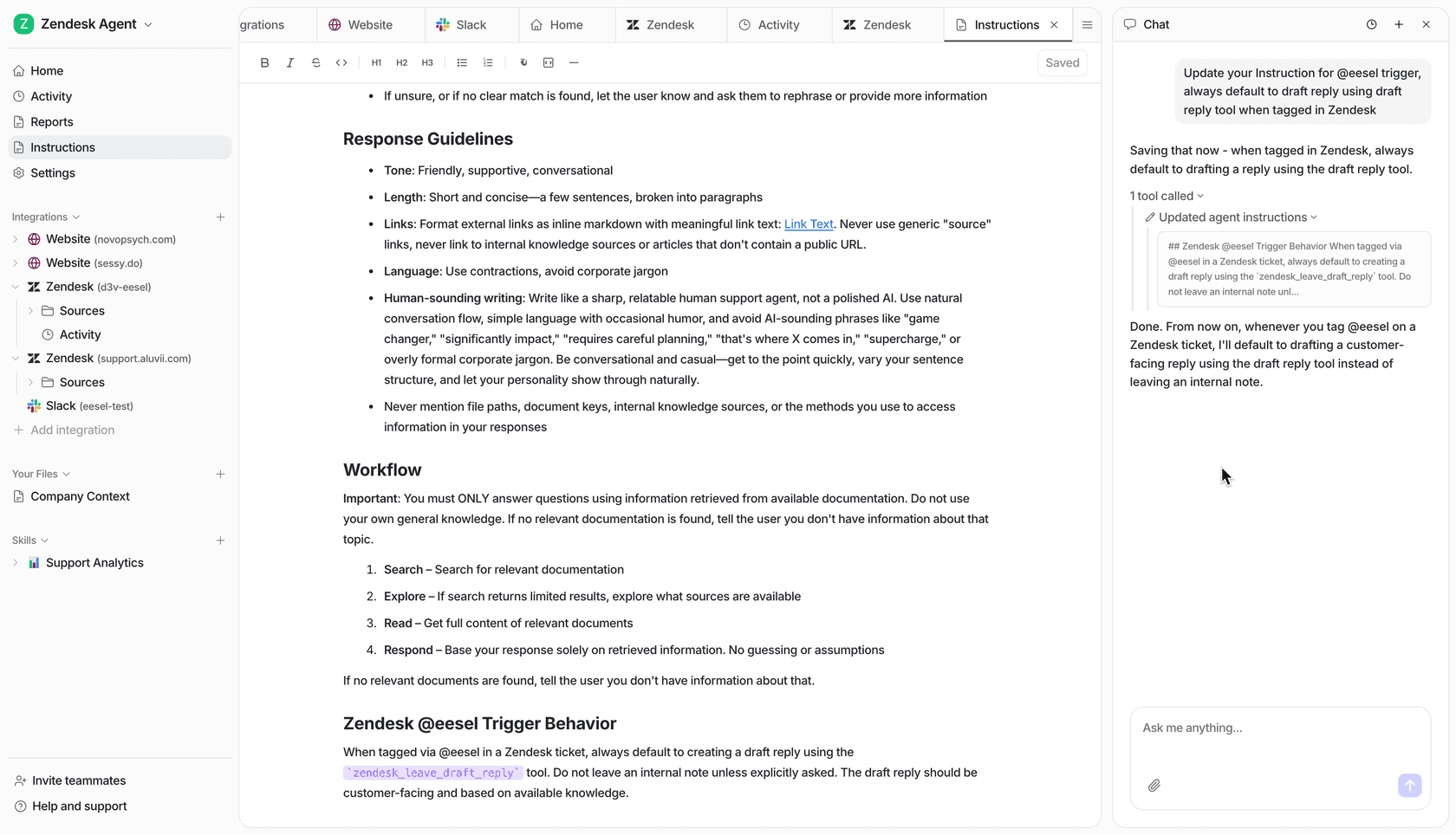
Our approach at eesel AI combines quality assurance with autonomous resolution. Instead of just reviewing conversations, our AI teammate actually handles tickets end-to-end.
Here's how the approaches differ:
| Capability | Zendesk QA | eesel AI |
|---|---|---|
| Primary function | Quality review and coaching | Resolution + QA combined |
| Coverage | 100% conversation review | Up to 81% autonomous resolution |
| Setup | Connects to existing Zendesk | Minutes to onboard, learns from your data |
| Pricing model | Per agent/month | Per interaction |
| Human involvement | Required for all responses | Handles frontline, escalates complex issues |
With eesel AI, you start by having the AI draft replies for your agents to review. As it proves itself, you level up to full autonomy where it handles routine tickets directly. You define escalation rules in plain English: "Always escalate billing disputes to a human" or "For VIP customers, CC the account manager."
The key difference is that Zendesk QA helps you monitor and improve your human agents, while eesel AI becomes an additional team member that handles volume directly. For teams drowning in ticket backlogs, autonomous resolution often delivers more immediate relief than QA improvements alone.
If you want to explore a hybrid approach, our AI Copilot drafts replies for human agents (similar to Zendesk's Copilot), while our AI Agent handles full autonomous resolution.
Getting started with AI-powered quality assurance
If you're evaluating QA solutions, start by assessing your current state:
-
What's your biggest pain point? Is it inconsistent service quality, slow agent onboarding, or simply not knowing what's happening in your support conversations?
-
Do you have the operational capacity to act on insights? QA surfaces problems, but you need managers who can coach, train, and update processes.
-
What's your total cost of ownership? Factor in both software costs and the time your team will spend on QA activities.
-
Do you need QA-only or resolution + QA? If ticket volume is the bigger problem than quality, consider whether autonomous resolution might help more than monitoring alone.
For teams already committed to Zendesk who need comprehensive QA analytics, Zendesk QA is a natural fit. For teams looking to reduce ticket volume while maintaining quality, an AI teammate approach might deliver more value.
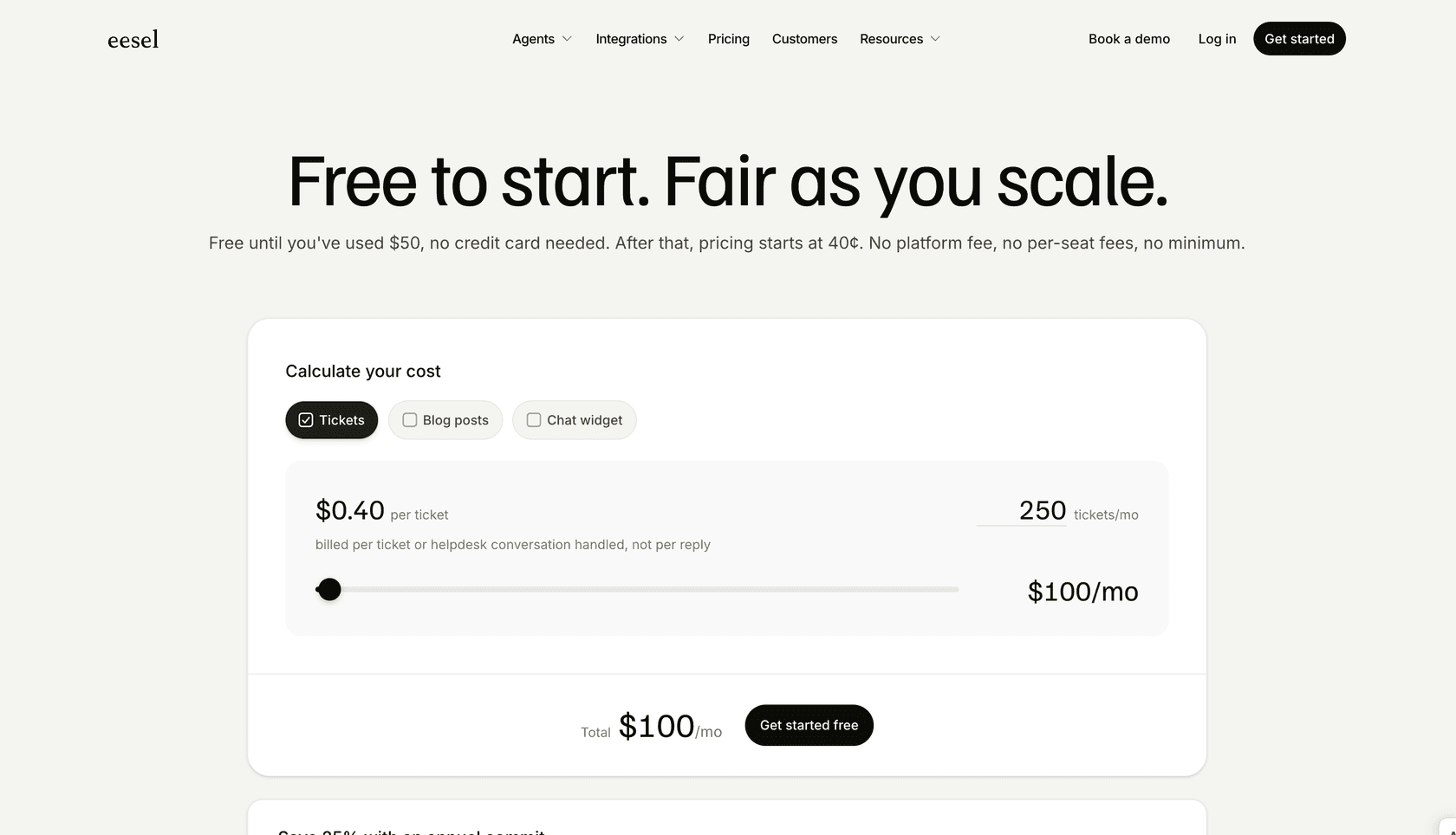
You can try eesel AI and see how autonomous resolution compares to traditional QA approaches. The platform learns from your past tickets and help center, so you can run simulations on historical data before going live.