

The short answer on Edge Delta pricing
Here is the published rate card, pulled from the pricing page and the plans documentation together, because neither one carries the whole picture.
| Hobby | Pro | Custom | |
|---|---|---|---|
| Price | $0 | $20 / month (per seat) | Quote only |
| What that buys | 5 credits, 14 days | 20 credits per seat, monthly | Pre-purchased credit pool |
| Credit value | 1 credit = $1 | 1 credit = $1 | Volume discounts available |
| Storage rate | 0.25 credits / GB | 0.25 credits / GB | 0.25 credits / GB |
| AI token rate | Per model, per 1M tokens | Per model, per 1M tokens | Contracted on order form |
| Pipeline volume | Not charged | Not charged | Not charged |
| Credit rollover | n/a | No, seat credits reset monthly | Pool depletes over term |
| Retention | Not included | 30 days data and memory | Custom |
| RCA investigations | Included | Unlimited | Unlimited |
| Custom teammates | Limited | Unlimited | Unlimited |
| Connectors | Included | Unlimited | Unlimited |
| Telemetry pipelines | Not included | Included | Included |
| RBAC and privacy guardrails | No | Yes | Yes |
| SOC 2 Type 2 | Yes | Yes | Yes |
| Volume discounts | No | No | Yes |
| Support SLA | None published | None published | Guaranteed, 24/7/365 options |
| Billing | n/a | Stripe, monthly | Account management |
| Free trial | 14 days, no card | n/a | n/a |
| Spend controls | n/a | Spending limits, Auto Buy | Pool management |
Two things in that table do more work than the rest. Seat credits do not roll over, so an underused month is money you simply do not get back. And "Unlimited AI Inference" sits on the Pro card alongside "$20 of included credits", which reads as a contradiction until you understand what each half means. The entitlement is unlimited. The meter is not. It is the same sleight of hand that trips people up on Freshservice pricing, where an unlimited-sounding tier still gates the AI behind a separate meter.
Worth noting the trial terms are unusually generous for the category: no credit card, and SSO and SAML included from the free start. Most vendors put SAML behind an enterprise gate, which is one of the sharper annoyances buyers hit when they compare ITSM tools on paper versus in a trial.
The three meters, and only two of them bill
Edge Delta is a Seattle company founded in 2018 by Ozan Unlu and Fatih Yildiz, with $82M raised to date and a customer list that includes Boeing, Nvidia, Snowflake and Panasonic. It sells two things that used to be priced as one: telemetry pipelines that filter and reshape data before it hits a backend, and an AI team that investigates incidents on top of that data. If you have looked at automated incident management tools before, the second half will feel familiar.
The pricing followed the product. Here is where the money sits now.
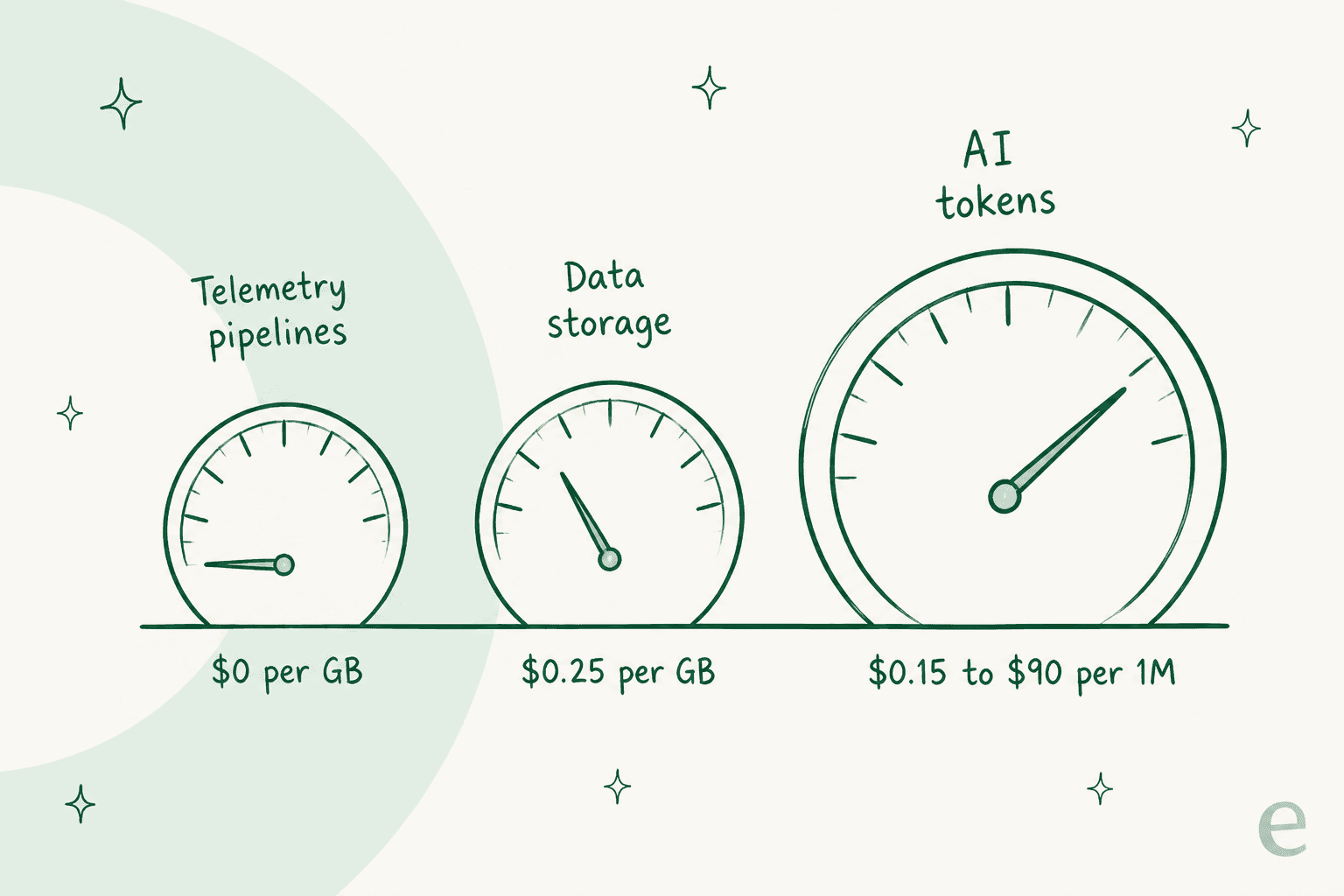
The docs say it in one line: "Pipelines data volume is not charged under AI Teammates licenses." That is a real change, and a buyer-friendly one. Edge Delta announced in April 2026 that pipeline throughput carries no per-GB licensing cost.
But watch what that does to the shape of the bill. The meter you could forecast, gigabytes in, went to zero. The meters that remain are storage, which you can forecast, and tokens, which you cannot, because token consumption tracks how often something breaks. Anyone who has budgeted an AI service desk rollout will recognise the shape of that problem.
Here is Edge Delta's own usage report, and it makes the point better than I can.
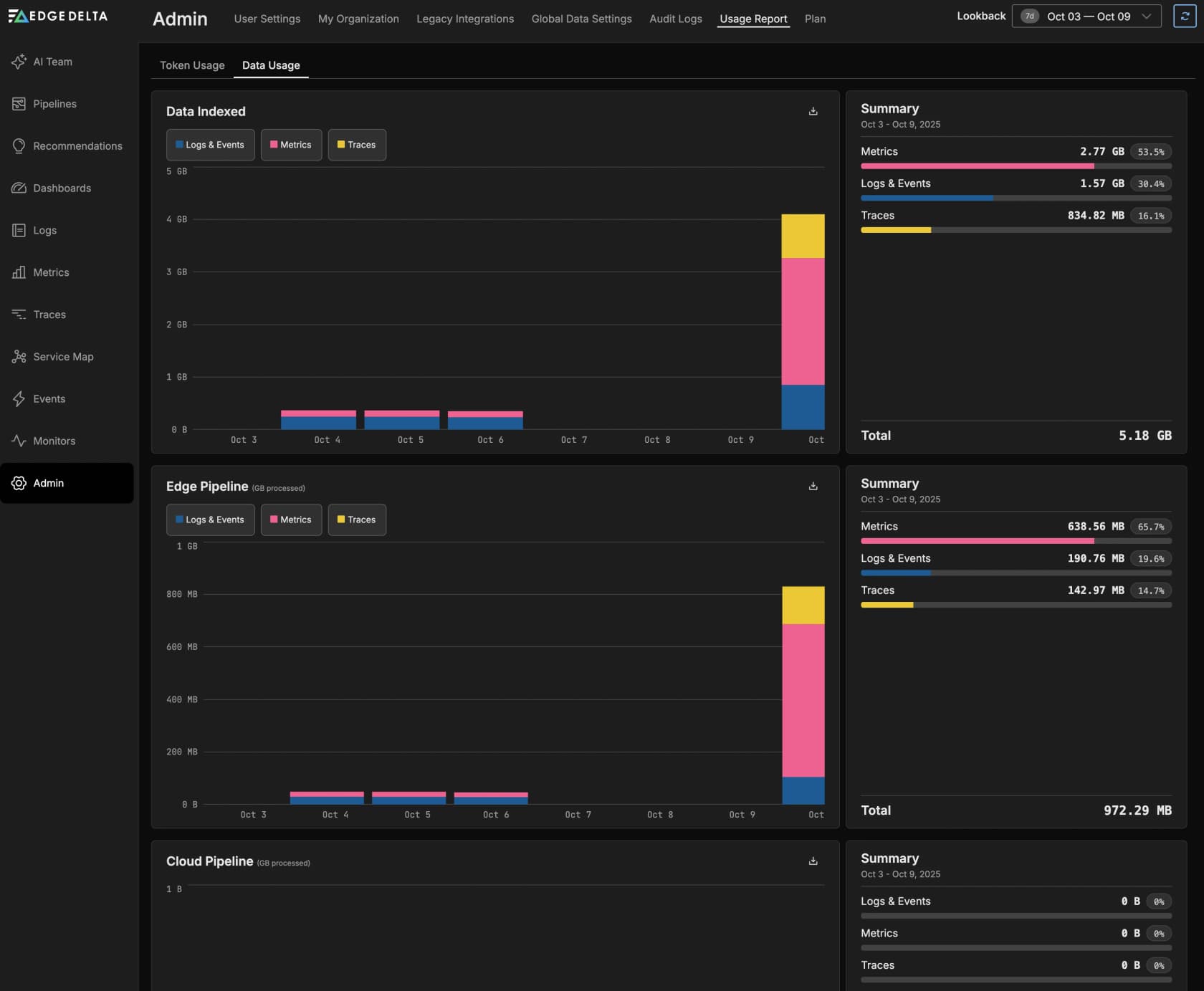
In that week, Data Indexed reads 5.18 GB and Edge Pipeline reads 972.29 MB. The free meter is the small number and the billed meter is more than five times larger. The pipeline reduces what you forward, which cuts your Datadog or Splunk bill, but the thing Edge Delta charges you for is what you keep on Edge Delta.
Work out your own monthly credit bill
The rates are all public, so the arithmetic is doable. It is just annoying to do by hand across two meters. Plug your own numbers in.
The token-per-investigation figure is your estimate, not Edge Delta's. Nobody publishes it, and it varies wildly with how much context a teammate pulls in. Start conservative and watch the usage report for a fortnight.
What a credit actually is
Edge Delta's docs are refreshingly blunt here, which is more than most of this category manages. From the plans page:
- One credit is equivalent to one US dollar.
- Credits come from a single shared pool covering both AI and storage.
- Storage bills at a flat 0.25 credits per GB, identical for logs, metrics and traces.
- AI tokens bill per model, per million input and output tokens.
- Professional grants 20 credits per seat per month, with no rollover.
- Enterprise buys a pool that depletes across the contract term.
- Trial gets 5 credits for 14 days.
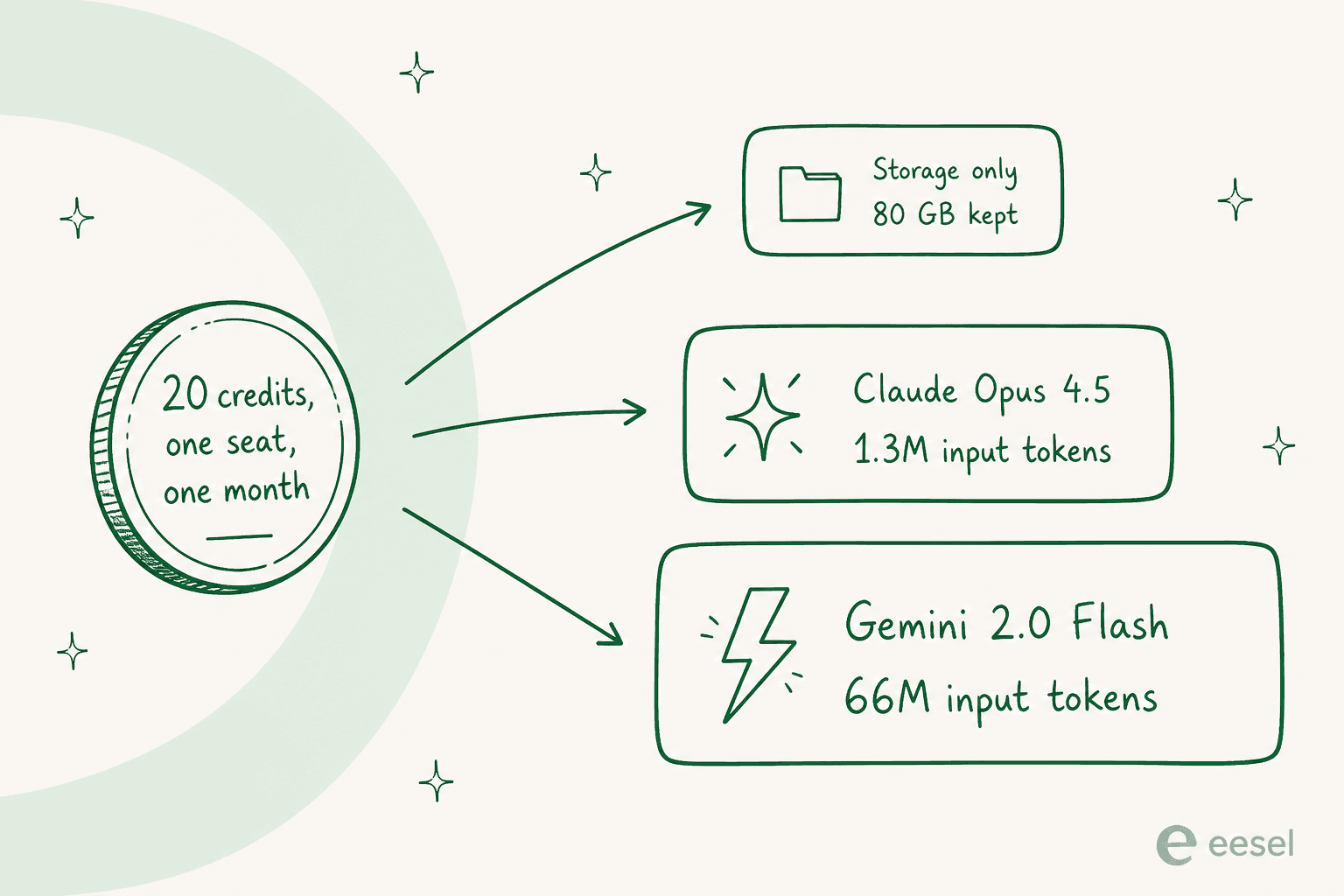
That last one is a useful sanity check on how much work 5 credits represents. Five dollars buys 20 GB of storage, or about 333,000 input tokens on Claude Opus 4.6. A fortnight of a busy on-call rotation will not fit inside it. Compare that with the trial lengths teams get on AI ticketing systems, where the constraint is usually days rather than dollars.
The docs even work an example: an account with 20 credits that spends 8 on tokens and indexes 30 GB (7.50 credits at 0.25 per GB) has consumed 15.50, leaving 4.50 for either meter. Simple enough to follow, and a lot clearer than the pricing page it belongs to. Most vendors in the AI agent category never publish arithmetic this specific. Working out Aisera pricing usually starts with a sales call rather than a spreadsheet, and Agentforce pricing is much the same.
The token rate is exactly 3x provider list price
This is the finding I did not expect, and it is the most useful thing in this post.
Edge Delta publishes a roughly fifty-row table of per-model token rates. I took nine of them and checked each against the model provider's own published price. Eight land on exactly 3.00x list, on both input and output. Not approximately. Exactly.
| Model | Provider list (in / out per 1M) | Edge Delta (credits per 1M) | Multiple |
|---|---|---|---|
| Claude Haiku 4.5 | $1.00 / $5.00 | 3.00 / 15.00 | 3.0x |
| Claude Sonnet 4.6 | $3.00 / $15.00 | 9.00 / 45.00 | 3.0x |
| Claude Opus 4.5 | $5.00 / $25.00 | 15.00 / 75.00 | 3.0x |
| GPT-5 | $1.25 / $10.00 | 3.75 / 30.00 | 3.0x |
| GPT-5 Mini | $0.25 / $2.00 | 0.75 / 6.00 | 3.0x |
| GPT-4o | $2.50 / $10.00 | 7.50 / 30.00 | 3.0x |
| Gemini 2.0 Flash | $0.10 / $0.40 | 0.30 / 1.20 | 3.0x |
| Gemini 2.5 Flash | $0.30 / $2.50 | 0.90 / 7.50 | 3.0x |
| Gemini 2.5 Pro | $1.25 / $10.00 | 7.50 / 45.00 | 6.0x / 4.5x |
List prices in the middle column come from each provider's own rate card:
Two notes, because context matters here. First, a 3x multiple on resold tokens is not scandalous. You are not buying raw inference, you are buying orchestration, retrieval, evaluation, a UI and a support contract wrapped around it, and somebody has to fund that. Plenty of platforms selling AI employees do the same without publishing the underlying rate at all, which is worse. Edge Delta publishing the table is a point in its favour.
Second, Gemini 2.5 Pro is the one that breaks the pattern, and it looks like a tiering artefact rather than a policy. Google prices it at $1.25 / $10.00 for prompts up to 200K tokens and $2.50 / $15.00 above that. Edge Delta's 7.50 / 45.00 is exactly 3x the long-context tier. So on short prompts you are effectively paying double the house rate. If your workload is mostly small prompts, that specific model is the expensive way to buy them.
The practical consequence is that the model dropdown is the biggest cost control in the product, ahead of retention settings or data volume. Here is what that dropdown looks like in the product, with each teammate carrying its assigned model as a badge.
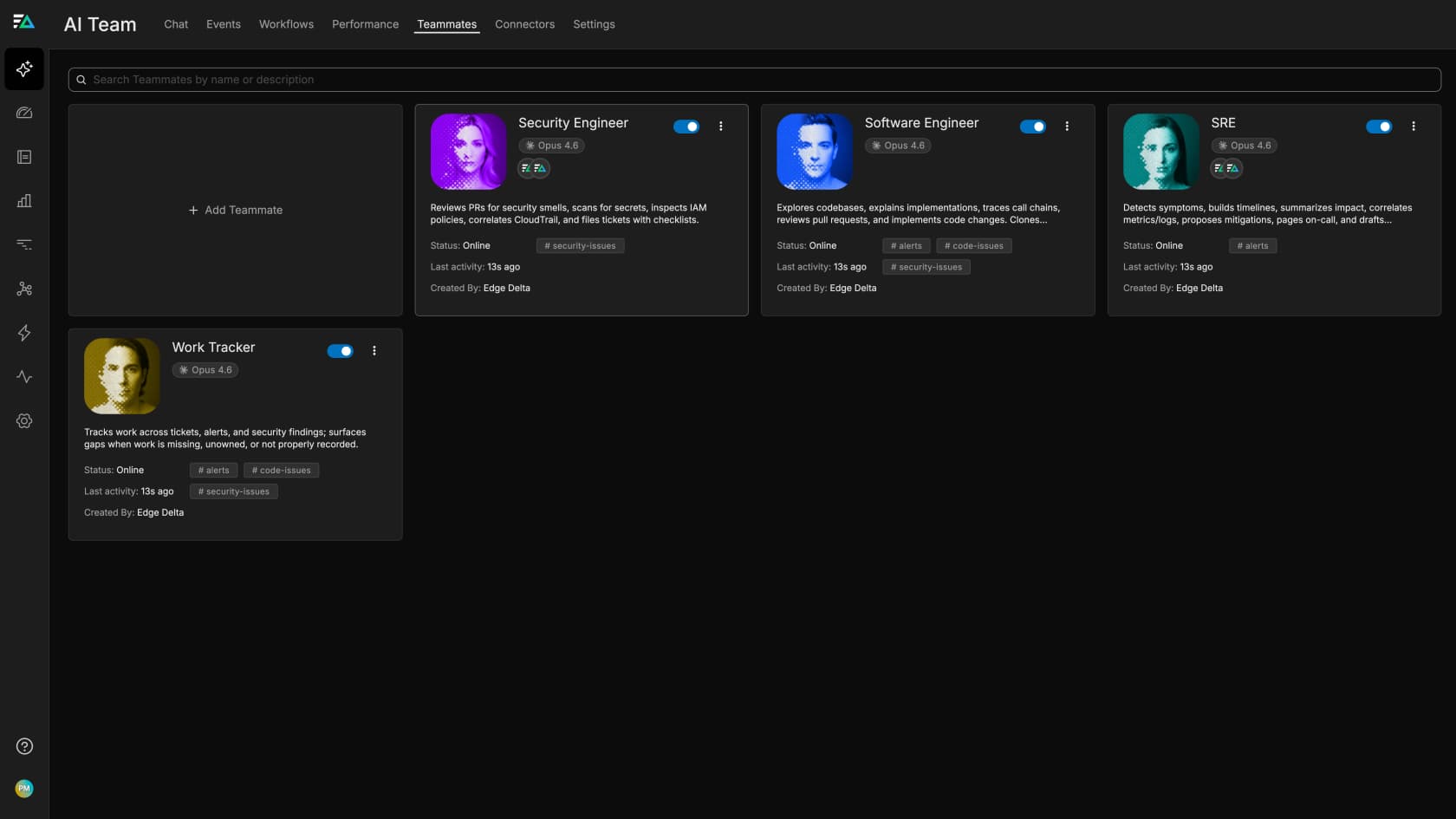
Every one of those badges is a price tag. Edge Delta's docs say it assigns higher-capability models to the reasoning-heavy roles like OnCall AI and SRE, and cheaper ones elsewhere, and that you can override the defaults. That per-role model assignment is a smarter design than most internal support tools manage, and it is the right place to put the control.
One trap in the table: Claude Opus 4 and 4.1 sit at 45.00 / 225.00 while Opus 4.5 and 4.6 sit at 15.00 / 75.00. Picking the older Opus costs triple the newer one, for no benefit most teams would notice.
Two worked months
Rates are abstract. Bills are not. Here are two, using the arithmetic above. Token volumes are my assumptions, clearly marked, because no vendor publishes them.
A five-engineer platform team
| Line | Working | Credits |
|---|---|---|
| Included (5 seats x 20) | (100) | |
| Storage, 200 GB indexed | 200 x 0.25 | 50 |
| AI, 200 investigations at 48K tokens on Sonnet 4.6 | 8M in x 9, 1.6M out x 45 | 144 |
| Total consumption | 194 | |
| Monthly bill | $194 |
A twenty-engineer org running teammates hard
| Line | Working | Credits |
|---|---|---|
| Included (20 seats x 20) | (400) | |
| Storage, 2 TB indexed | 2,048 x 0.25 | 512 |
| AI, 1,000 investigations at 72K tokens on Opus 4.6 | 60M in x 15, 12M out x 75 | 1,800 |
| Total consumption | 2,312 | |
| Monthly bill | $2,312 |
In the second month, 78% of the bill is tokens, not data. Swap the default from Opus 4.6 to Sonnet 4.6 and the AI line drops from 1,800 credits to 1,080, taking the bill to $1,592. That is $720 a month from one dropdown, and it is a bigger saving than any data-reduction work you could do in the same period.
That inversion is the thing to internalise. This is no longer a data pricing model wearing an AI hat. It is an AI pricing model with a data line item attached. Which means the right comparison set is not just Cribl and Datadog, it is every vendor charging for reasoning, the same arithmetic that decides AI agent versus human cost on the support side.
The AWS Marketplace card tells a different story
Edge Delta has exactly one cloud marketplace listing, Edge Delta AI Teammates on AWS, rated 4.4 stars from 7 ratings. There is no Azure or Google Cloud listing. And despite the title, every dimension on the card prices telemetry pipeline ingest, not teammate usage.
| Dimension | 12-month cost | Effective rate |
|---|---|---|
| 1 GB/day | $36.50 | $0.10 / GB |
| 100 GB/day | $3,650 | $0.10 / GB |
| 36.5 TB pooled over 12 months | $3,650 | $0.10 / GB |
| 250 GB/day | $27,375 | $0.30 / GB |
| 500 GB/day | $54,750 | $0.30 / GB |
| 1 TB/day | $109,500 | $0.30 / GB |
Divide the contract price by the gigabytes it entitles and something odd falls out.
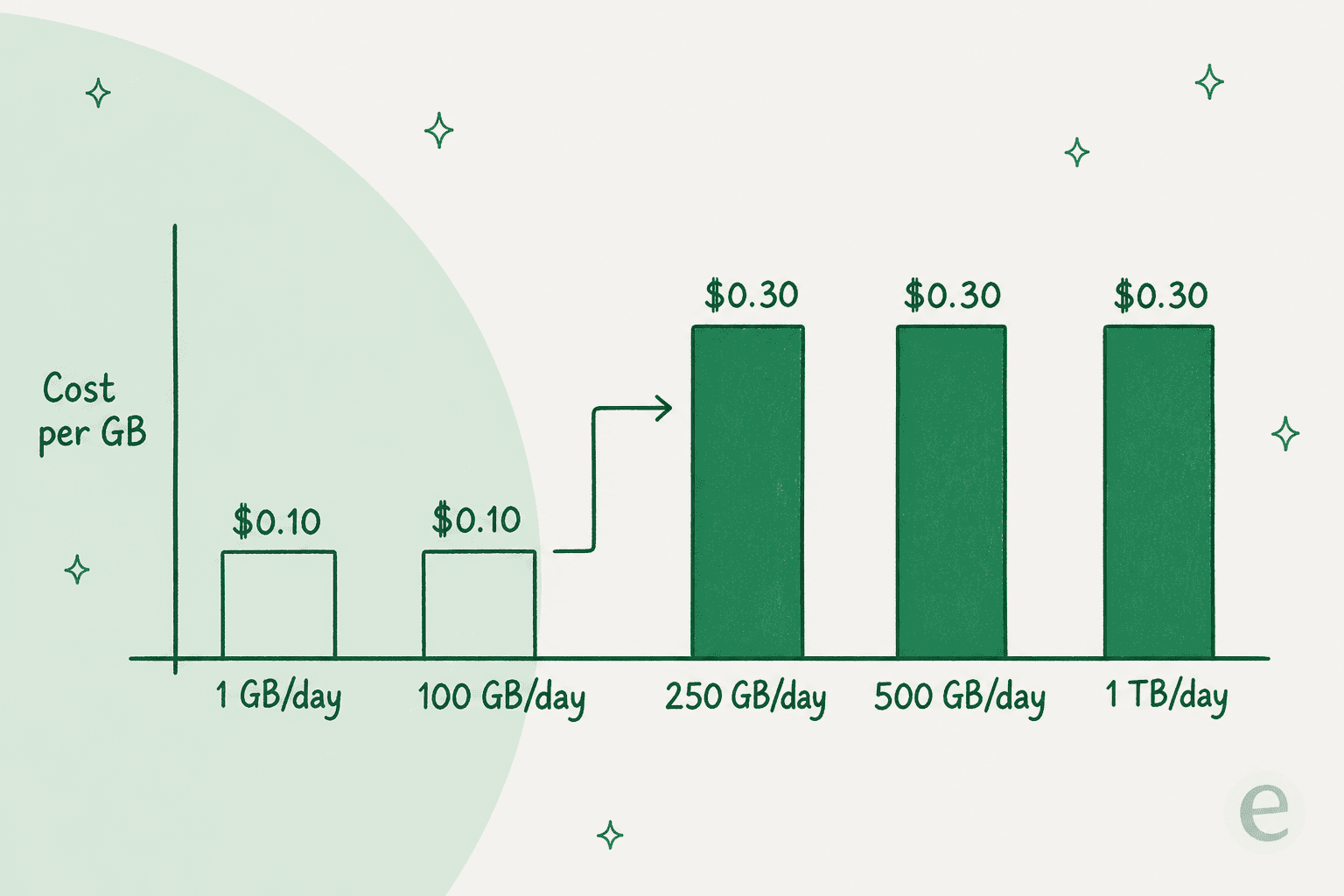
The rate triples at the 250 GB/day step and stays there. That is the opposite of a volume discount, and it runs against Edge Delta's own positioning of flat per-GB pricing with discounts at scale. On this card the discount is at the small end.
A few more things buyers should know about that listing. Daily caps do not roll over, so unused volume evaporates nightly, though the 36.5 TB dimension is a pooled annual allowance instead, which suits spiky workloads. There is no published overage rate, because the listed remedy is to move to a bigger dimension. There is no free trial on the listing, and the vendor refund policy reads "Refunds are not available." Marketplace listings are often the only place a quote-only vendor shows real numbers, which is why they are worth checking before any call about Jira Service Management pricing or anything else sold through a rep.
One row is unreliable and I would not quote it. The 5 TB/day dimension's name and description both state $146,000 for the year, while the cost column reads $10,950, which happens to be exactly three times the 100 GB/day price. Those imply $0.08/GB and $0.006/GB respectively. Treat $146,000 as the intended number and the column as a data-entry slip.
The bigger caveat: this card predates the free-pipelines announcement. It is a live listing selling a meter the product documentation says is no longer charged. If you are buying through AWS, get that reconciled in writing before you sign.
How the per-GB rate compares
For the teams still comparing pipeline vendors on gigabytes, here is where the published rates sit. This is the one part of the category where almost everyone shows their numbers.
| Vendor | Rate | Unit | Published? |
|---|---|---|---|
| Vector | $0 | Self-hosted, open source | Free, no rate card |
| Datadog Observability Pipelines | $0.095 / GB | Per GB ingested, uncompressed | Yes |
| Edge Delta (AWS card, low tier) | $0.10 / GB | Per GB raw ingest | Yes |
| Elastic Serverless | $0.07 to $0.09 / GB | Per GB ingested | Yes, as a floor |
| Cribl Edge | $0.21 / GB | Credits per GB at edge | Yes, on a sub-page |
| Edge Delta (AWS card, high tier) | $0.30 / GB | Per GB raw ingest | Yes |
| Cribl Stream | $0.26 to $0.32 / GB | Credits per GB ingested | Yes, on a sub-page |
| Grafana Cloud Logs | $0.05 process + $0.40 write + $0.10 retain | Three separate per-GB meters | Yes, with breakpoints |
| Chronosphere | Not published | n/a | No, /pricing 404s |
| Edge Delta storage | $0.25 / GB | Per GB stored on platform | Yes, in docs |
Two observations worth more than the ranking. Grafana's write meter is eight times its process meter, which is a vendor pricing the edge-processing argument explicitly. And Vector is free, open source, owned by Datadog, and is the engine underneath Datadog's own managed pipeline product, so $0.095/GB is effectively the published price of the management layer on identical software. If your objection to Edge Delta is the price rather than the product, that comparison is the one to run first.
Chronosphere is the only vendor here publishing nothing at all. Its pricing URL is a genuine 404, not a soft one. That is rarer in observability than it is in service desk software, where quote-gating is still close to the default.
What users actually say
Edge Delta's public review footprint is small and, unusually, almost none of it is about money. G2 shows 4.4 out of 5 from 7 reviews, Capterra 4.5 from 2, and TrustRadius has none. Across all nine published reviews there is exactly one sentence about cost and zero billing complaints. The recurring gripe is dashboard maturity.
"Cost savings is the main benefit that I see"

Read that one honestly, though. The same reviewer titled their review "Early adopter, not achieving the full benefits from the solution" and said the team never fully worked it into their habits. The value landed in the bill before it landed in the workflow, which is a pattern I see constantly on the support side too: a tool that saves money on paper but never becomes a habit tends to show up in the next round of helpdesk software shortlists anyway.
The sharper signal lives on Reddit, where one comment does the comparison work the review sites do not:
"Edge Delta is about half the cost and the pricing model is a lot simpler."

Note what that thread's original poster was actually worried about. Not the rate. The credit model, and whether they could predict it. That is the real buying criterion in this category, and it explains why observability pricing threads run to hundreds of comments:
"$38k for splunk. $12k for sentry. our actual aws infrastructure costs $52k. we're spending more money watching our systems than running them."
And the structural complaint underneath all of it, from a thread on auditing Datadog bills:
"The pricing model is designed so that doing the right thing (more observability) costs more. That's fundamentally broken."
Edge Delta's free-pipelines move is a direct answer to that complaint, and it deserves credit for it. The honest follow-up question is whether "more investigation costs more" is meaningfully better than "more observability costs more." For most teams it probably is, because investigation volume is smaller and more clearly tied to value. But it is the same shape of problem in a new unit, and it is why automated ticket resolution vendors who price on outcomes tend to win the trust argument even when their sticker looks higher.
One fair objection worth carrying, from a Splunk thread: some buyers think they do not need a separate pipeline vendor at all.
"Cribl and Apica do the edge fleet management as well so you don't need a separate solution like edge delta."
What you still have to ask sales
After reading every published page, these are the gaps I could not close. Take them into the call.
- What Custom actually costs. The tier is quote-only, and the structured data on the pricing page carries no price field at all.
- Whether the AWS card is still live pricing. It sells a per-GB pipeline meter the docs say is not charged.
- The numeric caps behind "Limited" and "Included" on Hobby. No number appears anywhere.
- Compute Unit rates for cloud pipelines. The docs define a CU as roughly 12 MB/s, about 1 TB/day, and bill allocated capacity rather than throughput, so an over-provisioned idle pipeline costs the same as a saturated one. No dollar rate is published.
- Retention beyond 30 days. Pro caps data and memory retention at 30 days and no archive tier or rate is documented.
Two behaviours are documented and worth planning around rather than asking about. On the AI side you can set a daily spend limit across all teammate activity, updating roughly every minute. On the data side, hitting an ingestion limit throttles the agent instead of billing an overage, so the failure mode is missing data, not a surprise invoice. Whether that trade is right for you depends on whether you would rather lose telemetry or lose budget. A hard cap is still better than the alternative, and it is more than most IT support tools give you.
One last note on the savings math. Edge Delta's own cost-savings dashboard requires you to type in your third-party vendors' per-GB rates before it computes anything, and the annual figure is simply the trailing 30 days multiplied by twelve. It is a useful internal estimate, not an audited number, and it should not be the centrepiece of a business case you take to finance.
Should you buy it
If your problem is that you forward too much data to an expensive backend, Edge Delta's pipeline is free now and that is hard to argue with. The $0.10 per GB entry rate on the marketplace card undercuts Cribl Edge's $0.21, and the "simpler pricing model" comment from r/cribl matches what I found: two meters, both published, both computable.
If your problem is that you want AI to work your on-call queue, price it as an AI purchase, not a data purchase. Pick your default model deliberately, set a spend cap in week one, and watch the token usage report for a fortnight before you commit to a seat count. The model you choose will move your bill more than anything else you configure. That is the same advice I would give anyone sizing an enterprise helpdesk rollout: measure on your own volume for two weeks before you sign a year.
And if you are running this comparison because a Datadog or Splunk renewal is coming, do the boring exercise first. Work out what you are paying per gigabyte today, then what you would pay Edge Delta to store the subset you actually query. The cost savings argument for any reduction tool only holds when you know both halves of it.
Where I would push back is on the pricing page itself. It says "Unlimited AI Inference" on a plan metered by credits, and it never once tells you what a credit buys. The answer is three clicks away in the docs and it is perfectly clear when you find it. Putting the rate table on the page you send buyers to would cost Edge Delta nothing and would make it the most transparent vendor in the category by a distance.
Try eesel for the queue Edge Delta does not cover
Edge Delta hires AI teammates for the on-call rotation. eesel hires them for the other queue, the one where customers are waiting. The roster today is an AI helpdesk teammate that joins your existing helpdesk and starts closing tickets, and an AI blog writer. Each arrives already knowing your integrations and your company context, so there is no prompt-engineering project before it does useful work, which is the same burden Edge Delta says its pre-built teammates exist to remove.
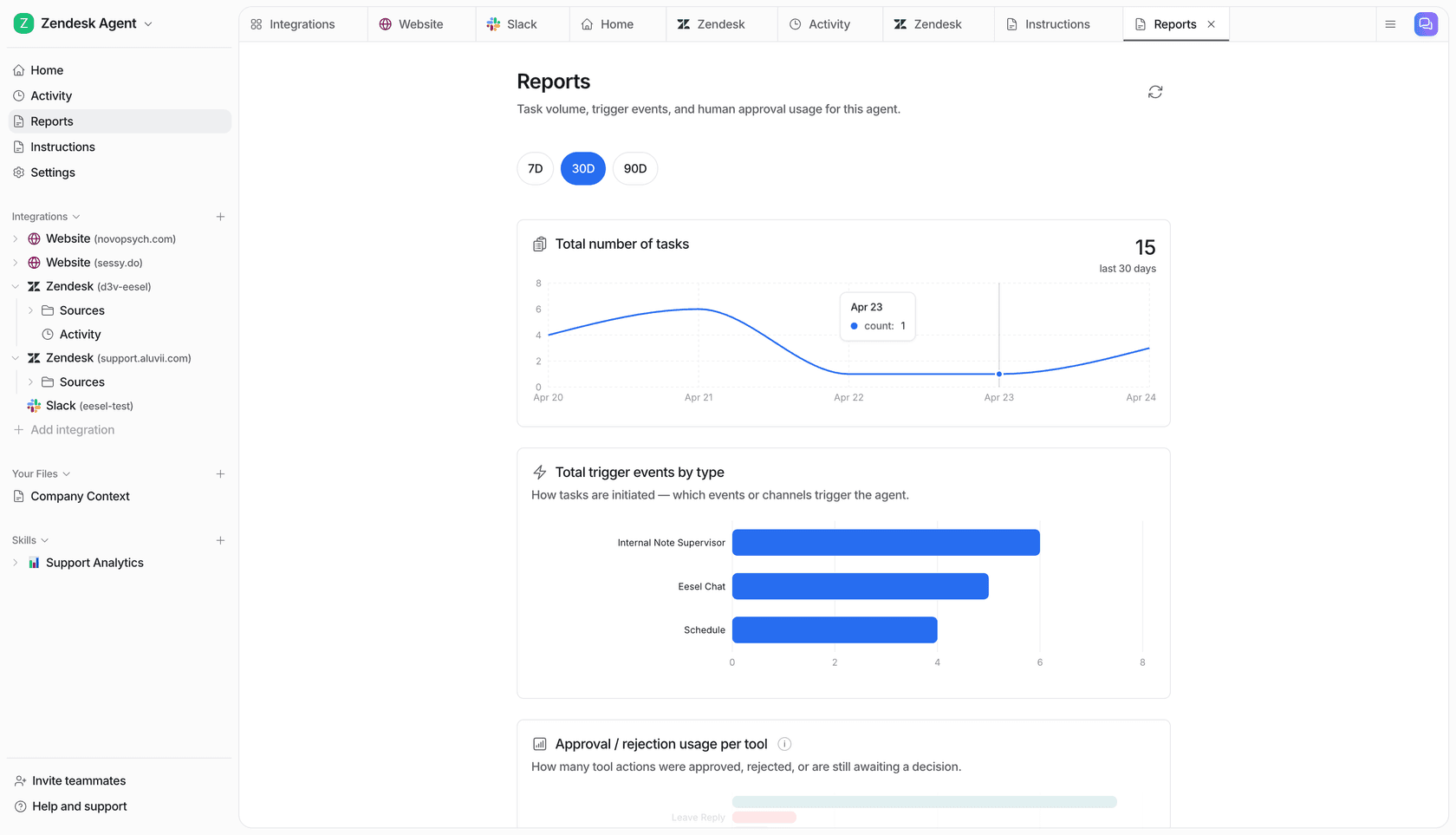
I took the opposite bet on pricing, and this post is a decent argument for why. eesel sells one fixed monthly price sized to volume, from $299/month for 500 credits, where 1 credit is one ticket or chat, a unit you already count, already forecast, and already report on. No token estimate to guess at, no month where the bill moves because one conversation ran long.
That predictability is the whole point, and it shows up fast. Kim Simpson at Gridwise put it plainly after a seven-day trial:
"In the first month, eesel is resolving 73% of our tier 1 requests... results quickly during our 7-day trial."
Kim Simpson, Gridwise
If you want the arithmetic before you commit, the pricing page shows the whole rate card on one screen, and you can try eesel free without a sales call. If your problem is the ticket queue rather than the alert queue, start with the AI helpdesk roundup instead.