The short version: there is no price, and that is on purpose
I spend a lot of my week reverse-engineering vendor pricing pages, and BlackBeltHelp's is one of the cleaner examples of a page that answers a different question than the one you came with. You land on it expecting tiers and per-seat numbers. What you get is a scope sheet.
Here is the actual page. Notice the two columns, "B1" and "B3", and that every row is marked "Free" or "Included" with zero dollar amounts:
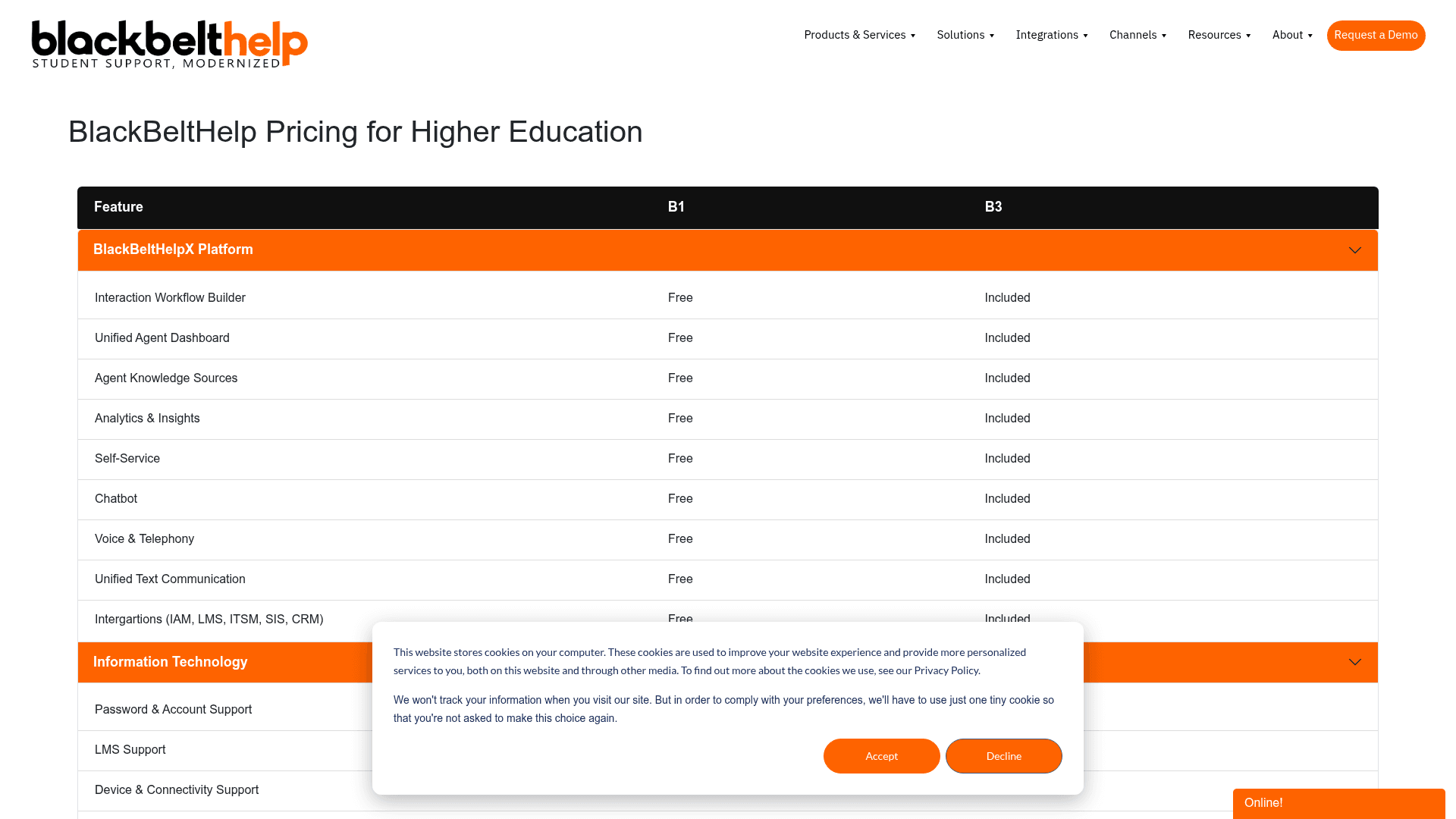
That is not an oversight. BlackBeltHelp is a managed service, which means it staffs the human agents itself and layers AI agents on top, rather than handing you a login and a per-seat bill. When a vendor sells you outcomes and people instead of software, the price really does depend on your specifics, so it goes behind a Request a Demo button. The honest read is that the number exists, it is just built per institution.
If you want the fastest possible answer on cost: you cannot get one without a sales call. That is worth knowing before you invest a procurement cycle, especially if you are comparing against tools with an AI ticketing system and a plan you can read on the page.
What the "pricing" page actually lists
Since the page is scope rather than price, it is still useful as a checklist of what a contract can include. The matrix bundles capabilities into groups (pricing page):
- BlackBeltHelpX platform: interaction workflow builder, unified agent dashboard, knowledge base sources, analytics and insights, self-service, chatbot, voice and telephony, unified text communication, and integrations across IAM, LMS, ITSM, SIS, and CRM. It bundles what many teams assemble from separate AI helpdesk tools, with the staffing included.
- IT support: password and account resets, LMS, device and connectivity, email and collaboration tools, classroom and learning tech.
- Student services: academic, financial aid and billing, student accounts and enrollment, campus services, and general student life.
- Admissions: application, program info, financial info, international student, and transfer support.
- Ongoing support: uptime notifications, 24x7 monitoring, email and phone support, and a technical account manager.
- Add-ons: WAF management, an SMS bundle, indoor wayfinding, financial aid, and CRM.
The takeaway for budgeting: the "B3" column is the fuller scope, and add-ons sit outside the base package. When you get your quote, map it against this list so you know which groups and which add-ons you are actually paying for. This is the same discipline I would apply to reading ServiceNow pricing or Zendesk pricing: the sticker is only meaningful once you know the scope behind it.
How BlackBeltHelp actually bills
BlackBeltHelp describes itself as interaction-based, which for a managed desk means you are paying for resolved student and staff interactions across every channel, not for a fixed number of agent seats. It is a form of customer service automation sold as a service, so the specific per-interaction rate is not published, and I will not invent one. What I can tell you is what moves the number.
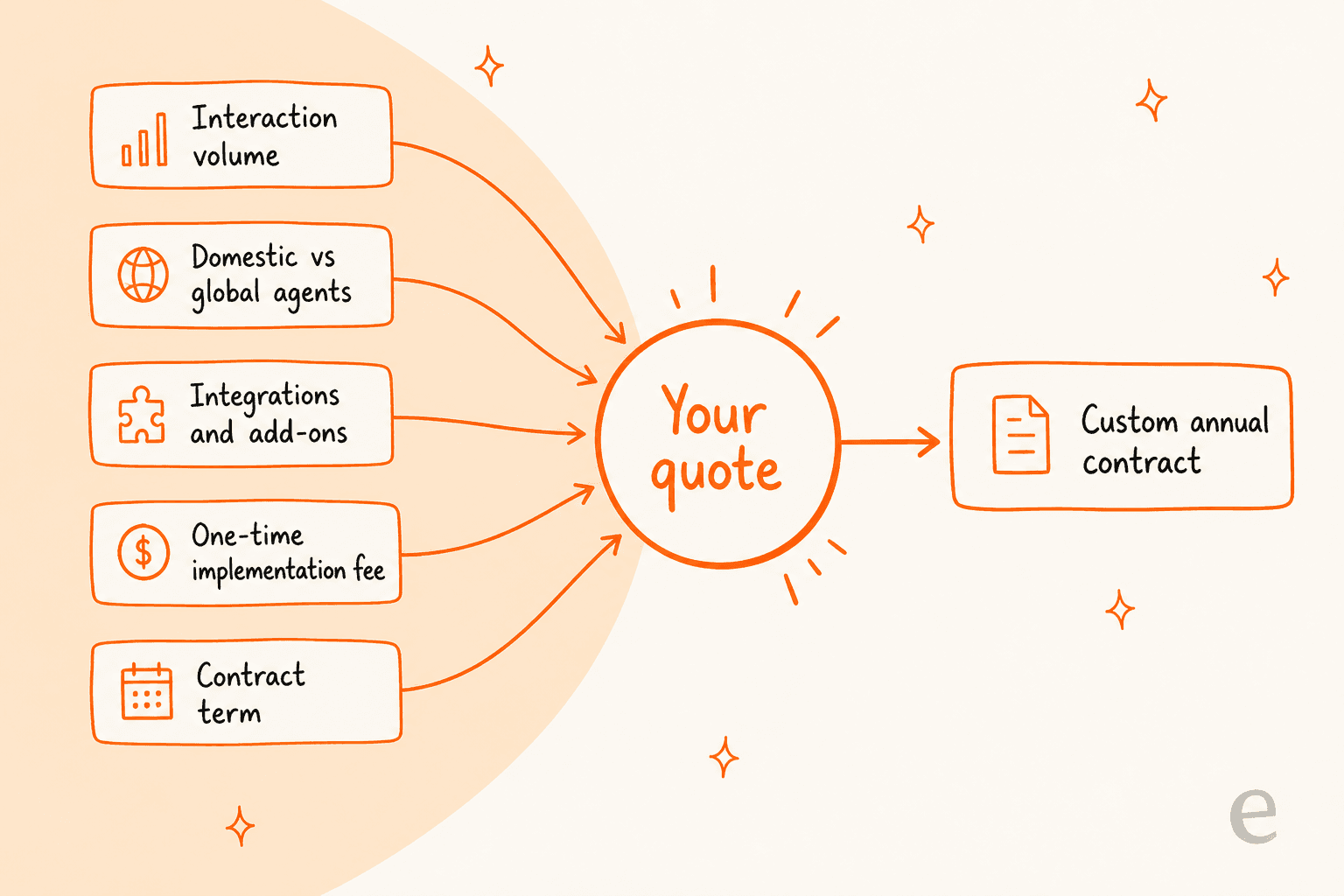
Five things drive the quote:
- Interaction volume. More calls, chats, and tickets means a bigger contract. Seasonal spikes (start of term, financial-aid deadlines) matter here, since a managed desk sizes staffing to your peaks.
- Domestic vs global agents. BlackBeltHelp staffs both US-based agents (across 18 states) and global agents in India. A US-heavy staffing mix costs more than an offshore-heavy one. OneStop student services, notably, is US-only.
- Integrations and add-ons. Wiring into your ITSM, SIS, LMS, and CRM, plus extras like the SMS bundle or WAF management, expands scope and price.
- A one-time implementation fee. BlackBeltHelp's own AI Front Desk page advertised waived implementation fees for institutions that signed by a set date, which is a clear tell that a setup fee normally exists.
- Contract term. This is an annual institutional agreement, not a month-to-month subscription, so the commitment length and renewal terms factor in.
None of that is unusual for the category. But it does mean forecasting your spend is harder than reading a per-seat plan, and your bill can move with volume in a way a flat license does not. If predictable cost is a priority, that is a genuine point to weigh, and it is worth reading up on AI customer support cost savings so you know what "good" looks like before you negotiate.
What you are actually paying for
To be fair to the model, an interaction-based managed desk is buying you real things: trained higher-ed agents, 24/7 coverage, and AI that handles the repetitive front line, the same jobs a good AI for ticketing systems takes on. BlackBeltHelp's headline product is now AI Front Desk, an agentic voice AI that authenticates callers, resets passwords and MFA, opens tickets, and hands off to a human with full context.
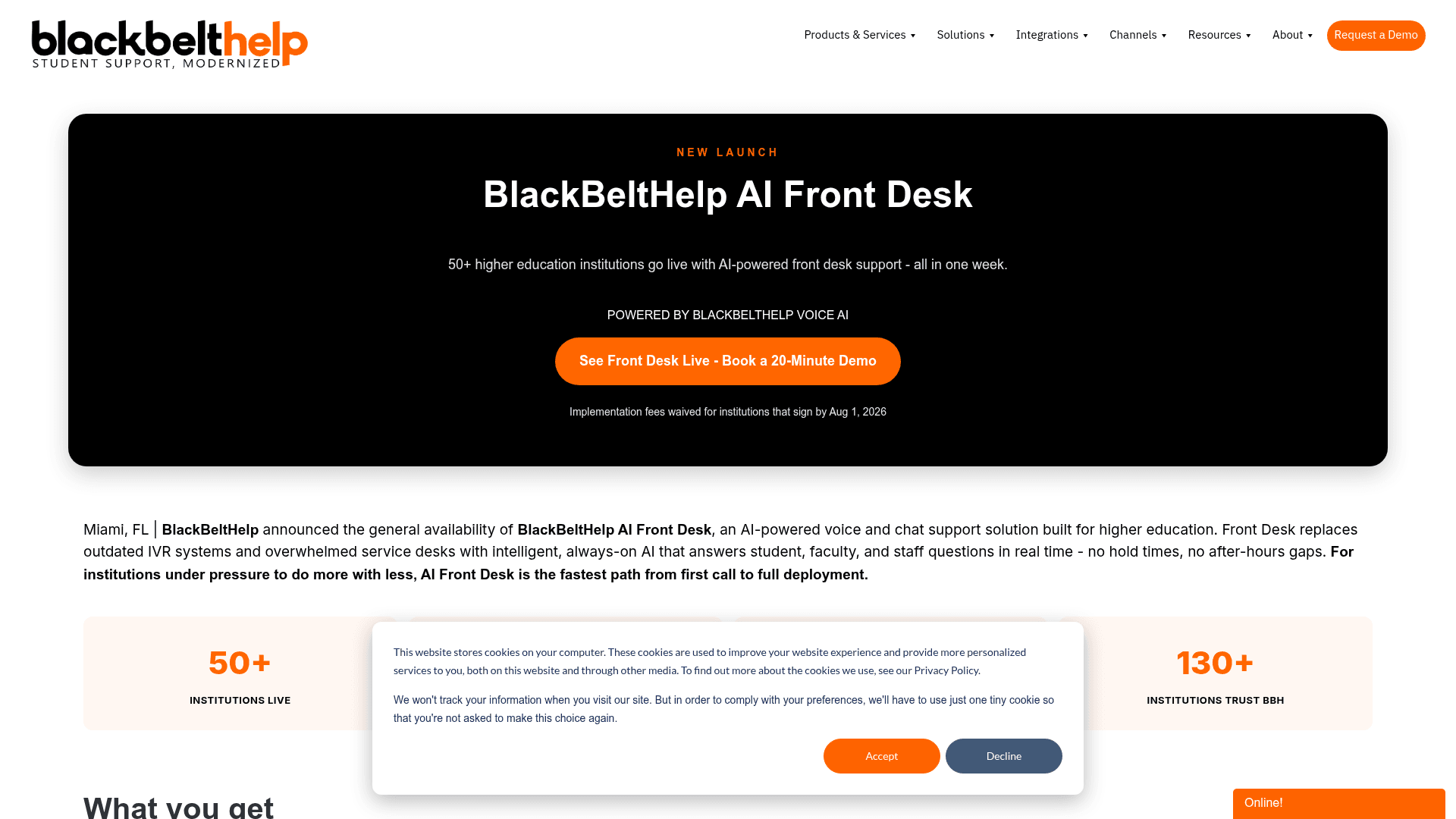
A useful detail from that page: AI Front Desk layers on top of ServiceNow and TeamDynamix rather than replacing them, BlackBeltHelp says 50+ institutions are live, and it quotes a 3-5 day deployment. If you have never seen this pattern, here is a primer on an AI front desk and the wider field of AI voice companies. Alongside it sits EduBot, the chat and AI chatbot voice bot, plus a managed 24/7 IT helpdesk, OneStop student services, and LMS support.
The vendor's stated results are strong: 87% first-contact resolution, 70.4% AI deflection, coverage in 42+ languages, and 90% CSAT (homepage), the kind of numbers a well-tuned agent assist setup also targets. Treat those as vendor figures, the same way you would any AI for customer service marketing stat, but they do describe what the price is meant to deliver.
What you are buying, in short, is conversational AI plus the humans behind it, wrapped in a managed contract.
The real decision: outsource the desk, or keep your team and add AI
This is the fork that actually decides your budget, more than any per-interaction rate. BlackBeltHelp is built for institutions that want to hand the whole desk to someone else. The alternative is to keep your own staff and bolt AI onto the stack you already run.
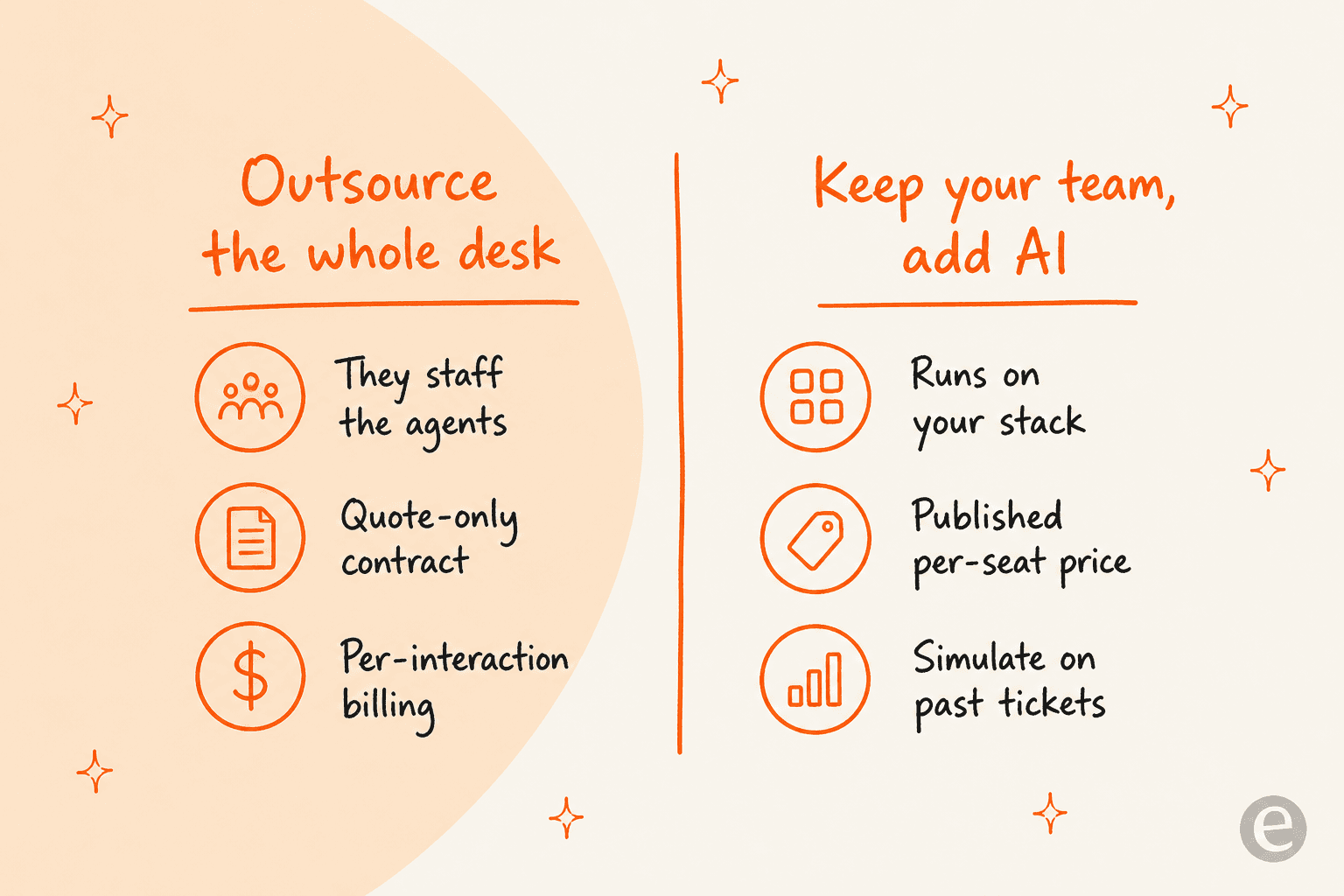
The two models charge very differently. An outsourced desk is a quote-only, per-interaction contract where the vendor staffs the agents. A keep-your-team-and-add-AI tool is usually a published per-seat or per-resolution price where the AI runs on your existing ServiceNow, Zendesk, or Freshdesk. Use the tool below to see which model fits your situation before you sit through a sales call.
Neither answer is wrong. Some campuses really do want to outsource staffing, and BlackBeltHelp is one of the few vendors built only for higher ed. Others have invested in a helpdesk and a team and just need tier-1 deflection or live chat deflection on top. Knowing which camp you are in saves everyone a procurement cycle.
What real people say (and the review gap)
Here is the honest limitation for anyone doing diligence: there are no verifiable third-party buyer reviews for BlackBeltHelp. As of 2026 there is no product page on G2, Capterra, or Trustpilot (the Trustpilot domain entry shows zero reviews), so any "4.x rating" badge you see on marketing material is a self-report, not a page you can click through and verify.
The only public sentiment that is verifiable is employee-side, on Glassdoor, and I want to be careful to label it correctly: this is a signal about the workforce running the desk, not about buyer satisfaction. BlackBeltHelp sits at 3.4/5 from 130 reviews, with recurring themes of supportive teammates and remote flexibility on the plus side, and low pay (around $12/hour cited) and understaffing on the minus side.
"The flexibility and understanding of 'life' is top-tier. My Team Manager, my QA, and my coworkers all have compassion for one another, and that makes the job worth going to."
"Since I've been there, the company has allowed its workforce to crumble while it continues to gain more clients and increase the workload with no pay increase."
Why does labor cost matter to a pricing article? Because in a managed, interaction-based desk, the agents are what you are buying. Staffing pressure is worth asking about directly in your sales call, since it shapes the resolution quality your students actually experience.
For the wider context BlackBeltHelp operates in, the debate over outsourced tier-1 support is worth reading. This account of how close-rate incentives can quietly punish escalation is the exact failure mode a campus IT lead worries about:
"Tier 1 support are outsourced and a huge part of their evaluations are how many tickets they close. Escalating hurts their numbers, so it's hard to get cases escalated, especially if you're not a paying customer."

And the counterpoint, because a well-run outsourced desk can absolutely handle a confused caller:
"I ran an outsourced IT helpdesk company for many years... the support staff would have asked the lady the name of her site, and the background story. Then patiently gotten to the bottom of the issue."
The lesson is not that outsourcing is bad. It is that in this model, ticket-close incentives and staffing quality are part of the "price", even though they never show up as a line item.
How BlackBeltHelp pricing compares to keeping it in-house
If you already run a desk, the cost comparison is less about BlackBeltHelp's rate and more about what you would spend to add AI to your own team. That is where I come at this from experience.
I have spent the last few years putting AI agents on live support queues, and the thing that made me a believer in the keep-your-team model is unglamorous: you can simulate a rollout on your own historical tickets before it answers a single real person. We do that because we have watched confident-sounding bots quietly give wrong answers, and the only reliable way to catch that is to test against real past conversations, not a demo script.
That is the practical difference from a managed desk. With an outsourced contract, you flip the switch and trust the vendor's process. With an AI for the IT helpdesk that runs on your stack, you keep your ServiceNow or Freshdesk pricing plan, your team, and your data, and you add automation you can test and tune yourself.
Tools like eesel publish a per-plan price, connect to your existing help desk software, and let you dry-run before go-live, which is the opposite of a quote-only, all-in contract.
For a campus IT desk drowning in password resets and LMS tickets, that can be the more controllable spend, and it does not require handing off your staff. If you are weighing options, the roundup of the best AI for IT helpdesk and the broader AI for ITSM landscape are good next reads, as is this look at an AI agent versus a rule-based chatbot.
So how should you budget for BlackBeltHelp?
Since there is no rate card, here is the practical approach I would take:
- Pull your interaction volume first. Count calls, chats, and tickets by month, including your term-start peaks. This is the single biggest driver of an interaction-based quote.
- Decide your staffing mix. US-based agents cost more than global ones. Know which you want before the call so the quote reflects reality.
- List your must-have integrations. IAM, SIS, LMS, ITSM, and any add-ons like SMS all expand scope. Fewer integrations, lower price.
- Ask about the implementation fee. It normally exists, and it is sometimes waived on a deadline promo, so ask directly and ask whether a promo is running.
- Check the co-op route. If you are a member of CollegeBuys or E&I, ask whether their pre-negotiated agreement beats a direct quote.
Do that, and you will walk into the sales call able to sanity-check the number instead of hearing it cold. And if the interaction-based, quote-only model does not fit how your institution budgets, that is a perfectly good reason to look at a published-price self-service portal and an AI teammate you can run yourself, without giving up your team or your stack. Smaller departments can start with an AI helpdesk for small teams, while a busy central desk can lean on a proper AI knowledge base to keep answers consistent.
Frequently Asked Questions
How much does BlackBeltHelp cost?
BlackBeltHelp does not publish a price. Its pricing page is a feature-inclusion matrix with no dollar amounts, no tiers you can buy online, and no free plan, so every number comes from a sales conversation. Billing is interaction-based and negotiated per institution, which is why BlackBeltHelp pricing varies with your call and chat volume, your integrations, and whether you buy through a cooperative agreement. For the trade-off behind that model, see this breakdown of AI agent vs human agent cost.
Does BlackBeltHelp have a free trial or free tier?
No. There is no free tier and no self-serve signup on the site. The homepage call to action is Request a Demo, not a trial, and access starts with a scoped, quoted contract. If a free trial matters to you, an AI for the IT helpdesk you can start yourself is a different buying path worth comparing.
What billing unit does BlackBeltHelp pricing use?
BlackBeltHelp describes itself as an interaction-based managed service, so the practical unit is a resolved student or staff interaction across voice, chat, SMS, email, and tickets rather than a per-seat license. The exact rate is not disclosed publicly. This is common for AI for ticketing systems sold as a managed contact center, and it makes forecasting harder than a flat ServiceNow pricing style per-agent plan.
Why is there no BlackBeltHelp price list online?
Because it is a managed service, not software you run. BlackBeltHelp staffs the human agents, layers AI on top, and prices the whole package per institution, so the cost depends on volume, staffing mix, and scope. That is the same reason many enterprise AI helpdesk software vendors hide rates, though plenty of tools now publish them.
How do colleges actually buy BlackBeltHelp?
Many buy through education cooperative purchasing agreements rather than a public rate card, including the CollegeBuys and E&I Cooperative awards, which pre-negotiate terms for member institutions. You still get a scoped quote; the co-op just shortens procurement.
What are the alternatives to BlackBeltHelp for a campus IT desk?
The real fork is outsource the whole desk (BlackBeltHelp) versus keep your team and add an AI for the IT helpdesk. A tool like eesel plugs an AI teammate into the ServiceNow, Zendesk, or Freshdesk you already run, publishes its price, and handles tier-1 deflection without a managed-services contract. See the wider roundup of the best AI helpdesk software 2026.
Is BlackBeltHelp worth it for higher education?
If you want to hand off staffing entirely and you value a vendor built only for higher ed, it can be. BlackBeltHelp says it works with 130+ colleges and universities and cites strong internal numbers. Just go in knowing the pricing is quote-only and interaction-based, so model your volume before you sign, the same way you would for any AI for ITSM contract.


Article by
Kurnia Kharisma Agung Samiadjie
Kurnia is a software engineer and writer at eesel AI with two years of SEO experience, writing about AI tools, helpdesk software, and customer support. He pairs a developer's understanding of how these products are built with search-driven research into what actually ranks and resonates with the people searching for them.