What BlackBeltHelp actually is
The one-line version: BlackBeltHelp is a managed helpdesk-as-a-service for colleges, with AI in front of trained human agents. The important word is "managed." You are not buying a bot to configure and a dashboard to log into. You are handing over a scope of tier-1 support (IT, LMS, admissions, financial aid, registrar, advising) and BlackBeltHelp resolves it with a mix of its own AI and its own 24/7 agents.
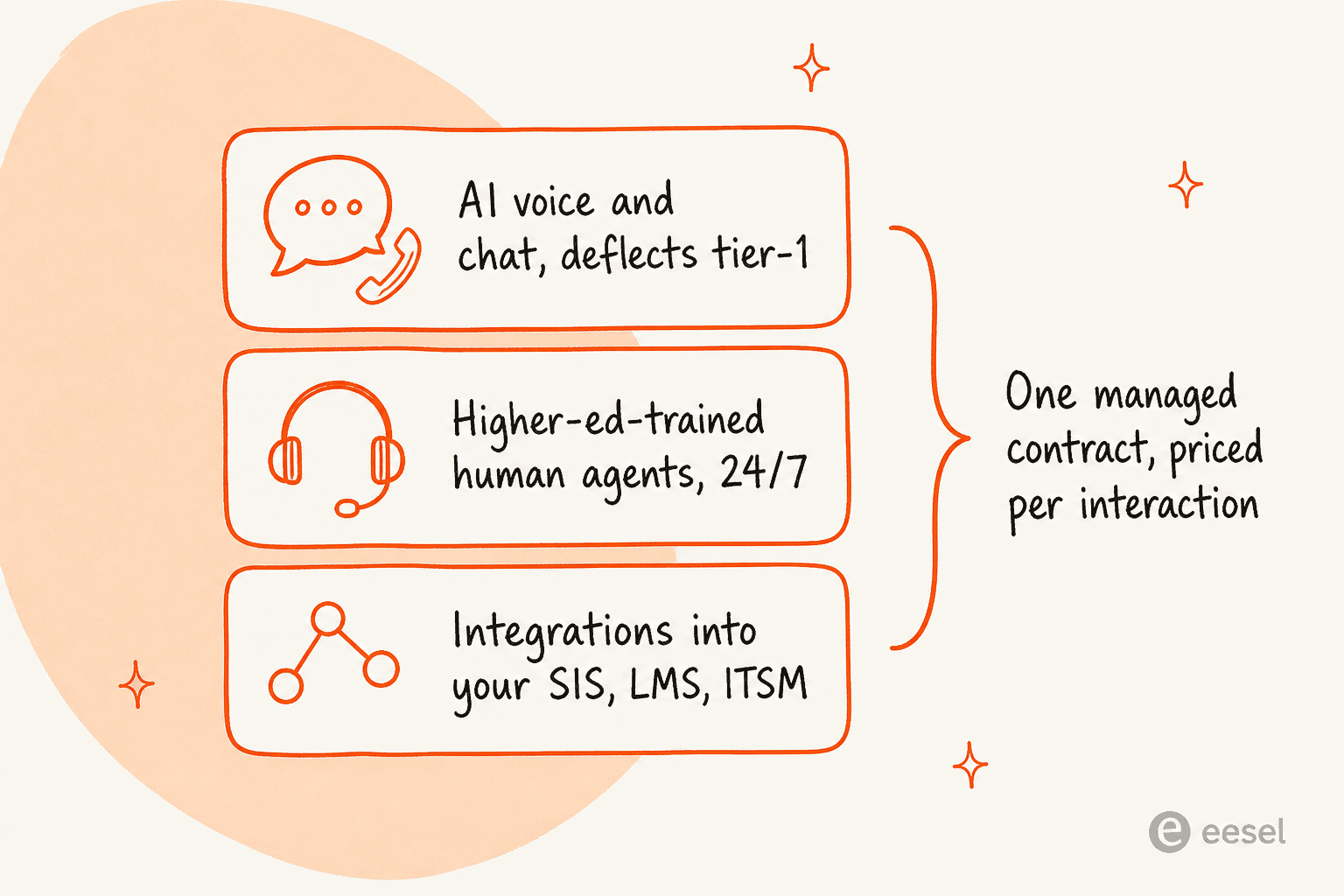
That is a real distinction, and it is the frame for everything below. Most tools in the AI helpdesk space sell you software. BlackBeltHelp sells you an outcome and the people to deliver it. Three layers, one contract:
The company reports the kind of numbers you would expect a contact-center operation to lead with: 87% first contact resolution and 70.4% AI deflection, 24/7 coverage in 42+ languages, and on its company overview a 60-second average speed of answer with 90% CSAT. Treat those as vendor-stated targets rather than audited results, but they are the SLAs the service is sold against. The named client wall is unusually strong for the segment: Columbia, Johns Hopkins, Cornell, Auburn, Colorado State, and a long list of community colleges.
One housekeeping note if you go looking: the live site is now blackbelthelp.ai, and the older blackbelthelp.com pages redirect there.
AI Front Desk: the product worth paying attention to
If you only look at one thing, make it AI Front Desk. It is the newest product, it is generally available, and it is where BlackBeltHelp is putting its weight. The pitch is a voice AI that replaces the old phone tree: no "press 1 for financial aid," just a caller talking normally and the AI acting on it.
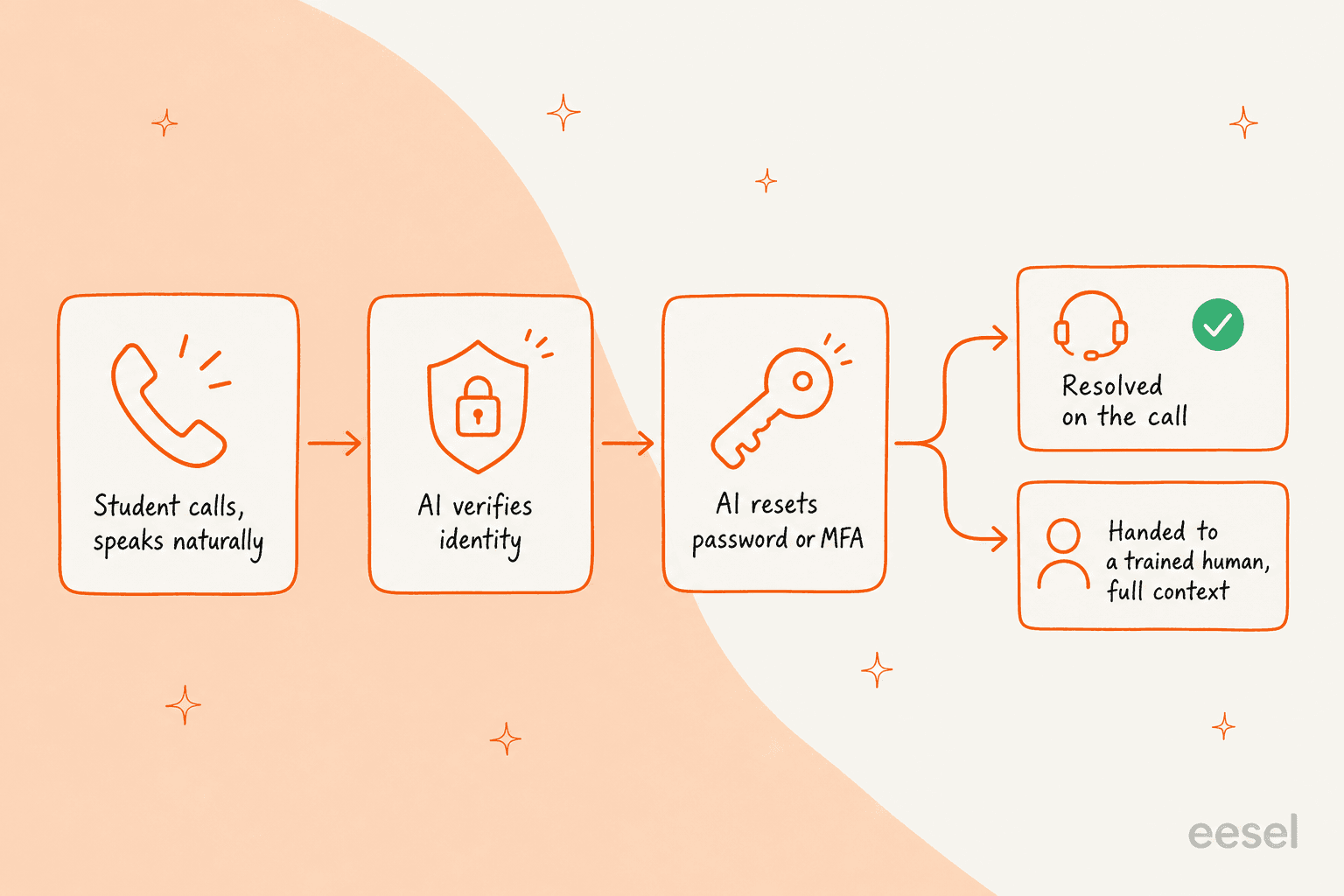
What makes it more than a talking FAQ is that it takes action inside campus systems. It verifies identity, resets credentials, and opens tickets, then hands off to a live agent with full context when judgment is needed, so the student never repeats themselves. Here is the loop:
The architectural choice I like: it is a layer, not a replacement. Per their own FAQ, AI Front Desk "layers on top of what you already have" and works alongside ServiceNow and TeamDynamix. BlackBeltHelp says it is live at 50+ institutions with a 3 to 5 day deployment, which is fast because the humans and the tuning are theirs to handle.
For proof, their own case study is the clearest data point they publish:
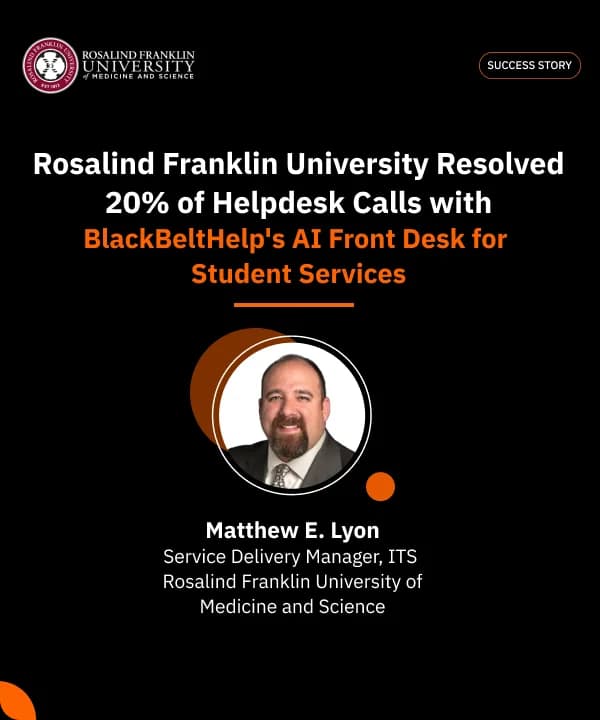
Twenty percent of helpdesk calls resolved by the voice AI is a believable, useful number for a tier-1 desk, and I appreciate that it is attributed to a named person rather than floated as an anonymous stat. If you want the neutral background on this category, we wrote up how an AI front desk works separately.
EduBot: the chatbot and voice bot
Alongside the front desk sits EduBot, BlackBeltHelp's chat and voice assistant. It is a generative bot with a "curated" layer on top, wired into campus systems (SIS, ITSM, LMS, CRM, MFA, SSO) so it can pull a student's real data instead of answering from a generic knowledge base. Here is the widget students actually see:
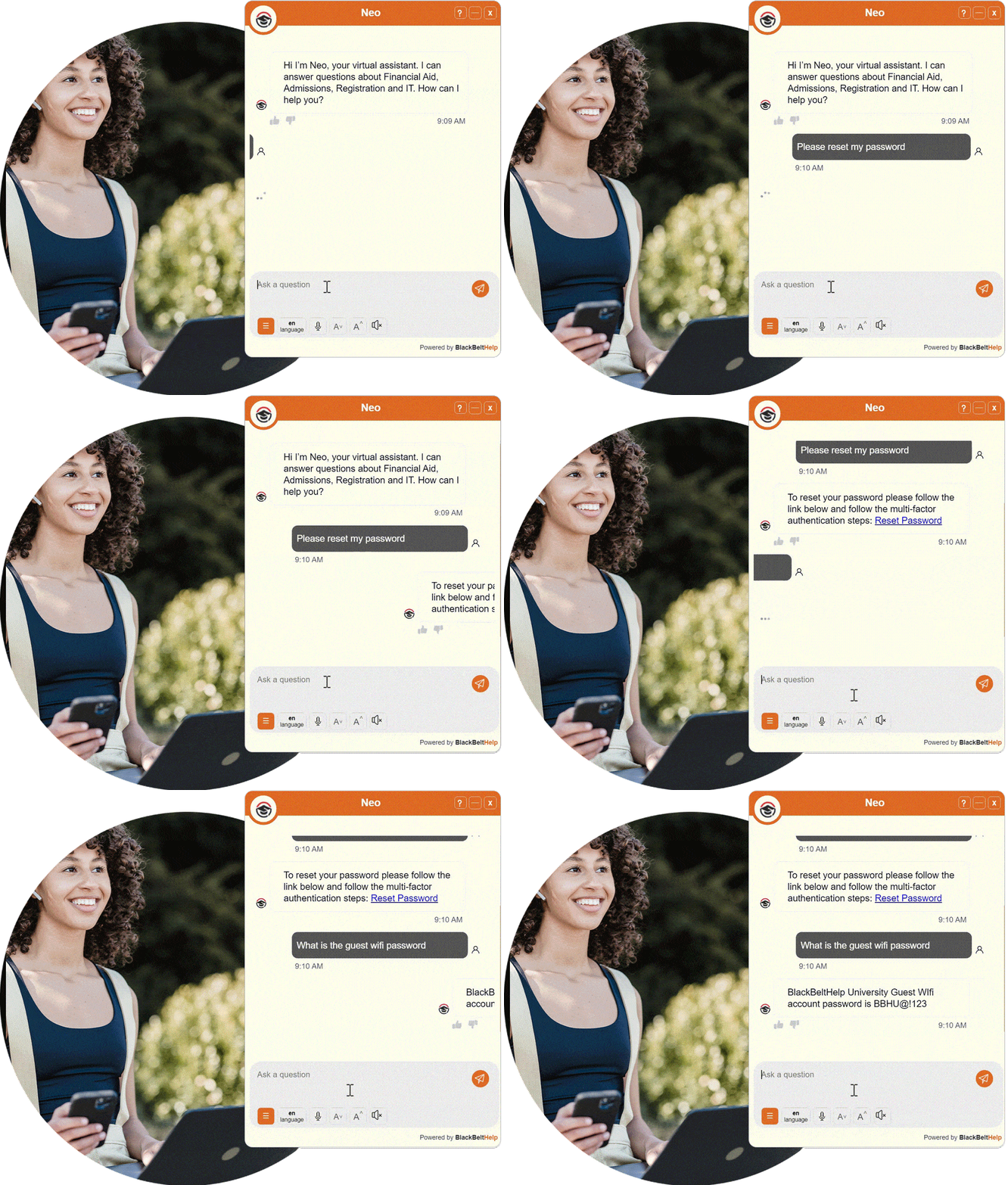
The part that separates this from a rule-based chatbot is the escalation logic: intent models watch confidence during a conversation and auto-hand-off to a live agent when uncertainty rises, so students do not get stuck in the dead-end loop everyone hates. BlackBeltHelp brands the whole thing "HumanAI," which is a fair name for a bot that is designed to fall back to staff it also provides. Reported outcomes on the page include a 97% chatbot resolution rate and 90% satisfaction, again vendor-stated.
If you are weighing whether to lead with chat or voice, our take on the benefits of conversational AI covers the general trade-offs, but for a campus the honest answer is usually both, because students split hard between the two by generation and by urgency.
The managed desk: IT helpdesk and OneStop
Under the AI sits the part of the business BlackBeltHelp has run longest: the managed IT helpdesk and OneStop student services. This is a genuine outsourced tier-1 operation. Agents remote into your systems over a secured tunnel and handle a defined scope: Banner and PeopleSoft, Canvas and Blackboard, network and device issues, Microsoft 365, and the perennial password and MFA resets, all logged through their ticketing system.
A few details that show they know the segment:
- Agents are certified in CompTIA A+, Network+, CCNA, and ITIL, and trained specifically on higher-ed workflows.
- Delivery is split into domestic (US agents across 18 states) and global (India) options, so you can trade cost against sourcing preference. OneStop student-services agents are described as all US-based.
- The compliance posture is built for campuses: ISO 27001 certified, FERPA aligned, HIPAA and GDPR handling, US data residency on AWS, and WCAG 2.1 AA accessibility.
OneStop is the same idea aimed at non-IT questions: instead of a student bouncing between the financial aid office, the registrar, and the bursar, one channel resolves it. For an institution that is truly short-staffed at nights and weekends, that single-number-for-everything promise is the real draw, and it is hard to replicate with software alone.
Integrations
The whole model only works if the AI and the agents can reach into your campus stack, and this is a strength. BlackBeltHelp advertises 200+ pre-built integrations across the systems that actually run a college:
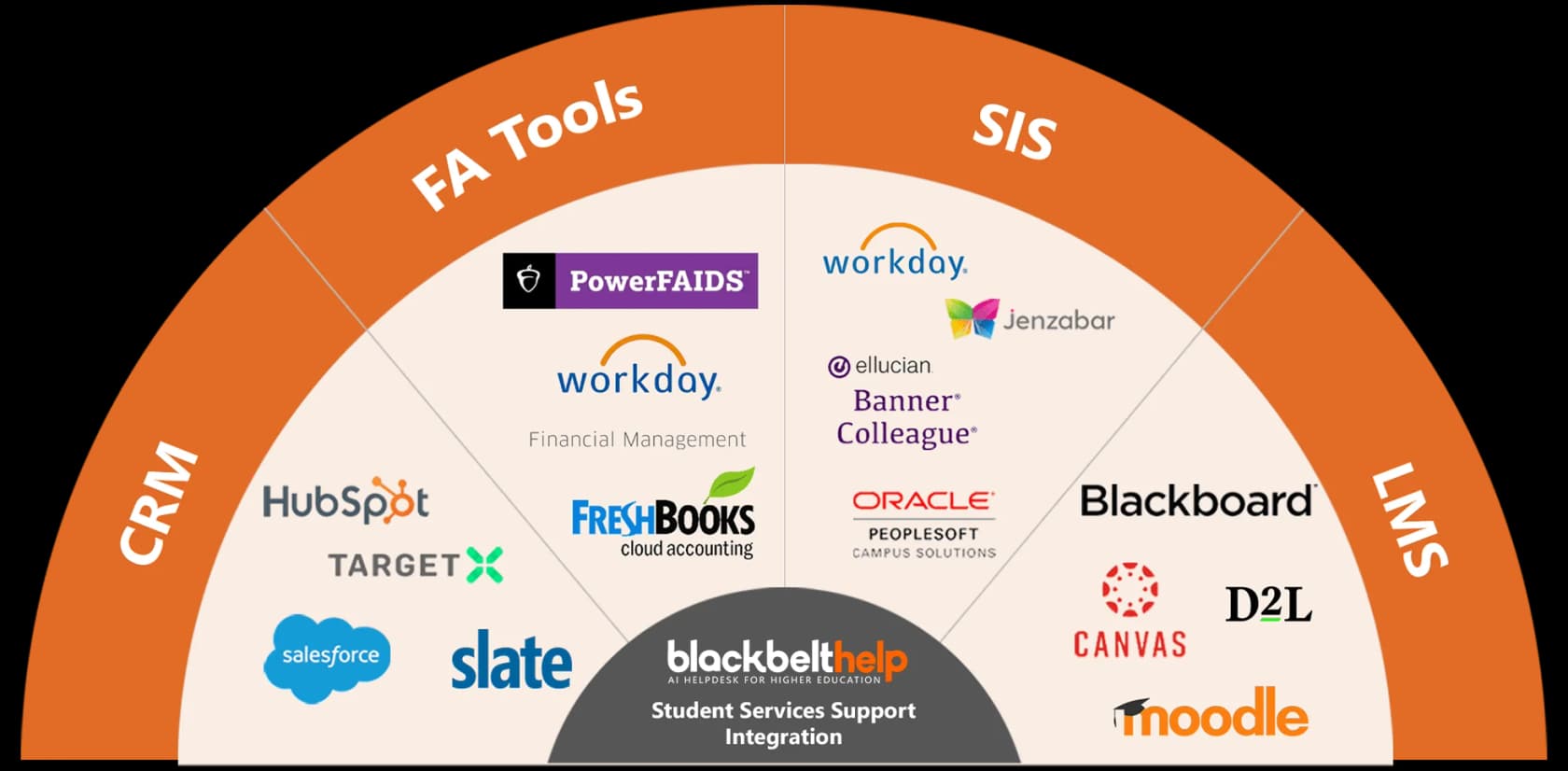
For identity and ITSM specifically it names Microsoft Entra, Okta, Duo, Active Directory, ServiceNow, TeamDynamix, and SysAid. If your desk lives in ServiceNow, that coverage matters, and it is the same reason we wrote about AI-powered features in ServiceNow and AI for IT service management more broadly.
Reporting: Insights
BlackBeltHelp reports AI and human performance on the same dashboard, which is the right call, because splitting them lets a vendor hide bot failures behind human recovery. The Insights view tracks the metrics a support lead actually reviews:
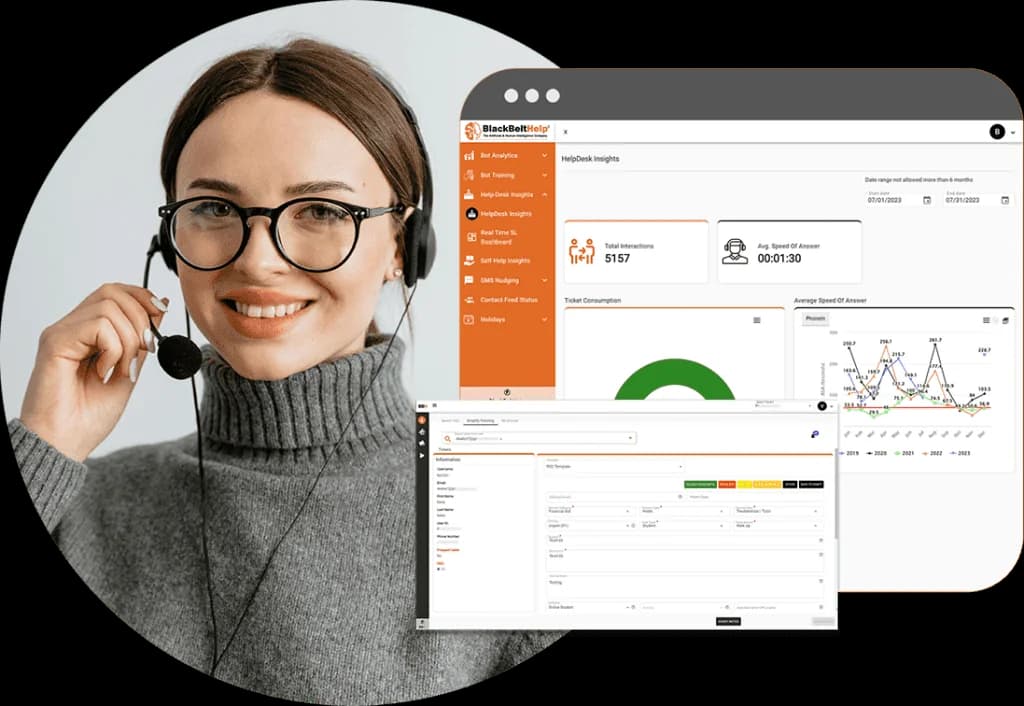
It comes in Insights Core and Insights Pro tiers, with 100% QA coverage scored automatically against contracted SLAs. If you care about the underlying numbers before you sign anything, our list of AI customer service metrics is a good checklist to bring to the demo.
BlackBeltHelp pricing: what it costs
Here is the honest answer: nobody outside a sales call knows the number. BlackBeltHelp does not publish rates. The pricing page is a feature-inclusion matrix with columns marked "Included" and zero dollar amounts, no free tier, and no self-serve checkout. Every price is a quote.
What we can pin down is the shape of the deal:
| Pricing dimension | What BlackBeltHelp discloses |
|---|---|
| Model | Managed service, quote-only, no public rate card |
| Billing unit | Interaction-based (per user interaction); exact unit not published |
| What moves the price | Domestic vs global agents, integrations required, scope of departments covered |
| Free tier / trial | None; entry point is Request a Demo |
| Implementation | 4 to 6 weeks for managed services; 3 to 5 days for AI Front Desk |
| How institutions buy | Direct, or via cooperative agreements (CollegeBuys, E&I) |
Interaction-based pricing on a managed desk is normal for this category, but it is worth naming the thing every buyer of per-interaction support eventually feels: your bill scales with volume, and volume spikes exactly when you can least afford surprises (add/drop, aid disbursement, finals). The cooperative-purchasing route through CollegeBuys and E&I actually helps here, because it gives you a competitively-solicited baseline instead of negotiating cold. Bring a realistic annual interaction estimate to the table, and model the peak months, not the average.
What users (and staff) actually say
This is where I have to be straight with you, because it is the biggest gap in evaluating BlackBeltHelp: there is no independent buyer review presence. As of 2026 there is no BlackBeltHelp product page on G2, Capterra, or Trustpilot that resolves to real customer reviews. Any "4.x stars" badge you see on the vendor's own materials is a self-report, not something you can click through and verify. So the customer proof is vendor-controlled case studies, full stop.
The one body of verifiable public sentiment is employee-side, on Glassdoor, and it matters here more than usual because in a managed service the workforce is the product. It sits at 3.4/5 from 130 reviews, roughly in line with Glassdoor's IT-industry average. The picture is mixed:
"The flexibility and understanding of 'life' is top-tier. My Team Manager, my QA, and my coworkers all have compassion for one another, and that makes the job worth going to."
"Greed (since I've been there, the company has allowed it's workforce to crumble while it continues to gain more clients and increase the workload with NO pay increase)."
Recurring themes are supportive peers and remote flexibility on the plus side, and low pay (around $12/hr cited), understaffing, and high call volume on the minus. Read that the way a buyer should: the quality of an outsourced desk tracks with agent tenure and morale, so it is a fair question to ask in the sales process how staffing holds up during your peak seasons.
Since there is little BlackBeltHelp-specific chatter, it is worth grounding the decision in what practitioners say about outsourced tier-1 generally. The close-rate incentive is the classic failure mode:
"The problem, of course, is that Tier 1 support are outsourced and a huge part of their evaluations are how many tickets they close. Escalating hurts their numbers, so it's hard to get cases escalated."

And the counter-current worth weighing before you outsource student-facing support:
"People will pay more money specifically to not interact with AI, just as they do now when they avoid phone or offshore support. It is already the hallmark of luxury to have a large staff of actual people willing to help you."
Neither of these is a knock on BlackBeltHelp specifically. They are the two risks any campus takes on when it hands tier-1 to an outside desk, and the mitigation, on either side, is measuring resolution honestly rather than close rate. That is also why we keep pushing AI agent vs human agent cost as a real calculation and not a vibe.
Where BlackBeltHelp fits, and where it doesn't
Here is the reframe I would want if I were the one signing. BlackBeltHelp answers a specific question well: "I don't have the staff to run a 24/7 desk, so run it for me." It is not really competing with helpdesk software; it is competing with hiring, offshoring, or leaving nights and weekends uncovered.
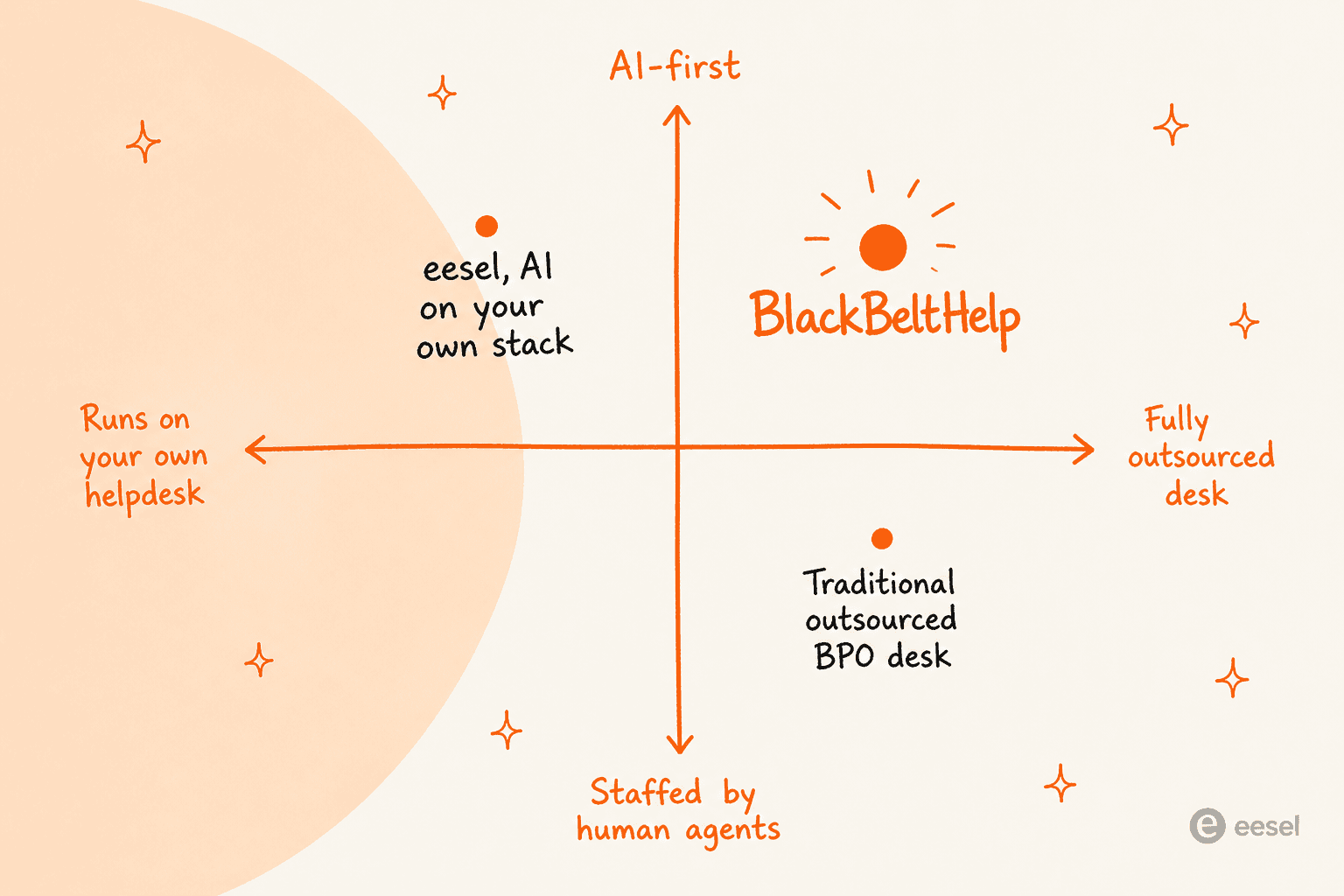
So the real decision is not "which vendor," it is "which model." Outsource the whole desk, or keep the team you have and add AI to it. Use this to place yourself:
If you landed on the second or third option, that is the moment worth pausing on, because it is a different product category from a managed desk, and it is where I spend my days.
Try eesel: keep your helpdesk, add an AI teammate
Full disclosure, I am on the eesel team, so here is the honest version of where we fit against BlackBeltHelp. We are not a managed service and we do not staff your desk. eesel is an AI teammate you hire for the helpdesk, and it plugs into the ServiceNow, Zendesk, or Freshdesk you already run and starts resolving tier-1 tickets on your own knowledge, without a 4-to-6-week onboarding or a per-interaction people contract.
The one thing I would put front and center, given the "no independent reviews, trust the demo" gap above: eesel lets you simulate on your past tickets before the AI answers a single real student, so you see the actual resolution rate on your own history instead of a vendor's headline stat. You keep the tickets, the data, and the control in-house.
And because a lot of campus IT now runs through scripts and agents, it is worth knowing eesel is drivable from a terminal too. The eesel CLI operates the same teammate and workspace as the dashboard, so a person can run it by hand, a script can automate a routine change, and a coding agent like Claude Code or Cursor can inspect the teammate, propose an instruction tweak, and review test responses before anything ships. For an IT team that already lives in the command line, that is a faster loop than filing a change request with an outside vendor. It is the same idea as an AI for the IT helpdesk, just one you own and can script.
BlackBeltHelp is a strong pick if what you truly lack is people. If what you lack is leverage on the team you already have, that is worth a free trial before you sign a managed-services contract.
Frequently Asked Questions
What is BlackBeltHelp?
BlackBeltHelp is a managed AI + human helpdesk built specifically for higher education. It handles IT support, LMS, admissions, financial aid, and student services across voice, chat, SMS, email, and tickets, and it staffs the human agents itself rather than selling you software to run. It says it works with 130+ colleges and universities. If you want to keep your own team and just add automation, an AI for the IT helpdesk that runs on your existing stack is a different model worth comparing.
How much does BlackBeltHelp cost?
BlackBeltHelp does not publish prices. The pricing page is a feature list with no dollar amounts, no free tier, and no self-serve signup, so every quote comes from a sales conversation. Billing is interaction-based and varies by domestic vs global agents, integrations, and any cooperative-purchasing contract. For a sense of the trade-off, see this breakdown of AI agent vs human agent cost.
What is BlackBeltHelp AI Front Desk?
AI Front Desk is BlackBeltHelp's voice AI product. Callers speak naturally, the AI verifies identity and takes actions like a password or MFA reset, and it hands off to a trained human with full context when needed. It layers on top of ServiceNow and TeamDynamix without replacing them. Here is a general primer on how an AI front desk works.
Does BlackBeltHelp have real user reviews?
Not on the buyer-review sites. There is no BlackBeltHelp product page on G2, Capterra, or Trustpilot as of 2026, so there is no independent customer score to cite. The only public sentiment is employee-side on Glassdoor (3.4/5), which is a signal about the workforce running the desk, not about buyer satisfaction.
What are the alternatives to BlackBeltHelp for a campus IT desk?
The main fork is outsource the whole desk (BlackBeltHelp) versus keep your team and add an AI for the IT helpdesk. Tools like eesel plug an AI teammate into the ServiceNow, Zendesk, or Freshdesk you already run and deflect tier-1 without a managed-services contract. See the wider roundup of best AI helpdesk software.


Article by
Riellvriany Indriawan
Riell is a designer and writer at eesel AI with about two years of experience researching CX platforms, AI chatbots, and helpdesk software. She combines her design background with a sharp eye for how these tools actually look and feel in practice — making her comparisons unusually visual and user-focused.