
Why "Instinct AI for marketing" means two things
I've spent two years on SEO at eesel, and the first thing I do with a keyword is ask what the person typing it actually wants. "Instinct AI for marketing" splits two ways. Some people want to know if they can use Instinct to do marketing work. Others want to know what Instinct does to their marketing.
Quick refresher: Instinct is an invite-only personal AI assistant you text or call, from Spear Street Technology, founded by Noah Shinn. Its homepage says it "connects to your applications and devices - email, messaging, screen, audio, location, and more."
I looked hard for the first kind of answer. Across Reddit, X, LinkedIn and Hacker News, I found nobody describing Instinct drafting social posts, newsletters, lead lists or ad campaigns. I found plenty of marketers and ecommerce people talking about the second kind. That's the reframe this post is built on.
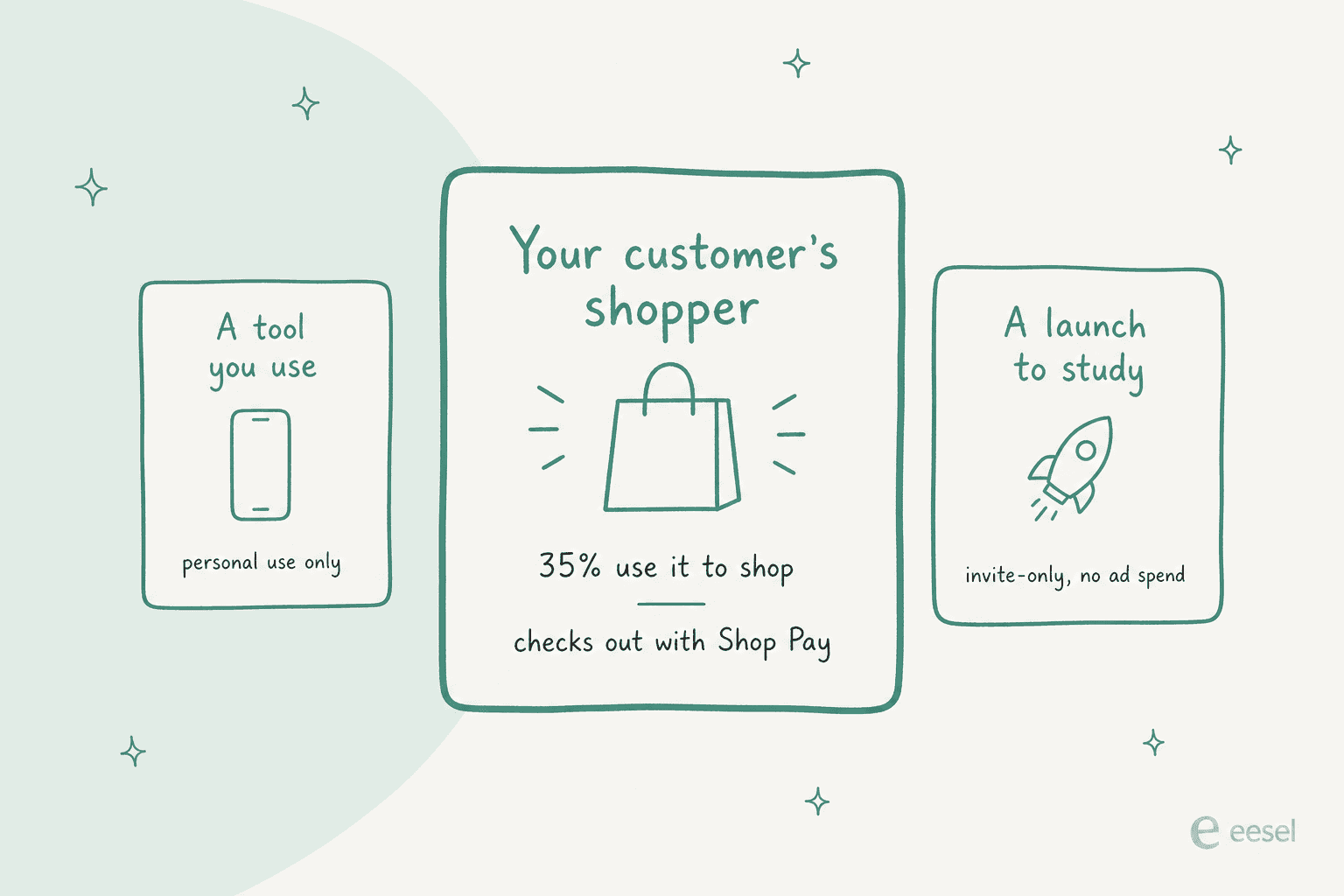
Instinct matters more to a marketer as the thing your customers send to buy from you than as something you'd use yourself. It's also a launch worth studying. I'll cover all three, smallest first.
Can you use Instinct for marketing work?
Short answer: not for your company's marketing. I checked Instinct's Terms of Service and Acceptable Use Policy on October 7, 2026. They're still the versions revised August 26 and August 20, 2026. Five clauses hit marketing work directly.
| Clause | What it says | What it means for marketing |
|---|---|---|
| Personal use | "We hereby permit you to use the Services for your personal use only" | No license for brand or client accounts |
| Spam | Bans "Generating, promoting, or distributing spam" | Outreach at volume is out |
| AI as human | Bans "Representing that Outputs are human-generated" | Posting its drafts as your own writing is a breach |
| Fake engagement | Bans "fake reviews, fake testimonials, and other means of fake online engagement" | No review seeding, no engagement pods |
| Data about people | Bans "Collecting, disclosing, or inferring private or sensitive information about individuals" without the rights | Lead-list scraping is risky |
There's also a gap between what the founder says and what the terms allow. Patrick O'Shaughnessy, who interviewed Noah Shinn, listed "Some small businesses run their entire back office on Instinct" among the podcast takeaways. The license grant still says personal use only, and there's no business plan to buy. I covered that tension in detail in Instinct AI for work.
The product itself isn't set up for it either. The privacy policy names only Google connectors (Gmail, Calendar, Drive, Docs, Sheets, Slides, Tasks). Nothing for LinkedIn, Meta Business Suite, HubSpot or an ad account. One frustrated user put it bluntly:
"instinct absolutely sucks. hundred million dollars and i literally can't have it answer my texts, imessage, and all social media. it's an absolute joke."

That's harsh, and plenty of other users love it for errands. But it's a fair read on social media.
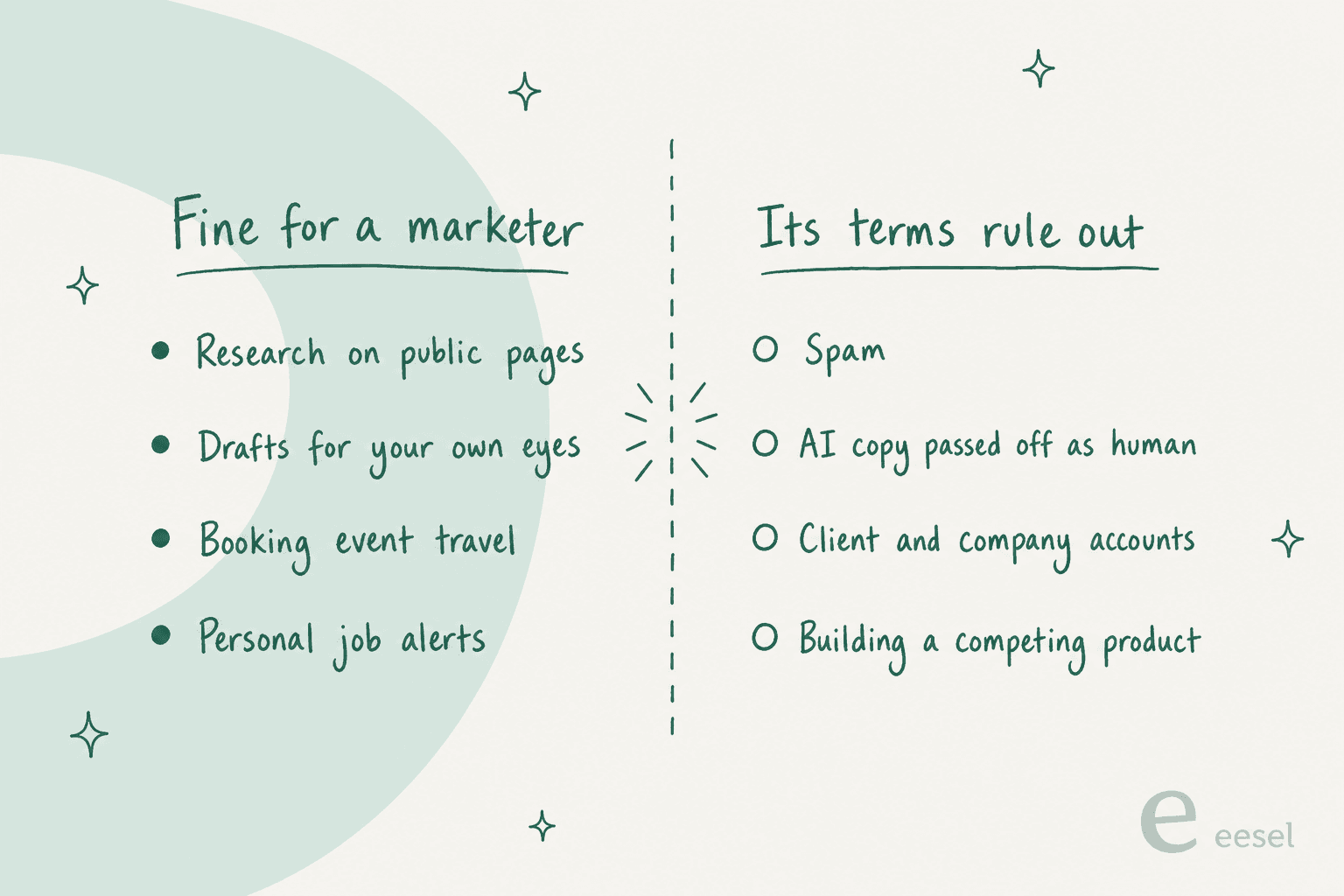
What's left is small but real. You can have it research public pages, like a competitor's pricing or a list of conferences, as long as you check the output. You can have it book your own travel to an event. One Reddit user has it pick events from their Luma history and register for them (u/Crafty-Luck9522, Reddit), which is handy if you go to meetups for networking. That's attendee work, not organizer work.
If you want an agent for campaign work, pick one with a business plan: OpenAI Dots, Grok Bot, or the AI marketing tools built for it.
Instinct as your customer's shopper
This is the part that should change your planning. Instinct shared three numbers on the founder's own X account:
- Users who make purchases spend over $1,300 a month on average through Instinct (Noah Shinn, X, August 28).
- 35% of users use it for personal shopping (Noah Shinn, X, September 28).
- In the podcast, Noah said Instinct does over $1B a year in transaction volume and half of it is travel, per the host's summary. That one is self-reported, and not everyone buys it: one reply simply said "No chance they have $1B in transaction volume" (@narendra, X).
The September 28 Shopify partnership makes this concrete. Instinct now handles "product discovery, checkout and order updates," and when a user is ready, "Instinct sets up your order with the store so you can check out with Shop Pay." The same post says the agent "knows your sizes, the brands you like, and what you've bought, kept or returned," and can surface "price-drop and back-in-stock notifications" plus "automatic discounts and promo codes tied to your Shop account." If you sell on Shopify, your store is already in reach.
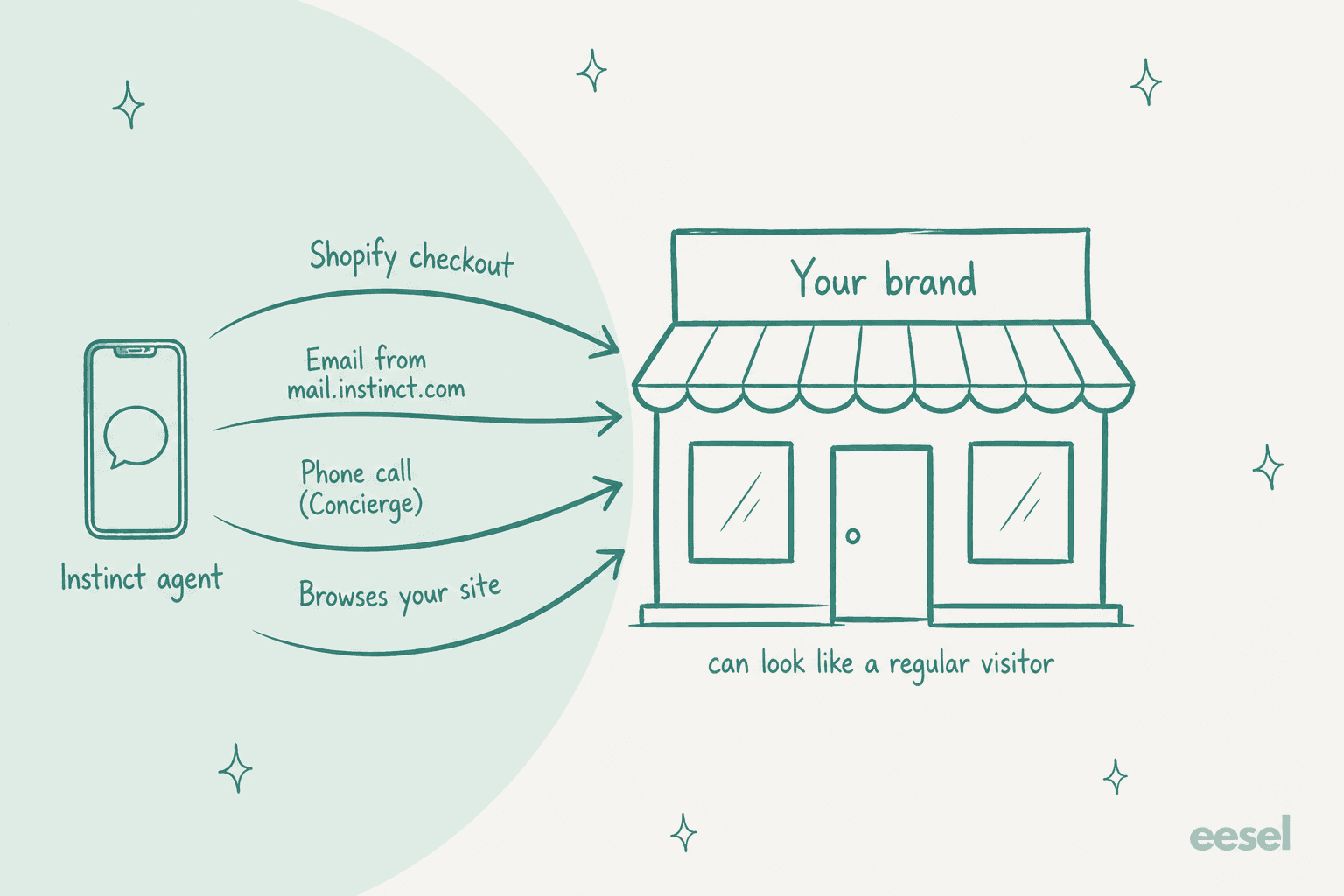
Shopify isn't the only way in. Since September 8, every Instinct has its own email address to "contact a restaurant about a special request, ask a business about availability, or sign up for a service." The September 16 Concierge launch added phone calls for high-touch cases. And without any partnership at all, Instinct uses your website the way a person would.
Joan Burkovic, an early Instinct user who runs a travel-data business, made that point in a long LinkedIn piece:
"Today, Instinct does not need agreements with merchants to work. It uses their sites the way a person would, and that is why it is useful from day one. If it starts asking merchants for a commission, what happens when one refuses?"

He also passes on the founder's test for companies: "how much of your revenue depends on attention, and how much on the service you deliver?" That's the question I'd put to any marketing plan right now.
If you want the wider picture beyond Instinct, I'd read up on agentic commerce, and the Agentic Commerce Protocol, plus how ChatGPT handles checkout. Instinct is one agent of several, and Meta Muse is doing something similar.
What changes for your marketing
Here's how I'd map the shift. The left column is the funnel most marketing teams are built around. The right is what happens when the buyer sends an agent.
| Marketing lever | When a person shops | When Instinct shops |
|---|---|---|
| Ads and sponsored listings | Seen on search and social | May never be seen |
| Landing page design | Persuades the visitor | The agent reads facts, not mood |
| Price and promo codes | One input among many | Price drops and Shop codes surface automatically |
| Cold email | Read, ignored or filtered | Instinct's own mail gets filtered too |
| Support and returns | A cost center | Part of whether an agent picks you again |
Ads lose reach when the agent does the browsing. VC Tanay Jaipuria put it plainly: "If an agent ends up purchasing from Amazon, they may never see the search results or sponsored listings." His prediction is that merchants will "offer their ad budget directly to the consumer via their agent" as discounts (Tanay Jaipuria, X). Noah's own version, via the podcast host: agents could wipe out the 70% of an app's money that comes from ads, but the 30% from selling "gets much bigger, because people buy more when buying takes zero effort" (Patrick O'Shaughnessy, X).
Instinct says it won't sell ads, but watch Selections. Burkovic writes that Instinct "rejects advertising" and "plans to earn a commission paid by merchants, at a level that is not yet set." Then on September 29 it launched Instinct Selections, curated recommendations from "local chefs, designers, architects, travel guides, and more." The top reply, with 51 likes, was "Sounds like a different word for Ads" (@npclfg, X). Instinct hasn't said publicly whether Selections earns money. If it ever opens to brands, it'll be a channel to watch.
Cold email gets harder for everyone, including the agents. When Instinct agents started emailing people, this landed:
"Checked my spam folder Saw emails from Instinct's AI bot Closed my spam folder Cold email is increasingly dead, and tools like Instict will speed it up even more"
Farhan Thawar replied that the "Biggest downside of instinct is the email spam issue" (@fnthawar, X). If agents send more email, filters get stricter, and your outbound gets caught in the same net. That's one more reason to lean on content people search for over cold email.
Friction gets punished. B2B marketer Kevin Bobowski had Instinct review his AT&T bill and negotiate with their support chatbot: "We saved over 40% without changing any commitments." His takeaway: "Businesses with built-in friction or opaque pricing will not fare well with this new class of personal agents" (Kevin Bobowski, LinkedIn). Retention offers that only appear when someone threatens to cancel are now one text away for every customer.
How to get picked by a personal agent
Nobody outside Instinct knows how it ranks stores, and I won't pretend otherwise. One ecommerce operator in an r/ecommerce thread admitted, "most advice around this stuff is just ideas currently" (u/Kyle772, Reddit). What I can give you is the advice that holds up from an SEO point of view, because agents and search engines want the same thing: clear, checkable facts.
The best tip I found came from that same thread:
"cheapest thing you can do this week: go through your inbox and pull the questions buyers ask you over and over. those are pretty much exactly what agents will ask. answer them in plain text on each product page. boring, but agents love boring."
Here's the checklist I'd run:
- Answer buyer questions on the page. Sizing, materials, shipping times, return windows, compatibility. Plain text, not buried in images or tabs. This is also good answer engine optimization.
- Say who a product is not for. Same Reddit commenter's second tip. An agent matching a buyer's needs can rule you in faster when you rule others out.
- Make pricing readable. Agents read the real total. Hidden fees and cancel-to-unlock discounts are what Bobowski's AT&T story is about.
- Get your support ready for agent email. Instinct contacts businesses from mail.instinct.com. Don't let a filter bounce a buyer's agent asking about a return. My guide on Instinct for customer support covers how to handle those messages.
- Keep your content current. Agents and AI search both pull from what's on your site. A post that still shows last year's prices is a wrong answer waiting to be quoted.
None of this is new SEO. It's E-E-A-T basics with a new reader. The difference is that this reader doesn't skim your hero banner, it reads everything.
What marketers can learn from Instinct's launch
Instinct is also a growth story, and a pretty unusual one. Per the podcast host, it "has spent nothing on marketing, and is growing roughly 10% A DAY" (Patrick O'Shaughnessy, X). It launched to about 200 friends and family, and invites have sold on eBay for around $300 (stats list). Those are founder figures relayed by an interviewer, not audited numbers.
Andrew Chapello summed up the playbook on launch day:
"Instinct has had the best consumer product launch strategy since Uber. This happened in 4 parts:
Exclusivity: it is invite only
Hype: lots of folks writing on X (including by me)
Mystery: who is the team? Who are the founders? Have they already raised?
A dash of fear: is this too powerful? How do they use my data? YOLO?"
The newest feature keeps the loop going. The October 5 group chat launch lets an Instinct join a group, and "Your friends don't even need Instinct to join in." Every group chat is a demo for people who don't have it yet. That's product-led growth in its purest form.
There's a cost, though, and it's a search lesson. In a Reddit thread on the launch, one commenter noted that "the first result I get when I Google "Instinct AI" is a Tech Crunch article with the headline, "Instinct's powerful AI assistant is raising privacy and security concerns"" (u/ADavies, Reddit). Instinct has no blog, no help center and no FAQ page; instinct.com/blog is a 404. Mystery builds hype, but when you publish nothing, someone else writes the page that ranks for your name.
For most companies, the takeaway is the second half. You probably can't run an invite-only hype machine. You can make sure the pages that answer questions about your product are yours.
Where an AI teammate fits for a marketing team
Instinct is a personal agent. It answers to one person and its license keeps it there. A marketing team has shared jobs, shared brand rules and someone who has to approve what goes out.
eesel is built for that kind of job. It's an AI teammate platform: you hire a ready-to-work teammate for one defined role, and it arrives with the skills, integrations and company context for it. For marketing teams, that's the AI blog writer. Give it your site and a keyword, and it researches the topic, writes the post in your brand voice, generates the images, adds FAQs and internal links, and hands you a draft to review.
This connects straight back to the checklist above. If agents and AI search read your content to decide who to recommend, you need more clear, current, well-sourced pages, not fewer. One SEO content lead on Webflow uses eesel to scale to 360+ posts a month (about 12 a day) from a keyword-to-publish pipeline, with bulk review before anything goes live. And it's not only support teams arriving: a marketer at a staffing agency said in chat with eesel, "I dont need your chat and ticket services. I need help with the SEO content writing for our website."
I'll be honest about the limit: eesel won't run your ads or post to your social accounts. If that's the job, look at AI social media tools or AI marketing automation. And if your support queue is getting agent emails from Instinct, eesel's AI helpdesk teammate covers that side, joining your existing support queue to answer or draft replies.
If you're still comparing personal agents for yourself, Instinct vs Grok Bot, Instinct vs Hermes Agent and the Instinct AI pricing breakdown cover that ground.
Try eesel's AI blog writer
Instinct is a fine errand runner for you, and a new kind of shopper for your customers. For the marketing job it can't do, keeping your site full of clear, current answers that buyers and their agents can trust, eesel's AI blog writer researches and writes on-brand posts with images, FAQs and internal links, and you review every draft before it ships. Try eesel free, or see how it compares in the best AI content writing tools roundup.
Frequently Asked Questions
Can I use Instinct AI for marketing?
How does Instinct AI affect ecommerce marketing?
How do I get my products recommended by Instinct AI?
Does Instinct AI show ads?
Why are emails from Instinct landing in spam?
Is Instinct AI good for SEO work?
What are the best Instinct AI alternatives for marketing teams?


Article by
Kurnia Kharisma
Kurnia is a software engineer and writer at eesel AI with two years of SEO experience, writing about AI tools, helpdesk software, and customer support. He pairs a developer's understanding of how these products are built with search-driven research into what actually ranks and resonates with the people searching for them.